Table of Contents
- 1. Product Overview
- 1.1 Core Advantages and Target Market
- 2. Technical Parameters: In-Depth Objective Interpretation
- 2.1 Absolute Maximum Ratings
- 2.2 Electro-Optical Characteristics
- 2.3 Thermal Characteristics
- 3. Binning System Explanation
- 3.1 Luminous Intensity Binning
- 3.2 Dominant Wavelength Binning
- 4. Performance Curve Analysis
- 4.1 Relative Intensity vs. Wavelength
- 4.2 Directivity Pattern
- 4.3 Forward Current vs. Forward Voltage (I-V Curve)
- 4.4 Relative Intensity vs. Forward Current
- 4.5 Temperature Dependency Curves
- 5. Mechanical and Package Information
- 5.1 Package Dimensions
- 5.2 Polarity Identification
- 6. Soldering and Assembly Guidelines
- 6.1 Lead Forming
- 6.2 Soldering
- 6.3 Storage Conditions
- 7. Packaging and Ordering Information
- 7.1 Moisture Resistant Packing
- 7.2 Taping and Reel Specifications
- 7.3 Packing Quantities
- 7.4 Label Explanation & Model Numbering
- 8. Application Suggestions and Design Considerations
- 8.1 Typical Application Circuits
- 8.2 Design Considerations for Display Applications
- 9. Technical Comparison and Differentiation
- 10. Frequently Asked Questions (Based on Technical Parameters)
- 10.1 What is the difference between Peak Wavelength and Dominant Wavelength?
- 10.2 Can I drive this LED at 30mA continuously?
- 10.3 How do I interpret the 110°/60° viewing angle?
- 10.4 Why is storage condition and shelf life important?
- 11. Practical Use Case Example
- 12. Operating Principle Introduction
- 13. Technology Trends (Objective Context)
1. Product Overview
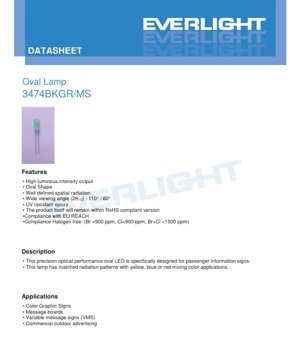
This document details the specifications for a precision optical performance oval LED lamp. The primary design objective of this component is for use in passenger information signs and similar applications requiring clear, defined illumination. Its oval shape and matched radiation patterns are engineered to facilitate effective color mixing in applications utilizing yellow, blue, or red colors alongside the primary green emission.
1.1 Core Advantages and Target Market
The lamp offers several key advantages that make it suitable for demanding display applications:
- High Luminous Intensity Output: Delivers high brightness levels essential for daylight-readable signs.
- Oval Shape & Defined Radiation Pattern: The unique oval lens creates a specific spatial radiation pattern (110° x 60° viewing angle), optimizing light distribution for rectangular or oval sign apertures.
- Material and Compliance: Constructed with UV-resistant epoxy for outdoor durability. The product is compliant with RoHS, EU REACH, and halogen-free standards (Br <900ppm, Cl <900ppm, Br+Cl <1500ppm), ensuring environmental and safety adherence.
The target markets and applications are clearly defined for graphic and informational displays:
- Color Graphic Signs
- Message Boards
- Variable Message Signs (VMS)
- Commercial Outdoor Advertising
2. Technical Parameters: In-Depth Objective Interpretation
This section provides a detailed, objective analysis of the lamp's electrical, optical, and thermal characteristics as defined in the datasheet. All parameters are specified at an ambient temperature (Ta) of 25°C unless otherwise noted.
2.1 Absolute Maximum Ratings
These ratings define the stress limits beyond which permanent damage to the device may occur. Operation at or near these limits is not recommended for reliable long-term performance.
- Reverse Voltage (VR): 5V. Exceeding this voltage in reverse bias can cause junction breakdown.
- Forward Current (IF): 30mA (Continuous).
- Peak Forward Current (IFP): 100mA (a 1/10 duty cycle, 1kHz). For pulsed operation only.
- Power Dissipation (Pd): 110mW. The maximum allowable power loss as heat.
- Operating Temperature (Topr): -40°C to +85°C. The ambient temperature range for normal operation.
- Storage Temperature (Tstg): -40°C to +100°C.
- Soldering Temperature (Tsol): 260°C for 5 seconds. This defines the reflow soldering profile tolerance.
2.2 Electro-Optical Characteristics
These parameters define the light output and electrical behavior under normal operating conditions (IF=20mA).
- Luminous Intensity (Iv): 2781-5760 mcd (Typical: 4635 mcd). This is the primary measure of brightness. The wide range is managed through a binning system (see Section 3).
- Viewing Angle (2θ1/2): 110° (X-axis) / 60° (Y-axis). This confirms the oval radiation pattern.
- Peak Wavelength (λp): 522 nm (Typical). The wavelength at which the emitted optical power is maximum.
- Dominant Wavelength (λd): 520-535 nm (Typical: 528 nm). The perceived color of the light, also managed through binning.
- Spectrum Radiation Bandwidth (Δλ): 20 nm (Typical). The spectral width of the emitted light at half the maximum intensity (FWHM).
- Forward Voltage (VF): 2.4V - 3.4V (at IF=20mA). The voltage drop across the LED when conducting.
- Reverse Current (IR): 50 μA (Max) at VR=5V. The small leakage current when the LED is reverse-biased.
2.3 Thermal Characteristics
While not listed in a separate table, thermal management is implied through the Power Dissipation (Pd) rating and the Operating Temperature range. The performance curves (Section 4) show how light output and forward current are affected by ambient temperature, which is critical for outdoor applications experiencing temperature extremes.
3. Binning System Explanation
To ensure consistency in brightness and color for end products, the LEDs are sorted (binned) based on key parameters. The datasheet defines two primary binning categories.
3.1 Luminous Intensity Binning
Ana rarraba LEDs zuwa rukunoni huɗu (GA, GB, GC, GD) bisa gwajin ƙarfin haskakawansu a 20mA. Rangwamen ƙarfin haskakawa shine ±10% a cikin kowane rukuni.
- Bin GA: 2781 - 3335 mcd
- Bin GB: 3335 - 4000 mcd
- Bin GC: 4000 - 4800 mcd
- Bin GD: 4800 - 5760 mcd
3.2 Dominant Wavelength Binning
LEDs are also binned into five groups (G1 to G5) based on their dominant wavelength, which determines the precise shade of green. The tolerance for dominant wavelength is ±1 nm within each bin.
- Bin G1: 520 - 523 nm
- Bin G2: 523 - 526 nm
- Bin G3: 526 - 529 nm
- Bin G4: 529 - 532 nm
- Bin G5: 532 - 535 nm
Yin zaɓin bins a lokacin oda yana ba masu ƙira damar cimma daidaiton launi da haske a faɗin nuni.
4. Performance Curve Analysis
The typical characteristic curves provide visual insight into the device's behavior under varying conditions, which is crucial for robust circuit and thermal design.
4.1 Relative Intensity vs. Wavelength
This curve shows the spectral power distribution, peaking around 522 nm (green) with a typical bandwidth (FWHM) of 20 nm. It confirms the monochromatic nature of the light source.
4.2 Directivity Pattern
This polar plot illustrates the spatial radiation pattern, visually confirming the 110° x 60° oval beam shape. This is key for optical design in sign assemblies.
4.3 Forward Current vs. Forward Voltage (I-V Curve)
This graph shows the exponential relationship between current and voltage. It is essential for designing the current-limiting driver circuit. The curve will shift with temperature.
4.4 Relative Intensity vs. Forward Current
This curve demonstrates that light output is relatively linear with current up to the rated level, but designers must not exceed the Absolute Maximum Ratings.
4.5 Temperature Dependency Curves
Relative Intensity vs. Ambient Temperature: E nye anamɔntu a ɛyɛ kanea no sɛnea ɛbɛyɛ a ɔhyew a ɛwɔ ho no reyɛ kɛse, nea ɛyɛ ade titiriw a wɔde di dwuma wɔ afiri. Ebia ɛsɛ sɛ wɔde hyew a wɔde ma no anaa wɔde ne tumi no so atumi ayɛ adwuma wɔ hyew a ɛwɔ mu kɛse no mu.
Forward Current vs. Ambient Temperature: Likely shows the required adjustment to maintain constant light output or other parameters as temperature varies, important for constant-current drivers with thermal feedback.
5. Mechanical and Package Information
5.1 Package Dimensions
The datasheet includes a detailed dimensional drawing. Key features include:
- Overall package size and lead spacing.
- Location and size of the epoxy lens.
- Lead length and thickness.
- Note: Dimensions are in millimeters with a standard tolerance of ±0.25mm unless specified otherwise. The maximum protrusion of resin under the flange is 1.5mm.
5.2 Polarity Identification
The cathode (negative) lead is typically identified by a flat spot on the LED package rim, a shorter lead (if cut), or a marking on the diagram. The datasheet drawing should be consulted for the exact identification method for this package.
6. Soldering and Assembly Guidelines
Proper handling is crucial to maintain reliability and performance.
6.1 Lead Forming
- Bend leads at a point at least 3mm from the base of the epoxy bulb.
- Perform lead forming before gyaɗa.
- Kauce wa damuwa ga kunshin yayin ƙirƙira don hana lalacewa ko karyewa a ciki.
- Yanke igiyoyi a yanayin daki. Yanke a yanayin zafi mai yawa na iya haifar da gazawa.
- Ensure PCB holes align perfectly with LED leads to avoid mounting stress, which can degrade the epoxy and the LED.
6.2 Soldering
- The soldering rating is 260°C for 5 seconds (reflow or hand soldering tip contact time).
- Maintain a distance of more than 3mm from the solder joint to the epoxy bulb to prevent thermal damage.
6.3 Storage Conditions
- Recommended storage after receipt: ≤30°C and ≤70% Relative Humidity.
- Shelf life under these conditions: 3 months.
- For storage beyond 3 months and up to 1 year, place components in a sealed container with a nitrogen atmosphere and moisture absorbent material.
- Evite transiciones rápidas de temperatura en ambientes húmedos para prevenir la condensación.
7. Packaging and Ordering Information
7.1 Moisture Resistant Packing
The components are supplied in moisture-resistant packaging, typically including desiccant and humidity indicator cards, to prevent moisture absorption during storage and transit.
7.2 Taping and Reel Specifications
The LEDs are provided on carrier tape and reel for automated assembly. The datasheet provides detailed carrier tape dimensions including pocket pitch (P=12.70mm), component cavity dimensions, and tape widths (W1=13.00mm, W3=18.00mm).
7.3 Packing Quantities
- 2500 pieces per inner carton.
- 10 inner cartons per master (outside) carton (25,000 pieces total).
7.4 Label Explanation & Model Numbering
The reel label includes key information: Customer Part Number (CPN), Product Number (P/N), Quantity (QTY), and the specific Binning Codes for Luminous Intensity (CAT), Dominant Wavelength (HUE), and Forward Voltage (REF), along with the Lot Number.
The model number follows a structure like: 3474 B K G R - □ □ □ □, where the fields likely designate the package type (3474), lens color/type, chip color, and the blank squares for the specific intensity, wavelength, and voltage bin codes selected.
8. Application Suggestions and Design Considerations
8.1 Typical Application Circuits
This LED requires a constant current driver or a current-limiting resistor in series with a voltage source. The resistor value (R) can be calculated using: R = (Vsource - VF) / IF. Always use the maximum VF from the datasheet for a conservative design to ensure the current does not exceed the desired level. For example, with a 5V supply and targeting IF=20mA: R = (5V - 3.4V) / 0.02A = 80 Ohms. A standard 82 Ohm resistor would be suitable.
8.2 Design Considerations for Display Applications
- Uniformity: Specify tight bin codes (CAT and HUE) for luminous intensity and wavelength to ensure visual consistency across a multi-LED display.
- Thermal Management: For high-brightness operation or high ambient temperatures (e.g., outdoor signs in direct sun), consider PCB layout for heat dissipation. Operating at lower currents can improve longevity.
- Optical Integration: The oval beam pattern should be matched to the shape of the light guide or diffuser in the sign to maximize efficiency and viewing angle performance.
- Driver Selection: Use drivers with appropriate current stability and, if possible, thermal fold-back to protect the LEDs in extreme conditions.
9. Technical Comparison and Differentiation
While a direct comparison requires specific competitor data, this LED's key differentiating factors based on its datasheet are:
- Oval Lens for Rectangular Apertures: Unlike standard round LEDs, its beam shape is inherently more efficient for illuminating the typical rectangular segments of alphanumeric or graphic displays, potentially reducing the number of LEDs needed or improving uniformity.
- Matched Radiation for Color Mixing: It is specifically characterized for use in systems combining colors, suggesting its spectral and spatial properties are designed to interact predictably with filters or other colored LEDs.
- High Intensity Binning: Offering bins up to 5760 mcd provides a high-brightness option for sunlight-readable applications.
10. Frequently Asked Questions (Based on Technical Parameters)
10.1 What is the difference between Peak Wavelength and Dominant Wavelength?
Peak Wavelength (λp): The physical wavelength at which the LED emits the most optical power. It is a property of the semiconductor material.
Dominant Wavelength (λd): The perceived color of the light. It is determined by how the human eye responds to the LED's full spectrum. For a monochromatic green LED, they are often close, but λd is the critical parameter for color matching in displays.
10.2 Can I drive this LED at 30mA continuously?
Yes, 30mA is the rated continuous forward current (IF). However, operating at the maximum rating will generate more heat and may reduce long-term reliability. For optimal lifespan, especially in high-temperature environments, driving at a lower current (e.g., 20mA) is often recommended, accepting a proportional reduction in light output.
10.3 How do I interpret the 110°/60° viewing angle?
This is an elliptical cone. The light intensity drops to half its maximum value (the half-intensity points) at 55 degrees to the left and right of the central axis (110° total) on the X-plane, and at 30 degrees up and down (60° total) on the Y-plane. This creates a wide, short beam pattern ideal for horizontal signage viewed from various angles.
10.4 Why is storage condition and shelf life important?
LED packages can absorb moisture from the air. During the high-temperature soldering process, this trapped moisture can rapidly expand, causing internal delamination or "popcorning," which cracks the epoxy and destroys the device. The prescribed storage conditions and shelf life minimize this risk.
11. Practical Use Case Example
Scenario: Designing a Bus Stop Passenger Information Sign.
A designer is creating an outdoor sign that displays route numbers and times. The sign uses a dark background with cut-out characters that are backlit.
- Zabi na Kayan Aiki: An zaɓi LED ɗin oval saboda siffar haskensa yana haskaka sassan harafi masu tsayi da kunkuntar yadda ya kamata. Ƙarfin haske mai ƙarfi (wanda ke ƙayyade Bin GC ko GD) yana tabbatar da iya karantawa cikin hasken rana.
- Ƙirar Kewayawa: A constant-current driver IC is selected to provide a stable 20mA to each LED string, compensating for forward voltage variations and ensuring uniform brightness. The driver's output voltage is sized based on the sum of the maximum VF of LEDs in series plus headroom.
- Thermal Design: The PCB is designed with thermal relief pads and is mounted to the metal sign chassis to act as a heat sink, keeping the LED junction temperature within safe limits during summer heat.
- Procurement: The order specifies the full part number including the desired luminous intensity (CAT) and dominant wavelength (HUE) bin codes to guarantee consistency across all signs produced.
12. Operating Principle Introduction
This LED is a solid-state light source based on a semiconductor diode. The core material is Indium Gallium Nitride (InGaN), as indicated in the Device Selection Guide. When a forward voltage exceeding the diode's threshold (VF) is applied, electrons and holes recombine in the active region of the semiconductor chip. In an InGaN chip, this recombination releases energy in the form of photons (light) with a wavelength corresponding to the bandgap energy of the material, which is tuned to produce green light (~522 nm). The epoxy lens then shapes the emitted light into the defined oval radiation pattern.
13. Technology Trends (Objective Context)
LEDs for signage and display applications continue to evolve. General industry trends that provide context for this type of component include:
- Increased Efficiency (lm/W): Ongoing improvements in chip design and materials yield higher light output for the same electrical input, reducing power consumption and thermal load.
- Miniaturization: Packages continue to get smaller while maintaining or increasing light output, enabling higher resolution displays.
- Improved Color Consistency: Advanced binning and manufacturing controls allow for tighter tolerances on wavelength and intensity, crucial for large, uniform displays.
- Enhanced Reliability: Improvements in epoxy materials, packaging, and thermal management lead to longer operational lifespans, especially important for inaccessible outdoor installations.
- Smart Integration: A broader trend involves integrating control electronics or sensors directly with LED packages, though this specific component is a discrete, traditional LED.
LED Specification Terminology
Complete explanation of LED technical terms
Photoelectric Performance
| Term | Unit/Representation | Simple Explanation | Why Important |
|---|---|---|---|
| Luminous Efficacy | lm/W (lumens per watt) | Light output per watt of electricity, higher means more energy efficient. | Directly determines energy efficiency grade and electricity cost. |
| Luminous Flux | lm (lumens) | Total light emitted by source, commonly called "brightness". | Determines if the light is bright enough. |
| Viewing Angle | ° (degrees), e.g., 120° | Angle where light intensity drops to half, determines beam width. | Affects illumination range and uniformity. |
| CCT (Color Temperature) | K (Kelvin), e.g., 2700K/6500K | Warmth/coolness of light, lower values yellowish/warm, higher whitish/cool. | Determines lighting atmosphere and suitable scenarios. |
| CRI / Ra | Unitless, 0–100 | Ability to render object colors accurately, Ra≥80 is good. | Affects color authenticity, used in high-demand places like malls, museums. |
| SDCM | MacAdam ellipse steps, e.g., "5-step" | Color consistency metric, smaller steps mean more consistent color. | Inahakikisha rangi sawa kwenye kundi moja la LED. |
| Dominant Wavelength | nm (nanometers), e.g., 620nm (red) | Wavelength corresponding to color of colored LEDs. | Determines hue of red, yellow, green monochrome LEDs. |
| Spectral Distribution | Wavelength vs intensity curve | Inaonyesha usambazaji wa nguvu kwenye urefu wa mawimbi. | Inaathiri uwasilishaji wa rangi na ubora. |
Electrical Parameters
| Term | Symbol | Simple Explanation | Design Considerations |
|---|---|---|---|
| Forward Voltage | Vf | Minimum voltage to turn on LED, like "starting threshold". | Driver voltage must be ≥Vf, voltages add up for series LEDs. |
| Forward Current | If | Current value for normal LED operation. | Usually constant current drive, current determines brightness & lifespan. |
| Max Pulse Current | Ifp | Peak current tolerable for short periods, used for dimming or flashing. | Pulse width & duty cycle must be strictly controlled to avoid damage. |
| Reverse Voltage | Vr | Max reverse voltage LED can withstand, beyond may cause breakdown. | Circuit must prevent reverse connection or voltage spikes. |
| Thermal Resistance | Rth (°C/W) | Resistance to heat transfer from chip to solder, lower is better. | High thermal resistance requires stronger heat dissipation. |
| ESD Immunity | V (HBM), e.g., 1000V | Ability to withstand electrostatic discharge, higher means less vulnerable. | Anti-static measures needed in production, especially for sensitive LEDs. |
Thermal Management & Reliability
| Term | Key Metric | Simple Explanation | Impact |
|---|---|---|---|
| Junction Temperature | Tj (°C) | Actual operating temperature inside LED chip. | Kila kupungua kwa 10°C kunaweza kuongeza maisha ya taa mara mbili; joto la juu sana husababisha kupungua kwa mwanga na mabadiliko ya rangi. |
| Kupungua kwa Lumen | L70 / L80 (saa) | Time for brightness to drop to 70% or 80% of initial. | Directly defines LED "service life". |
| Lumen Maintenance | % (e.g., 70%) | Percentage of brightness retained after time. | Indicates brightness retention over long-term use. |
| Color Shift | Δu′v′ or MacAdam ellipse | Degree of color change during use. | Affects color consistency in lighting scenes. |
| Thermal Aging | Material degradation | Deterioration due to long-term high temperature. | May cause brightness drop, color change, or open-circuit failure. |
Packaging & Materials
| Term | Common Types | Simple Explanation | Features & Applications |
|---|---|---|---|
| Package Type | EMC, PPA, Ceramic | Housing material protecting chip, providing optical/thermal interface. | EMC: good heat resistance, low cost; Ceramic: better heat dissipation, longer life. |
| Chip Structure | Front, Flip Chip | Chip electrode arrangement. | Flip chip: better heat dissipation, higher efficacy, for high-power. |
| Phosphor Coating | YAG, Silicate, Nitride | Covers blue chip, converts some to yellow/red, mixes to white. | Different phosphors affect efficacy, CCT, and CRI. |
| Lens/Optics | Flat, Microlens, TIR | Optical structure on surface controlling light distribution. | Determines viewing angle and light distribution curve. |
Quality Control & Binning
| Term | Binning Content | Simple Explanation | Purpose |
|---|---|---|---|
| Luminous Flux Bin | Code e.g., 2G, 2H | Grouped by brightness, each group has min/max lumen values. | Ensures uniform brightness in same batch. |
| Voltage Bin | Code e.g., 6W, 6X | Grouped by forward voltage range. | Facilitates driver matching, improves system efficiency. |
| Color Bin | 5-step MacAdam ellipse | Grouped by color coordinates, ensuring tight range. | Guarantees color consistency, avoids uneven color within fixture. |
| CCT Bin | 2700K, 3000K etc. | Grouped by CCT, each has corresponding coordinate range. | Meets different scene CCT requirements. |
Testing & Certification
| Term | Standard/Test | Simple Explanation | Significance |
|---|---|---|---|
| LM-80 | Lumen maintenance test | Long-term lighting at constant temperature, recording brightness decay. | Used to estimate LED life (with TM-21). |
| TM-21 | Standard ya kukadiria maisha | Inakadiria maisha chini ya hali halisi kulingana na data ya LM-80. | Provides scientific life prediction. |
| IESNA | Illuminating Engineering Society | Covers optical, electrical, thermal test methods. | Industry-recognized test basis. |
| RoHS / REACH | Environmental certification | Ensures no harmful substances (lead, mercury). | Market access requirement internationally. |
| ENERGY STAR / DLC | Energy efficiency certification | Energy efficiency and performance certification for lighting. | Used in government procurement, subsidy programs, enhances competitiveness. |