Table of Contents
- 1. Product Overview
- 1.1 Core Advantages and Target Market
- 1.2 Main Features
- 2. Detailed Technical Parameters
- 2.1 Device Selection and Absolute Maximum Ratings
- 2.2 Photoelectric Characteristics (Ta=25°C)
- I_F =20mA
- I_R
- 3.1 Luminous Intensity Binning
- G1
- G3
- The "Relative Intensity vs. Wavelength" curve shows a peak at approximately 522nm, confirming bright green luminescence, with a typical spectral bandwidth of 20nm. The "Directivity" diagram visually demonstrates an asymmetric 90°x45° viewing angle, illustrating the spatial distribution of light intensity.
- 5.1 Package Dimensions
- The bend point must be at least 3mm from the bottom of the epoxy LED.
- 6.2 Soldering Process
- 6.3 Storage Conditions
- 7. Packaging and Ordering Information
- 7.1 Moisture-Proof Packaging
- 8. Application Recommendations
- Passenger Information Displays:
- Compared to standard round LED lamps, this oval lamp offers a key advantage: its asymmetric radiation pattern (90°x45°) is inherently better suited for illuminating the rectangular pixels commonly found in character-type signs and information boards, potentially reducing light waste and improving efficiency. Designed specifically for color-mixing applications also distinguishes it from general-purpose indicator LEDs. Its compliance with the latest environmental standards (halogen-free, REACH) makes it suitable for modern, eco-conscious designs, whereas older component formulations may be restricted.
- 10. Frequently Asked Questions (Based on Technical Specifications)
- Q: Can I drive this LED continuously at 30mA? A: Yes, 30mA is the absolute maximum continuous forward current. However, operating at the maximum rating may reduce long-term reliability and increase junction temperature. Typical photometric data is given at 20mA, which is the recommended operating point for optimal performance and lifetime.
- Scenario: Designing pixels for highway Variable Message Signs (VMS). A single pixel on a monochrome (green) VMS may use one or several such oval LEDs. The designer will: 1. Select the luminous intensity grade (e.g., GC or GD) to ensure the sign meets minimum visibility standards under bright sunlight. 2. Select the dominant wavelength grade (e.g., G3) to ensure a consistent green color across the entire sign face. 3. Design the PCB layout to match the mechanical drawings of the LEDs and provide sufficient copper foil area for heat dissipation. 4. Implement a constant current drive circuit for each pixel or each row/column, set to provide a current of 20mA ±5%. 5. Precisely follow assembly guidelines, using automated equipment for pin insertion and soldering to maintain a 3mm gap. 6. Test within the operating temperature range (-40°C to +85°C) to verify that the light output remains within an acceptable range.
- LEDs for signage have evolved from simple indicator lights into high-performance optical components. The trends are toward higher efficiency (more lumens per watt), improved color consistency through tighter binning, and enhanced reliability for 24/7 outdoor operation. This oval LED represents a specialized solution within this trend, optimizing the form factor and beam pattern for specific application areas. Future developments may include integrated driver electronics, higher temperature tolerance, and narrower wavelength distributions for purer colors in full-color RGB displays. The emphasis on halogen-free and environmentally compliant materials reflects the broader industry shift toward sustainable electronics manufacturing.
- .1 Typical Application Scenarios
- .2 Design Considerations
- . Technical Comparison and Differentiation
- . Frequently Asked Questions (Based on Technical Parameters)
- . Practical Use Case Example
- . Operational Principle Introduction
- . Technology Trends and Context
1. Product Overview
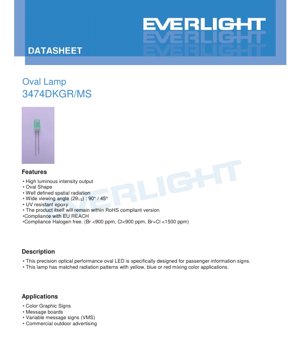
This document details the technical specifications of the precision elliptical LED lamp bead model 3474DKGR/MS. This component is specifically designed for applications within signage systems that require clear, high-visibility illumination. Its primary design objective is to deliver reliable performance in passenger information displays, variable message signs, and commercial outdoor advertising.
1.1 Core Advantages and Target Market
The distinctive feature of this LED is its elliptical structure, which produces a clear spatial radiation pattern. This optical design is particularly suitable for applications involving color mixing, such as when used with yellow, blue, or red filters, making it an ideal choice for multi-color graphic signs. The primary target markets are transportation infrastructure (e.g., variable message signs at airports, train stations, and highways) and commercial advertising, where long-term reliability and consistent color output are crucial.
1.2 Main Features
- High Luminous Intensity Output:Provides bright, visible light suitable for daytime viewing.
- Elliptical and Directional Radiation:Produz padrões de feixe específicos otimizados para iluminação de sinalização.
- Ângulo de Visão Ampla:A visão assimétrica de 90° (eixo X) / 45° (eixo Y) garante clara visibilidade de diferentes posições.
- Sturdy Material:Manufactured using UV-resistant epoxy resin, enhancing durability in outdoor environments.
- Environmental Compliance:产品符合RoHS、欧盟REACH及无卤标准(Br <900ppm, Cl <900ppm, Br+Cl <1500ppm)。
2. Detailed Technical Parameters
2.1 Device Selection and Absolute Maximum Ratings
LED hii inatumia chip ya InGaN (Indium Gallium Nitride) kupitia lenzi ya kijani iliyotawanyika kutoa mwanga mkali wa kijani. Kufanya kazi zaidi ya viwango vya juu kabisa vya kiwango cha juu kunaweza kusababisha uharibifu wa kudumu.
| Vigezo | Ishara | Rating | Unit |
|---|---|---|---|
| Reverse Voltage | VR | 5 | V |
| Forward Current | IF | 30 | mA |
| Peak forward current (duty cycle 1/10 @1kHz) | IFP | 100 | mA |
| Power consumption | Pd | 110 | mW |
| Operating temperature | TT_opr | -40 to +85 | °C |
| Joto la uhifadhi | TT_stg | -40 to +100 | °C |
| Welding temperature | TT_sol | 260 (for 5 seconds) | °C |
2.2 Photoelectric Characteristics (Ta=25°C)
These parameters define the optical output and electrical behavior under standard test conditions (forward current I_F =20mA).FVigezo
| Ishara | Unit | Min. | Typ. | Max. | Condition | Luminous intensity |
|---|---|---|---|---|---|---|
| I_V | Iv | 5020 | 6480 | 12000 | mcd | IFI_F =20mA |
| Perspective (2θ_1/2)2θ_1/2) | -- | X:90, Y:45 | 度 | IFI_F =20mA | ||
| Peak wavelength | λp | -- | 522 | -- | λ_p | IFnm |
| I_F =20mA | λd | 520 | 528 | 535 | Dominant wavelength | Fλ_d|
| nm | I_F =20mA | -- | 20 | -- | Spectral Bandwidth | IFΔλ |
| nm | VF | 2.4 | -- | 3.4 | V | IFI_F =20mA |
| Forward voltage | IR | -- | -- | 50 | V_F | VRV |
I_F =20mA
Reverse current
I_R
μA
| V_R =5V | 3. Explanation of the Binning System | To ensure consistency in mass production, LEDs are sorted into different bins based on key performance indicators. Designers must consider these ranges when selecting components for a project. |
|---|---|---|
| GA | 5020 | 6020 |
| GB | 6020 | 7220 |
| GC | 7220 | 8660 |
| GD | 8660 | 10400 |
| GE | 10400 | 12000 |
3.1 Luminous Intensity Binning
LEDs are categorized into five bins (GA through GE) based on their luminous intensity measured at 20mA. The tolerance is ±10%.
| Lambar mataki | Mafi ƙarancin ƙarfi (mcd) | Maximum Intensity (mcd) |
|---|---|---|
| 3.2 Dominant Wavelength Binning | 520 | 523 |
| The color (hue) is controlled by dividing the dominant wavelength into five groups (G1 to G5) with a tolerance of ±1nm. This is crucial for color matching in multi-LED signs. | 523 | 526 |
| Lambar mataki | 526 | 529 |
| Minimum Wavelength (nm) | 529 | 532 |
| Maximum wavelength (nm) | 532 | 535 |
G1
G2
G3
G4G54. Performance Curve AnalysisThe following typical curves illustrate the behavior of the device under various conditions. This is crucial for robust system design.4.1 Spectral Distribution and Directivity
The "Relative Intensity vs. Wavelength" curve shows a peak at approximately 522nm, confirming bright green luminescence, with a typical spectral bandwidth of 20nm. The "Directivity" diagram visually demonstrates an asymmetric 90°x45° viewing angle, illustrating the spatial distribution of light intensity.
4.2 Electrical and Thermal Characteristics"Forward Current vs. Forward Voltage (I-V Curve)" yana nuna halayen diode na ma'auni. A cikin yanayin aiki na yau da kullun na 20mA, ƙarfin lantarki na gaba yana faɗowa cikin kewayon 2.4V zuwa 3.4V. "Ƙarfin Dangi vs. Ƙarfin Gaba" lanƙwasa yana nuna fitowar haske yana ƙaruwa tare da ƙaruwar ƙarfin lantarki, amma masu ƙira ba za su wuce iyakar iyakar ba.4.3 Dogaro da Zazzabi"Ƙarfin Dangi vs. Yanayin Muhalli" lanƙwasa yana nuna cewa, yayin da zafin jiki ya tashi, fitowar haske zai ragu, wannan shine siffar gama gari na LED. "Ƙarfin Gaba vs. Yanayin Muhalli" lanƙwasa (watakila a cikin ƙarfin lantarki mai tsayi) na iya nuna canjin amfani da ƙarfin lantarki tare da zazzabi. Waɗannan jadawali suna da mahimmanci don ƙira sarrafa zafi da kewayon tuƙi, don tabbatar da aikin kwanciyar hankali a cikin ƙayyadaddun kewayon -40°C zuwa +85°C.5. Mechanical and Packaging Information
5.1 Package Dimensions
The elliptical lamp bead has specific package dimensions and outline. Key dimension notes include: Unless otherwise specified, all dimensions are in millimeters, with a standard tolerance of ±0.25mm. The maximum resin protrusion under the flange is 1.5mm. Detailed package drawings provide precise dimensions for PCB layout and mechanical assembly.5.2 Polarity Identification and MountingThis component has two pins. Correct polarity must be observed during installation to ensure proper operation and prevent damage from reverse bias. The PCB holes must be precisely aligned with the pin positions to avoid applying mechanical stress to the epoxy body during the soldering process.6. Soldering and Assembly Guide6.1 Pin Forming and Handling
The bend point must be at least 3mm from the bottom of the epoxy LED.
6.2 Soldering Process
The maximum soldering temperature is 260°C for 5 seconds. The solder joint must be more than 3mm away from the epoxy LED to prevent heat damage to the resin and semiconductor chip.
6.3 Storage Conditions
After shipment, store at ≤30°C and ≤70% relative humidity (RH). The shelf life under these conditions is 3 months. For storage exceeding 3 months up to one year, place the LEDs in a sealed container filled with nitrogen and containing a moisture-absorbing desiccant. Avoid sudden temperature changes in humid environments to prevent condensation on the component surface.
7. Packaging and Ordering Information
7.1 Moisture-Proof Packaging
- LEDs are supplied in moisture-proof packaging. They are typically loaded in carrier tapes, then placed into inner boxes, and finally packed into outer shipping cartons.
- 7.2 Adadin marufi da ƙayyadaddun tef ɗin ɗaukar kaya
- Daidaitaccen marufi: Kowane akwatin ciki yana ɗauke da 2,500. Kowane babban (waje) akwati yana ɗauke da akwatuna ciki 10 (Jimlar 25,000). An bayar da cikakkun bayanai game da girman tef ɗin ɗaukar kaya, gami da tazarar ramin ciyarwa (P=12.70mm), tazarar aljihun kayan aiki (F=2.54mm), da faɗin tef ɗin gabaɗaya (W3=18.00mm).
- 7.3 Label Description and Model Naming
- The packaging label includes fields for Customer Part Number (CPN), Part Number (P/N), Quantity (QTY), and specific binning codes for Luminous Intensity (CAT), Dominant Wavelength (HUE), and Forward Voltage (REF). The complete product naming follows a structured format:
8. Application Recommendations
8.1 Typical Application Scenarios
Passenger Information Displays:
- 8.2 Design Considerations
- Driving Circuit:
- 9. Technical Comparison and Differentiation
Compared to standard round LED lamps, this oval lamp offers a key advantage: its asymmetric radiation pattern (90°x45°) is inherently better suited for illuminating the rectangular pixels commonly found in character-type signs and information boards, potentially reducing light waste and improving efficiency. Designed specifically for color-mixing applications also distinguishes it from general-purpose indicator LEDs. Its compliance with the latest environmental standards (halogen-free, REACH) makes it suitable for modern, eco-conscious designs, whereas older component formulations may be restricted.
10. Frequently Asked Questions (Based on Technical Specifications)
Q: What is the difference between Peak Wavelength (typical 522nm) and Dominant Wavelength (typical 528nm)? A: Peak Wavelength is the point of highest intensity in the spectrum. Dominant Wavelength is the wavelength of monochromatic light that produces the same perceived color. Designers concerned with color appearance should focus on Dominant Wavelength and its binning.
Q: Can I drive this LED continuously at 30mA? A: Yes, 30mA is the absolute maximum continuous forward current. However, operating at the maximum rating may reduce long-term reliability and increase junction temperature. Typical photometric data is given at 20mA, which is the recommended operating point for optimal performance and lifetime.
- Q: How critical is the 3mm distance for lead bending and soldering? A: Extremely critical. Bending or applying heat within 3mm of the epoxy body transmits mechanical or thermal stress directly to the internal bond wires and the die itself, significantly increasing the risk of immediate failure or latent reliability issues.
- Q: Why are the storage conditions so specific (3 months at 30°C/70%RH)? A: LED packages absorb moisture from the atmosphere. If subjected to high-temperature soldering (reflow) after moisture absorption, the rapid vaporization of the moisture can cause internal delamination or cracking ("popcorn" effect). The specified storage limits and the requirement for dry baking or nitrogen storage after 3 months are standard industry practices (based on MSL - Moisture Sensitivity Level) to prevent this failure mode.
- 11. Practical Use Case Example
Scenario: Designing pixels for highway Variable Message Signs (VMS). A single pixel on a monochrome (green) VMS may use one or several such oval LEDs. The designer will: 1. Select the luminous intensity grade (e.g., GC or GD) to ensure the sign meets minimum visibility standards under bright sunlight. 2. Select the dominant wavelength grade (e.g., G3) to ensure a consistent green color across the entire sign face. 3. Design the PCB layout to match the mechanical drawings of the LEDs and provide sufficient copper foil area for heat dissipation. 4. Implement a constant current drive circuit for each pixel or each row/column, set to provide a current of 20mA ±5%. 5. Precisely follow assembly guidelines, using automated equipment for pin insertion and soldering to maintain a 3mm gap. 6. Test within the operating temperature range (-40°C to +85°C) to verify that the light output remains within an acceptable range.
12. Brief Introduction to Working PrincipleThis LED operates based on the principle of electroluminescence in semiconductors. The core is a chip made of InGaN (Indium Gallium Nitride) material. When a forward voltage (exceeding a threshold of approximately 2.4V) is applied, electrons and holes are injected into the active region of the semiconductor, where they recombine. This recombination process releases energy in the form of photons (light). The specific composition of the InGaN alloy determines the bandgap energy, which in turn defines the wavelength (color) of the emitted light—green in this case. An oval epoxy resin lens then encapsulates the chip, protecting it from environmental influences and shaping the emitted light into the desired radiation pattern.13. Fasahar Trend da Background
LEDs for signage have evolved from simple indicator lights into high-performance optical components. The trends are toward higher efficiency (more lumens per watt), improved color consistency through tighter binning, and enhanced reliability for 24/7 outdoor operation. This oval LED represents a specialized solution within this trend, optimizing the form factor and beam pattern for specific application areas. Future developments may include integrated driver electronics, higher temperature tolerance, and narrower wavelength distributions for purer colors in full-color RGB displays. The emphasis on halogen-free and environmentally compliant materials reflects the broader industry shift toward sustainable electronics manufacturing.
.1 Typical Application Scenarios
- Passenger Information Signs:In airports, train, and bus stations.
- Variable Message Signs (VMS):On highways for traffic alerts and guidance.
- Message Boards & Commercial Advertising:For indoor and outdoor digital displays.
- Color Graphic Signs:Where colored filters are used over a white or green light source to create multiple colors from a single LED type.
.2 Design Considerations
- Drive Circuit:Use a constant current driver set to ≤30mA (typical 20mA) to ensure stable light output and long life. Include protection against voltage transients and reverse connection.
- Thermal Management:Although power dissipation is low (110mW max), ensure adequate PCB copper area or heatsinking if operating at high ambient temperatures or in enclosed spaces to maintain performance and reliability.
- Optical Design:Leverage the oval beam pattern and wide viewing angle. For color mixing applications, ensure the selected wavelength bin provides the desired hue after filtering.
- Binning for Consistency:For large displays, specify tight bins (CAT and HUE) to minimize visible differences in brightness and color between adjacent LEDs.
. Technical Comparison and Differentiation
Compared to standard round LED lamps, this oval lamp offers a key advantage: its asymmetric radiation pattern (90°x45°) is inherently better suited for illuminating the rectangular pixels commonly found in character-based signs and message boards, potentially reducing optical waste and improving efficiency. The dedicated design for color-mixing applications also sets it apart from general-purpose indicator LEDs. Its compliance with the latest environmental standards (Halogen-Free, REACH) makes it suitable for modern, eco-conscious designs where older component formulations may be restricted.
. Frequently Asked Questions (Based on Technical Parameters)
Q: Menene bambancin tsakanin Peak Wavelength (522nm Typ.) da Dominant Wavelength (528nm Typ.)?
A: Peak Wavelength shine mafi girman ƙarfi a cikin bakan. Dominant Wavelength shine kawai tsayin haske na monochromatic wanda zai samar da launi ɗaya da ake gani. Masu zanen da ke damuwa da bayyanar launi yakamata su mai da hankali kan Dominant Wavelength da rarrabuwarsa.
Q: Inaweza niiendeshe LED hii kwa 30mA kila wakati?
A: Ndiyo, 30mA ndiyo Upeo Kabisa wa Mwendelezo wa Sasa wa Mbele. Hata hivyo, kufanya kazi kwa kiwango cha juu kabisa kunaweza kupunguza uaminifu wa muda mrefu na kuongeza joto la makutano. Data ya kawaida ya umeme-na-mwanga inatolewa kwa 20mA, ambayo ndiyo hatua inayopendekezwa ya uendeshaji kwa utendakazi bora na maisha marefu.
Q: Ni muhimu kiasi gani umbali wa 3mm kwa kupinda na kuuza waya?
A> It is very important. Bending or applying heat closer than 3mm to the epoxy body transfers mechanical or thermal stress directly to the internal wire bonds and the chip itself, significantly increasing the risk of immediate failure or latent reliability issues.
Q: Kí ni idi ti ipo ipamọ jẹ pataki bẹ (osu 3 ni 30°C/70%RH)?
A> LED packages can absorb moisture from the atmosphere. If subjected to high-temperature soldering (reflow) after absorption, the rapid vaporization of this moisture can cause internal delamination or cracking (\"popcorning\"). The specified storage limits and the requirement for dry-baking or nitrogen storage after 3 months are standard industry practices (based on MSL - Moisture Sensitivity Level ratings) to prevent this failure mode.
. Practical Use Case Example
Scenario: Designing a Highway Variable Message Sign (VMS) Pixel.
A single pixel on a monochrome (green) VMS might use one or several of these oval LEDs. The designer would:
. Select a luminous intensity bin (e.g., GC or GD) to ensure the sign meets minimum visibility standards in bright sunlight.
. Select a dominant wavelength bin (e.g., G3) to guarantee a consistent green color across the entire sign face.
. Design a PCB with a layout that matches the LED's mechanical drawing, providing sufficient copper area for heat dissipation.
. Implement a constant-current driver circuit per pixel or per row/column, set to deliver 20mA ±5%.
. Follow the assembly guidelines precisely, using automated equipment for lead insertion and soldering to maintain the 3mm clearance.
. Conduct testing over the operational temperature range (-40°C to +85°C) to verify light output remains within acceptable limits.
. Operational Principle Introduction
Wannan LED yana aiki bisa ka'idar electroluminescence a cikin semiconductor. Tsarin sa shine guntu da aka yi da kayan InGaN (Indium Gallium Nitride). Lokacin da aka yi amfani da ƙarfin lantarki na gaba (wanda ya wuce kusan 2.4V na bakin kofa), ana shigar da electrons da ramuka cikin yankin aiki na semiconductor inda suke sake haɗuwa. Wannan tsarin sake haɗuwa yana sakin makamashi a cikin nau'in photons (haske). Takamaiman abun da ke cikin gawa na InGaN yana ƙayyade makamashin bandgap, wanda kuma ke ayyana tsayin raƙuman ruwa (launi) na hasken da aka fitar—a wannan yanayin, kore. Sa'an nan kuma ruwan tabarau na epoxy mai siffar kwai yana rufe guntun, yana kare shi daga muhalli, kuma yana siffanta hasken da aka fitar zuwa tsarin radiyon da ake so.
. Technology Trends and Context
LEDs for signage have evolved from simple indicators to high-performance optical components. The trend is toward higher efficiency (more lumens per watt), improved color consistency through tighter binning, and enhanced reliability for 24/7 outdoor operation. This oval lamp represents a specialized solution within that trend, optimizing form factor and beam pattern for a specific application niche. Future developments may include integrated driver electronics, higher temperature tolerance, and even narrower wavelength distributions for purer colors in full-color RGB displays. The emphasis on halogen-free and environmentally compliant materials reflects the broader industry shift toward sustainable electronics manufacturing.
LED Specification Terminology Explained
Complete Explanation of LED Technical Terminology
I. Core Indicators of Photoelectric Performance
| Terminology | Unit/Representation | Popular Explanation | Why is it important |
|---|---|---|---|
| Luminous Efficacy | lm/W | The luminous flux emitted per watt of electrical power; the higher the value, the more energy-efficient. | It directly determines the energy efficiency rating and electricity cost of the luminaire. |
| Luminous Flux | lm (lumen) | The total amount of light emitted by a light source, commonly known as "brightness". | Determines whether the luminaire is bright enough. |
| Viewing Angle | ° (degree), e.g., 120° | The angle at which light intensity drops to half, determining the beam width. | Affects the illumination range and uniformity. |
| Color Temperature (CCT) | K (Kelvin), e.g., 2700K/6500K | The color temperature of light, lower values lean yellow/warm, higher values lean white/cool. | Determines the lighting ambiance and suitable application scenarios. |
| Color Rendering Index (CRI / Ra) | Unitless, 0–100 | The ability of a light source to reproduce the true colors of objects, with Ra≥80 being good. | Affects color fidelity, used in high-demand places such as shopping malls and art galleries. |
| Color tolerance (SDCM) | MacAdam ellipse steps, such as "5-step" | A quantitative metric for color consistency; a smaller step number indicates better color consistency. | Ensure no color variation among luminaires from the same batch. |
| Dominant Wavelength | nm (nanometer), e.g., 620nm (red) | The wavelength value corresponding to the color of a colored LED. | Determines the hue of monochromatic LEDs such as red, yellow, and green. |
| Spectral Distribution | Wavelength vs. Intensity curve | Shows the intensity distribution of light emitted by an LED at each wavelength. | Affects color rendering and color quality. |
II. Electrical Parameters
| Terminology | Ishara | Popular Explanation | Design Considerations |
|---|---|---|---|
| Forward Voltage | Vf | The minimum voltage required to light up an LED, similar to a "starting threshold". | The driving power supply voltage must be ≥ Vf; voltages add up when multiple LEDs are connected in series. |
| Forward Current | If | The current value that makes the LED emit light normally. | Constant current drive is often used, as the current determines brightness and lifespan. |
| Maximum Pulse Current | Ifp | Peak current that can be withstood for a short period, used for dimming or flashing. | Pulse width and duty cycle must be strictly controlled to prevent overheating damage. |
| Reverse Voltage | Vr | The maximum reverse voltage that an LED can withstand; exceeding it may cause breakdown. | Circuit must be protected against reverse polarity or voltage surges. |
| Thermal Resistance | Rth (°C/W) | The resistance to heat transfer from the chip to the solder joint. A lower value indicates better heat dissipation. | High thermal resistance requires a stronger heat dissipation design; otherwise, the junction temperature will increase. |
| ESD Immunity | V (HBM), e.g., 1000V | The higher the ESD immunity rating, the more resistant the device is to electrostatic damage. | Anti-static measures must be taken during production, especially for high-sensitivity LEDs. |
III. Thermal Management and Reliability
| Terminology | Key Indicators | Popular Explanation | Impact |
|---|---|---|---|
| Junction Temperature | Tj (°C) | The actual operating temperature inside the LED chip. | For every 10°C reduction, lifespan may double; excessively high temperatures cause lumen depreciation and color shift. |
| Lumen Depreciation | L70 / L80 (hours) | The time required for brightness to drop to 70% or 80% of its initial value. | Directly defines the "service life" of an LED. |
| Lumen Maintenance | % (e.g., 70%) | The percentage of remaining brightness after a period of use. | Characterizes the ability to maintain brightness after long-term use. |
| Color Shift | Δu′v′ or MacAdam ellipse | The degree of color change during use. | Affects the color consistency of the lighting scene. |
| Thermal Aging | Material performance degradation | Deterioration of packaging materials due to prolonged high temperatures. | May lead to decreased brightness, color shift, or open-circuit failure. |
IV. Packaging and Materials
| Terminology | Common Types | Popular Explanation | Characteristics and Applications |
|---|---|---|---|
| Packaging Type | EMC, PPA, Ceramic | The housing material that protects the chip and provides optical and thermal interfaces. | EMC tahan panas baik, biaya rendah; keramik pendinginan unggul, umur panjang. |
| Struktur chip | Face-up, Flip Chip | Chip electrode arrangement method. | Flip Chip offers better heat dissipation and higher luminous efficacy, suitable for high-power applications. |
| Phosphor coating | YAG, silicate, nitride | Covered on the blue light chip, partially converted into yellow/red light, mixed into white light. | Different phosphors affect luminous efficacy, color temperature, and color rendering. |
| Lens/Optical design | Planar, Microlens, Total Internal Reflection | Optical structure on the encapsulation surface, controlling light distribution. | Determine the beam angle and light distribution curve. |
V. Quality Control and Binning
| Terminology | Binning Content | Popular Explanation | Purpose |
|---|---|---|---|
| Luminous Flux Classification | Codes such as 2G, 2H | Group by brightness level, each group has a minimum/maximum lumen value. | Ensure consistent brightness for the same batch of products. |
| Voltage binning | Codes such as 6W, 6X | Group by forward voltage range. | Facilitates driver power matching and improves system efficiency. |
| Color binning | 5-step MacAdam Ellipse | Group by color coordinates to ensure colors fall within a minimal range. | Ensure color consistency to avoid uneven color within the same luminaire. |
| Color temperature binning | 2700K, 3000K, etc. | Grouped by color temperature, each group has a corresponding coordinate range. | To meet the color temperature requirements of different scenarios. |
VI. Testing and Certification
| Terminology | Standards/Testing | Popular Explanation | Significance |
|---|---|---|---|
| LM-80 | Lumen Maintenance Test | Record brightness attenuation data under constant temperature conditions over a long period of illumination. | Used to estimate LED lifespan (combined with TM-21). |
| TM-21 | Standard for Life Projection | Projecting lifetime under actual use conditions based on LM-80 data. | Provide scientific life prediction. |
| IESNA Standard | Illuminating Engineering Society Standard | Covers optical, electrical, and thermal testing methods. | Industry-recognized testing basis. |
| RoHS / REACH | Environmental Certification | Ensure products are free from hazardous substances (e.g., lead, mercury). | Market access requirements for entering the international market. |
| ENERGY STAR / DLC | Energy Efficiency Certification | Energy Efficiency and Performance Certification for Lighting Products. | Commonly used in government procurement and subsidy programs to enhance market competitiveness. |