Table of Contents
- 1. Product Overview
- 1.1 Core Advantages and Product Positioning
- 1.2 Target Market and Applications
- 2. In-depth Analysis of Technical Parameters
- 2.1 Device Selection and Absolute Maximum Ratings
- 2.2 Binciken Halayen Haske da Lantarki
- 3. Bayanin Tsarin Rarraba
- 3.1 Rarraba Ƙarfin Haskakawa
- 3.2 Rarraba Babban Tsawon Zango
- 4. Performance Curve Analysis
- 4.1 Spectral Distribution and Directivity
- 4.2 Electrical and Thermal Characteristics
- 5. Mechanical and Packaging Information
- 5.1 Girman Kunnawa da Tolerances
- 5.2 Gane Polarity
- 6. Jagororin Walda da Haɗawa
- 6.1 Siffata Ƙafar (Idan Ya Dace)
- 6.2 Storage Conditions
- 6.3 Soldering Process
- 7. Packaging and Ordering Information
- 7.1 Moisture Barrier Bag Packaging
- 7.2 Label Description and Carrier Tape Specification
- 7.3 Package Quantity and Model Number
- 8. Application Suggestions and Design Considerations
- 8.1 Typical Application Circuit
- 8.2 Thermal Management
- 8.3 Optical Integration
- 9. Technical Comparison and Differentiation
- 10. Frequently Asked Questions (Based on Technical Parameters)
- 11. Ayyukan Ƙira da Amfani na Ainihi
- 12. Gabatarwar Aikin Tsari
- 13. Trends da Bayanan Fasaha
- Cikakken Bayanin Kalmomin Ƙayyadaddun LED
- I. Core Indicators of Photoelectric Performance
- II. Electrical Parameters
- III. Thermal Management and Reliability
- IV. Packaging and Materials
- V. Quality Control and Grading
- VI. Testing and Certification
1. Product Overview
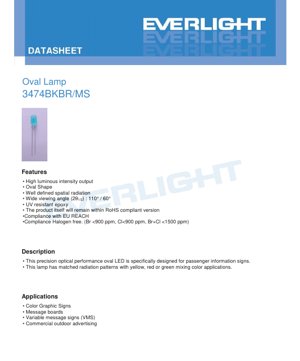
This document details the technical specifications of the high-precision optical performance oval LED lamp bead, model 3474BKBR/MS. This device is specifically designed for applications in information display systems that require high visibility and reliable performance.
1.1 Core Advantages and Product Positioning
The primary design objective of this elliptical LED is to serve passenger information signs and similar display applications. Its core advantage stems from its unique optical design:
- High Luminous Intensity Output:Provides bright, clear illumination, which is key to achieving daylight-readable signs.
- Elliptical and Well-Defined Radiation Pattern:The elliptical lens structure creates a well-defined spatial radiation pattern, optimizing light distribution for the rectangular or elliptical display apertures commonly found in signage.
- Wide and Asymmetric Viewing Angle:Viewing angle (2θ1/2) is 110° on one axis and 60° on the perpendicular axis. This asymmetric pattern is ideal for efficiently directing light toward the viewer in typical signage mounting configurations.
- Robust Material Construction:UV-resistant epoxy is used, enhancing long-term reliability and preventing lens yellowing or degradation when used outdoors or in high-UV environments.
- Environmental Compliance:本产品设计符合RoHS(有害物质限制)、欧盟REACH法规,并且不含卤素(溴<900 ppm,氯<900 ppm,溴+氯<1500 ppm)。
1.2 Target Market and Applications
This LED primarily targets the commercial and traffic signage markets. Its matched radiation pattern makes it suitable for mixing with yellow, red, or green filters or secondary optics in color applications. Typical use cases include:
- Color graphic signs
- Allon bayanai
- Alamar bayanai mai canzawa
- Allon tallan kasuwanci na waje
2. In-depth Analysis of Technical Parameters
Wannan sashe yana ba da cikakken bayani, haƙiƙa game da mahimman sigogi na lantarki, na gani, da na zafi waɗanda aka ayyana a cikin takardar ƙayyadaddun bayanai.
2.1 Device Selection and Absolute Maximum Ratings
Wannan LED tana amfani da kayan guntu na InGaN (Indium Gallium Nitride) don samar da haske mai shuɗi, sannan ta yada ta hanyar ruwan tabarau mai shuɗi. Fahimtar Cikakken Ƙimar Ƙimar yana da mahimmanci don tabbatar da tsawon rayuwar kayan aiki da hana lalacewa nan take.
- Ƙarfin lantarki na baya (VR): 5V- Yin amfani da ƙarfin lantarki na baya fiye da wannan ƙimar na iya haifar da lalacewar maras dawowa a haɗin LED.
- Ƙarfin lantarki na gaba (IF): 30mA- Matsakaicin ci gaba da ci gaba da ƙarfin lantarki na DC da za a iya amfani da shi. Yin aiki a wannan iyaka ko kusa da shi yana haifar da ƙarin zafi kuma yana iya rage tsawon rayuwa.
- Matsakaicin ƙarfin lantarki na gaba (IFP): 100mA- Wannan ƙimar bugun jini ce (duty cycle 1/10 @ 1kHz). Ba za a yi amfani da ita don aikin DC ba. Yana nuna cewa LED na iya jure ƙarfin gajeren lokaci, wanda zai iya kasancewa da alaƙa a wasu tsare-tsaren tuƙi masu yawa.
- Yin amfani da wutar lantarki (Pd): 110mW- A Ta=25°C, iyakar mafi girman wutar lantarki da fakit ɗin zai iya watsawa a matsayin zafi. Wucewa wannan iyaka yana da haɗarin zafi mai yawa. Haƙiƙanin ƙididdigar wutar lantarki shine ƙarfin lantarki na gaba (VF) × ƙarfin lantarki na gaba (IF).
- Aiki da yanayin ajiya:Kewayon daga -40°C zuwa +85°C (aiki) da -40°C zuwa +100°C (ajiye). Waɗannan faɗin kewayon sun tabbatar da dacewarsa ga yanayi mara kyau na waje.
- Yanayin goge-goge (Tsol): 260°C, for 5 seconds- This defines the tolerance of the reflow soldering profile, which is crucial for PCB assembly without damaging the epoxy package or internal bonds.
2.2 Binciken Halayen Haske da Lantarki
All parameters are specified under standard test conditions of Ta=25°C and IF=20mA, which is the recommended operating point.
- Luminous Intensity (Iv):Ranges from 550 mcd (min) to 1130 mcd (max), with a typical value of 800 mcd. This high intensity is a key characteristic for signage applications.
- Viewing Angle (2θ1/2):An tabbatar da 110° (X-axis) / 60° (Y-axis). Wannan rashin daidaituwa an tsara shi musamman don tambari.
- Tsawon zango mafi girma (λp):Matsakaicin ƙima 468 nm. Wannan shine tsawon zango da ke da mafi girman ƙarfin fitar da haske.
- Babban tsawon zango (λd):Kewayon daga 460 nm zuwa 475 nm. Wannan shine tsawon zango guda ɗaya da ido ke fahimta, wanda ke ayyana "launi" na shuɗi.
- Ƙarfin lantarki na gaba (VF):A 20mA, kewayon daga 2.4V zuwa 3.4V. Dole ne masu zane su tabbatar da cewa da'irar tuƙi za ta iya dacewa da wannan bambanci, musamman lokacin amfani da wutar lantarki mai tsayayyen ƙarfi.
- Kwararar lantarki ta baya (IR):A VR=5V, matsakaicin 50 µA. Ƙananan ƙima yana nuna ingantacciyar haɗin mahaɗa.
3. Bayanin Tsarin Rarraba
Don sarrafa bambance-bambancen kera, ana rarraba LED zuwa matakan aiki daban-daban. Wannan yana bawa masu zane damar zaɓar sassa waɗanda suka cika takamaiman buƙatun ƙarfi da daidaiton launi don aikace-aikacensu.
3.1 Rarraba Ƙarfin Haskakawa
An ayyana matakan ta lambobi BA zuwa BD, waɗanda ke haɗa da mafi ƙarancin da mafi girman ƙimar ƙarfin haskakawa da aka auna a IF= 20mA. Matsakaicin juzu'i shine ±10%.
- BA:550 mcd zuwa 660 mcd
- BB:660 mcd to 790 mcd
- BC:790 mcd to 945 mcd
- BD:945 mcd to 1130 mcd
Selecting a higher bin (e.g., BD) ensures maximum brightness but may incur additional cost. For a uniform appearance in multi-LED signs, specifying a narrow or single bin is crucial.
3.2 Rarraba Babban Tsawon Zango
Wavelength bins are defined by codes B1 through B5, each covering a 3 nm range from 460 nm to 475 nm. The tolerance is ±1 nm.
- B1:460 nm to 463 nm (bluer, leaning towards cyan-blue)
- B2:463 nm to 466 nm
- B3:466 nm to 469 nm
- B4:469 nm zuwa 472 nm
- B5:472 nm zuwa 475 nm (mai zurfi, shuɗin gemu)
Daidaiton launi na gaba ɗaya na nuni yana da mahimmanci. Ƙayyadaddun matakin tsawon raƙuman ruwa guda ɗaya (misali B3) yana tabbatar da cewa duk LED ɗin suna da kusan inuwa iri ɗaya.
4. Performance Curve Analysis
Lanƙwan da aka bayar na yau da kullun yana ba da haske mai mahimmanci don fahimtar halayen LED a cikin yanayin da ba daidai ba.
4.1 Spectral Distribution and Directivity
Relative Intensity vs. WavelengthThe curve shows the typical blue LED spectrum centered at 468 nm with a full width at half maximum of approximately 20 nm.DirectivityThe curve visually confirms the 110°/60° viewing angle, showing the decrease in relative intensity as the angle from the central axis increases.
4.2 Electrical and Thermal Characteristics
- Forward Current vs. Forward Voltage (I-V Curve):This curve is nonlinear, typical of a diode. It shows the relationship between voltage and current, which is crucial for designing current-limiting circuits. The knee voltage is approximately 2.8V to 3.0V.
- Relative Intensity vs. Forward Current:Light output increases with current, but not linearly. Driving current beyond 20mA leads to diminishing efficiency returns and increased heat.
- Relative Intensity vs. Ambient Temperature:LED light output decreases as ambient temperature (Ta) increases. This derating must be considered in thermal design, especially in enclosed signs or hot climates.
- Forward Current vs. Ambient Temperature:This curve likely illustrates the recommended maximum operating current derating as temperature increases to stay within the 110mW power dissipation limit.
5. Mechanical and Packaging Information
5.1 Girman Kunnawa da Tolerances
The datasheet includes detailed dimensional drawings of the oval LED package. Key features include:
- Overall package shape and lead pitch.
- Location and dimensions of the cathode identifier (typically the flat side or green dot on the package).
- A critical note specifies that all dimensions are in millimeters, with a standard tolerance of ±0.25mm, unless otherwise stated.
- The maximum resin protrusion below the flange is specified as 1.5mm, which is important for clearance during PCB mounting.
5.2 Gane Polarity
Correct polarity is crucial. The package includes a visual indicator (e.g., flat side, notch, or colored dot) to identify the cathode (-) lead. The anode (+) is typically the longer lead in through-hole versions, but for this SMD component, refer to the outline drawing to identify the marking on the package.
6. Jagororin Walda da Haɗawa
Proper handling is critical to maintaining reliability.
6.1 Siffata Ƙafar (Idan Ya Dace)
If leads require forming for through-hole mounting:
- Bend at a distance ≥ 3mm from the epoxy lamp base.
- 在Before soldering soldering.
- Perform molding. Avoid applying stress to the package; stress may damage internal connections or cause the epoxy resin to crack.
- Cut the leads at room temperature.
- Ensure the PCB holes are perfectly aligned with the LED leads to avoid mounting stress.
6.2 Storage Conditions
LED is a moisture-sensitive device.
- After receipt, store at ≤ 30°C and ≤ 70% relative humidity.
- The recommended storage life under this condition is 3 months.
- For storage exceeding 3 months up to 1 year, use a sealed container with a nitrogen atmosphere and desiccant.
- Avoid sudden temperature changes in humid environments to prevent condensation.
6.3 Soldering Process
- 保持焊点到环氧树脂灯珠的距离 > 3mm。
- Do not solder on the base of the LED itself.
- Follow the reflow soldering profile with a peak temperature of 260°C for a maximum of 5 seconds.
7. Packaging and Ordering Information
7.1 Moisture Barrier Bag Packaging
LEDs are provided in moisture barrier packaging, typically including:
- Carrier Tape:LEDs are placed in embossed carrier tapes for automatic SMT assembly.
- Reel:The carrier tape is wound onto the reel.
- Desiccant and Humidity Indicator Card:Included in the sealed bag for moisture protection.
- Inner Box and Master Carton:Used for bulk transportation and storage.
7.2 Label Description and Carrier Tape Specification
The packaging label contains the following codes:
- CPN (Customer Part Number)
- P/N (Product Number: 3474BKBR/MS)
- QTY (Quantity)
- CAT (Luminous Intensity Bin, e.g., BC)
- HUE (Dominant Wavelength Grade, e.g., B3)
- REF (Forward Voltage Grade)
- LOT No.
Detailed carrier tape dimensions (D, F, P, W1, W3, etc.) are provided to ensure compatibility with standard SMD assembly equipment.
7.3 Package Quantity and Model Number
- Standard Packing: 2500 pieces per inner box.
- Kowane babban akwati yana dauke da akwatuna 10 a ciki (gabaɗaya 25,000 guda).
- Nau'in3474BKBR/MSYana bin tsarin suna, mai yiwuwa yana nuna salon kunshewa (3474), launi (BKBR yana wakiltar shuɗi?) da shigarwa/salo (MS yana nufin mai hankali ga danshi ko makamantansu). Takardar ƙayyadaddun bayanai ta nuna wurin da aka keɓe don ƙara lambar ƙari (3474BKBR-□□□□) don ƙayyadaddun mataki ko bambance-bambancen.
8. Application Suggestions and Design Considerations
8.1 Typical Application Circuit
Don tabbatar da aiki mai dogaro:
- Constant Current Drive:It is highly recommended to use constant current drive instead of constant voltage drive. For low-current applications, a simple series resistor may be sufficient, but a dedicated constant current LED driver IC provides better stability, efficiency, and protection against voltage spikes.
- Current Setting:Operate at or below the typical test condition of 20mA for optimal efficiency and lifespan. Use the I-V curve to calculate the appropriate series resistor or driver setting based on your power supply voltage.
- Reverse Voltage Protection:If the LED may be exposed to reverse voltage transients, consider connecting a protection diode in parallel (cathode to anode, anode to cathode).
8.2 Thermal Management
Although the power is low (maximum 110mW), heat can still affect performance and lifespan:
- Yi amfani da PCB mai isasshen yanki na tagulla, kuma haɗa shi da kwanon LED don zama mai sanyaya.
- A cikin tsararrun da suka yi yawa, tabbatar da isasshen tazara, idan an rufe sai a yi la'akari da sanyaya mai ƙarfi.
- ReferenceRelative intensity vs. ambient temperatureCurve, don rage tsinkayar fitar da haske a yanayin zafi mai girma.
8.3 Optical Integration
- Tsarin hasken elliptical an tsara shi don dacewa da ramukan alama na yau da kullun. Daidaita babban axis na LED (110°) da axis na biyu (60°) tare da shimfidar alama, don samun mafi kyawun daidaito da inganci.
- When using color filters, ensure compatibility with the LED's blue spectrum and UV-resistant epoxy to prevent accelerated aging.
9. Technical Comparison and Differentiation
Although the datasheet does not provide a direct competitor comparison, the key differentiating factors of this product can be inferred:
- Compared to standard circular LEDs:The elliptical beam provides better coverage for rectangular pixels in signs, reducing the required number of LEDs or improving uniformity compared to circular LEDs with a circular beam.
- Compared to non-UV-resistant LEDs:UV-resistant epoxy resin is a critical advantage for any outdoor or long-life application, preventing the common failure mode of lens browning and output attenuation.
- Compared to low-intensity LEDs:High luminous intensity (up to 1130 mcd) makes it suitable for sunlight-readable applications in strong ambient light.
- Comprehensive binning:Detailed intensity and wavelength binning structure allows for achieving high color consistency in displays, a key requirement for professional signage.
10. Frequently Asked Questions (Based on Technical Parameters)
Q: Can I drive this LED continuously at 30mA?
A: The absolute maximum rating is 30mA, but typical operating conditions and all photometric specifications are given at 20mA. Operating at 30mA generates more heat, reduces efficiency (lumens per watt), and may shorten lifespan. For optimal reliability, it is recommended to design for 20mA or lower.
Q: What is the difference between peak wavelength and dominant wavelength?
A: Peak wavelength (λp) is the physical peak of the emission spectrum. Dominant wavelength (λd) is the single wavelength perceived as the color by the human eye, calculated from the full spectrum. λd is more relevant for color matching in displays.
Q: How to interpret the binning code when ordering?
A: To ensure sign uniformity, specify both the luminous intensity bin (e.g., BC) and the dominant wavelength bin (e.g., B3) in your order. This guarantees all LEDs have very similar brightness and color.
Q: Is a heatsink required?
A: For a single LED at 20mA (~2.8V * 0.02A = 56mW), a heatsink is typically not required if there is some copper on the PCB. For LED arrays or operation in high-temperature environments, thermal design becomes important.
11. Ayyukan Ƙira da Amfani na Ainihi
Scenario: Designing a single-line variable message sign character.
A character consists of a 5x7 pixel matrix. Each "pixel" is a rectangular aperture. Use this elliptical LED:
- Placement:Mount the LED behind each aperture, aligning its 110° wide axis with the rectangle's long side and its 60° narrow axis with the short side. This effectively fills the aperture.
- Circuit:Use a constant-current driver IC capable of driving a 35-LED (5x7) multiplexed matrix to reduce wiring. When active, set the current for each LED to 18-20mA.
- Binning:Order all LEDs for the entire sign from the same CAT (e.g., BC) and HUE (e.g., B3) bins to ensure uniform brightness and color across the display.
- Thermal Management:Design a PCB with thermal vias connected to the backplane ground layer under the LED pads to dissipate heat from the 35-LED array.
- Software:Implement PWM (Pulse Width Modulation) via the driver IC to achieve dimming control for different ambient lighting conditions.
12. Gabatarwar Aikin Tsari
This LED operates based on the principle of electroluminescence in a semiconductor diode. The core is a chip made of InGaN (Indium Gallium Nitride) semiconductor material. When a forward voltage exceeding the diode's knee voltage (approximately 2.8-3.0V) is applied, electrons are injected from the n-type region and holes from the p-type region into the active region. When these carriers recombine, they release energy in the form of photons (light). The specific composition of the InGaN alloy determines the bandgap energy, which in turn defines the wavelength of the emitted light—in this case, blue (approximately 468 nm). The elliptical epoxy resin lens surrounding the chip is designed to refract and shape the raw light into the desired 110°/60° radiation pattern.
13. Trends da Bayanan Fasaha
This component represents a specialized application of mainstream LED technology. The overarching trends in the LED industry providing context include:
- Efficiency Improvement:Continuous R&D steadily increases lumens per watt (luminous efficacy), enabling brighter displays or lower power consumption.
- Miniaturization:While this is a large package for high output, the trend in general lighting is toward smaller, more densely packed chips (e.g., chip-scale packaging).
- Smart & Connected Lighting:For signage, this means LEDs are integrated with smart drivers capable of networked control, dynamic content, and adaptive brightness.
- Color Quality & Consistency:As detailed in the grading sections of this specification, stricter grading and improved manufacturing processes are driven by the demand for excellent and consistent visual performance in professional displays.
- Sustainability:Compliance with halogen-free, RoHS, and REACH standards has now become a basic expectation, reflecting the industry's focus on environmental responsibility.
Elliptical LED packages remain a specialized solution where optical control for specific aperture shapes, reliability, and high-intensity output are prioritized over the smallest possible form factor.
Cikakken Bayanin Kalmomin Ƙayyadaddun LED
Complete Explanation of LED Technical Terminology
I. Core Indicators of Photoelectric Performance
| Istilah | Unit/Penulisan | Penjelasan Sederhana | Mengapa Penting |
|---|---|---|---|
| Efisiensi Cahaya (Luminous Efficacy) | lm/W (lumen per watt) | The luminous flux emitted per watt of electrical energy, the higher the more energy-efficient. | Directly determines the energy efficiency rating and electricity cost of the luminaire. |
| Luminous Flux | lm (lumen) | The total amount of light emitted by a light source, commonly known as "brightness". | Determines whether the luminaire is bright enough. |
| Kwanar Duban Gani (Viewing Angle) | ° (digiri), misali 120° | Kwanar da ƙarfin haske ya ragu zuwa rabi, wanda ke ƙayyade faɗin hasken. | Yana rinjayar iyakar haske da daidaito. |
| Yanayin Zafin Launi (CCT) | K (Kelvin), misali 2700K/6500K | The color temperature of light: lower values are yellowish/warm, higher values are whitish/cool. | Determines the lighting ambiance and suitable application scenarios. |
| Color Rendering Index (CRI / Ra) | Unitless, 0–100 | The ability of a light source to reproduce an object's true colors; Ra≥80 is considered good. | Affects color fidelity, used in high-demand places like shopping malls and art galleries. |
| Standard Deviation of Color Matching (SDCM) | MacAdam ellipse steps, e.g., "5-step" | A quantitative metric for color consistency; a smaller step number indicates better color consistency. | Ensures no color variation among luminaires from the same batch. |
| Dominant Wavelength | nm (nanometer), e.g., 620nm (red) | Wavelength values corresponding to the colors of colored LEDs. | Determines the hue of monochromatic LEDs such as red, yellow, and green. |
| Spectral Distribution | Wavelength vs. Intensity curve | Shows the intensity distribution of light emitted by an LED across various wavelengths. | Affects color rendering and color quality. |
II. Electrical Parameters
| Istilah | Symbol | Penjelasan Sederhana | Design Considerations |
|---|---|---|---|
| Forward Voltage | Vf | The minimum voltage required to light up an LED, similar to a "starting threshold". | The driving power supply voltage must be ≥ Vf. When multiple LEDs are connected in series, the voltages are cumulative. |
| Forward Current | If | The current value that enables the LED to emit light normally. | Constant current drive is commonly used, as the current determines brightness and lifespan. |
| Maximum Pulse Current | Ifp | Peak current that can be withstood for a short time, used for dimming or flashing. | Pulse width and duty cycle must be strictly controlled, otherwise overheating damage may occur. |
| Reverse Voltage | Vr | The maximum reverse voltage that an LED can withstand; exceeding it may cause breakdown. | The circuit must be protected against reverse connection or voltage surges. |
| Thermal Resistance | Rth (°C/W) | The resistance to heat flow from the chip to the solder joint; a lower value indicates better heat dissipation. | A high thermal resistance requires a more robust heat dissipation design; otherwise, the junction temperature will rise. |
| ESD Immunity | V (HBM), e.g., 1000V | Electrostatic discharge (ESD) immunity. A higher value indicates greater resistance to electrostatic damage. | Anti-static measures must be implemented during production, especially for high-sensitivity LEDs. |
III. Thermal Management and Reliability
| Istilah | Key Indicators | Penjelasan Sederhana | Impact |
|---|---|---|---|
| Junction Temperature | Tj (°C) | The actual operating temperature inside the LED chip. | For every 10°C reduction, lifespan may double; excessively high temperatures cause lumen depreciation and color shift. |
| Lumen Depreciation | L70 / L80 (hours) | Lokacin da ake buƙata don haske ya ragu zuwa 70% ko 80% na ƙimar farko. | Kai tsaye ayyana "rayuwar aiki" na LED. |
| Lumen Maintenance | % (misali 70%) | Kashi na hasken da ya rage bayan amfani na ɗan lokaci. | Yana nuna ikon riƙe haske bayan amfani na dogon lokaci. |
| Color Shift | Δu′v′ or MacAdam Ellipse | The degree of color change during use. | Affects the color consistency of the lighting scene. |
| Thermal Aging | Material performance degradation | Deterioration of packaging materials due to prolonged high temperatures. | May lead to decreased brightness, color shift, or open-circuit failure. |
IV. Packaging and Materials
| Istilah | Common Types | Penjelasan Sederhana | Characteristics and Applications |
|---|---|---|---|
| Package Types | EMC, PPA, Ceramic | The housing material that protects the chip and provides optical and thermal interfaces. | EMC has good heat resistance and low cost; ceramic offers superior heat dissipation and long lifespan. |
| Chip structure | Wire bonding, Flip Chip | The arrangement method of chip electrodes. | Flip-chip design offers better heat dissipation and higher luminous efficacy, suitable for high-power applications. |
| Phosphor coating | YAG, silicate, nitride | Coated on the blue LED chip, partially converting to yellow/red light, mixing to form white light. | Different phosphors affect luminous efficacy, color temperature, and color rendering. |
| Lens/optical design | Flat, microlens, total internal reflection | Optical structure on the package surface, controlling light distribution. | Determines the emission angle and light distribution curve. |
V. Quality Control and Grading
| Istilah | Binning Content | Penjelasan Sederhana | Purpose |
|---|---|---|---|
| Luminous flux binning | Codes such as 2G, 2H | Grouped by brightness level, each group has a minimum/maximum lumen value. | Ensure consistent brightness for the same batch of products. |
| Voltage binning | Codes such as 6W, 6X | Group by forward voltage range. | Facilitates driver matching and improves system efficiency. |
| Color binning | 5-step MacAdam ellipse | Group by color coordinates to ensure colors fall within a minimal range. | Ensures color consistency and avoids color variation within the same luminaire. |
| Color Temperature Grading | 2700K, 3000K, etc. | Group by color temperature, each group has a corresponding coordinate range. | Meet the color temperature requirements of different scenarios. |
VI. Testing and Certification
| Istilah | Standard/Test | Penjelasan Sederhana | Ma'ana |
|---|---|---|---|
| LM-80 | Jarabawar Kiyaye haske | A cikin yanayin zafi na dindindin, ana kunna dogon lokaci, ana rubuta bayanan raguwar haske. | Ana amfani da shi don ƙididdige rayuwar LED (haɗe da TM-21). |
| TM-21 | Standard for Life Projection | Projecting lifespan under actual use conditions based on LM-80 data. | Providing scientific life prediction. |
| IESNA Standard | Illuminating Engineering Society Standard | Covers optical, electrical, and thermal testing methods. | Industry-recognized testing basis. |
| RoHS / REACH | Environmental certification. | Ensure the product does not contain harmful substances (such as lead, mercury). | Entry requirements for the international market. |
| ENERGY STAR / DLC | Energy Efficiency Certification | Energy efficiency and performance certification for lighting products. | Commonly used in government procurement and subsidy programs to enhance market competitiveness. |