Table of Contents
- 1. Product Overview
- 1.1 Target Applications
- 2. In-depth Technical Parameter Analysis
- 2.1 Absolute Maximum Ratings
- 2.2 Electro-Optical Characteristics (Ta=25°C)
- 3. Explanation of the Grading System
- 3.1 Luminous Intensity Grading
- 3.2 Dominant Wavelength Binning
- 4. Performance Curve Analysis
- 4.1 Spectral Distribution
- 4.2 Directivity Pattern
- 4.3 Electrical Characteristics
- 4.4 Temperature Dependence
- 5. Mechanical and Packaging Information
- 5.1 Package Dimensions
- 5.2 Polarity Identification
- 6. Welding and Assembly Guide
- 6.1 Pin Forming
- 6.2 Storage Conditions
- 6.3 Welding Process
- 7. Packaging and Ordering Information
- 7.1 Moisture-Proof Packaging
- 7.2 Carrier Tape and Reel Specifications
- 7.3 Package Quantity
- 7.4 Label Description and Part Number Analysis
- 8. Application Design Considerations
- 8.1 Drive Circuit Design
- 8.2 Thermal Management
- 8.3 Optical Integration
- 9. Technical Comparison and Differentiation
- 10. Frequently Asked Questions (FAQ)
- 10.1 What is the difference between peak wavelength and dominant wavelength?
- 10.2 Can I drive this LED continuously at 160mA?
- 10.3 How to interpret the 90°/45° viewing angle?
- 10.4 Why are storage conditions important for LEDs?
- 11. Practical Application Examples
- 12. Working Principles
1. Product Overview
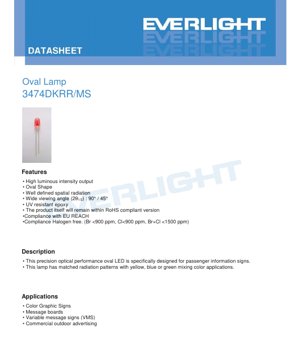
This document provides the complete technical specifications for the 3474DKRR/MS model precision oval LED lamp bead. This device is manufactured using AlGaInP chip technology, emits bright red light, and is encapsulated within a red diffused lens. Its primary design purpose is for use in Passenger Information Systems and various signage applications, where clear and unambiguous visual communication is crucial.
此LED的核心优势包括其高发光强度输出、定义清晰的独特椭圆形空间辐射模式,以及X轴90°、Y轴45°的宽视角配置。这种非对称视角专为匹配标识中混色应用的需求而设计。封装采用抗紫外线环氧树脂制成,确保在户外环境下的长期可靠性。此外,该产品符合RoHS、欧盟REACH及无卤标准(Br <900 ppm, Cl <900 ppm, Br+Cl <1500 ppm),适用于具有严格环保法规的全球市场。
1.1 Target Applications
The 3474DKRR/MS is highly suitable for applications requiring high visibility and color consistency. Its primary target markets include:
- Color graphic signage:For public transportation, airports, and sports venues.
- Information announcement boards:Used for displaying dynamic information in public spaces.
- Variable Message Sign (VMS):Crucial for traffic management and highway information systems.
- Commercial Outdoor Advertising:Provides bright and reliable lighting for advertising displays.
2. In-depth Technical Parameter Analysis
2.1 Absolute Maximum Ratings
These ratings define the limits beyond which permanent damage to the device may occur. Functional operation at or beyond these limits is not guaranteed.
- ):R):5V. Exceeding this voltage under reverse bias may lead to junction breakdown.
- Forward Current (IF):50 mA (continuous).
- Peak Forward Current (IFP):160 mA (duty cycle 1/10 @ 1kHz). This allows short pulses of higher current, suitable for multiplexing in display applications.
- Power dissipation (Pd):120 mW. This is the maximum power that can be dissipated by the package at Ta=25°C. Proper thermal management is required when operating near the maximum current.
- Operating temperature (Topr):-40°C to +85°C. This wide range ensures normal operation in harsh outdoor environments.
- Storage temperature (Tstg):-40°C to +100°C.
- Welding temperature (Tsol):260°C for 5 seconds. This applies to wave soldering or reflow soldering processes.
2.2 Electro-Optical Characteristics (Ta=25°C)
These parameters are measured under standard test conditions (IF=20mA) and represent the typical performance of the device.
- Luminous Intensity (Iv):1976-4600 mcd (Typical: 2800 mcd). This high output is a key feature for achieving visibility under sunlight.
- Viewing Angle (2θ1/2):X: 90°, Y: 45°. The elliptical spot is optimized for horizontal viewing of the sign.
- Peak Wavelength (λp):632 nm (Typical). The specific wavelength corresponding to the maximum spectral emission.
- Dominant Wavelength (λd):619-629 nm (Typical: 621 nm). This defines the perceived color (bright red).
- Spectral Bandwidth (Δλ):20 nm (typical). Indicates the spectral purity of the emitted light.
- Forward Voltage (VF):1.6V - 2.6V (at IF=20mA). This parameter must be considered when designing the drive circuit.
- Reverse current (IR):Maximum 10 μA (at VR=5V).
3. Explanation of the Grading System
To ensure color and brightness consistency in production, LEDs are sorted into different bins. This allows designers to select components that meet the requirements of specific applications.
3.1 Luminous Intensity Grading
Gear definitions have a tolerance of ±10%. Designers can select the gear based on the required brightness level, with higher gears (e.g., RE) providing maximum intensity.
- RA:1976 - 2370 mcd
- RB:2370 - 2840 mcd
- RC:2840 - 3400 mcd
- RD:3400 - 4080 mcd
- RE:4080 - 4600 mcd
3.2 Dominant Wavelength Binning
Wavelength binning ensures color uniformity across the entire display. The tolerance is ±1nm.
- R1:619 - 624 nm
- R2:624 - 629 nm
4. Performance Curve Analysis
The datasheet provides several characteristic curves, which are crucial for understanding the device's behavior under different operating conditions.
4.1 Spectral Distribution
The relative intensity versus wavelength curve shows a narrow Gaussian-like distribution centered at 632 nm (peak), with a typical bandwidth of 20 nm. This confirms the pure red light emission.
4.2 Directivity Pattern
4.3 Electrical Characteristics
The forward current versus forward voltage (I-V) curve shows the typical exponential relationship of a diode. At a test current of 20mA, the forward voltage typically ranges from 1.6V to 2.6V. The relative intensity versus forward current curve is nearly linear within the operating range, indicating that brightness can be effectively controlled by current.
4.4 Temperature Dependence
The relative intensity versus ambient temperature curve shows that the light output decreases as temperature increases, which is a common characteristic of LEDs. The forward current versus ambient temperature curve (possibly under constant voltage) illustrates how the device's operating point changes with temperature, which is crucial for thermal management in the final application.
5. Mechanical and Packaging Information
5.1 Package Dimensions
This LED is packaged in a standard oval lamp bead. Key dimensions include the overall body size and the lead pitch. The lead pitch is 2.54mm, which is compatible with standard PCB layouts. An important note is that the maximum protrusion of the resin below the flange is 1.5mm; this factor must be considered during mechanical mounting and PCB keep-out area design. All unspecified dimensional tolerances are ±0.25mm.
5.2 Polarity Identification
The cathode is typically indicated by a flat spot on the lens or the shorter lead. Refer to the datasheet diagram for this specific package (3474DKRR/MS) for exact markings. Correct polarity is crucial to prevent reverse bias damage.
6. Welding and Assembly Guide
Proper handling is crucial for maintaining LED performance and reliability.
6.1 Pin Forming
Bending must occur at least 3mm away from the bottom of the epoxy lamp bead to avoid stress on the internal chip connection points.
- Forming should always be performed
- Before soldering.Excessive stress during the molding process may cause epoxy cracking or damage wire bonding. soldering.
- Shear pins at room temperature; high-temperature shearing may cause thermal shock.
- PCB holes must be perfectly aligned with LED pins to avoid installation stress, which can lead to degradation of epoxy sealing performance over time.
- 6.2 Storage Conditions
Recommended storage conditions: ≤30°C and relative humidity ≤70%.
- Shelf life after transportation: 3 months under this condition.
- For longer storage (up to 1 year), devices should be stored in a sealed container with a nitrogen atmosphere and desiccant.
- Avoid sudden temperature changes in humid environments to prevent condensation on components.
- 6.3 Welding Process
During hand soldering or wave soldering, solder joints should be at least 3mm away from the epoxy LED.
- It is recommended to solder only to the bottom of the tie bar of the lead frame.
- Maximum soldering temperature is 260°C for 5 seconds, which is compatible with standard lead-free reflow profiles.
- 7. Packaging and Ordering Information
7.1 Moisture-Proof Packaging
LEDs are supplied in Moisture Barrier Bags to prevent damage during storage and transportation. They are typically placed on embossed carrier tapes.
7.2 Carrier Tape and Reel Specifications
Detailed carrier tape dimensions are provided, including feed hole pitch (P=12.70mm), component pitch (F=2.54mm), and pocket dimensions. These are crucial for setting up automatic placement equipment.
7.3 Package Quantity
Standard packaging: 2500 pieces per inner box.
- Shipping packaging: 10 inner boxes per master carton (25,000 pieces in total).
- 7.4 Label Description and Part Number Analysis
The packaging label contains key information for traceability and specifications:
CPN:
- Customer Internal Part Number.P/N:
- Manufacturer Part Number (e.g., 3474DKRR/MS).QTY:
- Quantity in package.CAT:
- Luminous intensity bin code (e.g., RA, RB, RC...).HUE:
- Dominant wavelength bin code (e.g., R1, R2).REF:
- Forward voltage bin code (if applicable).LOT No:
- Production lot number, used for quality traceability.Part Number Structure 3474 D K R R - □ □ □ □ allows specifying different grading and optional characteristics.
8. Application Design Considerations
8.1 Drive Circuit Design
Due to the exponential I-V characteristic of diodes, it is strongly recommended to use current regulation (rather than voltage regulation) to drive LEDs. For basic applications, a simple series resistor can be used, but a constant current driver provides better stability against temperature and supply voltage variations. The maximum continuous current is 50mA; for pulsed operation, please refer to I
8.2 Thermal ManagementFP rating.
Although the device has a wide operating temperature range, maintaining a lower junction temperature can extend its lifespan and sustain light output. If operating near the maximum current (I
=50mA) or at high ambient temperatures, ensure sufficient PCB copper area or heat dissipation measures.F8.3 Optical Integration
Asymmetric (elliptical) radiation patterns are ideal for illuminating rectangular areas commonly found in signage. When designing an array, the viewing angle should be considered to ensure uniform appearance from the intended viewing position. Mixing LEDs of different intensity/wavelength bins within the same display should be avoided to prevent visible inconsistencies.
9. Technical Comparison and Differentiation
The 3474DKRR/MS differentiates itself through its specific elliptical beam pattern, which is uncommon in standard circular LEDs. This provides a more efficient and tailored light distribution for horizontal signage without the need for secondary optics. Its high luminous intensity based on the AlGaInP chip offers superior brightness and color saturation compared to some alternative technologies for red emission. The combination of a wide operating temperature range, environmental compliance, and a well-defined binning structure makes it a robust and predictable choice for professional signage applications.
10. Frequently Asked Questions (FAQ)
10.1 What is the difference between peak wavelength and dominant wavelength?
Peak Wavelength (λ
) is the wavelength at which the spectral power distribution reaches its maximum (typical value 632 nm). Dominant wavelength (λp) is the wavelength of monochromatic light that matches the perceived color of the LED (typical value 621 nm). For LEDs, the dominant wavelength is typically more relevant for color specification.d10.2 Can I drive this LED continuously at 160mA?
No. The 160mA rating is for
pulse conditions.Peakforward current (duty cycle 1/10 @ 1kHz). MaximumContinuousForward Current (IF) is 50mA. Exceeding this value may lead to overheating, accelerated luminous flux degradation, and catastrophic failure.
10.3 How to interpret the 90°/45° viewing angle?
Wannan yana nuna kewayon kusurwa inda ƙarfin haske ya kasance aƙalla rabin matsakaicin ƙarfinsa (ma'ana rabin ƙarfi). Tsarin yana da siffar ellipsoid: a kwance (X) yana da 90°, a tsaye (Y) yana da 45°. Wannan yana da kyau ga aikace-aikace kamar alamun gefen hanya waɗanda ke buƙatar faɗin kallon kwance.
10.4 Why are storage conditions important for LEDs?
LED packaging absorbs moisture from the atmosphere. During high-temperature soldering, this trapped moisture rapidly expands, causing internal delamination or the "popcorn" effect, which damages the packaging and destroys the device. Specified storage conditions and shelf life can prevent excessive moisture absorption.
11. Practical Application Examples
Scenario: Designing a single-line text display screen for a bus stop.
- Requirements:Bright red text visible under direct sunlight, providing pedestrians with a wide horizontal viewing angle, for continuous operation.
- LED Selection:Select 3474DKRR/MS for its high intensity (choose RD or RE bin for maximum brightness) and 90° horizontal viewing angle.
- Circuit Design:Design a constant current driver that provides 20mA for each LED. This provides typical luminous intensity while ensuring long-term reliability and consistency. The series resistor is based on the driver's output voltage and the LED's VF range.
- Mechanical layout:LEDs are placed on the PCB with hole positions matching the 2.54mm pin pitch. The orientation of the oval lens is adjusted to maximize 90° light diffusion along the text line. A diffuser plate can be placed in front to blend individual light spots into smooth characters.
- Thermal Considerations:PCB design has sufficient copper area for heat dissipation, as the display may be enclosed and exposed to summer sunlight.
12. Working Principles
3474DKRR/MS is a semiconductor light source. Its core is a chip made of aluminum gallium indium phosphide (AlGaInP) material. When a forward voltage is applied, electrons and holes are injected into the active region of the semiconductor and recombine there. This recombination process releases energy in the form of photons (light). The specific composition of the AlGaInP alloy determines the bandgap energy, which directly defines the wavelength (color) of the emitted light—in this case, within the red spectral range (approximately 621-632 nm). The chip is encapsulated in a red diffused epoxy resin lens, providing mechanical protection, shaping the radiation pattern into an ellipse, and diffusing the light for a more uniform appearance.
13. Technical Trends
In the fields of signage and specialty lighting, LED technology continues to advance towards higher efficiency (more lumens per watt), higher color rendering, and stronger optical control. While standard white LEDs are developing rapidly, discrete color LEDs like the AlGaInP-based red remain crucial for applications requiring specific saturated colors, high reliability, and simple drive circuits. Trends include integrating on-board control circuits (e.g., addressable RGB LEDs) and further miniaturization. However, for robust, high-brightness monochrome applications such as traffic signage, discrete components with proven reliability and specific beam patterns (e.g., the elliptical lamp bead discussed here) still play a significant role in design.
Detailed Explanation of LED Specification Terminology
Complete Explanation of LED Technical Terminology
I. Core Indicators of Photoelectric Performance
| Terminology | Unit/Representation | Popular Explanation | Why It Is Important |
|---|---|---|---|
| Luminous Efficacy | lm/W | The luminous flux emitted per watt of electrical power, the higher the more energy efficient. | Directly determines the energy efficiency rating and electricity cost of the lighting fixture. |
| Luminous Flux | lm (lumen) | Total light output from a light source, commonly known as "brightness". | Determines if a luminaire is bright enough. |
| Viewing Angle | ° (degrees), e.g., 120° | The angle at which luminous intensity drops to half, determining the beam width. | Affects the illumination range and uniformity. |
| Color Temperature (CCT) | K (Kelvin), such as 2700K/6500K | The color temperature of light, lower values are yellowish/warm, higher values are whitish/cool. | Determines the lighting ambiance and suitable application scenarios. |
| Color Rendering Index (CRI / Ra) | Unitless, 0–100 | The ability of a light source to restore the true color of an object, Ra≥80 is recommended. | Affects color authenticity, used in high-demand places such as shopping malls and art galleries. |
| Color tolerance (SDCM) | MacAdam ellipse steps, e.g., "5-step" | A quantitative indicator of color consistency; a smaller step number indicates better color consistency. | Ensure no color variation among luminaires from the same batch. |
| Dominant Wavelength | nm (nanometer), e.g., 620nm (red) | Rangi ya LED ya rangi inayolingana na thamani ya urefu wa wimbi. | Inaamua rangi ya LED moja kama nyekundu, manjano, kijani, n.k. |
| Spectral Distribution | Wavelength vs. Intensity Curve | Shows the intensity distribution of light emitted by an LED at each wavelength. | Affects color rendering and color quality. |
II. Electrical Parameters
| Terminology | Symbol | Popular Explanation | Design Considerations |
|---|---|---|---|
| Forward Voltage | Vf | The minimum voltage required to light up an LED, similar to a "starting threshold". | The driving power supply voltage must be ≥ Vf, and the voltage accumulates when multiple LEDs are connected in series. |
| Forward Current | If | The current value that makes the LED emit light normally. | Constant current drive is often used, as current determines brightness and lifespan. |
| Maximum Pulse Current (Pulse Current) | Ifp | Peak current that can be withstood for a short period, used for dimming or flashing. | Pulse width and duty cycle must be strictly controlled, otherwise overheating damage will occur. |
| Reverse Voltage | Vr | The maximum reverse voltage that an LED can withstand; exceeding this may cause breakdown. | The circuit must be protected against reverse connection or voltage surges. |
| Thermal Resistance | Rth (°C/W) | The resistance to heat transfer from the chip to the solder joint; a lower value indicates better heat dissipation. | High thermal resistance requires a stronger heat dissipation design; otherwise, the junction temperature will increase. |
| Electrostatic Discharge Immunity (ESD Immunity) | V (HBM), e.g., 1000V | ESD strike resistance, the higher the value, the less susceptible to ESD damage. | Anti-static measures must be implemented during production, especially for high-sensitivity LEDs. |
III. Thermal Management and Reliability
| Terminology | Key Indicators | Popular Explanation | Impact |
|---|---|---|---|
| Junction Temperature | Tj (°C) | The actual operating temperature inside the LED chip. | For every 10°C reduction, the lifespan may double; excessively high temperatures lead to lumen depreciation and color shift. |
| Lumen Depreciation | L70 / L80 (hours) | Time required for brightness to drop to 70% or 80% of its initial value. | Directly define the "useful life" of an LED. |
| Lumen Maintenance | % (e.g., 70%) | The percentage of remaining brightness after a period of use. | Characterization of luminance maintenance capability after long-term use. |
| Color Shift | Δu′v′ or MacAdam ellipse | The degree of color change during use. | Affects the color consistency of the lighting scene. |
| Thermal Aging | Material performance degradation | Degradation of packaging materials due to prolonged high temperatures. | May lead to decreased brightness, color changes, or open-circuit failure. |
IV. Packaging and Materials
| Terminology | Common Types | Popular Explanation | Features and Applications |
|---|---|---|---|
| Package Types | EMC, PPA, Ceramic | The housing material that protects the chip and provides optical and thermal interfaces. | EMC has good heat resistance and low cost; ceramic has excellent heat dissipation and long lifespan. |
| Chip structure | Front side, Flip Chip | Chip electrode arrangement method. | Flip Chip offers better heat dissipation and higher luminous efficacy, suitable for high-power applications. |
| Phosphor coating | YAG, silicate, nitride | Coated on the blue LED chip, partially converted to yellow/red light, mixed to form white light. | Different phosphors affect luminous efficacy, color temperature, and color rendering. |
| Lens/Optical Design | Planar, microlens, total internal reflection | Optical structure on the encapsulation surface, controlling light distribution. | Determines the emission angle and light distribution curve. |
V. Quality Control and Binning
| Terminology | Binning Content | Popular Explanation | Purpose |
|---|---|---|---|
| Luminous Flux Binning | Codes such as 2G, 2H | Group by brightness level, each group has a minimum/maximum lumen value. | Ensure consistent brightness for products within the same batch. |
| Voltage binning | Codes such as 6W, 6X | Grouped by forward voltage range. | Facilitates driver power matching and improves system efficiency. |
| Color binning. | 5-step MacAdam ellipse | Group by color coordinates to ensure colors fall within an extremely small range. | Ensure color consistency to avoid color unevenness within the same luminaire. |
| Color temperature binning | 2700K, 3000K, etc. | Group by color temperature, each group has a corresponding coordinate range. | Meet the color temperature requirements of different scenarios. |
VI. Testing and Certification
| Terminology | Standard/Test | Popular Explanation | Significance |
|---|---|---|---|
| LM-80 | Lumen Maintenance Test | Long-term operation under constant temperature conditions, recording brightness attenuation data. | Used for estimating LED lifespan (combined with TM-21). |
| TM-21 | Life Extrapolation Standard | Estimating lifespan under actual operating conditions based on LM-80 data. | Providing scientific life prediction. |
| IESNA Standard | Illuminating Engineering Society Standard | Covering optical, electrical, and thermal testing methods. | Industry-recognized testing basis. |
| RoHS / REACH | Environmental Certification | Ensure products are free from hazardous substances (e.g., lead, mercury). | Conditions for market entry into the international market. |
| ENERGY STAR / DLC | Energy efficiency certification. | Energy Efficiency and Performance Certification for Lighting Products. | Commonly used in government procurement and subsidy programs to enhance market competitiveness. |