Table of Contents
- 1. Product Overview
- 1.1 Target Market and Applications
- 2. In-depth Technical Parameter Analysis
- 2.1 Photometry and Optical Characteristics
- 2.2 Electrical Characteristics
- 2.3 Thermal Characteristics
- 3. Absolute Maximum Ratings
- 4. Performance Curve Analysis
- 4.1 Forward Current vs. Forward Voltage Characteristic Curve (I-V Curve)
- 4.2 Relative Luminous Intensity vs. Forward Current Relationship
- 4.3 Temperature Dependence Curve
- 4.4 Forward Current Derating Curve
- 4.5 Allowable Pulse Handling Capability
- 5. Grading System Description
- 5.1 Luminous Intensity Grading
- 5.2 Dominant Wavelength Binning
- 6. Mechanical and Packaging Information
- 7. Soldering and Assembly Guide
- 7.1 Reflow Soldering Temperature Profile
- 7.2 Usage Precautions
- 8. Application Design Considerations
- 8.1 Drive Circuit Design
- 8.2 Thermal Design in Automotive Environment
- 8.3 Optical Integration
- 9. Technical Comparison and Differentiation
- 10. Frequently Asked Questions (Based on Technical Specifications)
- 11. Practical Design Case Analysis
- 12. Working Principle
- 13. Technical Trends
1. Product Overview
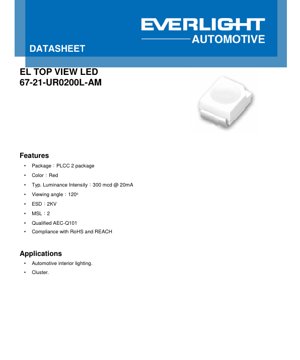
Bu belge, 67-21-UR0200L-AM model yüksek parlaklıklı kırmızı LED'in tam teknik özelliklerini sağlar. Cihaz, PLCC-2 (Plastik Leaded Chip Carrier) yüzey montaj paketini kullanır, otomotiv endüstrisi için tasarlanmış olup araç uygulamaları için gereken katı güvenilirlik ve performans standartlarını karşılar. Temel işlevi, araç kokpitindeki gösterge paneli ışık göstergeleri, iç aydınlatma ve diğer durum göstergeleri için verimli ve güvenilir kırmızı aydınlatma sağlamaktır.
The main advantage of this LED lies in its combination of performance and robustness. At a standard drive current of 20 milliamperes, its typical luminous intensity is 300 millicandelas, ensuring excellent visibility. Furthermore, it features a wide viewing angle of 120 degrees, making it suitable for application scenarios where the light source needs to be observed from multiple angles. The device is certified to the AEC-Q101 standard, which is the automotive industry benchmark test for discrete semiconductor components, ensuring it can withstand the typical harsh conditions (temperature, humidity, vibration) of the automotive environment. It is also confirmed to comply with RoHS (Restriction of Hazardous Substances) and REACH (Registration, Evaluation, Authorisation and Restriction of Chemicals) regulations.
1.1 Target Market and Applications
The primary target market for this LED is the automotive electronics sector. Its specific applications are concentrated in vehicle interiors, where requirements for reliability and long-term performance are extremely high.
- Automotive Interior Lighting:Used for map lights, dome lights, footwell illumination, and other general cabin lighting functions requiring red indication or ambient lighting.
- Dashboard:Applicable to warning lights, indicator icons, and backlighting within the dashboard. Consistent color and brightness are crucial for clearly conveying information to the driver.
2. In-depth Technical Parameter Analysis
This section provides a detailed and objective interpretation of the key electrical, optical, and thermal parameters defined in the datasheet. Understanding these values is crucial for proper circuit design and ensuring long-term reliability.
2.1 Photometry and Optical Characteristics
These parameters define the light output and color attributes of the LED.
- Luminous Intensity (IV):At IF=20mA, the typical value is 300 mcd, the minimum value is 140 mcd, and the maximum value is 450 mcd. This range accounts for normal manufacturing tolerances. The measurement tolerance for luminous flux is ±8%.
- Dominant Wavelength (λd):This defines the perceived color of red light. A typical value is 623 nanometers, with a range from 618 nanometers to 630 nanometers. The measurement tolerance is ±1 nanometer. This places the LED within the standard red spectral range.
- Viewing Angle (φ):Defined as the off-axis angle at which the luminous intensity drops to half of its peak value. This LED features a wide viewing angle of 120 degrees (tolerance ±5°), providing a broad emission pattern.
2.2 Electrical Characteristics
These parameters are critical for designing the driving circuit and ensuring the LED operates within its safe area.
- Forward Voltage (VF):At IFAt =20mA, the typical voltage drop across the LED is 2.0 volts, ranging from 1.75V to 2.75V. The forward voltage measurement tolerance is ±0.05V. This range represents 99% of production output. A current-limiting resistor or constant current driver must be used to accommodate this variation.
- Forward Current (IF):The recommended continuous operating current is 20 milliamps. The minimum current the device can withstand is 3 milliamps, with an absolute maximum of 30 milliamps. Operating above 30 milliamps risks permanent damage.
2.3 Thermal Characteristics
Managing heat is crucial for the performance and lifespan of LEDs. Excessive junction temperature reduces light output and may lead to premature failure.
- Thermal resistance (Rth JS):This parameter indicates the efficiency of heat conduction from the semiconductor junction to the solder point. Two values are given: 160 K/W (measured value) and 125 K/W (calculated by electrical method). Conservative thermal design should use the higher measured value. The lower the thermal resistance, the better, as it means heat is more easily dissipated.
- Junction Temperature (TJ):The maximum allowable temperature for the semiconductor junction is 125°C. The operating ambient temperature range is -40°C to +110°C.
- Power Dissipation (Pd):The maximum power that the device can dissipate is 82 milliwatts. This is calculated based on the maximum forward current and voltage (P = I * V).
3. Absolute Maximum Ratings
These are stress limits that must not be exceeded under any conditions, even momentarily. Operation beyond these ratings may cause permanent damage.
- Surge current (IFM):For pulses with a pulse width ≤10 microseconds and an extremely low duty cycle (D=0.005), it is 100 milliamperes. This rating pertains to withstanding brief transients.
- Reverse voltage (VR):The deviceNot designed for reverse operation.Applying reverse voltage may immediately damage the LED. If reverse voltage may occur in the circuit, protective measures must be taken (e.g., connecting a diode in parallel).
- Electrostatic Discharge (ESD):Rated at 2 kV (Human Body Model, HBM). This is a medium level of ESD protection; standard ESD handling precautions should still be followed during assembly.
- Reflow soldering temperature:During the reflow process, the package can withstand a peak temperature of 260°C for up to 30 seconds.
4. Performance Curve Analysis
The graphs in the datasheet illustrate how key parameters vary with operating conditions, providing essential data for practical design.
4.1 Forward Current vs. Forward Voltage Characteristic Curve (I-V Curve)
This basic chart shows the exponential relationship between current and voltage. For this LED, at 20 mA, the voltage is typically 2.0 volts. This curve is crucial for selecting the appropriate current-limiting resistor or designing a constant current driver. Voltage increases non-linearly with increasing current.
4.2 Relative Luminous Intensity vs. Forward Current Relationship
This graph shows that light output increases with current, but not completely linearly, especially at higher currents. It helps determine the drive current needed to achieve the desired brightness level while considering efficiency.
4.3 Temperature Dependence Curve
Three key charts show the impact of junction temperature (TJ):
- Relative luminous intensity vs. TJ:Relationship: Light output decreases with increasing temperature. This is a key consideration for applications in high-temperature environments such as automotive interiors.
- Relative forward voltage vs. TJ:Relationship: Forward voltage decreases linearly with increasing temperature (typically -2 mV/°C for red LEDs). This characteristic can sometimes be used for temperature sensing.
- Relative wavelength shift vs. TJ:Relationship: The dominant wavelength shifts slightly with temperature (typically a few nanometers), which may affect color perception in critical applications.
4.4 Forward Current Derating Curve
This is one of the most important charts for reliability. It shows the maximum allowable continuous forward current as a function of the pad temperature (TS). As the ambient/pad temperature increases, the maximum safe operating current decreases. For example, at a maximum pad temperature of 110°C, the maximum allowable continuous current is 30 milliamps. Designers must ensure the operating current stays below this derating line based on the worst-case temperature of their application.
4.5 Allowable Pulse Handling Capability
This graph defines the allowable peak pulse current for different pulse widths (tp) and duty cycles (D). It allows the LED to be driven with short, high-current pulses to achieve very high instantaneous brightness, provided the average power and junction temperature limits are not exceeded.
5. Grading System Description
Due to manufacturing tolerances, LEDs are binned according to performance. This allows customers to select devices with specific characteristics.
5.1 Luminous Intensity Grading
LEDs are grouped based on their minimum luminous intensity at 20 mA. The datasheet lists bins ranging from L1 (11.2-14 mcd) to GA (18000-22400 mcd). For the 67-21-UR0200L-AM, the typical bin is centered around 300 mcd, likely falling within the T1 (280-355 mcd) or T2 (355-450 mcd) bins. The datasheet will highlight the "possible output bin," indicating the specific intensity range available for this model.
5.2 Dominant Wavelength Binning
LEDs are also binned according to their dominant wavelength to ensure color consistency. Bins are defined in steps of 3 nm or 4 nm. For a typical wavelength of 623 nm, the relevant bins are 2124 (621-624 nm), 2427 (624-627 nm), and 2730 (627-630 nm). The specific bin for a particular order determines the exact shade of red.
6. Mechanical and Packaging Information
The device uses a standard PLCC-2 surface-mount package. This package has two leads and typically includes a molded plastic lens. Precise dimensions, including length, width, height, and lead pitch, are provided in the mechanical drawing (Section 7 of the PDF document). The recommended land pattern (Section 8) is crucial for achieving reliable solder joints and good thermal connection to the PCB. Adhering to these dimensions helps prevent tombstoning and ensures good heat dissipation.
7. Soldering and Assembly Guide
7.1 Reflow Soldering Temperature Profile
The datasheet specifies a reflow soldering profile with a peak temperature of 260°C for 30 seconds. This is a standard lead-free (SnAgCu) reflow profile. The preheating, soaking, reflow, and cooling rates should be controlled according to standard IPC/JEDEC guidelines to avoid thermal shock and ensure good solder joint formation.
7.2 Usage Precautions
General handling and design considerations include:
- ESD Protection:Use standard anti-static measures during operation and assembly.
- Current Control:Always operate LEDs using a current-limiting device (resistor or driver). Do not connect directly to a voltage source.
- Reverse Voltage Protection:Implement circuit protection if reverse bias may occur in the circuit.
- Thermal Management:When designing a PCB, sufficient copper area or thermal vias should be provided to dissipate heat, especially when operating under high current or high ambient temperature.
- Cleaning:Use appropriate cleaning solvents compatible with plastic packaging.
8. Application Design Considerations
8.1 Drive Circuit Design
The simplest driving method is to connect a resistor in series. The formula for calculating the resistance value (R) is R = (VPower supply- VF) / IF. Use the maximum V from the datasheetFValue (2.75V) to ensure that even for high VFdevices, the current does not exceed the required level. For example, using a 5V power supply with a target current of 20mA: R = (5V - 2.75V) / 0.020A = 112.5Ω (use 110Ω or 120Ω standard values). The resistor's power rating should be at least P = I2* R. For more stable brightness and efficiency, especially with temperature variations, the use of a constant current driver is recommended.
8.2 Thermal Design in Automotive Environment
Automotive interiors may experience extreme temperatures. Derating curves must be carefully applied. If LEDs are placed near heat sources (e.g., behind a sunlit dashboard), the local PCB temperature can be significantly higher than the cabin air temperature. Thermal simulation or measurement is recommended. Using a PCB with an internal ground plane connected to the LED thermal pad (if present) can greatly improve heat dissipation.
8.3 Optical Integration
A 120-degree viewing angle is suitable for wide-area illumination. For focused indicator lights, secondary optics (lenses or light guides) may be required. The plastic encapsulant material may have specific refractive index properties that should be considered when designing adjacent light pipes or diffusers.
9. Technical Comparison and Differentiation
Compared to general-purpose PLCC-2 red LEDs, the key differentiation of this model lies in itsAEC-Q101 certification和Detailed Binning InformationAEC-Q101 certification involves a series of stress tests not undergone by general-purpose components (High-Temperature Operating Life, Temperature Cycling, Moisture Resistance, etc.). This provides a higher level of confidence in long-term reliability for automotive applications. Extensive binning allows for tighter control of brightness and color consistency across production lots, which is critical for automotive dashboards where all warning lights must match.
10. Frequently Asked Questions (Based on Technical Specifications)
Q: Can I drive this LED continuously at 30 mA?
A: According to the derating curve, you can drive it continuously at 30 mA only when the pad temperature (TS) is equal to or below 30°C. At a more realistic automotive interior temperature of 85°C, the maximum continuous current is derated to approximately 22-24 mA. Always consult the derating chart for the temperature of your specific application.
Q: What is the difference between "Typical Value" and "Binning Value" luminous intensity?
A: The "Typical Value" (300 mcd) is the statistical average in the datasheet. When you place an order, you will receive products from a specificbin.(For example, T1: 280-355 mcd) devices. All LEDs in your order will have an intensity no lower than the minimum of this bin range, ensuring consistency. Typical values fall within the bin range.
Q: Why are two different values given for thermal resistance?
A: The "Measured" value (160 K/W) is obtained by direct measurement. The "Electrical" value (125 K/W) is calculated based on the temperature dependence of the forward voltage. For conservative thermal design, always use the higher "Measured" value.
Q: Is a heat sink required?
A: When operating continuously at 20mA in a moderate environment (ambient temperature ≈25°C), the power dissipation is about 40mW (20mA * 2.0V), which is below the maximum of 82mW. Typically, basic PCB pads are sufficient. However, in high-temperature automotive environments (e.g., 85°C) or at higher currents, it is necessary to improve the thermal path by using larger copper pads or thermal vias on the PCB to keep the junction temperature below 125°C.
11. Practical Design Case Analysis
Scenario:Design a red "Door Ajar" indicator light for an automotive dashboard. The LED will be driven by the vehicle's 12V system (nominal, but range can be from 9V to 16V). The expected maximum PCB temperature at the dashboard location is 85°C.
Design Steps:
- Current selection:At TS= 85°C, check the derating curve. The maximum continuous current is approximately 22 mA. To provide margin and ensure long life, select a drive current of 15 mA.
- Drive circuit:For simplicity, a series resistor is used. Use maximum VF(2.75V) and minimum supply voltage (9V during engine start) for worst-case current calculation. R = (9V - 2.75V) / 0.015A = 416.7Ω. Use a standard 430Ω resistor. Verify current at maximum supply voltage (16V): I = (16V - 1.75VMinimum forward voltage) / 430Ω = 33.1 mA. This exceeds the absolute maximum rating! Therefore, simple resistor drive is unsafe over such a wide voltage range.
- Revised Design:A linear constant current regulator or a small switching LED driver is required to maintain a stable 15 mA current over the 9V-16V input range. This ensures consistent brightness and protects the LED.
- Thermal Design:The power consumption of the LED at 15 mA is approximately 30 mW. Even at 85°C, this is well within the limits. The focus of thermal design shifts to the current regulator.
- Gear Selection:Specify a luminous intensity gear (e.g., T1) to ensure that all "door ajar" indicator lights in different vehicles have similar brightness.
12. Working Principle
This is a semiconductor light-emitting diode. When a forward voltage exceeding its characteristic threshold voltage (approximately 1.8V for a red LED) is applied, electrons and holes recombine within the semiconductor active region (for red light, typically made of aluminum indium gallium phosphide material). This recombination process releases energy in the form of photons (light). The specific composition of the semiconductor layers determines the wavelength (color) of the emitted light. The plastic PLCC package protects the semiconductor chip, provides mechanical protection, and includes a molded lens that shapes the light output to achieve a 120-degree viewing angle.
13. Technical Trends
The trend in automotive LEDs is towards higher efficiency (more lumens per watt), thereby reducing power consumption and thermal load. This enables brighter displays or lower energy consumption. Simultaneously, packaging is moving towards miniaturization while maintaining or increasing light output. Furthermore, as automotive displays become more sophisticated and high-end, the demand for stricter color and brightness consistency (narrower binning) is increasing. Integrating driver electronics and multiple LED chips into a single intelligent module is another ongoing trend, which simplifies design for automotive manufacturers.
Detailed Explanation of LED Specification Terminology
Complete Explanation of LED Technical Terms
I. Core Indicators of Photoelectric Performance
| Terminology | Unit/Representation | Layman's Explanation | Why is it important |
|---|---|---|---|
| Luminous Efficacy | lm/W | The luminous flux emitted per watt of electrical power; the higher the value, the more energy-efficient. | It directly determines the energy efficiency rating and electricity cost of the luminaire. |
| Luminous Flux | lm (lumen) | The total amount of light emitted by a light source, commonly known as "brightness". | Determines whether the luminaire is bright enough. |
| Viewing Angle | ° (degree), e.g., 120° | The angle at which light intensity drops to half, determining the beam width. | Affects the illumination range and uniformity. |
| Color Temperature (CCT) | K (Kelvin), e.g., 2700K/6500K | The color temperature of light: lower values lean yellow/warm, higher values lean white/cool. | Determines the lighting ambiance and suitable application scenarios. |
| Color Rendering Index (CRI / Ra) | Unitless, 0–100 | The ability of a light source to reproduce the true colors of objects, with Ra≥80 being preferable. | Affects color fidelity, used in high-demand places such as shopping malls and art galleries. |
| Color tolerance (SDCM) | MacAdam ellipse steps, such as "5-step" | A quantitative metric for color consistency; a smaller step number indicates better color consistency. | Ensure no color variation among luminaires from the same batch. |
| Dominant Wavelength | nm (nanometer), e.g., 620nm (red) | The wavelength value corresponding to the color of a colored LED. | Determines the hue of monochromatic LEDs such as red, yellow, and green. |
| Spectral Distribution | Wavelength vs. Intensity curve | Shows the intensity distribution of light emitted by an LED at various wavelengths. | Affects color rendering and color quality. |
II. Electrical Parameters
| Terminology | Symbol | Layman's Explanation | Design Considerations |
|---|---|---|---|
| Forward Voltage (Forward Voltage) | Vf | The minimum voltage required to light up an LED, similar to a "starting threshold". | The driving power supply voltage must be ≥ Vf, and the voltages add up when multiple LEDs are connected in series. |
| Forward Current | If | The current value that makes the LED emit light normally. | Constant current drive is often used, as the current determines brightness and lifespan. |
| Maximum Pulse Current | Ifp | Peak current that can be withstood for a short period of time, used for dimming or flashing. | Pulse width and duty cycle must be strictly controlled, otherwise overheating damage will occur. |
| Reverse Voltage | Vr | Maximum reverse voltage an LED can withstand; exceeding it may cause breakdown. | Reverse connection or voltage surges must be prevented in the circuit. |
| Thermal Resistance | Rth (°C/W) | The resistance to heat flow from the chip to the solder joint. A lower value indicates better heat dissipation. | High thermal resistance requires a stronger heat dissipation design, otherwise the junction temperature will increase. |
| Electrostatic Discharge Immunity (ESD Immunity) | V (HBM), such as 1000V | Electrostatic discharge immunity, higher value indicates greater resistance to electrostatic damage. | Anti-static measures must be implemented during production, especially for high-sensitivity LEDs. |
III. Thermal Management and Reliability
| Terminology | Key Indicators | Layman's Explanation | Impact |
|---|---|---|---|
| Junction Temperature | Tj (°C) | The actual operating temperature inside the LED chip. | For every 10°C reduction, the lifespan may double; excessively high temperatures lead to lumen depreciation and color shift. |
| Lumen Depreciation | L70 / L80 (hours) | The time required for the brightness to drop to 70% or 80% of its initial value. | Directly define the "service life" of an LED. |
| Lumen Maintenance | % (e.g., 70%) | The percentage of remaining brightness after a period of use. | Characterizes the ability to maintain brightness after long-term use. |
| Color Shift | Δu′v′ or MacAdam Ellipse | The degree of color change during use. | Affects the color consistency of the lighting scene. |
| Thermal Aging | Material performance degradation | Degradation of packaging materials due to prolonged high temperatures. | May lead to decreased brightness, color shift, or open-circuit failure. |
IV. Packaging and Materials
| Terminology | Common Types | Layman's Explanation | Features and Applications |
|---|---|---|---|
| Package Type | EMC, PPA, Ceramic | The housing material that protects the chip and provides optical and thermal interfaces. | EMC offers good heat resistance and low cost; ceramics provide superior heat dissipation and long lifespan. |
| Chip Structure | Face-up, Flip Chip | Chip Electrode Layout Method. | Flip-chip offers better heat dissipation and higher luminous efficacy, suitable for high-power applications. |
| Phosphor coating | YAG, silicate, nitride | Covered on the blue light chip, partially converted into yellow/red light, mixed into white light. | Different phosphors affect luminous efficacy, color temperature, and color rendering. |
| Lens/Optical Design | Flat, microlens, total internal reflection | The optical structure on the encapsulation surface controls the distribution of light. | It determines the light emission angle and the light distribution curve. |
V. Quality Control and Binning
| Terminology | Grading Content | Layman's Explanation | Purpose |
|---|---|---|---|
| Luminous flux binning | Codes such as 2G, 2H | Grouped by brightness level, each group has a minimum/maximum lumen value. | Ensure consistent brightness within the same batch of products. |
| Voltage binning | Codes such as 6W, 6X | Group by forward voltage range. | Facilitates driver power matching and improves system efficiency. |
| Color binning | 5-step MacAdam ellipse | Group by color coordinates to ensure colors fall within an extremely narrow range. | Ensure color consistency to avoid uneven color within the same luminaire. |
| Color temperature binning | 2700K, 3000K, etc. | Group by color temperature, each group has a corresponding coordinate range. | To meet the color temperature requirements of different scenarios. |
VI. Testing and Certification
| Terminology | Standard/Test | Layman's Explanation | Meaning |
|---|---|---|---|
| LM-80 | Lumen Maintenance Test | Long-term operation under constant temperature conditions, recording brightness attenuation data. | Used to estimate LED lifetime (combined with TM-21). |
| TM-21 | Lifetime projection standard | Life estimation under actual operating conditions based on LM-80 data. | Provide scientific life prediction. |
| IESNA standard | Illuminating Engineering Society Standard | Covers optical, electrical, and thermal test methods. | Industry-recognized testing basis. |
| RoHS / REACH | Environmental certification. | Ensure products do not contain harmful substances (e.g., lead, mercury). | Entry requirements for the international market. |
| ENERGY STAR / DLC | Energy Efficiency Certification | Energy efficiency and performance certification for lighting products. | Commonly used in government procurement and subsidy programs to enhance market competitiveness. |