Table of Contents
- 1. Product Overview
- 2. In-depth Technical Parameter Analysis
- 2.1 Absolute Maximum Ratings
- 2.2 Electro-Optical Characteristics
- 3. Performance Curve Analysis
- 3.1 Spectral Sensitivity
- 3.2 Relationship Between Dark Current and Ambient Temperature
- 3.3 Relationship Between Reverse Photocurrent and Irradiance (Ee)
- 3.4 Relationship Between Terminal Capacitance and Reverse Voltage
- 3.5 Relationship Between Response Time and Load Resistance
- 3.6 Relationship Between Power Consumption and Ambient Temperature
- 4. Mechanical and Packaging Information
- 4.1 Package Dimensions
- 4.2 Polarity Identification
- 5. Welding and Assembly Guide
- 6. Packaging and Ordering Information
- 6.1 Packaging Specifications
- 6.2 Label Specifications
- 7. Application Notes and Design Considerations
- 7.1 Typical Application Circuit
- 7.2 Design Considerations
- 8. Technical Comparison and Differentiation
- 9. Frequently Asked Questions (FAQ)
- 10. How It Works
- 11. Disclaimer and Usage Instructions
1. Product Overview
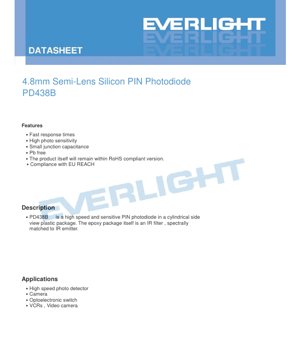
PD438B is a high-performance silicon PIN photodiode designed for applications requiring fast response and high infrared light sensitivity. It features a compact cylindrical side-view plastic package with a diameter of 4.8 mm. A key characteristic of this device is its epoxy encapsulation, formulated to act as an integrated infrared (IR) filter. This built-in filter is spectrally matched to common IR emitters, enhancing the signal-to-noise ratio by selectively transmitting the target infrared wavelengths while attenuating unwanted visible light.
The core advantages of PD438B include its fast response time, high photosensitivity, and low junction capacitance, making it suitable for high-speed detection circuits. The device is manufactured using lead-free materials and complies with relevant environmental regulations such as RoHS and EU REACH, ensuring its suitability for modern electronic manufacturing.
The primary target markets and application areas for this photodiode are consumer electronics and industrial sensing. It is highly suitable for use as a high-speed photodetector in systems such as cameras, video recorders, and camcorders. Its characteristics also make it a reliable component in various photoelectric switches and sensing modules, where precise detection of infrared signals is crucial.
2. In-depth Technical Parameter Analysis
2.1 Absolute Maximum Ratings
This device is designed to operate reliably within the specified environmental and electrical limits. Exceeding these absolute maximum ratings may cause permanent damage.
- Reverse Voltage (VR):32 V. This is the maximum reverse bias voltage that can be applied across the photodiode pins.
- Power Dissipation (Pd):150 mW. This rating considers the total power the device can handle, primarily from the reverse leakage current under bias.
- Operating Temperature (Topr):-40°C to +85°C. The temperature range over which the photodiode performance is guaranteed during normal operation.
- Storage Temperature (Tstg):-40°C to +100°C. The safe temperature range for the device when not powered.
- Soldering temperature (Tsol):Maximum 260°C, duration not exceeding 5 seconds. This defines the reflow soldering temperature profile limit to prevent package damage.
2.2 Electro-Optical Characteristics
These parameters, measured at the standard temperature of 25°C, define the core photodetection performance of the PD438B.
- Spectral Bandwidth (λ0.5):400 nm to 1100 nm. This defines the wavelength range over which the photodiode responsivity is at least half of its peak value. It confirms sensitivity from visible blue light to near-infrared.
- Peak Sensitivity Wavelength (λp):940 nm (typical). The photodiode is most sensitive to infrared light at this wavelength, which is a standard wavelength for many infrared LEDs and remote control systems.
- Open-Circuit Voltage (VOC):0.35 V (typical) at 940 nm wavelength, 5 mW/cm² irradiance (Ee). This is the voltage generated by the photodiode in photovoltaic mode (no external bias) under the specified illumination conditions.
- Short-circuit current (ISC):18 µA (typical) at 940 nm wavelength, 1 mW/cm² irradiance. This is the photocurrent generated when the diode terminals are shorted, representing its maximum current output at the given illumination level.
- Reverse photocurrent (IL):18 µA (typical) at 940nm wavelength, 1 mW/cm² irradiance, VR=5V. This is the photocurrent measured when the diode is reverse biased, which is the standard operating mode for high-speed and linear response.
- Dark current (Id):Under complete darkness, VR=10V condition, it is 5 nA (typical), 30 nA (maximum). This is the small leakage current that flows even when there is no light. Low dark current is crucial for detecting weak optical signals.
- Reverse Breakdown Voltage (BVR):170 V (typical), 32 V (minimum). The voltage at which the reverse current increases sharply. The operating reverse voltage should always be well below this value.
- Total Capacitance (Ct):25 pF (typical) at VR=3V, 1 MHz. This junction capacitance directly affects the device's speed; lower capacitance enables faster response times.
- Rise/Fall Time (tr/tf):50 ns / 50 ns (typical) at VR=10V, load resistance (RL) of 1 kΩ. These parameters specify how fast the photodiode's output current responds to changes in light pulses, defining its high-speed capability.
Tolerances for key parameters have been specified: luminous intensity (±10%), dominant wavelength (±1nm), and forward voltage (±0.1V) to ensure consistency across production batches.
3. Performance Curve Analysis
The datasheet provides several characteristic curves illustrating how key parameters vary with operating conditions. These are crucial for circuit designers.
3.1 Spectral Sensitivity
The spectral response curve shows the relative sensitivity of the photodiode at different wavelengths. Due to the integrated infrared-filtering epoxy, its peak will appear sharply around 940 nm, while sensitivity in the visible spectrum (400-700 nm) is significantly reduced. This curve is essential for ensuring wavelength matching between the detector and emitter.
3.2 Relationship Between Dark Current and Ambient Temperature
This curve typically shows that the dark current (Id) increases exponentially with rising ambient temperature. Designers must account for this increased noise floor in high-temperature applications or when detecting extremely weak optical signals.
3.3 Relationship Between Reverse Photocurrent and Irradiance (Ee)
This graph illustrates the linear relationship between incident optical power (irradiance) and the generated photocurrent (IL) when the diode is reverse-biased. Linearity is a key characteristic of PIN photodiodes, making them suitable for optical measurement applications.
3.4 Relationship Between Terminal Capacitance and Reverse Voltage
Junction capacitance (Ct) decreases as reverse bias voltage (VR) increases. This curve allows designers to select the operating bias voltage to optimize the trade-off between speed (lower capacitance at higher voltage) and power consumption/heat.
3.5 Relationship Between Response Time and Load Resistance
Rise/fall time (tr/tf) is influenced by the RC time constant formed by the photodiode junction capacitance and the external load resistance (RL). This curve shows how response time increases with larger load resistance, guiding the selection of RL in transimpedance amplifier circuits to achieve the desired speed.
3.6 Relationship Between Power Consumption and Ambient Temperature
This derating curve indicates the maximum allowable power dissipation as a function of ambient temperature. As temperature increases, the maximum power the device can safely handle decreases linearly, which is crucial for thermal management in system design.
4. Mechanical and Packaging Information
4.1 Package Dimensions
The PD438B employs a cylindrical side-view package with a nominal diameter of 4.8 mm. The detailed mechanical drawing in the datasheet provides all critical dimensions, including body diameter, length, lead pitch, and lead diameter. Unless otherwise specified, the standard tolerance for all package dimensions is ±0.25 mm. The side-view configuration is specifically designed for applications where the optical path is parallel to the PCB surface.
4.2 Polarity Identification
Photodiode abu ne mai polariti. Ana gane cathode yawanci ta hanyar mafi tsayin ƙafa, fili akan kunshe, ko alama ta musamman. Zanen kunshe a cikin takardar ƙayyadaddun bayanai yana nuna haɗin anode da cathode a sarari, waɗannan alamomin dole ne a bi su yayin haɗawa, don tabbatar da daidaitaccen bias (bisa kishiyawa yana buƙata don aiki daidai).
5. Welding and Assembly Guide
To maintain reliability and prevent damage during assembly, specific welding conditions must be followed.
- Reflow soldering:This component is suitable for surface mount assembly using reflow soldering technology. The peak soldering temperature must not exceed 260°C, and the time above this temperature should be limited to 5 seconds or less to prevent thermal damage to the epoxy package and semiconductor chip.
- Hand soldering:If hand soldering is necessary, a temperature-controlled soldering iron should be used. Contact time with the leads should be minimized, and it is recommended to use a heat sink on the lead between the solder joint and the package body.
- Storage Conditions:The device should be stored in its original moisture barrier bag. The storage environment should be controlled within a temperature range of -40°C to +100°C and maintain low humidity to prevent pin oxidation.
6. Packaging and Ordering Information
6.1 Packaging Specifications
The standard packaging process for PD438B is as follows: 500 pieces are packed in one anti-static bag. Six such bags are placed into an inner box. Finally, ten inner boxes are loaded into a master shipping (outer) carton, totaling 30,000 pieces per master carton.
6.2 Label Specifications
The label on the packaging contains several key identifiers:
- CPN:Customer Product Number (if assigned).
- P/N:Manufacturer Part Number (PD438B).
- QTY:The quantity of devices inside the package.
- CAT, HUE, REF:Codes representing luminous intensity grade, dominant wavelength grade, and forward voltage grade, respectively, applicable to binned products.
- LOT No:Nambari na rukunin samfurin da za a iya gano asalinsa.
7. Application Notes and Design Considerations
7.1 Typical Application Circuit
PD438B is most commonly used in one of the following two circuit configurations:
- Photovoltaic Mode (Zero Bias):Photodiode is directly connected to a high-impedance load (such as an op-amp input). This mode provides minimal dark current and noise but has slower response and lower linearity. Suitable for low-speed, precise optical measurements.
- Photoconductive mode (reverse bias):The photodiode is connected with the cathode to a positive voltage and the anode to a virtual ground (e.g., the inverting input of a transimpedance amplifier). This is the recommended mode for PD438B to leverage its high-speed capability. Reverse bias reduces junction capacitance (increasing speed) and improves linearity. The feedback resistor value in the transimpedance amplifier sets the gain (Vout = Iphoto * Rfeedback).
7.2 Design Considerations
- Bias Voltage Selection:Select a reverse bias voltage (e.g., 5V to 10V) to achieve a good balance between speed (lower capacitance) and power consumption. Do not exceed the maximum reverse voltage of 32V.
- Amplifier Selection:For high-speed applications, pair the PD438B with a low-noise, high-bandwidth operational amplifier configured as a transimpedance amplifier. The amplifier should have low input bias current and voltage noise to avoid degrading the photodiode's signal quality.
- PCB Layout:Place the photodiode and its associated amplifier close together to minimize parasitic capacitance and noise pickup on sensitive high-impedance nodes. Use a guard ring connected to a low-impedance point (such as the amplifier output or ground plane) around the photodiode's anode connection to reduce leakage current.
- Optical Alignment:Ensure proper mechanical alignment between the infrared emitter and photodiode. Side-view packages are specifically designed for this. Consider using tubes or barriers to block ambient light and crosstalk.
8. Technical Comparison and Differentiation
PD438B distinguishes itself in the market through the following key features:
- Integrated infrared filter:The epoxy package itself acts as a filter, eliminating the need for a separate filter component, which reduces part count, cost, and simplifies assembly.
- Side-view package:The cylindrical side-look form factor is ideal for applications where the optical path is parallel to the PCB, such as slot sensors, edge detection systems, and certain types of encoders.
- Balanced Performance:It offers a balanced combination of speed (50 ns), sensitivity (18 µA at 1 mW/cm²), and low dark current, making it a versatile choice for a wide range of medium-to-high-speed infrared detection tasks.
- Environmental Compliance:Its lead-free structure and compliance with RoHS and REACH regulations make it suitable for global markets with stringent environmental regulations.
9. Frequently Asked Questions (FAQ)
Q1: What is the purpose of the black epoxy lens?
A1: The black epoxy is not just for appearance; its formulation makes it an effective infrared filter. It transmits the target infrared wavelength (peak at 940 nm) while absorbing most visible light, significantly reducing interference from ambient light sources such as indoor lighting.
Q2: Should I operate the PD438B with or without a reverse bias voltage?
A2: Don aiki mai sauri (kamar yadda aka nuna lokacin tashi na 50 ns), ana ba da shawarar sosai yin amfani da aikin karkata baya a yanayin photoconductive don sarrafa PD438B, yawanci ƙarfin lantarki mai karkata tsakanin 5V zuwa 10V. Wannan yana rage ƙarfin capacitor na haɗin gwiwa, kuma yana inganta daidaito da sauri.
Q3: Ta yaya za a canza ƙarfin lantarki na haske zuwa siginar ƙarfin lantarki mai amfani?
A3: Hanya mafi yawanci kuma mai inganci ita ce amfani da da'irar amplifier mai jujjuyawa (TIA). Ana haɗa photodiode tsakanin shigarwar juzu'i da fitarwar amplifier na aiki, resistor na amsawa yana ƙayyade riba (Vout = -Iphoto * Rf). Yawanci, ana haɗa ƙaramin capacitor na amsawa a kan resistor don daidaita da'ira da iyakance bandwidth.
Q4: What is the significance of the "dark current" parameter?
A4: Dark current is the small current that flows through a photodiode when it is in complete darkness and under reverse bias. It acts as a noise source. A lower dark current (5 nA typical for PD438B) means the device can detect weaker optical signals without the signal being obscured by its own noise.
Q5: Can this photodiode be used for visible light detection?
A5: Although its spectral range starts from 400 nm (violet), its sensitivity in the visible spectrum is greatly attenuated by the infrared filter epoxy lens. Its peak sensitivity is clearly located in the infrared region at 940 nm. For primary visible light detection, using a photodiode without infrared filter packaging would be more appropriate.
10. How It Works
A PIN photodiode is a semiconductor device with a wide, lightly doped intrinsic (I) region sandwiched between P-type and N-type regions. When photons with energy greater than the semiconductor bandgap strike the device, they generate electron-hole pairs in the intrinsic region. Under the influence of an applied reverse bias electric field, these charge carriers are separated, producing a photocurrent proportional to the intensity of the incident light. The wide intrinsic region offers several advantages: it creates a larger depletion region for photon absorption (increasing sensitivity), reduces junction capacitance (increasing speed), and allows operation at higher reverse voltages. The PD438B uses silicon material, whose bandgap is suitable for detecting light from the visible to near-infrared spectrum.
11. Disclaimer and Usage Instructions
Information in this technical document is subject to change without notice. The provided charts and typical values are for design reference only and do not represent guaranteed specifications. When implementing this component, designers must strictly adhere to absolute maximum ratings to prevent device failure. The manufacturer assumes no responsibility for any damage resulting from the use of this product outside its specified operating conditions. Without prior consultation and specific certification, this product is not intended for safety-critical, life-support, military, automotive, or aerospace applications.
Detailed Explanation of LED Specification Terminology
Complete Interpretation of LED Technical Terminology
I. Core Indicators of Photoelectric Performance
| Terminology | Unit/Representation | Popular Explanation | Why It Matters |
|---|---|---|---|
| Luminous Efficacy | lm/W (lumens per watt) | The luminous flux emitted per watt of electrical power; higher values indicate greater energy efficiency. | It directly determines the energy efficiency rating of the luminaire and the electricity cost. |
| Luminous Flux | lm (lumen) | The total amount of light emitted by a light source, commonly known as "brightness". | Determines whether the luminaire is bright enough. |
| Viewing Angle | ° (degree), e.g., 120° | The angle at which luminous intensity drops to half, determining the beam width. | Affects the range and uniformity of illumination. |
| Correlated Color Temperature (CCT) | K (Kelvin), such as 2700K/6500K | Haske launin dumi da sanyi, ƙananan ƙima sun karkata zuwa rawaya/dumi, manyan ƙima sun karkata zuwa fari/sanyi. | Yana ƙayyade yanayin hasken wuta da kuma yanayin da ya dace. |
| Color Rendering Index (CRI / Ra) | Unitless, 0–100 | The ability of a light source to reproduce the true colors of objects, with Ra≥80 being preferable. | Affects color fidelity, used in high-demand places such as shopping malls and art galleries. |
| Color tolerance (SDCM) | MacAdam ellipse step, such as "5-step" | A quantitative metric for color consistency; a smaller step number indicates better color consistency. | Ensure no color variation among luminaires from the same batch. |
| Dominant Wavelength | nm (nanometer), e.g., 620nm (red) | Wavelength values corresponding to the colors of colored LEDs. | Determines the hue of monochromatic LEDs such as red, yellow, and green. |
| Spectral Distribution | Wavelength vs. Intensity Curve | Shows the intensity distribution of light emitted by an LED at each wavelength. | Affects color rendering and color quality. |
II. Electrical Parameters
| Terminology | Symbol | Popular Explanation | Design Considerations |
|---|---|---|---|
| Forward Voltage (Forward Voltage) | Vf | The minimum voltage required to light up an LED, similar to a "starting threshold". | The driving power supply voltage must be ≥ Vf; voltages add up when multiple LEDs are connected in series. |
| Forward Current | If | The current value that makes the LED emit light normally. | Constant current drive is often used, as the current determines brightness and lifespan. |
| Maximum Pulse Current | Ifp | The peak current that can be withstood for a short period of time, used for dimming or flashing. | Pulse width and duty cycle must be strictly controlled, otherwise overheating damage will occur. |
| Reverse Voltage | Vr | Maximum reverse voltage that an LED can withstand; exceeding it may cause breakdown. | Reverse connection or voltage surges must be prevented in the circuit. |
| Thermal Resistance (Thermal Resistance) | Rth (°C/W) | The resistance to heat flow from the chip to the solder joint. A lower value indicates better heat dissipation. | High thermal resistance requires stronger heat dissipation design, otherwise junction temperature rises. |
| Electrostatic Discharge Immunity (ESD Immunity) | V (HBM), e.g., 1000V | Electrostatic discharge immunity; a higher value indicates greater resistance to electrostatic damage. | Anti-static measures must be implemented during production, especially for high-sensitivity LEDs. |
III. Thermal Management and Reliability
| Terminology | Key Indicators | Popular Explanation | Impact |
|---|---|---|---|
| Junction Temperature | Tj (°C) | The actual operating temperature inside the LED chip. | For every 10°C reduction, the lifespan may double; excessively high temperatures cause lumen depreciation and color shift. |
| Lumen Depreciation | L70 / L80 (hours) | The time required for the brightness to drop to 70% or 80% of its initial value. | Directly define the "useful life" of an LED. |
| Lumen Maintenance | % (e.g., 70%) | The percentage of remaining brightness after a period of use. | Characterizes the ability to maintain brightness after long-term use. |
| Color Shift | Δu′v′ or MacAdam ellipse | The degree of color change during use. | Affects the color consistency of the lighting scene. |
| Thermal Aging | Material performance degradation | Degradation of packaging materials due to long-term high temperature. | Zai iya haifar da raguwar haske, canjin launi ko gazawar bude hanya. |
IV. Kullewa da Kayan aiki
| Terminology | Nau'o'in da aka saba gani | Popular Explanation | Characteristics and Applications |
|---|---|---|---|
| Package Types | EMC, PPA, Ceramic | The housing material that protects the chip and provides optical and thermal interfaces. | EMC offers good heat resistance and low cost; ceramic provides superior heat dissipation and long lifespan. |
| Chip Structure | Front-side, Flip Chip | Chip electrode arrangement method. | Flip-chip offers better heat dissipation and higher luminous efficacy, suitable for high-power applications. |
| Phosphor coating. | YAG, silicate, nitride | Coated on the blue LED chip, partially converted to yellow/red light, mixed to form white light. | Different phosphors affect luminous efficacy, color temperature, and color rendering. |
| Lens/Optical Design | Flat, microlens, total internal reflection | Optical structure on the packaging surface, controlling light distribution. | Determines the emission angle and light distribution curve. |
V. Quality Control and Grading
| Terminology | Grading Content | Popular Explanation | Purpose |
|---|---|---|---|
| Luminous Flux Binning | Codes such as 2G, 2H | Group by brightness level, each group has a minimum/maximum lumen value. | Ensure consistent brightness for products in the same batch. |
| Voltage binning | Codes such as 6W, 6X | Grouped by forward voltage range. | Facilitates driver power matching and improves system efficiency. |
| Color binning | 5-step MacAdam ellipse | Group by color coordinates to ensure colors fall within an extremely small range. | Ensure color consistency to avoid color unevenness within the same luminaire. |
| Color temperature grading | 2700K, 3000K, etc. | Group by color temperature, each group has a corresponding coordinate range. | Meet the color temperature requirements of different scenarios. |
VI. Testing and Certification
| Terminology | Standard/Test | Popular Explanation | Meaning |
|---|---|---|---|
| LM-80 | Lumen Maintenance Test | Long-term operation under constant temperature conditions, recording luminance attenuation data. | For estimating LED lifetime (in conjunction with TM-21). |
| TM-21 | Lifetime projection standard | Projecting lifespan under actual use conditions based on LM-80 data. | Providing scientific life prediction. |
| IESNA Standard | Illuminating Engineering Society Standard | Covers optical, electrical, and thermal test methods. | Industry-recognized testing basis. |
| RoHS / REACH | Environmental Certification | Ensure the product does not contain harmful substances (e.g., lead, mercury). | Entry requirements for the international market. |
| ENERGY STAR / DLC | Energy efficiency certification | Energy efficiency and performance certification for lighting products. | Commonly used in government procurement and subsidy programs to enhance market competitiveness. |