Table of Contents
- 1. Product Overview
- 1.1 Core Advantages and Target Market
- 2. In-depth Analysis of Technical Parameters
- 2.1 Absolute Maximum Ratings
- 2.2 Electro-Optical Characteristics
- 3. Grading System Description
- 4. Performance Curve Analysis
- 4.1 Spectral Distribution
- 4.2 Forward Current vs. Forward Voltage (IV Curve)
- 4.3 Forward Current Derating Curve
- 5. Mechanical and Packaging Information
- 5.1 Package Dimensions and Drawings
- 5.2 Internal Circuit Diagram and Polarity
- 6. Soldering and Assembly Guide
- 7. Packaging and Ordering Information
- 7.1 Packaging Specifications
- 7.2 Label Description
- 8. Shawarwarin Zane na Aikace-aikace
- 8.1 Da'irar Aikace-aikace ta Al'ada
- 8.2 Tunani da Abubuwan Lura na Zane
- 9. Kwatancen Fasaha da Bambanci
- 10. Frequently Asked Questions (Based on Technical Parameters)
- 11. Practical Application Examples
- 12. Introduction to Working Principles
- 13. Technical Trends and Background
- Detailed Explanation of LED Specification Terminology
- I. Core Indicators of Photoelectric Performance
- II. Electrical Parameters
- III. Thermal Management and Reliability
- IV. Packaging and Materials
- V. Quality Control and Binning
- VI. Testing and Certification
1. Product Overview
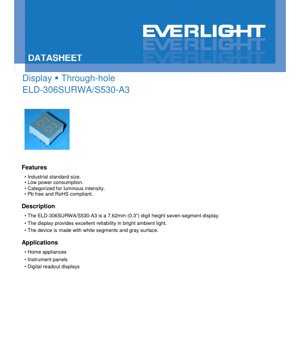
This document details the technical specifications of a 7.62 mm (0.3 inch) character height seven-segment display. The device features a through-hole mounting design, with white luminous segments and a grey background surface. This combination provides high contrast and excellent readability, making it ideally suited for applications requiring clear display of numeric or limited alphanumeric information under various lighting conditions.
1.1 Core Advantages and Target Market
The core advantages of this display include its industry-standard dimensions, ensuring compatibility with existing panel cutouts and designs. It features low power consumption, contributing to energy-efficient end products. The devices are binned for luminous intensity, ensuring consistent brightness across multiple units in an assembly. Furthermore, it is manufactured using lead-free materials and complies with the RoHS directive, meeting modern environmental and regulatory standards.
Its target applications are broad, including household appliances, various instrument panels, and general-purpose digital readout displays. Its reliability under bright ambient light makes it a robust choice for both consumer and industrial interfaces.
2. In-depth Analysis of Technical Parameters
This section provides a detailed and objective analysis of the device's electrical, optical, and thermal characteristics based on its absolute maximum ratings and typical operating parameters.
2.1 Absolute Maximum Ratings
These ratings define the limiting conditions beyond which permanent damage to the device may occur; they are not normal operating conditions.
- Reverse Voltage (VR):5V. Exceeding this reverse voltage may cause junction breakdown.
- Continuous Forward Current (IF):25mA. This is the maximum DC current that can be continuously passed through an LED segment.
- Peak Forward Current (IFP):60mA. Wannan babban ƙarfin yana ba da izini ne kawai a cikin yanayin bugun jini, musamman ma a cikin rabon aiki 1/10, mitar 1kHz. Yana ba da damar samun haske mafi girma a cikin ɗan gajeren lokaci, misali a cikin nunin turawa mai yawa.
- Amfani da wutar lantarki (Pd):60mW. Wannan shine matsakaicin ƙarfin da na'urar za ta iya ɓata a matsayin zafi, wanda aka lissafta shi da ƙarfin lantarki na gaba (VF) wanda aka ninka da ƙarfin lantarki na gaba (IF).
- Yanayin aiki (Topr):-40°C zuwa +85°C. Tabbatar da cewa na'urar tana aiki da kyau a cikin wannan kewayon zafin yanayi.
- Yanayin ajiya (Tstg):-40°C to +100°C. The device can be stored in this wider range under non-operating conditions.
- Soldering temperature (Tsol):Maximum 260°C, duration not exceeding 5 seconds. This parameter defines the temperature profile limit for wave soldering or reflow soldering to prevent damage to the plastic package and internal bonding.
2.2 Electro-Optical Characteristics
These parameters are measured at a standard ambient temperature of 25°C, defining the typical performance of the device under normal operating conditions.
- Luminous intensity (Iv):When forward current (IFWhen the current is 10mA, the typical value per segment is 6.4 millicandelas. The specified minimum value is 4.0 mcd. The datasheet notes a tolerance of ±10% for this parameter. This value is the average measured from a representative 7-segment character.
- Peak Wavelength (λp):At IF=20mA, the typical value is 632 nanometers. This is the wavelength at which the emitted white light spectral power distribution reaches its maximum. The white color is achieved by using an AlGaInP chip material (for red/orange emission) combined with a white diffusing resin, which may contain phosphors to broaden the spectrum.
- Dominant Wavelength (λd):At IF=20mA, the typical value is 624 nm. This is the wavelength of monochromatic light that most closely matches the perceived color of the light source. The difference between the peak wavelength and the dominant wavelength indicates that the spectral shape is not perfectly symmetrical.
- Spectral Radiant Bandwidth (Δλ):Typical value 20 nm. This parameter quantifies the width of the emission spectrum at half of its maximum power (Full Width at Half Maximum - FWHM).
- Forward Voltage (VF):Typical value 2.0V, with a maximum of 2.4V at IF=20mA. A tolerance of ±0.1V is noted. This parameter is crucial for designing current-limiting circuits (typically a series resistor).
- Reverse Current (IR):at a Reverse Bias Voltage (VR) of 5V, maximum 100 µA. This is the small leakage current that flows when the device is reverse-biased within its maximum ratings.
3. Grading System Description
The datasheet indicates the device is "binned by luminous intensity." This refers to a post-manufacturing sorting or classification process. Due to natural variations in semiconductor fabrication and assembly, the performance of individual LEDs will differ slightly. To ensure consistency for end users, the manufacturer measures the light output of each unit and classifies them into groups with tight tolerances around a target value (e.g., 6.4 mcd ±10%). This allows designers to procure displays where all digits in a multi-digit numeric assembly have uniform brightness, which is crucial for aesthetics and readability. Specific binning codes or categories may be detailed in separate ordering information.
4. Performance Curve Analysis
The datasheet references typical performance curves, which graphically show how key parameters vary with operating conditions.
4.1 Spectral Distribution
The spectral distribution curve (at Ta=25°C) will show the relative luminous intensity versus wavelength (λp, unit is nm). For this white LED display, the curve will not be a single narrow peak but a broader spectrum, with a peak around 632 nm due to the underlying AlGaInP chip. The phosphor in the white diffusing resin provides additional emission at other wavelengths, resulting in a white appearance. The 20 nm bandwidth indicates the width of the main emission peak.
4.2 Forward Current vs. Forward Voltage (IV Curve)
This curve plots forward current (IF, unit is mA) versus forward voltage (VF, unit is V) at 25°C. It demonstrates the exponential relationship characteristic of a diode. This curve is crucial for understanding the dynamic resistance of the LED and for designing precise constant current drivers, especially for applications requiring dimming or precise brightness control. The typical VFvalue of 2.0V at 20mA is a point on this curve.
4.3 Forward Current Derating Curve
This is a key chart for thermal management. It plots the maximum allowable continuous forward current (IFThe relationship between current (unit: mA) and ambient temperature (°C). As the ambient temperature increases, the internal junction temperature of the LED also rises. To prevent overheating, accelerated light degradation, or failure, the maximum allowable current must be reduced. This curve provides the derating factor, showing how much the 25mA rated value must be reduced for reliable operation at high temperatures (up to 85°C operating temperature).
5. Mechanical and Packaging Information
5.1 Package Dimensions and Drawings
The device uses a standard through-hole DIP package style. The package dimension drawing provides all key mechanical dimensions: overall height, width, and length; digit window size and position; pin pitch, diameter, and length; and mounting plane. The drawing specifies a general tolerance of ±0.25mm (unless otherwise noted), with all dimensions in millimeters. Accurate interpretation of this drawing is necessary for designing the PCB footprint, panel cutouts, and ensuring proper alignment and installation.
5.2 Internal Circuit Diagram and Polarity
The datasheet contains an internal circuit diagram. For the common-cathode seven-segment display (implied by the application), this diagram shows all eight LEDs (segments a through g, plus the decimal point DP), with their anodes connected to individual pins and their cathodes internally connected to a common pin (or two internally connected pins). This diagram is crucial for correctly connecting the display. The pinout defining which pin controls which segment and the common connection is provided in this section or the dimension drawing. Incorrect connection may cause the display not to light or result in permanent damage.
6. Soldering and Assembly Guide
Madaidaicin sigogin haɗin da aka bayar shine matsakaicin zafin haɗi na 260°C, tsawon lokacin da bai wuce dakika 5 ba. Wannan ya dace da tsarin haɗin igiyar igiyar ruwa. Don haɗin hannu ta amfani da ƙarfe mai zafi, ya kamata a kula don rage tsawon lokacin bayyanar zafi ga kowane ƙugiya, don hana narkewar kayan rufi na filastik ko lalata igiyar haɗin ciki. Kafin amfani, ya kamata a adana na'urar a cikin yanayin bushewa a cikin ƙayyadaddun kewayon -40°C zuwa +100°C. Muhimmin abin lura a cikin iyakokin aikace-aikace ya jaddada hankali ga rashin ƙarfi na fitar da tashin hankali. LED chip yana da sauƙin lalacewa ta hanyar tashin hankali. Sharuɗɗan kulawa da aka ba da shawarar sun haɗa da amfani da bel ɗin wuyan hannu, tashar aiki mai hana tashin hankali da bene, kafet ɗin wutar lantarki, da kuma ingantaccen ƙasa na duk kayan aiki. Ana iya amfani da na'urar ion don daidaita caji akan kayan da ba su da wutar lantarki.
7. Packaging and Ordering Information
7.1 Packaging Specifications
Na'urar tana bin takamaiman tsarin marufi: Ana sanya na'urori 32 akan tire (mai yiwuwa tire mai hana tashin hankali ko kuma na'urar nadi). Sannan ana sanya irin waɗannan tire 64 a cikin akwati. A ƙarshe, ana haɗa akwatuna 4 su zama babban akwatin jigilar kaya. Saboda haka, cikakken akwatin ya ƙunshi 32 x 64 x 4 = 8,192 na'ura. Wannan bayanin yana da mahimmanci ga kayan aiki, sarrafa kaya, da tsara samarwa.
7.2 Label Description
Tambarin akan kayan marufi ya ƙunshi takamaiman lambobi: CPN (Lambar Samfurin Abokin Ciniki), P/N (Lambar Samfurin Masana'anta, misali ELD-306SURWA/S530-A3), QTY (Adadin Marufi), CAT (Matsakaicin Ƙarfin Haskakawa ko Rukunin Rarrabuwa), HUE (Maganin Launi), REF (Maganin Gabaɗaya), LOT No (Lambar Rukunin Samarwa da za a iya gano asali) da kuma lambar tambarin REFERENCE. Fahimtar waɗannan tambari yana da mahimmanci don ingantaccen gano sassa, gano inganci, da kuma tabbatar da cewa abubuwan da aka karɓa sun dace da ƙayyadaddun oda (musamman rarrabuwar ƙarfin haskakawa CAT).
8. Shawarwarin Zane na Aikace-aikace
8.1 Da'irar Aikace-aikace ta Al'ada
In a typical application, the anode pin of each segment is connected to a microcontroller I/O pin or a driver IC (such as a 74HC595 shift register or a dedicated LED driver) through a current-limiting resistor. The value of this resistor is calculated using Ohm's Law: R = (VPower Supply- VF) / IF. For a 5V power supply, VFis 2.0V, and the desired IFIf the current is 10mA, then the resistance is (5 - 2.0) / 0.01 = 300 ohms. The common cathode pin is connected to ground. For multiplexing multiple digits, the common cathode is switched by transistors, and the segment data is presented in a high-frequency sequence.
8.2 Tunani da Abubuwan Lura na Zane
- Current Limiting:Always use a series resistor or constant current driver. Connecting an LED directly to a voltage source will cause excessive current and immediate damage.
- Heat Dissipation:Follow the derating curve in high-temperature environments. In enclosed spaces, sufficient ventilation around the display may be required.
- Viewing Angle:Although not specified in this datasheet, the gray background and diffusing resin typically provide a wide viewing angle. Please confirm if the application requires specific viewing angle data.
- ESD Protection:If the display is located in a user-accessible area, implement ESD protection diodes on the input lines and follow ESD handling guidelines during assembly.
9. Kwatancen Fasaha da Bambanci
Compared to ungraded generic displays, the key differentiation of this product lies in its luminous intensity grading, which ensures brightness uniformity. Compared to surface-mount device alternatives, this through-hole version offers superior mechanical strength for applications subject to vibration or physical stress and facilitates manual assembly or prototyping. Compared to older technologies, the use of AlGaInP chip material combined with white diffused resin typically provides good color stability and lifespan. The specified operating temperature range of -40°C to +85°C is very robust, suitable for industrial and automotive environments, unlike many consumer-grade displays with narrower ranges (e.g., 0°C to 70°C).
10. Frequently Asked Questions (Based on Technical Parameters)
Q: Can I drive all segments continuously at 20mA simultaneously?
A: Yes, but total power dissipation must be considered. At VFThe forward voltage is 2.0V, IFWhen the current is 20mA, one segment dissipates 40mW. If all 8 segments (7 segments + DP) are lit, the total power consumption may reach 320mW, which exceeds the device's absolute maximum power dissipation rating of 60mW. Therefore, you cannot continuously light all segments at 20mA. You must reduce the current per segment or use multiplexed driving, i.e., quickly lighting only one segment at a time, keeping the instantaneous power within the limits.
Q: What is the difference between the peak wavelength (632nm) and the white appearance?
A: The peak wavelength refers to the dominant color emitted by the LED chip itself (AlGaInP, red/orange). The white appearance is achieved by coating the chip with a white diffusing resin containing phosphor. The phosphor absorbs some of the blue/green light from the chip and re-emits light across a broader spectrum, which mixes with the chip's emission to create white light perceived by the human eye. The 632nm peak is a residual from the emission of the underlying chip.
Q: How to identify the common cathode pin?
A: The internal circuit diagram in the datasheet is the authoritative reference. Typically, for a common cathode display, using the diode test function of a multimeter, place the red probe on a segment pin and the black probe on different pins; the segment will light when the black probe is on the common cathode. The pinout in the dimension drawing will mark this pin (usually as "CC" or "Com. Cath.").
11. Practical Application Examples
Scenario: Designing a 4-digit temperature readout display for an industrial oven.
1. Circuit Design:Use a microcontroller or shift register with sufficient I/O pins to control the 7-segment lines (8 segments including DP). Use four NPN transistors (e.g., 2N3904) to switch the common cathode of each digit to ground. The microcontroller will multiplex the display: turn on the transistor for digit 1, send the segment pattern for the first digit, wait a short time (1-5ms), turn off digit 1, turn on digit 2, send the pattern for the second digit, and so on, cycling rapidly.
2. Component Calculation:For a 5V system, targeting a segment current of 10mA for good brightness, calculate the series resistor: R = (5V - 2.0V) / 0.01A = 300Ω. Using a standard 330Ω value yields IF≈ 9.1mA.
3. Thermal Considerations:The ambient temperature inside the oven may reach 70°C. Please refer to the forward current derating curve. At 70°C, the maximum allowable continuous current may be derated to, for example, 18mA. Since we use 9.1mA and employ multiplexed driving (with a duty cycle of 1/4 per digit), the actual average current per segment is even lower, ensuring reliable operation.
4. PCB Layout:Strictly design the pads according to the package dimension drawing. Ensure the panel cutout matches the bezel dimensions of the display. Place the current-limiting resistors and driver transistors close to the display connector to minimize noise.
12. Introduction to Working Principles
A seven-segment display is a component composed of seven (or eight, including the decimal point) light-emitting diodes arranged in a figure "8" pattern. Each LED constitutes a segment (labeled a through g). By selectively illuminating specific combinations of these segments, all decimal digits (0-9) and some letters (e.g., A, C, E, F) can be formed. In a common-cathode configuration, the cathodes (negative terminals) of all LEDs are internally connected to one or more common pins. To illuminate a segment, a positive voltage (through a current-limiting resistor) is applied to its individual anode pin, while the common cathode pin is connected to ground (0V). This allows independent control of each segment. The principle of white light emission involves electroluminescence in the semiconductor chip (AlGaInP), where electrons and holes recombine at the bandgap, releasing energy in the form of photons. The color of these photons is subsequently altered by a phosphor layer to produce white light.
13. Technical Trends and Background
Although through-hole displays like this remain crucial for reliability, maintainability, and high-power/industrial applications, the overall trend in electronics is miniaturization and automated assembly, favoring surface-mount technology. SMD seven-segment displays have a smaller footprint, lower profile, and are better suited for high-speed pick-and-place manufacturing. Furthermore, the adoption of dot-matrix displays and OLEDs is growing, offering greater flexibility in displaying graphics and alphanumeric characters compared to the limited character set of 7-segment devices. However, for simple, bright, low-cost numeric readouts, especially in harsh environments or where through-hole mounting is preferred for mechanical reasons, such displays maintain a strong and enduring market position. Integrating the driver IC directly into the display module (intelligent display) is another trend, simplifying the interface with the main microcontroller.
Detailed Explanation of LED Specification Terminology
Cikakken Bayani Kan Kalmomin Fasahar LED
I. Core Indicators of Photoelectric Performance
| Kalmomi | Rukuni/Nuni | Bayani Na Kowa | Me ya sa yake da muhimmanci |
|---|---|---|---|
| Luminous Efficacy | lm/W | Yawan hasken da ake samu daga kowace watt na wutar lantarki, mafi girma yana nufin mafi ƙarancin amfani da wutar lantarki. | Yana ƙayyadaddun matakin ingancin amfani da wutar lantarki na fitila da farashin wutar lantarki kai tsaye. |
| Luminous Flux | lm (lumen) | The total amount of light emitted by a light source, commonly known as "brightness". | Determines if a luminaire is bright enough. |
| Viewing Angle | ° (degree), e.g., 120° | The angle at which light intensity drops to half, determining the width of the light beam. | Yana rinjayar yankin haskakawa da daidaiton haske. |
| Yanayin zafin launi (CCT) | K (Kelvin), kamar 2700K/6500K | Launin haske mai dumi ko sanyi, ƙananan ƙima sun karkata zuwa rawaya/dumi, manyan ƙima sun karkata zuwa fari/sanyi. | Yana ƙayyade yanayin haskakawa da yankunan da ya dace. |
| Ma'aunin bayyana launi (CRI / Ra) | Unitless, 0–100 | The ability of a light source to reproduce the true colors of objects; Ra≥80 is considered good. | Affects color fidelity; used in high-demand places like shopping malls and art galleries. |
| Color Tolerance (SDCM) | MacAdam ellipse steps, e.g., "5-step" | A quantitative indicator of color consistency; a smaller step number indicates better color consistency. | Ensure no color difference among luminaires from the same batch. |
| Dominant Wavelength | nm (nanometer), e.g., 620nm (red) | Wavelength value corresponding to the color of a colored LED. | Determines the hue of monochromatic LEDs such as red, yellow, and green. |
| Spectral Distribution | Wavelength vs. Intensity Curve | Shows the intensity distribution of light emitted by an LED at each wavelength. | Affects color rendering and color quality. |
II. Electrical Parameters
| Kalmomi | Symbol | Bayani Na Kowa | Design Considerations |
|---|---|---|---|
| Forward Voltage | Vf | The minimum voltage required to light up an LED, similar to a "starting threshold". | The driving power supply voltage must be ≥ Vf; the voltage adds up when multiple LEDs are connected in series. |
| Forward Current | If | The current value that makes the LED emit light normally. | Constant current drive is often used, as the current determines brightness and lifespan. |
| Maximum Pulse Current | Ifp | The peak current that can be withstood for a short time, used for dimming or flashing. | Pulse width and duty cycle must be strictly controlled, otherwise overheating damage will occur. |
| Reverse Voltage | Vr | The maximum reverse voltage that an LED can withstand; exceeding it may cause breakdown. | Reverse connection or voltage surges must be prevented in the circuit. |
| Thermal Resistance | Rth (°C/W) | The resistance to heat flow from the chip to the solder joint. A lower value indicates better heat dissipation. | High thermal resistance requires a stronger heat dissipation design; otherwise, the junction temperature will increase. |
| Electrostatic Discharge Immunity (ESD Immunity) | V (HBM), e.g., 1000V | The ability to withstand electrostatic discharge. A higher value means it is less susceptible to damage from static electricity. | Anti-static measures must be implemented during production, especially for high-sensitivity LEDs. |
III. Thermal Management and Reliability
| Kalmomi | Key Indicators | Bayani Na Kowa | Impact |
|---|---|---|---|
| Junction Temperature | Tj (°C) | The actual operating temperature inside the LED chip. | For every 10°C reduction, the lifespan may double; excessively high temperatures cause lumen depreciation and color shift. |
| Lumen Depreciation | L70 / L80 (hours) | The time required for brightness to drop to 70% or 80% of its initial value. | Directly defines the "service life" of an LED. |
| Lumen Maintenance | % (e.g., 70%) | The percentage of remaining brightness after a period of use. | Characterizes the ability to maintain brightness after long-term use. |
| Color Shift | Δu′v′ or MacAdam Ellipse | The degree of color change during use. | Affects the color consistency of the lighting scene. |
| Thermal Aging | Material performance degradation. | Deterioration of packaging materials due to long-term high temperatures. | May lead to decreased brightness, color change, or open-circuit failure. |
IV. Packaging and Materials
| Kalmomi | Common Types | Bayani Na Kowa | Characteristics and Applications |
|---|---|---|---|
| Encapsulation Types | EMC, PPA, Ceramic | The housing material that protects the chip and provides optical and thermal interfaces. | EMC offers good heat resistance and low cost; ceramic provides superior heat dissipation and long lifespan. |
| Chip structure | Face-up, Flip Chip | Chip electrode arrangement method. | Flip Chip offers better heat dissipation and higher luminous efficacy, suitable for high power. |
| Phosphor coating | YAG, silicate, nitride | Applied over the blue LED chip, partially converts to yellow/red light, mixing to form white light. | Different phosphors affect luminous efficacy, color temperature, and color rendering. |
| Lens/Optical Design | Flat, microlens, total internal reflection | Optical structure on the encapsulation surface, controls light distribution. | Determines the emission angle and light distribution curve. |
V. Quality Control and Binning
| Kalmomi | Binning Content | Bayani Na Kowa | Purpose |
|---|---|---|---|
| Luminous Flux Binning | Codes such as 2G, 2H | Grouped by brightness level, each group has a minimum/maximum lumen value. | Ensure consistent brightness within the same batch of products. |
| Voltage binning | Codes such as 6W, 6X | Group by forward voltage range. | Facilitates driver matching and improves system efficiency. |
| Color binning | 5-step MacAdam ellipse | Group by color coordinates to ensure colors fall within a minimal range. | Ensure color consistency to avoid uneven colors within the same luminaire. |
| Color Temperature Sorting | 2700K, 3000K, etc. | Group by color temperature, each group has a corresponding coordinate range. | Meet the color temperature requirements of different scenarios. |
VI. Testing and Certification
| Kalmomi | Standard/Test | Bayani Na Kowa | Significance |
|---|---|---|---|
| LM-80 | Lumen Maintenance Test | Long-term illumination under constant temperature conditions, recording brightness attenuation data. | Used to estimate LED lifespan (combined with TM-21). |
| TM-21 | Life Projection Standard | Estimating lifespan under actual use conditions based on LM-80 data. | Providing scientific life prediction. |
| IESNA Standard | Illuminating Engineering Society Standard | Cover optical, electrical, and thermal testing methods. | Industry-recognized testing basis. |
| RoHS / REACH | Environmental certification. | Ensure products do not contain harmful substances (e.g., lead, mercury). | Entry requirements for the international market. |
| ENERGY STAR / DLC | Energy Efficiency Certification | Energy efficiency and performance certification for lighting products. | Commonly used in government procurement and subsidy programs to enhance market competitiveness. |