Table of Contents
- 1. Product Overview
- 2. Cikakken bayani na sigogi na fasaha
- 2.1 Absolute Maximum Ratings
- 2.2 Halayen haske da lantarki
- 4. Binciken lanƙwan aiki
- 4.1 Spectral Distribution
- 4.2 Forward Current vs. Forward Voltage (I-V Curve)
- 4.3 Forward Current Derating Curve
- 5. Mechanical and Packaging Information
- 5.1 Girman Kunshewa
- 5.2 Tsarin Fil da Gane Halayen
- 6. Jagorar Walda da Tari
- 7. Bayanin Marufi da Oda
- 8. Shawarar Aikace-aikace
- 8.1 Yanayin Aikace-aikace na Al'ada
- 8.2 Abubuwan Lura na Zane
- A aikace-aikacen da ke da zafi mai yawa na muhalli ko kuma lokacin da ake kaiwa kusa da iyakar ƙididdiga, tabbatar da isasshiyar iska a kusa da na'urar nuni. Bi madaidaicin lanƙwasa na rage ƙarfin lantarki.
- Mahimmancin abubuwan banbance shine takamaiman rarrabuwar ƙarfin haske (tabbatar da daidaiton haske), tsarin mara gubar kuma ya dace da RoHS, da ƙaƙƙarfan kunsa mai rami wanda aka ƙera don amincin yanayi mai tsanani.
- Amsa: Ana kera wannan na'urar ba tare da amfani da gubar (Pb) ba, kuma ta dace da umarnin EU na "Ƙuntata Abubuwa Masu Illa" (RoHS). Wannan yana sa ta dace don amfani a cikin samfuran da ake sayarwa a kasuwanni masu ƙaƙƙarfan dokokin muhalli.
- Wannan ƙirar tana amfani da fil ɗin MCU 12 kawai (sassa 7 + lambobi 4 + maki goma 1), maimakon 32 (sassa 8 x lambobi 4), tana adana albarkatun I/O. Daidaitaccen kunsa yana sauƙaƙe shimfidar PCB. Rarrabuwar ƙarfin haske yana tabbatar da daidaiton haske ga duk na'urori nuni huɗu.
- ELD-426USOWA/S530-A3 yana amfani da semiconductor AlGaInP (aluminum gallium indium phosphide). Ta hanyar sarrafa daidai gwargwado na waɗannan abubuwan yayin girma crystal, ana kunna makamashin tazarar band don fitar da haske a cikin sashin ja-orange na bakan (kimanin 615-621 nm). Na'urar nuni ta sassa bakwai kawai tarin waɗannan mahaɗan LED masu zaman kansu ne, waɗanda aka ƙera su zuwa daidaitattun sassa (a zuwa g), kuma an jera su cikin siffar "8", tare da haɗin lantarki gama gari (anode gama gari) don sauƙaƙe tuƙi.
- Cikakken Bayani Kan Kalmomin Ƙayyadaddun LED
- I. Maɓuɓɓukan Ma'auni na Ayyukan Hasken Lantarki
- II. Sigogin Lantarki
- III. Gudanar da Zafi da Amincewa
- IV. Packaging and Materials
- V. Quality Control and Binning
- VI. Testing and Certification
1. Product Overview
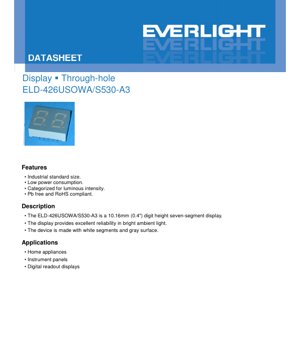
ELD-426USOWA/S530-A3 is a through-hole mounted seven-segment numeric display, designed to provide clear digital readouts in various electronic applications. It features a standard industrial package size, making it compatible with existing PCB layouts and sockets designed for similar displays. Its primary design goal is to deliver reliable, clear, and easily readable numeric and limited alphanumeric information under varying ambient lighting conditions.
The core advantage of this display lies in the combination of its standard physical dimensions and graded optical performance. The segments are made of white diffused resin with a gray face, enhancing contrast and readability. The device is manufactured using AlGaInP (Aluminum Gallium Indium Phosphide) semiconductor technology, renowned for efficiently producing high-brightness red and red-orange light. This makes the display particularly suitable for applications where power consumption is a concern but visibility is critical.
The target market for this component includes designers and manufacturers of consumer electronics, industrial control panels, home appliances, and test and measurement equipment. Its through-hole design ensures a robust mechanical connection, making it ideal for applications subject to vibration or where long-term reliability is paramount.
2. Cikakken bayani na sigogi na fasaha
2.1 Absolute Maximum Ratings
These ratings define the stress limits beyond which permanent damage to the device may occur. Operation at or near these limits is not guaranteed and should be avoided during normal use.
- Reverse Voltage (VR):5V. Exceeding this voltage under reverse bias may cause junction breakdown.
- Forward Current (IF):25 mA DC. This is the maximum continuous current allowed through a single segment.
- Peak Forward Current (IFP):60 mA. This current is only permitted under pulse conditions with a duty cycle of 1/10 and a frequency of 1 kHz. It allows for higher brightness for short periods, such as in multiplexed displays.
- Power Dissipation (Pd):60 mW. This is the maximum power the device can safely dissipate as heat.
- Operating Temperature (Topr):-40°C to +85°C. This device is suitable for industrial temperature range.
- Storage Temperature (Tstg):-40°C to +100°C.
- Soldering Temperature (Tsol):Maximum 260°C for up to 5 seconds. This is critical for wave soldering or hand soldering processes.
2.2 Halayen haske da lantarki
These parameters are measured at the standard junction temperature of 25°C, defining the device's performance under normal operating conditions.
- Luminous Intensity (Iv):At a forward current (IF) of 10 mA, the typical value is 24 mcd. The specified minimum is 11 mcd. This intensity is the average measured for each independent 7-segment digit. A tolerance of ±10% applies.
- Peak Wavelength (λp):Typical value 621 nm. This is the wavelength at which the emitted optical power is maximum. It defines the perceived color, which in this case falls within the red-orange spectrum.
- Dominant Wavelength (λd):Typical value 615 nm. This is the monochromatic wavelength that produces a color sensation matching the LED's output, crucial for applications with strict color requirements.
- Spectral Radiant Bandwidth (Δλ):Typical value 18 nm. This indicates the emission wavelength range centered on the peak wavelength. A narrower bandwidth indicates a purer spectral color.
- Forward Voltage (VF):Typical value 2.0V, maximum 2.4V at IF=20 mA. Tolerance is ±0.1V. This parameter is crucial for designing current limiting circuits.
- Reverse Current (IR):Maximum 100 µA at VR=5V. This is the leakage current when the device is reverse biased.
3. Binning System Description
The datasheet indicates the devices are "binned by luminous intensity." This refers to a binning or sorting process.
- Luminous Intensity Binning:Luminous Intensity (Iv) is measured and categorized into specific ranges or "bins." This ensures brightness uniformity among multiple units used in the same product, preventing noticeable segment brightness differences on displays. The "CAT" field on the packaging label indicates this luminous intensity grade.
- Color/Wavelength Consistency:While not explicitly stated as binning, the typical values for peak wavelength (621 nm) and dominant wavelength (615 nm) indicate strict control over semiconductor epitaxy and manufacturing processes to ensure consistent color output, a characteristic of AlGaInP technology.
- Forward Voltage:The specified ±0.1V tolerance indicates a controlled production process, minimizing variations in electrical characteristics that could affect driver circuit design.
4. Binciken lanƙwan aiki
The datasheet provides typical characteristic curves, which are invaluable for understanding device behavior under non-standard conditions.
4.1 Spectral Distribution
Kurba rarraba spectrum tana nuna ƙarfin haske da ake fitarwa a mabanbanta tsayin raƙuman ruwa. Ga ELD-426USOWA/S530-A3, wannan kurba za ta mai da hankali a 621 nm (ja-orange), tare da matsakaicin faɗin cikakken rabin tsayi (FWHM) na 18 nm. Wannan kurba tana da mahimmanci ga aikace-aikacen da hasken nuni zai iya hulɗa da tacewa ko kuma buƙatar takamaiman fahimtar launi.
4.2 Forward Current vs. Forward Voltage (I-V Curve)
Wannan kurba tana bayyana alaƙar da ba ta da layi tsakanin ƙarfin wutar lantarki da ake amfani da shi a ƙarshen LED da kuma ƙarfin da aka samar. Tana nuna ƙarfin wutar lantarki na "buɗewa" (kusan 1.8-2.0V ga wannan na'ura) da kuma yadda ƙarfin wutar lantarki ke ƙaruwa da ɗan ƙaramin ƙarfi. Masu ƙira suna amfani da wannan kurba don ƙididdige ƙimar juriya da ake buƙata a jere a cikin ƙarfin wutar lantarki da aka bayar, don isa ga ƙarfin aiki da ake so (misali 10 mA ko 20 mA).
4.3 Forward Current Derating Curve
Wannan shi ne zane mai mahimmanci game da amincin aiki. Yana nuna yadda dole ne a rage matsakaicin ƙarfin gaba na ci gaba da ake yarda da shi (IF) lokacin da yanayin zafi ya haura sama da 25°C. Yayin da zafin jiki ya ƙaru, ƙarfin LED na ɗaukar zafi yana raguwa. Don hana zafi da saurin tsufa, dole ne a rage ƙarfin aiki. Misali, a yanayin zafin jiki na 85°C, matsakaicin ƙarfin ci gaba da ake yarda da shi zai yi ƙasa sosai da ƙimar cikakkiyar matsakaicin 25 mA da aka ƙayyade a 25°C.
5. Mechanical and Packaging Information
5.1 Girman Kunshewa
This display conforms to the industrial standard dimensions for a 10.16 mm (0.4 inch) character height, single-digit, seven-segment package. The dimension drawing provides all critical dimensions, including overall height, width, digit size, segment size, and pin pitch. The pin pitch is typically on a 0.1 inch (2.54 mm) grid, compatible with standard through-hole prototyping boards and PCB layouts. All unspecified tolerances are ±0.25 mm.
5.2 Tsarin Fil da Gane Halayen
The internal circuit diagram shows the common anode configuration of the display. In a common anode display, the anodes of all LED segments are connected together to a common pin (or multiple pins to handle current). Each segment's cathode has its own dedicated pin. To illuminate a segment, the common anode pin is connected to the positive supply voltage (through a current-limiting resistor), and the corresponding cathode pin is pulled low (grounded). The pinout diagram clearly identifies pin 1, the common anode pin(s), and the cathode pins for segments a through g and the decimal point (if present). Correct polarity identification is crucial to prevent incorrect connections that could damage the display.
6. Jagorar Walda da Tari
- Soldering Process:This device can withstand a maximum soldering temperature of 260°C for up to 5 seconds. This applies to wave soldering or manual soldering using a temperature-controlled iron. Prolonged exposure to high temperatures can damage the internal bonding wires or epoxy.
- ESD (Electrostatic Discharge) Precautions:LED chips are sensitive to electrostatic discharge. Recommended handling precautions include the use of grounded wrist straps, ESD-safe workstations with conductive mats, and proper grounding of all equipment. The working environment should maintain appropriate humidity to minimize static charge generation. Ionizers can be used to neutralize charges on insulating materials.
- Storage Conditions:Devices should be stored in a dry, anti-static environment within the specified temperature range of -40°C to +100°C. The original packaging (tube) provides mechanical protection and should be used until the components are ready for assembly.
7. Bayanin Marufi da Oda
- Packaging Specifications:Devices are packaged 25 pieces per tube. For bulk handling, 64 tubes are packed in a box, and 4 boxes are packed in a master carton. Each carton contains a total of 6,400 pieces (25 x 64 x 4).
- Label Description:The packaging label contains several key fields:
- CPN:Customer Part Number (for customer reference).
- P/N:Manufacturer Part Number (ELD-426USOWA/S530-A3).
- QTY:The quantity of devices in this specific package.
- CAT:Daraja ko lambar rarrabuwar ƙarfin haske.
- LOT No:Lambar samarwa don bin diddigin asali.
8. Shawarar Aikace-aikace
8.1 Yanayin Aikace-aikace na Al'ada
- Kayan aikin gida:Mai ƙidayar lokaci akan tanda, microwave, da na'urar wanki; nuna zafin jiki akan firiji ko na'urar sanyaya iska.
- Allon kayan aiki:Voltage, current, frequency, or rotational speed readings for test equipment, power supplies, and automotive dashboards (for aftermarket or non-critical functions).
- Digital Readout Display:Standalone counters, clocks, thermometers, hygrometers, and simple control interfaces.
8.2 Abubuwan Lura na Zane
- Current Limiting:Always use a series resistor for each segment or common anode to limit the current to the desired value (e.g., 10-20 mA). Use the formula R = (VPower Supply- VF) / IF.
- Calculate the resistance value.Multiplexing:FPFor multi-digit displays, multiplexing is typically used. This involves rapidly cycling power to the segment lines for each digit, one digit at a time. The peak current (I
- rating 60 mA) allows for higher instantaneous current during brief multiplexing pulses to achieve an average brightness equivalent to a lower continuous current. The duty cycle must be managed correctly.Viewing Angle and Contrast:
- The gray face and white diffused segments are designed to provide good contrast. The intended viewing angle should be considered when mounting the display. The through-hole design allows for precise vertical alignment on the PCB.Thermal Management:
A aikace-aikacen da ke da zafi mai yawa na muhalli ko kuma lokacin da ake kaiwa kusa da iyakar ƙididdiga, tabbatar da isasshiyar iska a kusa da na'urar nuni. Bi madaidaicin lanƙwasa na rage ƙarfin lantarki.
9. Technical Comparison and Differentiation
- Compared to older technologies or smaller displays, the ELD-426USOWA/S530-A3 offers specific advantages:Comparison with smaller displays (e.g., 5mm or 3mm):
- The 10.16mm character height provides excellent visibility from a greater distance, making it suitable for panel-mounted equipment.Comparison with incandescent or VFD displays:
- LED technology consumes significantly less power, has a longer lifespan (typically tens of thousands of hours), offers higher resistance to shock and vibration, and has a faster response time. It also operates at lower voltages.Comparison with general red LEDs:
- Compared to older GaAsP (Gallium Arsenide Phosphide) red LEDs, the use of AlGaInP material typically offers higher luminous efficiency and better color stability across temperature and lifespan ranges. Industrial standard packaging ensures easy replacement and design compatibility.Differentiation among similar products:
Mahimmancin abubuwan banbance shine takamaiman rarrabuwar ƙarfin haske (tabbatar da daidaiton haske), tsarin mara gubar kuma ya dace da RoHS, da ƙaƙƙarfan kunsa mai rami wanda aka ƙera don amincin yanayi mai tsanani.
- 10. Frequently Asked Questions (based on technical parameters)
Q: For a 5V power supply, to drive a segment at 10 mA operating current, what resistor value should I use?FA: Using a typical VFvalue of 2.0V: R = (5V - 2.0V) / 0.01A = 300 Ω. A standard 300 Ω or 330 Ω resistor is suitable. For conservative design, always use the maximum V - value (2.4V): R = (5V - 2.4V) / 0.01A = 260 Ω.
Q: Can I drive this display directly from a microcontroller pin? - A: No. A typical MCU pin cannot continuously source or sink 10-20 mA per segment without risk of damage. You must use the MCU pin to control a transistor (BJT or MOSFET) or a dedicated driver IC (like a 74HC595 shift register with current-limiting resistors or a constant-current LED driver) to handle the higher segment currents.
Q: Why is the peak forward current (60 mA) higher than the continuous current (25 mA)? - A: This is to accommodate pulsed operation methods like multiplexing. An LED can handle a higher current for a very short pulse because the heat generated does not have time to raise the junction temperature to a dangerous level. A 1/10 duty cycle at 1 kHz means the pulse is on for 0.1 ms and off for 0.9 ms.
Q: What does "Lead-Free and RoHS Compliant" mean?
Amsa: Ana kera wannan na'urar ba tare da amfani da gubar (Pb) ba, kuma ta dace da umarnin EU na "Ƙuntata Abubuwa Masu Illa" (RoHS). Wannan yana sa ta dace don amfani a cikin samfuran da ake sayarwa a kasuwanni masu ƙaƙƙarfan dokokin muhalli.
11. Practical Design and Use Cases
Case: Designing a 4-Digit Multiplexed Panel Meter
- A designer is creating a benchtop DC voltmeter that displays values from 0.000 to 19.99V. They have selected four ELD-426USOWA/S530-A3 displays.Circuit Design:
- A microcontroller with an ADC reads the voltage. The MCU's I/O pins are connected to the segment cathodes (a-g, dp) via current-limiting resistors (e.g., 150 Ω for ~20 mA pulse current). Four additional MCU pins, each driving a PNP transistor, control the common anode of each digit.Multiplexing Procedure:
- The firmware activates the transistor for one digit at a time while outputting that digit's segment pattern on the cathode lines. It cycles through all four digits rapidly (e.g., at 200 Hz, giving a refresh rate of 50 Hz per digit). This persistence of vision effect makes all digits appear continuously lit.Current Calculation:FWith a 5V supply, a typical V
- of 2.0V, and a desired segment peak current of 20 mA during its active time, the resistor is R = (5V - 2.0V) / 0.02A = 150 Ω. The average current per segment is 20 mA / 4 digits = 5 mA, well within the 25 mA continuous rating. The 20 mA peak current is within the 60 mA pulse rating.Advantages Achieved:
Wannan ƙirar tana amfani da fil ɗin MCU 12 kawai (sassa 7 + lambobi 4 + maki goma 1), maimakon 32 (sassa 8 x lambobi 4), tana adana albarkatun I/O. Daidaitaccen kunsa yana sauƙaƙe shimfidar PCB. Rarrabuwar ƙarfin haske yana tabbatar da daidaiton haske ga duk na'urori nuni huɗu.
12. Brief Introduction to Working Principle
A Light Emitting Diode (LED) is a semiconductor p-n junction diode. When forward biased (positive voltage applied to the p-side relative to the n-side), electrons from the n-region and holes from the p-region are injected into the junction region. When these charge carriers recombine, they release energy. In an LED, this energy is released as photons (light). The specific wavelength (color) of the emitted light is determined by the bandgap energy of the semiconductor material used.
ELD-426USOWA/S530-A3 yana amfani da semiconductor AlGaInP (aluminum gallium indium phosphide). Ta hanyar sarrafa daidai gwargwado na waɗannan abubuwan yayin girma crystal, ana kunna makamashin tazarar band don fitar da haske a cikin sashin ja-orange na bakan (kimanin 615-621 nm). Na'urar nuni ta sassa bakwai kawai tarin waɗannan mahaɗan LED masu zaman kansu ne, waɗanda aka ƙera su zuwa daidaitattun sassa (a zuwa g), kuma an jera su cikin siffar "8", tare da haɗin lantarki gama gari (anode gama gari) don sauƙaƙe tuƙi.
13. Technical Trends and Developments
- Although through-hole, discrete seven-segment displays like the ELD-426USOWA/S530-A3 remain highly relevant due to their robustness and simplicity, several trends can be observed in display technology:Haɗin kai:
- Suna tafiya zuwa ga haɓaka na'urorin nuni masu haɗin kai, waɗannan na'urorin sun haɗa da lambobin LED, IC mai tuƙi, wani lokacin ma suna haɗa microcontroller a kan PCB guda. Waɗannan na'urorin suna sadarwa ta hanyar hanyoyin sadarwa na jeri (I2C, SPI), suna sauƙaƙa ƙirar tsarin mai gida sosai.Fasahar haɗawa ta saman (SMT):
- Don manyan tarawa ta atomatik, SMT na'urorin nuni na sassa bakwai suna zama gama gari. Idan aka kwatanta da kayan aikin rami mai ratsawa, suna adana sararin allon kuma suna ba da damar tsarin tarawa mai sauri da ƙarancin farashi.Madadin fasaha:
- Don aikace-aikacen da ke buƙatar ƙarin ƙayyadaddun bayanai, haruffa masu rikitarwa, ko zane-zane, galibi ana zaɓar na'urorin nuni na LED na matrix, OLED (LED na kwayoyin halitta), da LCD. Duk da haka, don sauƙaƙan karatun lambobi, mai haske mai ƙarfi, da ƙarancin farashi, na'urar nuni ta LED ta saba ta sassa bakwai har yanzu ita ce mafi rinjaye kuma amintacciyar mafita, musamman a fannonin masana'antu da na'urorin lantarki, inda samuwa na dogon lokaci da dorewa suke da muhimmanci.Haɓaka inganci:
Cikakken Bayani Kan Kalmomin Ƙayyadaddun LED
Full Explanation of LED Technical Terms
I. Maɓuɓɓukan Ma'auni na Ayyukan Hasken Lantarki
| Term | Unit/Representation | Layman's Explanation | Why It Is Important |
|---|---|---|---|
| Luminous Efficacy | lm/W (lumens per watt) | The luminous flux emitted per watt of electrical power; higher values indicate greater energy efficiency. | Directly determines the energy efficiency rating and electricity cost of a luminaire. |
| Luminous Flux | lm (lumen) | The total amount of light emitted by a light source, commonly known as "brightness". | Determines whether a luminaire is bright enough. |
| Viewing Angle | ° (degrees), e.g., 120° | The angle at which light intensity drops to half, determining the width of the beam. | Affects the illumination range and uniformity. |
| Correlated Color Temperature (CCT) | K (Kelvin), e.g., 2700K/6500K | The warmth or coolness of light color; lower values are yellowish/warm, higher values are whitish/cool. | Determines the lighting ambiance and suitable application scenarios. |
| Color Rendering Index (CRI / Ra) | Unitless, 0–100 | The ability of a light source to restore the true color of an object, Ra≥80 is preferred. | Affects color fidelity, used in high-demand places such as shopping malls and art galleries. |
| Color tolerance (SDCM) | MacAdam ellipse steps, e.g., "5-step" | A quantitative indicator of color consistency; the smaller the step number, the more consistent the color. | Ensures no color difference among the same batch of luminaires. |
| Dominant Wavelength | nm (nanometer), e.g., 620nm (red) | The wavelength value corresponding to the color of a colored LED. | Determines the hue of monochromatic LEDs such as red, yellow, and green. |
| Spectral Distribution | Wavelength vs. Intensity curve | Display the intensity distribution of light emitted by the LED across various wavelengths. | Affects color rendering and color quality. |
II. Sigogin Lantarki
| Term | Symbol | Layman's Explanation | Design Considerations |
|---|---|---|---|
| Forward Voltage (Forward Voltage) | Vf | Voltage ya chini inayohitajika kuwasha LED, kama "kizingiti cha kuanzisha". | Voltage ya chanzo cha umeme inahitaji kuwa ≥ Vf, voltage inajumlishwa wakati LED nyingi zimeunganishwa mfululizo. |
| Forward Current | If | Thamani ya mkondo inayofanya LED mwangaza kwa kawaida. | A kan yi amfani da kwararar kwarara ta dindindin, kwararar kwarara tana ƙayyadaddun haske da rayuwa. |
| Mafi girman kwararar bugun jini (Pulse Current) | Ifp | Ƙarfin koli da za a iya jurewa a cikin ɗan lokaci, ana amfani dashi don daidaita haske ko walƙiya. | Dole ne a sarrafa faɗin bugun jini da rabon aiki da ƙarfi, in ba haka ba zai yi zafi kuma ya lalace. |
| Ƙarfin lantarki na baya (Reverse Voltage) | Vr | The maximum reverse voltage that an LED can withstand; exceeding this may cause breakdown. | Reverse connection or voltage surges must be prevented in the circuit. |
| Thermal Resistance | Rth (°C/W) | The resistance to heat flow from the chip to the solder joint; a lower value indicates better heat dissipation. | High thermal resistance requires stronger heat dissipation design, otherwise junction temperature will increase. |
| Electrostatic Discharge Immunity (ESD Immunity) | V (HBM), e.g., 1000V | The ability to withstand electrostatic strikes; a higher value means it is less susceptible to damage from static electricity. | Anti-static measures must be implemented during production, especially for high-sensitivity LEDs. |
III. Gudanar da Zafi da Amincewa
| Term | Key Metrics | Layman's Explanation | Impact |
|---|---|---|---|
| Junction Temperature | Tj (°C) | The actual operating temperature inside the LED chip. | For every 10°C reduction, lifespan may double; excessively high temperatures cause lumen depreciation and color shift. |
| Lumen Depreciation | L70 / L80 (hours) | The time required for brightness to drop to 70% or 80% of its initial value. | Directly defines the "service life" of an LED. |
| Lumen Maintenance | % (e.g., 70%) | Yawanci hasken da ya rage bayan amfani da lokaci. | Yana nuna iyawar riƙe haske bayan dogon amfani. |
| Color Shift | Δu′v′ ko MacAdam ellipse | Matsayin canjin launi yayin amfani. | Yana shafar daidaiton launi a yanayin haskakawa. |
| Thermal Aging | Material Performance Degradation | Degradation of packaging materials due to prolonged high temperatures. | May lead to decreased brightness, color shift, or open-circuit failure. |
IV. Packaging and Materials
| Term | Common Types | Layman's Explanation | Features and Applications |
|---|---|---|---|
| Package Type | EMC, PPA, Ceramic | The housing material that protects the chip and provides optical and thermal interfaces. | EMC offers good heat resistance and low cost; ceramic provides superior heat dissipation and long lifespan. |
| Chip Structure | Front-side, Flip Chip | The arrangement of chip electrodes. | Flip Chip offers better heat dissipation and higher luminous efficacy, suitable for high-power applications. |
| Phosphor coating | YAG, silicate, nitride | It is coated on the blue LED chip, partially converting to yellow/red light, which mixes to form white light. | Different phosphors affect luminous efficacy, color temperature, and color rendering. |
| Lens/Optical Design | Flat, microlens, total internal reflection | The optical structure on the encapsulation surface controls light distribution. | Determines the emission angle and light distribution curve. |
V. Quality Control and Binning
| Term | Binning Content | Layman's Explanation | Purpose |
|---|---|---|---|
| Luminous Flux Binning | Codes such as 2G, 2H | Grouped by brightness level, each group has a minimum/maximum lumen value. | Ensure consistent brightness within the same batch of products. |
| Voltage Binning | Codes such as 6W, 6X | Grouped according to forward voltage range. | Facilitates driver matching and improves system efficiency. |
| Color Binning | 5-step MacAdam ellipse | Group by color coordinates to ensure colors fall within an extremely narrow range. | Ensure color consistency to avoid uneven color within the same luminaire. |
| Color temperature binning | 2700K, 3000K, etc. | Group by color temperature, each group has a corresponding coordinate range. | Meet the color temperature requirements of different scenarios. |
VI. Testing and Certification
| Term | Standard/Test | Layman's Explanation | Significance |
|---|---|---|---|
| LM-80 | Lumen Maintenance Test | Long-term operation under constant temperature conditions, recording data on luminous flux depreciation. | For estimating LED lifetime (in conjunction with TM-21). |
| TM-21 | Lifetime extrapolation standard | Estimating lifetime under actual use conditions based on LM-80 data. | Providing scientific lifetime prediction. |
| IESNA standard | Standard of the Illuminating Engineering Society | Covers optical, electrical, and thermal testing methods. | Industry-recognized testing basis. |
| RoHS / REACH | Environmental certification. | Ensures products do not contain harmful substances (e.g., lead, mercury). | Conditions for market entry into international markets. |
| ENERGY STAR / DLC | Energy efficiency certification. | Energy efficiency and performance certification for lighting products. | Commonly used in government procurement and subsidy programs to enhance market competitiveness. |