Table of Contents
- 1. Product Overview
- 1.1 Core Features and Advantages
- 1.2 Target Market and Positioning
- 2. In-depth Technical Parameter Analysis
- 2.1 Absolute Maximum Ratings
- 2.2 Photoelectric Characteristics
- 3. Grading and Classification System
- 3.1 Luminous Intensity Grading
- 3.2 Forward Voltage Consistency
- 4. Performance Curve Analysis
- 4.1 Spectral Distribution
- 4.2 Forward Current vs. Forward Voltage Characteristic Curve (I-V Curve)
- 4.3 Forward Current Derating Curve
- 5. Mechanical and Packaging Information
- 5.1 Physical Dimensions
- 5.2 Pin Arrangement and Internal Circuit Diagram
- 6. Soldering and Assembly Guide
- 6.1 Welding Parameters
- 6.2 Electrostatic Discharge (ESD) Protection
- 6.3 Storage Conditions
- 7. Packaging and Ordering Information
- 7.1 Packaging Specifications
- 7.2 Labeling Instructions
- 8. Application Notes and Design Considerations
- 8.1 Typical Application Scenarios
- 8.2 Drive Circuit Design
- 8.3 Thermal Management
- 9. Technical Comparison and Differentiation
- 10. Frequently Asked Questions (Based on Technical Parameters)
- 11. Design and Use Case Studies
- 12. How It Works
- 13. Technology Trends
1. Product Overview
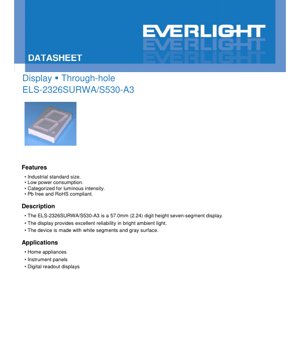
ELS-2326SURWA/S530-A3 is a through-hole mounted seven-segment display, specifically designed for applications requiring clear and reliable digital readouts under various lighting conditions. This device belongs to a series of industrial standard components, renowned for its durability and stable performance.
1.1 Core Features and Advantages
The primary advantages of this display module stem from its design and material selection. It adopts a standard industrial package size, ensuring compatibility with existing PCB layouts and sockets designed for similar components. A key advantage is its low power consumption, making it suitable for battery-powered or energy-sensitive applications. The device is manufactured using lead-free materials, fully complies with the RoHS directive, and meets modern environmental and regulatory requirements. Its segments are white against a gray background, providing high contrast and thereby enhancing readability.
1.2 Target Market and Positioning
This seven-segment display is positioned for cost-effective applications that prioritize reliability, where clear numeric indication is crucial. Its design emphasizes long-term performance in standard operating environments, rather than extreme conditions requiring special components.
2. In-depth Technical Parameter Analysis
ELS-2326SURWA/S530-A3 performance is defined by a series of electrical, optical, and thermal parameters, which designers must consider to ensure successful application.
2.1 Absolute Maximum Ratings
These ratings define the stress limits of the device; exceeding these limits may cause permanent damage. They are not intended for normal operation.
- Reverse Voltage (VR):5 V. Exceeding this voltage under reverse bias may cause junction breakdown.
- Continuous Forward Current (IF):25 mA. This is the maximum direct current that can be continuously applied to each segment.
- Peak forward current (IFP):60 mA. This current is only allowed under pulse conditions (duty cycle ≤ 10%, frequency ≤ 1 kHz) and must not be used for DC operation.
- Power Consumption (Pd):60 mW. The maximum power that can be dissipated as heat, calculated as forward voltage (VF) × forward current (IF).
- Operating Temperature (Topr):-40°C to +85°C. The device is specified to operate over this ambient temperature range.
- Storage Temperature (Tstg):-40°C to +100°C.
- Welding temperature (Tsol):260°C, kuma da mafi tsawon dakika 5. Wannan yana da mahimmanci ga aikin haɗa ƙwanƙwasa ko na hannu, don hana lalacewar rufin epoxy da haɗin ciki daga zafi.
2.2 Photoelectric Characteristics
Ana auna a daidaitaccen zafin haɗuwa (Ta= 25°C), waɗannan sigogi suna ayyana fitowar haske da halayen lantarki na na'urar a cikin yanayin aiki na yau da kullun.
- Luminous Intensity (Iv):15 mcd (minimum), 34 mcd (typical), under the condition of IF= 10 mA. This is the average light output per segment. This value has a ±10% tolerance, meaning the devices are binned or classified based on measured intensity.
- Peak Wavelength (λp):632 nm (typical). The wavelength at which spectral emission is strongest. This is the key parameter determining the perceived color (bright red).
- Dominant Wavelength (λd):624 nm (typical). The single wavelength that best matches the perceived color of the light, which may differ slightly from the peak wavelength.
- Spectral Bandwidth (Δλ):20 nm (typical). The range of wavelengths emitted, measured at full width at half maximum. A narrower bandwidth indicates a purer spectral color.
- Forward Voltage (VF):2.0 V (Typical), 2.4 V (Maximum), at IF= 20 mA condition. This is the voltage drop across the LED during operation. The drive circuit must be designed to provide sufficient voltage. A tolerance of ±0.1V is specified.
- Reverse Current (IR):100 µA (Maximum), at VRUnder the condition of = 5 V. This is the small leakage current that flows when the device is reverse-biased within its maximum ratings.
3. Grading and Classification System
The datasheet indicates that the device"Classified according to luminous intensity."This refers to the common "binning" practice in LED manufacturing.
3.1 Luminous Intensity Grading
Due to inherent variations in semiconductor epitaxial growth and manufacturing processes, the light output of LEDs will differ. To ensure consistency for end users, manufacturers test and categorize (bin) LEDs based on their measured luminous intensity. The ELS-2326SURWA/S530-A3 has a typical intensity of 34 mcd and a minimum of 15 mcd. Purchased devices will fall within a specific intensity range (bin), which should be consistent within the same production lot or order. The label description includes "CAT: Luminous Intensity Grade," confirming this practice.
3.2 Forward Voltage Consistency
Although not explicitly described as a binning parameter, the tight tolerance of forward voltage (±0.1V) indicates fine process control. Consistent VFis important for designing simple series resistor current-limiting circuits, as it minimizes brightness differences between segments when driven from a common voltage source.
4. Performance Curve Analysis
Graphical data provides in-depth insights into how parameters vary with operating conditions.
4.1 Spectral Distribution
The spectral curve shows the relative intensity of emitted light at different wavelengths. For this AlGaInP-based device, the curve will be centered at 632 nm (peak) with a typical bandwidth of 20 nm. This curve confirms its monochromatic "bright red" color, with no significant emission in other color bands.
4.2 Forward Current vs. Forward Voltage Characteristic Curve (I-V Curve)
This curve illustrates the nonlinear relationship between current and voltage in a semiconductor diode. For an LED, a small increase in voltage beyond the turn-on threshold (approximately 1.8V) causes the current to increase exponentially. This is why LEDs must be driven by a current-limiting source (such as a constant current driver or series resistor) rather than a constant voltage source, to prevent thermal runaway and damage.
4.3 Forward Current Derating Curve
This is one of the most critical charts in reliability design. It shows the maximum allowable continuous forward current (IF) How must be reduced as the ambient temperature increases. At 25°C, a full rating of 25 mA is allowed. When the temperature rises towards the maximum operating temperature of 85°C, the allowable current decreases significantly. This derating is necessary because the internal junction temperature of the LED increases with ambient temperature and self-heating from current flow. Exceeding the safe junction temperature reduces light output and drastically shortens lifespan. Designers must use this curve to select an appropriate operating current based on their application's worst-case ambient temperature.
5. Mechanical and Packaging Information
5.1 Physical Dimensions
The character height of this device is 57.0 mm (2.24 inches), classifying it as a large-size display suitable for long-distance viewing. The package dimension drawing provides detailed measurement data for the overall display body dimensions, through-hole pin pitch and dimensions, and segment layout. Unless otherwise specified, the general tolerance is ±0.25 mm. This drawing is crucial for creating the PCB footprint, ensuring proper installation, and defining the keep-out area on the board.
5.2 Pin Arrangement and Internal Circuit Diagram
The internal circuit diagram shows the electrical connections for each segment (a to g) and the common connection. This display uses a common-anode configuration, meaning the anodes (positive terminals) of all LED segments are internally connected to a common pin (or set of pins). The cathode (negative terminal) of each segment is brought out to an individual pin. To illuminate a segment, the common anode pin is connected to a positive voltage source, and the corresponding cathode pin is pulled low (grounded) through a current-limiting resistor. The pin arrangement diagram specifies which physical pin corresponds to which segment cathode and common anode.
6. Soldering and Assembly Guide
Proper handling is required to maintain device integrity and performance.
6.1 Welding Parameters
The absolute maximum ratings specify a soldering temperature of 260°C for a maximum of 5 seconds. This applies to the lead/solder wire temperature during wave soldering or manual soldering. For reflow soldering, a standard lead-free soldering profile with a peak temperature not exceeding 260°C should be used. Prolonged exposure to high temperatures can damage internal bonding wires, degrade the epoxy package, or cause delamination.
6.2 Electrostatic Discharge (ESD) Protection
The datasheet contains a strong warning regarding ESD sensitivity. AlGaInP semiconductor chips are susceptible to electrostatic damage, which can lead to immediate failure or latent defects that reduce long-term reliability. Mandatory precautions include: operators wearing grounded wrist straps; using anti-static workstations, mats, and tools; ensuring all equipment is properly grounded; and storing/transporting devices in conductive or anti-static packaging. Ionizers can be used to neutralize charges on non-conductive materials in the work area.
6.3 Storage Conditions
The device should be stored within the specified storage temperature range (-40°C to +100°C) in a dry environment to prevent moisture absorption and should remain in its original ESD protective packaging until use.
7. Packaging and Ordering Information
7.1 Packaging Specifications
The device follows a specific packaging flow: 10 pieces are loaded into a tube to provide mechanical protection and ease of handling. Then, 10 tubes are placed into a box. Finally, 4 boxes are packed into a master shipping carton. This tiered packaging (10 pieces/tube → 10 tubes/box → 4 boxes/carton) is common for through-hole components and aids in inventory management and automated assembly.
7.2 Labeling Instructions
The label on the packaging contains multiple codes: CPN (Customer Part Number), P/N (Manufacturer Part Number: ELS-2326SURWA/S530-A3), QTY (Quantity), CAT (Luminous Intensity Category/Class), and LOT No (Traceable Production Lot Number). The "CAT" code is crucial for ensuring brightness consistency across the entire production batch.
8. Application Notes and Design Considerations
8.1 Typical Application Scenarios
The datasheet suggests three primary applications: home appliances (e.g., oven timers, washing machine displays), instrument panels (for industrial equipment, test instruments, or automotive aftermarket), and general-purpose digital readout displays. Its large size and good contrast make it suitable for applications where the display needs to be read from several feet away or under fairly bright ambient light.
8.2 Drive Circuit Design
Designing a drive circuit requires several key calculations. First, based on the required brightness and ambient temperature, use the derating curve to determine the operating current (IF). Typical values may range between 10-20 mA. For a simple series resistor design of a common-anode display connected to the supply voltage VCC, the resistor value for each segment is: R = (VCC- VF) / IF. Using a typical VF= 2.0V, 5V power supply, IF=15mA, then R = (5 - 2.0) / 0.015 = 200 Ω. The resistor's power rating should be at least IF2× R = (0.015)2× 200 = 0.045W, so a standard 1/8W (0.125W) resistor is sufficient. For multi-digit multiplexing, dedicated driver ICs (such as the 74HC595 shift register or MAX7219 display driver) are typically used to control the segment cathodes and digit anodes, thereby significantly reducing the number of required microcontroller I/O pins.
8.3 Thermal Management
Although not a high-power device, thermal considerations remain important for extending lifespan. Ensure sufficient spacing on the PCB to allow for some air circulation. Avoid placing the display near other significant heat sources. Following the current derating curve is the primary method for thermal management. The wide operating temperature range (-40°C to +85°C) indicates its suitability for most indoor and many outdoor environments.
9. Technical Comparison and Differentiation
The ELS-2326SURWA/S530-A3 stands out due to its specific combination of attributes: a large 57.0 mm character height, through-hole mounting, bright red AlGaInP emission, and common anode configuration. Compared to smaller displays (e.g., 14.2 mm or 20 mm), it offers superior visibility for long-distance viewing. Compared to Surface-Mount Device (SMD) displays, through-hole versions like this are generally considered more robust in high-vibration environments or applications requiring manual repair, and are often easier for prototyping. Compared to older technologies, the AlGaInP material system provides high efficiency and good color purity within the red/orange/amber spectrum.
10. Frequently Asked Questions (Based on Technical Parameters)
Q: Can I drive this display directly from a 5V microcontroller pin?
A: No. Microcontroller pins cannot source or sink enough current (typically a maximum of 20-40mA per pin, with total package limits) to drive multiple segments brightly. More importantly, LEDs must have their current limited. Connecting them directly to a voltage source without a series resistor will attempt to draw excessive current, damaging the LEDs and potentially the microcontroller pin. Always use a series current-limiting resistor or a dedicated constant-current driver.
Q: Why does the display dim when I operate at 85°C, even though I use the same current as at room temperature?
A: The luminous efficacy (light output per unit electrical input) of an LED decreases as its junction temperature increases. This is a fundamental property of semiconductors. Furthermore, the derating curve requires you toreduceThe operating current is limited to prevent overheating. These two effects together lead to a decrease in brightness at high temperatures.
Q: What does "lead-free and RoHS compliant" mean for my design?
A: It means the device contains no lead (Pb) or other restricted hazardous substances as defined by the RoHS (Restriction of Hazardous Substances) directive. This is a legal requirement for selling electronic products in many regions, including the EU. It also affects your soldering process, requiring the use of lead-free solder with a higher melting point, which is why the 260°C soldering rating is important.
Q: The typical forward voltage is 2.0V. Can I power it from a 3.3V system?
A: Yes, absolutely. Using a 3.3V power supply (VCC), the series resistor value needs to be recalculated. For IF=15mA: R = (3.3 - 2.0) / 0.015 ≈ 87 Ω. Ensure your drive circuit (microcontroller, driver IC) can handle the segment current when pulling the cathode low.
11. Design and Use Case Studies
Scenario: Design a simple digital timer for a laboratory incubator.
The display needs to be clearly readable from across the room under laboratory ambient light. The 57.0 mm character height of the ELS-2326SURWA/S530-A3 was chosen to ensure visibility. The incubator interior houses a microcontroller running at 5V. To simplify the design, a common anode configuration was selected. This design uses a single 74HC595 shift register to control the 7 segment cathodes and uses a transistor array (e.g., ULN2003) to sink the common anode current for the 4 digits, enabling multiplexing. The operating current for each segment is set to 12 mA to ensure good brightness while staying within the 25mA limit and leaving margin for temperature derating inside the warm incubator enclosure (up to approximately 40°C). A 220 Ω series resistor is used ((5V - 2.0V)/0.012A ≈ 250Ω; 220Ω is the nearest standard value, resulting in IF≈ 13.6mA). The PCB layout incorporated the exact footprints from the datasheet. During assembly, technicians used ESD wrist straps and a soldering iron with temperature controlled to 350°C, with quick soldering time per pin, less than 3 seconds.
12. How It Works
Seven-segment display is a component composed of seven light-emitting diode (LED) bars arranged in the shape of an "8". Each bar is an independent LED. By selectively illuminating specific combinations of these seven segments, all decimal digits (0-9) and some letters can be formed. In a common anode display like this one, the anodes (positive terminals) of all segment LEDs are connected to a common node. The cathodes (negative terminals) are separate. To illuminate a segment, a positive voltage is applied to the common anode, and the cathode of the desired segment is connected to a lower voltage (usually ground) through a current-limiting circuit. The AlGaInP (aluminum gallium indium phosphide) semiconductor material used in this device is a direct bandgap compound, specifically designed to emit light in the red to amber region of the visible spectrum when electrons and holes recombine across the bandgap, a process known as electroluminescence.
13. Technology Trends
Soko la alama za nambari saba zilizojitenga kimsingi linadumishwa imara, aina kama hizi za kuingizwa moja kwa moja zinatumikia muundo wa jadi, soko la ukarabati, na matumizi yanayothaminiwa uthabiti. Mwenendo mpana zaidi wa teknolojia ya kuonyesha unaelekea kwenye vifaa vya kushikanwa kwenye uso (SMD) kwa usanikishaji wa kiotomatiki, moduli za nambari nyingi zenye msongamano mkubwa, na ujumuishaji wa kudhibiti na kuendesha ndani ya kifurushi cha kuonyesha. Pia kuna mwenendo wa kuelekea anuwai ya rangi pana na matumizi ya fosforasi ya hali ya juu katika taa za LED nyeupe, lakini kwa alama nyekundu za rangi moja, AlGaInP bado ndiyo teknolojia yenye ufanisi inayotawala. Kanuni za kuendesha umeme, usimamizi wa joto, na ulinzi wa ESD zilizofunikwa katika hati hii ya maelezo ya kiufundi ni za msingi, na zinatumika kwa ujumla kwa teknolojia zote za LED kutoka kwa vionyeshi vilivyojitenga kama hivi hadi taa za kisasa za LED zenye nguvu kubwa.
Maelezo ya kina ya Istilahi za Uainishaji wa LED
Complete Explanation of LED Technical Terms
I. Core Indicators of Photoelectric Performance
| Terminology | Unit/Representation | Layman's Explanation | Why is it important |
|---|---|---|---|
| Luminous Efficacy | lm/W | The luminous flux emitted per watt of electrical power; the higher the value, the more energy-efficient. | Directly determines the energy efficiency rating and electricity cost of the luminaire. |
| Luminous Flux | lm (Lumen) | The total amount of light emitted by a light source, commonly known as "brightness". | Determines whether the luminaire is bright enough. |
| Viewing Angle | ° (degree), such as 120° | The angle at which light intensity drops to half, determining the beam width. | Affects the illumination range and uniformity. |
| Color Temperature (CCT) | K (Kelvin), e.g., 2700K/6500K | The color temperature of light: lower values lean yellow/warm, higher values lean white/cool. | Determines the lighting ambiance and suitable application scenarios. |
| Color Rendering Index (CRI / Ra) | Unitless, 0–100 | The ability of a light source to reproduce the true colors of objects, with Ra≥80 being preferable. | Affects color fidelity, used in high-demand places such as shopping malls and art galleries. |
| Color tolerance (SDCM) | MacAdam ellipse steps, such as "5-step" | A quantitative metric for color consistency; a smaller step number indicates better color consistency. | Ensure no color variation among luminaires from the same batch. |
| Dominant Wavelength | nm (nanometer), e.g., 620nm (red) | The wavelength value corresponding to the color of a colored LED. | Determines the hue of monochromatic LEDs such as red, yellow, and green. |
| Spectral Distribution | Wavelength vs. Intensity Curve | Shows the intensity distribution of light emitted by an LED across various wavelengths. | Affects color rendering and color quality. |
II. Electrical Parameters
| Terminology | Symbol | Layman's Explanation | Design Considerations |
|---|---|---|---|
| Forward Voltage (Forward Voltage) | Vf | The minimum voltage required to light up an LED, similar to a "starting threshold". | The driving power supply voltage must be ≥ Vf, and the voltage adds up when multiple LEDs are connected in series. |
| Forward Current | If | The current value that makes the LED emit light normally. | Constant current drive is often used, as the current determines brightness and lifespan. |
| Maximum Pulse Current | Ifp | Peak current that can be withstood for a short period of time, used for dimming or flashing. | Pulse width and duty cycle must be strictly controlled, otherwise overheating damage will occur. |
| Reverse Voltage | Vr | Maximum reverse voltage an LED can withstand; exceeding it may cause breakdown. | Reverse connection or voltage surges must be prevented in the circuit. |
| Thermal Resistance | Rth (°C/W) | The resistance to heat flow from the chip to the solder joint. A lower value indicates better heat dissipation. | High thermal resistance requires a stronger heat dissipation design, otherwise the junction temperature will increase. |
| Electrostatic Discharge Immunity (ESD Immunity) | V (HBM), such as 1000V | Electrostatic discharge immunity, higher value indicates greater resistance to electrostatic damage. | Anti-static measures must be implemented during production, especially for high-sensitivity LEDs. |
III. Thermal Management and Reliability
| Terminology | Key Indicators | Layman's Explanation | Impact |
|---|---|---|---|
| Junction Temperature | Tj (°C) | The actual operating temperature inside the LED chip. | For every 10°C reduction, the lifespan may double; excessively high temperatures lead to lumen depreciation and color shift. |
| Lumen Depreciation | L70 / L80 (hours) | The time required for the brightness to drop to 70% or 80% of its initial value. | Directly define the "service life" of an LED. |
| Lumen Maintenance | % (e.g., 70%) | The percentage of remaining brightness after a period of use. | Characterizes the ability to maintain brightness after long-term use. |
| Color Shift | Δu′v′ or MacAdam Ellipse | The degree of color change during use. | Affects the color consistency of the lighting scene. |
| Thermal Aging | Material performance degradation | Degradation of packaging materials due to prolonged high temperatures. | May lead to decreased brightness, color shift, or open-circuit failure. |
IV. Packaging and Materials
| Terminology | Common Types | Layman's Explanation | Features and Applications |
|---|---|---|---|
| Package Type | EMC, PPA, Ceramic | The housing material that protects the chip and provides optical and thermal interfaces. | EMC has good heat resistance and low cost; ceramics offer superior heat dissipation and long lifespan. |
| Chip Structure | Face-up, Flip Chip (Flip Chip) | Chip Electrode Layout Method. | Flip-chip offers better heat dissipation and higher luminous efficacy, suitable for high-power applications. |
| Phosphor coating | YAG, silicate, nitride | Covered on the blue light chip, partially converted into yellow/red light, mixed into white light. | Different phosphors affect luminous efficacy, color temperature, and color rendering. |
| Lens/Optical Design | Flat, microlens, total internal reflection | The optical structure on the encapsulation surface controls the distribution of light. | It determines the light emission angle and the light distribution curve. |
V. Quality Control and Binning
| Terminology | Grading Content | Layman's Explanation | Purpose |
|---|---|---|---|
| Luminous flux binning | Codes such as 2G, 2H | Grouped by brightness level, each group has a minimum/maximum lumen value. | Ensure consistent brightness within the same batch of products. |
| Voltage binning | Codes such as 6W, 6X | Group by forward voltage range. | Facilitates driver power matching and improves system efficiency. |
| Color grading | 5-step MacAdam ellipse | Group by color coordinates to ensure colors fall within an extremely narrow range. | Ensure color consistency to avoid uneven color within the same luminaire. |
| Color temperature binning | 2700K, 3000K, etc. | Group by color temperature, each group has a corresponding coordinate range. | To meet the color temperature requirements of different scenarios. |
VI. Testing and Certification
| Terminology | Standard/Test | Layman's Explanation | Meaning |
|---|---|---|---|
| LM-80 | Lumen Maintenance Test | Long-term operation under constant temperature conditions, recording brightness attenuation data. | Used to estimate LED lifetime (combined with TM-21). |
| TM-21 | Lifetime projection standard | Life estimation under actual operating conditions based on LM-80 data. | Provide scientific life prediction. |
| IESNA standard | Illuminating Engineering Society Standard | Covers optical, electrical, and thermal test methods. | Industry-recognized testing basis. |
| RoHS / REACH | Environmental certification. | Ensure products are free from harmful substances (e.g., lead, mercury). | Entry requirements for the international market. |
| ENERGY STAR / DLC | Energy Efficiency Certification | Energy efficiency and performance certification for lighting products. | Commonly used in government procurement and subsidy programs to enhance market competitiveness. |