Table of Contents
- 1. Product Overview
- 2. Cikakken Bayanin Sigogi na Fasaha
- 2.1 Matsakaicin Ƙimar Ƙimar Ƙarshe
- 2.2 Halayen Haske da Lantarki
- 3. Bayanin Tsarin Rarraba
- 4. Performance Curve Analysis
- 4.1 Spectral Distribution
- 4.2 Forward Current vs. Forward Voltage (I-V Curve)
- 4.3 Forward Current Derating Curve
- 5. Mechanical and Package Information
- 6. Soldering and Assembly Guide
- 7. Packaging and Ordering Information
- 8. Application Recommendations
- 8.1 Yanayin Aikace-aikace na Al'ada
- 8.2 Abubuwan Lura na Zane
- 9. Kwatancen Fasaha da Bambance-bambance
- 10. Tambayoyin da ake yawan yi (bisa sigogin fasaha)
- 10.1 Can I drive this display directly with a 5V microcontroller pin?
- 10.2 Why is luminous intensity measured per segment instead of for the entire digit?
- 10.3 What is the difference between peak wavelength and dominant wavelength?
- 10.4 How to interpret the current derating curve?
- 11. Nazarin Ƙira da Amfani
- 12. Ayyukan Aiki
- 13. Trends na Fasaha
- Cikakken Bayani kan Kalmomin Ƙayyadaddun LED
- I. Core Indicators of Photoelectric Performance
- II. Electrical Parameters
- III. Thermal Management and Reliability
- IV. Packaging and Materials
- V. Quality Control and Grading
- VI. Testing and Certification
1. Product Overview
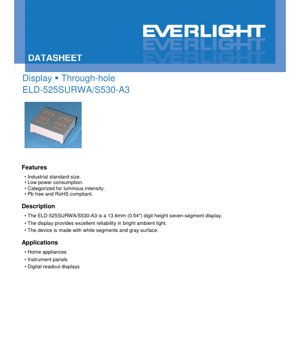
ELD-525SURWA/S530-A3 is a single-digit seven-segment display designed for through-hole mounting. It employs standard industrial package dimensions, ensuring compatibility with a wide range of existing PCB layouts and sockets. The primary application of this component is to provide clear, reliable numeric or limited alphanumeric readouts for electronic devices.
The core value of this display lies in its balance between performance and reliability. It is manufactured using AlGaInP (aluminum gallium indium phosphide) semiconductor chips, which are renowned for producing efficient and brilliant red light. The segments are white to achieve high contrast and are placed on a gray background, further enhancing readability, especially in brightly lit environments. This makes it suitable for applications where the displayed content must be easily visible under various lighting conditions.
This device is classified by luminous intensity, meaning units are binned and sold according to specific brightness ranges to ensure a consistent appearance when multiple displays are used in a single product. It also complies with the RoHS (Restriction of Hazardous Substances) directive and is manufactured using lead-free (Pb-free) processes, a key requirement for modern electronic products sold in many global markets.
2. Cikakken Bayanin Sigogi na Fasaha
The performance and limits of the ELD-525SURWA/S530-A3 are defined by its Absolute Maximum Ratings and Electro-Optical Characteristics, which must be strictly adhered to for reliable operation.
2.1 Matsakaicin Ƙimar Ƙimar Ƙarshe
These ratings define the stress limits that could cause permanent damage to the device. They are not the conditions for normal operation.
- Reverse voltage (VR):5V. Exceeding this voltage under reverse bias may cause immediate junction breakdown.
- Forward current (IF):25 mA DC. This is the maximum continuous current that can be applied.
- Peak forward current (IFP):60 mA. This is only allowed under pulse conditions (duty cycle ≤ 10%, frequency ≤ 1 kHz).
- Power dissipation (Pd):60 mW. This is the maximum power the device can dissipate as heat, calculated as forward voltage × forward current.
- Operating temperature (Topr):-40°C to +85°C. Ensures the device operates normally within this ambient temperature range.
- Storage temperature (Tstg):-40°C to +100°C.
- Soldering temperature (Tsol):260°C, for a duration not exceeding 5 seconds. This is crucial for wave soldering or hand soldering processes.
2.2 Halayen Haske da Lantarki
These are typical performance parameters measured at an ambient temperature (Ta) of 25°C. Designers should appropriately use typical (Typ.) or maximum (Max.) values based on their design margins.
- Luminous Intensity (Iv):At IF=10mA, each segment is 7.8 mcd (minimum), 12.5 mcd (typical). The datasheet specifies a tolerance of ±10% for this value. This intensity is measured for a single segment, not the entire digit.
- Peak Wavelength (λp):At IF=20mA, it is 632 nm (typical). This is the wavelength at which the spectral power distribution of the emitted light reaches its maximum, characteristic of the bright red color of the AlGaInP chip.
- Dominant Wavelength (λd):At IF=20mA, it is 624 nm (typical). This is the single wavelength perceived by the human eye as matching the color of the light, slightly different from the peak wavelength.
- Spectral Bandwidth (Δλ):At IFAt =20mA, it is 20 nm (typical). This defines the emission wavelength range centered at the peak wavelength.
- Forward voltage (VF):At IFAt =20mA, it is 2.0V (typical), 2.4V (max). Tolerance is ±0.1V. This parameter is crucial for designing current limiting circuits.
- Reverse current (IR):At VR=5V, it is 100 µA (max). This is the small leakage current when the diode is reverse biased.
3. Bayanin Tsarin Rarraba
The ELD-525SURWA/S530-A3 employs a classification or binning system, primarily forLuminous Intensity. During the manufacturing process, slight variations occur. Units are tested and sorted into different bins based on their light output measured at a standard test current (10mA). This ensures that when multiple displays are used side-by-side for instrument panels, they will have uniform brightness. Specific bin codes (e.g., CAT on the label) will be defined in a separate document provided to high-volume customers. The dominant wavelength is fixed by the AlGaInP chip material, so for this monochromatic red display, color binning is not a primary factor.
4. Performance Curve Analysis
The datasheet provides typical curves illustrating the variation of key parameters under different operating conditions. These are crucial for robust design.
4.1 Spectral Distribution
The spectral distribution curve shows the relative intensity of emitted light at different wavelengths. For this device, it is a bell-shaped curve centered at approximately 632 nm (peak wavelength), with a typical full width at half maximum (FWHM) of 20 nm. This narrow bandwidth is characteristic of direct bandgap semiconductors like AlGaInP and produces a saturated, pure red color.
4.2 Forward Current vs. Forward Voltage (I-V Curve)
This curve depicts the nonlinear relationship between the current flowing through the LED and the voltage across it. It shows the typical "knee" voltage (approximately 1.8-2.0V), at which current begins to increase significantly. Above the knee, the curve is relatively steep, meaning a small change in voltage results in a large change in current. This is why LEDs are almost always driven by a constant current source or a voltage source with a series current-limiting resistor, rather than a pure constant voltage source, to prevent thermal runaway.
4.3 Forward Current Derating Curve
This is one of the most critical curves for reliability. It shows how the maximum allowable continuous forward current (IF) must be reduced as the ambient operating temperature increases. The absolute maximum rating of 25 mA is only valid up to a certain temperature (likely 25-40°C). As the temperature rises towards the maximum operating limit of 85°C, the allowable current decreases linearly. This derating is necessary because the internal junction temperature of the LED increases due to ambient heat and self-heating from current flow. Exceeding the maximum junction temperature reduces the device's lifetime and light output.
5. Mechanical and Package Information
The display is a through-hole device with a standard 13.6 mm (0.54 inch) character height. The package outline drawing provides key dimensions for PCB layout:
- Overall Dimensions:The drawing specifies the length, width, and height of the plastic housing, as well as the dimensions of the digit window.
- Pin Layout and Spacing:It details the position, diameter, and spacing of the 10 pins (one for each segment, plus a common cathode or anode, depending on the internal circuit). The standard pin spacing is 2.54 mm (0.1 inch).
- Polarity Identification:The drawing or internal circuit diagram indicates pin 1, which is crucial for correct orientation during assembly. The internal circuit diagram shows the common connection point for all segments (such displays typically use a common cathode configuration).
- Tolerances:Unless otherwise specified on the drawing, the general dimensional tolerance is ±0.25 mm.
6. Soldering and Assembly Guide
Proper handling is required to ensure device integrity.
- Welding:This device can withstand a maximum soldering temperature of 260°C for no more than 5 seconds. This is suitable for most wave soldering and hand soldering processes. Prolonged exposure to high temperatures can damage internal wire bonds or the plastic package.
- Electrostatic Discharge (ESD):LED chips are sensitive to ESD. Recommended precautions include using grounded wrist straps, anti-static workstations and floors, conductive table mats, and proper grounding of all equipment. Ionizers can be used to neutralize charges on insulating materials.
- Storage:Devices should be stored in their original anti-static packaging, within the specified storage temperature range (-40°C to +100°C), in a low-humidity environment to prevent pin oxidation.
7. Packaging and Ordering Information
This device follows specific packaging procedures to provide protection during transportation and handling.
- Packaging Process:Units are first loaded into tubes, typically 20 pieces per tube. These tubes are then placed into boxes, with 36 tubes per box. Finally, 4 boxes are packed into a master shipping carton. This results in a total of 2,880 pieces per carton (20 x 36 x 4).
- Label Description:The packaging label contains several codes:
- P/N:Manufacturer Part Number (ELD-525SURWA/S530-A3).
- CAT:Bimbangar da matakin haske ko lambar rarrabawa.
- LOT No:Lambar samarwa, don bin diddigin asali.
- QTY:Adadin na'urori a cikin wannan takamaiman marufi.
8. Application Recommendations
8.1 Yanayin Aikace-aikace na Al'ada
Kamar yadda aka jera a cikin takardar ƙayyadaddun bayanai, manyan aikace-aikace sun haɗa da:
- Household appliances:Display panels for ovens, microwave ovens, washing machines, and air conditioners.
- Instrument panels:Reading displays for test equipment, industrial control, and automotive aftermarket instruments (meeting environmental specifications).
- Digital readout displays:Clocks, timers, counters, and simple measurement displays.
8.2 Abubuwan Lura na Zane
- Current Limiting:Always use a series resistor or constant current driver. Use the formula R = (VPower Supply- VF) / IF to calculate the resistor value. For a conservative design, use the maximum VFvalue from the datasheet to ensure the current does not exceed the limit.
- Multiplexing:For multi-digit displays, a multiplexing scheme is typically used to reduce the number of pins on the microcontroller. Ensure the peak current during multiplexing operation does not exceed IFPRated value, and consider the impact of duty cycle reduction on perceived brightness.
- Viewing angle:Although not detailed, through-hole seven-segment displays typically have a wide viewing angle. The gray background helps maintain contrast at off-axis viewing angles.
- Thermal management:Adhere to the current derating curve. In high ambient temperature applications, consider reducing drive current or providing ventilation to keep junction temperature low.
- Reverse voltage protection:The datasheet warns against applying continuous reverse bias, which may cause migration and failure. In circuits where reverse voltage may occur (e.g., AC-coupled or inductive loads), a protection diode should be connected in parallel (cathode-to-cathode for common anode displays, anode-to-anode for common cathode displays).
9. Kwatancen Fasaha da Bambance-bambance
Compared to older technologies or alternatives, the ELD-525SURWA/S530-A3 offers specific advantages:
- Compared to incandescent or VFD displays:LEDs have significantly lower power consumption, generate less heat, offer higher mechanical strength (no filament), and have a much longer operational lifespan.
- Compared to other LED colors/technologies:Using AlGaInP to produce red light is more efficient than older GaAsP red LEDs and offers better color saturation. The bright red color is visually very striking.
- Compared to Surface-Mount Device (SMD) displays:Through-hole displays like these are easier for prototyping, potentially more robust in high-vibration environments due to mechanical pin connections, and are often preferred for low-volume or serviceable products. SMD versions can save PCB space.
- Farklılaştırıcı Temel Faktörler:Endüstri standardı boyutlar tak-çalıştır uyumluluğunu garanti eder. Işık şiddeti sınıflandırması parlaklık düzgünlüğünü sağlar. RoHS uyumluluğu modern çevre düzenlemelerine uygundur.
10. Tambayoyin da ake yawan yi (bisa sigogin fasaha)
10.1 Can I drive this display directly with a 5V microcontroller pin?
Hayır, doğrudan sürülemez.Tipik bir mikrodenetleyici GPIO pini 20-25mA akım çıkışı veya emilimi sağlayabilir, bu da IFdeğeri ile uyuşur. Ancak, LED'in ileri voltajı (maks. 2.4V) 5V güç kaynağının altındadır. Doğrudan bağlantı, LED ve mikrodenetleyici pininden 25mA'nin çok üzerinde bir akım çekmeye çalışır ve büyük olasılıkla her ikisine de zarar verir. SizkullanmalısınızYi amfani da resistor na iyakancewar kwarara. Don wutar lantarki ta 5V da manufa IFshine 20mA, yi amfani da V mafi girmaF2.4V: R = (5V - 2.4V) / 0.02A = 130 ohms. Resistor na 150 ohms zai zama ƙimar da ta dace, mai aminci, wanda ke haifar da ƙaramin kwarara.
10.2 Why is luminous intensity measured per segment instead of for the entire digit?
Aunawa ta ɓangare hanya ce ta daidaitawa, saboda jimlar hasken lambar ya dogara da yadda aka kunna ɓangarori (misali, lambar "1" tana amfani da ɓangarori 2, lambar "8" tana amfani da ɓangarori 7). Ƙayyadaddun ƙarfin kowane ɓangare yana ba mai ƙira damar lissafin amfani da kwarara da hasken da ake gani na kowane harafi daidai. Jimlar kwararar lambar da aka kunna gaba ɗaya kusan sau 7 ne na kwararar ɓangare ɗaya (idan duk ɓangarori iri ɗaya ne).
10.3 What is the difference between peak wavelength and dominant wavelength?
Peak Wavelength (λp):Tsayin raƙuman jiki wanda LED ke fitar da mafi girman ƙarfin haske. Dukiyar kayan semiconductor ce.Dominant Wavelength (λd):Da fitarwar LED a cikin idon mutumPerceiving ColorThe wavelength of the matching monochromatic light. Because the sensitivity of the human eye (photopic response) varies with wavelength, these two values are different. λdis more relevant for color specifications in displays.
10.4 How to interpret the current derating curve?
This curve shows theMaximum Allowable Continuous Forward Currentat a given ambient temperature. For example, if your product operates in a 60°C environment, you must locate 60°C on the x-axis, go up to the derating line, and then read the corresponding current on the y-axis. This current will beless thanThe absolute maximum rating is 25mA. You must design the driving circuit to ensure the current never exceeds this lower, temperature-dependent value.
11. Nazarin Ƙira da Amfani
Scenario: Designing a simple digital timer for a kitchen appliance.
- Requirements:Countdown display from 99 minutes, visible under kitchen lighting. Powered by a regulated 5V supply. Limited microcontroller I/O pins.
- Component Selection:Select two ELD-525SURWA/S530-A3 displays for their good readability (white characters on gray background), standard size, and reliability.
- Circuit Design:
- Driving Method:Using multiplexing, control two digits with one set of eight segment lines (7 segments + decimal point) and two common cathode pins.
- Current Limiting:Place a current-limiting resistor on each of the eight segment lines, shared by both digits. Calculated at 10mA per segment (for good brightness at lower power): R = (5V - 2.4V) / 0.01A = 260 ohms. Use a standard 270-ohm resistor.
- Microcontroller Interface:The eight segment lines connect to eight GPIO pins configured as outputs. The two common cathode pins connect via NPN transistors (e.g., 2N3904) to two other GPIO pins to sink the higher combined cathode current (up to 80mA for one fully lit digit).
- Software:Implement a timer interrupt (e.g., 1ms). In the interrupt routine, turn off the currently active digit, update the segment pattern for the next digit, and turn on its transistor. This cycles rapidly, creating the illusion that both digits are continuously lit.
- Thermal Check:Kitchen environment may reach 40°C. Check derating curve: at 40°C, maximum IFmay still be very close to 25mA. Our design uses only 10mA per segment, well within the safe limit.
12. Ayyukan Aiki
A light-emitting diode (LED) is a semiconductor p-n junction diode. When forward biased (positive voltage applied to the p-side relative to the n-side), electrons from the n-region and holes from the p-region are injected across the junction. When these carriers recombine in the active region near the junction, they release energy. In an LED, this energy is released in the form ofphotons(light particles). The specific wavelength (color) of the emitted light is determined by the bandgap energy of the semiconductor material used. For the ELD-525SURWA/S530-A3, the bandgap of the AlGaInP (aluminum gallium indium phosphide) compound semiconductor corresponds to red light with a peak wavelength of approximately 632 nm. Each of the seven segments contains one or more such LED chips, connected in series/parallel to form the segment shape.
13. Trends na Fasaha
Seven-segment LED display is a mature technology. Current trends focus on:
- Miniaturization:Moving towards smaller character heights and surface-mount packages to achieve denser and lighter products.
- Integration:Integrating the display driver IC (typically an I2C or SPI-controlled chip) directly onto the module, or even within the same package, to simplify the tasks of the main microcontroller.
- Enhanced Features:Adding more colors (e.g., dual-color red/green), higher brightness for sunlight readability, and wider viewing angles.
- Material Advancements:Continuous improvements in semiconductor materials such as AlGaInP and InGaN (used for blue/green/white light) have led to higher luminous efficacy (more light output per watt of electrical input), enhancing energy efficiency.
- Market Positioning:While graphical displays (LCD, OLED) dominate in complex information display, seven-segment LEDs remain highly relevant in applications requiring simple, low-cost, high-reliability, high-contrast numeric readouts, where power consumption and long lifespan are critical.
Cikakken Bayani kan Kalmomin Ƙayyadaddun LED
Complete Explanation of LED Technical Terminology
I. Core Indicators of Photoelectric Performance
| Terminology | Unit/Penyajian | Penjelasan Populer | Mengapa Penting |
|---|---|---|---|
| Efisiensi Cahaya (Luminous Efficacy) | lm/W (lumen per watt) | Fluks cahaya yang dihasilkan per watt daya listrik, semakin tinggi semakin hemat energi. | Directly determines the energy efficiency rating and electricity cost of the lighting fixture. |
| Luminous Flux | lm (lumen) | The total amount of light emitted by a light source, commonly referred to as "brightness". | Determines whether the lighting fixture is bright enough. |
| Viewing Angle | ° (degree), e.g., 120° | The angle at which light intensity drops to half, determining the beam width. | Affects the lighting range and uniformity. |
| CCT | K (Kelvin), e.g., 2700K/6500K | The warmth or coolness of light color; lower values are yellowish/warm, higher values are whitish/cool. | Determines the lighting atmosphere and suitable application scenarios. |
| Color Rendering Index (CRI / Ra) | Unitless, 0–100 | The ability of a light source to reproduce an object's true colors, Ra≥80 is recommended. | Affects color authenticity, used in high-demand places like shopping malls and art galleries. |
| Color Tolerance (SDCM) | MacAdam ellipse steps, e.g., "5-step" | A quantitative metric for color consistency; a smaller step number indicates better color consistency. | Ensures no color variation among luminaires from the same batch. |
| Dominant Wavelength | nm (nanometer), e.g., 620nm (red) | The wavelength value corresponding to the color of a colored LED. | Determines the hue of monochromatic LEDs such as red, yellow, and green. |
| Spectral Distribution | Wavelength vs. Intensity curve | Shows the intensity distribution of light emitted by an LED across various wavelengths. | Affects color rendering and color quality. |
II. Electrical Parameters
| Terminology | Symbol | Penjelasan Populer | Design Considerations |
|---|---|---|---|
| Forward Voltage | Vf | The minimum voltage required to turn on an LED, similar to a "starting threshold". | The driving power supply voltage must be ≥ Vf; voltages add up when multiple LEDs are connected in series. |
| Forward Current | If | The current value that enables the LED to emit light normally. | Constant current drive is commonly used; the current determines brightness and lifespan. |
| Maximum Pulse Current | Ifp | Peak current that can be sustained for a short time, used for dimming or flashing. | Pulse width and duty cycle must be strictly controlled, otherwise overheating damage may occur. |
| Reverse Voltage | Vr | The maximum reverse voltage that an LED can withstand; exceeding it may cause breakdown. | The circuit must be protected against reverse connection or voltage surges. |
| Thermal Resistance | Rth (°C/W) | The resistance to heat flow from the chip to the solder joint; a lower value indicates better heat dissipation. | A high thermal resistance requires a more robust heat dissipation design; otherwise, the junction temperature will increase. |
| ESD Immunity | V (HBM), e.g., 1000V | Electrostatic discharge (ESD) immunity; a higher value indicates greater resistance to electrostatic damage. | Anti-static measures must be implemented during production, especially for high-sensitivity LEDs. |
III. Thermal Management and Reliability
| Terminology | Key Indicators | Penjelasan Populer | Impact |
|---|---|---|---|
| Junction Temperature | Tj (°C) | The actual operating temperature inside the LED chip. | For every 10°C reduction, lifespan may double; excessively high temperatures cause lumen depreciation and color shift. |
| Lumen Depreciation | L70 / L80 (hours) | The time required for brightness to drop to 70% or 80% of its initial value. | Ayyana "rayuwar LED" kai tsaye. |
| Lumen Maintenance | % (misali 70%) | Kashi na hasken da ya rage bayan amfani na ɗan lokaci. | Yana nuna ikon riƙe haske bayan amfani na dogon lokaci. |
| Color Shift | Δu′v′ or MacAdam Ellipse | The degree of color change during use. | Affects the color consistency of the lighting scene. |
| Thermal Aging | Degradation of material performance. | Deterioration of packaging materials due to long-term high temperature. | May lead to decreased brightness, color shift, or open-circuit failure. |
IV. Packaging and Materials
| Terminology | Common Types | Penjelasan Populer | Characteristics and Applications |
|---|---|---|---|
| Package Types | EMC, PPA, Ceramic | The housing material that protects the chip and provides optical and thermal interfaces. | EMC offers good heat resistance and low cost; ceramics provide superior heat dissipation and long lifespan. |
| Chip Structure | Front-side, Flip Chip | The arrangement method of chip electrodes. | Flip Chip offers better heat dissipation and higher luminous efficacy, suitable for high-power applications. |
| Phosphor coating | YAG, silicate, nitride | Coated on the blue LED chip, partially converting to yellow/red light, mixing to form white light. | Different phosphors affect luminous efficacy, color temperature, and color rendering. |
| Lens/Optical design | Flat, microlens, total internal reflection | Optical structure on the packaging surface, controlling light distribution. | Determines the emission angle and light distribution curve. |
V. Quality Control and Grading
| Terminology | Binning Content | Penjelasan Populer | Purpose |
|---|---|---|---|
| Luminous Flux Binning | Codes such as 2G, 2H | Grouped by brightness level, each group has a minimum/maximum lumen value. | Ensure consistent brightness within the same production batch. |
| Voltage binning | Codes such as 6W, 6X | Grouped by forward voltage range. | Facilitates driver matching and improves system efficiency. |
| Color binning | 5-step MacAdam ellipse | Group by color coordinates to ensure colors fall within a minimal range. | Ensures color consistency and avoids color variation within the same luminaire. |
| Color temperature binning | 2700K, 3000K, etc. | Group by color temperature, each group has a corresponding coordinate range. | Meet the color temperature requirements of different scenarios. |
VI. Testing and Certification
| Terminology | Standard/Test | Penjelasan Populer | Significance |
|---|---|---|---|
| LM-80 | Lumen Maintenance Test | Long-term operation under constant temperature conditions, recording data on luminous flux depreciation. | Used to project LED lifetime (in conjunction with TM-21). |
| TM-21 | Lifetime Projection Standard | Projecting lifespan under actual use conditions based on LM-80 data. | Providing scientific life prediction. |
| IESNA Standard | Illuminating Engineering Society Standard | Covers optical, electrical, and thermal testing methods. | Industry-recognized testing basis. |
| RoHS / REACH | Environmental certification | Ensure the product does not contain harmful substances (e.g., lead, mercury). | Entry requirements for the international market. |
| ENERGY STAR / DLC | Energy efficiency certification | Energy efficiency and performance certification for lighting products. | Commonly used in government procurement and subsidy programs to enhance market competitiveness. |