Table of Contents
- 1. Product Overview
- 2. In-depth Technical Parameter Analysis
- 2.1 Optical, Photoelectric, and Electrical Characteristics
- 2.2 Absolute Maximum Ratings and Thermal Management
- 3. Grading System Description
- 3.1 Luminous Intensity Binning
- 3.2 Dominant Wavelength Binning
- 4. Performance Curve Analysis
- 4.1 Forward Current vs. Forward Voltage Relationship Curve (IV Curve)
- 4.2 Relative Luminous Intensity vs. Forward Current
- 4.3 Temperature-Dependent Characteristics
- 4.4 Forward Current Derating Curve
- 4.5 Allowable Pulse Handling Capability
- 4.6 Spectral and Radiant Distribution
- 5. Mechanical, Assembly, and Packaging Information
- 5.1 Mechanical Dimensions and Polarity
- 5.2 Recommended Pad Design
- 5.3 Reflow Soldering Temperature Profile
- 5.4 Packaging Information
- 6. Application Guide and Design Considerations
- 6.1 Typical Application Scenarios
- 6.2 Key Design Considerations
- 7. Usage Precautions
- 8. Ordering Information
- 9. Frequently Asked Questions Based on Technical Parameters
1. Product Overview
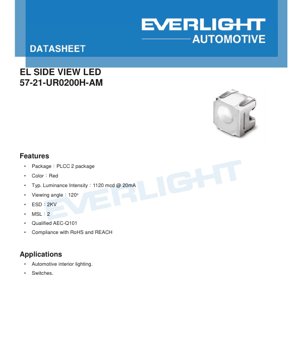
This document details the specifications of a high-performance side-emitting red LED designed specifically for automotive interior applications. The device utilizes a compact PLCC-2 (Plastic Leaded Chip Carrier) surface-mount package, offering both high luminous output and a wide viewing angle, making it suitable for backlighting and indicator functions.
The core advantage of this component lies in its automotive-grade reliability, having passed AEC-Q101 standard certification, ensuring stable operation under the typically harsh temperature, humidity, and vibration conditions found in vehicle environments. It complies with RoHS and REACH directives, making it suitable for global markets with stringent environmental regulations.
The target market is automotive electronics, with specific applications including dashboard backlighting, switch illumination, and other interior status indicators requiring stable, bright, and reliable red light output.
2. In-depth Technical Parameter Analysis
2.1 Optical, Photoelectric, and Electrical Characteristics
Key operating parameters define the performance of the LED under standard test conditions (Ts=25°C). At a forward current (IF) of 20mA, the typical forward voltage (VFThe voltage is 2.00V, with a specified range of 1.75V to 2.75V. This relatively low voltage is compatible with common automotive power rails.
The primary photometric parameter is the luminous intensity (IV), with a typical value of 1120 millicandelas (mcd) at 20mA. The minimum and maximum limits for this batch are 710 mcd and 1400 mcd, respectively. While achieving this high brightness, an extremely wide viewing angle (φ) of 120 degrees is maintained, which is defined as the off-axis angle where the luminous intensity drops to half of its peak value. This wide viewing angle ensures uniform illumination over a broad area, which is crucial for panel backlighting.
The dominant wavelength (λd) has a central value of 622 nm (typical), defining the hue of the emitted red light, with a range from 618 nm to 627 nm. This device is not designed for operation under reverse voltage.
2.2 Absolute Maximum Ratings and Thermal Management
These ratings define limits that may cause permanent damage. The absolute maximum continuous forward current is 50 mA, and the maximum power dissipation is 137 mW. For short pulses (t ≤ 10 μs, duty cycle D=0.005), the allowed surge current (IFM) is 100 mA.
Thermal management is crucial for the lifespan and performance stability of LEDs. The thermal resistance from the LED junction to the solder point (RthJS) specifies two values: 160 K/W (actual value, based on thermal measurement) and 120 K/W (electrical value, derived from electrical parameters). This parameter indicates the efficiency of heat conduction away from the semiconductor junction. The maximum allowable junction temperature (TJ) is 125°C. The operating and storage temperature range is -40°C to +110°C, confirming its suitability for harsh automotive environments.
The device has an ESD (Electrostatic Discharge) sensitivity rating of 2 kV (Human Body Model), which is a standard level for many electronic components, but standard ESD handling precautions are required during assembly.
3. Grading System Description
To manage production variations, LEDs are sorted into different bins based on key performance parameters. This datasheet provides detailed binning information for luminous intensity and dominant wavelength.
3.1 Luminous Intensity Binning
Luminous intensity is binned using alphanumeric codes (e.g., L1, M2, V1, AA). Each bin covers a specific minimum and maximum luminous intensity value range measured in millicandelas (mcd). The bins follow a logarithmic progression, with each step corresponding to approximately a 25% increase. For this specific model (57-21-UR0200H-AM), the possible output bins are highlighted, with the typical value of 1120 mcd falling into the "AA" bin (1120-1400 mcd). This system allows designers to select components with consistent brightness for their application.
Similarly, the dominant wavelength, which determines the precise color of the red light, is also graded. The grades are defined by numeric codes representing wavelength ranges in nanometers (nm). The typical value of 622 nm for this LED will fall within a specific wavelength grade, ensuring color consistency among multiple devices within a production batch. The tolerance for dominant wavelength measurement is ±1 nm.
4. Performance Curve Analysis
Datasheet ya ƙunshi jadawali da yawa, waɗanda ke bayyana halayen LED a ƙarƙashin yanayi daban-daban, wannan yana da mahimmanci ga ƙira da sarrafa zafi na kewayawa.
4.1 Forward Current vs. Forward Voltage Relationship Curve (IV Curve)
Wannan zane yana nuna madaidaicin ƙarfafawa (I
) and forward voltage (VF). It is crucial for designing current-limiting circuits. The curve indicates that a slight increase in voltage beyond the typical value of 2.0V can lead to a significant and potentially destructive increase in current, highlighting the necessity of using constant current drivers rather than constant voltage power supplies.F4.2 Relative Luminous Intensity vs. Forward Current
This diagram shows how the light output varies with the drive current. While the output increases with current, it is not perfectly linear, especially at higher currents where efficiency may decrease due to increased heat generation.
4.3 Temperature-Dependent Characteristics
Multiple charts detail the junction temperature (T
) nufa:JRelative luminous intensity vs. junction temperature:
- Shows that light output decreases as temperature increases. This derating must be considered in designs where the LED may operate at high ambient temperatures.Relative forward voltage vs. junction temperature:
- Indicates VIt has a negative temperature coefficient, decreasing by approximately 2 mV per degree Celsius. This may affect the performance of simple resistor-based current limiters.FRelative Wavelength vs. Junction Temperature:
- Indicates that the dominant wavelength shifts slightly with temperature (typically increasing), which may cause slight color variations in applications.4.4 Forward Current Derating Curve
This is one of the most critical charts for reliable design. It plots the maximum allowable continuous forward current against the pad temperature. As the solder point temperature rises, the maximum safe current decreases linearly. For example, at a maximum pad temperature of 110°C, the maximum allowable continuous current is only 34 mA, significantly lower than the absolute maximum of 50 mA at 25°C. Designers must ensure the thermal design keeps the solder point sufficiently cool to allow the required drive current.
4.5 Allowable Pulse Handling Capability
This diagram defines the relationship between the pulse width (t) and the allowed surge forward current (I) for different duty cycles (D).
) and the allowed surge forward current (Ip). It enables designers to understand the limits of pulsed operation, such as in multiplexed lighting systems or when creating flashing effects, ensuring the LED is not subjected to current pulses that could lead to performance degradation.F4.6 Spectral and Radiant Distribution
The relative spectral distribution graph shows the light output across the entire visible spectrum, peaking in the red light region at approximately 622 nm. The radiation pattern diagram (polar plot) visually confirms the 120-degree viewing angle, illustrating the spatial distribution of intensity.
5. Mechanical, Assembly, and Packaging Information
5.1 Mechanical Dimensions and Polarity
This component uses a standard PLCC-2 surface-mount package. The mechanical drawing provides precise dimensions for the package body, lead pitch, and overall height. Polarity is clearly indicated, typically by a notch or mark on the package and/or in the land pattern. Correct orientation is crucial for proper operation.
5.2 Recommended Pad Design
Provides pad pattern (footprint) recommendations for PCB design. This includes the dimensions and spacing of the copper pads to which the LED pins will be soldered. Following this recommendation ensures good solder joint formation, proper alignment, and optimal heat transfer from the device to the PCB.
5.3 Reflow Soldering Temperature Profile
The datasheet specifies a reflow soldering temperature profile compatible with lead-free (Pb-free) soldering processes. The peak temperature should not exceed 260°C, and the time above 240°C should be limited to a maximum of 30 seconds. Adherence to this profile is crucial to prevent thermal damage to the LED's plastic package and internal wire bonds during surface-mount assembly.
5.4 Packaging Information
The LEDs are supplied in tape-and-reel packaging suitable for automatic pick-and-place machines. Specifications include reel dimensions, carrier tape width, pocket pitch, and component orientation on the tape. This information is necessary for setting up assembly line equipment.
6. Application Guide and Design Considerations
6.1 Typical Application Scenarios
The main application is
Automotive interior lightingThis includes:Instrument cluster and dashboard backlighting:
- Illuminates the instrument cluster, LCD display, and warning symbols.Switch and Control Illumination:
- Provides backlighting for buttons of the air conditioning controls, audio system, window switches, and gear selector.General Status Indicator:
- Power Indicator, Door Ajar Warning, or other function indicators.Its side-emitting characteristics are ideal for applications requiring light to be guided parallel to the PCB surface into a light guide plate or diffuser.
1. Driving Circuit:
Be sure to use a constant current driver or a current-limiting resistor in series with the LED. The resistor value (R) can be calculated using Ohm's Law: R = (VPower Supply- V) / IF. Ensure the resistor's rated power is sufficient (P = IF* R).F22. Thermal Management:
This is crucial for reliability and maintaining light output. Use derating curves to determine the maximum drive current based on the expected operating temperature. Ensure sufficient copper area (thermal pad) on the PCB connected to the pad for heat dissipation. In high ambient temperature environments (e.g., near automotive engine compartment electronics), additional cooling measures may be required.3. ESD Protection:
Implement standard ESD handling procedures during assembly. For sensitive applications, consider adding Transient Voltage Suppression (TVS) diodes or other protection circuits on the input power lines.4. Optical Design:
A 120-degree viewing angle may require the use of a diffuser or light guide plate to achieve the desired uniformity and appearance in the final product. The side-emitting form factor is chosen precisely for efficient coupling into such optical elements.7. Usage Precautions
The datasheet includes a standard precautions section. Key points include:
Avoid applying reverse voltage.
- Do not exceed the absolute maximum ratings for current, power, and temperature.
- Follow the recommended reflow soldering temperature profile to prevent package damage.
- Store under appropriate conditions to avoid moisture absorption (MSL 2 indicates a floor life of 1 year after the dry pack is opened at ≤30°C/60% RH).
- Use cleaning methods compatible with the package material (avoid ultrasonic cleaning at certain frequencies).
- 8. Ordering Information
Model 57-21-UR0200H-AM follows a specific coding system. While the complete breakdown may be proprietary, it typically encodes information such as package type (57-21 may indicate PLCC-2), color (UR indicates red), brightness bin, and other possible attributes. For specific bin selection or packaging options (e.g., reel size), the ordering information section will provide the exact code to use.
9. Frequently Asked Questions Based on Technical Parameters
Q: Can I connect this LED directly to a 5V or 12V automotive power rail?
A: No. You must always use a series current-limiting resistor or a constant-current driver. Connecting it directly to a voltage source higher than its forward voltage will cause excessive current, potentially damaging the LED immediately.
Q: The datasheet shows a typical intensity of 1120mcd. Why might my measured value be different?
A: There are several factors that can affect the measured intensity: the drive current (which must be exactly 20mA), the temperature of the LED during measurement, the calibration of the measuring equipment, and inherent binning variations (your sample could be from the lower or upper end of the AA bin).
Q: Is this LED suitable for automotive exterior applications, such as taillights?
A: While it is AEC-Q101 qualified, its primary listed application is interior lighting. Exterior lamps typically have different requirements for higher brightness, different chromaticity coordinates, and more stringent weatherproofing and UV exposure protection. A dedicated exterior automotive-grade LED would be more appropriate.
Q: What does MSL 2 mean for storage?
A: Moisture Sensitivity Level 2 means the package can be exposed to factory floor conditions (≤30°C/60% RH) for up to 1 year before it requires baking prior to reflow soldering. Components on tape-and-reel are shipped in a dry bag with a humidity indicator card.
A: Moisture Sensitivity Level 2 means the package can be exposed to factory floor conditions (≤30°C/60% RH) for up to 1 year before it requires baking prior to reflow soldering. Components on tape-and-reel are shipped in a dry bag with a humidity indicator card.
Detailed Explanation of LED Specification Terminology
Complete Interpretation of LED Technical Terminology
I. Core Indicators of Photoelectric Performance
| Terminology | Unit/Representation | Popular Explanation | Why It Matters |
|---|---|---|---|
| Luminous Efficacy | lm/W (lumens per watt) | The luminous flux emitted per watt of electrical power; higher values indicate greater energy efficiency. | It directly determines the energy efficiency rating of the luminaire and the electricity cost. |
| Luminous Flux | lm (lumen) | The total amount of light emitted by a light source, commonly known as "brightness". | Determines whether the luminaire is bright enough. |
| Viewing Angle | ° (degree), e.g., 120° | The angle at which luminous intensity drops to half, determining the beam width. | Affects the range and uniformity of illumination. |
| Correlated Color Temperature (CCT) | K (Kelvin), such as 2700K/6500K | Haske launin dumi da sanyi, ƙananan ƙima sun karkata zuwa rawaya/dumi, manyan ƙima sun karkata zuwa fari/sanyi. | Yana ƙayyade yanayin hasken wuta da kuma yanayin da ya dace. |
| Color Rendering Index (CRI / Ra) | Unitless, 0–100 | The ability of a light source to reproduce the true colors of objects, with Ra≥80 being preferable. | Affects color authenticity, used in high-demand places such as shopping malls and art galleries. |
| Color tolerance (SDCM) | MacAdam ellipse step, such as "5-step" | A quantitative metric for color consistency; a smaller step number indicates better color consistency. | Ensure no color variation among luminaires from the same batch. |
| Dominant Wavelength | nm (nanometer), e.g., 620nm (red) | Wavelength values corresponding to the colors of colored LEDs. | Determines the hue of monochromatic LEDs such as red, yellow, and green. |
| Spectral Distribution | Wavelength vs. Intensity Curve | Shows the intensity distribution of light emitted by an LED at each wavelength. | Affects color rendering and color quality. |
II. Electrical Parameters
| Terminology | Symbols | Popular Explanation | Design Considerations |
|---|---|---|---|
| Forward Voltage (Forward Voltage) | Vf | The minimum voltage required to light up an LED, similar to a "starting threshold". | The driving power supply voltage must be ≥ Vf; the voltages add up when multiple LEDs are connected in series. |
| Forward Current | If | The current value that makes the LED emit light normally. | Constant current drive is often used, as the current determines brightness and lifespan. |
| Maximum Pulse Current | Ifp | Peak current that can be withstood for a short period, used for dimming or flashing. | Pulse width and duty cycle must be strictly controlled, otherwise overheating damage will occur. |
| Reverse Voltage | Vr | Maximum reverse voltage that an LED can withstand; exceeding it may cause breakdown. | Reverse connection or voltage surges must be prevented in the circuit. |
| Thermal Resistance (Thermal Resistance) | Rth (°C/W) | The resistance to heat flow from the chip to the solder joint. A lower value indicates better heat dissipation. | High thermal resistance requires stronger cooling design, otherwise junction temperature will rise. |
| Electrostatic Discharge Immunity (ESD Immunity) | V (HBM), e.g., 1000V | Electrostatic discharge immunity; a higher value indicates greater resistance to electrostatic damage. | Anti-static measures must be implemented during production, especially for high-sensitivity LEDs. |
III. Thermal Management and Reliability
| Terminology | Key Indicators | Popular Explanation | Impact |
|---|---|---|---|
| Junction Temperature | Tj (°C) | The actual operating temperature inside the LED chip. | For every 10°C reduction, the lifespan may double; excessively high temperatures cause lumen depreciation and color shift. |
| Lumen Depreciation | L70 / L80 (hours) | The time required for the brightness to drop to 70% or 80% of its initial value. | Directly define the "useful life" of an LED. |
| Lumen Maintenance | % (e.g., 70%) | The percentage of remaining brightness after a period of use. | Characterizes the ability to maintain brightness after long-term use. |
| Color Shift | Δu′v′ or MacAdam ellipse | The degree of color change during use. | Affects the color consistency of the lighting scene. |
| Thermal Aging | Material performance degradation | Degradation of packaging materials due to long-term high temperature. | Zai iya haifar da raguwar haske, canjin launi ko gazawar bude hanya. |
IV. Kullewa da Kayan aiki
| Terminology | Nau'o'in da aka saba gani | Popular Explanation | Characteristics and Applications |
|---|---|---|---|
| Package Types | EMC, PPA, Ceramic | The housing material that protects the chip and provides optical and thermal interfaces. | EMC offers good heat resistance and low cost; ceramic provides superior heat dissipation and long lifespan. |
| Chip Structure | Front-side, Flip Chip | Chip electrode arrangement method. | Flip-chip offers better heat dissipation and higher luminous efficacy, suitable for high-power applications. |
| Phosphor coating. | YAG, silicate, nitride | Coated on the blue LED chip, partially converted to yellow/red light, mixed to form white light. | Different phosphors affect luminous efficacy, color temperature, and color rendering. |
| Lens/Optical Design | Flat, microlens, total internal reflection | Optical structure on the packaging surface, controlling light distribution. | Determines the emission angle and light distribution curve. |
V. Quality Control and Grading
| Terminology | Grading Content | Popular Explanation | Purpose |
|---|---|---|---|
| Luminous Flux Binning | Codes such as 2G, 2H | Group by brightness level, each group has a minimum/maximum lumen value. | Ensure consistent brightness for products in the same batch. |
| Voltage binning | Codes such as 6W, 6X | Grouped by forward voltage range. | Ease of matching the driving power supply, improving system efficiency. |
| Color binning | 5-step MacAdam ellipse | Group by color coordinates to ensure colors fall within a minimal range. | Ensure color consistency to avoid uneven color within the same luminaire. |
| Color temperature grading | 2700K, 3000K, etc. | Group by color temperature, each group has a corresponding coordinate range. | Meet the color temperature requirements of different scenarios. |
VI. Testing and Certification
| Terminology | Standard/Test | Popular Explanation | Meaning |
|---|---|---|---|
| LM-80 | Lumen Maintenance Test | Long-term operation under constant temperature conditions, recording luminance attenuation data. | For estimating LED lifetime (in conjunction with TM-21). |
| TM-21 | Lifetime projection standard | Projecting lifespan under actual use conditions based on LM-80 data. | Providing scientific life prediction. |
| IESNA Standard | Illuminating Engineering Society Standard | Covers optical, electrical, and thermal test methods. | Industry-recognized testing basis. |
| RoHS / REACH | Environmental Certification | Ensure the product does not contain harmful substances (such as lead, mercury). | Entry requirements for the international market. |
| ENERGY STAR / DLC | Energy efficiency certification | Energy efficiency and performance certification for lighting products. | Commonly used in government procurement and subsidy programs to enhance market competitiveness. |