Table of Contents
- 1. Product Overview
- 1.1 Kasuwa da aikace-aikace
- 2. Bincike mai zurfi na sigogi na fasaha
- 2.1 Halaye na Photometry da Optics
- 2.2 Halaye na Lantarki
- 2.3 Thermal Characteristics
- 3. Absolute Maximum Ratings
- 4. Binning System Description
- 4.1 Luminous Intensity Binning
- 4.2 Chromaticity Coordinate Binning (Sky Blue)
- 5. Performance Curve Analysis
- 5.1 Forward Current vs. Forward Voltage (I-V Curve)
- 5.2 Relative Luminous Intensity vs. Forward Current
- 5.3 Temperature Dependence
- 5.4 Spectral Distribution and Radiation Pattern
- 5.5 Forward Current Derating and Pulse Handling Capability
- 6. Mechanical and Packaging Information
- 6.1 Mechanical Dimensions
- 6.2 Recommended Land Pattern
- 6.3 Polarity Identification
- 7. Soldering and Assembly Guide
- 7.1 Lankwalin Walda na Reflow
- 7.2 Abubuwan Lura na Amfani
- 7.3 Matakin Kula da Danshi (MSL)
- 8. Bayanin Marufi da Oda
- 8.1 Bayanin Bayani
- 8.2 Nau'in da Bayanin Oda
- 9. Tunani na Zane na Aikace-aikace
- 9.1 Zane na Lantarki
- 9.2 Thermal Design in Automotive Applications
- 9.3 Optical Integration
- 10. Technical Comparison and Differentiation
- 11. Frequently Asked Questions (Based on Technical Parameters)
- 12. Nazarin lamarin ƙira
- 13. Taƙaitaccen bayani na ka'idar fasaha
- 14. Yanayin masana'antu
- Cikakken bayani na kalmomin ƙayyadaddun LED
- I. Core Indicators of Photoelectric Performance
- II. Electrical Parameters
- III. Thermal Management and Reliability
- IV. Packaging and Materials
- V. Quality Control and Binning
- VI. Testing and Certification
1. Product Overview
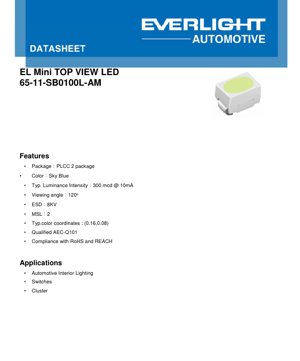
This document provides the complete technical specifications for a high-brightness sky blue LED utilizing a PLCC-2 (Plastic Leaded Chip Carrier) surface-mount package. The component is designed for reliability and performance in demanding applications, with a typical luminous intensity of 300 millicandelas (mcd) at a forward current of 10mA. Its primary design targets include automotive interior environments and other applications requiring consistent color and stable output.
The core advantage of this LED lies in its combination of a 120-degree wide viewing angle (suitable for area lighting) and compliance with the AEC-Q101 standard (which is crucial for automotive-grade components). It also complies with the RoHS and REACH environmental directives. The device provides detailed luminous intensity and chromaticity coordinate binning information, facilitating precise selection in designs with strict color requirements.
1.1 Kasuwa da aikace-aikace
The primary target market for this LED is the automotive electronics field, particularly interior lighting applications. Its reliability specifications make it suitable for integration into vehicle systems that must operate over a wide temperature range and withstand long-term use.
- Automotive Interior Lighting:Suitable for instrument panel backlighting, ambient lighting, and indicator lights within the cabin.
- Switches:Can be used for illuminating mechanical or capacitive touch switches.
- Dashboard:Suitable for instrument and display backlighting requiring stable blue illumination.
2. Bincike mai zurfi na sigogi na fasaha
The following section provides a detailed and objective interpretation of the key electrical, optical, and thermal parameters defined in the datasheet. Understanding these values is crucial for proper circuit design and thermal management.
2.1 Halaye na Photometry da Optics
Optical performance is defined under standard test conditions of 10mA forward current (IF) and a pad temperature of 25°C.
- Typical luminous intensity (IV):300 mcd. Wannan shine ƙimar tsakiya, tabbataccen mafi ƙarancin ƙimar samfurin daidaitacce shine 112 mcd, mafi girma shine 450 mcd.
- Kallon kusurwa (2θ½):120 digiri. Wannan shine cikakken kusurwar da ƙarfin haske ya ragu zuwa rabin ƙimar kololuwar sa. Tolerancin da ya dace shine ±5 digiri.
- Matsakaicin ma'auni na launi (CIE x, y):(0.16, 0.08). Waɗannan ma'auni suna ayyana takamaiman launin shuɗi a cikin taswirar launi ta CIE 1931. Tolerancin waɗannan ma'auni shine ±0.005.
2.2 Halaye na Lantarki
- Ƙarfin lantarki na gaba (VF):A cikin IF=10mA, matsakaicin ƙimar shine 3.1V, kewayon daga 2.75V (mafi ƙanƙanta) zuwa 3.75V (mafi girma). Tolerancin ma'auni na wannan siga shine ±0.05V. VFThe range represents 99% of the output yield.
- Forward Current (IF):The recommended continuous operating current is 10mA (typical). The absolute maximum rating is 20mA. The minimum current required for operation is 2mA.
- Electrostatic Discharge (ESD) Sensitivity:Rated at 8 kV (Human Body Model, HBM). This indicates a medium level of ESD robustness, but standard ESD precautions are still required during assembly.
2.3 Thermal Characteristics
- Thermal Resistance (RthJS):Two values are provided. The actual thermal resistance (junction-to-pad) is a maximum of 120 K/W, while the value derived by the electrical method is a maximum of 95 K/W. Designers should use the more conservative value of 120 K/W for reliable thermal calculations.
- Junction Temperature (TJ):The maximum allowable temperature for the LED chip junction is 125°C.
- Operating Temperature Range (Topr):-40°C to +110°C. This wide range is crucial for automotive applications.
3. Absolute Maximum Ratings
Exceeding these limits may cause permanent damage to the device. They are not operating conditions.
- Power Dissipation (Pd):75 mW
- Forward Current (IF):20 mA (DC)
- Surge current (IFM):Up to 300 mA for pulses with a pulse width ≤10μs and a duty cycle (D) of 0.005 (at 25°C).
- Reverse voltage (VR):This device is not designed for reverse operation. Applying reverse voltage may cause immediate failure.
- Storage temperature (Tstg):-40°C to +110°C.
- Reflow soldering temperature:Can withstand 260°C for 30 seconds, which is compatible with standard lead-free reflow soldering profiles.
4. Binning System Description
To ensure color and brightness consistency in production, LEDs are sorted into different bins. This device uses two primary binning structures.
4.1 Luminous Intensity Binning
Light output is grouped by alphanumeric codes (e.g., L1, R2, T1). Each bin defines a minimum and maximum luminous intensity in millicandelas (mcd). Bins follow a logarithmic progression, typically where a bin's maximum is about 1.26 times its minimum (the fifth root of 10). For this specific model, prominent possible output bins are centered in the T1/T2 range (280-450 mcd), aligning with a typical value of 300 mcd. The tolerance for luminous flux measurement is ±8%.
4.2 Chromaticity Coordinate Binning (Sky Blue)
Colors are defined in the CIE 1931 (x, y) chromaticity diagram. The datasheet shows a detailed binning structure diagram for sky blue. Bins are labeled (e.g., JA1, JA2, JA11), with each bin defined by four coordinate points forming a quadrilateral on the chromaticity diagram. The typical coordinate (0.16, 0.08) falls within this structure. A strict tolerance of ±0.005 ensures minimal visual color difference between units within the same bin.
5. Performance Curve Analysis
The provided graphs illustrate how key parameters vary with operating conditions, which is crucial for dynamic design analysis.
5.1 Forward Current vs. Forward Voltage (I-V Curve)
This graph shows the typical exponential relationship of a diode. At 25°C, the voltage increases from approximately 2.9V at 5mA to about 3.3V at 25mA. This curve is essential for calculating the LED's current-limiting resistor value and power dissipation.
5.2 Relative Luminous Intensity vs. Forward Current
The light output increases superlinearly with current. At 10mA, the relative intensity is defined as 1.0. At 25mA, it increases to approximately 2.2. This indicates that driving the LED with a current higher than the typical 10mA produces more light, but also increases heat and reduces efficiency (lumens per watt).
5.3 Temperature Dependence
- Relative Luminous Intensity vs. Junction Temperature:Light output decreases with increasing temperature. At the maximum junction temperature of 125°C, the output is about 40% of its value at 25°C. This significant drop must be considered in designs where the LED may operate at high ambient temperatures.
- Relative Forward Voltage vs. Junction Temperature:The forward voltage has a negative temperature coefficient, decreasing by approximately 2mV/°C. This can be used in some temperature sensing circuits, but is generally a secondary effect.
- Chromaticity Shift vs. Temperature/Current:The chart shows slight shifts in chromaticity coordinates (x and y) with changes in junction temperature and drive current. These shifts are typically within a few thousandths of a CIE unit, usually imperceptible to the human eye, but may be relevant in high-precision color-matching applications.
5.4 Spectral Distribution and Radiation Pattern
The relative spectral distribution plot shows the characteristic peak wavelength of the phosphor-coated blue LED for producing sky blue, resulting in a broader emission spectrum than a pure blue chip. The radiation pattern diagram confirms a Lambertian-like emission profile with a 120-degree viewing angle.
5.5 Forward Current Derating and Pulse Handling Capability
The derating curve specifies that the maximum allowable continuous forward current must be reduced as the pad temperature increases. At the maximum operating pad temperature of 110°C, the current must not exceed 20mA. The pulse handling capability chart shows that for very short duty cycles, the LED can withstand peak currents (IFP) significantly higher than its DC rating.
6. Mechanical and Packaging Information
6.1 Mechanical Dimensions
The PLCC-2 package measures approximately 3.1mm (length) x 2.8mm (width) x 1.9mm (height). Detailed drawings are provided showing overall dimensions with tolerances, lead pitch, and cavity details.
6.2 Recommended Land Pattern
A pad pattern design is recommended for PCB layout to ensure reliable soldering and proper alignment. Pad dimensions are typically slightly larger than the device leads to facilitate good fillet formation.
6.3 Polarity Identification
The PLCC-2 package incorporates a built-in polarity indicator. One corner of the device is chamfered or notched. The cathode (-) is typically located at this marked corner. The datasheet drawing clearly marks the anode and cathode.
7. Soldering and Assembly Guide
7.1 Lankwalin Walda na Reflow
A recommended reflow soldering profile is provided, compliant with standard lead-free processes. The key parameter is a peak temperature of 260°C, which the device can withstand for up to 30 seconds. Preheating, soaking, reflow, and cooling rates are specified to minimize thermal stress on the component.
7.2 Abubuwan Lura na Amfani
- ESD Protection:Despite an 8kV HBM rating, standard ESD control measures must be used during handling and assembly.
- Current Limiting:Always use a series resistor or constant current driver to limit the forward current to the desired value. Do not connect directly to a voltage source.
- Reverse Voltage Protection:Avoid applying any reverse bias. In circuits where reverse voltage may occur, a protection diode should be connected in series or in parallel (with current limiting).
- Thermal Management:Ensure sufficient PCB copper area or other heat dissipation measures to keep the pad temperature within limits, especially when driving at higher currents or in high ambient temperatures.
- Cleaning:If cleaning is required after soldering, use a compatible solvent that does not damage the plastic lens.
7.3 Matakin Kula da Danshi (MSL)
The humidity sensitivity level of this device is MSL 2. This means it can be exposed to factory floor conditions (≤30°C / 60% RH) for up to one year. If the sealed dry pack bag is opened, the component must be soldered within one week; otherwise, it needs to be baked before reflow soldering to prevent "popcorn" effect damage.
8. Bayanin Marufi da Oda
8.1 Bayanin Bayani
LEDs are supplied in embossed carrier tape and reel format, suitable for automatic pick-and-place assembly. The datasheet specifies the carrier tape width, pocket size, reel diameter, and the number of components per reel.
8.2 Nau'in da Bayanin Oda
The model system is not fully detailed in the excerpt, but it typically encodes key attributes such as package type, color, brightness bin, and possibly color bin. Specific ordering requires selecting the desired luminous intensity and chromaticity bin from the available options.
9. Tunani na Zane na Aikace-aikace
9.1 Zane na Lantarki
For basic operation using a constant voltage source (VCC), calculate the series resistor (RS) using the following formula: RS= (VCC- VF) / IF. Use the maximum V from the specification sheet.FValue, to ensure the minimum current can be met under all conditions. For example, using a 5V power supply and the desired IFFor 10mA: RS= (5V - 3.75V) / 0.01A = 125Ω. Use the next standard value, 130Ω. The power rating of the resistor should be at least IF2* RS= 0.013W, so a 1/8W or 1/10W resistor is sufficient.
9.2 Thermal Design in Automotive Applications
In automotive interiors, the ambient temperature can easily reach 85°C. If the LED is mounted on a small PCB with limited copper area, the pad temperature (TS) may approach ambient temperature. From the derating curve, at TSAt 85°C, the maximum allowable IFstill exceeds 20mA, so a 10mA drive is safe. However, if the LED is placed near other heat-generating components, the local temperature may be higher, requiring thermal analysis.
9.3 Optical Integration
The 120-degree viewing angle provides broad, uniform illumination. For applications requiring a more focused beam, external secondary optics (lenses) are needed. Plastic lens materials may be sensitive to prolonged exposure to strong UV light, which is typically not an issue in interior applications.
10. Technical Comparison and Differentiation
Compared to generic non-automotive-grade PLCC-2 LEDs, the key differentiators of this device are its AEC-Q101 certification and detailed, guaranteed binning structure. Many standard LEDs have looser tolerances for luminous intensity and color, which can lead to visible inconsistencies in the final product. The 8kV ESD rating is also higher than many basic commercial-grade LEDs. The wide operating temperature range (-40 to +110°C) is specifically targeted for automotive requirements, whereas consumer-grade LEDs typically have a narrower range, such as -20 to +85°C.
11. Frequently Asked Questions (Based on Technical Parameters)
Tambaya: Zan iya sarrafa wannan LED a ci gaba da 20mA?
Amsa: I, amma idan zafin gindin (TS) ya yi daidai ko ƙasa da 25°C. Yayin da TSya tashi, bisa ga lanƙwan rage ƙimar, mafi girman ƙarfin da aka yarda zai ragu. A yanayin zafi na yau da kullun, ƙaramin ƙarfi (kamar 10-15mA) ya fi aminci don dogon lokaci.
Tambaya: Na yau da kullun VFshine 3.1V, amma na'urata ta auna 3.0V. Shin wannan yana da matsala?
Amsa: A'a. VFyana da kewayon (2.75V zuwa 3.75V) da rarraba samarwa. Ma'aunin 3.0V gaba ɗaya yana cikin ƙayyadaddun mafi ƙanƙanta da ƙimar yau da kullun. Haƙiƙanin ƙarfin hasken ku na iya bambanta kaɗan daga abin da aka annabta ta hanyar lanƙwan na yau da kullun, amma har yanzu zai kasance cikin iyakokin rarrabuwa.
Tambaya: Me yasa ƙarfin haske aka ƙayyade a 10mA maimakon mafi girman 20mA?
Amsa: 10mA shine daidaitaccen yanayin gwaji don tabbatar da daidaiton aunawa da kwatanta tsakanin LED daban-daban da masu kera. Yana wakiltar madaidaicin wurin aiki na yau da kullun wanda ke daidaita haske, inganci da rayuwar na'urar.
Q: How to choose the correct bin for my application?
A: For applications where multiple LEDs are used side-by-side (e.g., light strips), select tight luminous intensity bins (e.g., T1 only) and a single chromaticity bin code to ensure uniform brightness and color. For single LED applications, wider bins (e.g., T1/T2) may be acceptable and potentially more cost-effective.
12. Nazarin lamarin ƙira
Scenario:Design backlighting for an automotive center console switch panel. Four identical sky-blue LEDs are needed to evenly illuminate four buttons.
Design Steps:
1. Electrical Design:Vehicle power supply nominal 12V. Use linear regulator to provide stable 5V power for LEDs. For each LED: RS= (5V - 3.75V) / 0.01A = 125Ω. Use 130Ω, 1/10W resistor. Total current consumption: 4 * 10mA = 40mA.
2. Optics and Binning Selection:To ensure the four buttons appear consistent, order all LEDs with the same luminous intensity bin (e.g., T1: 280-355 mcd) and the same chromaticity bin (e.g., JA1). This minimizes unit-to-unit variation.
3. Thermal and Layout:The internal temperature of the center console may reach 80°C. LEDs will be mounted on small PCBs. To keep TSlow, use PCB with at least 1oz copper and connect the LED's thermal pad to a small copper pour area. The derating curve shows operation at 10mA is still safe at this temperature.
4. Verification:Build prototypes and measure luminous output and color at room temperature and after 80°C hot soak. Verify if the intensity drop at high temperature is acceptable for the application.
13. Taƙaitaccen bayani na ka'idar fasaha
This LED is based on the principle of semiconductor electroluminescence. A forward bias applied across the p-n junction causes recombination of electrons and holes, releasing energy in the form of photons. The base semiconductor material (typically InGaN) emits blue light. To achieve sky blue, a portion of the blue light from the chip is converted by a phosphor coating (typically based on cerium-doped yttrium aluminum garnet or similar materials). The mixture of direct blue light emission and the broad-spectrum light from down-conversion produces the final sky blue chromaticity point defined by CIE coordinates. The PLCC-2 package provides a molded plastic lens that shapes the light output into the required 120-degree radiation pattern and protects the semiconductor die and bond wires.
14. Yanayin masana'antu
Driven by the popularity of ambient lighting and fully digital instrument clusters, the market for SMD LEDs in automotive interiors continues to grow. Trends include:
Higher Efficiency:Ci gaba da ci gaba yana nufin samar da haske mai ƙarfi (mcd) a ƙarƙashin wutar lantarki iri ɗaya ko ƙasa, don haka rage amfani da wutar lantarki da kuma nauyin zafi.
Daidaita launi da daidaito:Buƙatun da ke ƙaruwa don daidaitaccen launi tsakanin LED da yawa da kuma cikin tsawon rayuwar samfur, suna haifar da ƙaƙƙarfan ƙa'idodin rarrabuwa da kuma fitowar direbobin LED masu shirye-shirye na tashoshi da yawa.
Haɗaɗɗiya:Yarjejeniyar ita ce haɗa ƙwayoyin LED da yawa (misali RGB) cikin fakit ɗaya, ko haɗa LED tare da IC mai tuƙi don sauƙaƙa ƙira.
Mai da hankali kan amincin aiki:Yayin da LED ke zama mahimmanci a cikin aikace-aikacen da ke da alaƙa da aminci (misali alamun gargaɗi), ƙa'idodin takaddun shaida kamar AEC-Q102 (AEC-Q101 don madaidaicin ma'auni na na'urorin haske masu rarrabuwa) suna ƙara ƙarfi, suna buƙatar masu samarwa su ba da cikakkun bayanai na gwajin rayuwa da damuwa.
Cikakken bayani na kalmomin ƙayyadaddun LED
Complete Explanation of LED Technical Terminology
I. Core Indicators of Photoelectric Performance
| Terminology | Unit/Representation | Layman's Explanation | Why It Is Important |
|---|---|---|---|
| Luminous Efficacy | lm/W (lumen per watt) | The luminous flux emitted per watt of electrical power; higher values indicate greater energy efficiency. | Directly determines the energy efficiency rating of the luminaire and the electricity cost. |
| Luminous Flux | lm (lumen) | Total light output from a light source, commonly known as "brightness". | Determines if a luminaire is bright enough. |
| Viewing Angle | ° (degree), e.g., 120° | The angle at which light intensity drops to half, determining the beam width. | Affects the illumination range and uniformity. |
| Yanayin zafi na launi (CCT) | K (Kelvin), misali 2700K/6500K | Launin haske mai dumi ko sanyi, ƙananan ƙima yana karkata zuwa rawaya/dumi, babban ƙima yana karkata zuwa fari/sanyi. | Yana ƙayyade yanayin haskakawa da wurin da ya dace. |
| Ma'auni na nuna launi (CRI / Ra) | Babu raka'a, 0–100 | The ability of a light source to restore the true color of an object, Ra≥80 is preferred. | Affects color fidelity, used in high-demand places such as shopping malls and art galleries. |
| Color tolerance (SDCM) | MacAdam ellipse steps, e.g., "5-step" | A quantitative indicator of color consistency; the smaller the step number, the more consistent the color. | Ensures no color difference among the same batch of luminaires. |
| Dominant Wavelength | nm (nanometer), e.g., 620nm (red) | The wavelength value corresponding to the color of a colored LED. | Determines the hue of monochromatic LEDs such as red, yellow, and green. |
| Spectral Distribution | Wavelength vs. Intensity curve | Shows the intensity distribution of light emitted by the LED across various wavelengths. | Affects color rendering and color quality. |
II. Electrical Parameters
| Terminology | Symbol | Layman's Explanation | Design Considerations |
|---|---|---|---|
| Forward Voltage | Vf | The minimum voltage required to turn on an LED, similar to a "starting threshold". | The driving power supply voltage must be ≥ Vf; voltages add up when multiple LEDs are connected in series. |
| Forward Current | If | The current value that allows an LED to emit light normally. | Constant current drive is commonly used, as the current determines brightness and lifespan. |
| Maximum Pulse Current | Ifp | The peak current that can be withstood for a short duration, used for dimming or flashing. | Pulse width and duty cycle must be strictly controlled to prevent overheating and damage. |
| Reverse Voltage | Vr | The maximum reverse voltage that an LED can withstand; exceeding this may cause breakdown. | Reverse connection or voltage surges must be prevented in the circuit. |
| Thermal Resistance | Rth (°C/W) | The resistance to heat flow from the chip to the solder point; a lower value indicates better heat dissipation. | High thermal resistance requires a stronger heat dissipation design; otherwise, the junction temperature will increase. |
| Electrostatic Discharge Immunity (ESD Immunity) | V (HBM), e.g., 1000V | The ability to withstand electrostatic strikes; a higher value indicates greater resistance to damage from static electricity. | Anti-static measures must be implemented during production, especially for high-sensitivity LEDs. |
III. Thermal Management and Reliability
| Terminology | Viashiria Muhimu | Layman's Explanation | Athari |
|---|---|---|---|
| Junction Temperature | Tj(°C) | Joto halisi la kufanya kazi ndani ya chip ya LED. | Kwa kila kupungua kwa 10°C, maisha yanaweza kupanuliwa mara mbili; joto la juu sana husababisha kupungua kwa mwanga na kuteleza kwa rangi. |
| Lumen Depreciation | L70 / L80 (hours) | The time required for brightness to drop to 70% or 80% of its initial value. | Directly defines the "useful life" of an LED. |
| Lumen Maintenance | % (e.g., 70%) | The percentage of remaining brightness after a period of use. | Characterizes the ability to maintain brightness after long-term use. |
| Color Shift | Δu′v′ or MacAdam Ellipse | The degree of color change during use. | Affects the color consistency of the lighting scene. |
| Thermal Aging | Decline in material performance. | Degradation of packaging materials due to prolonged high temperatures. | May lead to decreased brightness, color shift, or open-circuit failure. |
IV. Packaging and Materials
| Terminology | Common Types | Layman's Explanation | Characteristics and Applications |
|---|---|---|---|
| Package Types | EMC, PPA, Ceramic | The housing material that protects the chip and provides optical and thermal interfaces. | EMC offers good heat resistance and low cost; ceramic provides superior heat dissipation and long lifespan. |
| Chip Structure | Front-side, Flip Chip | Chip electrode arrangement. | Flip Chip offers better heat dissipation and higher luminous efficacy, suitable for high power. |
| Phosphor coating | YAG, silicate, nitride | Coated on the blue LED chip, partially converting to yellow/red light, mixing to form white light. | Different phosphors affect luminous efficacy, color temperature, and color rendering. |
| Lens/Optical Design | Flat, microlens, total internal reflection | Optical structure on the package surface, controls light distribution. | Determines the emission angle and light distribution curve. |
V. Quality Control and Binning
| Terminology | Grading Content | Layman's Explanation | Purpose |
|---|---|---|---|
| Luminous Flux Grading | Codes such as 2G, 2H | Grouped by brightness level, each group has a minimum/maximum lumen value. | Ensure consistent brightness within the same batch of products. |
| Voltage Binning | Codes such as 6W, 6X | Group according to forward voltage range. | Facilitates driver matching and improves system efficiency. |
| Color Binning | 5-step MacAdam ellipse | Group by color coordinates to ensure colors fall within an extremely narrow range. | Ensure color consistency to avoid color variation within the same luminaire. |
| Color temperature binning | 2700K, 3000K, etc. | Group by color temperature, each group has a corresponding coordinate range. | Meet the color temperature requirements of different scenarios. |
VI. Testing and Certification
| Terminology | Standard/Test | Layman's Explanation | Significance |
|---|---|---|---|
| LM-80 | Lumen Maintenance Test | Long-term illumination under constant temperature conditions, recording brightness attenuation data. | Used to estimate LED lifetime (combined with TM-21). |
| TM-21 | Lifetime extrapolation standard | Estimate lifetime under actual use conditions based on LM-80 data. | Provide scientific lifetime prediction. |
| IESNA standard | Illuminating Engineering Society Standard | Covers optical, electrical, and thermal test methods. | Industry-recognized testing basis. |
| RoHS / REACH | Environmental Certification | Ensures products do not contain harmful substances (e.g., lead, mercury). | Market access requirements for entering international markets. |
| ENERGY STAR / DLC | Energy efficiency certification. | Energy efficiency and performance certification for lighting products. | Commonly used in government procurement and subsidy programs to enhance market competitiveness. |