Table of Contents
- 1. Product Overview
- 1.1 Core Advantages and Target Market
- 2. In-depth Analysis of Technical Parameters
- 2.1 Absolute Maximum Ratings
- 2.2 Electro-Optical Characteristics
- 3. Explanation of the Grading System
- 3.1 Luminous Intensity Grading
- 3.2 Dominant Wavelength Binning
- 3.3 Forward Voltage Binning
- 4. Performance Curve Analysis
- 4.1 Relative Luminous Intensity vs. Forward Current
- 4.2 Relative Luminous Intensity vs. Ambient Temperature
- 4.3 Forward Current Derating Curve
- 4.4 Forward Voltage vs. Forward Current
- 4.5 Spectral Distribution and Radiation Pattern
- 5. Mechanical and Packaging Information
- 5.1 Package Dimensions
- 5.2 Polarity Identification
- 6. Soldering and Assembly Guide
- 6.1 Storage and Moisture Sensitivity
- 6.2 Reflow soldering temperature profile
- 6.3 Manual soldering and rework
- 7. Packaging and Ordering Information
- 7.1 Reel and Carrier Tape Specifications
- 7.2 Label Description
- 8. Application Suggestions and Design Considerations
- 8.1 Typical Application Scenarios
- 8.2 Key Design Considerations
- 9. Technical Comparison and Differentiation
- 10. Frequently Asked Questions (Based on Technical Parameters)
- 10.1 Why is a current-limiting resistor absolutely essential?
- 10.2 Can I drive this LED directly with a 3.3V or 5V logic output?
- 10.3 What does a 120° viewing angle mean for my design?
- 10.4 How critical is the 7-day floor life after opening the moisture barrier bag?
- 11. Practical Design and Application Cases
- 12. Introduction to Working Principles
- 13. Technology Trends and Background
1. Product Overview
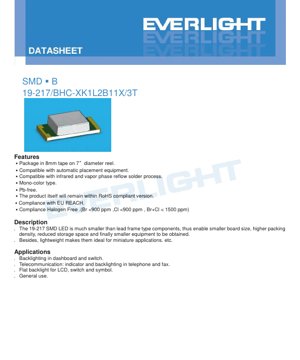
19-217, modern elektronik uygulamalar için güvenilir gösterge ışığı ve arka aydınlatma çözümleri gerektiren kompakt bir yüzey montajlı mavi ışık yayan diyottur. Cihaz, mavi spektrumda, tipik tepe dalga boyu 468 nanometre olarak ışık yayan InGaN (indiyum galyum nitrür) yarı iletken çip kullanır. Ana avantajı, geleneksel telli bileşenlere kıyasla baskılı devre kartlarında önemli ölçüde alan tasarrufu ve daha yüksek montaj yoğunluğu sağlayan mini paket boyutudur. Cihaz, RoHS (Zararlı Maddelerin Kısıtlanması), AB REACH düzenlemeleri dahil olmak üzere çağdaş çevresel ve üretim standartlarına tam uyumludur ve halojensiz bir ürün olarak sınıflandırılır.
1.1 Core Advantages and Target Market
The design of the 19-217 SMD LED offers several key advantages for engineers and designers. Its compact and lightweight nature makes it ideally suited for applications where space and weight are critical constraints. The device is supplied in 8mm carrier tape format, wound on 7-inch diameter reels, and is fully compatible with high-speed automated pick-and-place assembly equipment, thereby streamlining the manufacturing process. This LED is also compatible with standard infrared and vapor phase reflow soldering processes. Its primary target markets include automotive electronics (for dashboard and switch backlighting), telecommunications equipment (for telephone and fax machine indicator lights), consumer electronics for LCD backlighting, and general indicator applications.
2. In-depth Analysis of Technical Parameters
This section provides a detailed and objective analysis of the key electrical, optical, and thermal parameters specified in the datasheet, which are crucial for proper circuit design and reliability assessment.
2.1 Absolute Maximum Ratings
Absolute maximum ratings define the stress limits that may cause permanent damage to the device. These are not normal operating conditions.
- Reverse Voltage (VR):5V. Exceeding this voltage under reverse bias may cause junction breakdown.
- Continuous Forward Current (IF):10mA. The maximum DC current that can be continuously applied.
- Peak Forward Current (IFP):40mA. This is the maximum allowable pulse current, specified with a duty cycle of 1/10 and a frequency of 1kHz. Suitable for brief, high-intensity pulses, but not for continuous operation.
- Power Dissipation (Pd):40mW. The maximum power the package can dissipate as heat, calculated as forward voltage (VF) * forward current (IF). Operating near this limit requires careful thermal management.
- Electrostatic Discharge (ESD) Human Body Model (HBM):150V. This is a relatively low ESD tolerance, indicating that the device is sensitive to static electricity. Proper ESD handling procedures must be followed during assembly and handling.
- Operating Temperature (Topr):-40°C to +85°C. The ambient temperature range over which the device is guaranteed to meet its published specifications.
- Storage Temperature (Tstg):-40°C to +90°C.
- Soldering Temperature:The device can withstand reflow soldering with a peak temperature of 260°C for up to 10 seconds, or hand soldering at 350°C for up to 3 seconds per pin.
2.2 Electro-Optical Characteristics
Unless otherwise specified, these parameters are measured under standard test conditions of Ta=25°C and IF=2mA. They define the optical performance of the LED.
- Luminous Intensity (Iv):The range is from a minimum of 7.2 mcd to a maximum of 18.0 mcd. No typical value is specified, indicating that performance is managed through a binning system (see Section 3).
- Viewing Angle (2θ1/2):120 degrees. This is the full angle at which the luminous intensity drops to half of its peak value. The 120° angle provides a wide, diffuse emission pattern, suitable for area lighting and backlighting.
- Peak Wavelength (λp):468 nm (typical). This is the wavelength at which the spectral power distribution reaches its maximum.
- Dominant Wavelength (λd):465.0 nm to 470.0 nm. This is the single wavelength perceived by the human eye for the LED color and is a parameter used for color binning.
- Spectral Bandwidth (Δλ):25 nm (typical). This is the width of the emission spectrum, measured at half the maximum intensity (Full Width at Half Maximum - FWHM).
- Forward Voltage (VF):It is 2.60V to 2.90V at IF=2mA. This range is crucial for designing current limiting circuits.
- Reverse Current (IR):Maximum 50 μA at VR=5V. The datasheet clearly states that this device is not designed for reverse operation; this parameter is for test purposes only.
3. Explanation of the Grading System
To ensure performance consistency in mass production, LEDs are sorted into different bins based on key parameters. The 19-217 employs a three-dimensional binning system.
3.1 Luminous Intensity Grading
Based on the luminous intensity measured at 2mA, LEDs are sorted into four bins (K1, K2, L1, L2).
- Bin K1:7.2 - 9.0 mcd
- Gear K2:9.0 - 11.5 mcd
- Gear L1:11.5 - 14.5 mcd
- Gear L2:14.5 - 18.0 mcd
Gear limit applies ±11% tolerance.
3.2 Dominant Wavelength Binning
For this product, color control is within a single gear.
- Gear X:465.0 - 470.0 nm. A strict tolerance of ±1nm is specified.
3.3 Forward Voltage Binning
The forward voltage is divided into three bins to aid in designing consistent current drivers.
- Bin 28:2.60 - 2.70V
- Gear 29:2.70 - 2.80V
- Gear 30:2.80 - 2.90V
Apply a tolerance of ±0.05V.
4. Performance Curve Analysis
The datasheet provides several characteristic curves, which are crucial for understanding the behavior of LEDs under different operating conditions.
4.1 Relative Luminous Intensity vs. Forward Current
This curve shows that the light output is not linearly related to the current. It increases with current but eventually saturates. Operating above the recommended continuous current (10mA) may lead to reduced efficiency and accelerated aging.
4.2 Relative Luminous Intensity vs. Ambient Temperature
This diagram illustrates the negative temperature coefficient of LED light output. As the junction temperature increases, the luminous intensity decreases. For the 19-217, the output drops significantly when the ambient temperature approaches the maximum operating limit of 85°C. This must be considered in designs requiring consistent brightness over a wide temperature range.
4.3 Forward Current Derating Curve
This is one of the most critical charts for reliability. It shows the maximum allowable continuous forward current as a function of ambient temperature. As the temperature rises, the maximum safe current decreases. At 85°C, the permissible current is much lower than the 10mA rating at 25°C. Failure to derate the current can lead to thermal runaway and device failure.
4.4 Forward Voltage vs. Forward Current
This IV (Current-Voltage) curve shows the typical exponential relationship of a diode. Voltage increases logarithmically with current. This curve is crucial for selecting the appropriate current-limiting resistor or designing a constant-current driver.
4.5 Spectral Distribution and Radiation Pattern
The spectral plot confirms a blue emission centered at 468nm with a full width at half maximum of approximately 25nm. The radiation pattern diagram illustrates the spatial distribution of light, confirming a Lambertian-like emission pattern with the specified 120° viewing angle.
5. Mechanical and Packaging Information
5.1 Package Dimensions
19-217 uses a standard SMD package. Key dimensions (unit: mm) include a body length of approximately 2.0mm, a width of approximately 1.25mm, and a height of approximately 0.8mm. The datasheet provides detailed drawings; unless otherwise specified, the tolerance is ±0.1mm. The anode and cathode are clearly marked, which is crucial for correct orientation during the assembly process.
5.2 Polarity Identification
Correct polarity is crucial for LED operation. The package includes visual markers (usually a notch or a green dot) to identify the cathode. Designers must ensure the PCB footprint matches this orientation.
6. Soldering and Assembly Guide
Proper handling and welding are crucial for yield and long-term reliability.
6.1 Storage and Moisture Sensitivity
LED ana ake a cikin jakar da ba ta da danshi tare da maganin bushewa. Kada a buɗe jakar kafin a shirya amfani da kayan. Bayan an buɗe, ɓangarorin da ba a yi amfani da su ba yakamata a adana su a cikin yanayin ≤30°C da ≤60% zafi na dangi (RH), kuma a yi amfani da su cikin sa'o'i 168 (kwanaki 7). Idan ya wuce wannan taga, yana buƙatar gasa a 60±5°C na awanni 24 kafin a yi walda, don hana al'amarin "gwangwani" (fashewar kulli saboda matsi na tururi yayin aikin walda).
6.2 Reflow soldering temperature profile
Ya tsara ma'aunin zafin jiki na reflow soldering maras gubar:
- Preheating:150-200°C, for 60-120 seconds.
- Time Above Liquidus (TAL):Above 217°C, for 60-150 seconds.
- Peak Temperature:Up to 260°C, hold for a maximum of 10 seconds.
- Ramp Rate:Maximum heating rate 6°C/sec, maximum cooling rate 3°C/sec.
6.3 Manual soldering and rework
Idan ba za a yi amfani da wuta na hannu ba, dole ne zafin wutar ya kasance ƙasa da 350°C, kowane ƙugiya ba za a yi amfani da shi fiye da dakika 3 ba, kuma a yi amfani da wutar da ke da ƙarfin ƙasa da 25W. Dole ne a sami tsaka-tsakin sanyaya aƙalla dakika 2 tsakanin ƙugiyoyi. Ba a ba da shawarar sake gyara ba. Idan ba za a iya kaucewa ba, dole ne a yi amfani da wutar wuta mai ƙugiya biyu don dumama ƙugiyoyi biyu lokaci guda, don hana matsin injiniya akan haɗin wutar.
7. Packaging and Ordering Information
7.1 Reel and Carrier Tape Specifications
Components are supplied in embossed carrier tape. Dimensions are provided in the datasheet. The tape width is 8mm, wound on a standard 7-inch (178mm) diameter reel. Each reel contains 3000 devices.
7.2 Label Description
Label reel e kunshi bayanai masu mahimmanci don bin diddigin da kuma amfani daidai:
- P/N:Lambar samfur (misali, 19-217/BHC-XK1L2B11X/3T).
- QTY:Packaging quantity (3000 pieces).
- CAT:Luminous intensity grade (e.g., K1, L2).
- HUE:Chroma/Dominant Wavelength Grade (X).
- REF:Positive voltage level (e.g., 28, 29, 30).
- LOT No:Production lot number, used for traceability.
8. Application Suggestions and Design Considerations
8.1 Typical Application Scenarios
- Automotive Interior Lighting:Backlighting for dashboards, buttons, and switches. Wide viewing angle and blue color suitable for creating a modern aesthetic effect.
- Consumer Electronics:Status indicators and key backlighting on remote controls, home appliances, and audio equipment.
- Telecommunications and Networking Equipment:Link activity, power, and status indicators on routers, switches, and modems.
- General Panel Indicators:Any application requiring small, reliable, and bright blue indicator lights.
8.2 Key Design Considerations
- Current limiting must be performed:An external current-limiting resistor or constant-current driver must be used in series with the LED. The forward voltage has a negative temperature coefficient, meaning it decreases as temperature increases. Without current limiting, a small increase in voltage or temperature can lead to a large, potentially destructive increase in current.
- Thermal Management:Consider the operating environment. Use the derating curve to select the appropriate operating current, especially in cases of high ambient temperature or poor PCB heat dissipation.
- ESD Protection:If the LED is user-accessible, implement ESD protection on the input line and enforce anti-static handling procedures during assembly.
- Optical Design:The 120° viewing angle provides broad coverage. For a focused beam (e.g., illuminating a specific point), this LED alone is not suitable and requires secondary optics.
9. Technical Comparison and Differentiation
Although many SMD blue LEDs exist, the parameter combination of 19-217 makes it suitable for specific use cases. Compared to smaller packages (e.g., 0402), it offers higher light output and potentially better heat dissipation due to its larger size. Compared to high-power LEDs, it operates at a much lower current, requiring simpler drive circuits, making it cost-effective for indicator applications. Its explicit compliance with halogen-free and REACH standards is a key differentiating factor for markets with strict environmental regulations, such as the EU.
10. Frequently Asked Questions (Based on Technical Parameters)
10.1 Why is a current-limiting resistor absolutely essential?
LED is a current-driven device, not voltage-driven. Its V-I characteristic is exponential. At a typical forward voltage of about 2.8V, a small change in the supply voltage or a drop in the LED's Vf due to heating can cause a sharp increase in current, exceeding the maximum rating and damaging the device. The resistor sets a fixed current according to Ohm's law (I = (supply voltage - Vf) / R).
10.2 Can I drive this LED directly with a 3.3V or 5V logic output?
No, it cannot be driven directly.The GPIO pins of a microcontroller typically cannot safely and continuously supply sufficient current for an LED (often limited to 20-25mA) and lack current regulation. You must use a series resistor. For a 3.3V supply, with a target current of 5mA and a Vf of 2.8V, the resistor value should be R = (3.3V - 2.8V) / 0.005A = 100 ohms. Always check the pin current output capability of the microcontroller.
10.3 What does a 120° viewing angle mean for my design?
This means the light is emitted in a wide cone. This is ideal if you need the LED to be visible from multiple angles (e.g., a panel indicator). If you need a focused beam (e.g., to illuminate a specific point), this LED alone is not suitable and requires secondary optics.
10.4 How critical is the 7-day floor life after opening the moisture barrier bag?
It is crucial for reflow soldering. Moisture absorbed into the plastic package turns into steam during the high-temperature reflow cycle, causing internal delamination or cracking ("popcorn" phenomenon), which leads to immediate or latent failures. If the bag opening time exceeds 168 hours, the baking procedure must be followed.
11. Practical Design and Application Cases
Scenario: Designing status indicator lights for a consumer-grade router.The LED needs to display "Power On" and "WAN Activity" (blinking). The system uses a 3.3V power rail. To ensure long life and avoid excessive stress on the microcontroller, an external transistor (e.g., a small NPN or NFET) is used to switch the LED. A series resistor is placed between the 3.3V power rail and the LED anode, with the transistor switching the cathode to ground. A conservative 5mA current is chosen for the continuous "Power" indication, and calculations use a maximum Vf of 2.9V to ensure brightness under all conditions: R = (3.3V - 2.9V) / 0.005A = 80 ohms (use a standard 82-ohm resistor). The power dissipation in the LED is Pd = Vf * If = 2.9V * 0.005A = 14.5mW, well below the 40mW maximum, ensuring excellent reliability even within a potentially hot chassis.
12. Introduction to Working Principles
19-217 LEDs operate based on the principle of electroluminescence in a semiconductor p-n junction. The active region is composed of InGaN. When a forward voltage exceeding the junction's built-in potential is applied, electrons from the n-type region and holes from the p-type region are injected into the active region. When these carriers recombine, they release energy in the form of photons (light). The specific composition of the InGaN alloy determines the bandgap energy, which directly corresponds to the wavelength (color) of the emitted light—in this case, blue (approximately 468 nm). An epoxy resin package is used to protect the semiconductor chip, provide mechanical stability, and act as the primary lens to shape the light output.
13. Technology Trends and Background
O lenei masini e fa'atusalia se vaega matua ma fa'atauaina lelei o tekinolosi LED. O le fa'aogaina o le InGaN e gaosia ai le malamalama lanumoana ua matua mautu. O fa'asologa o lo'o i ai nei mo le SMD LED fa'ailoga e taula'i i nisi o itu: 1)Fa'aitiitiga:Provide smaller packages than 19-217 (e.g., 0402, 0201) for ultra-high-density circuit boards. 2)Higher Efficiency:Newer chip designs and materials continuously improve lumens per watt, thereby allowing lower operating current and reduced power consumption. 3)Higher reliability and consistency:Advanced manufacturing and binning technologies result in tighter parameter distribution.4)Extensive environmental compliance:As shown by this device, compliance with RoHS, REACH, and halogen-free standards has now become a fundamental requirement for entering the global market. The 19-217 is suitable for applications that prioritize proven, reliable, and standardized components over cutting-edge performance.
Detailed Explanation of LED Specification Terminology
Complete Explanation of LED Technical Terminology
I. Core Indicators of Photoelectric Performance
| Terminology | Units/Representation | Popular Explanation | Why It Is Important |
|---|---|---|---|
| Luminous Efficacy | lm/W (lumens per watt) | The luminous flux emitted per watt of electrical power; the higher the value, the more energy-efficient it is. | Directly determines the energy efficiency rating and electricity cost of the lighting fixture. |
| Luminous Flux | lm (lumen) | The total amount of light emitted by a light source, commonly known as "brightness". | Determines whether a light fixture is bright enough. |
| Viewing Angle | ° (degrees), e.g., 120° | The angle at which light intensity drops to half determines the beam width. | Affects the illumination range and uniformity. |
| Color Temperature (CCT) | K (Kelvin), e.g., 2700K/6500K | The warmth or coolness of light color; lower values are yellowish/warm, higher values are whitish/cool. | Determines the lighting atmosphere and suitable application scenarios. |
| Color Rendering Index (CRI / Ra) | Unitless, 0–100 | The ability of a light source to restore the true color of an object, Ra≥80 is recommended. | Affects color authenticity, used in high-demand places such as shopping malls and art galleries. |
| Color Tolerance (SDCM) | MacAdam Ellipse Steps, e.g., "5-step" | A quantitative indicator of color consistency; a smaller step number indicates higher color consistency. | Ensure no color difference among the same batch of luminaires. |
| Dominant Wavelength | nm (nanometer), misali 620nm (jike) | Ƙimar tsawon raƙuman LED masu launi. | Yana ƙayyade launi na LED guda ɗaya kamar ja, rawaya, kore. |
| Spectral Distribution | Wavelength vs. Intensity Curve | Display the intensity distribution of light emitted by the LED across various wavelengths. | Affect color rendering and color quality. |
II. Electrical Parameters
| Terminology | Symbol | Popular Explanation | Design Considerations |
|---|---|---|---|
| Forward Voltage | Vf | The minimum voltage required to light up an LED, similar to a "starting threshold". | The driving power supply voltage must be ≥ Vf; voltages add up when multiple LEDs are connected in series. |
| Forward Current | If | The current value that makes the LED emit light normally. | Constant current drive is often used, as the current determines brightness and lifespan. |
| Maximum Pulse Current (Pulse Current) | Ifp | Peak current that can be withstood in a short time, used for dimming or flashing. | Pulse width and duty cycle must be strictly controlled, otherwise overheating damage will occur. |
| Reverse Voltage | Vr | The maximum reverse voltage that an LED can withstand; exceeding it may cause breakdown. | The circuit must be protected against reverse polarity or voltage surges. |
| Thermal Resistance | Rth (°C/W) | The resistance to heat flow from the chip to the solder joint. A lower value indicates better heat dissipation. | High thermal resistance requires a stronger heat dissipation design; otherwise, the junction temperature will increase. |
| ESD Immunity | V (HBM), e.g., 1000V | The ability to withstand electrostatic discharge; a higher value indicates greater resistance to damage from static electricity. | Anti-static measures must be taken during production, especially for high-sensitivity LEDs. |
III. Thermal Management and Reliability
| Terminology | Key Metrics | Popular Explanation | Impact |
|---|---|---|---|
| Junction Temperature | Tj (°C) | The actual operating temperature inside the LED chip. | For every 10°C reduction, lifespan may double; excessively high temperatures cause lumen depreciation and color shift. |
| Lumen Depreciation | L70 / L80 (hours) | The time required for brightness to drop to 70% or 80% of its initial value. | Directly defines the "lifetime" of an LED. |
| Lumen Maintenance | % (e.g., 70%) | The percentage of remaining brightness after a period of use. | Characterizes the ability to maintain brightness after long-term use. |
| Color Shift | Δu′v′ or MacAdam ellipse | The degree of color change during use. | Affects the color consistency of the lighting scene. |
| Thermal Aging | Material performance degradation | Deterioration of packaging materials due to prolonged high temperatures. | May lead to decreased brightness, color shift, or open-circuit failure. |
IV. Packaging and Materials
| Terminology | Common Types | Popular Explanation | Characteristics and Applications |
|---|---|---|---|
| Packaging Type | EMC, PPA, Ceramic | The housing material that protects the chip and provides optical and thermal interfaces. | EMC tahan panas baik, biaya rendah; keramik pendinginan unggul, umur panjang. |
| Struktur chip | Face-up, Flip Chip | Chip electrode arrangement method. | Flip Chip offers better heat dissipation and higher luminous efficacy, suitable for high-power applications. |
| Phosphor coating | YAG, silicate, nitride | Covered on the blue light chip, partially converted into yellow/red light, mixed into white light. | Different phosphors affect luminous efficacy, color temperature, and color rendering. |
| Lens/Optical design | Planar, Microlens, Total Internal Reflection | Optical structures on the encapsulation surface control light distribution. | Determine the beam angle and light distribution curve. |
V. Quality Control and Binning
| Terminology | Binning Content | Popular Explanation | Purpose |
|---|---|---|---|
| Luminous Flux Classification | Codes such as 2G, 2H | Group by brightness level, each group has a minimum/maximum lumen value. | Ensure consistent brightness for the same batch of products. |
| Voltage binning | Codes such as 6W, 6X | Group by forward voltage range. | Facilitates driver matching and improves system efficiency. |
| Color binning. | 5-step MacAdam ellipse | Group by color coordinates to ensure colors fall within a minimal range. | Ensure color consistency to avoid uneven color within the same luminaire. |
| Color temperature binning | 2700K, 3000K, etc. | Grouped by color temperature, each group has a corresponding coordinate range. | To meet the color temperature requirements of different scenarios. |
VI. Testing and Certification
| Terminology | Standards/Testing | Popular Explanation | Significance |
|---|---|---|---|
| LM-80 | Lumen Maintenance Test | Record brightness attenuation data under constant temperature conditions over an extended period. | Used to estimate LED lifetime (in conjunction with TM-21). |
| TM-21 | Standard for Life Projection | Projecting lifetime under actual use conditions based on LM-80 data. | Provide scientific life prediction. |
| IESNA Standard | Illuminating Engineering Society Standard | Covers optical, electrical, and thermal testing methods. | Industry-recognized basis for testing. |
| RoHS / REACH | Environmental Certification | Ensure products are free from hazardous substances (e.g., lead, mercury). | Market access requirements for entering the international market. |
| ENERGY STAR / DLC | Energy Efficiency Certification | Energy Efficiency and Performance Certification for lighting products. | Commonly used in government procurement, subsidy programs to enhance market competitiveness. |