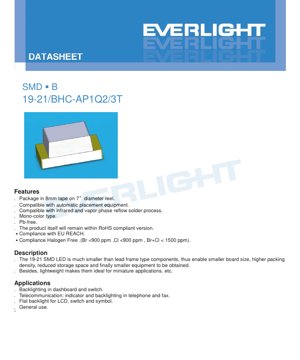
1. Product Overview
The 19-21/BHC-AP1Q2/3T is a compact, surface-mount blue LED designed for modern electronic applications requiring high-density component placement and reliable performance. This device utilizes InGaN chip technology to produce a blue emission with a typical dominant wavelength of 468 nm. Its primary advantages include a significantly reduced footprint compared to leaded LEDs, enabling smaller PCB designs, higher packing density, and ultimately more compact end products. The lightweight construction further makes it ideal for miniature and portable applications.
Key product positioning includes use as an indicator or backlight source in consumer electronics, telecommunications equipment, automotive dashboards, and general illumination where a compact blue light source is required. The device is fully compliant with RoHS, REACH, and halogen-free regulations, making it suitable for global markets with strict environmental standards.
1.1 Core Features and Advantages
- Miniaturized Package: The 19-21 SMD format is substantially smaller than traditional lead-frame LEDs, contributing to space savings on the PCB.
- Automation Compatibility: Supplied on 8mm tape on 7-inch reels, it is fully compatible with high-speed automatic pick-and-place equipment.
- Robust Soldering: Compatible with both infrared and vapor phase reflow soldering processes, ensuring reliable assembly in high-volume manufacturing.
- Environmental Compliance: The product is Pb-free, RoHS compliant, REACH compliant, and meets halogen-free requirements (Br <900 ppm, Cl <900 ppm, Br+Cl < 1500 ppm).
- Mono-Color Design: Provides a consistent blue color output.
2. Technical Parameter Deep Dive
2.1 Absolute Maximum Ratings
These ratings define the stress limits beyond which permanent damage to the device may occur. Operation under or at these limits is not guaranteed.
| Parameter | Symbol | Rating | Unit | Condition |
|---|---|---|---|---|
| Reverse Voltage | VR | 5 | V | |
| Forward Current | IF | 20 | mA | Continuous |
| Peak Forward Current | IFP | 40 | mA | Duty 1/10 @1KHz |
| Power Dissipation | Pd | 75 | mW | |
| Electrostatic Discharge (HBM) | ESD | 150 | V | Human Body Model |
| Operating Temperature | Topr | -40 to +85 | °C | |
| Storage Temperature | Tstg | -40 to +90 | °C | |
| Soldering Temperature | Tsol | 260°C for 10 sec (Reflow) 350°C for 3 sec (Hand) | °C |
Interpretation: The forward current rating of 20mA is standard for small-signal LEDs. The low reverse voltage rating (5V) highlights that this device is not designed for reverse bias operation and requires protection in circuits where reverse voltage might occur. The ESD rating of 150V (HBM) indicates moderate sensitivity; proper ESD handling procedures are essential during assembly.
2.2 Electro-Optical Characteristics
These parameters are measured at Ta=25°C and define the typical performance of the LED under normal operating conditions.
| Parameter | Symbol | Min. | Typ. | Max. | Unit | Condition |
|---|---|---|---|---|---|---|
| Luminous Intensity | Iv | 45.0 | - | 112.0 | mcd | IF=20mA |
| Viewing Angle (2θ1/2) | - | - | 100 | - | deg | |
| Peak Wavelength | λp | - | 468 | - | nm | |
| Dominant Wavelength | λd | 464.5 | - | 476.5 | nm | |
| Spectrum Bandwidth | Δλ | - | 25 | - | nm | |
| Forward Voltage | VF | 2.70 | 3.3 | 3.7 | V | IF=20mA |
| Reverse Current | IR | - | - | 50 | μA | VR=5V |
Interpretation: The luminous intensity has a wide range (45-112 mcd), which is managed through a binning system (detailed later). The typical forward voltage of 3.3V at 20mA is a key parameter for circuit design, as it determines the required current-limiting resistor value. The 100-degree viewing angle provides a wide emission pattern suitable for indicator applications.
2.3 Thermal Characteristics
While not explicitly listed in a separate table, thermal management is implied through the power dissipation (75mW) and operating temperature range (-40 to +85°C). The forward current derating curve (shown in the PDF) is critical for design. As ambient temperature increases, the maximum allowable forward current must be reduced to prevent overheating and accelerated degradation. Designers must consult this curve to ensure reliable operation at elevated temperatures.
3. Binning System Explanation
The LED manufacturing process results in natural variations in key parameters. Binning sorts LEDs into groups (bins) with tightly controlled characteristics to ensure consistency in the final application.
3.1 Luminous Intensity Binning
| Bin Code | Min. Intensity | Max. Intensity | Unit | Condition |
|---|---|---|---|---|
| P1 | 45.0 | 57.0 | mcd | IF =20mA |
| P2 | 57.0 | 72.0 | mcd | |
| Q1 | 72.0 | 90.0 | mcd | |
| Q2 | 90.0 | 112.0 | mcd |
Application Note: For applications requiring uniform brightness across multiple LEDs (e.g., backlighting arrays), specifying a single, narrow bin (e.g., Q1 only) is essential. The product code "AP1Q2/3T" likely includes bin information (Q2 for intensity).
3.2 Dominant Wavelength Binning
| Bin Code | Min. Wavelength | Max. Wavelength | Unit | Condition |
|---|---|---|---|---|
| A9 | 464.5 | 467.5 | nm | IF =20mA |
| A10 | 467.5 | 470.5 | nm | |
| A11 | 470.5 | 473.5 | nm | |
| A12 | 473.5 | 476.5 | nm |
Application Note: This binning ensures color consistency. The typical peak wavelength is 468nm, which falls within the A10 bin. Matching wavelength bins is crucial for applications where color perception is important.
4. Performance Curve Analysis
The datasheet provides several characteristic curves that are vital for understanding device behavior under non-standard conditions.
4.1 Relative Luminous Intensity vs. Forward Current
This curve shows that luminous intensity is not linearly proportional to current. It increases with current but may saturate or even decrease at very high currents due to thermal effects and efficiency droop. Operating at or below the recommended 20mA ensures optimal efficiency and longevity.
4.2 Relative Luminous Intensity vs. Ambient Temperature
LED light output decreases as the junction temperature rises. This curve quantifies that relationship. For example, at an ambient temperature of 85°C, the light output may be only 70-80% of its value at 25°C. This must be factored into brightness calculations for high-temperature environments.
4.3 Forward Voltage vs. Forward Current
This IV curve demonstrates the diode's exponential relationship between voltage and current. The \"knee\" voltage is around 2.7-3.0V. A small increase in voltage beyond this point causes a large increase in current, underscoring the critical need for a current-limiting driver or resistor.
4.4 Spectrum Distribution
The graph shows a single peak centered around 468nm with a typical full width at half maximum (FWHM) of 25nm. This is characteristic of a blue InGaN LED and defines the pure blue color emitted.
4.5 Radiation Pattern
The polar diagram illustrates the spatial distribution of light. The 19-21 package exhibits a lambertian or near-lambertian pattern with a 100-degree viewing angle, meaning light intensity is highest when viewed head-on and decreases gradually towards the sides.
5. Mechanical and Package Information
5.1 Package Dimensions
The 19-21 SMD LED has nominal dimensions of 2.0mm (length) x 1.25mm (width) x 0.8mm (height). Tolerances are typically ±0.1mm unless otherwise specified. The package drawing clearly indicates the cathode mark, which is essential for correct orientation during PCB assembly. The recommended PCB land pattern (pad design) should follow these dimensions to ensure proper soldering and mechanical stability.
5.2 Polarity Identification
A distinct cathode mark is present on the device. Correct polarity is mandatory; applying reverse voltage exceeding 5V can cause immediate damage.
6. Soldering and Assembly Guidelines
6.1 Reflow Soldering Profile
A lead-free (Pb-free) reflow profile is specified:
- Pre-heating: 150-200°C for 60-120 seconds.
- Time Above Liquidus (217°C): 60-150 seconds.
- Peak Temperature: 260°C maximum, held for no more than 10 seconds.
- Heating Rate: Maximum 6°C/sec.
- Cooling Rate: Maximum 3°C/sec.
6.2 Hand Soldering
If hand soldering is unavoidable, use a soldering iron with a tip temperature below 350°C. Contact time per terminal should be less than 3 seconds, with a soldering iron power rating below 25W. Allow a cooling interval of at least 2 seconds between soldering each terminal. Hand soldering poses a higher risk of thermal damage.
6.3 Rework and Repair
Repair after soldering is not recommended. If absolutely necessary, a specialized double-head soldering iron should be used to simultaneously heat both terminals and lift the component without applying mechanical stress to the LED body. The potential for damage is high.
7. Storage and Handling Precautions
7.1 Moisture Sensitivity
The LEDs are packaged in a moisture-resistant bag with desiccant.
- Do not open the moisture-proof bag until ready for use.
- After opening, unused LEDs should be stored at ≤30°C and ≤60% Relative Humidity.
- The "floor life" after bag opening is 168 hours (7 days).
- If not used within this time, or if the desiccant indicator has changed color, a bake-out is required: 60 ±5°C for 24 hours before use.
7.2 Kariya daga ESD
Tare da ƙimar ESD na 150V (HBM), waɗannan na'urori suna da hankali ga zubar da wutar lantarki. Yi amfani da matakan kariya na ESD na yau da kullun yayin sarrafawa da haɗawa: tashoshin aiki masu ƙasa, abun wuya na wuyan hannu, da kwantena masu ɗaukar wutar lantarki.
8. Packaging and Ordering Information
8.1 Standard Packaging
The device is supplied on embossed carrier tape with dimensions tailored for the 19-21 package. The tape is wound on a standard 7-inch diameter reel. Each reel contains 3000 pieces.
8.2 Reel and Tape Dimensions
Detailed drawings for the reel, carrier tape, and cover tape are provided in the datasheet. Adherence to these dimensions ensures compatibility with automated assembly equipment.
8.3 Label Information
The reel label contains critical information for traceability and verification:
- P/N: Product Number (e.g., 19-21/BHC-AP1Q2/3T).
- QTY: Packing Quantity (3000 pcs/reel).
- CAT: Luminous Intensity Rank (e.g., Q2).
- HUE: Chromaticity/Dominant Wavelength Rank (e.g., A10).
- REF: Forward Voltage Rank.
- LOT No: Manufacturing Lot Number for traceability.
9. Application Suggestions and Design Considerations
9.1 Typical Applications
- Backlighting: For buttons, switches, symbols, and LCD panels in consumer electronics, automotive dashboards, and industrial controls.
- Status Indicators: In telecommunications equipment (phones, fax machines), networking devices, and power supplies.
- General Illumination: As a compact blue light source in decorative lighting, signage, and wearable electronics.
9.2 Critical Design Considerations
- Current Limiting: An external current-limiting resistor is MANDATORY. The LED's exponential V-I characteristic means a small voltage change causes a large current change, leading to thermal runaway and failure. Calculate the resistor value using R = (Vsupply - VF) / IF, where VF is the maximum expected forward voltage from the datasheet (e.g., 3.7V).
- Thermal Management: Ko da yake yana da ƙarancin wutar lantarki, dole ne a yi la'akari da zubar da zafi, musamman a cikin wuraren da aka rufe ko yanayin zafi mai girma. Yi amfani da lanƙwasa rage ƙima. Tabbatar da isasshen yanki na tagulla akan PCB a ƙarƙashin da kewaye da kushin LED don yin aiki azaman mai sanyaya zafi.
- Optical Design: Kallon kusurwar digiri 100 ya dace da kallon fadi. Don ƙarin haske mai mai da hankali, ana iya buƙatar ruwan tabarau na waje ko jagororin haske. Yi la'akari da lambobin binning don tabbatar da daidaiton launi da haske a cikin ƙirar LED da yawa.
- PCB Layout: Follow the recommended pad layout from the package drawing. Ensure the cathode mark on the footprint matches the device orientation.
10. Technical Comparison and Differentiation
19-21/BHC-AP1Q2/3T ya bambanta da farko ta wurin ƙaramin ƙirar sa na 2.0x1.25mm, wanda ya fi ƙanƙanta da yawancin fitilun SMD na gargajiya kamar fakitin 0603 (1.6x0.8mm) ko 0805 (2.0x1.25mm) waɗanda sukan ɗauki fitilu, yana ba da damar ajiye sarari. Matsakaicin ƙarfin lantarki na 3.3V na yau da kullun ya dace da wadataccen lantarki na 3.3V. Idan aka kwatanta da fitilun da ba a rarraba su ba, ƙayyadaddun ƙa'idodin ƙarfi da tsawon raƙuman ruwa suna ba da aikin da ake iya hasasawa, suna rage rashin tabbas na ƙira. Bin ka'idojin muhalli na zamani (RoHS, Halogen-Free) wani abu ne na asali amma har yanzu yana zama babban abin bambanta a kasuwanni masu ƙa'ida.
11. Tambayoyin da ake yawan yi (FAQ)
Q1: Menene manufar lambobin rarrabawa (P1, Q2, A10, da sauransu)?
A1: Binning yana tabbatar da daidaito. Binning na Luminous Intensity (P1, Q2) yana ba da garantin mafi ƙarancin haske. Binning na Wavelength (A9-A12) yana ba da garantin takamaiman kewayon launi. Koyaushe kaƙayyade binning don aikace-aikacen da ke buƙatar daidaito.
Q2: Shin zan iya tuƙa wannan LED kai tsaye daga filin microcontroller na 3.3V?
A2: A'a. Farashin gaba yawanci 3.3V ne, wanda ba ya barin sararin ƙarfin lantarki don resistor mai iyakancewar halin yanzu idan an haɗa shi kai tsaye zuwa layin 3.3V. Wannan zai haifar da halin yanzu mara sarrafawa da lalacewa. Dole ne ka yi amfani da da'irar tuƙi ko mafi girman ƙarfin wadata tare da resistor na jerin.
Q3: Yaya za a iya lissafta madaidaicin resistor na jerin?
A3: Yi amfani da Dokar Ohm: R = (Vs - Vf) / If. Don wadata na 5V (Vs), ta amfani da matsakaicin Vf na 3.7V da manufar If na 20mA: R = (5 - 3.7) / 0.02 = 65 ohms. Yi amfani da ƙimar da ta biyo baya (misali, 68 ohms). Koyaushe a sake lissafta ɓarkewar wutar lantarki a cikin resistor: P = (If^2)*R.
Q4: Me ya sa tsarin ajiya da gasa yake da mahimmanci haka?
A4: SMD packages can absorb moisture. During reflow soldering, this moisture can turn to steam rapidly, causing internal delamination or "popcorning," which cracks the package and destroys the LED. The baking process removes this absorbed moisture.
12. Practical Application Example
Scenario: Designing a status indicator panel with 10 uniform blue LEDs.
- Specification: Select the 19-21/BHC-AP1Q2/3T for its compact size and blue color.
- Binning: Domin kuma da haske da launi iri ɗaya, a ƙayyade kwandon ƙarfi guda ɗaya (misali, Q1) da kwandon tsayin raɗaɗi guda ɗaya (misali, A10) a cikin odar siye.
- Zane na'urar lantarki: Yin amfani da wutar lantarki na tsarin 5V. Yi lissafin resistor: R = (5V - 3.7V) / 0.02A = 65Ω. Yi amfani da resistors 68Ω 5%. Ƙarfin kowane resistor: (0.02^2)*68 = 0.0272W, don haka resistor na yau da kullun 1/10W (0.1W) ya isa.
- PCB Layout: Sanya LEDs tare da fakitin 2.0x1.25mm, tabbatar da daidaitaccen alkiblar cathode. Haɗa da ƙaramin jigon tagulla da aka haɗa zuwa fakitin cathode don ɗan yaduwar zafi.
- Assembly: Follow the specified reflow profile. Keep the reel sealed until the moment of use in production.
13. Operating Principle
The 19-21/BHC-AP1Q2/3T is a semiconductor light-emitting diode. Its core is a chip made of Indium Gallium Nitride (InGaN) materials. When a forward voltage exceeding the diode's knee voltage (approx. 2.7V) is applied, electrons and holes are injected into the active region of the semiconductor. These charge carriers recombine, releasing energy in the form of photons (light). The specific composition of the InGaN alloy determines the bandgap energy, which directly corresponds to the wavelength of the emitted light—in this case, blue light around 468 nm. The water-clear resin encapsulant protects the chip and acts as a primary lens, shaping the initial light output pattern.
14. Technology Trends
The development of SMD LEDs like the 19-21 series follows broader industry trends: Miniaturization continues, enabling ever-smaller and denser electronic assemblies. Increased Efficiency is a constant driver, yielding higher luminous intensity from the same or smaller chip sizes. Enhanced Reliability and Robustness are critical, leading to improved materials for encapsulants and higher temperature tolerances for lead-free soldering. Tighter Binning and Color Consistency are increasingly demanded by applications like display backlighting. Finally, integration of control electronics directly with the LED die (e.g., IC-driven LEDs) is a growing trend, though for simple indicator types like this, the discrete, driver-less model remains dominant due to its cost-effectiveness and design flexibility.
LED Specification Terminology
Complete explanation of LED technical terms
Photoelectric Performance
| Term | Unit/Representation | Simple Explanation | Why Important |
|---|---|---|---|
| Luminous Efficacy | lm/W (lumens per watt) | Light output per watt of electricity, higher means more energy efficient. | Directly determines energy efficiency grade and electricity cost. |
| Luminous Flux | lm (lumens) | Total light emitted by source, commonly called "brightness". | Determines if the light is bright enough. |
| Viewing Angle | ° (degrees), e.g., 120° | Angle where light intensity drops to half, determines beam width. | Affects illumination range and uniformity. |
| CCT (Zazzabin Launi) | K (Kelvin), misali, 2700K/6500K | Haske ko haske mai zafi/sanyi, ƙananan ƙimomi suna da rawaya/da zafi, mafi girma fari/sanyi. | Yana ƙayyade yanayin haske da yanayin da ya dace. |
| CRI / Ra | Unitless, 0–100 | Ability to render object colors accurately, Ra≥80 is good. | Affects color authenticity, used in high-demand places like malls, museums. |
| SDCM | MacAdam ellipse steps, e.g., "5-step" | Color consistency metric, smaller steps mean more consistent color. | Ensures uniform color across same batch of LEDs. |
| Dominant Wavelength | nm (nanometers), e.g., 620nm (red) | Wavelength corresponding to color of colored LEDs. | Determines hue of red, yellow, green monochrome LEDs. |
| Spectral Distribution | Wavelength vs intensity curve | Inaonyesha usambazaji wa nguvu kwenye urefu wa mawimbi. | Inaathiri uwasilishaji wa rangi na ubora. |
Electrical Parameters
| Term | Symbol | Simple Explanation | Design Considerations |
|---|---|---|---|
| Forward Voltage | Vf | Minimum voltage to turn on LED, like "starting threshold". | Driver voltage must be ≥Vf, voltages add up for series LEDs. |
| Forward Current | If | Current value for normal LED operation. | Usually constant current drive, current determines brightness & lifespan. |
| Max Pulse Current | Ifp | Peak current tolerable for short periods, used for dimming or flashing. | Pulse width & duty cycle must be strictly controlled to avoid damage. |
| Reverse Voltage | Vr | Max reverse voltage LED can withstand, beyond may cause breakdown. | Circuit must prevent reverse connection or voltage spikes. |
| Thermal Resistance | Rth (°C/W) | Resistance to heat transfer from chip to solder, lower is better. | High thermal resistance requires stronger heat dissipation. |
| ESD Immunity | V (HBM), e.g., 1000V | Ability to withstand electrostatic discharge, higher means less vulnerable. | Anti-static measures needed in production, especially for sensitive LEDs. |
Thermal Management & Reliability
| Term | Key Metric | Simple Explanation | Impact |
|---|---|---|---|
| Junction Temperature | Tj (°C) | Halin zazzabi na aiki a cikin LED chip. | Kowane raguwar 10°C na iya ninka tsawon rayuwa; yana da yawa yana haifar da lalacewar haske, canjin launi. |
| Lumen Depreciation | L70 / L80 (hours) | Time for brightness to drop to 70% or 80% of initial. | Directly defines LED "service life". |
| Lumen Maintenance | % (e.g., 70%) | Percentage of brightness retained after time. | Indicates brightness retention over long-term use. |
| Color Shift | Δu′v′ or MacAdam ellipse | Degree of color change during use. | Yana shafar daidaiton launi a cikin yanayin haske. |
| Thermal Aging | Material degradation | Deterioration due to long-term high temperature. | May cause brightness drop, color change, or open-circuit failure. |
Packaging & Materials
| Term | Common Types | Simple Explanation | Features & Applications |
|---|---|---|---|
| Package Type | EMC, PPA, Ceramic | Housing material protecting chip, providing optical/thermal interface. | EMC: good heat resistance, low cost; Ceramic: better heat dissipation, longer life. |
| Chip Structure | Front, Flip Chip | Chip electrode arrangement. | Flip chip: better heat dissipation, higher efficacy, for high-power. |
| Phosphor Coating | YAG, Silicate, Nitride | Covers blue chip, converts some to yellow/red, mixes to white. | Different phosphors affect efficacy, CCT, and CRI. |
| Lens/Optics | Flat, Microlens, TIR | Optical structure on surface controlling light distribution. | Determines viewing angle and light distribution curve. |
Quality Control & Binning
| Term | Binning Content | Simple Explanation | Purpose |
|---|---|---|---|
| Luminous Flux Bin | Code e.g., 2G, 2H | Grouped by brightness, each group has min/max lumen values. | Ensures uniform brightness in same batch. |
| Voltage Bin | Code e.g., 6W, 6X | Grouped by forward voltage range. | Facilitates driver matching, improves system efficiency. |
| Color Bin | 5-step MacAdam ellipse | Grouped by color coordinates, ensuring tight range. | Guarantees color consistency, avoids uneven color within fixture. |
| CCT Bin | 2700K, 3000K etc. | Grouped by CCT, each has corresponding coordinate range. | Meets different scene CCT requirements. |
Testing & Certification
| Term | Standard/Test | Simple Explanation | Significance |
|---|---|---|---|
| LM-80 | Lumen maintenance test | Long-term lighting at constant temperature, recording brightness decay. | Used to estimate LED life (with TM-21). |
| TM-21 | Life estimation standard | Estimates life under actual conditions based on LM-80 data. | Provides scientific life prediction. |
| IESNA | Illuminating Engineering Society | Covers optical, electrical, thermal test methods. | Industry-recognized test basis. |
| RoHS / REACH | Environmental certification | Ensures no harmful substances (lead, mercury). | Market access requirement internationally. |
| ENERGY STAR / DLC | Energy efficiency certification | Energy efficiency and performance certification for lighting. | Used in government procurement, subsidy programs, enhances competitiveness. |