Table of Contents
- 1. Product Overview
- 1.1 Fa'idodi na asali
- 1.2 Kasuwa da aikace-aikace da aka yi niyya
- 2. Bincike mai zurfi na sigogi na fasaha
- 2.1 Matsakaicin iyaka na cikakke
- 2.2 Electro-Optical Characteristics
- 3. Bin System Description
- 3.1 Color Rendering Index (CRI) Binning
- 3.2 Forward Current Index
- 3.3 Forward Voltage Exponent
- 3.4 Luminous Flux Binning
- 3.5 Forward Voltage Binning
- 3.6 Chromaticity Coordinates (Color Temperature) Binning
- 4. Mass Production List and Part Number Decoding
- 5. Application Design Considerations
- 5.1 Thermal Management
- 5.2 Electrical Drive
- 5.3 ESD and Operation
- 5.4 Welding Process
- 6. Performance Analysis and Trends
- 6.1 Luminous Efficacy
- 6.2 Color Quality and Consistency
- 6.3 Application-Specific Optimization
- 7. Frequently Asked Questions (Based on Technical Specifications)
- Detailed Explanation of LED Specification Terminology
- I. Core Indicators of Photoelectric Performance
- II. Electrical Parameters
- III. Thermal Management and Reliability
- IV. Packaging and Materials
- V. Quality Control and Binning
- VI. Testing and Certification
1. Product Overview
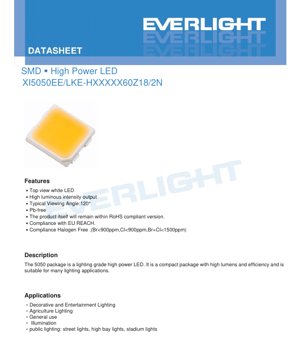
The 5050 package represents a lighting-grade, high-power LED solution designed for demanding lighting applications. It is a compact surface-mount device (SMD) that delivers high luminous flux and high efficiency within a small package size. Its primary design goal is to provide a reliable and powerful light source suitable for various professional and general lighting applications requiring stable, bright white light.
1.1 Fa'idodi na asali
The key advantages of this LED series include its high luminous intensity output, enabling excellent optical performance. It features a typical wide viewing angle of 120 degrees, providing broad and uniform illumination. The product is manufactured lead-free (Pb-free), complies with EU REACH regulations, and meets halogen-free requirements. Specifically, bromine (Br) content is below 900 ppm, chlorine (Cl) content is below 900 ppm, and their combined total is below 1500 ppm. This makes it suitable for environmentally conscious designs and applications with strict material restrictions.
1.2 Kasuwa da aikace-aikace da aka yi niyya
This LED is designed for versatile lighting applications. Its primary markets include decorative and entertainment lighting, which demand high color quality and brightness. It is also suitable for agricultural lighting, supporting plant growth spectra when combined with appropriate phosphors. General lighting is its main application area, covering both indoor and outdoor illumination. Specifically, it targets public lighting infrastructure such as street lights, high-bay lights for industrial or commercial spaces, and stadium lights, where high output and reliability are critical.
2. Bincike mai zurfi na sigogi na fasaha
This section provides a detailed and objective interpretation of the key technical parameters that define the LED's performance and operational limits.
2.1 Matsakaicin iyaka na cikakke
These ratings define the stress limits that may cause permanent damage to the device. It is not recommended to operate at or near these limits for extended periods. Absolute maximum ratings are specified at a solder point temperature (Tsoldering) of 25°C.
- Forward Current (IF):1050 mA (DC). This is the maximum continuous current that can be applied.
- Power Dissipation (Pd):6300 mW (6.3 W). This is the maximum power the package can dissipate.
- Pulse Forward Current (IPF):2000 mA. Wannan mafi girma na yanzu kawai an yarda a cikin yanayin bugun jini, ba za a iya ci gaba da aiki ba.
- Yanayin aiki (TAiki):-35°C zuwa +105°C. Wannan shine kewayon yanayin muhalli da aka tabbatar don aiki mai dogaro.
- Yanayin ajiya (TAjiya):-35°C zuwa +105°C. Wannan shine kewayon zafin jiki mai aminci lokacin da na'urar ba ta kunna wuta ba.
- Juriyar zafi (Rth J-S):2.5 °C/W (junction to solder point). A lower value indicates better thermal transfer performance from the LED chip (junction) to the circuit board. Effective thermal management is crucial to ensure the junction temperature does not exceed its limit.
- Junction Temperature (Tj):125 °C (maximum). The temperature of the semiconductor chip itself must not exceed this limit to ensure lifespan and performance.
- ESD Sensitivity:2000 V (Human Body Model). This device is sensitive to electrostatic discharge and requires proper handling procedures.
- Soldering Temperature:For reflow soldering, the peak temperature is 260°C for 10 seconds. For hand soldering, the limit is 350°C for 3 seconds.
2.2 Electro-Optical Characteristics
These characteristics define the typical performance of the LED under normal operating conditions, measured at Tsoldering= 25°C, with a forward current (IF) of 180mA.
- Luminous Flux (Φ):Ranges from a minimum of 160 lumens to a maximum of 255 lumens, depending on the product binning (see Section 3). Typical tolerance is ±11%.
- Forward Voltage (VF):Maximum 6.0 V at 180mA. Typical tolerance is ±0.1V. The actual VFvaries depending on binning and individual units.
- Color Rendering Index (CRI or Ra):Minimum 70 for the standard series, with a tolerance of ±2. Options with higher CRI are available (see Section 3.1).
- Perspective (2θ1/2):The typical value is 120 degrees. This is the full angle at which the light intensity is half of the peak value.
- Reverse Current (IR):At a Reverse Voltage (VR) of 5V, the maximum is 10 µA.
3. Bin System Description
To ensure color and brightness consistency in production, LEDs are sorted into different bins based on key parameters. This allows designers to select devices that meet the requirements of specific applications.
3.1 Color Rendering Index (CRI) Binning
CRI indicates how naturally a light source renders colors compared to a reference source. The single-letter symbol in the part number denotes the minimum CRI. For example, 'L' corresponds to a minimum CRI of 70, 'K' to 80, and 'H' or 'R' to 90. The 'R' bin has an additional requirement: a minimum R9 value (saturated red) of 50, which is crucial for high-quality lighting. The tolerance for CRI is ±2.
3.2 Forward Current Index
The symbol 'Z18' in the part number indicates the nominal forward current used for testing and specifying parameters, which is 180mA (IF= 180mA).
3.3 Forward Voltage Exponent
The symbol '60' denotes the maximum forward voltage for this group, which is 6.0V.
3.4 Luminous Flux Binning
Ana rarraba LED bisa ga mafi ƙarancin fitar da haske (luminous flux) a ƙarƙashin 180mA. Lambar bin, kamar '160L15' ko '230L15', tana ƙayyadadden kewayon flux. Misali, '230L15' yana nufin mafi ƙarancin flux na lumens 230, kuma faɗin bin shine lumens 15 (don haka kewayon ya zama 230-245 lumens). Gabaɗaya ƙimar rashin daidaituwa (tolerance) na flux shine ±11%.
3.5 Forward Voltage Binning
Ana kuma rarraba ƙarfin lantarki (voltage) don taimakawa wajen ƙira mai turawa (driver design) da daidaita igiyar lantarki (current matching) a cikin jeri (array). Ana bayyana rukunin ta lamba mai lambobi biyu, kamar '52B', inda '52' ke nufin mafi ƙarancin ƙarfin lantarki (5.2V), kuma 'B' alamar rarrabuwa ce. Kewayon '52B' shine daga 5.2V zuwa 5.4V. Sauran rukunoni sun haɗa da '54B' (5.4-5.6V), '56B' (5.6-5.8V), da '58B' (5.8-6.0V). Ƙimar rashin daidaituwa (tolerance) ita ce ±0.1V.
3.6 Chromaticity Coordinates (Color Temperature) Binning
Ana sarrafa Haɗin Zafin Launi (Correlated Color Temperature - CCT) ta hanyar rarraba ma'auni na launi (chromaticity coordinates) (x, y) akan taswirar launi ta CIE 1931. Takaddun bayanan samfur (datasheet) yana ba da cikakkun akwatunan ma'auni na CCT daban-daban, kamar 1800K, 2200K, da 2700K (warm white), da sauransu har zuwa 6500K (cool white). Kowane CCT yana da ƙananan rukunoni da yawa (misali, 18K-A, 18K-B), don tabbatar da madaidaicin daidaiton launi. Misali, kewayon tunani na bin 1800K yana tsakanin 1765K zuwa 1960K, ya danganta da zaɓin ƙananan bin.
4. Mass Production List and Part Number Decoding
Imetoa orodha ya bidhaa za kiwango cha uzalishaji. Kwa mfano, nambari ya sehemuXI5050EE/LKE-H5023060Z18/2NInaweza kusimbwa kama ifuatavyo:
- XI5050EE/LKE:Msururu wa msingi wa bidhaa (5050 SMD LED yenye nguvu kubwa).
- H:Kiambishi awali cha msimbo wa utendaji.
- 50:Correlated Color Temperature (CCT) code, representing 5000K.
- 230:Minimum luminous flux code, representing 230 lumens.
- 60:Forward Voltage Index (maximum 6.0V).
- Z18:Forward Current Index (180mA).
- /2N:Packaging or reel specification.
Therefore, this specific model is a 5000K (neutral white) LED with a minimum luminous flux of 230 lumens, a maximum forward voltage of 6.0V at 180mA, and a CRI of at least 70 (implied by the standard series). The mass production table lists variants from 1800K to 6500K and their corresponding minimum and typical flux values at different test currents (180mA, 640mA, 750mA).
5. Application Design Considerations
5.1 Thermal Management
Considering the power dissipation of up to 6.3W and the critical junction temperature limit of 125°C, effective thermal management is the most important design aspect. The low thermal resistance of 2.5 °C/W from junction to solder point is advantageous, but this requires a well-designed PCB with sufficient thermal vias and typically connection to a heatsink. The maximum operating ambient temperature is 105°C, but at high ambient temperatures, the practically achievable current and brightness are reduced due to thermal derating.
5.2 Electrical Drive
A constant current driver is essential for reliable operation. The driver should be selected based on the required operating current (maximum continuous current 1050 mA) and the forward voltage bin of the LEDs used. For series connection, the total Vf of the entire series string must be considered.FThe device is sensitive to reverse voltage, with a maximum reverse voltage of 5V before significant leakage current occurs; the circuit should prevent reverse bias.
5.3 ESD and Operation
An ESD sensitivity rating of 2000V (HBM) requires standard ESD precautions during handling, assembly, and installation. Use grounded workstations, wrist straps, and conductive containers.
5.4 Welding Process
Strictly adhere to the soldering profile: reflow peak temperature 260°C for a duration not exceeding 10 seconds. Avoid prolonged time above the liquidus temperature. For repair, hand soldering at 350°C should be limited to 3 seconds per pad. These limits prevent damage to internal die attach, wire bonds, and plastic package.
6. Performance Analysis and Trends
6.1 Luminous Efficacy
Although not explicitly stated in lumens per watt (lm/W), luminous efficacy can be calculated from the data. For the 5000K model with a minimum flux of 230 lumens, at 180mA and a typical VFpossibly 5.6V (power = 1.008W), the minimum luminous efficacy is approximately 228 lm/W. At a higher current such as 750mA, the typical flux is 835 lumens. Assuming at this current VFis higher (e.g., 6.2V, power = 4.65W), the typical luminous efficacy is about 180 lm/W. This demonstrates the high-efficiency characteristics of this lighting-class LED, although efficacy decreases at higher currents due to increased thermal and electrical losses.
6.2 Color Quality and Consistency
提供高达90(且R9 > 50)的CRI选项以及严格的色品分档,反映了专业应用中对高质量白光的需求。每个CCT的多档位结构使制造商能够提供批次间颜色匹配度极高的产品,适用于建筑或零售照明等对批次一致性要求苛刻的应用。
6.3 Application-Specific Optimization
The wide CCT range (1800K-6500K) allows designers to tailor light for specific environments: warm white (1800K-3000K) is suitable for cozy or decorative settings, neutral white (3500K-5000K) for general and office lighting, and cool white (5700K-6500K) for task lighting or simulating daylight. The high luminous flux output makes it suitable for replacing traditional light sources in retrofit projects or designing new, highly efficient luminaires.
7. Frequently Asked Questions (Based on Technical Specifications)
Q: What is the main advantage of the 5050 package size?
A: The 5.0mm x 5.0mm package size offers an excellent balance between high light output (from a relatively large emitting area) and PCB space efficiency. It allows for good thermal management while maintaining a compact form factor, making it suitable for many luminaire designs.
Q: Can I operate this LED continuously at its maximum current of 1050mA?
A: While technically possible, continuous operation at the absolute maximum rating is not recommended for reliable long-term performance. The practical maximum operating current will be lower and is determined by the system's thermal design (PCB, heatsink, ambient temperature) to ensure the junction temperature (Tj) remains safely below 125°C. Derating curves (though not provided in this summary) are crucial for such design considerations.
Q: How do I choose the correct CRI bin?
答:对于色彩表现至关重要的应用(例如零售、博物馆、美术馆、高端住宅),选择高CRI档位(80、85、90)。'R'档位(CRI 90,R9>50)特别适合还原红色调。对于成本是更大考虑因素的一般或实用照明,标准的CRI 70档位通常就足够了。
Q: Why is the viewing angle 120 degrees?
A: A wide viewing angle is ideal for many general lighting applications as it provides broad, uniform illumination, reducing harsh shadows and glare. It is well-suited for area lighting, downlights, and panel lights that require a wide beam without secondary optics. For spotlighting, secondary lenses will be used to narrow the beam.
Q: What does "Halogen-Free" compliance mean for my product?
A: It means the LED materials comply with restrictions on bromine and chlorine-based flame retardants. This is important for meeting certain environmental regulations (such as IEC 61249-2-21), reducing toxic emissions in case of fire, and is often required for consumer electronics, automotive, and other eco-label certifications.
Detailed Explanation of LED Specification Terminology
Complete Explanation of LED Technical Terminology
I. Core Indicators of Photoelectric Performance
| Terminology | Unit/Representation | Layman's Explanation | Why It's Important |
|---|---|---|---|
| Luminous Efficacy | lm/W | The luminous flux emitted per watt of electrical power, higher values indicate greater energy efficiency. | Directly determines the energy efficiency rating and electricity cost of the luminaire. |
| Luminous Flux | lm (Lumen) | The total quantity of light emitted by a light source, commonly referred to as "brightness". | Determines whether a luminaire is bright enough. |
| Viewing Angle | ° (degrees), e.g., 120° | The angle at which light intensity drops to half, determining the beam width. | Affects the lighting range and uniformity. |
| CCT | K (Kelvin), e.g., 2700K/6500K | The warmth or coolness of light color; lower values are yellowish/warm, higher values are whitish/cool. | Determines the lighting ambiance and suitable application scenarios. |
| Color Rendering Index (CRI / Ra) | Unitless, 0–100 | The ability of a light source to reproduce an object's true colors; Ra≥80 is considered good. | Affects color authenticity; used in high-demand places like shopping malls and art galleries. |
| Color Tolerance (SDCM) | MacAdam ellipse steps, e.g., "5-step" | A quantitative indicator of color consistency; the smaller the step number, the more consistent the color. | Ensures no color difference among the same batch of luminaires. |
| Dominant Wavelength | nm (nanometer), e.g., 620nm (red) | Rangi ya LED ya rangi inayolingana na thamani ya urefu wa mawimbi. | Huamua hue ya LED ya rangi moja kama nyekundu, manjano, kijani, n.k. |
| Spectral Distribution | Mkunjo wa Urefu wa Mawimbi vs. Nguvu | Inaonyesha usambazaji wa nguvu ya mwanga unaotolewa na LED katika kila urefu wa mawimbi. | Huathiri uhalisi wa rangi na ubora wa rangi. |
II. Electrical Parameters
| Terminology | Symbol | Layman's Explanation | Design Considerations |
|---|---|---|---|
| Forward Voltage | Vf | The minimum voltage required to light up an LED, similar to a "starting threshold". | The driving power supply voltage must be ≥ Vf; voltages add up when multiple LEDs are connected in series. |
| Forward Current | If | The current value that enables an LED to emit light normally. | Constant current drive is commonly used, where the current determines brightness and lifespan. |
| Maximum Pulse Current | Ifp | Peak current that can be withstood for a short time, used for dimming or flashing. | Pulse width and duty cycle must be strictly controlled, otherwise overheating damage may occur. |
| Reverse Voltage (Reverse Voltage) | Vr | The maximum reverse voltage that the LED can withstand; exceeding it may cause breakdown. | A cikin da'ira, ya kamata a hana haɗuwa ta baya ko kuma ƙarfin wutar lantarki. |
| Thermal Resistance | Rth (°C/W) | Matsalar zafi daga guntu zuwa wurin walda, ƙimar da ta yi ƙasa tana nuna ingantacciyar hanyar sanyaya. | Babban matsalar zafi yana buƙatar ƙirar sanyaya mai ƙarfi, in ba haka ba zafin jiki zai ƙaru. |
| ESD Immunity | V (HBM), e.g., 1000V | The higher the value, the more resistant it is to electrostatic damage. | Anti-static measures must be taken during production, especially for high-sensitivity LEDs. |
III. Thermal Management and Reliability
| Terminology | Key Indicators | Layman's Explanation | Impact |
|---|---|---|---|
| Junction Temperature | Tj (°C) | Yanayin aiki na ainihi a cikin guntu na LED. | Kowane raguwa na 10°C, rayuwa na iya tsawaita sau biyu; yawan zafi yana haifar da raguwar haske, karkatar launi. |
| Lumen Depreciation | L70 / L80 (hours) | The time required for brightness to drop to 70% or 80% of its initial value. | Directly defines the "useful life" of an LED. |
| Lumen Maintenance | % (e.g., 70%) | The percentage of remaining brightness after a period of use. | Characterizes the ability to maintain brightness after long-term use. |
| Color Shift | Δu′v′ or MacAdam ellipse | The degree of color change during use. | Affects the color consistency of the lighting scene. |
| Thermal Aging | Degradation of material performance. | Degradation of packaging materials due to long-term high temperature. | May lead to decreased brightness, color shift, or open-circuit failure. |
IV. Packaging and Materials
| Terminology | Common Types | Layman's Explanation | Characteristics and Applications |
|---|---|---|---|
| Package Type | EMC, PPA, Ceramic | The housing material that protects the chip and provides optical and thermal interfaces. | EMC offers good heat resistance and low cost; ceramic provides superior heat dissipation and long lifespan. |
| Chip Structure | Wire Bond, Flip Chip | The arrangement method of chip electrodes. | Flip-chip offers better heat dissipation and higher luminous efficacy, suitable for high-power applications. |
| Phosphor coating | YAG, silicate, nitride | Coated on the blue LED chip, partially converts to yellow/red light, mixing to form white light. | Different phosphors affect luminous efficacy, color temperature, and color rendering. |
| Lens/optical design | Flat, Microlens, Total Internal Reflection | Optical structure on the package surface, controlling light distribution. | Determines the emission angle and light distribution curve. |
V. Quality Control and Binning
| Terminology | Binning Content | Layman's Explanation | Purpose |
|---|---|---|---|
| Luminous Flux Binning | Codes such as 2G, 2H | Grouped by brightness level, each group has a minimum/maximum lumen value. | Ensure consistent brightness for products in the same batch. |
| Voltage Binning | Codes such as 6W, 6X | Grouped by forward voltage range. | Facilitates driver matching and improves system efficiency. |
| Color binning | 5-step MacAdam ellipse | Grouped by color coordinates to ensure colors fall within a very narrow range. | Ensures color consistency and avoids color variation within the same luminaire. |
| Color temperature binning | 2700K, 3000K, etc. | Group by color temperature, each group has a corresponding coordinate range. | Meet the color temperature requirements of different scenarios. |
VI. Testing and Certification
| Terminology | Standard/Test | Layman's Explanation | Significance |
|---|---|---|---|
| LM-80 | Lumen Maintenance Test | Long-term operation under constant temperature conditions, recording data on luminous flux depreciation. | Used to estimate LED lifetime (in conjunction with TM-21). |
| TM-21 | Standard ya kiyayyade rayuwa | Kimanta rayuwa a yanayin amfani na gaske bisa bayanan LM-80. | Bayar da hasashen rayuwa na kimiyya. |
| IESNA Standard | Standard na Cibiyar Injiniyanci na Haske | Ya ƙunshi hanyoyin gwajin haske, lantarki, da zafi. | Industry-recognized testing basis. |
| RoHS / REACH | Environmental certification. | Ensure products do not contain harmful substances (e.g., lead, mercury). | Entry requirements for the international market. |
| ENERGY STAR / DLC | Takaddar ingancin makamashi | Takaddar ingancin makamashi da aiki don samfuran haske. | Ana amfani da shi sau da yawa a cikin sayayyar gwamnati, ayyukan tallafi, don haɓaka gasar kasuwa. |