Table of Contents
- 1. Product Overview
- 2. In-Depth Technical Parameter Analysis
- 2.1 Photometric and Electrical Characteristics
- 2.2 Absolute Maximum Ratings and Thermal Management
- 2.3 Reliability and Robustness Specifications
- 3. Performance Curve Analysis
- 3.1 Forward Current vs. Forward Voltage (IV Curve)
- 3.2 Relative Luminous Flux vs. Forward Current
- 3.3 Relative Luminous Flux vs. Junction Temperature
- 3.4 Chromaticity Shift vs. Current and Temperature
- 3.5 Forward Current Derating Curve
- 3.6 Permissible Pulse Handling Capability
- 3.7 Spectral Distribution
- 4. Binning System Explanation
- 4.1 Luminous Flux Binning
- 4.2 Color Binning
- 5. Mechanical, Assembly, and Packaging Information
- 5.1 Mechanical Dimensions and Polarity
- 5.2 Recommended Soldering Pad Layout
- 5.3 Reflow Soldering Profile
- 5.4 Packaging Information
- 6. Application Guidelines and Design Considerations
- 6.1 Primary Application: Automotive Exterior Lighting
- 6.2 Driver Circuit Design
- 6.3 Thermal Management Design
- 6.4 Optical Design
- 6.5 Precautions for Use
- 7. Ordering Information and Part Number Decoding
- 8. Technical Comparison and Differentiation
- 9. Frequently Asked Questions (FAQ) Based on Technical Parameters
- 10. Operational Principles and Technology Trends
- 10.1 Basic Operating Principle
- 10.2 Industry Trends
1. Product Overview
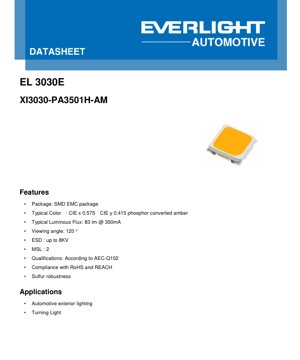
The XI3030-PA3501H-AM is a high-performance, surface-mount device (SMD) LED designed primarily for demanding automotive exterior lighting applications. It utilizes a phosphor conversion technology to produce a stable amber color output. The device is built on an EMC (Epoxy Molding Compound) package platform, which offers enhanced reliability and thermal performance compared to standard plastic packages. Its core advantages include a high typical luminous flux of 83 lumens at a standard drive current of 350mA, a wide 120-degree viewing angle for excellent light distribution, and robust construction qualified to the stringent AEC-Q102 standard for automotive discrete optoelectronic devices. The target market is squarely focused on automotive lighting designers and manufacturers, specifically for applications such as turn signals and other exterior signal functions where reliability, color consistency, and brightness are critical.
2. In-Depth Technical Parameter Analysis
2.1 Photometric and Electrical Characteristics
The key operational parameters are defined under a standard test condition of a forward current (IF) of 350mA. The typical luminous flux (IV) is 83 lumens, with a specified minimum of 70 lm and a maximum of 100 lm, accounting for an 8% measurement tolerance. The forward voltage (VF) typically measures 3.1V, ranging from a minimum of 2.5V to a maximum of 3.5V at this current. This parameter is crucial for thermal management and driver design. The dominant chromaticity coordinates are CIE x = 0.575 and CIE y = 0.415, placing it firmly in the amber region of the color spectrum with a tolerance of ±0.005. The viewing angle, defined as the angle where luminous intensity drops to half of its peak value, is a full 120 degrees.
2.2 Absolute Maximum Ratings and Thermal Management
To ensure long-term reliability, the device must not be operated beyond its absolute maximum ratings. The maximum continuous forward current is 500 mA. The maximum power dissipation (Pd) is rated at 1750 mW. The junction temperature (Tj) must never exceed 150°C. The operating ambient temperature range is specified from -40°C to +125°C. Thermal management is a critical design consideration. The datasheet provides two thermal resistance values: a real thermal resistance (Rth JS real) of 12.9 K/W and an electrical thermal resistance (Rth JS el) of 10.8 K/W, both measured from the junction to the solder point. The lower electrical value is typically used for design calculations as it is derived from the temperature-sensitive electrical parameter (TSEP) method. Proper heatsinking is essential to maintain the junction temperature within safe limits, especially at higher drive currents.
2.3 Reliability and Robustness Specifications
The LED is designed for harsh environments. It features Electrostatic Discharge (ESD) protection up to 8 kV (Human Body Model), which is essential for handling during assembly. It is compliant with RoHS and REACH environmental directives. Furthermore, it possesses sulfur robustness, a critical feature for automotive applications where sulfur-containing gases from exhausts and other sources can corrode silver-plated components. The Moisture Sensitivity Level (MSL) is rated at Level 2, indicating it can be stored for up to one year at ≤30°C/60% RH before requiring baking prior to reflow soldering.
3. Performance Curve Analysis
3.1 Forward Current vs. Forward Voltage (IV Curve)
IV curve inaonyesha uhusiano kati ya mkondo wa mbele na voltage ya mbele. Sio mstari wa moja kwa moja, kama kawaida kwa diodes. Kwa 350mA, voltage iko karibu 3.1V. Wabunifu hutumia curve hii kuchagua mzunguko unaokidhi kikomo cha mkondo na kukadiria matumizi ya nguvu (VF * IF).
3.2 Relative Luminous Flux vs. Forward Current
This graph illustrates how light output scales with drive current. While output increases with current, it is not perfectly linear, and efficiency typically decreases at higher currents due to increased thermal effects and droop. The curve helps designers balance desired brightness against efficiency and thermal load.
3.3 Relative Luminous Flux vs. Junction Temperature
This is one of the most critical graphs for application design. It shows the reduction in light output as the junction temperature rises. LED efficacy is inversely related to temperature. For the XI3030, the light output decreases as Tj increases above 25°C. Effective thermal design is paramount to maintain consistent brightness over the operating temperature range, especially in hot automotive environments.
3.4 Chromaticity Shift vs. Current and Temperature
Two graphs detail the shift in color coordinates (ΔCIE x, ΔCIE y). One shows shift versus forward current at a constant temperature, and the other shows shift versus junction temperature at a constant current (350mA). These shifts are generally small but must be considered in applications requiring strict color consistency. The amber color point is relatively stable, but designers should verify that shifts remain within acceptable limits for their specific application.
3.5 Forward Current Derating Curve
Wannan lanƙwasa tana ƙayyadad da matsakaicin halaccen ci gaba na gaba bisa zafin da aka auna a wurin solder. Yayin da zafin wurin ya ƙaru, matsakaicin amintaccen halaccen yana raguwa. Misali, a matsakaicin ƙimar zafin wurin solder na 125°C, matsakaicin halaccen ci gaba shine 500mA. Ba a ba da shawarar aiki a ƙasa da 50mA ba. Wannan jadawali yana da mahimmanci don ƙayyade yanayin aiki mai aminci a cikin aikace-aikacen ƙarshe.
3.6 Permissible Pulse Handling Capability
This graph defines the LED's ability to handle short-duration current pulses that exceed the maximum DC rating. It plots pulse current (IF) against pulse time (tp) for various duty cycles (D). For very short pulses (e.g., microseconds) at low duty cycles, the LED can withstand currents significantly higher than 500mA. This is relevant for pulsed operation schemes sometimes used in signaling.
3.7 Spectral Distribution
The relative spectral power distribution graph shows the emitted light intensity across wavelengths. As a phosphor-converted amber LED, the spectrum will typically have a primary peak from the blue or near-UV pump LED and a broader secondary peak in the yellow/amber region from the phosphor. The exact shape defines the perceived color and Color Rendering Index (CRI), though CRI is less critical for signal lighting.
4. Binning System Explanation
Datasheet ina bayyana tsarin binning don rarraba LEDs bisa ga ayyukansu na photometric da colorimetric, tabbatar da daidaito a cikin rukunin samarwa.
4.1 Luminous Flux Binning
Ana amfani da lambobi da haruffa (misali, E1, F2, J5, K3) don rarraba luminous flux. Kowane bin yana ayyana mafi ƙarancin da matsakaicin kewayon luminous flux a cikin lumens. Misali, bin F6 ya ƙunshi 60 zuwa 70 lm, yayin da bin K1 ya ƙunshi 225 zuwa 250 lm. XI3030-PA3501H-AM, tare da matsakaicin 83 lm, zai faɗi cikin takamaiman bin na flux (wataƙila a kusa da kewayon F7 zuwa F8 ko J1, ko da yake ba a ƙayyade ainihin bin na wannan lambar sashi a cikin abin da aka ba da). Wannan yana ba masu ƙira damar zaɓar sassan da ke da tabbataccen mafi ƙarancin haske.
4.2 Color Binning
The color is binned according to the ECE (Economic Commission for Europe) phosphor yellow bin structure. The provided chart shows two primary bins: YA and YB, defined by a quadrilateral area on the CIE 1931 chromaticity diagram. The target coordinates for this LED (x=0.575, y=0.415) fall within or near the YB bin. The binning ensures all LEDs in a batch emit light within a tightly controlled color region, which is vital for automotive applications where multiple LEDs are used together and must match perfectly.
5. Mechanical, Assembly, and Packaging Information
5.1 Mechanical Dimensions and Polarity
The LED uses a standard 3030 footprint (approximately 3.0mm x 3.0mm). The exact height and detailed dimensional drawing with tolerances would be found in the "Mechanical Dimension" section. The component will have a polarity marking, typically a cathode indicator (e.g., a notch, a dot, or a green marking) on the package. Correct orientation during placement is essential for operation.
5.2 Recommended Soldering Pad Layout
An ba da shawarar tsarin ƙasa (sawun ƙafa) don ƙirar PCB. Wannan ya haɗa da girman da siffar gindin zafi da gindin lambobin lantarki. Bin wannan shawarar yana tabbatar da samuwar haɗin solder daidai, kyakkyawan canja wurin zafi zuwa PCB, da hana kabari ko wasu lahani na taro.
5.3 Reflow Soldering Profile
The device is rated for reflow soldering with a peak temperature of 260°C for up to 30 seconds. A specific reflow profile (time vs. temperature) is recommended, typically following IPC/JEDEC J-STD-020 guidelines for MSL2 components. This profile includes preheat, soak, reflow (with time above liquidus, TAL, and peak temperature), and cooling stages. Adhering to this profile prevents thermal damage to the LED package and internal die.
5.4 Packaging Information
The LEDs are supplied on tape and reel for automated pick-and-place assembly. The packaging details include reel dimensions, tape width, pocket spacing, and orientation of the components on the tape. This information is necessary for configuring assembly equipment.
6. Application Guidelines and Design Considerations
6.1 Primary Application: Automotive Exterior Lighting
The primary and explicitly stated application is automotive exterior lighting, with turning lights (turn signals) given as a specific example. Its AEC-Q102 qualification, wide temperature range, sulfur robustness, and high brightness make it suitable for other exterior functions such as daytime running lights (DRLs), position lights, and side marker lights, where amber color is required.
6.2 Driver Circuit Design
LEDs are current-driven devices. A constant-current driver is mandatory to ensure stable light output and prevent thermal runaway. The driver should be designed to provide the desired current (e.g., 350mA for typical specs) while respecting the absolute maximum ratings and the current derating curve based on the application's thermal environment. The forward voltage variation (2.5V to 3.5V) must be accounted for in the driver's compliance voltage.
6.3 Thermal Management Design
This cannot be overstated. The PCB must be designed to act as a heatsink. This involves using a board with sufficient thermal vias under the LED's thermal pad, connecting to internal ground planes or dedicated copper pours. In high-power or high-ambient-temperature applications, an external heatsink may be required. The goal is to minimize the temperature rise from the solder pad (Ts) to the junction (Tj) using the formula: Tj = Ts + (Rth JS * Power). Power is calculated as VF * IF.
6.4 Optical Design
The 120-degree viewing angle is a Lambertian or near-Lambertian emission pattern. Secondary optics (lenses, reflectors) are almost always used in automotive lighting to shape the beam according to regulatory standards (e.g., ECE, SAE). The optical designer must consider the LED's spatial intensity distribution, size, and color uniformity.
6.5 Precautions for Use
General precautions include: avoiding mechanical stress on the lens, preventing contamination of the lens surface, using ESD-safe handling procedures, and ensuring the soldering process does not exceed the specified profile. Storage should be in a dry, controlled environment as per the MSL2 rating.
7. Ordering Information and Part Number Decoding
The part number XI3030-PA3501H-AM likely follows a company-specific coding system. A typical breakdown could be: XI (series/platform), 3030 (package size), PA (Phosphor-converted Amber), 3501 (inaweza kuhusiana na flux/color bin au drive current), H (inaweza kuonyesha mwangaza wa juu au kipengele maalum), AM (labda Amber). Sehemu ya "Ordering Information" ingefafanua chaguo zozote zinazopatikana (k.m., flux bins tofauti, color bins, tape and reel specifications) na jinsi ya kuzibainisha katika msimbo wa agizo.
8. Technical Comparison and Differentiation
While a direct comparison requires competitor data, key differentiators of this LED can be inferred from its specs: EMC Package: Offers better thermal performance and long-term reliability (resistance to yellowing, moisture) compared to standard PPA (Polyphthalamide) or PCT plastics, especially in high-temperature automotive environments. AEC-Q102 Qualification: This is a mandatory requirement for automotive-grade LEDs, involving rigorous stress tests for temperature cycling, humidity, high-temperature operation, and solder heat resistance. Not all 3030 LEDs have this qualification. Sulfur Robustness: A critical differentiator for automotive and industrial applications exposed to corrosive atmospheres. High Flux Density: 83 lm from a 3030 package represents a high-efficiency solution, allowing for smaller optics or lower power consumption for a given light output.
9. Frequently Asked Questions (FAQ) Based on Technical Parameters
Q: Can I drive this LED at 500mA continuously?
A: You can, but only if you can guarantee the solder pad temperature remains at or below 25°C (see derating curve). In a real-world application with elevated temperatures, you must derate the current. At a more typical pad temperature of 85°C, the maximum allowed current is significantly lower. Always design using the derating curve.
Q: What is the difference between the real and electrical thermal resistance?
A: The real thermal resistance (12.9 K/W) is measured using a physical temperature sensor. The electrical thermal resistance (10.8 K/W) is calculated from the change in forward voltage with temperature, a method that can be more precise but is sensitive to measurement conditions. For conservative design, use the higher value (12.9 K/W).
Q: How stable is the amber color over temperature and current?
A: The provided graphs show the shift. The ΔCIE x and y values are relatively small over the operating range. For most automotive signaling applications, this shift is acceptable and within regulatory color boundaries. For extremely color-critical applications, the system should be characterized at its extreme operating conditions.
Q: Is a lens or silicone cover required over the LED?
A: While the LED has a primary lens, most automotive exterior applications require secondary optics for beam shaping and to meet photometric regulations. Furthermore, a secondary silicone lens or potting compound is often used for additional environmental protection (against water, dust, chemicals) and to enhance light extraction.
10. Operational Principles and Technology Trends
10.1 Basic Operating Principle
This is a phosphor-converted amber LED. At its core is a semiconductor chip (typically based on InGaN) that emits light in the blue or near-ultraviolet spectrum when forward biased. This primary light is not emitted directly. Instead, it strikes a layer of phosphor material deposited inside the package. The phosphor absorbs the high-energy blue/UV photons and re-emits light at longer, lower-energy wavelengths, primarily in the yellow/amber region. The combination of any unconverted blue light and the broad yellow phosphor emission results in the perceived amber color. The exact phosphor composition determines the precise color coordinates (x=0.575, y=0.415).
10.2 Industry Trends
The automotive LED lighting market trends towards: Higher Efficiency (lm/W): Kugedzera magetsi emagetsi pamotokari. Kuwedzera Simba Density: Chiedza chakawanda kubva mumapakeji madiki, zvichiita kuti marambi ave akatsetseka. Kuvimbika Kwakawedzerwa: Longer lifetimes under harsher conditions, driven by packages like EMC. Smart Lighting: Integration with sensors and controls for adaptive driving beams (ADB) and communication (Li-Fi, though not for this product). Color Tuning: While this is a fixed-color LED, trends exist for multi-color or tunable-white LEDs for interior and adaptive exterior lighting. The XI3030-PA3501H-AM aligns with the trends for high reliability, efficiency, and performance in a robust package suitable for the evolving automotive landscape.
LED Specification Terminology
Complete explanation of LED technical terms
Photoelectric Performance
| Term | Unit/Representation | Simple Explanation | Why Important |
|---|---|---|---|
| Luminous Efficacy | lm/W (lumens per watt) | Light output per watt of electricity, higher means more energy efficient. | Directly determines energy efficiency grade and electricity cost. |
| Luminous Flux | lm (lumens) | Total light emitted by source, commonly called "brightness". | Determines if the light is bright enough. |
| Viewing Angle | ° (degrees), e.g., 120° | Angle where light intensity drops to half, determines beam width. | Affects illumination range and uniformity. |
| CCT (Zazzabin Launi) | K (Kelvin), misali, 2700K/6500K | Warmth/coolness of light, lower values yellowish/warm, higher whitish/cool. | Determines lighting atmosphere and suitable scenarios. |
| CRI / Ra | Unitless, 0–100 | Ability to render object colors accurately, Ra≥80 is good. | Affects color authenticity, used in high-demand places like malls, museums. |
| SDCM | MacAdam ellipse steps, e.g., "5-step" | Color consistency metric, smaller steps mean more consistent color. | Ensures uniform color across same batch of LEDs. |
| Dominant Wavelength | nm (nanometers), e.g., 620nm (red) | Wavelength corresponding to color of colored LEDs. | Determines hue of red, yellow, green monochrome LEDs. |
| Spectral Distribution | Wavelength vs intensity curve | Shows intensity distribution across wavelengths. | Affects color rendering and quality. |
Electrical Parameters
| Term | Symbol | Simple Explanation | Design Considerations |
|---|---|---|---|
| Forward Voltage | Vf | Minimum voltage to turn on LED, like "starting threshold". | Driver voltage must be ≥Vf, voltages add up for series LEDs. |
| Forward Current | If | Current value for normal LED operation. | Usually constant current drive, current determines brightness & lifespan. |
| Max Pulse Current | Ifp | Peak current tolerable for short periods, used for dimming or flashing. | Pulse width & duty cycle must be strictly controlled to avoid damage. |
| Reverse Voltage | Vr | Max reverse voltage LED can withstand, beyond may cause breakdown. | Circuit must prevent reverse connection or voltage spikes. |
| Thermal Resistance | Rth (°C/W) | Resistance to heat transfer from chip to solder, lower is better. | High thermal resistance requires stronger heat dissipation. |
| ESD Immunity | V (HBM), e.g., 1000V | Ability to withstand electrostatic discharge, higher means less vulnerable. | Anti-static measures needed in production, especially for sensitive LEDs. |
Thermal Management & Reliability
| Term | Key Metric | Simple Explanation | Impact |
|---|---|---|---|
| Junction Temperature | Tj (°C) | Halin zazzabi na aiki a cikin LED chip. | Kowane raguwar 10°C na iya ninka tsawon rayuwa; yawan zafi yana haifar da raguwar haske, canjin launi. |
| Lumen Depreciation | L70 / L80 (hours) | Time for brightness to drop to 70% or 80% of initial. | Directly defines LED "service life". |
| Lumen Maintenance | % (e.g., 70%) | Percentage of brightness retained after time. | Indicates brightness retention over long-term use. |
| Color Shift | Δu′v′ or MacAdam ellipse | Degree of color change during use. | O nifun iyipada awọ ni awọn iṣẹlẹ itanna. |
| Thermal Aging | Material degradation | Deterioration due to long-term high temperature. | May cause brightness drop, color change, or open-circuit failure. |
Packaging & Materials
| Term | Common Types | Simple Explanation | Features & Applications |
|---|---|---|---|
| Package Type | EMC, PPA, Ceramic | Housing material protecting chip, providing optical/thermal interface. | EMC: good heat resistance, low cost; Ceramic: better heat dissipation, longer life. |
| Chip Structure | Front, Flip Chip | Chip electrode arrangement. | Flip chip: better heat dissipation, higher efficacy, for high-power. |
| Phosphor Coating | YAG, Silicate, Nitride | Covers blue chip, converts some to yellow/red, mixes to white. | Different phosphors affect efficacy, CCT, and CRI. |
| Lens/Optics | Flat, Microlens, TIR | Optical structure on surface controlling light distribution. | Determines viewing angle and light distribution curve. |
Quality Control & Binning
| Term | Binning Content | Simple Explanation | Purpose |
|---|---|---|---|
| Luminous Flux Bin | Code e.g., 2G, 2H | Grouped by brightness, each group has min/max lumen values. | Ensures uniform brightness in same batch. |
| Voltage Bin | Code e.g., 6W, 6X | Grouped by forward voltage range. | Facilitates driver matching, improves system efficiency. |
| Color Bin | 5-step MacAdam ellipse | Grouped by color coordinates, ensuring tight range. | Guarantees color consistency, avoids uneven color within fixture. |
| CCT Bin | 2700K, 3000K etc. | Grouped by CCT, each has corresponding coordinate range. | Meets different scene CCT requirements. |
Testing & Certification
| Term | Standard/Test | Simple Explanation | Significance |
|---|---|---|---|
| LM-80 | Lumen maintenance test | Long-term lighting at constant temperature, recording brightness decay. | Used to estimate LED life (with TM-21). |
| TM-21 | Life estimation standard | Estimates life under actual conditions based on LM-80 data. | Provides scientific life prediction. |
| IESNA | Illuminating Engineering Society | Covers optical, electrical, thermal test methods. | Industry-recognized test basis. |
| RoHS / REACH | Environmental certification | Ensures no harmful substances (lead, mercury). | Market access requirement internationally. |
| ENERGY STAR / DLC | Energy efficiency certification | Energy efficiency and performance certification for lighting. | Used in government procurement, subsidy programs, enhances competitiveness. |