Table of Contents
- 1. Product Overview
- 1.1 Core Advantages
- 1.2 Target Market
- 2. In-depth Technical Parameter Analysis
- 2.1 Photometric and electrical characteristics
- 2.2 Thermal Characteristics
- 3. Absolute Maximum Ratings
- 4. Binning System Description
- 4.1 Luminous Flux Binning
- 4.2 Binning ya Voltage ya Mbele
- 4.3 Color (Chroma) Grading
- 5. Performance Curve Analysis
- 5.1 Spectral Distribution
- 5.2 Forward Current vs. Forward Voltage (I-V Curve)
- 5.3 Relative Luminous Flux vs. Forward Current
- 5.4 Temperature Dependence
- 5.5 Forward Current Derating Curve
- 5.6 Allowable Pulse Handling Capability
- 6. Mechanical and Package Information
- 6.1 Mechanical Dimensions
- 6.2 Recommended Solder Pad Layout
- 7. Soldering and Assembly Guide
- 7.1 Reflow Soldering Temperature Profile
- 7.2 Usage Precautions
- 8. Application Suggestions and Design Considerations
- 8.1 Typical Application Scenarios
- 8.2 Design Considerations
- 9. Frequently Asked Questions (Based on Technical Specifications)
- 9.1 What is the typical power consumption?
- 9.2 How to calculate the junction temperature?
- 9.3 Ina iya amfani da wutar lantarki 12V kai tsaye don kunna shi?
- 9.4 Menene ma'anar takaddun shaida na AEC-Q102 ga zanena?
- 10. Practical Design Case Study
- 11. Working Principle
- 12. Technology Trends
1. Product Overview
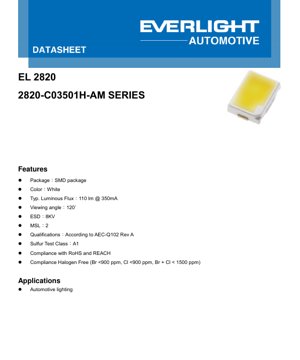
The 2820-C03501H-AM series is a high-brightness surface-mount device (SMD) LED, primarily targeting demanding automotive lighting applications. It features a compact 2820 package (2.8mm x 2.0mm footprint) and emits cool white light. A key characteristic of this series is its compliance with the AEC-Q102 Rev A standard, which is the stress test qualification for discrete optoelectronic semiconductors in automotive applications. This ensures its reliability under harsh automotive environmental conditions. Other certifications include sulfur resistance (Class A1), compliance with RoHS, REACH, and halogen-free requirements, making it suitable for modern eco-friendly designs.
1.1 Core Advantages
- Automotive-Grade Reliability:AEC-Q102 certification ensures its performance under extreme temperatures, humidity, and mechanical stress.
- High Luminous Output:Under a drive current of 350 mA, the typical luminous flux can reach 110 lumens, providing outstanding brightness for its size.
- Wide Viewing Angle:A 120-degree viewing angle provides broad and uniform illumination.
- Sturdy Structure:With 8 kV ESD protection (HBM) and Level 2 Moisture Sensitivity Level (MSL), it enhances the robustness of handling and assembly.
- Environmental Compliance:Conform to RoHS, REACH, and halogen-free directives, supporting green manufacturing initiatives.
1.2 Target Market
The primary application of this LED series isAutomotive LightingThis includes interior lighting (dome lights, reading lights, ambient lighting), exterior signal lights (side marker lights, rear combination lamps requiring small package and high brightness), and other lighting functions within the vehicle that may require reliable, bright white light sources.
2. In-depth Technical Parameter Analysis
2.1 Photometric and electrical characteristics
Key operating parameters are defined under the condition of a typical forward current (IF) of 350 mA and a pad temperature of 25°C.
- Luminous flux (IV):100 lm (minimum), 110 lm (typical), 130 lm (maximum). Measurement tolerance is ±8%.
- Forward voltage (VF):At 350 mA, 3.00 V (minimum), 3.25 V (typical), 3.75 V (maximum). Measurement tolerance is ±0.05V.
- Viewing angle (φ):120 degrees (typical value).
- Chromaticity coordinates (CIE):x = 0.3227 (typical value), y = 0.3351 (typical value). The tolerance for both x and y is ±0.005, placing it in the cool white region.
- Forward current (IF):The operating range is from 50 mA to 500 mA.
2.2 Thermal Characteristics
Effective thermal management is crucial for the performance and lifespan of LEDs.
- Thermal Resistance (Rth JS):Two values are provided: the actual thermal resistance (junction-to-solder point) is 20 K/W (typical) to 22 K/W (maximum), and the electrical thermal resistance is 16 K/W (maximum). The actual thermal resistance is the key parameter for calculating junction temperature in thermal design.
- Junction Temperature (TJ):Maximum allowed junction temperature is 150°C.
3. Absolute Maximum Ratings
These ratings define the limits beyond which permanent damage to the device may occur. Operation under these conditions is not guaranteed.
- Power consumption (Pd):1750 mW
- Forward current (IF):500 mA(连续),1000 mA(浪涌,t<=10 μs,0.5%占空比)
- Reverse voltage (VR):Non-inverting operation design.
- Operating and Storage Temperature:-40°C to +125°C
- ESD Sensitivity (HBM):8 kV
- Reflow soldering temperature:Peak 260°C, maximum 30 seconds.
4. Binning System Description
LEDs are binned according to key performance parameters to ensure consistency in mass production.
4.1 Luminous Flux Binning
Binning is defined based on the minimum and maximum luminous flux values under test conditions (IF=350mA, 25°C pad temperature).
- J1:100 lm to 110 lm
- J2:110 lm to 120 lm
- J3:120 lm to 130 lm
4.2 Binning ya Voltage ya Mbele
Binning is defined based on the forward voltage range at the test current.
- 3032:3.00 V to 3.25 V
- 3235:3.25 V to 3.50 V
- 3537:3.50 V to 3.75 V
4.3 Color (Chroma) Grading
The datasheet provides a detailed chromaticity diagram, defining the bins for cool white light (e.g., 56M, 58M, 61M, 63M). Each bin is a quadrilateral area on the CIE 1931 chromaticity diagram, defined by four sets of (x, y) coordinates. This allows for the selection of LEDs with very tight color consistency, which is crucial for automotive lighting that typically requires color matching of multiple LEDs.
5. Performance Curve Analysis
These charts provide important insights into the behavior of LEDs under different operating conditions.
5.1 Spectral Distribution
The relative spectral distribution plot shows a peak in the blue wavelength region (approximately 450-460nm), accompanied by a broad phosphor-converted yellow emission, resulting in cool white light. The absence of significant output in the deep red or infrared regions is typical for white phosphor-converted LEDs.
5.2 Forward Current vs. Forward Voltage (I-V Curve)
This graph illustrates the typical exponential relationship of a diode. At 350 mA, the forward voltage clusters around the typical value of 3.25V. Designers use this curve for driver design and power consumption calculations.
5.3 Relative Luminous Flux vs. Forward Current
Light output increases sublinearly with current. While driving at higher current produces more light, it also generates more heat, thereby reducing efficiency and lifetime. This graph aids in selecting the optimal operating point.
5.4 Temperature Dependence
- Relative Luminous Flux vs. Junction Temperature:As the junction temperature (TJ) increases, the light output decreases. This graph quantifies the degree of decrease, which is crucial for thermal design to maintain consistent brightness.
- Relative Forward Voltage vs. Junction Temperature:Forward voltage has a negative temperature coefficient, decreasing as temperature increases. This can be used for indirect temperature monitoring in certain applications.
- 色度偏移 vs. 结温 & 电流:These charts show how the white point (CIE x, y coordinates) shifts with changes in drive current and junction temperature. The shift is relatively small but must be considered in color-critical applications.
5.5 Forward Current Derating Curve
This is a key chart for ensuring reliable operation. It shows the maximum allowable continuous forward current as a function of the pad temperature (TS) increases. As TSWhen the temperature rises, the maximum allowable current must be reduced to prevent the junction temperature from exceeding 150°C. For example, at a maximum operating TSof 125°C, the maximum continuous current is 500 mA.
5.6 Allowable Pulse Handling Capability
This graph defines the surge current capability for pulse operation. It shows the allowable peak pulse current (IF) as a function of pulse width (tp) for different duty cycles (D). It allows the use of currents higher than the 500 mA DC maximum for short periods, which is useful for applications such as strobe or flashing lights.
6. Mechanical and Package Information
6.1 Mechanical Dimensions
The datasheet contains a detailed dimensional drawing of the 2820 SMD package. Key dimensions include a body size of 2.8mm (length) x 2.0mm (width). The drawing specifies the cathode mark location, lens geometry, and pad locations. Unless otherwise noted, all dimensions are in millimeters with a standard tolerance of ±0.1mm.
6.2 Recommended Solder Pad Layout
Separate drawings provide the recommended pad layout for PCB design. This includes the dimensions and spacing of electrical pads and the central thermal pad. Adhering to this layout is crucial for proper soldering, thermal performance, and mechanical stability. The thermal pad is essential for dissipating heat from the LED junction to the PCB.
7. Soldering and Assembly Guide
7.1 Reflow Soldering Temperature Profile
The LED is rated for a maximum peak reflow soldering temperature of 260°C for 30 seconds. A typical reflow profile, including preheat, soak, reflow, and cooling stages, should be followed to ensure temperatures do not exceed the specified limits. The Moisture Sensitivity Level (MSL) is Level 2, meaning the device must be used within one year after the factory-sealed package is opened. Baking may be required if exposed to environmental conditions exceeding its floor life.
7.2 Usage Precautions
- ESD Protection:Although rated for 8 kV HBM, standard ESD precautions should still be observed during handling and assembly.
- Cleaning:Use appropriate cleaning solvents that will not damage the LED lens or packaging materials.
- Mechanical Stress:Avoid applying direct force or vibration to the LED lens.
- Current Control:Always use a constant current source instead of a constant voltage source to drive LEDs, ensuring stable operation and preventing thermal runaway.
8. Application Suggestions and Design Considerations
8.1 Typical Application Scenarios
- Automotive Interior Lighting:Overhead console lights, map reading lights, footwell illumination, and ambient light strips.
- Automotive Exterior Lighting:Daytime Running Lights (DRL), side marker lights, Center High-Mounted Stop Lights (CHMSL), and license plate lights requiring small package and high brightness.
8.2 Design Considerations
- Thermal Management:This is the most critical aspect. Use thermal resistance (Rth JS= 20 K/W) and derating curves to design adequate thermal pathways. This involves using a PCB with sufficient copper area (thermal vias under the thermal pad are strongly recommended), and for high-power or high ambient temperature applications, an aluminum substrate (MCPCB) may also be required.
- Driver Selection:Select an automotive-grade LED driver capable of providing a stable 350 mA (or other required current) from the vehicle electrical system (typically 12V or 24V). The driver should include protection against overvoltage, reverse polarity, and load-dump transients common in automotive environments.
- Optical Design:A 120° viewing angle is suitable for diffuse illumination. For a focused beam, secondary optics (lens or reflector) will be required. The small source size of this LED is advantageous for optical control.
- Color Consistency:For applications using multiple LEDs, specify the required color bin (e.g., 61M) to ensure uniformity of white across the entire assembly.
9. Frequently Asked Questions (Based on Technical Specifications)
9.1 What is the typical power consumption?
At the typical operating point of 350 mA and 3.25V, the electrical power input is approximately 1.14 watts (P = IF* VF= 0.35A * 3.25V).
9.2 How to calculate the junction temperature?
Junction Temperature (TJ) ana iya kiyasin shi da wannan dabara: TJ= TS+ (Pd* Rth JS), where TSis the measured pad temperature, PdIt is power consumption (unit: watt), Rth JSis the actual thermal resistance (20 K/W). For reliable operation, TJmust be kept below 150°C, and the lower it is, the more beneficial it is for extending lifespan.
9.3 Ina iya amfani da wutar lantarki 12V kai tsaye don kunna shi?
No.Direct connection to a 12V power source will immediately damage the LED due to excessive current. A constant-current LED driver or current-limiting circuit must be used.
9.4 Menene ma'anar takaddun shaida na AEC-Q102 ga zanena?
This means the LED component has passed a series of rigorous stress tests simulating automotive environmental conditions (extended temperature cycling, high temperature/high humidity bias, high temperature storage, etc.). Using AEC-Q102 qualified components can simplify your system-level qualification process and significantly increase confidence in the long-term reliability of the lighting module.
10. Practical Design Case Study
Scenario:Design an interior dome light for a passenger car. The requirement is uniform, bright white light illumination.
Design Steps:
- LED Selection:Select the 2820-C03501H-AM series for its high brightness, automotive-grade quality, and compact size.
- Quantity and Arrangement:Based on the required illumination level (lumens), calculate the number of LEDs needed. For example, 500 lumens may require 5 LEDs from the J2 bin (each 110-120 lumens). They will be arranged linearly or in clusters on the PCB.
- Thermal Design:PCB design uses 2-ounce copper layers. Use a dedicated thermal pad pattern matching the datasheet recommendation, with a set of thermal vias connecting it to a large area of copper foil on the bottom layer as a heat sink. Check the derating curve: if the compartment ambient temperature can reach 85°C, the pad temperature (TS) may be estimated at 95°C. The derating curve shows the allowable current is still above 350 mA, so the design is thermally sound.
- Electrical Design:Select an automotive-qualified buck LED driver IC to convert the vehicle's 12V battery voltage to a constant 350 mA output for a series of 5 LEDs. The total forward voltage of this series is approximately 16.25V (5 * 3.25V), which is within the operating range of a typical buck converter from a 12V input.
- Optical Design:Place a diffuser lens or cover over the LED array to utilize each LED's 120° viewing angle, blending the individual light sources into a uniform area light source.
11. Working Principle
This LED is a phosphor-converted white LED. At its core is a semiconductor chip, typically made of indium gallium nitride (InGaN), which emits blue light when forward-biased (current flows through it). Part of this blue light is absorbed by a layer of phosphor material (e.g., cerium-doped yttrium aluminum garnet, YAG:Ce) deposited on or around the chip. The phosphor absorbs some of the blue photons and re-emits light with a broad spectrum in the yellow region. The remaining blue light combines with the converted yellow light, which is perceived by the human eye as white light. The exact hue (such as cool white or warm white in this datasheet) is determined by the composition and thickness of the phosphor layer.
12. Technology Trends
The development of LEDs for automotive lighting follows several distinct trends:
- Luminous Efficacy Improvement (lm/W):Continuous improvements in chip design, phosphor efficiency, and package thermal management result in more light output per watt of electrical input, thereby reducing energy consumption and thermal load.
- Higher Power Density and Miniaturization:Products like the 2820 package, which can deliver over 100 lumens, represent the trend of integrating more performance within a smaller footprint, enabling more stylish and compact lighting designs.
- Enhanced Reliability and Robustness:Standards like AEC-Q102 are becoming fundamental requirements. Further development focuses on enhancing resistance to specific automotive stress sources, such as sulfur-containing atmospheres (addressed in this specification by sulfur test grade A1) and electrochemical corrosion.
- Intelligent and Adaptive Lighting:Although this is a basic component, the LED, the industry is moving towards integrated modules that incorporate drivers, controllers, and communication interfaces (e.g., LIN or CAN) for Adaptive Front-lighting Systems (AFS) and dynamic interior lighting.
- Color Tuning and Quality:The focus is on achieving higher Color Rendering Index (CRI) values and more precise color point control (tighter binning) to attain better aesthetic quality and safety in automotive environments.
Detailed Explanation of LED Specification Terminology
Complete Explanation of LED Technical Terminology
I. Core Indicators of Photoelectric Performance
| Terminology | Unit/Representation | Popular Explanation | Why It Is Important |
|---|---|---|---|
| Luminous Efficacy | lm/W (lumens per watt) | The luminous flux emitted per watt of electrical energy, the higher the more energy-efficient. | Directly determines the energy efficiency class and electricity cost of the luminaire. |
| Luminous Flux | lm (lumen) | The total amount of light emitted by a light source, commonly known as "brightness". | Determine if the light fixture is bright enough. |
| Viewing Angle | ° (degrees), such as 120° | The angle at which light intensity drops to half, determining the beam's width. | Affects the illumination range and uniformity. |
| Color Temperature (CCT) | K (Kelvin), e.g., 2700K/6500K | The warmth or coolness of light color; lower values are yellowish/warm, higher values are whitish/cool. | Determines the lighting atmosphere and suitable application scenarios. |
| Color Rendering Index (CRI / Ra) | No unit, 0–100 | The ability of a light source to reproduce the true colors of objects, Ra≥80 is recommended. | Affects color fidelity, used in high-demand places such as shopping malls and art galleries. |
| Color Tolerance (SDCM) | MacAdam Ellipse Steps, e.g., "5-step" | Quantitative indicator of color consistency, the smaller the step number, the more consistent the color. | Ensure no color difference among the same batch of luminaires. |
| Dominant Wavelength | nm (nanometer), e.g., 620nm (Red) | Wavelength values corresponding to colored LED colors. | Determine the hue of monochromatic LEDs such as red, yellow, and green. |
| Spectral Distribution | Wavelength vs. Intensity Curve | It shows the intensity distribution of light emitted by an LED across various wavelengths. | It affects color rendering and color quality. |
II. Electrical Parameters
| Terminology | Symbols | Popular Explanation | Design Considerations |
|---|---|---|---|
| Forward Voltage | Vf | Minimum voltage required to turn on an LED, similar to a "starting threshold". | The driving power supply voltage must be ≥ Vf, and the voltage adds up when multiple LEDs are connected in series. |
| Forward Current | If | The current value that allows the LED to emit light normally. | Constant current drive is commonly used, where the current determines brightness and lifespan. |
| Maximum Pulse Current (Pulse Current) | Ifp | Peak current that can be withstood in a short time, used for dimming or flashing. | Pulse width and duty cycle must be strictly controlled, otherwise overheating damage will occur. |
| Reverse Voltage | Vr | The maximum reverse voltage that an LED can withstand; exceeding it may cause breakdown. | The circuit needs to prevent reverse connection or voltage surge. |
| Thermal Resistance | Rth (°C/W) | The resistance to heat flow from the chip to the solder joint. A lower value indicates better heat dissipation. | High thermal resistance requires a more robust thermal design; otherwise, the junction temperature will increase. |
| Electrostatic Discharge Immunity (ESD Immunity) | V (HBM), such as 1000V | Anti-static strike capability, the higher the value, the less susceptible to damage from static electricity. | Anti-static measures must be implemented during production, especially for high-sensitivity LEDs. |
III. Thermal Management and Reliability
| Terminology | Key Indicators | Popular Explanation | Impact |
|---|---|---|---|
| Junction Temperature | Tj (°C) | The actual operating temperature inside the LED chip. | For every 10°C reduction, the lifespan may double; excessively high temperatures cause lumen depreciation and color shift. |
| Lumen Depreciation | L70 / L80 (hours) | The time required for the brightness to drop to 70% or 80% of its initial value. | Directly defines the "useful life" of an LED. |
| Lumen Maintenance | % (e.g., 70%) | Percentage of remaining brightness after a period of use. | Characterizes the ability to maintain brightness after long-term use. |
| Color Shift | Δu′v′ or MacAdam Ellipse | The degree of color change during use. | Affects the color consistency of the lighting scene. |
| Thermal Aging | Material performance degradation | Degradation of packaging materials due to long-term high temperature. | May lead to decreased brightness, color shift, or open-circuit failure. |
IV. Encapsulation and Materials
| Terminology | Common Types | Popular Explanation | Characteristics and Applications |
|---|---|---|---|
| Package Type | EMC, PPA, Ceramic | Material casing yang melindungi chip dan menyediakan antarmuka optik serta termal. | EMC tahan panas baik, biaya rendah; keramik disipasi panas unggul, umur panjang. |
| Struktur chip | Front-side, Flip Chip | Chip Electrode Layout. | Flip-chip offers better heat dissipation and higher luminous efficacy, suitable for high-power applications. |
| Phosphor coating | YAG, Silicate, Nitride | Covered on the blue light chip, partially converted into yellow/red light, mixed into white light. | Different phosphors affect luminous efficacy, color temperature, and color rendering. |
| Lens/Optical Design | Flat, Microlens, Total Internal Reflection | Optical structure on the encapsulation surface, controlling light distribution. | Determines the emission angle and light distribution curve. |
V. Quality Control and Binning
| Terminology | Grading Content | Popular Explanation | Purpose |
|---|---|---|---|
| Luminous Flux Grading | Codes such as 2G, 2H | Grouped by brightness level, each group has a minimum/maximum lumen value. | Ensure uniform brightness for products within the same batch. |
| Voltage binning | Codes such as 6W, 6X | Grouped by forward voltage range. | Facilitates driver power matching and improves system efficiency. |
| Color Grading | 5-step MacAdam Ellipse | Group by color coordinates to ensure colors fall within a minimal range. | Ensure color consistency to avoid uneven colors within the same luminaire. |
| Color temperature binning | 2700K, 3000K, etc. | Grouped by color temperature, each group has a corresponding coordinate range. | To meet the color temperature requirements of different scenarios. |
VI. Testing and Certification
| Terminology | Standard/Test | Popular Explanation | Meaning |
|---|---|---|---|
| LM-80 | Lumen Maintenance Test | Long-term illumination under constant temperature conditions, recording brightness attenuation data. | Used to estimate LED lifetime (combined with TM-21). |
| TM-21 | Standard for Life Projection | Projecting the lifespan under actual use conditions based on LM-80 data. | Providing scientific lifespan prediction. |
| IESNA standard | Standard of the Illuminating Engineering Society | Covers optical, electrical, and thermal testing methods. | Industry-recognized testing basis. |
| RoHS / REACH | Environmental certification | Ensure the product does not contain harmful substances (e.g., lead, mercury). | Conditions for access to the international market. |
| ENERGY STAR / DLC | Energy Efficiency Certification | Energy efficiency and performance certification for lighting products. | Yawan da ake amfani da shi a cikin sayayyar gwamnati da ayyukan tallafi, don haɓaka gasar kasuwa. |