Table of Contents
- 1. Product Overview
- 2. Technical Parameter Deep Dive
- 2.1 Absolute Maximum Ratings
- 2.2 Electro-Optical Characteristics
- 3. Binning System Explanation
- 3.1 Luminous Intensity Binning
- 3.2 Dominant Wavelength Binning
- 3.3 Forward Voltage Binning
- 4. Performance Curve Analysis
- 5. Mechanical and Package Information
- 5.1 Package Dimensions
- 5.2 Polarity Identification
- 6. Soldering and Assembly Guide
- 6.1 Reflow Soldering Profile
- 6.2 Hand Soldering
- 6.3 Storage and Moisture Sensitivity
- 7. Packaging and Ordering Information
- 8. Application Suggestions
- 8.1 Typical Application Scenarios
- 8.2 Design Considerations
- 9. Technical Comparison and Differentiation
- 10. Frequently Asked Questions (FAQs)
- 11. Practical Design Case
- 12. Operating Principle
- 13. Technology Trends
- 14. Application Restrictions Disclaimer
1. Product Overview
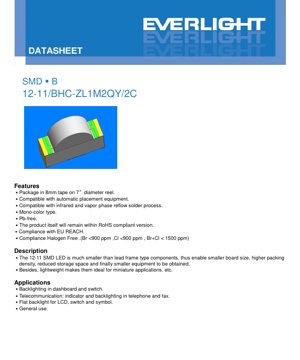
The 12-11/BHC-ZL1M2QY/2C is a compact, surface-mount blue LED designed for modern electronic applications requiring high-density component placement. This device utilizes InGaN (Indium Gallium Nitride) semiconductor technology to produce blue light with a typical dominant wavelength of 468 nm. Its primary advantage lies in its miniature 12-11 package footprint, which is significantly smaller than traditional leaded LEDs, enabling designers to reduce overall board size and create more compact end products.
The core advantages of this component include its compatibility with standard automated pick-and-place assembly equipment and standard infrared (IR) or vapor phase reflow soldering processes. This makes it suitable for high-volume manufacturing. It is a mono-color (blue) device and is manufactured to be Pb-free, compliant with the EU RoHS and REACH directives, and meets halogen-free requirements (Br <900 ppm, Cl <900 ppm, Br+Cl < 1500 ppm). The small size and lightweight nature make it ideal for space-constrained and portable applications.
2. Technical Parameter Deep Dive
2.1 Absolute Maximum Ratings
Operating the device beyond these limits may cause permanent damage. The absolute maximum ratings are specified at an ambient temperature (Ta) of 25°C.
- Reverse Voltage (VR): 5 V. Exceeding this voltage in reverse bias can damage the LED's semiconductor junction.
- Continuous Forward Current (IF): 10 mA. This is the maximum DC current that can be applied continuously.
- Peak Forward Current (IFP): 100 mA. This is permissible only under pulsed conditions with a duty cycle of 1/10 at 1 kHz. It is crucial for applications requiring brief, high-intensity flashes.
- Power Dissipation (Pd): 40 mW. This is the maximum power the package can dissipate as heat, calculated as Forward Voltage (VF) multiplied by Forward Current (IF).
- Electrostatic Discharge (ESD) Human Body Model (HBM): 2000 V. This rating indicates the LED's sensitivity to static electricity; proper ESD handling procedures are mandatory.
- Operating Temperature (Topr): -40°C to +85°C. The device is guaranteed to function within this ambient temperature range.
- Storage Temperature (Tstg): -40°C to +90°C.
- Soldering Temperature (Tsol): For reflow soldering, the peak temperature should not exceed 260°C for a maximum of 10 seconds. For hand soldering, the iron tip temperature should be below 350°C for a maximum of 3 seconds per terminal.
2.2 Electro-Optical Characteristics
The typical performance is measured at Ta=25°C with a forward current (IF) of 5 mA, which is the standard test condition.
- Luminous Intensity (Iv): Ranges from a minimum of 11.5 mcd to a maximum of 28.5 mcd. The specific value is determined by the bin code (L1, L2, M1, M2). The tolerance is ±11%.
- Viewing Angle (2θ1/2): 120 degrees. This wide viewing angle makes the LED suitable for applications requiring broad illumination or visibility from multiple angles.
- Peak Wavelength (λp): Typically 468 nm. This is the wavelength at which the spectral power distribution is maximum.
- Dominant Wavelength (λd): Ranges from 465.0 nm to 475.0 nm, binned into codes X (465-470 nm) and Y (470-475 nm). Tolerance is ±1 nm. This is the wavelength perceived by the human eye.
- Spectral Bandwidth (Δλ): Typically 25 nm. This defines the width of the emitted spectrum at half its maximum intensity (Full Width at Half Maximum - FWHM).
- Forward Voltage (VF): Ranges from 2.7 V to 3.2 V at IF=5mA, binned into codes 29 to 33. Tolerance is ±0.05V. This parameter is critical for designing the current-limiting circuit.
3. Binning System Explanation
Don kammala daidaito a cikin samarwa, ana rarraba LEDs (binned) bisa mahimman ma'auni na gani da na lantarki. Wannan yana ba masu zane damar zaɓar abubuwan da suka dace da takamaiman buƙatun aikace-aikace na haske da launi.
3.1 Luminous Intensity Binning
Ana rarraba LEDs zuwa rukunoni guda huɗu bisa ga ma'aunin ƙarfinsu na haske da aka auna a 5 mA:
- L1: 11.5 - 14.5 mcd
- L2: 14.5 - 18.0 mcd
- M1: 18.0 - 22.5 mcd
- M2: 22.5 - 28.5 mcd
The product code "M2" in "BHC-ZL1M2QY/2C" indicates this device belongs to the M2 intensity bin.
3.2 Dominant Wavelength Binning
LEDs are sorted into two wavelength bins to control the shade of blue:
- X: 465 - 470 nm (wavelength mafi gajere, shuɗi mai ɗan violet-blue)
- Y: 470 - 475 nm (wavelength mafi tsawo, shuɗi mai ɗan cyan-blue)
The product code "QY" indicates this device belongs to the Y wavelength bin.
3.3 Forward Voltage Binning
LEDs are also binned by forward voltage drop to aid in circuit design, especially for parallel connections or precise power management:
- 29: 2.70 - 2.80 V
- 30: 2.80 - 2.90 V
- 31: 2.90 - 3.00 V
- 32: 3.00 - 3.10 V
- 33: 3.10 - 3.20 V
The "2C" in the part number likely corresponds to a specific voltage bin, though the exact mapping should be confirmed with the manufacturer's detailed bin code guide.
4. Performance Curve Analysis
While the PDF references typical electro-optical characteristic curves, the specific graphs are not provided in the text. Based on standard LED behavior, the following curves are typically analyzed:
- Current vs. Voltage (I-V) Curve: E fa'aalia ai le sootaga fa'atele i le va o le au i luma ma le voltage i luma. O le pi'o o le ai ai se voltage ki e tusa ma le 2.7V ma se fa'ase'e fa'ase'e i le vaega galue, e fa'ailoa ai le mana'omia o le fa'atonutonuina o le au.
- Luminous Intensity vs. Forward Current (Iv-IF): This curve is generally linear at lower currents but may show saturation or efficiency droop at higher currents, emphasizing why operation within the specified 10 mA limit is important.
- Luminous Intensity vs. Ambient Temperature (Iv-Ta): LED light output typically decreases as ambient temperature increases. Understanding this derating is crucial for applications operating in high-temperature environments.
- Spectral Distribution: A plot of relative intensity versus wavelength, showing a peak at ~468 nm and a FWHM of ~25 nm, confirming the monochromatic blue output.
5. Mechanical and Package Information
5.1 Package Dimensions
The 12-11 SMD LED has a compact rectangular package. Key dimensions (in mm, tolerance ±0.1mm unless specified) include:
- Package Length: Approximately 1.2 mm (inferred from "12-11" naming).
- Package Width: Approximately 1.0 mm.
- Package Height: Approximately 0.6 mm.
- Electrode pad dimensions and spacing are designed for reliable solder joint formation. The cathode is marked for polarity identification, which is essential for correct orientation during assembly.
5.2 Polarity Identification
A clear cathode mark is present on the package. Correct polarity must be observed during PCB layout and assembly to ensure proper function and prevent damage from reverse bias.
6. Soldering and Assembly Guide
6.1 Reflow Soldering Profile
The device is compatible with lead-free (Pb-free) reflow soldering processes. The recommended temperature profile is critical to prevent thermal damage:
- Pre-heating: 150-200°C for 60-120 seconds.
- Ramp-up Rate: Maximum 3°C/second to the peak temperature.
- Time Above Liquidus (217°C): 60-150 seconds.
- Peak Temperature: Maximum 260°C.
- Time Within 5°C of Peak: Maximum 10 seconds.
- Time Above 255°C: Maximum 30 seconds.
- Cooling Rate: Maximum 6°C/second.
Reflow soldering should not be performed more than two times on the same device.
6.2 Hand Soldering
If hand soldering is necessary, extreme care must be taken:
- Yi amfani da ƙarfe mai ƙarfe tare da zazzabi na ƙarshe a ƙasa da 350°C.
- Iyakance lokacin tuntuɓar zuwa matsakaicin 3 daƙiƙa kowace tasha.
- Yi amfani da ƙarfe mai ƙimar wutar lantarki na 25W ko ƙasa da haka.
- Ba da mafi ƙarancin tazarar 2 daƙiƙa tsakanin yin haɗin kowane tasha don sarrafa shigar da zafi.
- Guji amfani da matsin injiniya ga jikin LED yayin ko bayan haɗin ƙarfe.
6.3 Storage and Moisture Sensitivity
The LEDs are packaged in moisture-resistant barrier bags with desiccant to prevent moisture absorption, which can cause "popcorning" during reflow.
- Before Opening: Store at ≤30°C and ≤90% Relative Humidity (RH).
- After Opening: The "floor life" is 1 year at ≤30°C and ≤60% RH. Unused components should be resealed in a moisture-proof bag.
- Baking: If the desiccant indicator shows moisture absorption or the storage time is exceeded, bake the LEDs at 60 ±5°C for 24 hours before use.
7. Packaging and Ordering Information
The LEDs are supplied on embossed carrier tape for automated assembly.
- Tape Width: 8 mm.
- Reel Size: Diameter ya inchi 7.
- Idadi kwa Reel: Vipande 2000.
Lebo ya reel inajumuisha taarifa muhimu: Nambari ya Sehemu ya Mteja (CPN), Nambari ya Sehemu ya Mtengenezaji (P/N), Idadi (QTY), na msimbo wa kifurushi kwa Nguvu ya Mwangaza (CAT), Urefu wa Wimbi Kuu (HUE), na Voltage ya Mbele (REF).
8. Application Suggestions
8.1 Typical Application Scenarios
- Backlighting: Ideal for backlighting indicators, switches, symbols, and small LCD displays in consumer electronics, automotive dashboards, and industrial control panels.
- Status Indicators: Perfect for power, connectivity, or function status indicators in telecommunications equipment (phones, faxes), computer peripherals, and networking devices.
- General Purpose Illumination: Suitable for any application requiring a compact, reliable, low-power blue light source.
8.2 Design Considerations
- Current Limiting: An external current-limiting resistor is absolutely mandatoryLED's forward voltage has a negative temperature coefficient, meaning it decreases as temperature rises. Without a resistor, a small increase in voltage can lead to a large, potentially destructive, increase in current (thermal runaway). The resistor value can be calculated using Ohm's Law: R = (Vsupply - VF) / IF.
- Thermal Management: While the power is low, ensure the PCB layout does not trap heat around the LED, especially if multiple LEDs are used closely together or if the ambient temperature is high.
- ESD Protection: Implement ESD protection measures in the handling and assembly process, as the device is rated for 2000V HBM.
- Repair: Avoid repairing soldered LEDs. If absolutely necessary, use a specialized double-head soldering iron to simultaneously heat both terminals and lift the component without twisting, which can damage the internal bonds.
9. Technical Comparison and Differentiation
The primary differentiation of the 12-11 LED lies in its package size. Compared to larger SMD LEDs (e.g., 3528, 5050) or through-hole LEDs, it offers a significant reduction in footprint and height, enabling ultra-miniaturization. Compared to other 1206-sized LEDs, its specific binning for intensity (M2), wavelength (Y), and voltage provides predictable performance for designers requiring consistency. Its compliance with modern environmental standards (RoHS, REACH, Halogen-Free) is also a key advantage for products targeting global markets.
10. Frequently Asked Questions (FAQs)
Q: Why is a current-limiting resistor necessary?
A: LEDs are current-driven devices, not voltage-driven. Their I-V characteristic is exponential. A resistor in series sets a fixed operating current, preventing thermal runaway and ensuring stable, long-term operation within the specified limits.
Q: Can I drive this LED directly from a 3.3V or 5V logic supply?
A: Hapana. Lazima utumie daima kipingamizi cha mfululizo. Kwa usambazaji wa 3.3V na mkondo wa lengo wa 5mA na VF ya 3.0V, kipingamizi kitakuwa R = (3.3V - 3.0V) / 0.005A = 60 Ohms. Tumia daima VF ya juu kutoka kwenye bin ili kuhesabu thamani ya kipingamizi katika hali mbaya zaidi.
Q: "12-11" katika jina la sehemu inamaanisha nini?
A: Kwa kawaida inarejelea vipimo vya kifurushi katika sehemu ya kumi ya milimita: urefu wa 1.2 mm kwa upana wa 1.0 mm. Urefu ni paramu tofauti.
Q: Yaya za a fassara lambobin bin akan lakabin reel?
A: Lambobin CAT, HUE, da REF sun yi daidai da Luminous Intensity, Dominant Wavelength, da Forward Voltage bins da aka bayyana a sashe na 3.1, 3.2, da 3.3. Waɗannan suna tabbatar da cewa kun karɓi LEDs tare da takamaiman halayen aikin da kuka oda.
11. Practical Design Case
Scenario: Designing a compact status indicator for a USB device. The device runs on 5V USB power and requires a clearly visible blue indicator.
Design Steps:
1. Zabiɓar Kayan Aiki: Zaɓi 12-11/BHC-ZL1M2QY/2C LED saboda ƙaramin girmansa da fitarwa mai haske mai shuɗi (M2 bin).
2. Current Setting: Decide on an operating current. For a status indicator, 5mA (the test condition) provides good visibility without excessive power draw.
3. Resistor Calculation: Use the maximum VF from the voltage bin (e.g., 3.2V for bin 33) for a robust design. R = (5.0V - 3.2V) / 0.005A = 360 Ohms. The nearest standard value is 360Ω or 390Ω. Using 390Ω gives a slightly lower, safe current: I = (5.0V - 3.2V) / 390Ω ≈ 4.6 mA.
4. PCB Layout: Place the 1206 footprint resistor adjacent to the LED's anode pad. Ensure the cathode pad is correctly oriented to the PCB's cathode marking.
5. Assembly: Follow the reflow soldering profile in section 6.1. The small size allows placement very close to other components, saving board space.
12. Operating Principle
Wannan LED na'urar haske ce ta semiconductor. Ta dogara ne akan tsarin InGaN (Indium Gallium Nitride) heterostructure. Lokacin da aka yi amfani da ƙarfin lantarki mai gaba wanda ya wuce ƙarfin kunna diode (~2.7V), ana shigar da electrons da ramuka cikin yankin aiki daga sassan semiconductor na n-type da p-type, bi da bi. Waɗannan masu ɗaukar caji suna haɗuwa ta hanyar haske, suna sakin makamashi a cikin nau'in photons. Takamaiman abun da ke cikin gawa na InGaN yana ƙayyade makamashin bandgap, wanda kai tsaye yana ayyana tsawon zango (launi) na hasken da aka fitar—a wannan yanayin, hasken shuɗi mai kololuwa a kusa da 468 nm. Resin mai tsabta na ruwa yana kare guntun semiconductor kuma yana aiki azaman ruwan tabarau, yana siffanta kusurwar kallo na digiri 120.
13. Technology Trends
The development of SMD LEDs like the 12-11 package follows broader trends in electronics: miniaturization, increased efficiency, and enhanced reliability. The use of InGaN technology for blue LEDs was a foundational achievement in solid-state lighting, enabling white LEDs (via phosphor conversion) and full-color displays. Current trends in the industry include pushing for even higher luminous efficacy (more light output per watt), improved color consistency through tighter binning, and the development of novel package formats for specialized applications like mini-LED and micro-LED displays. The environmental compliance (Pb-free, halogen-free) highlighted in this datasheet reflects the industry-wide shift towards more sustainable manufacturing processes.
14. Application Restrictions Disclaimer
This product is designed for general commercial and industrial applications. It is not specifically designed or qualified for high-reliability applications where failure could lead to personal injury, loss of life, or significant property damage. Such applications include, but are not limited to:
- Military and aerospace systems (e.g., flight controls).
- Automotive safety and security systems (e.g., airbag controls, braking systems).
- Life-supporting or life-critical medical equipment.
For use in these or any other application outside the published specifications, consultation with the component manufacturer is essential to determine if a different, specially qualified product is required.
LED Specification Terminology
Complete explanation of LED technical terms
Photoelectric Performance
| Term | Unit/Representation | Simple Explanation | Why Important |
|---|---|---|---|
| Luminous Efficacy | lm/W (lumens per watt) | Light output per watt of electricity, higher means more energy efficient. | Directly determines energy efficiency grade and electricity cost. |
| Luminous Flux | lm (lumens) | Total light emitted by source, commonly called "brightness". | Determines if the light is bright enough. |
| Kallon Kallo | ° (digiri), misali, 120° | Kallo inda ƙarfin haske ya ragu zuwa rabi, yana ƙayyade faɗin katako. | Affects illumination range and uniformity. |
| CCT (Color Temperature) | K (Kelvin), misal, 2700K/6500K | Gumi/ƙanƙanin haske, ƙananan ƙimomi suna da rawaya/dumi, mafi girma fari/sanyi. | Yana ƙayyade yanayin hasken da ya dace da yanayin da ya dace. |
| CRI / Ra | Unitless, 0–100 | Ability to render object colors accurately, Ra≥80 is good. | Affects color authenticity, used in high-demand places like malls, museums. |
| SDCM | MacAdam ellipse steps, e.g., "5-step" | Color consistency metric, smaller steps mean more consistent color. | E tabara i te tae o te piha LED i te tahi atu. |
| Dominant Wavelength | nm (nanometers), e mea taua, 620nm (ura) | Wavelength corresponding to color of colored LEDs. | Determines hue of red, yellow, green monochrome LEDs. |
| Spectral Distribution | Wavelength vs intensity curve | Shows intensity distribution across wavelengths. | Affects color rendering and quality. |
Electrical Parameters
| Term | Symbol | Simple Explanation | Design Considerations |
|---|---|---|---|
| Forward Voltage | Vf | Minimum voltage to turn on LED, like "starting threshold". | Driver voltage must be ≥Vf, voltages add up for series LEDs. |
| Forward Current | If | Current value for normal LED operation. | Usually constant current drive, current determines brightness & lifespan. |
| Max Pulse Current | Ifp | Peak current tolerable for short periods, used for dimming or flashing. | Pulse width & duty cycle must be strictly controlled to avoid damage. |
| Reverse Voltage | Vr | Max reverse voltage LED can withstand, beyond may cause breakdown. | Circuit must prevent reverse connection or voltage spikes. |
| Thermal Resistance | Rth (°C/W) | Resistance to heat transfer from chip to solder, lower is better. | High thermal resistance requires stronger heat dissipation. |
| ESD Immunity | V (HBM), e.g., 1000V | Ability to withstand electrostatic discharge, higher means less vulnerable. | Anti-static measures needed in production, especially for sensitive LEDs. |
Thermal Management & Reliability
| Term | Key Metric | Simple Explanation | Impact |
|---|---|---|---|
| Junction Temperature | Tj (°C) | Halin yanzu aiki zafi a cikin LED chip. | Kowane raguwa 10°C na iya ninka tsawon rayuwa; yana da yawa yana haifar da lalacewar haske, canjin launi. |
| Kupungua kwa Lumen | L70 / L80 (masaa) | Time for brightness to drop to 70% or 80% of initial. | Directly defines LED "service life". |
| Lumen Maintenance | % (e.g., 70%) | Percentage of brightness retained after time. | Indicates brightness retention over long-term use. |
| Color Shift | Δu′v′ or MacAdam ellipse | Degree of color change during use. | Affects color consistency in lighting scenes. |
| Thermal Aging | Material degradation | Deterioration due to long-term high temperature. | May cause brightness drop, color change, or open-circuit failure. |
Packaging & Materials
| Term | Common Types | Simple Explanation | Features & Applications |
|---|---|---|---|
| Package Type | EMC, PPA, Ceramic | Housing material protecting chip, providing optical/thermal interface. | EMC: yana da kyau zafi juriya, ƙananan farashi; Ceramic: mafi kyau zafi watsi, tsawon rai. |
| Tsarin Chip | Gaba, Flip Chip | Chip electrode arrangement. | Flip chip: better heat dissipation, higher efficacy, for high-power. |
| Phosphor Coating | YAG, Silicate, Nitride | Covers blue chip, converts some to yellow/red, mixes to white. | Different phosphors affect efficacy, CCT, and CRI. |
| Lens/Optics | Flat, Microlens, TIR | Optical structure on surface controlling light distribution. | Determines viewing angle and light distribution curve. |
Quality Control & Binning
| Term | Binning Content | Simple Explanation | Purpose |
|---|---|---|---|
| Luminous Flux Bin | Code e.g., 2G, 2H | Grouped by brightness, each group has min/max lumen values. | Ensures uniform brightness in same batch. |
| Voltage Bin | Code e.g., 6W, 6X | An rarraba ta hanyar kewayon ƙarfin lantarki na gaba. | Facilitates driver matching, improves system efficiency. |
| Color Bin | 5-step MacAdam ellipse | An rarraba ta hanyar daidaitawar launi, tabbatar da kewayon matsi. | Yana ba da tabbacin daidaiton launi, yana guje wa rashin daidaiton launi a cikin kayan haske. |
| CCT Bin | 2700K, 3000K etc. | Grouped by CCT, each has corresponding coordinate range. | Meets different scene CCT requirements. |
Testing & Certification
| Term | Standard/Test | Simple Explanation | Significance |
|---|---|---|---|
| LM-80 | Lumen maintenance test | Long-term lighting at constant temperature, recording brightness decay. | Used to estimate LED life (with TM-21). |
| TM-21 | Standard ya kukadiria maisha | Inakadiria maisha chini ya hali halisi kulingana na data ya LM-80. | Inatoa utabiri wa kisayansi wa maisha. |
| IESNA | Illuminating Engineering Society | Covers optical, electrical, thermal test methods. | Industry-recognized test basis. |
| RoHS / REACH | Takardun muhalli | Yana tabbatar da babu abubuwa masu cutarwa (gubar, mercury). | Market access requirement internationally. |
| ENERGY STAR / DLC | Energy efficiency certification | Energy efficiency and performance certification for lighting. | Used in government procurement, subsidy programs, enhances competitiveness. |