Table of Contents
- 1. Product Overview
- 1.1 Core Advantages and Product Positioning
- 1.2 Target Applications and Markets
- 2. Technical Specifications and In-Depth Interpretation
- 2.1 Absolute Maximum Ratings
- 2.2 Electro-Optical Characteristics
- 3. Binning System Explanation
- 3.1 Luminous Intensity Binning
- 3.2 Dominant Wavelength Binning
- 3.3 Forward Voltage Binning
- 4. Performance Curve Analysis
- 4.1 Relative Luminous Intensity vs. Forward Current
- 4.2 Relative Luminous Intensity vs. Ambient Temperature
- 4.3 Forward Current Derating Curve
- 4.4 Spectrum Distribution and Radiation Pattern
- 5. Mechanical and Packaging Information
- 5.1 Package Dimensions and Tolerances
- 5.2 Polarity Identification and Pad Design
- 6. Soldering and Assembly Guidelines
- 6.1 Reflow Soldering Parameters
- 6.2 Hand Soldering and Rework Precautions
- 6.3 Storage and Moisture Sensitivity
- 7. Packaging and Ordering Information
- 7.1 Reel and Tape Specifications
- 7.2 Label Explanation and Model Numbering
- 8. Application Design Considerations
- 8.1 Circuit Design and Current Limiting
- 8.2 Thermal Management in End-Use
- 8.3 Optical Integration
- 9. Technical Comparison and Differentiation
- 10. Frequently Asked Questions (FAQ) Based on Technical Parameters
- 10.1 What resistor value should I use with a 5V supply?
- 10.2 Can I drive this LED at 20 mA for higher brightness?
- 10.3 How do I interpret the bin codes on the label?
- 11. Misalai na Zane da Amfani na Aiki
- 11.1 Dashboard Indicator Cluster
- 11.2 Low-Power Status Indicator
- 12. Operational Principle
- 13. Technology Trends and Context
1. Product Overview
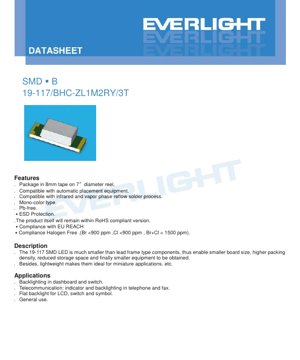
The 19-117/BHC-ZL1M2RY/3T is a compact, surface-mount blue LED designed for modern electronic applications requiring high reliability and efficient assembly. This component represents a significant advancement over traditional lead-frame LEDs, offering substantial benefits in terms of board space utilization and manufacturing efficiency.
1.1 Core Advantages and Product Positioning
The primary advantage of this LED is its miniature footprint, which directly enables the design of smaller printed circuit boards (PCBs). This reduction in size contributes to higher component packing density, allowing for more complex functionality within a constrained space. Furthermore, the reduced storage requirements for both the components and the final assembled equipment lead to overall cost savings in logistics and product housing.
Its lightweight construction makes it particularly suitable for portable and miniature electronic devices where weight is a critical design factor. The component is supplied on industry-standard 8mm tape mounted on 7-inch diameter reels, ensuring full compatibility with high-speed automated pick-and-place assembly equipment, which is essential for mass production.
1.2 Target Applications and Markets
This LED is versatile and finds use in several key application areas. A primary use case is backlighting for instrument panels, dashboard indicators, and membrane switches, where its consistent blue output provides clear illumination. In the telecommunications sector, it serves as status indicators and keypad backlights in devices such as telephones and fax machines.
It is also employed for flat backlighting solutions behind liquid crystal displays (LCDs), symbols, and various switch interfaces. Its general-purpose nature means it can be adapted for a wide range of consumer, industrial, and automotive indicator applications where a reliable blue light source is required.
2. Technical Specifications and In-Depth Interpretation
Understanding the absolute maximum ratings is crucial for ensuring the long-term reliability and preventing premature failure of the LED in an application circuit.
2.1 Absolute Maximum Ratings
The device is rated for a continuous forward current (IF) of 10 mA. Exceeding this value will generate excessive heat, degrading the internal semiconductor junction and leading to a rapid decrease in luminous output and eventual catastrophic failure. For pulsed operation, a peak forward current (IFP) of 40 mA is permissible, but only under a strict duty cycle of 1/10 at a frequency of 1 kHz. This allows for brief moments of higher brightness without overheating.
The total power dissipation (Pd) must not exceed 40 mW, which is a function of the forward current and voltage. The operating and storage temperature ranges are specified from -40°C to +85°C and -40°C to +90°C, respectively, indicating suitability for harsh environments. The component offers a degree of protection against electrostatic discharge (ESD), rated at 2000V according to the Human Body Model (HBM), which is a standard level for handling in a controlled environment but still necessitates proper ESD precautions during assembly.
2.2 Electro-Optical Characteristics
Under standard test conditions (ambient temperature Ta=25°C and a forward current of 5 mA), the LED exhibits key performance parameters. The luminous intensity (Iv) has a typical range, with minimum and maximum values defined by the binning system detailed later. The viewing angle (2θ1/2) is a wide 120 degrees, providing a broad, diffuse emission pattern suitable for area illumination rather than a focused beam.
The spectral characteristics are central to its blue color. The peak wavelength (λp) is typically 468 nanometers (nm), while the dominant wavelength (λd) falls between 465.0 nm and 475.0 nm. The spectral bandwidth (Δλ) is approximately 25 nm, defining the purity of the blue color. The forward voltage (VF) required to achieve the 5 mA test current ranges from 2.50V to 3.10V. This parameter is critical for circuit design, as it determines the voltage drop across the LED and the necessary current-limiting resistor value.
3. Binning System Explanation
To ensure consistency in mass production, LEDs are sorted into performance bins. This system allows designers to select components that meet specific minimum criteria for their application.
3.1 Luminous Intensity Binning
The luminous output is categorized into four distinct bins: L1, L2, M1, and M2. The L1 bin represents the lowest output range (11.5 - 14.5 mcd), while the M2 bin represents the highest (22.5 - 28.5 mcd). Designers can specify a bin code to guarantee a minimum brightness level for their product, which is essential for applications requiring uniform panel illumination or meeting specific visibility standards.
3.2 Dominant Wavelength Binning
The color of the blue light is controlled through dominant wavelength binning. Two bins are defined: 'X' (465.0 - 470.0 nm) and 'Y' (470.0 - 475.0 nm). Bin 'X' produces a slightly shorter wavelength, deeper blue, while bin 'Y' is a slightly longer wavelength, leaning towards a blue-cyan hue. This allows for color matching between different LEDs in an array or ensuring a specific blue tone for brand or aesthetic reasons.
3.3 Forward Voltage Binning
The forward voltage is binned into three categories: 9 (2.50 - 2.70V), 10 (2.70 - 2.90V), and 11 (2.90 - 3.10V). Knowing the voltage bin is vital for designing an efficient driver circuit. Using LEDs from the same or a known voltage bin minimizes variations in current and brightness when multiple LEDs are connected in parallel without individual current regulation.
4. Performance Curve Analysis
The provided characteristic curves offer deep insight into the LED's behavior under varying operational conditions, which is necessary for robust system design.
4.1 Relative Luminous Intensity vs. Forward Current
The curve showing relative luminous intensity as a function of forward current is typically non-linear. The output increases with current but will eventually saturate. More importantly, operating above the recommended current leads to excessive junction temperature, which not only reduces efficiency but also shortens the device's lifespan. This curve helps designers find the optimal balance between desired brightness and operational longevity.
4.2 Relative Luminous Intensity vs. Ambient Temperature
Aikin LED yana da dogaro sosai akan zafin jiki. Yayin da zafin yanayi ya tashi, fitowar haske gabaɗaya tana raguwa. Wannan lanƙwasa tana ƙididdige wannan raguwar ƙarfi. Don aikace-aikacen da ke fuskantar yanayin zafi mai yawa (misali, a cikin dashboard na mota ko kusa da sauran sassan da ke samar da zafi), wannan bayanin yana da mahimmanci don tabbatar da cewa LED ya kasance yana da haske mai isa a ƙarƙashin duk yanayin aiki. Yana iya buƙatar ƙira don kwandon haske mafi girma ko aiwatar da dabarun sarrafa zafi.
4.3 Forward Current Derating Curve
This is arguably the most critical curve for reliability. It defines the maximum allowable continuous forward current at any given ambient temperature. As temperature increases, the maximum safe current decreases. Adhering to this derating curve prevents thermal runaway and ensures the LED operates within its safe operating area (SOA), which is fundamental to achieving the specified lifetime.
4.4 Spectrum Distribution and Radiation Pattern
The spectrum distribution plot shows the intensity of light emitted across different wavelengths, centered around 468 nm. The radiation pattern diagram (often a polar plot) illustrates how light is emitted spatially from the package. The wide 120-degree viewing angle confirms a Lambertian or near-Lambertian emission pattern, where intensity is highest perpendicular to the chip and decreases at wider angles.
5. Mechanical and Packaging Information
5.1 Package Dimensions and Tolerances
The LED features a standard SMD package. Critical dimensions include the body size, which dictates the PCB land pattern, and the placement of the anode and cathode terminals. The dimensional drawing specifies all key measurements with a standard tolerance of ±0.1 mm unless otherwise noted. This information is used to create the PCB footprint, ensuring proper soldering and alignment.
5.2 Polarity Identification and Pad Design
Correct polarity is essential for LED operation. The datasheet's package drawing clearly indicates the anode and cathode. Typically, one pad may be marked or have a different shape (e.g., a notch or a beveled edge) on the component itself for visual identification under magnification. The recommended PCB pad layout ensures a reliable solder joint and proper thermal and electrical connection.
6. Soldering and Assembly Guidelines
Proper handling and soldering are critical to maintaining the LED's performance and reliability.
6.1 Reflow Soldering Parameters
The component is compatible with infrared and vapor phase reflow processes. A specific Pb-free soldering temperature profile is provided. Key parameters include a pre-heating stage (150-200°C for 60-120 seconds), a time above liquidus (217°C) of 60-150 seconds, and a peak temperature not exceeding 260°C for a maximum of 10 seconds. The maximum ramp-up and cool-down rates are also specified to prevent thermal shock. It is strongly recommended that reflow soldering not be performed more than two times to avoid damaging the internal wire bonds or the epoxy lens.
6.2 Hand Soldering and Rework Precautions
If hand soldering is unavoidable, extreme care must be taken. The soldering iron tip temperature must be below 350°C, and contact time with each terminal must not exceed 3 seconds. A low-power iron (≤25W) is recommended. A significant warning is provided: damage often occurs during hand soldering. For rework, a specialized double-head soldering iron designed for SMD components should be used to simultaneously heat both terminals and lift the component without stressing the solder joints or the LED body.
6.3 Storage and Moisture Sensitivity
Ana tattara LEDs a cikin jakar kariya daga danshi tare da busasshiyar iska don hana shan danshin yanayi. Kada a bude jakar har sai an shirya kayan aikin don amfani a cikin samarwa. Da aka bude, ya kamata a yi amfani da LEDs a cikin sa'o'i 168 (kwanaki 7) idan an adana su a yanayin ≤30°C da ≤60% danshin dangi. Idan an wuce wannan lokacin fallasa, ana buƙatar maganin gasa (60 ±5°C na awanni 24) don cire danshi da hana "popcorning" ko rabuwa yayin aikin sake kwarara mai zafi.
7. Packaging and Ordering Information
7.1 Reel and Tape Specifications
The product is supplied in a tape-and-reel format for automated assembly. The carrier tape dimensions, pocket size, and reel dimensions are specified. Each reel contains 3000 pieces. The reel and tape materials are designed to be moisture-resistant, protecting the components during storage and transport.
7.2 Label Explanation and Model Numbering
The packaging label contains several key fields: the customer part number (CPN), the manufacturer's part number (P/N), packing quantity (QTY), and the specific bin codes for luminous intensity (CAT), dominant wavelength (HUE), and forward voltage (REF). The lot number (LOT No.) is also provided for traceability. Understanding this labeling is essential for verifying that the received components match the ordered specifications.
8. Application Design Considerations
8.1 Circuit Design and Current Limiting
The most critical design rule is the mandatory use of a series current-limiting resistor (or a constant-current driver for advanced applications). The LED's forward voltage has a negative temperature coefficient and a manufacturing tolerance. A slight increase in supply voltage without current limiting can cause a large, potentially destructive increase in current. The resistor value is calculated using Ohm's Law: R = (Vsupply - VF) / IF, where VF and IF are the target operating points.
8.2 Thermal Management in End-Use
Ko LED din yana da ƙanƙanta, sarrafa zafinsa yana da mahimmanci ga aiki da tsawon rayuwa. Masu zane ya kamata su yi la'akari da hanyar zafi daga kafaffen LED zuwa PCB kuma mai yuwuwa zuwa heatsink. Yin amfani da PCB tare da isasshen yanki na tagulla (kafaffen zafi) a kusa da sawun LED na iya taimakawa wajen kawar da zafi. Dole ne a tuntuɓi lanƙwasa rage ƙima don aikace-aikacen da ke da yanayin zafi mai girma.
8.3 Optical Integration
For backlighting or indicator applications, consider the optical path. The wide viewing angle is beneficial for illuminating a diffuser or light guide evenly. The distance between the LED and the illuminated surface, as well as the use of reflectors or lenses, will affect the final brightness and uniformity. The blue color may also be converted to white or other colors using phosphor-coated lenses or remote phosphor techniques in some applications.
9. Technical Comparison and Differentiation
Compared to older through-hole LED technologies, this SMD LED offers superior performance in key areas. The absence of leads eliminates parasitic inductance and allows for higher-frequency switching if used in a pulsed mode, though this is not a typical application. The smaller thermal mass of the SMD package can allow for faster thermal response, but it also means heat must be conducted away more efficiently via the PCB.
Within the category of blue SMD LEDs, the 19-117 differentiates itself with its specific combination of package size (enabling very dense layouts), wide viewing angle (for broad illumination), and comprehensive binning system (for design flexibility and consistency). Its compliance with RoHS, REACH, and halogen-free standards makes it suitable for global markets with strict environmental regulations.
10. Frequently Asked Questions (FAQ) Based on Technical Parameters
10.1 What resistor value should I use with a 5V supply?
Using the maximum forward voltage (3.10V from bin 11) and a target current of 5 mA for standard brightness: R = (5V - 3.10V) / 0.005A = 380 Ohms. The nearest standard value is 390 Ohms. Recalculating with 390 Ohms gives IF = (5V - 3.10V) / 390 = ~4.87 mA, which is safe. Always use the maximum VF Daga zaɓaɓɓen kwandon ku don wannan lissafin don tabbatar da cewa halin yanzu bai wuce iyaka ba.
10.2 Can I drive this LED at 20 mA for higher brightness?
A'a. Matsakaicin matsakaicin ci gaba na yanzu na ci gaba shine 10 mA. Yin aiki a 20 mA zai wuce wannan ƙimar, yana haifar da zafi mai tsanani, raguwar haske mai sauri, da kusan tabbataccen gazawa. Don samun ƙarin haske, zaɓi LED daga mafi girman ƙarfin haske (M1 ko M2) ko amfani da LED da yawa, ba mafi girma na yanzu ba.
10.3 How do I interpret the bin codes on the label?
Fage na lakabin CAT, HUE, da REF sun yi daidai da kwandon. Misali, lakabin da ke nuna CAT: M2, HUE: X, REF: 10 yana nufin cewa LED ɗin da ke kan wannan reel ɗin suna da ƙarfin haske tsakanin 22.5 zuwa 28.5 mcd (M2), tsayin zango mai rinjaye tsakanin 465.0 zuwa 470.0 nm (X), da ƙarfin lantarki na gaba tsakanin 2.70 zuwa 2.90V (10).
11. Misalai na Zane da Amfani na Aiki
11.1 Dashboard Indicator Cluster
In an automotive dashboard, multiple 19-117 LEDs might be used behind a polycarbonate lens to illuminate warning symbols (e.g., high beam, turn signal). Designers would select a specific brightness bin (e.g., M1) to ensure visibility under bright daylight conditions. The LEDs would be driven by the vehicle's 12V system via a current-limiting resistor network or a dedicated LED driver IC. The wide viewing angle ensures the symbol is evenly lit. The high operating temperature range (-40 to +85°C) is essential for this harsh environment.
11.2 Low-Power Status Indicator
For a wall-powered consumer device like a router or charger, a single 19-117 LED provides a clear power-on/status indication. Driven at 5 mA from a 5V USB rail or a 3.3V logic rail (with an appropriately calculated resistor), it consumes very little power. The blue color is often associated with "active" or "connected" status. Its small size allows it to fit into the increasingly slim profiles of modern electronics.
12. Operational Principle
The 19-117 LED is a semiconductor light source. Its core is a chip composed of materials like indium gallium nitride (InGaN), which form a p-n junction. When a forward voltage exceeding the junction's built-in potential is applied, electrons and holes are injected across the junction. When these charge carriers recombine, energy is released in the form of photons (light). The specific bandgap energy of the InGaN material determines the wavelength of the emitted photons, in this case, around 468 nm, which is perceived as blue light. The epoxy lens encapsulates the chip, provides mechanical protection, and shapes the emitted light into the desired radiation pattern.
13. Technology Trends and Context
The 19-117 LED sits within the broader trend of electronics miniaturization and the transition from through-hole to surface-mount technology. This shift enables automated, high-volume assembly, reducing manufacturing costs and improving reliability by eliminating manual soldering steps. In the LED industry specifically, ongoing developments focus on increasing luminous efficacy (more light output per watt of electrical input), improving color consistency and saturation, and enhancing reliability under high-temperature and high-current conditions. While this is a standard blue LED, the underlying material science and packaging techniques continue to evolve, driving performance improvements in subsequent generations of components.
LED Specification Terminology
Complete explanation of LED technical terms
Photoelectric Performance
| Term | Unit/Representation | Simple Explanation | Why Important |
|---|---|---|---|
| Luminous Efficacy | lm/W (lumens per watt) | Light output per watt of electricity, higher means more energy efficient. | Directly determines energy efficiency grade and electricity cost. |
| Luminous Flux | lm (lumens) | Total light emitted by source, commonly called "brightness". | Determines if the light is bright enough. |
| Viewing Angle | ° (degrees), e.g., 120° | Angle where light intensity drops to half, determines beam width. | Affects illumination range and uniformity. |
| CCT (Color Temperature) | K (Kelvin), e.g., 2700K/6500K | Warmth/coolness of light, lower values yellowish/warm, higher whitish/cool. | Determines lighting atmosphere and suitable scenarios. |
| CRI / Ra | Unitless, 0–100 | Ability to render object colors accurately, Ra≥80 is good. | Affects color authenticity, used in high-demand places like malls, museums. |
| SDCM | MacAdam ellipse steps, e.g., "5-step" | Color consistency metric, smaller steps mean more consistent color. | Ensures uniform color across same batch of LEDs. |
| Dominant Wavelength | nm (nanometers), e.g., 620nm (red) | Wavelength corresponding to color of colored LEDs. | Determines hue of red, yellow, green monochrome LEDs. |
| Spectral Distribution | Wavelength vs intensity curve | Shows intensity distribution across wavelengths. | Affects color rendering and quality. |
Electrical Parameters
| Term | Symbol | Simple Explanation | Design Considerations |
|---|---|---|---|
| Forward Voltage | Vf | Minimum voltage to turn on LED, like "starting threshold". | Driver voltage must be ≥Vf, voltages add up for series LEDs. |
| Forward Current | If | Current value for normal LED operation. | Usually constant current drive, current determines brightness & lifespan. |
| Max Pulse Current | Ifp | Peak current tolerable for short periods, used for dimming or flashing. | Pulse width & duty cycle must be strictly controlled to avoid damage. |
| Reverse Voltage | Vr | Max reverse voltage LED can withstand, beyond may cause breakdown. | Circuit must prevent reverse connection or voltage spikes. |
| Thermal Resistance | Rth (°C/W) | Resistance to heat transfer from chip to solder, lower is better. | High thermal resistance requires stronger heat dissipation. |
| ESD Immunity | V (HBM), e.g., 1000V | Ability to withstand electrostatic discharge, higher means less vulnerable. | Anti-static measures needed in production, especially for sensitive LEDs. |
Thermal Management & Reliability
| Term | Key Metric | Simple Explanation | Impact |
|---|---|---|---|
| Junction Temperature | Tj (°C) | Actual operating temperature inside LED chip. | Kowane raguwar 10°C na iya ninka tsawon rayuwa; yana da yawa yana haifar da lalacewar haske, canjin launi. |
| Lumen Depreciation | L70 / L80 (hours) | Time for brightness to drop to 70% or 80% of initial. | Directly defines LED "service life". |
| Lumen Maintenance | % (e.g., 70%) | Percentage of brightness retained after time. | Indicates brightness retention over long-term use. |
| Color Shift | Δu′v′ or MacAdam ellipse | Degree of color change during use. | Affects color consistency in lighting scenes. |
| Thermal Aging | Material degradation | Deterioration due to long-term high temperature. | May cause brightness drop, color change, or open-circuit failure. |
Packaging & Materials
| Term | Common Types | Simple Explanation | Features & Applications |
|---|---|---|---|
| Package Type | EMC, PPA, Ceramic | Housing material protecting chip, providing optical/thermal interface. | EMC: good heat resistance, low cost; Ceramic: better heat dissipation, longer life. |
| Chip Structure | Front, Flip Chip | Chip electrode arrangement. | Flip chip: kona mafuta mazuri zaidi, ufanisi wa juu, kwa nguvu kubwa. |
| Phosphor Coating | YAG, Silicate, Nitride | Covers blue chip, converts some to yellow/red, mixes to white. | Different phosphors affect efficacy, CCT, and CRI. |
| Lens/Optics | Flat, Microlens, TIR | Optical structure on surface controlling light distribution. | Determines viewing angle and light distribution curve. |
Quality Control & Binning
| Term | Binning Content | Simple Explanation | Purpose |
|---|---|---|---|
| Luminous Flux Bin | Code e.g., 2G, 2H | Grouped by brightness, each group has min/max lumen values. | E kia mau tonu te tūrama ōrite i roto i te pākete kotahi. |
| Voltage Bin | Code e.g., 6W, 6X | Grouped by forward voltage range. | Facilitates driver matching, improves system efficiency. |
| Color Bin | 5-step MacAdam ellipse | Grouped by color coordinates, ensuring tight range. | Guarantees color consistency, avoids uneven color within fixture. |
| CCT Bin | 2700K, 3000K etc. | Grouped by CCT, each has corresponding coordinate range. | Meets different scene CCT requirements. |
Testing & Certification
| Term | Standard/Test | Simple Explanation | Significance |
|---|---|---|---|
| LM-80 | Lumen maintenance test | Long-term lighting at constant temperature, recording brightness decay. | Used to estimate LED life (with TM-21). |
| TM-21 | Life estimation standard | Estimates life under actual conditions based on LM-80 data. | Provides scientific life prediction. |
| IESNA | Illuminating Engineering Society | Covers optical, electrical, thermal test methods. | Industry-recognized test basis. |
| RoHS / REACH | Environmental certification | Yana tabbataccen cewa babu abubuwa masu cutarwa (gubar, mercury). | Bukatar shiga kasuwa a duniya. |
| ENERGY STAR / DLC | Ilimin ingancin makamashi | Ilimin ingancin makamashi da aiki don hasken wuta. | Used in government procurement, subsidy programs, enhances competitiveness. |