Table of contents
- 1. Product Overview
- 1.1 Core Features and Compliance
- 2. Technical Parameter Analysis
- 2.1 Absolute Maximum Ratings
- 2.2 Electro-Optical Characteristics (Ta=25°C)
- 3. Binning System Description
- 3.1 Dominant Wavelength Binning
- 3.2 Luminous Intensity Binning
- 3.3 Forward Voltage Binning
- 4. Performance Curve Analysis
- 4.1 Forward Current vs. Forward Voltage (I-V Curve)
- 4.2 Luminous Intensity vs. Forward Current
- 4.3 Luminous Intensity vs. Ambient Temperature
- 4.4 Forward Current Derating Curve
- 4.5 Spectral Distribution
- 4.6 Radiation Pattern
- 5. Mechanical and Package Information
- 5.1 Girman Kunshewa
- 5.2 Shawarar Tsarin Gindin Walda
- 6. Jagorar Walda da Haɗawa
- 6.1 Lankwalin Walda na Koma-baya (Maras Gubar)
- 6.2 Hand Soldering
- 6.3 Storage and Moisture Sensitivity
- 6.4 Key Considerations
- 7. Packaging and Ordering Information
- 7.1 Reel and Tape Specifications
- 7.2 Label Description
- 8. Application Recommendations
- 8.1 Typical Application Scenarios
- 8.2 Design Considerations
- 9. Technical Comparison and Differentiation
- 10. Frequently Asked Questions (Based on Technical Parameters)
- 11. Design and Usage Case Studies
- 12. Introduction to Technical Principles
- 13. Industry Trends and Background
- Detailed Explanation of LED Specification Terminology
- I. Core Indicators of Photoelectric Performance
- II. Electrical Parameters
- III. Thermal Management and Reliability
- IV. Packaging and Materials
- V. Quality Control and Binning
- VI. Testing and Certification
1. Product Overview
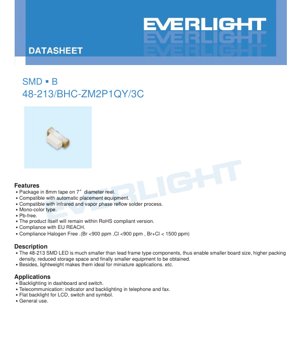
The 48-213 is a compact Surface-Mount Device (SMD) LED, specifically designed for modern electronic applications requiring miniaturization and high reliability. This monochromatic blue LED utilizes InGaN chip technology to produce light with a typical peak wavelength of 468nm. Its primary advantage lies in a significantly reduced footprint compared to leaded components, thereby increasing component density on PCBs, lowering storage requirements, and ultimately contributing to smaller end-product designs. Its lightweight construction makes it particularly suitable for portable and miniaturized applications.
1.1 Core Features and Compliance
- Packaging Method:Supplied in 8mm tape and reel format, with a reel diameter of 7 inches, compatible with standard automatic placement equipment.
- Soldering Process:Compatible with Infrared (IR) and Vapor Phase Reflow soldering processes.
- Environmental Compliance:The product is lead-free, compliant with the EU RoHS Directive, and follows the EU REACH Regulation.
- Halogen-Free:符合无卤素要求(溴<900 ppm,氯<900 ppm,溴+氯<1500 ppm)。
2. Technical Parameter Analysis
2.1 Absolute Maximum Ratings
These ratings define the limiting conditions that may cause permanent damage to the device. Operation under these conditions is not guaranteed.
- Reverse Voltage (VR):5V. Exceeding this voltage under reverse bias may cause junction breakdown.
- Continuous Forward Current (IF):25 mA.
- Peak Forward Current (IFP):100 mA, allowed only under pulse conditions (duty cycle 1/10 @ 1kHz).
- Power dissipation (Pd):95 mW. This is the maximum allowable power that the package can dissipate at an ambient temperature (Ta) of 25°C.
- Electrostatic discharge (ESD):Withstands 150V according to the Human Body Model (HBM). Appropriate ESD precautions must be taken.
- Temperature range:Operating temperature: -40°C to +85°C; Storage temperature: -40°C to +90°C.
- Soldering temperature:Reflow Soldering Peak Temperature: Maximum 260°C, duration up to 10 seconds. Hand Soldering: Maximum 350°C per solder terminal, up to 3 seconds.
2.2 Photoelectric Characteristics (Ta=25°C)
These parameters are measured under standard test conditions (IF= 5mA), defining the device's performance.
- Luminous Intensity (Iv):ranges from 22.5 mcd (minimum) to 57.0 mcd (maximum), with a typical tolerance of ±11%. The actual value is determined by the binning code (M2, N1, N2, P1).
- Viewing Angle (2θ1/2):120 degrees (typical). This wide viewing angle provides a broad emission pattern, suitable for backlight and indicator applications.
- Peak Wavelength (λp):468 nm (Typical).
- Dominant Wavelength (λd):Ranges from 465 nm to 475 nm, categorized into Z bin (465-470nm) and Y bin (470-475nm).
- Spectral Bandwidth (Δλ):35 nm (Typical), defining the spectral purity of the emitted blue light.
- Forward Voltage (VF):At 5mA, ranges from 2.7V to 3.2V, with a typical tolerance of ±0.05V. Categorized into bins Q29 to Q33.
- Reverse Current (IR):At VR= 5V, maximum 50 μA. Note: The device is tested for reverse voltage but is not designed for reverse bias operation.
3. Binning System Description
To ensure color and brightness consistency in production, LEDs are binned according to key parameters.
3.1 Dominant Wavelength Binning
It defines the perceived color of the LED. Two groups ensure color uniformity within an application.
Group Z: 465 nm – 470 nm
Group Y: 470 nm – 475 nm
3.2 Luminous Intensity Binning
Binning is based on the light output of the LED at 5mA.
M2: 22.5 – 28.5 mcd
N1: 28.5 – 36.0 mcd
N2: 36.0 – 45.0 mcd
P1: 45.0 – 57.0 mcd
3.3 Forward Voltage Binning
Grouping based on the LED's forward voltage drop is crucial for current-limiting resistor calculation and power supply design.
Q29: 2.7V – 2.8V
Q30: 2.8V – 2.9V
Q31: 2.9V – 3.0V
Q32: 3.0V – 3.1V
Q33: 3.1V – 3.2V
4. Performance Curve Analysis
The datasheet provides several characteristic curves that are crucial for design engineers.
4.1 Forward Current vs. Forward Voltage (I-V Curve)
This nonlinear relationship indicates that once the voltage exceeds the knee voltage, a small increase in voltage leads to a large increase in current. This highlights the necessity of using a series current-limiting resistor or a constant current driver to prevent thermal runaway and device damage.
4.2 Luminous Intensity vs. Forward Current
Light output increases with forward current, but not in a linear relationship. This curve helps designers select an operating point that balances brightness, efficiency, and device lifetime.
4.3 Luminous Intensity vs. Ambient Temperature
The light output of an LED decreases as its junction temperature rises. This curve shows that the relative luminous intensity declines as the ambient temperature increases from -40°C to +100°C. Effective thermal management in the application is crucial for maintaining brightness consistency.
4.4 Forward Current Derating Curve
This is one of the most critical charts for reliability. It shows how the maximum allowable continuous forward current decreases as the ambient temperature exceeds 25°C. At 85°C, the maximum allowable current is significantly reduced to prevent exceeding the maximum junction temperature and to ensure long-term reliability.
4.5 Spectral Distribution
It displays the relative radiant power at each wavelength, centered at 468nm with a typical bandwidth of 35nm. This confirms its characteristic monochromatic blue light.
4.6 Radiation Pattern
A polar plot illustrating the spatial distribution of light intensity, confirming a 120° viewing angle. The pattern is typically Lambertian or near-Lambertian.
5. Mechanical and Package Information
5.1 Girman Kunshewa
The 48-213 utilizes a compact SMD package, with key dimensions as follows (unit: mm):
- Length: 2.25 ±0.20
- Width: 1.45 ±0.10
- Height: 0.72 ±0.10
- Pin pitch: 1.80 (between anode and cathode pads)
The package is clearly marked with a cathode indicator for correct polarity identification during assembly.
5.2 Shawarar Tsarin Gindin Walda
The recommended land pattern (package dimensions), including pad sizes, is provided. The datasheet explicitly states that this drawing is for reference only and should be modified based on specific PCB design requirements, solder paste volume, and assembly process.
6. Jagorar Walda da Haɗawa
6.1 Lankwalin Walda na Koma-baya (Maras Gubar)
A detailed temperature profile is specified:
- Preheat: 150–200°C, for 60–120 seconds.
- Time above liquidus (217°C): 60–150 seconds.
- Peak temperature: Maximum 260°C, hold time maximum 10 seconds.
- Heating rate: Maximum 3°C/second (to 255°C), overall maximum 6°C/second.
- Cooling rate: Determined by the process.
Strict adherence to this profile is critical. The same device should not undergo reflow soldering more than twice.
6.2 Hand Soldering
If manual soldering must be performed:
- Soldering iron tip temperature must be below 350°C.
- Contact time per solder pad must not exceed 3 seconds.
- Soldering iron power should be below 25W.
- Allow an interval of more than 2 seconds between soldering each pad to prevent thermal shock.
Datasheet warns that damage often occurs during manual soldering.
6.3 Storage and Moisture Sensitivity
LEDs are packaged in moisture barrier bags with desiccant.
- Before opening: Store at ≤30°C and ≤90% RH.
- After opening: "Floor life" is 1 year at ≤30°C and ≤60% RH. Unused devices must be resealed in moisture barrier packaging.
- If the desiccant indicator changes color or storage time is exceeded, baking is required: Bake at 60 ±5°C for 24 hours before use, after which reflow soldering can proceed.
6.4 Key Considerations
- Current Limiting:An external current-limiting resistor must be used. The exponential I-V characteristic of the LED means a small voltage change causes a large current change, which will destroy it instantly without protection.
- Mechanical Stress:Avoid applying stress to the LED body during soldering or final application. Do not bend the PCB after soldering.
- Rework:Rework after soldering is strongly discouraged. If absolutely necessary, use a dual-tip soldering iron to heat both solder terminals simultaneously to minimize thermal stress.
7. Packaging and Ordering Information
7.1 Reel and Tape Specifications
Devices are supplied in embossed carrier tape:
- Reel diameter: 7 inches.
- Carrier tape width: 8mm.
- Quantity per reel: 3000 pieces.
Provides detailed dimensions for the carrier tape pockets and reel to ensure compatibility with automatic feeders.
7.2 Label Description
The reel label contains several key identifiers:
- P/N: Product Number (e.g., 48-213/BHC-ZM2P1QY/3C).
- QTY: Quantity.
- CAT: Luminous Intensity Category (e.g., M2, P1).
- HUE: Chromaticity/Dominant Wavelength Category (e.g., Z, Y).
- REF: Forward Voltage Category (e.g., Q29, Q33).
- LOT No.: Traceable Lot Number.
8. Application Recommendations
8.1 Typical Application Scenarios
- Backlight:With its wide viewing angle and compact size, it is ideal for dashboard indicator lights, switch illumination, and flat backlighting for LCDs and symbols.
- Communication Equipment:Status indicator lights and keyboard backlighting in telephones, fax machines, and other communication equipment.
- General Indicator Lights:Any application requiring a reliable, compact blue status indicator.
8.2 Design Considerations
- Thermal Management:Despite low power consumption, PCB layout should consider heat dissipation, especially under high ambient temperatures or when the drive current is near its maximum. Refer to the derating curve.
- Current Drive Circuit:Always use a constant current source or a voltage source with a series resistor. Use the maximum V from the binFand the required IFto calculate the resistor value, ensuring the current never exceeds the absolute maximum rating.
- Optical Design:The 120° viewing angle provides a wide coverage area. External lenses or light guides may be required for more focused light.
- ESD Protection:Implement ESD protection on input lines and ensure the assembly area meets ESD safety requirements, as the device has an ESD rating of 150V HBM.
9. Technical Comparison and Differentiation
The 48-213 SMD LED offers several key advantages in its category:
Size Advantage:Its 2.25 x 1.45 mm footprint is significantly smaller than traditional 3mm or 5mm leaded LEDs, enabling ultra-compact designs.
Process Compatibility:Fully compatible with standard SMT reflow processes (infrared and vapor phase), enabling high-volume, low-cost automated assembly, unlike through-hole LEDs which require manual or wave soldering.
Performance Consistency:A detailed binning system for wavelength, intensity, and voltage allows designers to select components that ensure visual uniformity across all units in a product, which is crucial for backlighting and multi-LED arrays.
Robustness:When properly soldered, SMD packages offer superior mechanical stability and vibration resistance compared to leaded components.
10. Frequently Asked Questions (Based on Technical Parameters)
Q1: Why is a current-limiting resistor absolutely essential?
A1: Forward Voltage (VF) has a tolerance and a negative temperature coefficient. A slight increase in the power supply voltage or VFKutokana na kupungua kwa joto, inaweza kusababisha ongezeko la mkazo la mkondo bila udhibiti (kukimbia kwa joto), na kusababisha hitilafu ya papo hapo. Upinzani unaweza kudumisha uthabiti wa mkondo.
Q2: Can I drive this LED continuously at 25mA?
A2: Yes, but only if the ambient temperature (Ta) equal to or below 25°C. Please refer to the forward current derating curve (Section 4.4). At higher ambient temperatures, the maximum allowable continuous current must be reduced to keep the junction temperature within a safe range.
Q3: What does the grading code (e.g., ZM2P1QY) mean?
A3: This is a composite code. 'Z' or 'Y' indicates the dominant wavelength bin. 'M2', 'P1', etc., indicate the luminous intensity bin. 'Q29' to 'Q33' indicate the forward voltage bin. Selecting specific bin combinations ensures predictable color, brightness, and electrical behavior.
Q4: How to understand "peak" wavelength and "dominant" wavelength?
A4: Peak wavelength (λp) is the wavelength at which the emitted optical power is maximum (typical value 468nm). Dominant wavelength (λd) is the wavelength of monochromatic light that matches the perceived color of the LED (465-475nm). λdis more relevant for color specification.
11. Design and Usage Case Studies
Scenario: Designing a multi-LED status panel for a portable medical device.
Requirements:Provide uniform blue backlighting for 10 membrane switches, ultra-thin profile, reliable operation from -10°C to +60°C, powered by a regulated 5V supply.
Design Steps:
1. LED Selection:Select 48-213 for its small size, wide viewing angle (conducive to uniform backlighting), and SMD compatibility.
2. Binning Selection:To ensure uniform color and brightness, specify a single bin (e.g., Y-P1-Q31) for the entire order.
3. Current Setting:To balance brightness and lifespan, set IFto 10mA. According to the derating curve, 10mA is safe up to approximately 85°C, well above the 60°C requirement.
4. Resistor Calculation:Using the worst-case (maximum) VF(3.0V) from bin Q31 and the supply voltage (5V): R = (5V - 3.0V) / 0.01A = 200 Ω. Select a standard 200 Ω, 1/10W resistor.
5. PCB Layout:Use the recommended pad layout as a starting point. Add a small thermal pad on the cathode pad to aid soldering while maintaining electrical connection. The LED spacing is designed to allow uniform light diffusion through the light guide plate.
6. Assembly:Load the reel into the placement machine. Program the specified lead-free reflow profile into the reflow oven. After reflow soldering, do not apply any post-soldering stress to the circuit board.
12. Introduction to Technical Principles
The 48-213 LED is based on a semiconductor diode structure made from indium gallium nitride (InGaN) material. When a forward voltage exceeding the diode's knee voltage (approximately 2.7-3.2V) is applied, electrons and holes are injected into the active region of the semiconductor. Their recombination releases energy in the form of photons (light). The specific composition of the InGaN alloy determines the bandgap energy, which directly corresponds to the wavelength of the emitted light—in this case, blue light at approximately 468nm. The transparent resin encapsulant protects the semiconductor chip and acts as a primary lens, shaping the initial radiation pattern. The SMD package provides mechanical protection, electrical connection via metallized pads, and a thermal path from the chip to the PCB.
13. Industry Trends and Background
The 48-213 represents a mature product in the evolution of SMD LEDs. The overall industry trend continues to move in the following directions:
Efficiency Improvement:Updated chip designs and materials (such as advanced InGaN structures) offer higher luminous efficacy (more light output per watt of electrical power), enabling brighter displays or lower power consumption.
Miniaturization:Smaller package sizes (e.g., 1.0x0.5mm) are becoming common in space-constrained applications (such as wearable technology and ultra-thin displays).
Improved Color Consistency:Tighter binning tolerances and the use of phosphor-converted white LEDs with higher Color Rendering Index (CRI) have become standard for display backlighting, although this device remains a monochromatic blue LED.
Integrated Solutions:A growing trend is the integration of LED driver ICs, current-limiting resistors, and sometimes even control logic into a single module or package, simplifying end-user design. The 48-213 remains a fundamental discrete component offering maximum design flexibility.
Detailed Explanation of LED Specification Terminology
Cikakken Ma'anar Kalmomin Fasahar LED
I. Core Indicators of Photoelectric Performance
| Kalma | Naúra/Bayanin | Bayani a Harshen Gargajiya | Me Ya Sa Yake Da Muhimmanci |
|---|---|---|---|
| Luminous Efficacy | lm/W | The luminous flux emitted per watt of electrical power; higher values indicate greater energy efficiency. | Directly determines the energy efficiency rating and electricity cost of a luminaire. |
| Luminous Flux | lm | The total amount of light emitted by a light source, commonly known as "brightness". | Determines whether a luminaire is bright enough. |
| Viewing Angle | ° (degrees), e.g., 120° | The angle at which light intensity drops to half, determining the width of the light beam. | Affects the illumination range and uniformity. |
| Correlated Color Temperature (CCT) | K (Kelvin), e.g., 2700K/6500K | The warmth or coolness of light color; lower values are yellowish/warm, higher values are whitish/cool. | Determines the lighting ambiance and suitable application scenarios. |
| Color Rendering Index (CRI / Ra) | Unitless, 0–100 | The ability of a light source to restore the true color of an object, Ra≥80 is recommended. | Affects color authenticity, used in high-demand places such as shopping malls and art galleries. |
| Color tolerance (SDCM) | MacAdam ellipse steps, such as "5-step" | A quantitative indicator of color consistency, the smaller the step number, the more consistent the color. | Ensures no color difference among the same batch of luminaires. |
| Dominant Wavelength | nm (nanometer), e.g., 620nm (red) | The wavelength value corresponding to the color of a colored LED. | Determines the hue of monochromatic LEDs such as red, yellow, and green. |
| Spectral Distribution | Wavelength vs. Intensity curve | Display the intensity distribution of light emitted by the LED across various wavelengths. | Affects color rendering and color quality. |
II. Electrical Parameters
| Kalma | Symbol | Bayani a Harshen Gargajiya | Design Considerations |
|---|---|---|---|
| Forward Voltage (Forward Voltage) | Vf | Voltage ya chini inayohitajika kuwasha LED, kama "kizingiti cha kuanzisha". | Voltage ya chanzo cha umeme inahitaji kuwa ≥ Vf, voltage inajumlishwa wakati LED nyingi zimeunganishwa mfululizo. |
| Forward Current | If | Thamani ya mkondo inayofanya LED mwangaza kwa kawaida. | A yawanci ana amfani da tuƙi mai tsayayyen kwarara, kwararar wutar lantarki tana ƙayyadaddun haske da rayuwa. |
| Matsakaicin ƙarfin kwararar bugun jini (Pulse Current) | Ifp | Matsakaicin ƙarfin kwarara da za a iya jurewa a cikin ɗan gajeren lokaci, ana amfani dashi don daidaita haske ko walƙiya. | Faɗin bugun jini da rabon aiki dole ne a sarrafa su sosai, in ba haka ba za su yi zafi su lalace. |
| Ƙarfin wutar lantarki na baya (Reverse Voltage) | Vr | The maximum reverse voltage that an LED can withstand; exceeding this may cause breakdown. | Reverse connection or voltage surges must be prevented in the circuit. |
| Thermal Resistance | Rth (°C/W) | The resistance to heat flow from the chip to the solder point; a lower value indicates better heat dissipation. | High thermal resistance requires stronger heat dissipation design, otherwise junction temperature will rise. |
| Electrostatic Discharge Immunity (ESD Immunity) | V (HBM), such as 1000V | The ability to withstand electrostatic strikes; a higher value indicates greater resistance to electrostatic damage. | Anti-static measures must be implemented during production, especially for high-sensitivity LEDs. |
III. Thermal Management and Reliability
| Kalma | Key Metrics | Bayani a Harshen Gargajiya | Impact |
|---|---|---|---|
| Junction Temperature | Tj (°C) | The actual operating temperature inside the LED chip. | For every 10°C reduction, lifespan may double; excessively high temperatures cause lumen depreciation and color shift. |
| Lumen Depreciation | L70 / L80 (hours) | The time required for brightness to drop to 70% or 80% of its initial value. | Directly defines the "service life" of an LED. |
| Lumen Maintenance | % (e.g., 70%) | Yawanci haske da ya rage bayan amfani da lokaci. | Halin riƙe haske bayan dogon amfani. |
| Color Shift | Δu′v′ ko MacAdam ellipse | Matsakaicin canjin launi yayin amfani. | Yana shafar daidaiton launi a yanayin haske. |
| Thermal Aging | Material Performance Degradation | Degradation of packaging materials due to prolonged exposure to high temperatures. | May lead to decreased brightness, color shift, or open-circuit failure. |
IV. Packaging and Materials
| Kalma | Common Types | Bayani a Harshen Gargajiya | Features and Applications |
|---|---|---|---|
| Package Type | EMC, PPA, Ceramic | A housing material that protects the chip and provides optical and thermal interfaces. | EMC offers good heat resistance and low cost; ceramic provides superior heat dissipation and long lifespan. |
| Chip Structure | Front-side, Flip Chip | Chip electrode arrangement method. | Flip Chip offers better heat dissipation, higher luminous efficacy, suitable for high-power applications. |
| Phosphor coating | YAG, Silicate, Nitride | Coated on the blue LED chip, partially converts to yellow/red light, mixes to form white light. | Different phosphors affect luminous efficacy, color temperature, and color rendering. |
| Lens/Optical Design | Flat, microlens, total internal reflection | The optical structure on the package surface controls light distribution. | Determines the emission angle and light distribution curve. |
V. Quality Control and Binning
| Kalma | Bin Content | Bayani a Harshen Gargajiya | Purpose |
|---|---|---|---|
| Luminous Flux Binning | Codes such as 2G, 2H | Grouped by brightness level, each group has a minimum/maximum lumen value. | Ensure consistent brightness within the same batch of products. |
| Voltage Binning | Codes such as 6W, 6X | Grouped according to forward voltage range. | Facilitates driver matching and improves system efficiency. |
| Color Binning | 5-step MacAdam Ellipse | Group by color coordinates, ensuring colors fall within an extremely narrow range. | Ensure color consistency to avoid uneven color within the same luminaire. |
| Color temperature binning | 2700K, 3000K, etc. | Group by color temperature, each group has a corresponding coordinate range. | Meet the color temperature requirements of different scenarios. |
VI. Testing and Certification
| Kalma | Standard/Test | Bayani a Harshen Gargajiya | Significance |
|---|---|---|---|
| LM-80 | Lumen Maintenance Test | Long-term operation under constant temperature conditions, recording data on luminous flux depreciation. | For estimating LED lifetime (in conjunction with TM-21). |
| TM-21 | Lifetime projection standard | Estimating lifetime under actual use conditions based on LM-80 data. | Providing scientific lifetime prediction. |
| IESNA standard | Standard of the Illuminating Engineering Society | Covers optical, electrical, and thermal testing methods. | Industry-recognized testing basis. |
| RoHS / REACH | Environmental certification. | Ensures products do not contain harmful substances (e.g., lead, mercury). | Conditions for market entry into the international market. |
| ENERGY STAR / DLC | Energy efficiency certification. | Energy efficiency and performance certification for lighting products. | Commonly used in government procurement and subsidy programs to enhance market competitiveness. |