Table of Contents
- 1. Product Overview
- 1.1 Core Advantages and Target Market
- 2. Absolute Maximum Ratings and Technical Parameters
- 3. Photoelectric Characteristics
- 4. Binning System Description
- 4.1 Luminous Intensity Binning
- 4.2 Dominant Wavelength Binning
- 4.3 Forward Voltage Binning
- 5. Performance Curve Analysis
- 5.1 Luminous Intensity vs. Forward Current
- 5.2 Luminous Intensity vs. Ambient Temperature
- 5.3 Forward Current Derating Curve
- 5.4 Forward Voltage vs. Forward Current
- 5.5 Spectral Distribution
- 5.6 Radiation Pattern
- 6. Mechanical and Packaging Information
- 7. Soldering, Assembly and Storage Guidelines
- 7.1 Current Limiting Requirements
- 7.2 Storage and Moisture Sensitivity
- 7.3 Soldering Conditions
- 7.4 Manual Welding and Rework
- 8. Packaging and Ordering Information
- 9. Application Design Considerations
- 9.1 Circuit Design
- 9.2 Thermal Management
- 9.3 Optical Integration
- 10. Technical Comparison and Differentiation
- 11. Frequently Asked Questions (FAQ)
- 12. Design and Use Case Examples
- 13. How It Works
- 14. Teknoloji Trendleri
1. Product Overview
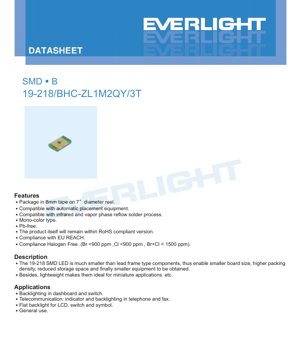
19-218/BHC-ZL1M2QY/3T is a Surface Mount Device (SMD) Light Emitting Diode (LED) designed specifically for modern compact electronic applications. This component represents a significant advancement over traditional lead-frame type LEDs, enabling a substantial reduction in the size of the end product. Its core value lies in enabling smaller Printed Circuit Board (PCB) designs, higher component assembly density, and reducing the overall size and weight of the device. This makes it an ideal choice for applications where space and weight are critical limiting factors.
该 LED 为单色型,发射蓝光,采用环保材料制造。它完全符合主要的国际法规,包括欧盟的《有害物质限制指令》(RoHS)、《化学品注册、评估、授权和限制法规》(REACH) 以及无卤素要求 (Br <900 ppm, Cl <900 ppm, Br+Cl < 1500 ppm)。产品以卷带形式供货,兼容标准的自动化贴片组装设备,简化了大规模制造流程。
1.1 Core Advantages and Target Market
The primary advantage of this SMD LED stems from its miniature package and lightweight structure. By eliminating bulky leads, it enables more efficient utilization of PCB space. This directly translates into smaller end-product enclosures, lower material costs, and lighter end-user devices. The high assembly density achievable with SMD components is crucial for modern feature-rich electronic products.
The target applications for this LED are diverse, primarily focusing on indicator and backlighting functions. Key markets include automotive interiors (e.g., dashboard and switch backlighting), telecommunications equipment (e.g., status indicators and keypad backlighting in telephones and fax machines), and consumer electronics (e.g., flat backlighting for Liquid Crystal Displays (LCDs), switches, and symbols). Its versatility also makes it suitable for a wide range of other indicator applications in both industrial and consumer fields.
2. Absolute Maximum Ratings and Technical Parameters
Understanding absolute maximum ratings is crucial for ensuring reliable operation and preventing premature device failure. These ratings define the stress limits that could cause permanent damage.
- Reverse Voltage (VR):5 V. Exceeding this voltage in the reverse direction may cause junction breakdown.
- Continuous Forward Current (IF):25 mA. This is the maximum DC current that can be continuously applied.
- Peak Forward Current (IFP):100 mA. Wannan ƙimar bugun jini (aikin 1/10, mitar 1 kHz) yana ba da izinin aiki na ɗan gajeren lokaci mai haske, amma ba za a yi amfani da shi don ci gaba da aiki ba.
- Amfani da wutar lantarki (Pd):95 mW. Wannan shine mafi girman ƙarfin da na'urar za ta iya ɓata a matsayin zafi, wanda aka lissafta azaman samfurin ƙarfin lantarki na gaba da kuma ƙarfin lantarki na gaba.
- Electrostatic Discharge (ESD) Human Body Model (HBM):150 V. Proper ESD handling procedures must be followed during assembly and handling to avoid electrostatic damage.
- Operating Temperature (Topr):-40°C to +85°C. The device is guaranteed to operate normally within this ambient temperature range.
- Storage temperature (Tstg):-40°C to +90°C.
- Welding temperature:The device can withstand a peak temperature of 260°C for up to 10 seconds during reflow soldering, or 350°C for up to 3 seconds per terminal during hand soldering.
3. Photoelectric Characteristics
Photoelectric characteristics are measured under standard test conditions with an ambient temperature (Ta) of 25°C and a forward current (IF) of 5 mA, unless otherwise specified. These parameters define the light output and electrical behavior of the LED.
- Luminous intensity (Iv):The range spans from a minimum of 11.5 millicandelas (mcd) to a maximum of 28.5 mcd. A typical value is not specified in the summary table, but the binning system provides specific ranges.
- Viewing Angle (2θ1/2):120 degrees. This is the full angle at which the luminous intensity drops to half of its 0-degree (axial) intensity. Such a wide viewing angle is suitable for applications requiring wide-angle illumination or multi-angle visibility.
- Peak Wavelength (λp):468 nm. This is the wavelength at which the spectral power distribution reaches its maximum value.
- Dominant Wavelength (λd):Ranging from 465 nm to 475 nm. This is the single wavelength that the human eye perceives as matching the color of the LED light. It is a key parameter for defining color.
- Spectral Radiant Bandwidth (Δλ):25 nm (typical). This defines the width of the emission spectrum at half the peak intensity.
- Forward Voltage (VF):At IF= 5mA, the range is from 2.7 V to 3.2 V. This is the voltage drop across the LED when the conduction current is applied.
- Reverse current (IR):When a reverse voltage (VR) of 5V is applied, the maximum is 50 μA.
Tolerance description:The luminous intensity tolerance is ±11%, the dominant wavelength tolerance is ±1 nm, and the forward voltage tolerance is ±0.05 V. These tolerances have been considered in the binning system.
4. Binning System Description
To ensure color and brightness consistency in production, LEDs are sorted into different bins based on key parameters. This allows designers to select components that meet the uniformity requirements of specific applications.
4.1 Luminous Intensity Binning
Based on the luminous intensity measured at IF= 5mA, the LEDs are categorized into four bins (L1, L2, M1, M2).
- Bin L1:11.5 mcd to 14.5 mcd
- Gear L2:14.5 mcd to 18.0 mcd
- Gear M1:18.0 mcd to 22.5 mcd
- Gear M2:22.5 mcd to 28.5 mcd
4.2 Dominant Wavelength Binning
LEDs are grouped according to their dominant wavelength to control the hue of blue.
- Group Z:This group contains the gear positions for the blue LED.
- Gear X:465 nm to 470 nm (wavelength slightly shorter, possibly greenish-blue)
- Bin Y:470 nm to 475 nm (wavelength slightly longer, possibly purer or deeper blue)
4.3 Forward Voltage Binning
LEDs are also binned according to forward voltage (VF) to aid circuit design, particularly for current-limiting resistor calculation and power supply design.
- Group Q:This group contains forward voltage levels.
- Level 29:2.7 V to 2.8 V
- Level 30:2.8 V to 2.9 V
- Gear 31:2.9 V to 3.0 V
- Gear 32:3.0 V to 3.1 V
- Gear 33:3.1 V to 3.2 V
The complete product model (e.g., BHC-ZL1M2QY/3T) contains codes specifying the luminous intensity, dominant wavelength, and forward voltage bin to which the device belongs.
5. Performance Curve Analysis
The datasheet provides several characteristic curves illustrating the performance variation of the LED under different operating conditions. These are crucial for robust design.
5.1 Luminous Intensity vs. Forward Current
This curve shows that luminous intensity increases with forward current, but the relationship is not perfectly linear, especially at higher currents. Operating above the recommended continuous current increases light output but also generates more heat, which can shorten lifespan and cause color shift.
5.2 Luminous Intensity vs. Ambient Temperature
As ambient temperature increases, the luminous intensity of the LED decreases. This is a fundamental characteristic of semiconductor light sources. The curve shows a decline in relative luminous intensity as temperature rises from -40°C to +100°C. This derating must be considered in designs for high-temperature environments.
5.3 Forward Current Derating Curve
To prevent overheating, the maximum allowable continuous forward current must be reduced as the ambient temperature increases. This curve provides derating information, specifying lower IFat higher Talimits to stay within the power dissipation rating.
5.4 Forward Voltage vs. Forward Current
This is the current-voltage (I-V) characteristic of an LED diode. It shows an exponential relationship, where a small increase in voltage beyond the turn-on threshold leads to a large increase in current. This highlights the absolute necessity of a current-limiting device (such as a resistor or constant current driver) in series with the LED.
5.5 Spectral Distribution
The figure depicts the relative radiant power emitted within the visible spectrum, centered at a peak wavelength of 468 nm with a typical bandwidth of 25 nm. This defines the purity and specific hue of the blue light.
5.6 Radiation Pattern
This polar plot visually represents the spatial distribution of light, confirming a 120-degree viewing angle. It shows how the intensity diminishes at angles deviating from the central axis.
6. Mechanical and Packaging Information
The physical dimensions of the SMD LED package are provided in the detailed drawings. Key dimensions include overall length, width, height, as well as the location and size of the solderable terminals. A recommended pad layout is also suggested to ensure reliable solder joints and proper alignment during reflow. The pad design is for reference only; designers may modify it based on their specific PCB fabrication capabilities and thermal management requirements. Unless otherwise specified, the tolerance for package dimensions is typically ±0.1 mm.
This component uses a transparent (colorless) resin lens, allowing blue light from the InGaN semiconductor chip to be emitted without the need for color filtering. Polarity is indicated by a mark on the package, which must be observed during mounting to ensure correct electrical connection.
7. Soldering, Assembly and Storage Guidelines
Adherence to these guidelines is critical for assembly yield and long-term reliability.
7.1 Current Limiting Requirements
An external current limiting resistor must be used. The exponential I-V characteristic of an LED means that small variations in supply voltage can cause large and potentially destructive changes in forward current. The resistor reliably sets the operating current.
7.2 Storage and Moisture Sensitivity
LEDs are packaged in moisture barrier bags with desiccant to prevent absorption of atmospheric moisture. The bag should not be opened until ready for production. Before opening, storage conditions should be ≤30°C and ≤90% RH. After opening, the components have a 1-year "floor life" if kept at ≤30°C and ≤60% RH. Unused parts should be resealed in moisture barrier packaging. If the desiccant indicator changes color or the storage time exceeds the specification, baking at 60 ±5°C for 24 hours is required prior to reflow soldering to remove moisture.
7.3 Soldering Conditions
This device is compatible with infrared (IR) and vapor phase reflow soldering processes. A lead-free reflow temperature profile is provided, specifying preheating, time above liquidus (217°C), peak temperature (maximum 260°C, maximum 10 seconds), and cooling rate. Reflow soldering should not be performed more than twice on the same LED. During the soldering process, no mechanical stress should be applied to the component, and the PCB should not warp after the process.
7.4 Manual Welding and Rework
如果必须进行手工焊接,烙铁头温度必须低于 350°C,每个端子的接触时间不应超过 3 秒。建议使用低功率烙铁 (<25W),焊接每个端子之间至少间隔 2 秒。强烈不建议在 LED 焊接后进行返修。如果绝对不可避免,必须使用专用的双头烙铁同时加热两个端子,并且必须事先验证对 LED 特性的影响。
8. Packaging and Ordering Information
The product is supplied in standard 8mm carrier tape on 7-inch diameter reels. Each reel contains 3000 pieces. The carrier tape and reel dimensions are specified to ensure compatibility with automated assembly equipment. Packaging includes a foil moisture barrier bag, desiccant, and labels. The label on the reel provides key information, including the product number (P/N), customer part number (CPN), packaging quantity (QTY), specific bin codes for luminous intensity (CAT), dominant wavelength/chromaticity (HUE) and forward voltage (REF), as well as the production lot number (LOT No).
9. Application Design Considerations
9.1 Circuit Design
The basic design step is to select an appropriate current-limiting resistor. Its value is calculated using Ohm's Law: R = (VPower Supply- VF) / IF. Use the maximum V from the datasheet (or specific grade)Fto ensure the current does not exceed the required I under worst-case conditionsF. The resistor's power rating must also be sufficient: PR= (IF)² * R. For designs requiring consistent brightness across a temperature range or among multiple LEDs, consider using a constant current driver instead of a simple resistor.
9.2 Thermal Management
Although SMD LEDs are highly efficient, they still generate heat. Operating at or near the maximum rated current increases the junction temperature. High temperatures reduce light output (luminous decay) and may accelerate long-term performance degradation. Ensure the PCB layout provides sufficient heat dissipation, especially when LEDs are driven at high currents or used in high ambient temperature environments. Follow the forward current derating curve provided in the datasheet.
9.3 Optical Integration
The 120-degree viewing angle provides a wide emission angle. For applications requiring a more focused beam, secondary optical elements such as lenses or light guides may be necessary. The transparent resin package is suitable for use with external optical components. When designing light guides or diffusers, the spatial radiation pattern and spectral output of the LED must be considered.
10. Technical Comparison and Differentiation
Compared to traditional leaded through-hole LEDs, this SMD LED offers decisive advantages for modern manufacturing: significantly reduced board space, suitability for fully automated assembly, and a lower profile height enabling thinner products. Within the SMD LED category, key differentiators for this specific model include its relatively high luminous intensity binning range (up to 28.5 mcd at 5mA), a very wide 120-degree viewing angle, and compliance with stringent halogen-free and RoHS standards. The detailed binning system for intensity, wavelength, and voltage provides designers with the necessary granularity for applications demanding high consistency, such as multi-LED backlight arrays or status indicator clusters where color and brightness matching are visually critical.
11. Frequently Asked Questions (FAQ)
Q: Why is a current-limiting resistor absolutely necessary?
A: An LED is a diode with a nonlinear, exponential current-voltage relationship. Without a resistor to limit the current, even a small overvoltage can cause the current to rise uncontrollably, almost instantly damaging the LED due to overheating.
Q: Can I drive this LED with a 3.3V power supply without a resistor?
A: Ee, ba. Gasken wutar lantarki mai kyau shine daga 2.7V zuwa 3.2V. Wutar lantarki 3.3V ta wuce mafi ƙarancin VF, idan babu resistor don rage ƙarin ƙarfin lantarki na 0.1V zuwa 0.6V, za a daina sarrafa halin yanzu, kuma mai yuwuwa ya wuce matsakaicin ƙimar da aka ƙayyade, wanda zai lalata LED.
Tambaya: Ma'anar alamar "Ba ta da gubar" akan walda?
A: Wannan yana nufin cewa tashoshin na'urar ba su ƙunshi gubar ba. Wannan yana buƙatar amfani da gami na walda mara gubar (Pb-free) yayin haɗawa, wanda yawanci yake da narkewa mafi girma fiye da tsohuwar gami na tagulla-da-gubar. Ana ba da jadawalin karkatarwa musamman don waɗannan hanyoyin da ba su da gubar masu zafi mafi girma.
Q: How to interpret the binning codes in the model number (e.g., ZL1M2QY)?
A: These codes correspond to binning groups. For example, 'L1' or 'M2' indicates luminous intensity bins, 'Y' indicates the dominant wavelength bin (470-475nm), and 'QY' may refer to the forward voltage bin group. The exact mapping should be confirmed by referring to the manufacturer's detailed binning code documentation.
12. Design and Use Case Examples
Case 1: Automotive Dashboard Switch Backlight:Use 5-10 such LED clusters to provide backlighting for various buttons and knobs. Designers select LEDs from the same luminous intensity bin (e.g., M1) and dominant wavelength bin (e.g., Y) to ensure uniform color and brightness across all switches. The wide 120° viewing angle ensures the backlight is visible from the driver's perspective. The LEDs are driven at a conservative 10mA by a constant current regulator integrated into the dashboard control module to maintain stable brightness during fluctuations in the vehicle's 12V electrical system.
Case 2: Industrial Status Indicator Panel:Using a single LED as a "power on" indicator on factory equipment. A simple circuit was designed, including a 5V power rail and a current-limiting resistor calculated for a 15mA operating current (using maximum VF3.2V: R = (5-3.2)/0.015 = 120Ω) and LED. The bright blue light is highly conspicuous in well-lit industrial environments. The SMD package allows it to be placed directly on the main control PCB, saving space and assembly costs compared to panel-mounted through-hole LEDs.
13. How It Works
This LED is a semiconductor photonic device. Its core is a chip made from InGaN (Indium Gallium Nitride) material. When a forward voltage exceeding the diode's turn-on threshold is applied, electrons and holes are injected into the active region of the semiconductor. These carriers recombine, and the energy released from recombination is emitted in the form of photons (light). The specific composition of the InGaN alloy determines the semiconductor's bandgap energy, which directly dictates the wavelength (color) of the emitted light—in this case, blue. A transparent epoxy encapsulation protects the delicate semiconductor chip, acts as a lens to shape the light output, and provides mechanical stability.
14. Teknoloji Trendleri
The development of SMD LEDs like the 19-218 series is part of a broader trend in the electronics industry towards miniaturization, increased functionality per unit area, and automated, large-scale manufacturing. Advances in semiconductor materials, particularly in the efficiency and color gamut range of InGaN-based blue and white LEDs, have been a primary driver. Future trends for such components may include further improvements in luminous efficacy (more light output per watt of electrical power), enhancements in color consistency and color rendering, integration of control circuitry on board (becoming "smart" LEDs), and packaging designed for higher power density and better thermal management. The push for sustainability continues to drive the elimination of hazardous substances and improvements in energy efficiency throughout the lifecycle.
Detailed Explanation of LED Specification Terminology
Complete Explanation of LED Technical Terminology
I. Core Indicators of Photoelectric Performance
| Terminology | Unit/Representation | Popular Explanation | Why It Is Important |
|---|---|---|---|
| Luminous Efficacy | lm/W | The luminous flux emitted per watt of electrical power, the higher the more energy efficient. | Directly determines the energy efficiency rating and electricity cost of the lighting fixture. |
| Luminous Flux | lm (lumen) | Total light output from a light source, commonly known as "brightness". | Determines if a luminaire is bright enough. |
| Viewing Angle | ° (degrees), e.g., 120° | The angle at which luminous intensity drops to half, determining the beam width. | Affects the range and uniformity of illumination. |
| Color Temperature (CCT) | K (Kelvin), e.g., 2700K/6500K | The warmth or coolness of light color; lower values are yellowish/warm, higher values are whitish/cool. | Determines the lighting ambiance and suitable application scenarios. |
| Color Rendering Index (CRI / Ra) | Unitless, 0–100 | The ability of a light source to restore the true color of an object, Ra≥80 is preferred. | Affects color authenticity, used in high-demand places such as shopping malls and art galleries. |
| Color tolerance (SDCM) | MacAdam ellipse steps, e.g., "5-step" | A quantitative metric for color consistency; a smaller step number indicates better color consistency. | Ensure no color variation among luminaires from the same batch. |
| Dominant Wavelength | nm (nanometer), e.g., 620nm (red) | Rangi ya LED ya rangi inayolingana na thamani ya urefu wa mawimbi. | Inaamua rangi ya LED moja kama nyekundu, manjano, kijani, n.k. |
| Spectral Distribution | Wavelength vs. Intensity Curve | Shows the intensity distribution of light emitted by an LED across various wavelengths. | Affects color rendering and color quality. |
II. Electrical Parameters
| Terminology | Symbol | Popular Explanation | Design Considerations |
|---|---|---|---|
| Forward Voltage | Vf | The minimum voltage required to light up an LED, similar to a "starting threshold". | The driving power supply voltage must be ≥ Vf, and the voltage accumulates when multiple LEDs are connected in series. |
| Forward Current | If | The current value that makes the LED emit light normally. | Constant current drive is often used, as current determines brightness and lifespan. |
| Maximum Pulse Current (Pulse Current) | Ifp | Peak current that can be withstood for a short period, used for dimming or flashing. | Pulse width and duty cycle must be strictly controlled, otherwise overheating damage will occur. |
| Reverse Voltage | Vr | The maximum reverse voltage that an LED can withstand; exceeding it may cause breakdown. | The circuit needs to prevent reverse connection or voltage surges. |
| Thermal Resistance | Rth (°C/W) | The resistance to heat transfer from the chip to the solder joint; a lower value indicates better heat dissipation. | High thermal resistance requires a stronger heat dissipation design; otherwise, the junction temperature will increase. |
| Electrostatic Discharge Immunity (ESD Immunity) | V (HBM), e.g., 1000V | ESD strike resistance, the higher the value, the less susceptible to ESD damage. | Anti-static measures must be implemented during production, especially for high-sensitivity LEDs. |
III. Thermal Management and Reliability
| Terminology | Key Indicators | Popular Explanation | Impact |
|---|---|---|---|
| Junction Temperature | Tj (°C) | The actual operating temperature inside the LED chip. | For every 10°C reduction, the lifespan may double; excessively high temperatures lead to lumen depreciation and color shift. |
| Lumen Depreciation | L70 / L80 (hours) | Time required for brightness to drop to 70% or 80% of its initial value. | Directly define the "useful life" of an LED. |
| Lumen Maintenance | % (e.g., 70%) | The percentage of remaining brightness after a period of use. | Characterization of luminance maintenance capability after long-term use. |
| Color Shift | Δu′v′ or MacAdam ellipse | The degree of color change during use. | Affects the color consistency of the lighting scene. |
| Thermal Aging | Material performance degradation | Deterioration of packaging materials due to prolonged high temperatures. | May lead to decreased brightness, color changes, or open-circuit failure. |
IV. Packaging and Materials
| Terminology | Common Types | Popular Explanation | Features and Applications |
|---|---|---|---|
| Package Types | EMC, PPA, Ceramic | The housing material that protects the chip and provides optical and thermal interfaces. | EMC has good heat resistance and low cost; ceramic has excellent heat dissipation and long lifespan. |
| Chip Structure | Front-side, Flip Chip | Chip electrode arrangement method. | Flip Chip offers better heat dissipation and higher luminous efficacy, suitable for high-power applications. |
| Phosphor coating | YAG, silicate, nitride | Coated on the blue LED chip, partially converted to yellow/red light, mixed to form white light. | Different phosphors affect luminous efficacy, color temperature, and color rendering. |
| Lens/Optical Design | Planar, microlens, total internal reflection | Optical structure on the encapsulation surface, controlling light distribution. | Determines the emission angle and light distribution curve. |
V. Quality Control and Binning
| Terminology | Binning Content | Popular Explanation | Purpose |
|---|---|---|---|
| Luminous Flux Binning | Codes such as 2G, 2H | Group by brightness level, each group has a minimum/maximum lumen value. | Ensure consistent brightness for products within the same batch. |
| Voltage binning | Codes such as 6W, 6X | Grouped by forward voltage range. | Facilitates driver power matching, improving system efficiency. |
| Color binning | 5-step MacAdam ellipse | Group by color coordinates to ensure colors fall within an extremely small range. | Ensure color consistency to avoid color unevenness within the same luminaire. |
| Color temperature binning | 2700K, 3000K, etc. | Group by color temperature, each group has a corresponding coordinate range. | Meet the color temperature requirements of different scenarios. |
VI. Testing and Certification
| Terminology | Standards/Testing | Popular Explanation | Significance |
|---|---|---|---|
| LM-80 | Lumen Maintenance Test | Long-term operation under constant temperature conditions, recording data on luminance attenuation. | Used to estimate LED lifespan (combined with TM-21). |
| TM-21 | Life Extrapolation Standard | Estimating lifespan under actual use conditions based on LM-80 data. | Providing scientific life prediction. |
| IESNA Standard | Illuminating Engineering Society Standard | Covers optical, electrical, and thermal testing methods. | Industry-recognized testing basis. |
| RoHS / REACH | Environmental Certification | Ensure the product does not contain hazardous substances (e.g., lead, mercury). | Conditions for entering the international market. |
| ENERGY STAR / DLC | Energy efficiency certification. | Energy Efficiency and Performance Certification for Lighting Products. | Commonly used in government procurement and subsidy programs to enhance market competitiveness. |