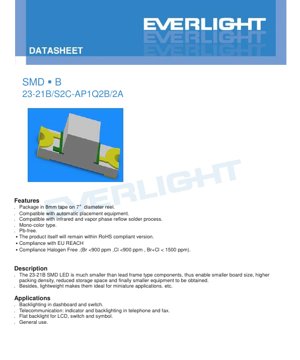
1. Product Overview
The 23-21B is a surface-mount device (SMD) LED designed for applications requiring a brilliant orange indicator or backlight source. It utilizes an AlGaInP (Aluminum Gallium Indium Phosphide) chip material to produce its characteristic orange color with a water-clear resin encapsulation. This component is significantly smaller than traditional lead-frame type LEDs, enabling higher packing density on printed circuit boards (PCBs), reduced equipment size, and lighter overall product weight, making it ideal for space-constrained and miniature applications.
Key advantages of this LED include its compatibility with standard automated pick-and-place assembly equipment and mainstream soldering processes such as infrared and vapor phase reflow. It is a Pb-free (lead-free) product, compliant with the RoHS (Restriction of Hazardous Substances) directive, EU REACH regulations, and halogen-free requirements (Br <900 ppm, Cl <900 ppm, Br+Cl < 1500 ppm). The device is supplied on 8mm tape wound on 7-inch diameter reels for efficient manufacturing handling.
2. Technical Specifications and Objective Interpretation
2.1 Absolute Maximum Ratings
These ratings define the limits beyond which permanent damage to the device may occur. Operation under these conditions is not guaranteed.
- Reverse Voltage (VR): 5V. Exceeding this voltage in reverse bias can cause junction breakdown.
- Continuous Forward Current (IF): 25 mA. The maximum DC current for reliable long-term operation.
- Peak Forward Current (IFP): 50 mA. Wannan ƙarfin lantarki mai bugun jini (1/10 aikin aiki a 1 kHz) ana ƙididdige shi don aiki na ɗan gajeren lokaci, ba na ci gaba ba.
- Ragewar Wutar Lantarki (Pd): 60 mW. Matsakaicin wutar lantarki da fakitin zai iya ragewa a yanayin zafin muhalli (Ta) na 25°C. Wannan ƙimar tana raguwa tare da haɓakar yanayin zafin muhalli.
- Electrostatic Discharge (ESD) Human Body Model (HBM): 2000V. This indicates a moderate level of ESD robustness. Standard ESD handling precautions (e.g., grounded workstations, wrist straps) are still recommended during assembly.
- Operating Temperature (Topr): -40°C to +85°C. The ambient temperature range over which the device is specified to operate.
- Storage Temperature (Tstg): -40°C to +90°C.
- Soldering Temperature (Tsol): Reflow soldering: 260°C peak for a maximum of 10 seconds. Hand soldering: 350°C iron tip temperature for a maximum of 3 seconds per terminal.
2.2 Electro-Optical Characteristics
These parameters are measured at a standard test condition of Ta=25°C and IF=20mA, unless otherwise specified. They define the typical performance of the device.
- Luminous Intensity (Iv): 45.0 to 112.0 mcd (millicandela). The actual output falls into specific bins (P1, P2, Q1, Q2). A tolerance of ±11% applies.
- Viewing Angle (2θ1/2): 130 degrees (typical). This is the full angle at which the luminous intensity is half of the peak intensity (on-axis). It indicates a wide viewing pattern suitable for indicator applications.
- Peak Wavelength (λp): 611 nm (typical). The wavelength at which the spectral power distribution is maximum.
- Dominant Wavelength (λd): 600.5 to 612.5 nm. This is the single wavelength perceived by the human eye as the color of the light. It is binned into ranges D8 through D11 with a tolerance of ±1nm.
- Spectral Bandwidth (Δλ): 17 nm (typical). The width of the emitted spectrum at half the maximum intensity (FWHM). A narrower bandwidth indicates a more saturated, pure color.
- Forward Voltage (VF): 1.75 to 2.35 V at IF=20mA. This is binned into three ranges (0, 1, 2) with a tolerance of ±0.1V. Lower VF generally leads to higher efficiency and less heat generation.
- Reverse Current (IR): 10 μA (max) at VR=5V. This is a leakage current measurement parameter; the device is not designed for operation in reverse bias.
3. Binning System Explanation
To ensure color and brightness consistency in production, LEDs are sorted into bins based on key parameters. The 23-21B uses a three-dimensional binning system.
3.1 Luminous Intensity Binning (CAT)
Defines the minimum and maximum luminous intensity for each bin code at IF=20mA.
- P1: 45.0 - 57.0 mcd
- P2: 57.0 - 72.0 mcd
- Q1: 72.0 - 90.0 mcd
- Q2: 90.0 - 112.0 mcd
3.2 Dominant Wavelength Binning (HUE)
Defines the color (wavelength) range for each bin code.
- D8: 600.5 - 603.5 nm
- D9: 603.5 - 606.5 nm
- D10: 606.5 - 609.5 nm
- D11: 609.5 - 612.5 nm
3.3 Forward Voltage Binning (REF)
Groups LEDs by their forward voltage drop at IF=20mA, which is important for current-limiting resistor calculation and power supply design.
- 0: 1.75 - 1.95 V
- 1: 1.95 - 2.15 V
- 2: 2.15 - 2.35 V
4. Performance Curve Analysis
The datasheet provides several characteristic curves that illustrate device behavior under varying conditions.
4.1 Relative Luminous Intensity vs. Forward Current
Wannan lanƙwasa ya nuna cewa ƙarfin haske yana ƙaruwa tare da halin yanzu na gaba, amma dangantakar ba ta da kyau sosai, musamman a manyan igiyoyin ruwa. Ya nuna mahimmancin tuƙi LED a takamaiman gwajin gwaji (20mA) don cimma ƙimar ƙarfin haske.
4.2 Relative Luminous Intensity vs. Ambient Temperature
This graph demonstrates the thermal quenching effect common in LEDs: as the junction temperature rises (due to increased ambient temperature or self-heating), the luminous output decreases. The output is normalized to 100% at 25°C. Designers must account for this derating in applications with high ambient temperatures.
3.3 Forward Current Derating Curve
This is a critical design tool. It shows the maximum allowable continuous forward current as a function of ambient temperature. As ambient temperature increases, the maximum safe current must be reduced to prevent exceeding the device's maximum junction temperature and power dissipation rating. For example, at 85°C, the maximum continuous current is significantly lower than the 25mA rating at 25°C.
4.4 Forward Voltage vs. Forward Current
This IV (Current-Voltage) curve shows the exponential relationship typical of a diode. The forward voltage increases with current. The curve's slope in the operating region helps determine the dynamic resistance of the LED.
4.5 Radiation Pattern
A polar diagram illustrating the spatial distribution of light intensity. The 23-21B shows a typical lambertian or near-lambertian pattern, with intensity decreasing as the viewing angle moves away from the central axis (0°).
4.6 Spectral Distribution
A graph of relative intensity versus wavelength, centered around the peak wavelength of ~611 nm. It confirms the monochromatic nature of the AlGaInP chip with a defined spectral bandwidth.
5. Mechanical and Package Information
5.1 Package Dimensions
LED yana da ƙaramin ƙafa na SMD. Muhimman ma'auni (a cikin mm, jurewa ±0.1mm sai dai an lura) sun haɗa da:
- Tsawon Gabaɗaya: 2.0 mm
- Faɗin Gabaɗaya: 1.25 mm
- Overall Height: 0.8 mm
- Cathode Identifier: A chamfer or marking on the package denotes the cathode (negative) terminal. Correct polarity orientation during placement is essential.
5.2 Recommended PCB Land Pattern
A suggested pad layout is provided to ensure reliable soldering and proper mechanical alignment. The pad design accommodates the component's terminals and allows for appropriate solder fillet formation. Following this recommendation helps prevent tombstoning and ensures good thermal and electrical connection.
6. Soldering and Assembly Guidelines
6.1 Reflow Soldering Profile (Pb-free)
A specific temperature profile is recommended for lead-free solder:
- Preheat: 150-200°C for 60-120 seconds.
- Time Above Liquidus (217°C): 60-150 seconds.
- Peak Temperature: 260°C maximum, held for no more than 10 seconds.
- Heating Rate: Maximum 6°C/second up to 255°C, then 3°C/second maximum to peak.
- Cooling Rate: Controlled to minimize thermal stress.
Important: Reflow soldering should not be performed more than two times on the same device.
6.2 Hand Soldering
If manual repair is necessary, extreme care must be taken:
- Soldering iron tip temperature: < 350°C.
- Contact time per terminal: < 3 seconds.
- Soldering iron power: < 25W.
- A minimum 2-second interval should be left between soldering each terminal.
- A double-head soldering iron is suggested for removal to apply heat evenly to both terminals simultaneously and avoid mechanical stress.
6.3 Storage and Moisture Sensitivity
The LEDs are packaged in a moisture-resistant barrier bag with desiccant to prevent absorption of atmospheric moisture, which can cause "popcorning" (package cracking) during reflow.
- Do not open the bag until ready for use.
- After opening, unused parts should be stored at ≤30°C and ≤60% Relative Humidity (RH).
- The "floor life" after bag opening is 168 hours (7 days).
- If the floor life is exceeded or the desiccant indicator shows saturation, a bake-out at 60 ±5°C for 24 hours is required before reflow.
7. Packaging and Ordering Information
7.1 Reel and Tape Specifications
The device is supplied in embossed carrier tape:
- Tape Width: 8 mm.
- Reel Diameter: 7 inches (178 mm).
- Quantity per Reel: 2000 pieces.
- Reel dimensions (hub, flange) are provided for compatibility with automated feeders.
7.2 Label Explanation
The reel label contains critical information for traceability and correct application:
- CPN: Customer's Product Number (optional).
- P/N: Manufacturer's Part Number (23-21B/S2C-AP1Q2B/2A).
- QTY: Packing Quantity.
- CAT: Luminous Intensity Bin Code (e.g., Q2).
- HUE: Dominant Wavelength Bin Code (e.g., D10).
- REF: Forward Voltage Bin Code (e.g., 1).
- LOT No.: Manufacturing Lot Number for traceability.
8. Application Suggestions and Design Considerations
8.1 Typical Applications
- Backlighting: Dashboard indicators, switch illumination, keypads.
- Telecommunications: Status indicators and backlights in telephones, fax machines, and networking equipment.
- Consumer Electronics: Symbol and status indication in various portable and fixed devices.
- General Purpose Indication: Any application requiring a bright, reliable orange indicator.
8.2 Critical Design Considerations
- Current Limiting: An external current-limiting resistor is absolutely mandatory. The LED's exponential V-I characteristic means a small increase in voltage can cause a large, destructive increase in current. The resistor value (R) is calculated using Ohm's Law: R = (Vsupply - VF) / IF, where VF should be the maximum value from the bin (e.g., 2.35V) to ensure safe operation under all conditions.
- Thermal Management: Consider the derating curves. In high ambient temperature environments or if driven near maximum current, ensure adequate PCB copper area or other means to dissipate heat and keep the junction temperature within safe limits.
- ESD Protection: While rated for 2000V HBM, incorporating transient voltage suppression (TVS) diodes or resistors on sensitive lines in ESD-prone environments (e.g., user-accessible indicators) is good practice.
- Optical Design: The wide 130° viewing angle provides good off-axis visibility. For applications requiring a more focused beam, secondary optics (lenses) would be needed.
9. Technical Comparison and Differentiation
The 23-21B, based on AlGaInP technology, offers distinct advantages for orange/red color applications compared to other technologies like phosphor-converted white LEDs or older GaAsP devices.
- vs. Phosphor-Converted LEDs: AlGaInP provides higher luminous efficacy and more saturated color purity in the orange-red spectrum without the efficiency losses associated with phosphor conversion.
- vs. Older GaAsP LEDs: AlGaInP technology offers significantly higher brightness and better temperature stability.
- vs. Larger Leaded LEDs: The SMD package enables automated assembly, reduces board space, and improves reliability by eliminating bent leads and manual insertion errors.
- Key Differentiator: The combination of a specific brilliant orange color from a direct-emitting semiconductor, compact SMD package, and compliance with modern environmental regulations (RoHS, Halogen-Free) makes it suitable for contemporary electronic designs.
10. Frequently Asked Questions (Based on Technical Parameters)
Q1: What resistor value should I use with a 5V supply?
A1: Yin amfani da mafi munin yanayin matsakaicin VF na 2.35V da kuma IF da ake so na 20mA: R = (5V - 2.35V) / 0.020A = 132.5 Ohms. Matsakaicin ƙimar daidaitaccen ƙima mafi girma (misali, 150 Ohms) zai zama zaɓi mai aminci, wanda zai haifar da IF ≈ 17.7mA.
Q2: Shin zan iya tuka wannan LED a 30mA don ƙarin haske?
A2: Matsakaicin Ƙimar Cikakken Iyaka don ci gaba da gaba na gaba shine 25mA. Yin aiki a 30mA ya wuce wannan ƙimar, wanda zai iya rage amincin aiki da rayuwa, haifar da zafi mai yawa, kuma yana iya haifar da gazawar nan take. Koyaushe yi aiki cikin iyakokin da aka ƙayyade.
Q3: Bin ya haske shine Q2 (90-112 mcd). Wane fitarwa zan iya tsammani a cikin zanena?
A3: Kuna iya tsarawa da hankali don ƙimar mafi ƙanƙanta na 90 mcd. Na'urar da kuke karɓa ta ainihi za ta kasance tsakanin 90 da 112 mcd. Tolerance na ±11% ya shafi iyakokin bin, don haka wata na'ura ta musamman mai lakabin Q2 a ka'idar za ta iya zama ƙasa kamar ~80 mcd ko kuma sama kamar ~124 mcd, ko da yake za ta kasance cikin iyakar Q2.
Q4: Ta yaya zan fassara jadawalin bayanin gidan soldering?
A4: The graph shows temperature (Y-axis) vs. time (X-axis). Your reflow oven must be programmed so that the temperature measured at the LED leads follows this trajectory: a gradual preheat, a controlled ramp-up, a specific time above the solder melting point (217°C), a controlled peak temperature (≤260°C), and a controlled cool-down. Deviating significantly, especially exceeding time-at-temperature limits, can damage the LED.
11. Practical Design and Usage Case
Scenario: Designing a status indicator panel with multiple orange LEDs.
- Binning Selection: For uniform appearance, specify tight bins for both Dominant Wavelength (HUE, e.g., D10 only) and Luminous Intensity (CAT, e.g., Q1 only). This ensures all indicators have nearly identical color and brightness.
- Circuit Design: Using a 3.3V microcontroller supply. Assuming VF bin "1" (max 2.15V) and targeting 15mA for lower power consumption: R = (3.3V - 2.15V) / 0.015A = 76.7 Ohms. Use a 75 Ohm resistor. Power in resistor: (1.15V^2)/75Ω ≈ 18mW. Use a 1/10W or larger resistor.
- PCB Layout: Place the LED according to the recommended land pattern. Include a small copper pour connected to the cathode pad to aid in heat dissipation, especially if multiple LEDs are placed close together.
- Assembly: Keep reels in sealed bags until loaded into the pick-and-place machine. Follow the reflow profile precisely. After assembly, avoid bending the PCB near the LEDs.
12. Operating Principle Introduction
The 23-21B LED operates on the principle of electroluminescence in a semiconductor p-n junction. The active region is composed of AlGaInP (Aluminum Gallium Indium Phosphide) layers grown epitaxially on a substrate. When a forward voltage exceeding the junction's built-in potential is applied, electrons from the n-type region and holes from the p-type region are injected into the active region. Here, they recombine radiatively, releasing energy in the form of photons (light). The specific composition of the AlGaInP alloy determines the bandgap energy, which directly dictates the wavelength (color) of the emitted light—in this case, brilliant orange (~611 nm). The water-clear epoxy resin encapsulates the chip, provides mechanical protection, and acts as a primary lens shaping the light output pattern.
13. Technology Trends and Context
SMD LEDs like the 23-21B represent the mainstream packaging technology for indicator and low-power lighting applications, having largely replaced through-hole LEDs. The trend in this sector continues towards:
- Miniaturization: Even smaller package footprints (e.g., 0402, 0201 metric) for ultra-high-density boards.
- Increased Efficiency: Ongoing improvements in epitaxial growth and chip design yield higher luminous efficacy (more light output per electrical watt).
- Enhanced Reliability: Improved packaging materials and processes lead to longer operational lifetimes and better performance under harsh environmental conditions (temperature, humidity).
- Integration: Growth of multi-chip packages (RGB, multi-color) and LEDs with integrated controllers (ICs) for smart lighting applications.
- Broadened Spectrum: Development of semiconductor materials to efficiently produce colors across the entire visible spectrum and into ultraviolet (UV) and infrared (IR). While AlGaInP dominates the red-orange-amber-yellow range, other materials like InGaN are used for blue, green, and white LEDs.
The 23-21B fits into this landscape as a reliable, standardized component offering a balance of performance, size, and cost for its target color and application range.
LED Specification Terminology
Complete explanation of LED technical terms
Photoelectric Performance
| Term | Unit/Representation | Simple Explanation | Why Important |
|---|---|---|---|
| Luminous Efficacy | lm/W (lumens per watt) | Light output per watt of electricity, higher means more energy efficient. | Directly determines energy efficiency grade and electricity cost. |
| Luminous Flux | lm (lumens) | Total light emitted by source, commonly called "brightness". | Determines if the light is bright enough. |
| Viewing Angle | ° (degrees), e.g., 120° | Angle where light intensity drops to half, determines beam width. | Affects illumination range and uniformity. |
| CCT (Color Temperature) | K (Kelvin), e.g., 2700K/6500K | Warmth/coolness of light, lower values yellowish/warm, higher whitish/cool. | Yana ƙayyade yanayin haske da yanayin da ya dace. |
| CRI / Ra | Unitless, 0–100 | Ability to render object colors accurately, Ra≥80 is good. | Affects color authenticity, used in high-demand places like malls, museums. |
| SDCM | MacAdam ellipse steps, e.g., "5-step" | Metric ya Usawazishaji wa Rangi, hatua ndogo zina maana rangi inayolingana zaidi. | Inahakikisha rangi sawa kwenye kundi moja la LED. |
| Dominant Wavelength | nm (nanometers), e.g., 620nm (red) | Wavelength corresponding to color of colored LEDs. | Determines hue of red, yellow, green monochrome LEDs. |
| Spectral Distribution | Wavelength vs intensity curve | Shows intensity distribution across wavelengths. | Affects color rendering and quality. |
Electrical Parameters
| Term | Symbol | Simple Explanation | Design Considerations |
|---|---|---|---|
| Forward Voltage | Vf | Minimum voltage to turn on LED, like "starting threshold". | Driver voltage must be ≥Vf, voltages add up for series LEDs. |
| Forward Current | If | Current value for normal LED operation. | Usually constant current drive, current determines brightness & lifespan. |
| Max Pulse Current | Ifp | Peak current tolerable for short periods, used for dimming or flashing. | Pulse width & duty cycle must be strictly controlled to avoid damage. |
| Reverse Voltage | Vr | Max reverse voltage LED can withstand, beyond may cause breakdown. | Circuit must prevent reverse connection or voltage spikes. |
| Thermal Resistance | Rth (°C/W) | Resistance to heat transfer from chip to solder, lower is better. | High thermal resistance requires stronger heat dissipation. |
| ESD Immunity | V (HBM), e.g., 1000V | Ability to withstand electrostatic discharge, higher means less vulnerable. | Anti-static measures needed in production, especially for sensitive LEDs. |
Thermal Management & Reliability
| Term | Key Metric | Simple Explanation | Impact |
|---|---|---|---|
| Junction Temperature | Tj (°C) | Actual operating temperature inside LED chip. | Every 10°C reduction may double lifespan; too high causes light decay, color shift. |
| Lumen Depreciation | L70 / L80 (hours) | Time for brightness to drop to 70% or 80% of initial. | Directly defines LED "service life". |
| Lumen Maintenance | % (e.g., 70%) | Percentage of brightness retained after time. | Indicates brightness retention over long-term use. |
| Color Shift | Δu′v′ or MacAdam ellipse | Degree of color change during use. | Affects color consistency in lighting scenes. |
| Thermal Aging | Material degradation | Deterioration due to long-term high temperature. | May cause brightness drop, color change, or open-circuit failure. |
Packaging & Materials
| Term | Common Types | Simple Explanation | Features & Applications |
|---|---|---|---|
| Package Type | EMC, PPA, Ceramic | Housing material protecting chip, providing optical/thermal interface. | EMC: good heat resistance, low cost; Ceramic: better heat dissipation, longer life. |
| Chip Structure | Front, Flip Chip | Chip electrode arrangement. | Flip chip: kona mafuta mazuri zaidi, ufanisi wa juu, kwa nguvu kubwa. |
| Phosphor Coating | YAG, Silicate, Nitride | Covers blue chip, converts some to yellow/red, mixes to white. | Different phosphors affect efficacy, CCT, and CRI. |
| Lens/Optics | Flat, Microlens, TIR | Optical structure on surface controlling light distribution. | Determines viewing angle and light distribution curve. |
Quality Control & Binning
| Term | Binning Content | Simple Explanation | Purpose |
|---|---|---|---|
| Luminous Flux Bin | Code e.g., 2G, 2H | Grouped by brightness, each group has min/max lumen values. | E kia mau tonu te tūrama i roto i te pāhi kotahi. |
| Voltage Bin | Code e.g., 6W, 6X | Grouped by forward voltage range. | Facilitates driver matching, improves system efficiency. |
| Color Bin | 5-step MacAdam ellipse | Grouped by color coordinates, ensuring tight range. | Guarantees color consistency, avoids uneven color within fixture. |
| CCT Bin | 2700K, 3000K etc. | Grouped by CCT, each has corresponding coordinate range. | Meets different scene CCT requirements. |
Testing & Certification
| Term | Standard/Test | Simple Explanation | Significance |
|---|---|---|---|
| LM-80 | Lumen maintenance test | Long-term lighting at constant temperature, recording brightness decay. | Used to estimate LED life (with TM-21). |
| TM-21 | Life estimation standard | Estimates life under actual conditions based on LM-80 data. | Provides scientific life prediction. |
| IESNA | Illuminating Engineering Society | Covers optical, electrical, thermal test methods. | Industry-recognized test basis. |
| RoHS / REACH | Environmental certification | Yana tabbatar da babu abubuwa masu cutarwa (gubar, mercury). | Bukatar shiga kasuwa a duniya. |
| ENERGY STAR / DLC | Energy efficiency certification | Energy efficiency and performance certification for lighting. | Used in government procurement, subsidy programs, enhances competitiveness. |