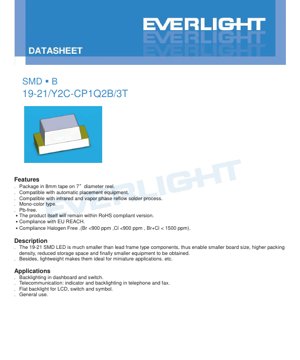
1. Product Overview
The 19-21/Y2C-CP1Q2B/3T is a surface-mount device (SMD) LED designed for modern electronic applications requiring compact size and reliable performance. This component utilizes an AlGaInP (Aluminum Gallium Indium Phosphide) semiconductor chip to produce a brilliant yellow light output. The LED is encapsulated in a water-clear resin package, which enhances light extraction and provides environmental protection. Its primary advantages include a significantly reduced footprint compared to traditional lead-frame LEDs, enabling higher packing density on printed circuit boards (PCBs), reduced storage requirements, and ultimately contributing to the miniaturization of end equipment. The lightweight construction further makes it ideal for portable and miniature applications.
1.1 Key Features and Compliance
- Packaged on 8mm tape wound on a 7-inch diameter reel for compatibility with automated pick-and-place assembly equipment.
- Designed for use with standard infrared (IR) and vapor phase reflow soldering processes.
- Mono-color type emitting brilliant yellow light.
- An yi kayan da ba su da gubar (Pb-free) aka gina shi.
- Samfurin ya bi ka'idojin RoHS (Restriction of Hazardous Substances).
- Yin bin dokokin EU REACH (Registration, Evaluation, Authorisation and Restriction of Chemicals).
- Halogen-free construction, with limits for Bromine (Br) and Chlorine (Cl) set at <900 ppm individually and <1500 ppm for their combined total.
2. Technical Specifications Deep Dive
2.1 Absolute Maximum Ratings
These ratings define the limits beyond which permanent damage to the device may occur. Operation under these conditions is not guaranteed. All values are specified at an ambient temperature (Ta) of 25°C.
- Reverse Voltage (VR): 5 V. Exceeding this voltage in reverse bias can cause junction breakdown.
- Continuous Forward Current (IF): 25 mA. The maximum DC current that can be continuously applied.
- Peak Forward Current (IFP): 60 mA. Owo ni iye ti o pọju ti iṣan iwaju pulsed, ti o gba laaye nikan labẹ aṣayan iṣẹ ti 1/10 ni agbara ti 1 kHz. O ṣe pataki fun awọn ohun elo ti o ni awọn ifọranṣẹ kukuru, ti o ga pupọ.
- Power Dissipation (Pd): 60 mW. The maximum power the device can dissipate as heat, calculated as Forward Voltage (VF) multiplied by Forward Current (IF).
- Electrostatic Discharge (ESD) Human Body Model (HBM): 2000 V. This rating indicates the LED's sensitivity to static electricity. Proper ESD handling procedures must be followed during assembly and handling.
- Operating Temperature Range (Topr): -40°C to +85°C. The ambient temperature range over which the device is designed to function.
- Storage Temperature Range (Tstg): -40°C to +90°C.
- Soldering Temperature (Tsol): For reflow soldering, a peak temperature of 260°C for a maximum of 10 seconds is specified. For hand soldering, the iron tip temperature should not exceed 350°C for a maximum of 3 seconds per terminal.
2.2 Electro-Optical Characteristics
These parameters define the LED's performance under normal operating conditions, typically measured at Ta=25°C and IF=20mA unless otherwise stated.
- Luminous Intensity (Iv): Ranges from a minimum of 45.0 mcd to a maximum of 112.0 mcd. The typical value falls within this range based on the binning code (see Section 3).
- Viewing Angle (2θ1/2): Kusan digiri 100. Wannan shine cikakken kusurwar da ƙarfin haske ya rabi na ƙarfin da yake a digiri 0 (a kan-axis).
- Peak Wavelength (λp): Typically around 591 nm. This is the wavelength at which the spectral power distribution reaches its maximum.
- Dominant Wavelength (λd): Ranges from 585.5 nm to 591.5 nm. This is the single wavelength perceived by the human eye that matches the color of the LED's light.
- Spectral Bandwidth (Δλ): Typically 15 nm. This is the width of the spectrum at half the maximum intensity (Full Width at Half Maximum - FWHM).
- Forward Voltage (VF): Ranges from 1.75 V to 2.35 V. The voltage drop across the LED when operating at the specified forward current.
- Reverse Current (IR): Maximum of 10 μA when a reverse voltage of 5V is applied. The device is not intended for operation in reverse bias.
Important Notes: Tolerances are specified as ±11% for Luminous Intensity, ±1nm for Dominant Wavelength, and ±0.1V for Forward Voltage. The Reverse Voltage rating applies only to the IR test condition.
3. Binning System Explanation
To ensure consistent color and brightness in production, LEDs are sorted into bins based on key parameters.
3.1 Luminous Intensity Binning
Bins define the minimum and maximum luminous intensity at IF=20mA.
P1: 45.0 - 57.0 mcd
P2: 57.0 - 72.0 mcd
Q1: 72.0 - 90.0 mcd
Q2: 90.0 - 112.0 mcd
3.2 Dominant Wavelength Binning
Bins define the color consistency.
D3: 585.5 - 588.5 nm
D4: 588.5 - 591.5 nm
3.3 Forward Voltage Binning
Bins aid in circuit design for current regulation.
0: 1.75 - 1.95 V
1: 1.95 - 2.15 V
2: 2.15 - 2.35 V
4. Performance Curve Analysis
Datasheet ina bayar da yawa madaidaicin zane-zane masu mahimmanci don ƙira.
4.1 Forward Current vs. Forward Voltage (I-V Curve)
Wannan lanƙwasa tana nuna alaƙar ƙima tsakanin ƙarfin lantarki da ƙarfin wuta. Ƙaramin ƙaruwa a cikin ƙarfin lantarki fiye da bakin kofa na kunna yana haifar da babban ƙaruwa a cikin ƙarfin lantarki. Wannan yana jaddada buƙatar mahimmanci na resistor mai iyakance ƙarfin lantarki ko direba mai ƙarfin lantarki a cikin da'irar aikace-aikacen don hana guduwar zafi da gazawar na'urar.
4.2 Relative Luminous Intensity vs. Ambient Temperature
The light output of an LED decreases as the junction temperature increases. The curve typically shows a gradual decline in intensity from low temperatures up to around 25°C, followed by a more pronounced decrease at higher ambient temperatures. This must be factored into designs where the LED operates in elevated temperature environments to ensure sufficient brightness.
4.3 Relative Luminous Intensity vs. Forward Current
This curve demonstrates that light output increases with forward current, but not linearly. Efficiency (lumens per watt) often peaks at a current lower than the absolute maximum rating. Operating above this optimal point reduces efficiency and generates more heat.
4.4 Spectrum Distribution
The graph plots relative intensity against wavelength, showing a single peak in the yellow region (~591 nm) with a typical bandwidth of 15 nm, confirming its monochromatic nature.
4.5 Radiation Pattern
Polar diagram inaonyesha usambazaji wa mwanga katika nafasi. Kifurushi cha 19-21 kwa kawaida huonyesha muundo wa lambertian au karibu na lambertian, hutoa pembe ya kutazama pana na sawa inayofaa kwa matumizi ya kiashiria na taa ya nyuma.
4.6 Forward Current Derating Curve
Mkunjo huu huamua kiwango cha juu cha ruhusiwa cha mkondo endelevu wa mbele kama utendakazi wa halijoto ya mazingira. Kadiri halijoto ya mazingira inavyopanda, mkondo wa juu wa salama lazima upunguzwe ili kuweka halijoto ya kiunganisho ndani ya mipaka na kuzuia uharibifu wa kasi.
5. Mechanical and Package Information
5.1 Package Dimensions
The 19-21 SMD LED has a compact rectangular footprint. Key dimensions (in mm, tolerance ±0.1mm unless noted) include a body length of approximately 2.0 mm, a width of 1.25 mm, and a height of 0.8 mm. The package features two anode and cathode terminals on the bottom for soldering. A cathode identification mark is clearly indicated on the package, which is crucial for correct PCB orientation.
6. Soldering and Assembly Guidelines
6.1 Current Protection
An external current-limiting mechanism (resistor or driver IC) is mandatory. The LED's exponential I-V characteristic means minor supply voltage fluctuations can cause large current surges, leading to instantaneous failure.
6.2 Storage and Moisture Sensitivity
LEDs are packaged in a moisture-resistant barrier bag with desiccant.
- Do not open the bag until ready for use.
- After opening, unused LEDs should be stored at ≤30°C and ≤60% Relative Humidity.
- The "floor life" after bag opening is 168 hours (7 days).
- If the floor life is exceeded or the desiccant indicates moisture ingress, a bake-out at 60±5°C for 24 hours is required before reflow soldering to prevent "popcorn" damage.
6.3 Reflow Soldering Profile
A lead-free (Pb-free) reflow profile is specified:
- Preheat: 150-200°C for 60-120 seconds.
- Time above liquidus (217°C): 60-150 seconds.
- Peak Temperature: 260°C maximum, for no more than 10 seconds.
- Heating Rate: Maximum 6°C/sec up to 255°C.
- Cooling Rate: Maximum 3°C/sec.
- Reflow should not be performed more than two times.
6.4 Hand Soldering and Rework
Idan ake buƙatar haɗa ta hannu, yi amfani da ƙarfe mai ƙarfe tare da zazzabi na tip ≤350°C, yi amfani da zafi ga kowane tasha na ≤3 daƙiƙa, kuma yi amfani da ƙarfe mai ƙarfin wutar lantarki ≤25W. Bari tazarar sanyi aƙalla daƙiƙa 2 tsakanin tashoshi. Ana ƙin matukar gyara. Idan ba za a iya kaucewa ba, ya kamata a yi amfani da ƙarfe mai haɗa kai biyu don dumama tashoshi biyu lokaci guda yayin cirewa don guje wa matsin inji akan kunshin. Koyaushe tabbatar da aikin na'urar bayan kowane gyara.
7. Packaging and Ordering Information
7.1 Tape and Reel Specifications
O yɛ mfoni wɔ embossed carrier tape a ne tɛtrɛ yɛ 8 mm mu, na wɔde bɔ 7-inch (178 mm) diameter reel a ɛyɛ standard so. Reel biara mu wɔ mfoni 3000. Wɔde carrier tape pockets ne reel no nhyehyɛe a ɛyɛ denkyem ma sɛnea ɛbɛyɛ a ɛbɛyɛ adwuma wɔ automated feeders ho.
7.2 Label Explanation
The reel label contains critical information for traceability and correct application:
- CPN: Customer's Part Number (if assigned).
- P/N: Manufacturer's Part Number (e.g., 19-21/Y2C-CP1Q2B/3T).
- QTY: Quantity of pieces on the reel.
- CAT: Luminous Intensity bin code (e.g., P1, Q2).
- HUE: Chromaticity/Dominant Wavelength bin code (e.g., D3, D4).
- REF: Forward Voltage bin code (e.g., 0, 1, 2).
- LOT No: Manufacturing lot number for quality tracking.
8. Application Suggestions
8.1 Typical Application Scenarios
- Backlighting: Ideal for backlighting symbols, switches, and small areas on dashboards, control panels, and consumer electronics.
- Status Indicators: Perfect for power, connectivity, or function status indicators in telecommunications equipment (phones, faxes), networking hardware, and industrial controls.
- General Purpose Indication: Suitable for any application requiring a compact, bright, yellow visual signal.
8.2 Design Considerations
- Current Drive: Always use a series resistor or constant-current driver. Calculate the resistor value using R = (Vsupply - VF) / IF, where VF should be chosen from the maximum value in the bin or datasheet to ensure current does not exceed limits under worst-case conditions.
- Thermal Management: While the package is small, ensure adequate PCB copper area or thermal vias under the thermal pad (if applicable) to dissipate heat, especially when operating near maximum ratings or in high ambient temperatures.
- ESD Protection: Implement ESD protection on input lines if the LED is in a user-accessible location. During handling and assembly, use grounded workstations and wrist straps.
- Optical Design: The wide viewing angle makes it suitable for applications requiring broad visibility. For focused light, external lenses or light guides may be necessary.
9. Technical Comparison and Differentiation
The 19-21/Y2C-CP1Q2B/3T offers several advantages in its category:
Size Advantage: Its 2.0x1.25mm footprint is significantly smaller than traditional 3mm or 5mm through-hole LEDs, enabling denser PCB layouts.
Material Technology: The use of AlGaInP semiconductor material provides high efficiency and excellent color purity in the yellow/orange/red spectrum compared to older technologies.
Reliability: The SMD construction and robust packaging contribute to good mechanical stability and resistance to vibration.
Compliance: Full compliance with RoHS, REACH, and halogen-free standards makes it suitable for global markets with strict environmental regulations.
10. Frequently Asked Questions (FAQ)
Q1: What is the purpose of the binning codes?
A1: Binning ensures color and brightness consistency within a production batch. For applications requiring uniform appearance (e.g., multi-LED arrays), specifying tight bins or ordering from the same lot is recommended.
Q2: Ina iya tuka wannan LED kai tsaye daga wutar lantarki na 3.3V ko 5V?
A2: A'a. Dole ne koyaushe ka yi amfani da resistor mai iyakancewar ƙarfin lantarki. Misali, tare da wutar lantarki na 3.3V da kuma VF na yau da kullun na 2.0V a 20mA, ƙimar resistor zata zama (3.3V - 2.0V) / 0.020A = 65 Ohms. Madaidaicin resistor na 68 Ohm zai dace.
Q3: Me ya sa akwai tsayayyen rayuwar bene na kwanaki 7 bayan buɗe jakar shinge na danshi?
A3: SMD packages can absorb moisture from the atmosphere. During the high-temperature reflow soldering process, this trapped moisture can vaporize rapidly, causing internal delamination or cracking ("popcorn effect"), which destroys the device.
Q4: How do I identify the cathode?
A4: The package has a distinct cathode mark. On the 19-21 package, this is typically a green stripe, a notch, or a chamfered corner on the side of the cathode terminal. Always refer to the package dimension drawing for the specific marking.
11. Practical Design Case Study
Scenario: Designing a compact status indicator panel with 10 yellow LEDs for a portable medical device.
Design Steps:
1. Circuit Design: Use a common 3.3V rail. Calculate the worst-case series resistor: R = (3.3V - 2.35Vmax VF) / 0.020A = 47.5 Ohms. Select a standard 47 Ohm, 1/10W resistor. This ensures the current never exceeds 20.2 mA even if the LED has the minimum VF.
2. PCB Layout: Place the LEDs with a center-to-center spacing of at least 5mm for individual visibility. Include a small copper pour connected to the cathode pads to aid in heat dissipation. Add silkscreen outlines and polarity marks (+ for anode, - or cathode symbol for cathode) for assembly clarity.
3. Assembly: Order all LEDs from the same luminous intensity (e.g., Q1 bin) and dominant wavelength (e.g., D4 bin) to ensure uniform brightness and color. Schedule PCB assembly so that the LEDs are used immediately after opening the moisture barrier bag.
4. Testing: Verify forward voltage and light output of a sample from the panel under the designed operating conditions.
12. Operating Principle
Haske wutar lantarki a wannan LED ya dogara ne akan electroluminescence a cikin semiconductor p-n junction da aka yi da AlGaInP. Lokacin da aka yi amfani da ƙarfin lantarki na gaba wanda ya wuce ƙarfin da aka gina a cikin junction, electrons daga yankin n-type da ramuka daga yankin p-type ana shigar da su cikin yankin aiki. A can, sun sake haɗuwa, suna sakin makamashi a cikin nau'in photons. Takamaiman makamashin bandgap na gawa AlGaInP yana ƙayyade tsawon zangon hasken da aka fitar, wanda a wannan yanayin yana cikin bakan rawaya (~591 nm). Abin rufe epoxy resin mai tsabta na ruwa yana kare guntu, yana ba da tallafi na injiniya, kuma yana siffanta tsarin fitar da haske.
13. Technology Trends
The trend in SMD LEDs like the 19-21 series continues towards:
Increased Efficiency: Ongoing improvements in epitaxial growth and chip design yield higher lumens per watt (lm/W), reducing power consumption for the same light output.
Miniaturization: Even smaller package sizes (e.g., 1.0x0.5mm) are being developed for ultra-compact devices.
Enhanced Reliability: Improved packaging materials and processes lead to longer operational lifetimes and better performance under high temperature and humidity.
Smart Integration: The broader market is seeing growth in LEDs with integrated drivers or control circuits, though standard discrete components like the 19-21 remain essential for cost-effective, high-volume indicator and backlight applications.
LED Specification Terminology
Complete explanation of LED technical terms
Photoelectric Performance
| Term | Unit/Representation | Simple Explanation | Why Important |
|---|---|---|---|
| Luminous Efficacy | lm/W (lumens per watt) | Haske a kowane watt na wutar lantarki, mafi girma yana nufin mafi ingancin makamashi. | Kai tsaye yana ƙayyade matakin ingancin makamashi da farashin wutar lantarki. |
| Luminous Flux | lm (lumens) | Total light emitted by source, commonly called "brightness". | Determines if the light is bright enough. |
| Viewing Angle | ° (degrees), e.g., 120° | Angle where light intensity drops to half, determines beam width. | Affects illumination range and uniformity. |
| CCT (Color Temperature) | K (Kelvin), e.g., 2700K/6500K | Mwangaza wa joto/baridi, thamani za chini ni manjano/joto, za juu nyeupe/baridi. | Huamua mazingira ya taa na matukio yanayofaa. |
| CRI / Ra | Unitless, 0–100 | Ability to render object colors accurately, Ra≥80 is good. | Affects color authenticity, used in high-demand places like malls, museums. |
| SDCM | MacAdam ellipse steps, e.g., "5-step" | Color consistency metric, smaller steps mean more consistent color. | Ensures uniform color across same batch of LEDs. |
| Dominant Wavelength | nm (nanometers), e.g., 620nm (red) | Wavelength corresponding to color of colored LEDs. | Determines hue of red, yellow, green monochrome LEDs. |
| Spectral Distribution | Wavelength vs intensity curve | Shows intensity distribution across wavelengths. | Affects color rendering and quality. |
Electrical Parameters
| Term | Symbol | Simple Explanation | Design Considerations |
|---|---|---|---|
| Forward Voltage | Vf | Minimum voltage to turn on LED, like "starting threshold". | Driver voltage must be ≥Vf, voltages add up for series LEDs. |
| Forward Current | If | Current value for normal LED operation. | Usually constant current drive, current determines brightness & lifespan. |
| Max Pulse Current | Ifp | Peak current tolerable for short periods, used for dimming or flashing. | Pulse width & duty cycle must be strictly controlled to avoid damage. |
| Reverse Voltage | Vr | Max reverse voltage LED can withstand, beyond may cause breakdown. | Circuit must prevent reverse connection or voltage spikes. |
| Thermal Resistance | Rth (°C/W) | Resistance to heat transfer from chip to solder, lower is better. | High thermal resistance requires stronger heat dissipation. |
| ESD Immunity | V (HBM), e.g., 1000V | Ability to withstand electrostatic discharge, higher means less vulnerable. | Anti-static measures needed in production, especially for sensitive LEDs. |
Thermal Management & Reliability
| Term | Key Metric | Simple Explanation | Impact |
|---|---|---|---|
| Junction Temperature | Tj (°C) | Yanzu aiki zazzabi a cikin LED chip. | Kowane raguwar 10°C na iya ninka tsawon rayuwa; yana da yawa yana haifar da lalacewar haske, canjin launi. |
| Lumen Depreciation | L70 / L80 (hours) | Time for brightness to drop to 70% or 80% of initial. | Directly defines LED "service life". |
| Lumen Maintenance | % (e.g., 70%) | Percentage of brightness retained after time. | Indicates brightness retention over long-term use. |
| Color Shift | Δu′v′ or MacAdam ellipse | Iyipada awọ nigba lilo. | O nife si idahun awọ ninu awọn iboju itansẹ. |
| Thermal Aging | Material degradation | Deterioration due to long-term high temperature. | May cause brightness drop, color change, or open-circuit failure. |
Packaging & Materials
| Term | Common Types | Simple Explanation | Features & Applications |
|---|---|---|---|
| Package Type | EMC, PPA, Ceramic | Housing material protecting chip, providing optical/thermal interface. | EMC: good heat resistance, low cost; Ceramic: better heat dissipation, longer life. |
| Tsarin Chip | Gaba, Flip Chip | Chip electrode arrangement. | Flip chip: better heat dissipation, higher efficacy, for high-power. |
| Phosphor Coating | YAG, Silicate, Nitride | Covers blue chip, converts some to yellow/red, mixes to white. | Phosphors ya daban-daban suna tasiri inganci, CCT, da CRI. |
| Lens/Optics | Flat, Microlens, TIR | Optical structure on surface controlling light distribution. | Determines viewing angle and light distribution curve. |
Quality Control & Binning
| Term | Binning Content | Simple Explanation | Purpose |
|---|---|---|---|
| Luminous Flux Bin | Code e.g., 2G, 2H | Grouped by brightness, each group has min/max lumen values. | Ensures uniform brightness in same batch. |
| Voltage Bin | Code e.g., 6W, 6X | Grouped by forward voltage range. | Facilitates driver matching, improves system efficiency. |
| Color Bin | 5-step MacAdam ellipse | Grouped by color coordinates, ensuring tight range. | Guarantees color consistency, avoids uneven color within fixture. |
| CCT Bin | 2700K, 3000K etc. | Grouped by CCT, each has corresponding coordinate range. | Meets different scene CCT requirements. |
Testing & Certification
| Term | Standard/Test | Simple Explanation | Significance |
|---|---|---|---|
| LM-80 | Lumen maintenance test | Long-term lighting at constant temperature, recording brightness decay. | Used to estimate LED life (with TM-21). |
| TM-21 | Life estimation standard | Estimates life under actual conditions based on LM-80 data. | Provides scientific life prediction. |
| IESNA | Illuminating Engineering Society | Covers optical, electrical, thermal test methods. | Industry-recognized test basis. |
| RoHS / REACH | Environmental certification | Ensures no harmful substances (lead, mercury). | Market access requirement internationally. |
| ENERGY STAR / DLC | Energy efficiency certification | Energy efficiency and performance certification for lighting. | Used in government procurement, subsidy programs, enhances competitiveness. |