Table of Contents
- 1. Product Overview
- 1.1 Siffofi da fa'idodi na asali
- 1.2 Aikace-aikacen da ake nufi
- 2. Ƙayyadaddun fasaha
- 2.1 Zaɓin kayan aiki da kayan
- 2.2 Absolute Maximum Ratings
- 2.3 Electro-Optical Characteristics
- 3. Bin System Description
- 3.1 Luminous Intensity Binning
- 3.2 Dominant Wavelength Binning
- 3.3 Forward Voltage Binning
- 4. Performance Curve Analysis
- 4.1 Relative Luminous Intensity vs. Ambient Temperature
- 4.2 Forward Current Derating Curve
- 4.3 Luminous Intensity vs. Forward Current
- 4.4 Spectral Distribution
- 4.5 Forward Current vs. Forward Voltage (I-V Curve)
- 4.6 Radiation Pattern
- 5. Mechanical and Packaging Information
- 5.1 Package Dimensions
- The recommended PCB land pattern is provided to ensure reliable soldering and mechanical stability. The recommended land pattern dimensions are for reference only; designers should modify them based on their specific PCB fabrication process and thermal requirements.
- 6.1 Label Description
- The reel label contains multiple codes for traceability and identification:
- Specifies the dimensions of the carrier tape and the 7-inch diameter reel. The standard loading quantity is 3000 pieces per reel.
- LEDs are packaged in a moisture barrier bag (aluminum foil moisture barrier bag) with desiccant included to absorb ambient moisture. The label on the bag indicates the Moisture Sensitivity Level (MSL) and handling instructions. This packaging is critical for components susceptible to moisture damage ("popcorn" effect) during the reflow soldering process.
- 7.1 Muhimman Abubuwan Lura
- Kariya daga Yawan Kwarara:
- Bayan Buɗewa: "Rayuwar Sashin Aiki" (lokacin da kayan za su iya kasancewa a cikin iskar yanayin masana'anta) yana da shekara 1 a ƙarƙashin yanayin ≤30°C da ≤60% RH. Sashin da ba a yi amfani da shi ba yakamata a sake rufe shi a cikin kayan kariya na hana danshi tare da abin bushewa.
- Lokacin da yake sama da layin ruwa (217°C): dakika 60-150.
- Wutar lantarki
- - V
- Faɗin kusurwar kallo na digiri 120 ya sa wannan LED ya dace da aikace-aikacen da ke buƙatar haske mai faɗi. Don haske mafi ƙayyadaddun shugabanci, ƙila ana buƙatar ruwan tabarau na waje ko farantin jagorar haske. Guro na gaskiya mara launi yana ba da tushe tsaka tsaki don aikace-aikacen da LED ke aiki tare da tace launi ko filaye masu yadawa.
- Wannan LED kore na tushen InGaN yana ba da mafita ta al'ada ga kasuwar LED mai nuna alama ta SMD. Babban bambancinsa shine cewa ya dace da ka'idojin muhalli na zamani (babu halogen, REACH) da kuma ƙayyadaddun sa don tsarin sake karkatar da maras gubar. Bayanan rarrabuwa da aka bayar suna ba da matakin daidaiton launi da haske wanda ke da mahimmanci ga tsararrun LED masu yawa ko nuni. Haɗin babban ƙarfin haske (har zuwa 285 mcd a 20mA) tare da daidaitaccen girman kunshe na SMD, ya sa ya zama zaɓi na gama gari don ayyukan nuna alama da haske na baya mara ƙarfi. Masu zane yakamata su kwatanta rarrabuwar ƙarfin lantarki na gaba da rarrabuwar ƙarfin haske tare da buƙatun ƙarin ƙarfin lantarki na musamman da daidaiton haske.
- Q: What is the purpose of the binning code?
- LEDs from the same bin ensure uniform brightness when driven using a common current-limiting resistor. Using LEDs from the same wavelength bin ensures color matching.
- Select the drive current. To balance brightness and lifetime, choose I
- The development of such SMD LEDs is driven by trends in electronic device miniaturization, automation, and energy efficiency. The industry continuously pursues higher luminous efficacy (more light output per watt of electrical power), which improves system efficiency and reduces thermal load. Advancements in phosphor technology and chip design are expanding the color gamut and color rendering capabilities of LEDs. Furthermore, integration is a key trend, with multi-chip packages (RGB, white light) and even driver ICs being combined into a single module. The emphasis on environmental compliance (halogen-free, REACH) and high-reliability manufacturing processes for automotive and industrial applications continues to influence component specifications and testing requirements.
- Detailed Explanation of LED Specification Terminology
- I. Core Photometric and Colorimetric Performance Indicators
- II. Electrical Parameters
- III. Thermal Management and Reliability
- IV. Packaging and Materials
- V. Quality Control and Binning
- VI. Testing and Certification
1. Product Overview
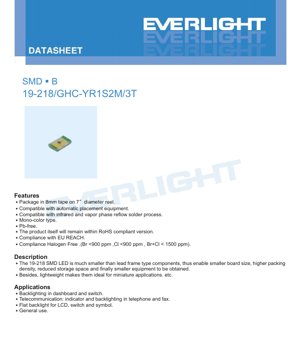
This document details the technical specifications of a surface-mount device (SMD) LED that emits bright green light. This component is specifically designed for high-density mounting on printed circuit boards (PCBs), offering significant advantages in miniaturization and automated assembly processes.
1.1 Siffofi da fa'idodi na asali
该LED以卷带形式供货,卷带宽度为8mm,缠绕在直径为7英寸的卷盘上,兼容标准自动化贴片设备。它适用于红外回流焊和气相回流焊工艺。此为单色型LED。产品符合环保法规:无铅(Pb-free),符合RoHS指令,遵守欧盟REACH法规,并满足无卤要求(溴<900 ppm,氯<900 ppm,溴+氯<1500 ppm)。
Compared to traditional lead-frame components, the compact SMD package offers significant design advantages. These advantages include: reduced board space consumption, increased component packaging density, lower storage requirements, and ultimately the potential for miniaturization of end-product devices. The lightweight nature of the package itself also makes it an ideal choice for micro and portable applications.
1.2 Aikace-aikacen da ake nufi
This LED is suitable for various indicator and backlighting functions, including:
- Hasken baya na dashboard da kuma maɓalli a cikin mota ko kayan sarrafa masana'antu.
- Alamun nuni na yanayi da hasken baya na maɓalli a cikin na'urorin sadarwa kamar waya, faks, da sauransu.
- Hasken baya na lebur na Liquid Crystal Display (LCD), maɓalli, da alamomi.
- Aikace-aikacen alamun nuni na gabaɗaya.
2. Ƙayyadaddun fasaha
2.1 Zaɓin kayan aiki da kayan
LED chips are made from indium gallium nitride (InGaN) semiconductor material, producing a bright green emission color. The encapsulation resin is colorless and transparent.
2.2 Absolute Maximum Ratings
The following ratings define the limiting conditions that could cause permanent damage to the device. Operation under or beyond these conditions is not guaranteed.
- Reverse Voltage (VR):5 V
- Forward Current (IF):25 mA (continuous)
- Peak Forward Current (IFP):100 mA (Duty Cycle 1/10 @ 1 kHz)
- Power Dissipation (Pd):110 mW
- Electrostatic Discharge (ESD) Human Body Model (HBM):150 V
- Operating Temperature (Topr):-40°C to +85°C
- Storage temperature (Tstg):-40°C to +90°C
- Soldering temperature (Tsol):
- Reflow soldering: Peak temperature 260°C, maximum 10 seconds.
- Hand soldering: 350°C, maximum 3 seconds.
2.3 Electro-Optical Characteristics
These parameters are specified at an ambient temperature of 25°C and represent typical operating performance.
- Luminous Intensity (Iv):112 - 285 mcd (measured at IF= 20 mA). Tolerance is ±11%.
- Viewing Angle (2θ1/2):120 degrees (typical).
- Peak Wavelength (λp):518 nm (typical value).
- Dominant wavelength (λd):520 - 535 nm. Tolerance is ±1 nm.
- Spectral radiation bandwidth (Δλ):20 nm (typical value).
- Forward voltage (VF):2.75 - 3.95 V (at IF= 20 mA). Tolerance is ±0.05 V.
- Reverse current (IR):Maximum 50 μA (at VR= 5 V).
3. Bin System Description
To ensure color and brightness consistency in production, LEDs are sorted into different bins based on key parameters. This allows designers to select components that meet the requirements of specific applications.
3.1 Luminous Intensity Binning
Based on the luminous intensity measured at 20 mA, LEDs are categorized into four bins (R1, R2, S1, S2).
- R1:112 - 140 mcd
- R2:140 - 180 mcd
- S1:180 - 225 mcd
- S2:225 - 285 mcd
3.2 Dominant Wavelength Binning
The dominant wavelength related to perceived color is divided into three groups (X, Y, Z).
- X:520 - 525 nm
- Y:525 - 530 nm
- Z:530 - 535 nm
3.3 Forward Voltage Binning
The forward voltage is divided into four codes (5, 6, 7, 8) within the M group. This is very important for current limiting circuit design.
- 5:2.75 - 3.05 V
- 6:3.05 - 3.35 V
- 7:3.35 - 3.65 V
- 8:3.65 - 3.95 V
4. Performance Curve Analysis
The datasheet provides several characteristic curves to illustrate the device's behavior under different conditions. These are crucial for robust circuit design.
4.1 Relative Luminous Intensity vs. Ambient Temperature
This curve shows how the light output decreases as the ambient temperature rises. Designers must account for this thermal derating, especially in high-temperature environments or high-power applications, to ensure sufficient brightness is maintained.
4.2 Forward Current Derating Curve
This graph defines the maximum allowable continuous forward current as a function of ambient temperature. As the temperature increases, the maximum safe operating current decreases to prevent overheating and ensure long-term reliability. The absolute maximum of 25 mA is valid only when the ambient temperature is equal to or below 25°C.
4.3 Luminous Intensity vs. Forward Current
Wannan lanƙwasa yana kwatanta alaƙar da ba ta layi ba tsakanin kwararar wutar lantarki mai tuƙi da fitar da haske. Ko da yake ƙara kwararar wutar lantarki zai ƙara haske, amma kuma zai ƙara amfani da wutar lantarki da zafin haɗin gwiwa, wanda ke shafar inganci da tsawon rayuwa.
4.4 Spectral Distribution
Lanƙwasa fitar da bakan haske yana nuna ƙarfin haske da ake fitarwa a mabanbanta tsayin raƙuman ruwa, tare da tsakiya a kusa da kololuwar tsayin raƙuman ruwa na kusan 518 nm. Ƙunƙuntaccen faɗin bakan haske sifa ce ta kore LED na tushen InGaN.
4.5 Forward Current vs. Forward Voltage (I-V Curve)
Wannan ainihin lanƙwasa yana nuna alaƙar ma'auni tsakanin ƙarfin wutar lantarki da kwararar wutar lantarki a cikin diode. Ƙarfin wutar lantarki na "karkatacciyar batu" shine inda wutar lantarki ta fara gudana sosai. Gangaren yankin aiki yana nuna juriya mai motsi.
4.6 Radiation Pattern
Taswirar iyakacin duniya tana kwatanta rarraba sararin samaniya na ƙarfin haske. Kallon kusurwar digiri 120 yana nuna yanayin fitarwa mai faɗi mai kama da Lambert, wanda ya dace da hasken yanki da alamun nuni masu faɗin kallo.
5. Mechanical and Packaging Information
5.1 Package Dimensions
Takardar ƙayyadaddun bayanai ta ƙunshi cikakken zanen girma na kunshen LED. Mahimman girma sun haɗa da tsayin jiki, faɗi, tsayi da wurin tashar cathode/anode. Duk rashin daidaitaccen ƙima shine ±0.1 mm.
The recommended PCB land pattern is provided to ensure reliable soldering and mechanical stability. The recommended land pattern dimensions are for reference only; designers should modify them based on their specific PCB fabrication process and thermal requirements.
6. Label and Packaging Information
6.1 Label Description
The reel label contains multiple codes for traceability and identification:
CPN:
- Customer Part Number.P/N:
- Manufacturer Part Number (e.g., 19-218/GHC-YR1S2M/3T).QTY:
- Package Quantity.CAT:
- Luminous Intensity Grade (e.g., R1, S2).HUE:
- Chromaticity Coordinates and Dominant Wavelength Grade (e.g., X, Y, Z).REF:
- Forward Voltage Grade (e.g., 5, 6, 7, 8).LOT No:
- Production lot number, used for traceability.6.2 Reel and Carrier Tape Dimensions
Specifies the dimensions of the carrier tape and the 7-inch diameter reel. The standard loading quantity is 3000 pieces per reel.
6.3 Moisture Barrier Packaging
LEDs are packaged in a moisture barrier bag (aluminum foil moisture barrier bag) with desiccant included to absorb ambient moisture. The label on the bag indicates the Moisture Sensitivity Level (MSL) and handling instructions. This packaging is critical for components susceptible to moisture damage ("popcorn" effect) during the reflow soldering process.
7. Soldering and Assembly Guidelines
7.1 Muhimman Abubuwan Lura
Kariya daga Yawan Kwarara:
LED is a current-driven device. An external current-limiting resistor must be used in series. A slight variation in forward voltage can cause a large change in current, which may lead to immediate failure (burnout).7.2 Storage and HandlingDo not open the moisture barrier bag until the components are ready for use.Before opening: Store at ≤30°C and ≤90% relative humidity (RH).
Bayan Buɗewa: "Rayuwar Sashin Aiki" (lokacin da kayan za su iya kasancewa a cikin iskar yanayin masana'anta) yana da shekara 1 a ƙarƙashin yanayin ≤30°C da ≤60% RH. Sashin da ba a yi amfani da shi ba yakamata a sake rufe shi a cikin kayan kariya na hana danshi tare da abin bushewa.
- If the desiccant indicator changes color or the storage time exceeds the specification, baking is required: 60 ±5°C, 24 hours.
- 7.3 Soldering Conditions
- Reflow Profile (Lead-Free):
- Preheat: 150-200°C, 60-120 seconds.
Lokacin da yake sama da layin ruwa (217°C): dakika 60-150.
Peak Temperature: Maximum 260°C.
- Time within peak temperature ±5°C: Maximum 10 seconds.
- Heating rate: Maximum 3°C/second (from preheat to peak).
- Cooling rate: Maximum 6°C/second.
- Reflow soldering should not exceed two times. Avoid applying mechanical stress to the LED during heating, and do not bend the PCB after soldering.
- Hand soldering:
- 使用烙铁头温度<350°C的烙铁,每个端子焊接时间不超过3秒。烙铁功率应为25W或更低。焊接每个端子之间至少间隔2秒。手工焊接存在较高的热损伤风险。
Rework after soldering is not recommended. If unavoidable, use a dual-tip soldering iron to simultaneously heat both terminals and evenly lift the component to avoid damaging the pads or the LED itself. Device functionality should be verified after any rework.8. Application Notes and Design Considerations
8.1 Circuit DesignAlways use a series resistor to limit the forward current. Calculate the resistor value using Ohm's Law: R = (V
Wutar lantarki
- V
) / I. Use the maximum V from the binning or datasheetvalue to ensure the current does not exceed the limit under worst-case conditions. Consider the resistor's power rating (P = IF* R). For driving multiple LEDs, a series configuration is beneficial for current matching but requires a higher supply voltage. A parallel configuration requires an independent current-limiting resistor for each LED to prevent current imbalance.F8.2 Thermal ManagementFAlthough it is a small SMD component, thermal management is crucial for lifespan and stable performance. The derating curve clearly shows the performance loss with temperature. Ensure sufficient PCB copper area (thermal pads) for heat dissipation, especially when operating near the maximum rated current or in high ambient temperatures. Avoid placing the LED near other heat-generating components.F28.3 Optical Integration
Faɗin kusurwar kallo na digiri 120 ya sa wannan LED ya dace da aikace-aikacen da ke buƙatar haske mai faɗi. Don haske mafi ƙayyadaddun shugabanci, ƙila ana buƙatar ruwan tabarau na waje ko farantin jagorar haske. Guro na gaskiya mara launi yana ba da tushe tsaka tsaki don aikace-aikacen da LED ke aiki tare da tace launi ko filaye masu yadawa.
9. Technical Comparison and Positioning
Wannan LED kore na tushen InGaN yana ba da mafita ta al'ada ga kasuwar LED mai nuna alama ta SMD. Babban bambancinsa shine cewa ya dace da ka'idojin muhalli na zamani (babu halogen, REACH) da kuma ƙayyadaddun sa don tsarin sake karkatar da maras gubar. Bayanan rarrabuwa da aka bayar suna ba da matakin daidaiton launi da haske wanda ke da mahimmanci ga tsararrun LED masu yawa ko nuni. Haɗin babban ƙarfin haske (har zuwa 285 mcd a 20mA) tare da daidaitaccen girman kunshe na SMD, ya sa ya zama zaɓi na gama gari don ayyukan nuna alama da haske na baya mara ƙarfi. Masu zane yakamata su kwatanta rarrabuwar ƙarfin lantarki na gaba da rarrabuwar ƙarfin haske tare da buƙatun ƙarin ƙarfin lantarki na musamman da daidaiton haske.
10. Frequently Asked Questions (FAQ)
Q: What is the purpose of the binning code?
A: Binning ensures consistency in electrical and optical characteristics. For example, using LEDs from the same V
LEDs from the same bin ensure uniform brightness when driven using a common current-limiting resistor. Using LEDs from the same wavelength bin ensures color matching.
Q: If my power supply voltage is exactly 3.2V, can I drive this LED without a current-limiting resistor?
A: No. The forward voltage has a range (2.75V-3.95V). A 3.2V power supply voltage may cause excessive current in low VFLEDs, leading to failure. For constant voltage drive, a series resistor is always mandatory.
Q: How to understand the "Peak Forward Current" rating of 100mA?
A: This is a pulsed current rating (1/10 duty cycle at 1kHz). It cannot be used for continuous operation. The continuous DC current must not exceed 25mA.FQ: Why is moisture barrier packaging important?
A: Moisture absorbed by the plastic package can rapidly vaporize during high-temperature reflow soldering, causing internal delamination, cracking, or "popcorn" effect, thereby damaging the component.
11. Design Use Case Example
Scenario: Design a status indicator panel with 10 uniformly bright green LEDs.
Current Setting:
Select the drive current. To balance brightness and lifetime, choose I
= 20 mA.
- Voltage bin selection:To ensure uniform brightness when using a single current-limiting resistor value, specify LEDs from the same forward voltage bin (e.g., Bin 6: 3.05-3.35V). Use the maximum VFvalue (3.35V) from this bin for worst-case resistor calculation.
- Luminous intensity bin selection:Specify the required luminous intensity bin (e.g., S1: 180-225 mcd) to guarantee the minimum brightness level.FCircuit design:
- Use a 5V power supply (VWutar lantarki
- ), calculate the series resistor: R = (5V - 3.35V) / 0.020A = 82.5Ω. Use the nearest standard value of 82Ω. Resistor power: P = (0.020A)* 82Ω = 0.0328W. A standard 1/10W (0.1W) resistor is sufficient.Layout:Place the LEDs on the PCB using the recommended pad layout. Connect all LEDs in parallel, each in series with an 82Ω resistor to prevent current imbalance.2Assembly:
- Follow the reflow soldering profile guidelines. Store opened reels in a dry cabinet if not used immediately.Working Principle
- Wannan LED na'urar haske ce ta semiconductor. Tsakiyarta shine guntu da aka yi da kayan InGaN (Indium Gallium Nitride), wanda ya samar da haɗin p-n. Lokacin da aka yi amfani da ƙarfin lantarki mai girma fiye da ƙimar bakin haɗin, ana shigar da electrons da ramuka cikin yankin haɗin. Lokacin da waɗannan masu ɗaukar kaya suka sake haɗuwa, suna sakin makamashi a cikin nau'in photons (haske). Takamaiman abun da ke cikin gawa na InGaN yana ƙayyade ƙarfin bandgap, wanda kai tsaye yayi daidai da tsayin raƙuman haske (launi) da aka fitar—a cikin wannan misali, kore mai haske (kimanin 518-535 nm). Epoxy resin mara launi mai gani yana rufe guntun, yana ba da kariya ta injiniya, yana siffanta yanayin radiyo, kuma yana aiki azaman matsakaicin juzu'i.13. Trends na Fasaha
The development of such SMD LEDs is driven by trends in electronic device miniaturization, automation, and energy efficiency. The industry continuously pursues higher luminous efficacy (more light output per watt of electrical power), which improves system efficiency and reduces thermal load. Advancements in phosphor technology and chip design are expanding the color gamut and color rendering capabilities of LEDs. Furthermore, integration is a key trend, with multi-chip packages (RGB, white light) and even driver ICs being combined into a single module. The emphasis on environmental compliance (halogen-free, REACH) and high-reliability manufacturing processes for automotive and industrial applications continues to influence component specifications and testing requirements.
This LED is a semiconductor photonic device. Its core is a chip made of InGaN (Indium Gallium Nitride) materials, forming a p-n junction. When a forward voltage exceeding the junction's threshold is applied, electrons and holes are injected across the junction. When these charge carriers recombine, they release energy in the form of photons (light). The specific composition of the InGaN alloy determines the bandgap energy, which directly corresponds to the wavelength (color) of the emitted light—in this case, brilliant green (~518-535 nm). The water-clear epoxy resin encapsulates the chip, providing mechanical protection, shaping the radiation pattern, and acting as a refractive medium.
. Technology Trends
The development of SMD LEDs like this one is driven by trends in electronics miniaturization, automation, and energy efficiency. There is a continuous push for higher luminous efficacy (more light output per electrical watt), which improves system efficiency and reduces thermal load. Advancements in phosphor technology and chip design are expanding the color gamut and color rendering capabilities of LEDs. Furthermore, integration is a key trend, with multi-chip packages (RGB, white) and even driver ICs being combined into single modules. The emphasis on environmental compliance (Halogen-Free, REACH) and high-reliability manufacturing processes for automotive and industrial applications continues to shape component specifications and testing requirements.
Detailed Explanation of LED Specification Terminology
Complete Explanation of LED Technical Terminology
I. Core Photometric and Colorimetric Performance Indicators
| Terminology | Unit / Notation | Layman's Explanation | Me ya sa yake da muhimmanci |
|---|---|---|---|
| Tasirin haske (Luminous Efficacy) | lm/W (lumen/watt) | Yawan hasken da ake samu daga kowace watt na wutar lantarki, mafi girma yana nufin mafi ƙarancin amfani da wutar lantarki. | Yana ƙayyadaddun matakin ingancin amfani da wutar lantarki na fitila da farashin wutar lantarki kai tsaye. |
| Gudun haske (Luminous Flux) | lm (lumen) | The total amount of light emitted by a light source, commonly known as "brightness". | Determines whether a luminaire is bright enough. |
| Viewing Angle | ° (degree), e.g., 120° | The angle at which the light intensity drops to half, determining the width of the light beam. | Yana rinjayar iyakar haske da daidaito. |
| Yanayin zafin launi (CCT) | K (Kelvin), kamar 2700K/6500K | Launin haske mai dumi ko sanyi, ƙananan ƙima ja zuwa rawaya/dumi, manyan ƙima ja zuwa fari/sanyi. | Yana ƙayyade yanayin haskakawa da wurin da ya dace. |
| Ma'aunin nuna launi (CRI / Ra) | No unit, 0–100 | The ability of a light source to reproduce the true colors of objects, Ra≥80 is good. | Affects color fidelity, used in high-demand places like shopping malls and art galleries. |
| Color Tolerance (SDCM) | MacAdam ellipse steps, e.g., "5-step" | A quantitative indicator of color consistency; the smaller the step number, the more consistent the color. | Ensure no color difference among luminaires from the same batch. |
| Dominant Wavelength | nm (nanometer), e.g., 620nm (red) | Wavelength value corresponding to the color of a colored LED. | Determines the hue of monochromatic LEDs such as red, yellow, and green. |
| Spectral Distribution | Wavelength vs. Intensity Curve | Shows the intensity distribution of light emitted by an LED at each wavelength. | Affects color rendering and color quality. |
II. Electrical Parameters
| Terminology | Symbol | Layman's Explanation | Design Considerations |
|---|---|---|---|
| Forward Voltage | Vf | The minimum voltage required to light up an LED, similar to a "starting threshold". | The driving power supply voltage must be ≥ Vf; the voltages add up when multiple LEDs are connected in series. |
| Forward Current | If | The current value that makes the LED emit light normally. | Constant current drive is often used, as the current determines brightness and lifespan. |
| Maximum Pulse Current | Ifp | The peak current that can be withstood for a short time, used for dimming or flashing. | Pulse width and duty cycle must be strictly controlled, otherwise overheating damage will occur. |
| Reverse Voltage | Vr | The maximum reverse voltage that an LED can withstand; exceeding it may cause breakdown. | Reverse connection or voltage surges must be prevented in the circuit. |
| Thermal Resistance | Rth (°C/W) | The resistance to heat flow from the chip to the solder joint. A lower value indicates better heat dissipation. | High thermal resistance requires a stronger heat dissipation design; otherwise, the junction temperature will increase. |
| Electrostatic Discharge Immunity (ESD Immunity) | V (HBM), e.g., 1000V | The ability to withstand electrostatic discharge. A higher value means it is less susceptible to damage from static electricity. | Anti-static measures must be implemented during production, especially for high-sensitivity LEDs. |
III. Thermal Management and Reliability
| Terminology | Key Metrics | Layman's Explanation | Impact |
|---|---|---|---|
| Junction Temperature | Tj (°C) | The actual operating temperature inside the LED chip. | For every 10°C reduction, the lifespan may double; excessively high temperatures cause lumen depreciation and color shift. |
| Lumen Depreciation | L70 / L80 (hours) | The time required for brightness to drop to 70% or 80% of its initial value. | Directly defines the "service life" of an LED. |
| Lumen Maintenance | % (e.g., 70%) | The percentage of remaining brightness after a period of use. | Characterizes the ability to maintain brightness after long-term use. |
| Color Shift | Δu′v′ or MacAdam Ellipse | The degree of color change during use. | Affects the color consistency of the lighting scene. |
| Thermal Aging | Material performance degradation. | Deterioration of packaging materials due to long-term high temperatures. | May lead to decreased brightness, color change, or open-circuit failure. |
IV. Packaging and Materials
| Terminology | Common Types | Layman's Explanation | Characteristics and Applications |
|---|---|---|---|
| Encapsulation Types | EMC, PPA, Ceramic | The housing material that protects the chip and provides optical and thermal interfaces. | EMC offers good heat resistance and low cost; ceramic provides superior heat dissipation and long lifespan. |
| Chip structure | Face-up, Flip Chip | Chip electrode arrangement method. | Flip Chip offers better heat dissipation and higher luminous efficacy, suitable for high power. |
| Phosphor coating | YAG, silicate, nitride | Applied over the blue LED chip, partially converts to yellow/red light, mixing to form white light. | Different phosphors affect luminous efficacy, color temperature, and color rendering. |
| Lens/Optical Design | Flat, microlens, total internal reflection | Optical structure on the encapsulation surface, controls light distribution. | Determines the emission angle and light distribution curve. |
V. Quality Control and Binning
| Terminology | Binning Content | Layman's Explanation | Purpose |
|---|---|---|---|
| Luminous Flux Binning | Codes such as 2G, 2H | Grouped by brightness level, each group has a minimum/maximum lumen value. | Ensure consistent brightness within the same batch of products. |
| Voltage binning | Codes such as 6W, 6X | Group by forward voltage range. | Facilitates driver matching and improves system efficiency. |
| Color binning | 5-step MacAdam ellipse | Group by color coordinates to ensure colors fall within an extremely narrow range. | Ensure color consistency to avoid color unevenness within the same luminaire. |
| Color Temperature Sorting | 2700K, 3000K, etc. | Group by color temperature, each group has a corresponding coordinate range. | Meet the color temperature requirements of different scenarios. |
VI. Testing and Certification
| Terminology | Standard/Test | Layman's Explanation | Significance |
|---|---|---|---|
| LM-80 | Lumen Maintenance Test | Long-term illumination under constant temperature conditions, recording brightness attenuation data. | Used to estimate LED lifespan (combined with TM-21). |
| TM-21 | Life Extrapolation Standard | Estimating lifespan under actual usage conditions based on LM-80 data. | Providing scientific lifespan prediction. |
| IESNA Standard | Illuminating Engineering Society Standard | Cover optical, electrical, and thermal testing methods. | Industry-recognized testing basis. |
| RoHS / REACH | Environmental certification. | Ensure products do not contain harmful substances (e.g., lead, mercury). | Entry requirements for the international market. |
| ENERGY STAR / DLC | Energy Efficiency Certification | Energy efficiency and performance certification for lighting products. | Commonly used in government procurement, subsidy programs to enhance market competitiveness. |