Table of Contents
- 1. Bayanin Samfur
- 2. Cikakken Bayanin Fasaha
- 2.1 Halayen Lantarki da Haske
- 2.2 Sigogin Lantarki
- 2.3 Zazzabi da Matsakaicin Matsayi
- 3. Binning System Explanation
- 3.1 Luminous Intensity Binning
- 3.2 Dominant Wavelength Binning
- 3.3 Forward Voltage Binning
- 4. Performance Curve Analysis
- 5. Mechanical and Package Information
- 6. Soldering and Assembly Guidelines
- 6.1 Reflow Soldering Parameters
- 6.2 Storage and Moisture Sensitivity
- 6.3 Hand Soldering and Rework
- 7. Packaging and Ordering Information
- 8. Application Recommendations
- 8.1 Yanayin Aikace-aikace na Al'ada
- 8.2 Muhimman Abubuwan Zane-zane
- 9. Daidaitawa da Ka'idojin Muhalli
- 10. Hani na Aikace-aikace da Bayanin Amincewa
- 11. Technical Principle Introduction
- 12. Common Questions Based on Technical Parameters
- LED Specification Terminology
- Photoelectric Performance
- Electrical Parameters
- Thermal Management & Reliability
- Packaging & Materials
- Quality Control & Binning
- Testing & Certification
1. Bayanin Samfur
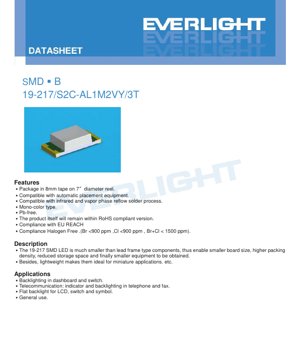
The 19-217/S2C-AL1M2VY/3T is a surface-mount device (SMD) LED designed for modern electronic applications requiring reliable, compact, and efficient indicator lighting. This component utilizes AlGaInP (Aluminum Gallium Indium Phosphide) semiconductor technology to produce a brilliant orange light output. Its primary design goals are miniaturization, compatibility with automated assembly processes, and adherence to stringent environmental and safety standards.
The core advantages of this LED stem from its SMD package. It is significantly smaller than traditional lead-frame type LEDs, enabling higher component packing density on printed circuit boards (PCBs). This leads to reduced overall board size, minimized storage space requirements, and ultimately contributes to the development of smaller and lighter end-user equipment. The lightweight nature of the package makes it particularly suitable for miniature and portable applications where space and weight are critical constraints.
The target market for this product is broad, encompassing general electronics, consumer devices, and industrial equipment. It is engineered to meet the needs of designers looking for a dependable, RoHS-compliant, and halogen-free orange indicator solution that can be integrated using standard surface-mount technology (SMT) lines.
2. Cikakken Bayanin Fasaha
2.1 Halayen Lantarki da Haske
Ana ƙayyade aikin lantarki da na'ura mai haske a daidaitaccen yanayin gwaji na zafin yanayi (Ta) na 25°C da kuma ci gaba na gaba (IF) na 5mA. Maɓuɓɓukan ma'auni suna ayyana fitar da haske da ingancin launi.
- Ƙarfin Haskakawa (Iv): Ƙarfin hasken da aka daidaita don hankalin idon ɗan adam. Ba a ƙayyade ƙimar ta yau da kullun a matsayin lamba ɗaya ba; a maimakon haka, ana rarraba samfurin zuwa kwandon shara (L1, L2, M1, M2) tare da mafi ƙarancin ƙimomi daga 11.5 mcd zuwa 22.5 mcd. Matsakaicin mafi girman kwandon shara (M2) shine 28.5 mcd. Ana amfani da jurewar ±11% ga ƙarfin haskakawa.
- Kusurwar Dubawa (2θ1/2): Wannan shine kusurwar da ƙarfin haske ya rabi na ƙarfin a digiri 0 (a kan-axis). Wannan LED yana da faɗin kusurwar kallo mai faɗin digiri 120, yana mai da shi dacewa da aikace-aikacen da ake buƙatar ganin haske daga faɗin hangen nesa.
- Kololuwar Tsawon Tsinkaya (λp): Tsawon tsinkaya inda fitarwar bakan ta fi girma. Ƙimar ta na yau da kullun shine nanometer 611 (nm), yana sanya shi a cikin yankin lemu na bakan gani.
- Rinjaye Tsawon Tsinkaya (λd): Wannan shine tsawon tsinkaya guda ɗaya wanda idon ɗan adam ke ganinsa a matsayin launin hasken. Ya bambanta daga 600.5 nm zuwa 612.5 nm, tare da ƙaƙƙarfan jurewa na ±1 nm. Ana kuma rarraba rinjaye tsawon tsinkaya zuwa rukunoni (D8 zuwa D11).
- Faɗin Bakan (Δλ): Faɗin bakan da aka fitar a rabin mafi girman ƙarfinsa. Ƙimar ta na yau da kullun shine 17 nm, yana nuna ingantaccen siffar fitarwar launi na fasahar AlGaInP.
2.2 Sigogin Lantarki
Electrical characteristics define the operating limits and conditions for reliable performance.
- Forward Voltage (VF): The voltage drop across the LED when operating at the specified current. At IF=5mA, it ranges from a minimum of 1.70V to a maximum of 2.20V, with a tolerance of ±0.05V. This low forward voltage is advantageous for low-power and battery-operated devices. The voltage is also binned (codes 19 to 23).
- Reverse Voltage (VR): The maximum voltage that can be applied in the reverse direction without damaging the device. The absolute maximum rating is 5V.
- Reverse Current (IR): The leakage current when the maximum reverse voltage (5V) is applied. It has a maximum value of 10 µA.
- Forward Current (IF): The recommended continuous operating current is 25 mA.
- Peak Forward Current (IFP): For pulsed operation (duty cycle 1/10 at 1 kHz), the LED can handle a peak current of up to 60 mA.
2.3 Zazzabi da Matsakaicin Matsayi
These ratings define the environmental and stress limits beyond which permanent damage may occur.
- Power Dissipation (Pd): The maximum allowable power dissipation is 60 mW.
- Operating Temperature (Topr): Yanayin yanayin zafi don aiki mai dogaro daga -40°C zuwa +85°C.
- Storage Temperature (Tstg): Yanayin zafi don ajiye ba tare da aiki ba daga -40°C zuwa +90°C.
- Electrostatic Discharge (ESD): Na'urar na iya jure 2000V ta amfani da Tsarin Jikin Mutum (HBM), wanda shine matakin kariya na daidaitawa don sarrafawa a cikin yanayin da aka sarrafa ESD.
- Soldering Temperature: Kunshin ya dace da duka reflow da haɗa hannu.
- Reflow Soldering: Maximum peak temperature of 260°C for up to 10 seconds.
- Hand Soldering: Iron tip temperature up to 350°C for a maximum of 3 seconds per terminal.
3. Binning System Explanation
To ensure color and brightness consistency in production, LEDs are sorted into bins based on key parameters. This allows designers to select parts that meet specific application requirements.
3.1 Luminous Intensity Binning
LEDs are categorized into four bins (L1, L2, M1, M2) based on their measured luminous intensity at 5mA. This allows selection for applications requiring different brightness levels while maintaining predictable performance.
3.2 Dominant Wavelength Binning
Launin launi (hue) ana sarrafa ta hanyar kwandon tsayin raƙuman ruwa guda huɗu (D8, D9, D10, D11), kowanne yana ɗaukar kewayon 3nm daga 600.5nm zuwa 612.5nm. Wannan yana tabbatar da daidaiton launi na gani a cikin raka'a da yawa a cikin taro.
3.3 Forward Voltage Binning
Ana rarraba ƙarfin lantarki na gaba zuwa kwando biyar (19 zuwa 23), kowanne yana ɗaukar kewayon 0.1V daga 1.70V zuwa 2.20V. Wannan yana da amfani musamman ga masu zane waɗanda ke buƙatar sarrafa ƙirar wadata wutar lantarki da lissafin resistor mai iyakancewar halin yanzu daidai, musamman a cikin manyan tsararraki inda raguwar ƙarfin lantarki zai iya zama abin damuwa.
4. Performance Curve Analysis
Duk da yake an ambaci takamaiman lanƙwan masu lanƙwasa a cikin takardar bayanai, ana iya bayyana abubuwan da suke nufi bisa ga daidaitattun halayen LED da kuma sigogin da aka bayar.
The Current vs. Voltage (I-V) curve would show the exponential relationship typical of a diode. The specified forward voltage range (1.7-2.2V at 5mA) indicates the "knee" of this curve. Operating significantly above 5mA would require a higher forward voltage, moving up the exponential slope. This underscores the importance of using a current-limiting resistor or constant-current driver, as a small increase in voltage can cause a large, potentially destructive increase in current.
The Luminous Intensity vs. Forward Current (L-I) curve is generally linear over a range. Operating at the maximum continuous current (25mA) would produce significantly higher light output than at the test current of 5mA, but it would also increase power dissipation and junction temperature, which must be managed through proper PCB thermal design.
The Temperature Dependence characteristics are critical. For AlGaInP LEDs, luminous intensity typically decreases as the junction temperature increases. While the exact derating curve is not provided, the wide operating temperature range (-40°C to +85°C) confirms the device's robustness. Designers must account for intensity drop in high-temperature environments. The forward voltage also has a negative temperature coefficient, meaning it decreases slightly as temperature rises.
The Spectral Distribution Curve ya nuna wani guda, kunkuntar koli mai tsakiya a kusa da 611 nm (na yau da kullun), tare da bandwidth na 17 nm yana ayyana faɗinsa. Wannan ya tabbatar da yanayin monochromatic na fitarwa, wanda ya dace da aikace-aikacen da ke buƙatar takamaiman launin orange mai cikakke.
5. Mechanical and Package Information
19-217 LED yana zuwa a cikin daidaitaccen kunshin SMD. An ba da ainihin girmansu a cikin cikakken zane a cikin takardar bayanai, tare da daidaitattun ƙa'idodin ±0.1mm sai dai idan an faɗi akasin haka. Fitattun sifofin injiniya sun haɗa da:
- Tsarin Kunshin: Zanen ya ƙayyade tsayi, faɗi, da tsayin jikin LED, da kuma girma da tazara na tashoshin da ake iya gyarawa (pad).
- Ƙirar Pad: Sawun ƙafar da ke kan PCB dole ne ya dace da shimfidar pad da aka ba da shawarar don tabbatar da ingantaccen gyarawa, kwanciyar hankali na injiniya, da yuwuwar ɓarkewar zafi.
- Gano Polarity: The datasheet drawing clearly indicates the anode and cathode terminals. Correct polarity is essential for device operation. Typically, one pad may be marked or shaped differently (e.g., a notch or a beveled corner on the LED package itself) to indicate the cathode.
- Material: The lens (resin) color is specified as "Water Clear," meaning the orange light is emitted through a transparent encapsulant, which contributes to the wide 120-degree viewing angle.
6. Soldering and Assembly Guidelines
Proper handling and soldering are crucial for reliability. The LED is supplied in moisture-resistant packaging (tape on reel) compatible with automatic pick-and-place equipment.
6.1 Reflow Soldering Parameters
A lead-free (Pb-free) reflow soldering profile is recommended. The profile includes:
- Pre-heating: Ramp from ambient to 150-200°C over 60-120 seconds.
- Soak/Reflow: Time above liquidus (217°C) should be 60-150 seconds. The peak temperature must not exceed 260°C, and the time at or above 255°C must be limited to a maximum of 30 seconds.
- Cooling: The maximum cooling rate should be 6°C per second.
Critical Note: Reflow soldering should not be performed more than two times on the same LED assembly to avoid thermal stress damage.
6.2 Storage and Moisture Sensitivity
The components are packaged in a moisture-barrier bag with desiccant.
- Before Opening: Store at ≤30°C and ≤90% Relative Humidity (RH).
- After Opening: The "floor life" (time components can be exposed to ambient factory air) is 1 year at ≤30°C and ≤60% RH. Unused parts should be resealed in moisture-proof packaging.
- Baking: If the desiccant indicates saturation or the storage time is exceeded, a bake at 60±5°C for 24 hours is required before reflow to prevent "popcorn" cracking during soldering.
6.3 Hand Soldering and Rework
Idan ake buƙatar sayar da hannu:
- Yi amfani da ƙarfe na ƙarfe tare da zazzabi mai zazzabi ≤350°C.
- Iyakance lokacin tuntuɓar zuwa ≤3 seconds kowace tasha.
- Yi amfani da ƙarfe tare da ƙimar wutar lantarki ≤25W.
- Ƙyale aƙalla tazarar 2-second tsakanin sayar da kowace tasha.
Ana ƙarfafa hana sake aiki. If absolutely unavoidable, a specialized double-head soldering iron must be used to simultaneously heat both terminals and lift the component without applying mechanical stress. The impact on LED characteristics must be verified after any rework.
7. Packaging and Ordering Information
The standard shipping package is an 8mm wide carrier tape wound on a 7-inch diameter reel. Each reel contains 3000 pieces.
The reel and carrier tape have specific dimensions provided in the datasheet drawings to ensure compatibility with automated assembly equipment.
The packaging label contains critical information for traceability and correct application:
- CPN: Customer's Product Number (if assigned).
- P/N: The manufacturer's part number (19-217/S2C-AL1M2VY/3T).
- QTY: Packing quantity (3000 pcs/reel).
- CAT: Luminous Intensity bin code (e.g., L1, M2).
- HUE: Dominant Wavelength bin code (e.g., D9, D11).
- REF: Forward Voltage bin code (e.g., 20, 22).
- LOT No: Manufacturing lot number for traceability.
8. Application Recommendations
8.1 Yanayin Aikace-aikace na Al'ada
- Backlighting: Ideal for backlighting dashboard icons, membrane switches, and control panels where a wide viewing angle is beneficial.
- Telecommunication Equipment: Ana aiki azaman alamomin yanayi, fitilolin jiran saƙo, ko fitilolin baya na maɓalli a cikin wayoyi, injunan faks, da kayan aikin hanyar sadarwa.
- Hasken Baya na Panel LCD: Ana iya amfani da su don hasken baya mai lebur, mai haske gefe a cikin ƙananan nuni na LCD masu launi ɗaya ko don haskaka takamaiman alamomi.
- Amfanin Alamar Gabaɗaya: Alamomin kunna wuta, zaɓin yanayi, siginar ƙararrawa, da fitilolin yanayi a cikin ɗimbin samfuran lantarki na mabukaci da na masana'antu.
8.2 Muhimman Abubuwan Zane-zane
- Iyakancewar Halin Yanzu Wajibi Ne: An external current-limiting resistor must always be used in series with the LED. The forward voltage has tolerance and a negative temperature coefficient. A slight increase in supply voltage or a decrease in VF due to heating can cause a large, destructive current surge if not properly limited. The resistor value (R) is calculated as R = (V_supply - VF_LED) / I_desired.
- Thermal Management: While the package is small, the 60mW maximum power dissipation must be respected. Operating at high currents (e.g., 25mA) generates heat. The PCB layout should provide adequate copper area around the LED pads to act as a heat sink, especially in high ambient temperature environments or when multiple LEDs are clustered.
- ESD Precautions: Although rated for 2000V HBM, standard ESD handling procedures should be followed during assembly and handling to prevent latent damage.
- Optical Design: The 120-degree viewing angle provides a very wide, diffuse emission pattern. For applications requiring a more focused beam, an external lens or light guide may be necessary.
- Waveform for Pulsed Operation: Idan ana amfani da kololuwar halin yanzu na gaba (60mA) a cikin yanayin bugun jini, tabbatar da cewa tsarin aiki bai wuce 10% ba kuma mitar ita ce 1kHz kamar yadda aka kayyade. Matsakaicin halin yanzu dole ne har yanzu ya kasance cikin ƙimar ci gaba na 25mA.
9. Daidaitawa da Ka'idojin Muhalli
An ƙera wannan samfur don ya dace da mahimman ka'idojin muhalli da aminci na duniya, wanda ke da muhimmiyar fa'ida don shiga kasuwa.
- RoHS Compliant: Samfurin ya kasance ba shi da ƙayyadaddun abubuwa masu haɗari bisa ga umarnin EU na ƙuntata abubuwa masu haɗari.
- Pb-Free: Kayan kammalawa da kayan da ake amfani da su don haɗawa ba su ƙunshi gubar ba.
- EU REACH Compliance: Yana daidai da Dokar Rajista, Kimantawa, Izini da Ƙuntatawa na Sinadarai.
- Ba shi da Halogen: Meets strict limits on bromine (Br) and chlorine (Cl) content: Br < 900 ppm, Cl < 900 ppm, and Br+Cl < 1500 ppm. This is important for reducing toxic emissions in case of fire.
10. Hani na Aikace-aikace da Bayanin Amincewa
An bayyana a sarari cewa wannan samfur, kamar yadda aka ƙayyade a cikin wannan takardar bayanan, ba a nufin shi don aikace-aikacen babban aminci ko masu mahimmanci na aminci ba tare da tuntubar farko ba. Wannan ya haɗa da:
- Tsarin soja da na sararin samaniya.
- Tsarin aminci ko tsaro na mota (misali, sarrafa jakar iska, fitilun birki).
- Kayan aikin tallafin rayuwa na likita ko mahimman kayan aikin bincike.
Don irin waɗannan aikace-aikacen, ana iya buƙatar nau'ikan samfura daban-daban tare da ƙarin gwaji mai yawa, kewayon zafin jiki mai faɗi, da garantin rayuwa mai tsawo. Ƙayyadaddun yana ba da garantin inganci da aikin LED a matsayin ɓangaren ɓangare a ƙarƙashin ƙayyadaddun yanayin gwaji. Yin amfani da samfurin a waje da waɗannan iyakokin da aka ƙayyade yana soke wannan garantin.
11. Technical Principle Introduction
LED 19-217 ya dogara ne akan kayan semiconductor na AlGaInP (Aluminum Gallium Indium Phosphide) da aka girma akan substrate. Lokacin da aka yi amfani da ƙarfin lantarki na gaba, ana shigar da electrons da ramuka cikin yankin aiki na haɗin semiconductor. Haɗuwarsu yana sakin makamashi a cikin nau'in photons (haske). Takamaiman abun da ke cikin gawa na AlGaInP yana ƙayyade makamashin bandgap, wanda kai tsaye yayi daidai da tsayin raƙuman ruwa (launi) na hasken da aka fitar. A wannan yanayin, an daidaita abun da ke ciki don samar da photons a cikin bakan orange (~611 nm). Resin epoxy mai "bayyanannen ruwa" yana kare die na semiconductor, yana aiki azaman ruwan tabarau don siffanta fitowar haske (cimma tsarin digiri 120), kuma yana ba da kariya ta injiniya da muhalli. Kunshin da ke kan saman yana fasalta tashoshi na ƙarfe guda biyu (anode da cathode) waɗanda aka yi musu solder kai tsaye zuwa PCB, yana kawar da buƙatar ramuka da wayoyi.
12. Common Questions Based on Technical Parameters
- Q: Wane resistor nake buƙata don wadata 5V? A: Ta yin amfani da mafi munin matsakaicin VF na 2.2V da kuma ƙaƙƙarfan naɗi na 5mA: R = (5V - 2.2V) / 0.005A = 560 Ohms. Ta yin amfani da daidaitaccen resistor na 560Ω, ainihin naɗin zai kasance daga ~5mA (idan VF=2.2V) zuwa ~5.9mA (idan VF=1.7V). Resistor 470Ω shima ya zama gama gari, yana ba da ɗan ƙaramin haske amma yana tabbatar da cewa naɗin ya kasance ƙasa da 25mA ko da tare da mafi ƙarancin VF.
- Q: Shin zan iya tuƙa shi kai tsaye daga fil ɗin microcontroller? A: Yiwu, amma da hankali. Fil na MCU na yau da kullun zai iya fitarwa/karkatarwa 20-25mA, wanda yake a cikin iyakar iyakar LED. Wannan baya barin wani gefe kuma yana damun duka MCU da LED. Yana da mafi kyau koyaushe a yi amfani da filin MCU don tuka transistor (misali, MOSFET) wanda sannan ya sarrafa kwararar LED.
- Q: Me yasa kusurwar kallo ta yi fadi haka? A: "Ruwa mai tsabta" dome-dimbin kayan rufi yana aiki azaman ruwan tabarau wanda ke jujjuya haske daga ƙaramin guntu na semiconductor a kan yanki mai faɗi sosai. Wannan ya dace da aikace-aikacen nuna alama inda ake buƙatar ganin LED daga kusurwoyi da yawa.
- Q: Me ake nufi da lambar kwandon "S2C-AL1M2VY/3T"? A: Wannan shine lambar samfur na cikin gida na masana'anta. Mai yiwuwa tana ɓoye halaye na musamman kamar nau'in fakiti (SMD), fasahar guntu (AlGaInP), launi (Orange/Yellow), kwandon haske, da sauran bambance-bambancen masana'antu. Ma'anar daidai ta keɓance, amma mahimman sigogi na aiki an bayyana su gaba ɗaya a cikin tebur na bayanan.
- Q: LED za ta daɗe har yaushe? A: Duk da yake ba a bayar da takamaiman rayuwar L70/L50 (sa'o'i zuwa 70% ko 50% na hasken farko) a cikin wannan takardar bayanan, AlGaInP LEDs an san su da dogon rayuwar aiki (sau da yawa dubunnan sa'o'i) lokacin da ake aiki a cikin ƙayyadaddun iyakokin lantarki da zafin jiki. Babban hanyar lalata rayuwa shine raguwar fitarwa mai haske a hankali saboda lahani a cikin kayan semiconductor da fakiti a ƙarƙashin matsanancin zafi da damuwa na yanzu.
LED Specification Terminology
Cikakken bayanin kalmomin fasaha na LED
Photoelectric Performance
| Kalma | Naúra/Wakilci | Bayani Mai Sauƙi | Me Ya Sa Yake Da Muhimmanci |
|---|---|---|---|
| Haske | lm/W (lumens per watt) | Haske kowane a kowane watt na wutar lantarki, mafi girma yana nufin mafi inganci na makamashi. | Kai tsaye yana ƙayyade matakin ingancin makamashi da farashin wutar lantarki. |
| Kwararar Haske | lm (lumens) | Total light emitted by source, commonly called "brightness". | Determines if the light is bright enough. |
| Viewing Angle | ° (degrees), e.g., 120° | Angle where light intensity drops to half, determines beam width. | Affects illumination range and uniformity. |
| CCT (Color Temperature) | K (Kelvin), e.g., 2700K/6500K | Warmth/coolness of light, lower values yellowish/warm, higher whitish/cool. | Determines lighting atmosphere and suitable scenarios. |
| CRI / Ra | Unitless, 0–100 | Ability to render object colors accurately, Ra≥80 is good. | Affects color authenticity, used in high-demand places like malls, museums. |
| SDCM | MacAdam ellipse steps, e.g., "5-step" | Color consistency metric, smaller steps mean more consistent color. | Ensures uniform color across same batch of LEDs. |
| Wavelength ya Kuvikia | nm (nanometers), mfano, 620nm (nyekundu) | Wavelength inayolingana na rangi ya LEDs zenye rangi. | Huamua rangi ya LEDs za rangi moja nyekundu, manjano, kijani. |
| Spectral Distribution | Mkunjo wa Wavelength dhidi ya ukali | Yana nuna haske a tsakanin tsayin daddare. | Yana shafar yadda ake nuna launi da inganci. |
Electrical Parameters
| Kalma | Symbol | Bayani Mai Sauƙi | Design Considerations |
|---|---|---|---|
| Forward Voltage | Vf | Minimum voltage to turn on LED, like "starting threshold". | Driver voltage must be ≥Vf, voltages add up for series LEDs. |
| Forward Current | If | Current value for normal LED operation. | Usually constant current drive, current determines brightness & lifespan. |
| Matsakaicin Ƙarfin Wuta na Bugun Jini | Ifp | Matsakaicin ƙarfin wuta da za a iya jurewa na ɗan lokaci, ana amfani dashi don dushewa ko walƙiya. | Pulse width & duty cycle must be strictly controlled to avoid damage. |
| Ƙarfin Wuta na Baya | Vr | Max reverse voltage LED can withstand, beyond may cause breakdown. | Circuit must prevent reverse connection or voltage spikes. |
| Thermal Resistance | Rth (°C/W) | Resistance to heat transfer from chip to solder, lower is better. | High thermal resistance requires stronger heat dissipation. |
| ESD Immunity | V (HBM), e.g., 1000V | Ability to withstand electrostatic discharge, higher means less vulnerable. | Anti-static measures needed in production, especially for sensitive LEDs. |
Thermal Management & Reliability
| Kalma | Metric Muhimmi | Bayani Mai Sauƙi | Tasiri |
|---|---|---|---|
| Junction Temperature | Tj (°C) | Yanayin aiki na ainihi a cikin guntu LED. | Kowane raguwa na 10°C na iya ninka tsawon rayuwa; yana da yawa yana haifar da lalacewar haske, canjin launi. |
| Lumen Depreciation | L70 / L80 (hours) | Time for brightness to drop to 70% or 80% of initial. | Directly defines LED "service life". |
| Lumen Maintenance | % (e.g., 70%) | Percentage of brightness retained after time. | Indicates brightness retention over long-term use. |
| Color Shift | Δu′v′ or MacAdam ellipse | Degree of color change during use. | Affects color consistency in lighting scenes. |
| Thermal Aging | Material degradation | Deterioration due to long-term high temperature. | May cause brightness drop, color change, or open-circuit failure. |
Packaging & Materials
| Kalma | Common Types | Bayani Mai Sauƙi | Features & Applications |
|---|---|---|---|
| Nau'in Kunshin | EMC, PPA, Ceramic | Kayan ginin da ke kare guntu, yana samar da hanyar sadarwa ta gani/thermal. | EMC: mai kyau juriya zafi, ƙarancin farashi; Ceramic: mafi kyau zubar da zafi, tsawon rai. |
| Tsarin Guntu | Front, Flip Chip | Chip electrode arrangement. | Flip chip: better heat dissipation, higher efficacy, for high-power. |
| Phosphor Coating | YAG, Silicate, Nitride | Covers blue chip, converts some to yellow/red, mixes to white. | Phosphors daban-daban suna tasiri aikin, CCT, da CRI. |
| Lens/Optics | Flat, Microlens, TIR | Tsarin gani a saman da ke sarrafa rarraba haske. | Yana ƙayyade kusurwar kallo da lanƙwasa rarraba haske. |
Quality Control & Binning
| Kalma | Binning Content | Bayani Mai Sauƙi | Purpose |
|---|---|---|---|
| Luminous Flux Bin | Code e.g., 2G, 2H | Grouped by brightness, each group has min/max lumen values. | Ensures uniform brightness in same batch. |
| Voltage Bin | Code e.g., 6W, 6X | Grouped by forward voltage range. | Facilitates driver matching, improves system efficiency. |
| Color Bin | 5-step MacAdam ellipse | An rarraba ta hanyar daidaitawar launi, tabbatar da ƙuntatawa. | Yana tabbatar da daidaiton launi, yana guje wa rashin daidaiton launi a cikin kayan aiki. |
| CCT Bin | 2700K, 3000K etc. | An rarraba ta CCT, kowanne yana da madaidaicin kewayon daidaitawa. | Yana cika buƙatun CCT na fage daban-daban. |
Testing & Certification
| Kalma | Standard/Test | Bayani Mai Sauƙi | Significance |
|---|---|---|---|
| LM-80 | Lumen maintenance test | Long-term lighting at constant temperature, recording brightness decay. | Ana amfani da shi don kimanta rayuwar LED (tare da TM-21). |
| TM-21 | Ma'aunin kimanta rayuwa | Yana kimanta rayuwa a ƙarƙashin yanayi na ainihi bisa bayanan LM-80. | Yana ba da hasashen rayuwa na kimiyya. |
| IESNA | Illuminating Engineering Society | Yana'anta da hanyoyin gwajin haske, lantarki, da zafi. | Tushen gwaji da masana'antu suka amince da shi. |
| RoHS / REACH | Takaddun shaida na muhalli. | Yana tabbatar da babu abubuwa masu cutarwa (gubar, mercury). | Manufar samun kasuwa a duniya. |
| ENERGY STAR / DLC | Takardar shaidar ingancin amfani da makamashi. | Takardar shaidar ingancin amfani da makamashi da aiki don haske. | Ana amfani da shi a sayayyun gwamnati, shirye-shiryen tallafi, yana haɓaka gasa. |