Table of Contents
- 1. Product Overview
- 1.1 Core Advantages and Product Positioning
- 1.2 Compliance and Environmental Standards
- 2. Technical Specifications and Objective Interpretation
- 2.1 Absolute Maximum Ratings
- 2.2 Electro-Optical Characteristics (Ta=25°C)
- 3. Binning System Explanation
- 3.1 Luminous Intensity Binning
- 3.2 Dominant Wavelength Binning
- 3.3 Forward Voltage Binning
- 4. Performance Curve Analysis
- 4.1 Relative Luminous Intensity vs. Forward Current
- 4.2 Relative Luminous Intensity vs. Ambient Temperature
- 4.3 Forward Current Derating Curve
- 4.4 Spectrum Distribution and Radiation Pattern
- 5. Mechanical and Package Information
- 5.1 Package Dimensions
- 5.2 Polarity Identification
- 6. Soldering and Assembly Guidelines
- 6.1 Reflow Soldering Profile
- 6.2 Critical Precautions
- 7. Storage and Moisture Sensitivity
- 8. Packaging and Ordering Information
- 8.1 Standard Packaging
- 8.2 Label Explanation
- 9. Application Suggestions
- 9.1 Typical Application Scenarios
- 9.2 Design Considerations
- 10. Technical Comparison and Differentiation
- 11. Frequently Asked Questions (Based on Technical Parameters)
- 12. Practical Design and Usage Case
- 13. Operating Principle Introduction
- 14. Technology Trends and Context
1. Product Overview
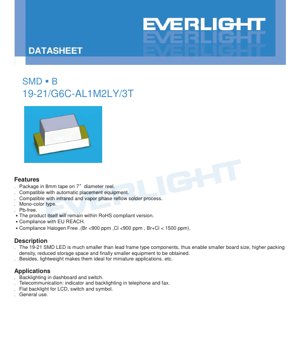
The 19-21/G6C-AL1M2LY/3T is a surface-mount device (SMD) LED designed for modern electronic applications requiring compact size, high reliability, and consistent performance. This component belongs to the 19-21 package family, characterized by its miniature footprint, making it ideal for space-constrained designs.
1.1 Core Advantages and Product Positioning
The primary advantage of this LED is its significantly reduced size compared to traditional lead-frame type components. This miniaturization enables several key benefits for designers and manufacturers:
- Smaller Board Size: Allows for more compact PCB layouts.
- Higher Packing Density: Enables more components to be placed on a single board, increasing functionality.
- Reduced Storage Space: The smaller physical size of both the component and its packaging (8mm tape on 7-inch reels) optimizes logistics and inventory management.
- Lightweight Design: The minimal weight is crucial for portable and miniature applications where every gram counts.
- Manufacturing Compatibility: The device is fully compatible with standard automatic placement equipment and mainstream soldering processes, including infrared and vapor phase reflow, facilitating high-volume production.
1.2 Compliance and Environmental Standards
This product is designed with modern environmental and safety regulations in mind, ensuring broad market acceptance:
- Pb-free: Manufactured without lead, complying with RoHS (Restriction of Hazardous Substances) directives.
- Halogen-Free: Compliant with halogen-free requirements, with Bromine (Br) and Chlorine (Cl) content each below 900 ppm, and their sum below 1500 ppm.
- REACH Compliance: Adheres to the EU's REACH regulation concerning the registration, evaluation, authorization, and restriction of chemicals.
2. Technical Specifications and Objective Interpretation
This section provides a detailed, objective analysis of the device's electrical, optical, and thermal parameters as defined in the datasheet.
2.1 Absolute Maximum Ratings
These ratings define the stress limits beyond which permanent damage to the device may occur. Operation under or at these limits is not guaranteed and should be avoided in reliable designs.
- Reverse Voltage (VR): 5V. Exceeding this voltage in reverse bias can cause immediate junction breakdown.
- Continuous Forward Current (IF): 25 mA. The maximum DC current for continuous operation.
- Peak Forward Current (IFP): 60 mA (Duty 1/10 @1kHz). Suitable for short pulse operation but not for DC.
- Power Dissipation (Pd): 60 mW. The maximum power the package can dissipate at Ta=25°C. Derating is necessary at higher ambient temperatures.
- Electrostatic Discharge (ESD) HBM: 2000V. Provides a measure of the device's robustness against static electricity, classified as Class 2 per the Human Body Model (HBM).
- Operating Temperature (Topr): -40°C to +85°C. The ambient temperature range for reliable operation.
- Storage Temperature (Tstg): -40°C to +90°C.
- Soldering Temperature: Specifies the thermal profile limits for assembly.
- Reflow Soldering: 260°C peak for a maximum of 10 seconds.
- Hand Soldering: 350°C at the iron tip for a maximum of 3 seconds per terminal.
2.2 Electro-Optical Characteristics (Ta=25°C)
These are the typical performance parameters measured under standard test conditions (IF = 5mA).
- Luminous Intensity (Iv): Ranges from 11.5 mcd (Min) to 28.5 mcd (Max), with a typical tolerance of ±11%. This defines the perceived brightness.
- Viewing Angle (2θ1/2): 100 degrees (Typical). This wide viewing angle makes it suitable for applications where the LED may not be viewed head-on.
- Peak Wavelength (λp): 575 nm (Typical). The wavelength at which the spectral emission is strongest.
- Dominant Wavelength (λd): 569.5 nm to 577.5 nm. This parameter more closely correlates with the perceived color (Brilliant Yellow Green) and is subject to binning.
- Spectral Bandwidth (Δλ): 20 nm (Typical). The width of the emitted spectrum at half the maximum intensity (FWHM).
- Forward Voltage (VF): 1.70V to 2.30V at IF=5mA, with a typical tolerance of ±0.05V. This range is critical for current-limiting resistor calculation.
- Reverse Current (IR): Maximum 10 μA at VR=5V. The datasheet explicitly notes that the device is not designed for reverse operation; this parameter is for test purposes only.
3. Binning System Explanation
To ensure color and brightness consistency in production, LEDs are sorted into bins. This device uses three independent binning parameters.
3.1 Luminous Intensity Binning
LEDs are grouped based on their measured luminous intensity at IF=5mA. The bin codes (L1, L2, M1, M2) represent ascending brightness levels, from 11.5-14.5 mcd (L1) to 22.5-28.5 mcd (M2). Designers can select a bin to meet specific brightness requirements.
3.2 Dominant Wavelength Binning
Wannan binning yana tabbatar da daidaiton launi. Babban tsayin zango an tsara shi zuwa matakai na 2nm, tare da lambobin bin C16 (569.5-571.5nm) har zuwa C19 (575.5-577.5nm). Zaɓin bin mai matsi yana haifar da kamanni mafi kama da launi a cikin LED da yawa a cikin jeri.
3.3 Forward Voltage Binning
An tsara ƙarfin lantarki na gaba a cikin matakai na 0.1V, daga lamba 19 (1.70-1.80V) zuwa lamba 24 (2.20-2.30V). Sanin VF bin can help optimize the design of the current-limiting circuit for efficiency and to ensure consistent brightness when LEDs are driven in parallel.
4. Performance Curve Analysis
The datasheet provides several characteristic curves that are essential for understanding the device's behavior under non-standard conditions.
4.1 Relative Luminous Intensity vs. Forward Current
Wannan lanƙwasa ya nuna cewa fitowar haske ba ta daidaita daidai da ƙarfin lantarki. Tana ƙaruwa tare da ƙarfin lantarki amma tana iya cika ko zama ƙasa da inganci a ƙarfin lantarki mafi girma. Yin aiki kusa da matsakaicin ƙarfin lantarki da aka ƙayyade (25mA) bazai haifar da ribar haske mai daidaito ba kuma yana ƙara zafi.
4.2 Relative Luminous Intensity vs. Ambient Temperature
LED efficiency decreases as junction temperature rises. This curve typically shows a decline in light output as ambient temperature increases from 25°C towards the maximum operating temperature (+85°C). This must be factored into designs for high-temperature environments.
4.3 Forward Current Derating Curve
This is a critical graph for thermal management. It shows the maximum allowable continuous forward current as a function of ambient temperature. As Ta increases, the maximum IF must be reduced to prevent the junction temperature from exceeding safe limits and to maintain long-term reliability.
4.4 Spectrum Distribution and Radiation Pattern
The spectrum distribution plot confirms the monochromatic yellow-green output centered around 575nm. The radiation diagram (polar plot) visually represents the 100-degree viewing angle, showing the angular distribution of light intensity.
5. Mechanical and Package Information
5.1 Package Dimensions
The 19-21 package has nominal dimensions of 2.0mm in length, 1.25mm in width, and 0.8mm in height (tolerance ±0.1mm unless otherwise specified). The datasheet includes a detailed dimensional drawing showing pad layout, component outline, and the cathode identification mark. Accurate footprint design based on this drawing is essential for proper soldering and alignment.
5.2 Polarity Identification
The cathode is clearly marked on the device, as shown in the package diagram. Correct polarity must be observed during placement to ensure proper circuit operation.
6. Soldering and Assembly Guidelines
6.1 Reflow Soldering Profile
A detailed Pb-free reflow profile is provided:
- Pre-heating: 150-200°C for 60-120 seconds.
- Time Above Liquidus (217°C): 60-150 seconds.
- Peak Temperature: 260°C maximum.
- Time at Peak: 10 seconds maximum.
- Heating/Cooling Rate: Maximum 6°C/sec heating, 3°C/sec cooling.
6.2 Critical Precautions
- Current Limiting: Resistor na iya takurawa wutar lantarki wajibi ne. LED na'urar da ake turawa ce ta yanzu; ƙaramin canji a cikin ƙarfin gaba zai iya haifar da babban canji a cikin yanzu, wanda zai haifar da gazawar sauri (konewa).
- Reflow Cycles: Ba za a yi Reflow soldering fiye da sau biyu ba don hana matsanancin damuwa na zafi.
- Mechanical Stress: Avoid applying stress to the LED body during heating or bending the PCB after soldering.
- Hand Soldering: If necessary, use a soldering iron at ≤350°C for ≤3 seconds per terminal, with a power rating ≤25W. Allow a cooling interval of ≥2 seconds between terminals. Hand soldering carries a higher risk of damage.
- Repair: Avoid rework after soldering. If absolutely necessary, use a dual-head soldering iron to simultaneously heat both terminals and lift the component evenly to prevent pad damage.
7. Storage and Moisture Sensitivity
This component is moisture-sensitive. Improper handling can lead to "popcorning" (package cracking) during reflow due to rapid vaporization of absorbed moisture.
- Unopened Bag: Do not open the moisture-proof barrier bag until ready for use.
- Floor Life: After opening, LEDs must be used within 168 hours (7 days) if stored at ≤30°C and ≤60% Relative Humidity.
- Rebaking: If the storage time is exceeded or the desiccant indicator shows saturation, a bake at 60±5°C for 24 hours is required before use.
- Repackaging: Unused LEDs should be resealed in the moisture-proof bag with fresh desiccant.
8. Packaging and Ordering Information
8.1 Standard Packaging
The device is supplied in moisture-resistant packaging:
- Carrier Tape: 8mm wide tape.
- Reel: Reel diameter 7-inch.
- Quantity: 3000 pieces per reel.
- Packaging: Includes desiccant and is sealed in an aluminum moisture-proof bag with appropriate labels.
8.2 Label Explanation
The reel label contains key information for traceability and identification:
- CPN: Customer's Product Number.
- P/N: Manufacturer's Product Number (e.g., 19-21/G6C-AL1M2LY/3T).
- QTY: Packing quantity.
- CAT: Luminous Intensity bin code (e.g., L1, M2).
- HUE: Chromaticity/Dominant Wavelength bin code (e.g., C17, C19).
- REF: Forward Voltage bin code (e.g., 20, 23).
- LOT No: Nambari ya kundi la uzalishaji kwa ajili ya ufuatiliaji.
9. Application Suggestions
9.1 Typical Application Scenarios
- Backlighting: Ideal for dashboard indicators, switch backlighting, and flat backlighting for LCDs and symbols due to its wide viewing angle and consistent color.
- Telecommunication Equipment: Status indicators and keypad backlighting in phones, fax machines, and other communication devices.
- General Indication: Power status, mode indication, and other general-purpose visual feedback in consumer electronics, appliances, and industrial controls.
9.2 Design Considerations
- Current Drive: Always use a series resistor or constant current driver. Calculate the resistor value using R = (Vsupply - VF) / IF, using the maximum VF from the bin or datasheet to ensure current does not exceed limits under worst-case conditions.
- Thermal Management: For continuous operation at high ambient temperatures or near maximum current, consider PCB layout for heat dissipation. Avoid placing LEDs near other heat sources.
- ESD Protection: Implement standard ESD handling procedures during assembly. While the device has 2kV HBM protection, additional circuit-level protection may be needed in high-ESD-risk environments.
- Optical Design: The wide viewing angle may require light guides or diffusers if a more focused beam is desired. The water-clear resin lens provides good light extraction.
10. Technical Comparison and Differentiation
Compared to older through-hole LEDs or larger SMD packages, the 19-21 offers a compelling combination of miniaturization and performance. Its key differentiators are its very small 2.0x1.25mm footprint within the low-power indicator LED category and its use of AlGaInP semiconductor material, which provides high efficiency and saturated color in the yellow-green spectrum. Compared to some other miniaturized packages, it maintains a relatively standard pad layout and a robust moisture sensitivity level, making it a reliable choice for automated assembly.
11. Frequently Asked Questions (Based on Technical Parameters)
Q: Shin zan i tuƙar wannan LED kai tsaye daga wutar lantarki na 3.3V ko 5V?
A: A'a. Dole ne koyaushe ka yi amfani da resistor mai iyakancewar ƙarfin lantarki. Misali, tare da wutar 3.3V da VF na 2.0V a 5mA, ana buƙatar resistor na (3.3V - 2.0V) / 0.005A = 260Ω. Koyaushe yi amfani da V mafi girmaF daga takardar bayanai (2.3V) don ƙirar mai tsauri: (3.3V - 2.3V) / 0.005A = 200Ω.
Q: Why is the storage and baking procedure so important?
A: SMD components absorb moisture from the air. During the high-temperature reflow soldering process, this moisture can turn to steam rapidly, creating enough internal pressure to crack the epoxy package ("popcorning"), leading to immediate or latent failure.
Q: What do the bin codes mean for my design?
A: If your application requires uniform appearance (e.g., an array of LEDs), you should specify tight bins for Dominant Wavelength (HUE) and Luminous Intensity (CAT). For a single indicator, standard bins are usually sufficient. The Forward Voltage (REF) bin can help if you are driving many LEDs in parallel to ensure even current distribution.
12. Practical Design and Usage Case
Scenario: Designing a multi-indicator status panel for a portable device.
A designer needs 5 identical yellow-green LEDs to show battery, connectivity, and mode statuses on a small, battery-powered gadget.
- Component Selection: The 19-21 LED is chosen for its small size, low power consumption, and suitable color.
- Binning Specification: To ensure all 5 LEDs look identical, the designer specifies a single, tight bin for both CAT (e.g., M1 only) and HUE (e.g., C18 only) on the purchase order.
- Circuit Design: The device is powered by a 3.0V coin cell. Using the maximum VF of 2.3V and a target IF of 5mA for adequate brightness and long battery life, the current-limiting resistor is calculated: R = (3.0V - 2.3V) / 0.005A = 140Ω. A standard 150Ω resistor is selected.
- PCB Layout: The compact 19-21 footprint allows the 5 LEDs to be placed closely together. The cathode mark on the silkscreen ensures correct orientation.
- Assembly: The factory receives the reels, which are stored in their sealed bags until the production line is ready. The PCB undergoes a single reflow cycle using the specified profile.
- Result: The final product has a clean, professional-looking indicator panel with uniformly bright and consistently colored LEDs, thanks to proper bin selection and circuit design.
13. Operating Principle Introduction
This LED is based on Aluminum Gallium Indium Phosphide (AlGaInP) semiconductor technology. When a forward voltage exceeding the diode's junction potential is applied, electrons and holes are injected into the active region from the n-type and p-type materials, respectively. These charge carriers recombine, releasing energy in the form of photons. The specific composition of the AlGaInP alloy determines the bandgap energy, which in turn defines the wavelength (color) of the emitted light—in this case, Brilliant Yellow Green (~575nm). The water-clear epoxy resin encapsulant protects the semiconductor die, acts as a lens to shape the light output, and enhances light extraction from the chip.
14. Technology Trends and Context
The 19-21 package represents the ongoing trend in electronics towards miniaturization and surface-mount technology. The move from leaded packages to SMDs like this one enables automated, high-speed pick-and-place assembly, significantly reducing manufacturing costs and increasing reliability by eliminating manual soldering steps. The use of AlGaInP material represents an advancement over older technologies like GaAsP, offering higher luminous efficiency and more vibrant, saturated colors. Furthermore, the compliance with Pb-free, halogen-free, and REACH standards reflects the industry-wide shift towards environmentally sustainable manufacturing processes and materials, which is now a critical requirement for global market access.
LED Specification Terminology
Complete explanation of LED technical terms
Photoelectric Performance
| Term | Unit/Representation | Simple Explanation | Why Important |
|---|---|---|---|
| Luminous Efficacy | lm/W (lumens per watt) | Haske a kowane watt na wutar lantarki, mafi girma yana nufin mafi ingancin makamashi. | Kai tsaye yana ƙayyade matakin ingancin makamashi da farashin wutar lantarki. |
| Luminous Flux | lm (lumens) | Total light emitted by source, commonly called "brightness". | Determines if the light is bright enough. |
| Viewing Angle | ° (degrees), e.g., 120° | Angle where light intensity drops to half, determines beam width. | Affects illumination range and uniformity. |
| CCT (Color Temperature) | K (Kelvin), e.g., 2700K/6500K | Mwangaza wa joto/baridi, thamani za chini ni manjano/joto, za juu nyeupe/baridi. | Huamua mazingira ya taa na matukio yanayofaa. |
| CRI / Ra | Unitless, 0–100 | Ability to render object colors accurately, Ra≥80 is good. | Affects color authenticity, used in high-demand places like malls, museums. |
| SDCM | MacAdam ellipse steps, e.g., "5-step" | Color consistency metric, smaller steps mean more consistent color. | Ensures uniform color across same batch of LEDs. |
| Dominant Wavelength | nm (nanometers), e.g., 620nm (red) | Wavelength corresponding to color of colored LEDs. | Determines hue of red, yellow, green monochrome LEDs. |
| Spectral Distribution | Wavelength vs intensity curve | Shows intensity distribution across wavelengths. | Affects color rendering and quality. |
Electrical Parameters
| Term | Symbol | Simple Explanation | Design Considerations |
|---|---|---|---|
| Forward Voltage | Vf | Minimum voltage to turn on LED, like "starting threshold". | Driver voltage must be ≥Vf, voltages add up for series LEDs. |
| Forward Current | If | Current value for normal LED operation. | Usually constant current drive, current determines brightness & lifespan. |
| Max Pulse Current | Ifp | Peak current tolerable for short periods, used for dimming or flashing. | Pulse width & duty cycle must be strictly controlled to avoid damage. |
| Reverse Voltage | Vr | Max reverse voltage LED can withstand, beyond may cause breakdown. | Circuit must prevent reverse connection or voltage spikes. |
| Thermal Resistance | Rth (°C/W) | Resistance to heat transfer from chip to solder, lower is better. | High thermal resistance requires stronger heat dissipation. |
| ESD Immunity | V (HBM), e.g., 1000V | Ability to withstand electrostatic discharge, higher means less vulnerable. | Anti-static measures needed in production, especially for sensitive LEDs. |
Thermal Management & Reliability
| Term | Key Metric | Simple Explanation | Impact |
|---|---|---|---|
| Junction Temperature | Tj (°C) | Yanzu aiki zazzabi a cikin LED chip. | Kowane raguwar 10°C na iya ninka tsawon rayuwa; yana da yawa yana haifar da lalacewar haske, canjin launi. |
| Lumen Depreciation | L70 / L80 (hours) | Time for brightness to drop to 70% or 80% of initial. | Directly defines LED "service life". |
| Lumen Maintenance | % (e.g., 70%) | Percentage of brightness retained after time. | Indicates brightness retention over long-term use. |
| Color Shift | Δu′v′ or MacAdam ellipse | Iru lilo awọ nigba lilo. | O n fa ibaramu awọ ninu awọn iboju itansẹ. |
| Thermal Aging | Material degradation | Deterioration due to long-term high temperature. | May cause brightness drop, color change, or open-circuit failure. |
Packaging & Materials
| Term | Common Types | Simple Explanation | Features & Applications |
|---|---|---|---|
| Package Type | EMC, PPA, Ceramic | Housing material protecting chip, providing optical/thermal interface. | EMC: good heat resistance, low cost; Ceramic: better heat dissipation, longer life. |
| Muundo wa Chip | Mbele, Flip Chip | Chip electrode arrangement. | Flip chip: better heat dissipation, higher efficacy, for high-power. |
| Phosphor Coating | YAG, Silicate, Nitride | Covers blue chip, converts some to yellow/red, mixes to white. | Phosphors ya daban-daban suna tasiri inganci, CCT, da CRI. |
| Lens/Optics | Flat, Microlens, TIR | Optical structure on surface controlling light distribution. | Determines viewing angle and light distribution curve. |
Quality Control & Binning
| Term | Binning Content | Simple Explanation | Purpose |
|---|---|---|---|
| Luminous Flux Bin | Code e.g., 2G, 2H | Grouped by brightness, each group has min/max lumen values. | Ensures uniform brightness in same batch. |
| Voltage Bin | Code e.g., 6W, 6X | Grouped by forward voltage range. | Yana taimaka da daidaita direbobi, yana inganta ingancin tsarin. |
| Kwandon Launi | 5-step MacAdam ellipse | Grouped by color coordinates, ensuring tight range. | Guarantees color consistency, avoids uneven color within fixture. |
| CCT Bin | 2700K, 3000K etc. | Grouped by CCT, each has corresponding coordinate range. | Meets different scene CCT requirements. |
Testing & Certification
| Term | Standard/Test | Simple Explanation | Significance |
|---|---|---|---|
| LM-80 | Lumen maintenance test | Long-term lighting at constant temperature, recording brightness decay. | Used to estimate LED life (with TM-21). |
| TM-21 | Life estimation standard | Yana kiyasin rayuwa a ƙarƙashin yanayi na ainihi bisa bayanan LM-80. | Yana ba da hasashen rayuwa na kimiyya. |
| IESNA | Illuminating Engineering Society | Covers optical, electrical, thermal test methods. | Industry-recognized test basis. |
| RoHS / REACH | Environmental certification | Ensures no harmful substances (lead, mercury). | Market access requirement internationally. |
| ENERGY STAR / DLC | Energy efficiency certification | Energy efficiency and performance certification for lighting. | Used in government procurement, subsidy programs, enhances competitiveness. |