Table of Contents
- 1. Product Overview
- 1.1 Fa'idodi na asali da matsayi na samfur
- 1.2 Kasuwa da aikace-aikace da aka yi niyya
- 2. Bincike mai zurfi na sigogi na fasaha
- 2.1 Absolute Maximum Ratings
- 2.2 Electro-Optical Characteristics
- 2.3 Thermal Characteristics and Derating
- 3. Binning System Description
- 3.1 Luminous Intensity Binning
- 3.2 Dominant Wavelength Binning
- 3.3 Forward Voltage Binning
- 4. Performance Curve Analysis
- 4.1 Relationship Between Relative Luminous Intensity and Forward Current
- 4.2 Relationship Between Relative Luminous Intensity and Ambient Temperature
- 4.3 Relationship Between Forward Voltage and Forward Current (I-V Curve)
- 4.4 Spectral Distribution and Radiation Pattern
- 5. Mechanical and Packaging Information
- 5.1 Package Dimensions and Polarity Marking
- 5.2 Tape and Reel Packaging
- 5.3 Moisture Sensitivity and Handling
- 6. Soldering and Assembly Guidelines
- 6.1 Tsarin Zazzabi na Solder na Koma-baya
- 6.2 Abubuwan da ake Kula da Solder na Hannu
- 6.3 Ajiya da Gasasshen
- 7. Bayanin Aikace-aikace da La'akari da Ƙira
- 7.1 Current Limiting Measures Must Be Used
- 7.2 PCB Thermal Management
- 7.3 Optical Design Considerations
- 8. Technical Comparison and Differentiation
- 9. Frequently Asked Questions (Based on Technical Parameters)
- 9.1 If my power supply voltage is exactly 2.0V, can I drive this LED directly without a resistor?
- 9.2 Why is the luminous intensity given as a range (18-45 mcd) instead of a single value?
- 9.3 What is the difference between peak wavelength and dominant wavelength?
- 9.4 Ta yaya ake fahimtar matakin ESD na 2000V (HBM)?
1. Product Overview
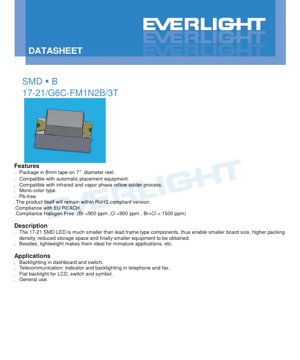
17-21/G6C-FM1N2B/3T na'urar LED ce mai haɗawa ta saman (SMD), wacce aka tsara don aikace-aikacen lantarki na zamani waɗanda ke buƙatar ƙaramin girma, ingantaccen aminci da kuma aiki mai daidaito. Wannan kayan aiki yana wakiltar ci gaba mai girma idan aka kwatanta da LED na tsarin igiya na gargajiya, yana ba da damar ƙira mafi inganci da ƙanƙanta.
1.1 Fa'idodi na asali da matsayi na samfur
Babbar fa'idar wannan LED ita ce ƙaramin sararin da take ɗauka a allon. Kunshe na 17-21 ya fi na'urorin tsarin igiya ƙanƙanta sosai, wanda kai tsaye yana kawo fa'idodi masu mahimmanci ga masu ƙira da masu kera. Yana ba da damar ƙaramin girman allon da'ira (PCB), wanda ke haifar da samfurin ƙarshe mafi ƙanƙanta. Amfani da wannan nau'in SMD yana ba da damar yawan tattarawa mai girma, ma'ana ana iya sanya ƙarin na'urori a kan allon da'ira guda ɗaya, yana inganta amfani da sarari. Rage girman kayan aiki kuma yana rage buƙatar sarari ajiya a cikin tsarin kera da kuma hanyoyin kaya. A ƙarshe, waɗannan abubuwan suna taimakawa wajen haɓaka ƙananan na'urorin lantarki, masu sauƙi, masu ɗauka. Kunshen sa mai sauƙin nauyi ya dace musamman da aikace-aikacen da nauyi ke taka muhimmiyar rawa, kamar na'urorin hannu, na'urorin sawa da ƙananan kayan aiki.
1.2 Kasuwa da aikace-aikace da aka yi niyya
This LED is designed for a wide range of indicator and backlight applications across multiple industries. Its primary application is in automotive and industrial instrument panels, serving as indicator lights or backlighting for switches and gauges, providing clear and reliable illumination. In the telecommunications field, it is well-suited for use as status indicator lights and keyboard backlighting in devices such as telephones and fax machines. Another important application is providing uniform planar backlighting for liquid crystal displays (LCDs), switches, and symbols, where even and consistent lighting is required. Its versatile design also makes it suitable for various consumer electronics, household appliances, and instrumentation that require bright yellow-green indication.
2. Bincike mai zurfi na sigogi na fasaha
The performance of the 17-21 LED is defined by a comprehensive set of electrical, optical, and thermal parameters. Understanding these specifications is crucial for proper circuit design and ensuring long-term reliability.
2.1 Absolute Maximum Ratings
These ratings define the stress limits that could cause permanent damage to the device. These values must not be exceeded, even momentarily, under normal operating or fault conditions.
- Reverse voltage (VR):5 V. Applying a reverse voltage higher than this value may cause junction breakdown.
- Forward current (IF):25 mA. This is the maximum continuous DC current that can flow through the LED.
- Peak forward current (IFP):60 mA. This is the maximum pulse current, specified at a duty cycle of 1/10 and a frequency of 1 kHz. Not suitable for continuous operation.
- Power dissipation (Pd):60 mW. This is the maximum power that the package can dissipate as heat without exceeding its thermal limit.
- Electrostatic discharge (ESD):2000 V (Human Body Model). This rating indicates the LED's sensitivity to static electricity; proper ESD handling procedures must be followed.
- Operating Temperature (Topr):-40°C to +85°C. The device is guaranteed to operate within specifications over this ambient temperature range.
- Storage Temperature (Tstg):-40°C to +90°C.
- Soldering Temperature (Tsol):The device can withstand a peak temperature of 260°C for up to 10 seconds during reflow soldering, or hand soldering at 350°C for up to 3 seconds per pin.
2.2 Electro-Optical Characteristics
Measured under standard test conditions of 25°C ambient temperature and 20 mA forward current, these parameters define the LED's light output and electrical behavior.
- Luminous Intensity (Iv):18.0 - 45.0 mcd. The actual output is determined by the binning code (see Section 3). The typical value is in the middle of this range. Viewing Angle (2θ1/2) is typically 140 degrees, providing a wide beam.
- Peak Wavelength (λp):Yawanci 575 nm. Wannan shine tsayin raƙuman ruwa lokacin da rarraba ikon bakan ya kai kololuwa.
- Babban tsayin raƙuman ruwa (λd):570.0 - 574.5 nm. Wannan ma'auni ya fi kusantar launin haske da idon mutum ke gani, wato haske mai rawaya-kore mai haske. Ƙimar takamaiman ta dogara ne akan rarrabuwar launi.
- Faɗin bakan (Δλ):Yawanci 20 nm. Wannan yana ayyana faɗin bakan fitarwa a rabin mafi girman ikonsa, yana nuna tsaftar launi.
- Ƙarfin lantarki na gaba (VF):A cikin IF= 20 mA yana 1.75 - 2.35 V. Ƙimar takamaiman ta dogara ne akan rarrabuwar ƙarfin lantarki. Wannan ma'auni ne mahimmanci don ƙira da'irar iyakancewar igiyar ruwa.
- Kuskuren igiyar ruwa ta baya (IR):A cikin VR= 5 V matsakaicin 10 μA. Ya kamata a lura cewa, wannan na'urar ba a ƙirƙira ta don aiki a cikin karkatar da baya ba; wannan ma'auni ana amfani dashi ne kawai don dalilai na gwajin ɗigon ruwa.
2.3 Thermal Characteristics and Derating
LED performance is highly dependent on temperature. The forward voltage decreases as temperature increases, and the light output also declines. The derating curve provided in the datasheet shows how the maximum allowable forward current must be reduced when the ambient temperature exceeds 25°C to prevent overheating and ensure longevity. For reliable operation, the junction temperature must be kept within safe limits, which is managed by adhering to power dissipation ratings and using proper PCB thermal design, such as thermal pads or vias.
3. Binning System Description
To ensure consistency in mass production, LEDs are sorted into different bins based on key performance parameters. This allows designers to select components that meet the specific requirements of their application.
3.1 Luminous Intensity Binning
Light output is divided into four bins: M1, M2, N1, and N2. Each bin covers a specific range of millicandela values measured at 20 mA. For example, bin M1 covers 18.0-22.5 mcd, while bin N2 covers the highest output range of 36.0-45.0 mcd. Designers can specify a bin code to guarantee a minimum brightness level for their application, which is crucial for ensuring uniform appearance in multi-LED arrays or meeting specific visibility thresholds.
3.2 Dominant Wavelength Binning
The color of the emitted light is controlled through dominant wavelength binning. The 17-21 LEDs use CC2, CC3, and CC4 bins, corresponding to wavelength ranges of 570.0-571.5 nm, 571.5-573.0 nm, and 573.0-574.5 nm, respectively. This tight control (with a tolerance of ±1 nm within each bin) ensures high color consistency between LEDs, which is crucial for applications where color matching is important, such as in multi-segment displays or status indicators that must appear identical.
3.3 Forward Voltage Binning
The forward voltage is divided into three categories: 0, 1, and 2. Bin 0 covers 1.75-1.95 V, Bin 1 covers 1.95-2.15 V, and Bin 2 covers 2.15-2.35 V. Understanding VFbinning is important for power supply design. If LEDs with different VFbins are connected in parallel without individual current limiting, they may draw unequal currents due to slight differences in voltage drop, leading to uneven brightness. Specifying tight VFbins helps mitigate this issue in parallel configurations or simplifies the design of constant current drivers.
4. Performance Curve Analysis
Datasheet ya ba da wasu jadawalin halaye da yawa, wadanda suka bayyana yadda na'urar ke aiki a yanayi daban-daban. Wadannan zane-zane suna da mahimmanci don fahimtar dangantakar da ba ta layi ba da kuma amfanin su wajen yin kwaikwayo.
4.1 Relationship Between Relative Luminous Intensity and Forward Current
Wannan lanƙwasa yana nuna cewa fitar da haske bai yi daidai da ƙarfin kwarara ba. Ko da yake fitarwa yana ƙaruwa tare da ƙaruwar ƙarfin kwarara, a ƙarfin kwarara mafi girma, saboda ƙaruwar tasirin zafi da raguwar inganci, dangantakar tana karkata zuwa ƙasa da layi. Yin aikin LED da ƙarfin kwarara da ya fi shawarar 20 mA gwajin ƙarfin kwarara, na iya haifar da raguwar dawowa a cikin haske, yayin da yake rage rayuwa da amincin sa da sauri.
4.2 Relationship Between Relative Luminous Intensity and Ambient Temperature
Wannan zanen yana nuna mummunan tasirin zafin jiki akan fitar da haske. Yayin da yanayin muhalli (da kuma sakamakon zafin jiki) ya tashi, ƙarfin haske yana raguwa. Wannan tasirin kashe zafi shine ainihin siffa na na'urorin hasken semiconductor. Wannan lanƙwasa yana taimaka wa masu ƙira su ƙididdige asarar haske a cikin yanayin zafi mai girma, kuma yana iya ba da bayanai don yanke shawara kan sarrafa zafi ko ramawar ƙarfin kwarara.
4.3 Relationship Between Forward Voltage and Forward Current (I-V Curve)
I-V curve yana nuna halayen diode na al'ada na ma'ana. "Karkatarwa" na ƙarfin lantarki wanda yake fara hawan ƙarfin lantarki yana kusa da V na al'ada.FWannan lanƙwasa yana da mahimmanci don ƙirƙirar da'irar tuƙi, saboda yana nuna cewa ƙananan canje-canje a cikin ƙarfin lantarki na iya haifar da babban canji a cikin ƙarfin lantarki, yana jaddada matuƙar buƙatar daidaita ƙarfin lantarki maimakon ƙarfin lantarki.
4.4 Spectral Distribution and Radiation Pattern
Taswirar rarraba bakan ta tabbatar da yanayin launi ɗaya na LED, yana nuna kololuwa guda ɗaya kusa da 575 nm. Taswirar tsarin radiation (galibi taswira mai ma'ana) yana bayyana rarraba kusurwar ƙarfin haske. Matsakaicin kusurwar gani na 140 yana nuna tsarin fitarwa na Lambert ko kusa da Lambert, inda ƙarfin yake mafi girma lokacin kallon gaba kuma yana raguwa a hankali zuwa gefe.
5. Mechanical and Packaging Information
5.1 Package Dimensions and Polarity Marking
17-21 SMD LED yana amfani da ƙunƙuntaccen kunshe na rectangular. Mahimman girma sun haɗa da tsawon jiki, faɗi, da tsayi. An yiwa cathode alama a sarari, yawanci ta hanyar kore, tsaga, ko kusurwa a kan kunshe. Yin amfani da alamun polarity daidai yayin haɗawa yana da mahimmanci don hana na'urar ta yi karkata ta baya. An ba da shawarar tsarin PCB pad (kunshe) don tabbatar da gyarar daidai da kwanciyar hankali na injiniya.
5.2 Tape and Reel Packaging
For automated assembly, the LEDs are supplied in 8mm wide embossed carrier tape, wound on 7-inch diameter reels. The standard quantity per reel is 3000 pieces. Reel dimensions and carrier tape pocket specifications are provided to ensure compatibility with standard pick-and-place equipment. The packaging is designed to protect the components from mechanical damage and moisture during storage and transportation.
5.3 Moisture Sensitivity and Handling
The components are packaged in moisture barrier bags with desiccant to protect them from ambient humidity, as moisture absorption can lead to "popcorn" effect or delamination during high-temperature reflow soldering. The label on the bag provides key information, including product number, quantity, and binning codes for luminous intensity (CAT), dominant wavelength (HUE), and forward voltage (REF).
6. Soldering and Assembly Guidelines
Proper soldering is critical for the reliability and performance of SMD components. The datasheet provides detailed instructions to prevent damage.
6.1 Tsarin Zazzabi na Solder na Koma-baya
Specifies the lead-free reflow soldering temperature profile. Key parameters include: a preheat zone of 150-200°C, lasting 60-120 seconds, to gradually heat the circuit board and components; time above liquidus (217°C) of 60-150 seconds; peak temperature not exceeding 260°C, with a maximum hold time of 10 seconds; and controlled ramp-up and cooling rates (maximum 3°C/sec and 6°C/sec respectively) to minimize thermal shock. It is strongly recommended that reflow soldering be performed no more than twice on the same LED.
6.2 Abubuwan da ake Kula da Solder na Hannu
If manual soldering must be performed, extreme caution is required. The soldering iron tip temperature should be below 350°C, and the contact time with each pin should not exceed 3 seconds. Use of a low-power soldering iron (25W or lower) is recommended. An interval of at least 2 seconds should be allowed between soldering two pins to facilitate heat dissipation. No mechanical stress should be applied to the LED during or after soldering.
6.3 Ajiya da Gasasshen
Unopened moisture barrier bags can be stored under standard factory conditions. Once opened, if the ambient conditions are 30°C/60%RH or lower, the LEDs should be used within 168 hours (7 days). If not used within this timeframe, or if the desiccant indicator shows saturation, the LEDs must be baked at 60 ±5°C for 24 hours to drive out absorbed moisture before reflow soldering.
7. Bayanin Aikace-aikace da La'akari da Ƙira
7.1 Current Limiting Measures Must Be Used
When driving this LED from a voltage source, an external current-limiting resistor is absolutely necessary. Due to the steep I-V characteristic, a small increase in supply voltage can cause a large, potentially destructive increase in forward current. The resistor value can be calculated using Ohm's Law: R = (Vsupply- VF) / IF. Using the maximum VFfrom the datasheet in this calculation ensures that the current will not exceed the limit even for devices with low VF. For optimal stability, a constant current drive circuit is recommended, especially for applications requiring precise brightness control, or when operating from a variable or poorly regulated voltage source.
7.2 PCB Thermal Management
Despite their small size, LEDs generate heat. For reliable long-term operation, especially under high ambient temperatures or drive currents, attention should be paid to PCB layout to facilitate heat dissipation. Using a copper pad (thermal pad) connected to the ground or power plane beneath the LED and linking it through thermal vias helps conduct heat away from the junction. It is also advisable to avoid placing LEDs near other heat-generating components.
7.3 Optical Design Considerations
The 140-degree wide viewing angle makes this LED suitable for applications requiring broad, uniform illumination. For applications needing a more focused beam, secondary optical elements such as lenses or light guides can be employed. The bright yellow-green color is highly visible to the human eye and is often chosen for eye-catching indicator lights. Designers should consider the interaction of the LED's emitted light with overlays, diffusers, or color filters to achieve the desired final visual effect.
8. Technical Comparison and Differentiation
The 17-21/G6C-FM1N2B/3T LED offers specific advantages in the indicator LED field. Compared to through-hole LEDs, its main benefits are the significant reduction in board space and assembly costs achieved through surface-mount technology. Compared to other SMD LEDs, the AlGaInP (Aluminum Gallium Indium Phosphide) semiconductor material it uses is key. AlGaInP technology is renowned for producing high-efficiency light in the yellow, orange, and red regions of the spectrum. For this bright yellow-green, it typically offers higher luminous efficacy and better temperature stability than older technologies like GaAsP on GaP. The "water-clear" resin lens (as opposed to diffused or tinted resin) provides the highest possible light output and a clear, saturated color point. Its compliance with RoHS, REACH, and halogen-free standards makes it suitable for the global market with stringent environmental regulations.
9. Frequently Asked Questions (Based on Technical Parameters)
9.1 If my power supply voltage is exactly 2.0V, can I drive this LED directly without a resistor?
No, this is not recommended and is likely to damage the LED.Ƙarfin lantarki na gaba (VF) is not a fixed value but a range (1.75-2.35V). If 2.0V is applied directly, an LED with a VFof 1.8V (from bin 0) will be overdriven by 0.2V. Due to the diode's exponential I-V curve, this small overvoltage can cause the current to exceed the absolute maximum rating, leading to rapid degradation or instant failure. Reliable operation from a voltage source always requires a series resistor.
9.2 Why is the luminous intensity given as a range (18-45 mcd) instead of a single value?
Due to inherent variations in the semiconductor manufacturing process, parameters like luminous intensity can vary from wafer to wafer and even within the same wafer. To provide predictable performance, LEDs are tested and sorted into different "bins" based on their measured output. The full range (18-45 mcd) represents the overall production distribution. By specifying a bin code (e.g., N1 corresponds to 28.5-36.0 mcd), designers can ensure all LEDs in their product fall within a tighter, predictable brightness range, guaranteeing consistency in the final application.
9.3 What is the difference between peak wavelength and dominant wavelength?
Peak Wavelength (λp):The specific wavelength at which the LED's spectral power output actually reaches its highest point. It is a physical measurement taken from the spectrum.
Babban tsayin raƙuman ruwa (λd):The wavelength of monochromatic light that matches the perceived color of the LED when combined with a specified white reference source. It correlates more directly to the "color" seen by the human eye. For monochromatic LEDs like this one, they are often close, but λdis used for color binning because it better defines visual consistency.
9.4 Ta yaya ake fahimtar matakin ESD na 2000V (HBM)?
This rating indicates the LED's robustness against electrostatic discharge according to the Human Body Model (HBM) test standard. A 2000V rating means the device can typically withstand a human body discharge of up to 2000 volts (simulated by a 100pF capacitor through a 1.5kΩ resistor). This is a standard rating for many commercial components. However, it remains crucial to follow ESD-safe handling procedures during assembly, such as using grounded workstations, wrist straps, and conductive containers, to prevent latent damage that may not cause immediate failure but can shorten the device's lifespan.
Detailed Explanation of LED Specification Terminology
Cikakken Ma'anar Kalmomin Fasahar LED
1. Ma'auni na Asali na Ayyukan Haske da Lantarki
| Kalma | Naúra/Bayanin | Bayani a Harshen Gargajiya | Me Ya Sa Yake Da Muhimmanci |
|---|---|---|---|
| Luminous Efficacy | lm/W | The luminous flux emitted per watt of electrical power; higher values indicate greater energy efficiency. | Directly determines the energy efficiency rating and electricity cost of a luminaire. |
| Luminous Flux | lm | The total amount of light emitted by a light source, commonly known as "brightness". | Determines whether a luminaire is bright enough. |
| Viewing Angle | ° (degrees), e.g., 120° | The angle at which light intensity drops to half, determining the width of the light beam. | Affects the illumination range and uniformity. |
| Correlated Color Temperature (CCT) | K (Kelvin), e.g., 2700K/6500K | The warmth or coolness of light color; lower values are yellowish/warm, higher values are whitish/cool. | Determines the lighting ambiance and suitable application scenarios. |
| Color Rendering Index (CRI / Ra) | Unitless, 0–100 | The ability of a light source to restore the true color of an object, Ra≥80 is preferred. | Affects color authenticity, used in high-demand places such as shopping malls and art galleries. |
| Color tolerance (SDCM) | MacAdam ellipse steps, such as "5-step" | A quantitative indicator of color consistency, the smaller the step number, the more consistent the color. | Ensures no color difference among the same batch of luminaires. |
| Dominant Wavelength | nm (nanometer), e.g., 620nm (red) | The wavelength value corresponding to the color of a colored LED. | Determines the hue of monochromatic LEDs such as red, yellow, and green. |
| Spectral Distribution | Wavelength vs. Intensity curve | Display the intensity distribution of light emitted by the LED across various wavelengths. | Affects color rendering and color quality. |
II. Electrical Parameters
| Kalma | Symbol | Bayani a Harshen Gargajiya | Design Considerations |
|---|---|---|---|
| Forward Voltage (Forward Voltage) | Vf | Voltage ya chini inayohitajika kuwasha LED, kama "kizingiti cha kuanzisha". | Voltage ya chanzo cha umeme inahitaji kuwa ≥ Vf, voltage inajumlishwa wakati LED nyingi zimeunganishwa mfululizo. |
| Forward Current | If | Thamani ya mkondo inayofanya LED mwangaza kwa kawaida. | A yawanci ana amfani da tuƙi mai dindindin, ƙarfin lantarki yana ƙayyadaddun haske da rayuwa. |
| Mafi girman ƙarfin bugun jini (Pulse Current) | Ifp | Ƙarfin kololuwa da za a iya jurewa a cikin ɗan lokaci, ana amfani dashi don daidaita haske ko walƙiya. | Dole ne a sarrafa faɗin bugun jini da rabon aiki da kyau, in ba haka ba zai yi zafi kuma ya lalace. |
| Ƙarfin lantarki na baya (Reverse Voltage) | Vr | The maximum reverse voltage that an LED can withstand; exceeding this may cause breakdown. | Reverse connection or voltage surges must be prevented in the circuit. |
| Thermal Resistance | Rth (°C/W) | The resistance to heat flow from the chip to the solder joint; a lower value indicates better heat dissipation. | High thermal resistance requires stronger heat dissipation design, otherwise junction temperature will rise. |
| Electrostatic Discharge Immunity (ESD Immunity) | V (HBM), e.g., 1000V | The higher the value of electrostatic strike resistance, the less susceptible it is to damage from static electricity. | Anti-static measures must be implemented during production, especially for high-sensitivity LEDs. |
III. Thermal Management and Reliability
| Kalma | Key Metrics | Bayani a Harshen Gargajiya | Impact |
|---|---|---|---|
| Junction Temperature | Tj (°C) | The actual operating temperature inside the LED chip. | For every 10°C reduction, lifespan may double; excessively high temperatures cause lumen depreciation and color shift. |
| Lumen Depreciation | L70 / L80 (hours) | The time required for brightness to drop to 70% or 80% of its initial value. | Directly defines the "service life" of an LED. |
| Lumen Maintenance | % (e.g., 70%) | Yawanci haske da ya rage bayan amfani da lokaci. | Halin riƙe haske bayan dogon amfani. |
| Color Shift | Δu′v′ ko MacAdam ellipse | Matsakaicin canjin launi yayin amfani. | Yana shafar daidaiton launi a yanayin haske. |
| Thermal Aging | Material Performance Degradation | Degradation of packaging materials due to prolonged high temperatures. | May lead to decreased brightness, color shift, or open-circuit failure. |
IV. Packaging and Materials
| Kalma | Common Types | Bayani a Harshen Gargajiya | Features and Applications |
|---|---|---|---|
| Package Type | EMC, PPA, Ceramic | A housing material that protects the chip and provides optical and thermal interfaces. | EMC offers good heat resistance and low cost; ceramic provides superior heat dissipation and long lifespan. |
| Chip Structure | Front-side, Flip Chip | Chip electrode arrangement method. | Flip Chip offers better heat dissipation, higher luminous efficacy, suitable for high-power applications. |
| Phosphor coating | YAG, Silicate, Nitride | Coated on the blue LED chip, partially converting to yellow/red light, mixing to form white light. | Different phosphors affect luminous efficacy, color temperature, and color rendering. |
| Lens/Optical Design | Flat, microlens, total internal reflection | The optical structure on the package surface controls light distribution. | Determines the beam angle and light distribution curve. |
V. Quality Control and Binning
| Kalma | Bin Content | Bayani a Harshen Gargajiya | Purpose |
|---|---|---|---|
| Luminous Flux Binning | Codes such as 2G, 2H | Grouped by brightness level, each group has a minimum/maximum lumen value. | Ensure consistent brightness within the same batch of products. |
| Voltage Binning | Codes such as 6W, 6X | Grouped according to forward voltage range. | Facilitates driver matching and improves system efficiency. |
| Color Binning | 5-step MacAdam ellipse | Group by color coordinates, ensuring colors fall within an extremely narrow range. | Ensure color consistency to avoid uneven colors within the same luminaire. |
| Color temperature binning | 2700K, 3000K, etc. | Group by color temperature, each group has a corresponding coordinate range. | Meet the color temperature requirements of different scenarios. |
VI. Testing and Certification
| Kalma | Standard/Test | Bayani a Harshen Gargajiya | Significance |
|---|---|---|---|
| LM-80 | Lumen Maintenance Test | Long-term operation under constant temperature conditions, recording luminance attenuation data. | For estimating LED lifetime (in conjunction with TM-21). |
| TM-21 | Lifetime extrapolation standard | Estimating lifetime under actual use conditions based on LM-80 data. | Providing scientific lifetime prediction. |
| IESNA standard | Standard of the Illuminating Engineering Society | Covers optical, electrical, and thermal testing methods. | Industry-recognized testing basis. |
| RoHS / REACH | Environmental certification. | Ensures products do not contain harmful substances (e.g., lead, mercury). | Conditions for entering the international market. |
| ENERGY STAR / DLC | Energy efficiency certification. | Energy efficiency and performance certification for lighting products. | Commonly used in government procurement and subsidy programs to enhance market competitiveness. |