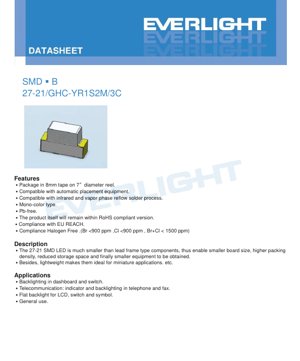
1. Product Overview
The 27-21 SMD LED is a compact, surface-mount device designed for high-density electronic assemblies. Its primary advantage lies in its significantly reduced footprint compared to traditional lead-frame type LEDs, enabling smaller printed circuit board (PCB) designs, higher component packing density, and ultimately more compact end-user equipment. The device is lightweight, making it particularly suitable for miniature and space-constrained applications.
The core technology utilizes an InGaN (Indium Gallium Nitride) semiconductor chip encapsulated in a water-clear resin, which emits a brilliant green light. It is a mono-color type LED, supplied in a format compatible with standard automated pick-and-place assembly equipment. The product is compliant with major environmental and safety directives, being Pb-free, RoHS compliant, EU REACH compliant, and halogen-free (with Bromine <900 ppm, Chlorine <900 ppm, and Br+Cl < 1500 ppm).
1.1 Key Features and Advantages
- Rage Girma: Yana ba da damar ƙirar allon ƙarami da ƙima mai yawa na tattarawa.
- Mai Dacewa da Sarrafa Kansa: Packaged in 8mm tape on 7-inch diameter reels for compatibility with automatic placement systems.
- Robust Process Compatibility: Suitable for both infrared and vapor phase reflow soldering processes.
- Environmental Compliance: Adheres to Pb-free, RoHS, REACH, and halogen-free standards.
2. Technical Parameter Deep Dive
2.1 Absolute Maximum Ratings
These ratings define the limits beyond which permanent damage to the device may occur. Operation at or beyond these limits is not guaranteed.
- Reverse Voltage (VR): 5 V - The maximum voltage that can be applied in the reverse direction.
- Forward Current (IF): 25 mA - The maximum continuous DC forward current.
- Peak Forward Current (IFP): 100 mA - The maximum pulsed forward current, permissible at a duty cycle of 1/10 and a frequency of 1 kHz.
- Power Dissipation (Pd): 95 mW - The maximum power the device can dissipate at an ambient temperature (Ta) of 25°C.
- Electrostatic Discharge (ESD) Human Body Model (HBM): 150 V - Indicates a moderate sensitivity to ESD; proper handling procedures are required.
- Operating Temperature (Topr): -40°C to +85°C - The ambient temperature range for reliable operation.
- Storage Temperature (Tstg): -40°C to +90°C.
- Soldering Temperature (Tsol): Reflow: 260°C peak for 10 seconds max. Hand soldering: 350°C for 3 seconds max per terminal.
2.2 Electro-Optical Characteristics
These parameters are measured at a standard test condition of Ta=25°C and IF=20 mA, unless otherwise specified. They define the optical and electrical performance of the LED.
- Luminous Intensity (Iv): 112 to 285 mcd (millicandela). The typical value is not specified, indicating performance is managed through the binning system described later.
- Viewing Angle (2θ1/2): 130 degrees (typical). This wide viewing angle makes it suitable for indicator and backlighting applications where visibility from various angles is important.
- Peak Wavelength (λp): 518 nm (typical). The wavelength at which the spectral emission is strongest.
- Dominant Wavelength (λd): 520 to 535 nm. This is the single-wavelength perception of the LED's color by the human eye.
- Spectral Bandwidth (Δλ): 35 nm (typical). The width of the emitted spectrum at half its maximum intensity (FWHM).
- Forward Voltage (VF): 2.75 to 3.95 V at IF=20 mA. This range is critical for circuit design, particularly for current-limiting resistor calculation.
- Reverse Current (IR): 50 μA (max) at VR=5V.
Important Notes: The datasheet specifies tolerances for key parameters: Luminous Intensity (±11%), Dominant Wavelength (±1 nm), and Forward Voltage (±0.1 V). It also explicitly warns that the reverse voltage condition is for test purposes only, and the LED should not be operated in reverse bias.
3. Binning System Explanation
To ensure consistent color and brightness in production, LEDs are sorted into performance bins. This device uses a three-dimensional binning system.
3.1 Luminous Intensity Binning
Bins are defined by codes R1, R2, S1, and S2, with minimum and maximum luminous intensity values measured at IF=20 mA.
- R1: 112 - 140 mcd
- R2: 140 - 180 mcd
- S1: 180 - 225 mcd
- S2: 225 - 285 mcd
3.2 Dominant Wavelength Binning
Bins are defined by codes X, Y, and Z, controlling the precise shade of green.
- X: 520 - 525 nm
- Y: 525 - 530 nm
- Z: 530 - 535 nm
3.3 Forward Voltage Binning
Bins are defined by codes 5, 6, 7, and 8, which is crucial for designing uniform current drive circuits, especially when multiple LEDs are connected in parallel.
- 5: 2.75 - 3.05 V
- 6: 3.05 - 3.35 V
- 7: 3.35 - 3.65 V
- 8: 3.65 - 3.95 V
4. Performance Curve Analysis
The datasheet references typical electro-optical characteristic curves, which are essential for understanding device behavior under non-standard conditions. While the specific graphs are not detailed in the provided text, they typically include:
- Dangantakar Haske mai Haske da Yanayin Yanayi: Yana nuna yadda fitowar haske ke raguwa yayin da zafin jiki ke tashi. Wannan yana da mahimmanci ga sarrafa zafi a cikin aikace-aikacen mai ƙarfi ko babban yanayin zafi.
- Dangantakar Haske mai Haske da Gaba na Gaba: Illustrates the non-linear relationship between drive current and light output. Operating above the recommended current leads to diminished efficiency and accelerated degradation.
- Forward Voltage vs. Forward Current (I-V Curve): Demonstrates the exponential relationship, highlighting the need for current-limiting circuitry. A small increase in voltage can cause a large, potentially destructive, increase in current.
- Spectral Distribution: A graph of relative intensity vs. wavelength, showing the peak at ~518 nm and the ~35 nm bandwidth, confirming the brilliant green color point.
5. Mechanical and Package Information
5.1 Package Dimensions
The 27-21 SMD LED has a compact rectangular package. Key dimensions (in mm, with a general tolerance of ±0.1mm unless specified) include the overall length, width, and height, as well as the pad spacing and size. These dimensions are critical for PCB land pattern design to ensure proper soldering and alignment. The polarity is indicated by a marking on the package, which must be aligned with the corresponding marking on the PCB footprint.
5.2 Polarity Identification
Correct polarity is essential for device operation. The datasheet's package drawing will indicate the cathode (negative) terminal, typically with a visual marker such as a notch, dot, or beveled edge on the package. The PCB footprint design must incorporate this marker to prevent assembly errors.
6. Soldering and Assembly Guidelines
6.1 Reflow Soldering Profile
The device is compatible with Pb-free reflow processes. The recommended temperature profile is crucial to prevent thermal shock and damage:
- Pre-heating: 150–200°C for 60–120 seconds.
- Time Above Liquidus (TAL): 60–150 seconds above 217°C.
- Peak Temperature: 260°C maximum, held for no more than 10 seconds.
- Ramp-up Rate: Maximum 6°C per second.
- Time Above 255°C: Maximum 30 seconds.
- Cooling Rate: Maximum 3°C per second.
Critical Restriction: Reflow soldering should not be performed more than two times on the same device.
6.2 Hand Soldering
If hand soldering is necessary, extreme care must be taken:
- Use a soldering iron with a tip temperature less than 350°C.
- Iyakance lokacin tuntuɓar zuwa dakika 3 ko ƙasa da kowace tasha.
- Yi amfani da ƙarfe mai ƙimar wutar lantarki 25W ko ƙasa da haka.
- Bari a tazara mafi ƙarancin daƙiƙa 2 tsakanin yin solder kowane tashoshi don ba da damar sanyaya.
6.3 Ajiya da Hanzarin Danshi
An tattara LEDs a cikin jakunkunan kariya daga danshi tare da desiccant.
- Before Opening: Store at ≤30°C and ≤60% Relative Humidity.
- Floor Life: After opening the moisture-proof bag, components must be used within 168 hours (7 days).
- Rebaking: If the floor life is exceeded or the desiccant indicator changes color, a bake-out at 60 ±5°C for 24 hours is required before reflow soldering.
6.4 Repair and Rework
Ba a yi yarda da gyara bayan an yi solder. Idan ba za a iya kaucewa ba, dole ne a yi amfani da ƙarfe na soldering mai kai biyu na musamman don dumama tashoshi biyu lokaci guda, don hana matsi na injiniya akan haɗin solder. Yuwuwar lalata LED yayin gyara yana da yawa kuma ya kamata a kimanta shi a gabani.
7. Packaging and Ordering Information
7.1 Packaging Specifications
The device is supplied in a tape-and-reel format for automated assembly.
- Carrier Tape Width: 8 mm.
- Reel Diameter: 7 inches.
- Quantity per Reel: 3000 pieces.
- Moisture-Sensitive Level (MSL): Implied by the 7-day floor life and baking requirements, typically corresponding to MSL 3.
7.2 Label Explanation
The reel label contains critical information for traceability and correct application:
- P/N: Product Number (e.g., 27-21/GHC-YR1S2M/3C).
- CAT: Luminous Intensity Rank (e.g., S2).
- HUE: Chromaticity Coordinates & Dominant Wavelength Rank (e.g., Y).
- REF: Forward Voltage Rank (e.g., 6).
- LOT No: Manufacturing Lot Number for traceability.
8. Application Suggestions and Design Considerations
8.1 Typical Application Scenarios
- Backlighting: Ideal for dashboard indicators, switch illumination, and flat backlighting for LCDs and symbols due to its wide viewing angle and consistent color.
- Telecommunication Equipment: Status indicators and keypad backlighting in devices like telephones and fax machines.
- General Purpose Indication: Any application requiring a compact, reliable, bright green indicator.
8.2 Critical Design Considerations
- Current Limiting is Mandatory: LEDs are current-driven devices. An external current-limiting resistor must always be used in series with the LED. The value is calculated using Ohm's Law: R = (Vsupply - VF) / IF. Use the maximum VF from the bin or datasheet to ensure the current does not exceed 25 mA under worst-case conditions.
- Thermal Management: While power dissipation is low, maintaining a low junction temperature is key to long-term reliability and stable light output. Ensure adequate PCB copper area or thermal vias if operating at high ambient temperatures or near maximum current.
- ESD Protection: Implement standard ESD precautions during handling and assembly. Consider adding transient voltage suppression (TVS) diodes or resistors on sensitive lines if the application environment is prone to static discharge.
- Binning for Consistency: For applications requiring uniform appearance (e.g., multi-LED arrays), specify tight bins for luminous intensity (CAT) and dominant wavelength (HUE). Using LEDs from the same manufacturing lot (LOT No.) further enhances consistency.
9. Technical Comparison and Differentiation
The 27-21 SMD LED differentiates itself primarily through its balance of size, performance, and reliability features.
- vs. Larger Lead-Frame LEDs: Offers a drastic reduction in footprint and weight, enabling modern miniaturized designs. The SMD format allows for faster, more reliable automated assembly.
- vs. Other SMD Greens: The specific combination of a 130-degree viewing angle, a brilliant green color from the InGaN chip, and comprehensive environmental compliance (Halogen Free, REACH) makes it suitable for a broad range of consumer and industrial applications where these factors are prioritized.
- Integrated Compliance: O kpaawo ni aṣẹ ti o tobi julọ ni agbaye (RoHS, REACH, Halogen-Free) mu ki o rọrun fun awọn oludamoran lati ṣe iwadii, nfunni ni anfani nla ninu awọn ọja ti a ti ṣe ofin.
10. Awọn Ibeere Ti A Nbeere Nigbagbogbo (Ti o Da Lori Awọn Iṣiro Imọ-ẹrọ)
Ibeere 1: Kini idi ti a resistor ti o n ṣe idiwọn iṣan jẹ ohun ti o ṣe pataki pupọ?
A1: Tabia ya I-V ya LED ni ya kielelezo. Ongezeko dogo la voltage ya mbele kupita thamani ya kawaida husababisha ongezeko kubwa la sasa, ambalo linaweza kuzidi kwa haraka kiwango cha juu kabisa cha 25 mA na kuharibu kifaa. Kizuizi hutoa punguzo la voltage laini, linalotabirika ili kudumisha sasa.
Q2: Je, naweza kutumia LED hii na usambazaji wa 3.3V bila kizuizi?
A2: Hapana. Hata kama 3.3V iko ndani ya VF range (2.75-3.95V), the actual VfF of a specific LED is not known without binning. A 3.3V supply could apply 3.3V directly to an LED with a VfF of 3.0V, causing excessive current. Always use a series resistor.
Q3: What happens if I exceed the 7-day floor life after opening the bag?
A3: O le afifi palasitika e mitiia le susū. I le taimi o le toe faʻafefeteina, o lenei susū e mafai ona faʻateleina vave, e mafua ai le vaeluaina i totonu poʻo le "popcorning," lea e taʻe ai le afifi ma oʻo atu ai i le toilalo. O le taoina i le 60°C mo le 24 itula e aveese ai lenei susū ua mitiia.
Q4: Aisea e faʻatapulaʻaina ai le toe faʻafefeteina i taʻamilosaga e lua?
A4: O taʻamilosaga taʻitasi o le toe faʻafefeteina e faʻaalia ai le masini i le mamafa tele o le vevela. O le tele o taʻamilosaga e mafai ona faʻaleagaina ai fusi uaea i totonu, faʻavaivaia soʻoga solder, pe faʻaleagaina ai le masini semiconductor lava ia, ma faʻaitiitia ai le faʻamaoni.
11. Practical Application Case Study
Scenario: Designing a multi-indicator status panel for a consumer electronics device.
- Requirement: 10 uniform brilliant green LEDs for "power on" and "mode active" indicators.
- Design Steps:
- Circuit Design: A 5V supply is available. Using the maximum VF of 3.95V and a target IF of 20 mA, calculate R = (5V - 3.95V) / 0.02A = 52.5Ω. Select the nearest standard value (e.g., 56Ω). Re-calculate actual current: IF = (5V - 3.2Vtyp) / 56Ω ≈ 32 mA (too high). Re-iterate using a more realistic typical VF of 3.2V: R = (5V - 3.2V) / 0.02A = 90Ω. This gives a safe current between 17.8 mA (at VF=3.95V) and 20 mA (at VF=3.2V). A 91Ω or 100Ω resistor is a good choice.
- PCB Layout: Place LEDs with correct polarity alignment. Provide sufficient spacing for the 130-degree viewing cone if indicators are viewed from an angle.
- Procurement: Specify tight bins to the distributor: e.g., CAT=S2 (225-285 mcd) and HUE=Y (525-530 nm) to ensure brightness and color consistency across all 10 indicators. Requesting parts from the same LOT No. is advisable.
- Assembly: Follow the reflow profile precisely. Use the LEDs within 7 days of opening the sealed bag.
12. Operating Principle Introduction
Light Emitting Diodes (LEDs) are semiconductor devices that convert electrical energy directly into light through a process called electroluminescence. The core of the 27-21 LED is a chip made from InGaN (Indium Gallium Nitride) semiconductor materials. When a forward voltage is applied across the P-N junction of this semiconductor, electrons from the N-type material recombine with holes from the P-type material in the active region. This recombination releases energy in the form of photons (light particles). The specific wavelength (color) of the emitted light is determined by the bandgap energy of the semiconductor material. InGaN has a bandgap that corresponds to light in the blue-to-green spectrum. In this device, the composition is tuned to produce brilliant green light with a peak wavelength around 518 nm. The water-clear epoxy resin encapsulant protects the chip and also acts as a lens, shaping the light output into the specified 130-degree viewing angle.
13. Technology Trends and Context
The 27-21 LED represents a mature and widely adopted technology within the broader evolution of solid-state lighting. Key trends influencing this product segment include:
- Continued Miniaturization: The drive for smaller, thinner, and more feature-packed electronic devices pushes the development of ever-smaller LED packages (e.g., 0201, 01005 sizes) while maintaining or improving optical performance.
- Enhanced Efficiency and Luminance: Ongoing improvements in epitaxial growth and chip design lead to higher luminous efficacy (more light output per unit of electrical input), allowing for lower power consumption or higher brightness from the same package size.
- Color Consistency and Advanced Binning: Demands from display and automotive applications are driving tighter binning tolerances and the use of more sophisticated multi-parameter binning (e.g., combining flux, wavelength, and forward voltage into a single code) to achieve perfect uniformity in large arrays.
- Integration of Functionality: A trend towards integrating control circuitry (like constant current drivers) or multiple color chips (RGB) into a single package to simplify system design and reduce PCB real estate.
- Reliability and Harsh Environment Suitability: Development of LEDs with improved performance at high temperatures and under high humidity, expanding their use into automotive, industrial, and outdoor applications. The environmental compliance (Halogen-Free, REACH) highlighted in this datasheet is a direct response to global regulatory trends.
While the 27-21 is a standard component, its design reflects these industry demands for reliability, compliance, and performance in a compact, automatable format.
LED Specification Terminology
Complete explanation of LED technical terms
Photoelectric Performance
| Term | Unit/Representation | Simple Explanation | Why Important |
|---|---|---|---|
| Luminous Efficacy | lm/W (lumens per watt) | Light output per watt of electricity, higher means more energy efficient. | Directly determines energy efficiency grade and electricity cost. |
| Luminous Flux | lm (lumens) | Total light emitted by source, commonly called "brightness". | Determines if the light is bright enough. |
| Viewing Angle | ° (degrees), e.g., 120° | Angle where light intensity drops to half, determines beam width. | Affects illumination range and uniformity. |
| CCT (Color Temperature) | K (Kelvin), e.g., 2700K/6500K | Warmth/coolness of light, lower values yellowish/warm, higher whitish/cool. | Determines lighting atmosphere and suitable scenarios. |
| CRI / Ra | Unitless, 0–100 | Ability to render object colors accurately, Ra≥80 is good. | Affects color authenticity, used in high-demand places like malls, museums. |
| SDCM | MacAdam ellipse steps, e.g., "5-step" | Metric ya usawa wa rangi, hatua ndogo zina maana rangi inayolingana zaidi. | Inahakikisha rangi sawa kwenye kundi moja la LED. |
| Dominant Wavelength | nm (nanometers), e.g., 620nm (red) | Wavelength corresponding to color of colored LEDs. | Determines hue of red, yellow, green monochrome LEDs. |
| Spectral Distribution | Wavelength vs intensity curve | Shows intensity distribution across wavelengths. | Affects color rendering and quality. |
Electrical Parameters
| Term | Symbol | Simple Explanation | Design Considerations |
|---|---|---|---|
| Forward Voltage | Vf | Minimum voltage to turn on LED, like "starting threshold". | Driver voltage must be ≥Vf, voltages add up for series LEDs. |
| Forward Current | If | Current value for normal LED operation. | Usually constant current drive, current determines brightness & lifespan. |
| Max Pulse Current | Ifp | Peak current tolerable for short periods, used for dimming or flashing. | Pulse width & duty cycle must be strictly controlled to avoid damage. |
| Reverse Voltage | Vr | Max reverse voltage LED can withstand, beyond may cause breakdown. | Circuit must prevent reverse connection or voltage spikes. |
| Thermal Resistance | Rth (°C/W) | Resistance to heat transfer from chip to solder, lower is better. | High thermal resistance requires stronger heat dissipation. |
| ESD Immunity | V (HBM), e.g., 1000V | Ability to withstand electrostatic discharge, higher means less vulnerable. | Anti-static measures needed in production, especially for sensitive LEDs. |
Thermal Management & Reliability
| Term | Key Metric | Simple Explanation | Impact |
|---|---|---|---|
| Junction Temperature | Tj (°C) | Actual operating temperature inside LED chip. | Every 10°C reduction may double lifespan; too high causes light decay, color shift. |
| Lumen Depreciation | L70 / L80 (hours) | Time for brightness to drop to 70% or 80% of initial. | Directly defines LED "service life". |
| Lumen Maintenance | % (e.g., 70%) | Percentage of brightness retained after time. | Indicates brightness retention over long-term use. |
| Color Shift | Δu′v′ or MacAdam ellipse | Degree of color change during use. | Affects color consistency in lighting scenes. |
| Thermal Aging | Material degradation | Deterioration due to long-term high temperature. | May cause brightness drop, color change, or open-circuit failure. |
Packaging & Materials
| Term | Common Types | Simple Explanation | Features & Applications |
|---|---|---|---|
| Package Type | EMC, PPA, Ceramic | Housing material protecting chip, providing optical/thermal interface. | EMC: good heat resistance, low cost; Ceramic: better heat dissipation, longer life. |
| Chip Structure | Front, Flip Chip | Chip electrode arrangement. | Flip chip: kona mafuta bora, ufanisi wa juu, kwa nguvu kubwa. |
| Phosphor Coating | YAG, Silicate, Nitride | Covers blue chip, converts some to yellow/red, mixes to white. | Different phosphors affect efficacy, CCT, and CRI. |
| Lens/Optics | Flat, Microlens, TIR | Optical structure on surface controlling light distribution. | Determines viewing angle and light distribution curve. |
Quality Control & Binning
| Term | Binning Content | Simple Explanation | Purpose |
|---|---|---|---|
| Luminous Flux Bin | Code e.g., 2G, 2H | Grouped by brightness, each group has min/max lumen values. | E kia mau ai te taurite o te kanapa i roto i te rōpū kotahi. |
| Voltage Bin | Code e.g., 6W, 6X | Grouped by forward voltage range. | Facilitates driver matching, improves system efficiency. |
| Color Bin | 5-step MacAdam ellipse | Grouped by color coordinates, ensuring tight range. | Guarantees color consistency, avoids uneven color within fixture. |
| CCT Bin | 2700K, 3000K etc. | Grouped by CCT, each has corresponding coordinate range. | Meets different scene CCT requirements. |
Testing & Certification
| Term | Standard/Test | Simple Explanation | Significance |
|---|---|---|---|
| LM-80 | Lumen maintenance test | Long-term lighting at constant temperature, recording brightness decay. | Used to estimate LED life (with TM-21). |
| TM-21 | Life estimation standard | Estimates life under actual conditions based on LM-80 data. | Provides scientific life prediction. |
| IESNA | Illuminating Engineering Society | Covers optical, electrical, thermal test methods. | Industry-recognized test basis. |
| RoHS / REACH | Environmental certification | Yana tabbatar da babu abubuwa masu cutarwa (gubar, mercury). | Bukatar shiga kasuwa a duniya. |
| ENERGY STAR / DLC | Energy efficiency certification | Energy efficiency and performance certification for lighting. | Ana amfani a cikin sayayyar gwamnati, shirye-shiryen tallafi, yana haɓaka gasa. |