Table of Contents
- 1. Product Overview
- 1.1 Core Advantages
- 1.2 Target Applications
- 2. Absolute Maximum Ratings
- 3. Electro-Optical Characteristics
- 4. Explanation of the Grading System
- 4.1 Luminous Intensity Grading (CAT)
- 4.2 Dominant Wavelength Binning (HUE)
- 4.3 Forward Voltage Binning (REF)
- 5. Performance Curve Analysis
- 5.1 Forward Current vs. Forward Voltage (I-V Curve)
- 5.2 Luminous Intensity vs. Forward Current
- 5.3 Luminous Intensity vs. Ambient Temperature
- 5.4 Forward Current Derating Curve
- 5.5 Spectral Distribution
- 5.6 Radiation Pattern
- 6. Mechanical and Packaging Information
- 6.1 Package Dimensions
- 6.2 Recommended Land Pattern
- 6.3 Polarity Marking
- 7. Welding and Assembly Guide
- 7.1 Reflow Soldering Temperature Profile (Lead-Free)
- 7.2 Manual Soldering
- 7.3 Rework and Repair
- 8. Storage and Moisture Sensitivity
- 9. Packaging and Ordering Information
- 9.1 Tape and Reel Specifications
- 9.2 Label Description
- 10. Application Design Considerations
- 10.1 Current Limiting Resistor Calculation
- 10.2 Thermal Management
- 10.3 ESD Protection
- 11. Technical Comparison and Differentiation
- 12. Frequently Asked Questions (FAQ)
- 13. Design Case Study: Dashboard Switch Backlight
- 14. Technical Principles
- 15. Industry Trends
1. Product Overview
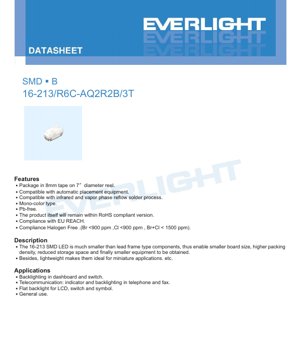
16-213 is a surface-mount device (SMD) LED designed for high-density, miniaturized applications. It utilizes AlGaInP semiconductor technology to produce bright red light output. Its compact form factor significantly saves space on printed circuit boards (PCBs) compared to traditional lead frame components, contributing to smaller end-product designs and reduced storage requirements.
1.1 Core Advantages
- Miniaturization:The small package size allows for higher packaging density and makes it possible to design more compact electronic devices.
- Lightweighting:Suitable for applications where weight is a critical factor.
- Compatibility:Packaged in 8mm tape on 7-inch reels, making it fully compatible with standard automatic surface-mount assembly equipment.
- Environmental Compliance:产品为无铅设计,符合 RoHS、欧盟 REACH 及无卤素标准 (Br <900ppm, Cl <900ppm, Br+Cl <1500ppm)。
- Process Compatibility:Suitable for infrared (IR) and vapor phase reflow soldering processes.
1.2 Target Applications
This LED is ideal for various indicator and backlight functions, including:
- Dashboard and switch backlighting in automotive and industrial control equipment.
- Status indicators and keyboard backlighting in communication devices such as telephones and fax machines.
- Flat backlight for LCD panels, switches, and symbols.
- General indicator light applications.
2. Absolute Maximum Ratings
The following ratings define the limits beyond which permanent damage to the device may occur. Operation under or beyond these conditions is not guaranteed.
| Parameter | Symbol | Rating | Unit |
|---|---|---|---|
| Reverse Voltage | VR | 5 | V |
| Continuous Forward Current | IF | 25 | mA |
| Peak Forward Current (Duty Cycle 1/10 @1kHz) | IFP | 60 | mA |
| Power consumption | Pd | 60 | mW |
| Electrostatic discharge (Human Body Model) | ESD (HBM) | 2000 | V |
| Operating temperature | TT_opr | -40 to +85 | °C |
| Storage temperature | TT_stg | -40 to +90 | °C |
| Soldering temperature (Reflow) | TT_sol | Maximum 260°C, duration not exceeding 10 seconds. | - |
| Welding Temperature (Manual Welding) | TT_sol | Maximum 350°C, duration not exceeding 3 seconds. | - |
3. Electro-Optical Characteristics
These parameters are measured under the condition of an ambient temperature (T_a) of 25°C and a forward current (I_F) of 20mA (unless otherwise specified). They represent the typical performance of the device.aT_aFI_F
| Parameter | Symbol | Min. | Typ. | Max. | Unit | Condition |
|---|---|---|---|---|---|---|
| Luminous intensity | Iv | 90.0 | - | 180 | I_V | IFmcd |
| I_F=20mAViewing Angle (2θ_1/2)) | 2θ_1/2deg | - | 120 | - | Peak Wavelength | - |
| λ_p | λp | - | 632 | - | nm | - |
| Dominant Wavelength | λd | 617.5 | - | 633.5 | λ_d | - |
| nm | Spectral Bandwidth (FWHM) | - | 20 | - | Δλ | - |
| nm | VF | 1.75 | - | 2.35 | V | IFForward Voltage |
| V_F | IR | - | - | 10 | I_F=20mA | VRReverse current |
I_R
- μA
- V_R=5V
- Note:
Luminous intensity tolerance: ±11%
Dominant wavelength tolerance: ±1nm
Forward Voltage Tolerance: ±0.05V
4. Explanation of the Grading SystemFTo ensure consistency in application performance, LEDs are classified (binned) according to key parameters. 16-213 employs a three-code binning system.
| 4.1 Luminous Intensity Grading (CAT) | This code indicates the minimum and maximum luminous intensity at I_F=20mA. | Binning Code |
|---|---|---|
| Minimum (mcd) | 90.0 | 112 |
| Maximum (mcd) | 112 | 140 |
| Q2 | 140 | 180 |
R1
R2
| 4.2 Dominant Wavelength Binning (HUE) | This code defines the color purity range of the emitted red light. | Binning Code |
|---|---|---|
| Minimum Value (nm) | 617.5 | 621.5 |
| Maximum (nm) | 621.5 | 625.5 |
| E4 | 625.5 | 629.5 |
| E5 | 629.5 | 633.5 |
E6
E7F4.3 Forward Voltage Binning (REF)
| This code groups LEDs based on their forward voltage drop at I_F=20mA, which is crucial for current-limiting resistor calculation and power supply design. | Group | Binning Code | Minimum (V) |
|---|---|---|---|
| B | 0 | 1.75 | 1.95 |
| B | 1 | 1.95 | 2.15 |
| B | 2 | 2.15 | 2.35 |
Maximum (V)
5. Performance Curve AnalysisaThe following typical curves reveal the device's behavior under different conditions. Unless noted, all curves are measured at T_a=25°C.
5.1 Forward Current vs. Forward Voltage (I-V Curve)
This curve illustrates the exponential relationship between applied voltage and resulting current. At the standard operating current of 20mA, the forward voltage (V_F) typically ranges from 1.75V to 2.35V. Designers must use a series current-limiting resistor to prevent thermal runaway, as a slight increase in voltage beyond the knee point can lead to a large and potentially destructive surge in current.FV_F
5.2 Luminous Intensity vs. Forward Current
Luminous intensity increases approximately linearly with forward current until the maximum rated current is reached. Operation above the absolute maximum rating (25mA continuous current) will shorten lifetime and reduce reliability.
5.3 Luminous Intensity vs. Ambient Temperature
The light output of an LED decreases as the junction temperature rises. This curve shows the relative luminous intensity declining as the ambient temperature increases from -40°C to +85°C. This derating must be considered in designs where LEDs operate in high-temperature environments or at high drive currents.
5.4 Forward Current Derating Curve
This critical curve defines the maximum allowable continuous forward current as a function of ambient temperature. To ensure reliable operation and prevent overheating, the forward current must be reduced when operating at high ambient temperatures.
5.5 Spectral Distribution
The spectrum is centered around a typical peak wavelength (λ_p) of 632nm with a full width at half maximum (FWHM) of approximately 20nm, which is characteristic of AlGaInP-based red LEDs. The dominant wavelength (λ_d) defines the perceived color.pλ_dd5.6 Radiation Pattern
This LED features a wide viewing angle of 120 degrees (2θ_1/2), providing a broad and uniform emission pattern, suitable for area lighting and indicator applications that require a wide viewing angle.
6. Mechanical and Packaging Information6.1 Package DimensionsThe datasheet provides the physical outline and key dimensions of the LED package. Unless otherwise specified, the tolerance is typically ±0.1mm. Designers should refer to the exact drawing to create the footprint.
6.2 Recommended Land Pattern
Contains the recommended pad pattern (footprint) for PCB design. This pattern is for reference only and should be optimized based on specific manufacturing processes, solder paste volume, and thermal management requirements.
6.3 Polarity Marking
The cathode is usually marked on the device. Correct polarity orientation during assembly is crucial to prevent damage from reverse bias.
7. Welding and Assembly Guide
7.1 Reflow Soldering Temperature Profile (Lead-Free)
This LED is compatible with standard infrared or vapor phase reflow processes using lead-free solder. The recommended temperature profile includes:
Dumama kafin aiki:
150-200°C, na tsawon dakika 60-120.
Time Above Liquidus (TAL):
- 60-150 seconds above 217°C.Peak Temperature:
- Maximum 260°C, hold time not exceeding 10 seconds.Ramp rate:
- Up to 255°C maximum 3°C/sec, then to peak maximum 6°C/sec.Cooling rate:
- Maximum 6°C/s.Key point:
- No more than two reflow soldering cycles should be performed on the same device.7.2 Manual Soldering
Idan dole ne a yi waldar hannu, dole ne a yi taka tsantsan sosai:Yi amfani da irin wuta wanda zafin ƙarfe bai wuce 350°C ba.
Ƙayyade lokacin haɗin kowane ƙarshen waldar zuwa aƙalla daƙiƙa 3.
Yi amfani da ƙarfe mai ƙarfin wutar lantarki na 25W ko ƙasa da haka.
- Tsakanin kowane tashar haɗin gwiwa, a bar aƙalla dakika 2 don sanyaya.
- Avoid applying mechanical stress to the LED body during heating.
- 7.3 Rework and Repair
- Repair after LED soldering is strongly not recommended. If unavoidable, a dedicated dual-tip soldering iron must be used to heat both solder terminals simultaneously to minimize thermal stress. The impact on LED characteristics must be verified after rework.
- 8. Storage and Moisture Sensitivity
LEDs are packaged in moisture barrier bags with desiccant.
Gbẹtọ nọ yin nukọntọ de mẹ to osẹn de mẹ.
Nọ yin nukọntọ de mẹ to osẹn de mẹ.
After Opening (Floor Life):
- Unused devices must be soldered within 1 year when stored at ≤30°C and ≤60% RH. If not used within this period, they must be rebaked and repacked.Baking Procedure:
- If the desiccant indicator changes color or exceeds the shop life, it must be baked at 60 ±5°C for 24 hours before use.9. Packaging and Ordering Information
- 9.1 Tape and Reel SpecificationsDevices are supplied in 8mm wide embossed carrier tape, wound on 7-inch diameter reels. Each reel contains 3000 pieces.
9.2 Label Description
The reel label contains several key codes:
CPN:
Customer Part Number.
P/N:
- Manufacturer Part Number (e.g., 16-213/R6C-AQ2R2B/3T).QTY:
- Quantity per reel.CAT:
- Luminous intensity grade (e.g., Q2, R1, R2).HUE:
- Dominant wavelength grade (e.g., E4, E5, E6, E7).REF:
- Forward voltage level (e.g., 0, 1, 2).LOT No:
- Traceable production lot number.10. Application Design Considerations
- 10.1 Current Limiting Resistor CalculationA series resistor must be used to set the forward current. The resistor value (R_S) can be calculated using Ohm's law: R_S = (V_Supply - V_F) / I_F. For conservative design, use the maximum V_F value from the binning table to ensure I_F does not exceed the desired value. The resistor's power rating must also be calculated: P_R = (I_F)² * R_S.
V_Supply
V_F
I_FV_FI_FSI_FSR_S10.2 Thermal ManagementDespite the compact package, the power dissipation (up to 60mW) can lead to a significant junction temperature rise, especially in high ambient temperatures or enclosed spaces. This reduces light output and lifetime. If operating near maximum ratings, ensure sufficient PCB copper area or thermal vias are used for heat dissipation.F10.3 ESD ProtectionFAlthough rated for 2000V HBM, standard ESD precautions should always be followed during assembly and handling to prevent potential damage.F11. Technical Comparison and DifferentiationFThe 16-213 LED based on AlGaInP technology offers distinct advantages in red indicator applications:RCompared to older technologies (e.g., GaAsP):FAlGaInP provides higher luminous efficacy, producing brighter output at the same current, and better color purity (more saturated red).S.
Compared to broad-spectrum white LEDs with filters:
For generating pure red light, monochromatic red LEDs are far more efficient than filtering white light, resulting in lower power consumption.
Compared to larger leaded LEDs:
The SMD form factor enables automated assembly, saves board space, and improves mechanical reliability by eliminating the flexible and breakable leads.
12. Frequently Asked Questions (FAQ)
Q1: What is the difference between Peak Wavelength (λp) and Dominant Wavelength (λd)?
- A1: Peak wavelength is the wavelength at which the spectral power distribution reaches its maximum. Dominant wavelength is the wavelength of monochromatic light that matches the perceived color of the LED. In indicator applications, λd is more relevant for color specification.Q2: If my power supply is exactly 2.0V, can I drive this LED without a current-limiting resistor?
- A2: Forward voltage has tolerances and varies with temperature. A supply voltage equal to the nominal V_F can lead to excessive current due to device-to-device variation or a drop in temperature. A series resistor is always required for reliable operation.V_F
- Q3: Why is the storage temperature range wider than the operating temperature range?A3: Storage ratings apply when the device is in a non-operating, unpowered state. The operating range is narrower because operation generates heat at the semiconductor junction, and the combined effect of ambient temperature and self-heating must be limited to ensure performance and longevity.
Q4: How to interpret the part number 16-213/R6C-AQ2R2B/3T?
A4: Although the exact decoding rules may be proprietary, it typically contains a base product code (16-213), followed by codes specifying performance bins (e.g., luminous intensity 'R2', dominant wavelength likely in the 'E6/E7' range, forward voltage 'B2'), and possibly the package type ('3T' may refer to tape and reel).
13. Design Case Study: Dashboard Switch Backlight
Scenario:
Design backlighting for automotive dashboard switches, requiring uniform and reliable red illumination in environments with ambient temperatures up to 70°C.No.Design Steps:FCurrent Selection:
To ensure long life at high temperatures, current derating is required. According to the derating curve, at an ambient temperature of 70°C, the maximum allowable I_F is significantly lower than 25mA. Selecting I_F = 15mA provides a good safety margin.
I_F
I_F
Resistor Calculation:
Using a 12V automotive power supply and the maximum V_F (2.35V) of the B2 bin. R_S = (12V - 2.35V) / 0.015A ≈ 643Ω. Use a standard 620Ω or 680Ω resistor. Power: P = (0.015)² * 643 ≈ 0.145W. A 1/4W resistor is sufficient.
V_FR_S
Bin selection:
- To ensure a consistent appearance among multiple switches, strict HUE (dominant wavelength, e.g., only E6) and CAT (luminous intensity, e.g., only R1) binning must be specified. This ensures uniformity in color and brightness.Layout:FPlace the LED and its current-limiting resistor close together. Use the recommended pad layout from the datasheet. Small thermal relief connections can be added to aid soldering.F14. Technical Principles
- This LED is based on an aluminum gallium indium phosphide (AlGaInP) semiconductor heterostructure. When a forward voltage is applied across the p-n junction, electrons and holes are injected into the active region where they recombine. The energy released during recombination is emitted as photons (light). The specific bandgap energy of the AlGaInP alloy determines the wavelength of the emitted light, which in this case is in the red spectrum (approximately 632nm). The water-clear resin lens allows the light to escape with minimal absorption, and its shape provides a wide viewing angle of 120 degrees.15. Industry TrendsFKasuwar LED masu nuna alama na SMD kamar 16-213 na ci gaba da haɓakawa. Manyan abubuwan da ke faruwa sun haɗa da:SHaɓaka inganci:
- Ci gaba da ingantattun kimiyyar kayan aiki da nufin samar da mafi girman ingancin haske (ƙarin fitowar haske a kowace ƙarfin lantarki), wanda ke haifar da ƙarancin amfani da wutar lantarki ko fitilu masu haske.Miniaturization:
- The demand for smaller end products drives the continuous reduction in LED package sizes (e.g., 0402, 0201 metric sizes) while maintaining or improving optical performance.Reliability Enhancement:
Improvements in packaging materials and die-attach technologies focus on extending operational lifespan and enhancing robustness against thermal cycling and humidity.
Integration:
The trend of integrating multiple LEDs (e.g., RGB clusters) or combining LEDs with control ICs (such as driver chips) into a single package to simplify circuit design and save board space.
The market for SMD indicator LEDs like the 16-213 continues to evolve. Key trends include:
- Increased Efficiency:Ongoing material science improvements aim to deliver higher luminous efficacy (more light output per unit of electrical input), allowing for lower power consumption or brighter indicators.
- Miniaturization:The drive for smaller end products pushes for ever-smaller LED packages (e.g., 0402, 0201 metric sizes) while maintaining or improving optical performance.
- Enhanced Reliability:Improvements in packaging materials and die-attach technologies focus on extending operational lifetime and robustness against thermal cycling and humidity.
- Integration:A trend towards integrating multiple LEDs (e.g., RGB clusters) or combining LEDs with control ICs (like driver chips) into single packages to simplify circuit design and save board space.
LED Specification Terminology Explained
Complete Explanation of LED Technical Terms
I. Core Indicators of Photoelectric Performance
| Terminology | Unit/Representation | Layman's Explanation | Why is it important |
|---|---|---|---|
| Luminous Efficacy | lm/W | The luminous flux emitted per watt of electrical power; the higher the value, the more energy-efficient. | It directly determines the energy efficiency rating and electricity cost of the luminaire. |
| Luminous Flux | lm (lumen) | The total amount of light emitted by a light source, commonly known as "brightness". | Determines whether the luminaire is bright enough. |
| Viewing Angle | ° (degree), such as 120° | The angle at which light intensity drops to half, determining the beam width. | Affects the illumination range and uniformity. |
| Color Temperature (CCT) | K (Kelvin), e.g., 2700K/6500K | The color temperature of light: lower values lean yellow/warm, higher values lean white/cool. | Determines the lighting ambiance and suitable application scenarios. |
| Color Rendering Index (CRI / Ra) | Unitless, 0–100 | The ability of a light source to reproduce the true colors of objects, with Ra≥80 being preferable. | Affects color fidelity, used in high-demand places such as shopping malls and art galleries. |
| Color tolerance (SDCM) | MacAdam ellipse steps, such as "5-step" | A quantitative metric for color consistency; a smaller step number indicates better color consistency. | Ensure no color variation among luminaires from the same batch. |
| Dominant Wavelength | nm (nanometer), e.g., 620nm (red) | The wavelength value corresponding to the color of a colored LED. | Determines the hue of monochromatic LEDs such as red, yellow, and green. |
| Spectral Distribution | Wavelength vs. Intensity curve | Shows the intensity distribution of light emitted by an LED at various wavelengths. | Affects color rendering and color quality. |
II. Electrical Parameters
| Terminology | Symbol | Layman's Explanation | Design Considerations |
|---|---|---|---|
| Forward Voltage | Vf | The minimum voltage required to light up an LED, similar to a "starting threshold". | The driving power supply voltage must be ≥ Vf; voltages add up when multiple LEDs are connected in series. |
| Forward Current | If | The current value that makes the LED emit light normally. | Constant current drive is often used, as the current determines brightness and lifespan. |
| Matsakaicin ƙarfin kwarara na bugun jini (Pulse Current) | Ifp | Peak current that can be sustained for a short period, used for dimming or flashing. | Pulse width and duty cycle must be strictly controlled to prevent overheating damage. |
| Reverse Voltage | Vr | The maximum reverse voltage that an LED can withstand; exceeding it may cause breakdown. | The circuit must be protected against reverse polarity or voltage surges. |
| Thermal Resistance | Rth (°C/W) | The resistance to heat transfer from the chip to the solder joint. A lower value indicates better heat dissipation. | High thermal resistance requires a stronger heat dissipation design; otherwise, the junction temperature will rise. |
| ESD Immunity | V (HBM), e.g., 1000V | The higher the value, the more resistant it is to electrostatic damage. | Anti-static measures must be implemented during production, especially for high-sensitivity LEDs. |
III. Thermal Management and Reliability
| Terminology | Key Metrics | Layman's Explanation | Impact |
|---|---|---|---|
| Junction Temperature | Tj (°C) | The actual operating temperature inside the LED chip. | For every 10°C reduction, lifespan may double; excessively high temperatures cause lumen depreciation and color shift. |
| Lumen Depreciation | L70 / L80 (hours) | The time required for brightness to drop to 70% or 80% of its initial value. | Directly defines the "service life" of an LED. |
| Lumen Maintenance | % (e.g., 70%) | The percentage of remaining brightness after a period of use. | Characterizes the ability to maintain brightness after long-term use. |
| Color Shift | Δu′v′ or MacAdam ellipse | The degree of color change during use. | Affects the color consistency of the lighting scene. |
| Thermal Aging | Material performance degradation | Deterioration of packaging materials due to prolonged high temperatures. | May lead to decreased brightness, color shift, or open-circuit failure. |
IV. Packaging and Materials
| Terminology | Common Types | Layman's Explanation | Characteristics and Applications |
|---|---|---|---|
| Packaging Type | EMC, PPA, Ceramic | The housing material that protects the chip and provides optical and thermal interfaces. | EMC tahan panas baik, biaya rendah; keramik pendinginan unggul, umur panjang. |
| Struktur chip | Face-up, Flip Chip | Chip electrode arrangement method. | Flip Chip offers better heat dissipation and higher luminous efficacy, suitable for high-power applications. |
| Phosphor coating | YAG, silicate, nitride | Covered on the blue light chip, partially converted into yellow/red light, mixed into white light. | Different phosphors affect luminous efficacy, color temperature, and color rendering. |
| Lens/Optical design | Flat, Microlens, Total Internal Reflection | Optical structure on the encapsulation surface, controlling light distribution. | Determine the beam angle and light distribution curve. |
V. Quality Control and Binning
| Terminology | Binning Content | Layman's Explanation | Purpose |
|---|---|---|---|
| Luminous Flux Classification | Codes such as 2G, 2H | Group by brightness level, each group has a minimum/maximum lumen value. | Ensure consistent brightness for the same batch of products. |
| Voltage binning | Codes such as 6W, 6X | Group by forward voltage range. | Facilitates driver matching and improves system efficiency. |
| Color binning. | 5-step MacAdam ellipse | Group by color coordinates to ensure colors fall within a minimal range. | Ensure color consistency to avoid uneven color within the same luminaire. |
| Color temperature binning | 2700K, 3000K, etc. | Grouped by color temperature, each group has a corresponding coordinate range. | To meet the color temperature requirements of different scenarios. |
VI. Testing and Certification
| Terminology | Standards/Testing | Layman's Explanation | Significance |
|---|---|---|---|
| LM-80 | Lumen Maintenance Test | Record brightness attenuation data under constant temperature conditions over a long period of illumination. | Used to estimate LED lifetime (combined with TM-21). |
| TM-21 | Standard for Life Projection | Projecting lifetime under actual use conditions based on LM-80 data. | Provide scientific life prediction. |
| IESNA Standard | Illuminating Engineering Society Standard | Covers optical, electrical, and thermal testing methods. | Industry-recognized testing basis. |
| RoHS / REACH | Environmental Certification | Ensure products are free from hazardous substances (e.g., lead, mercury). | Market access requirements for entering the international market. |
| ENERGY STAR / DLC | Energy Efficiency Certification | Energy Efficiency and Performance Certification for Lighting Products. | Commonly used in government procurement and subsidy programs to enhance market competitiveness. |