Table of Contents
- 1. Product Overview
- 2. In-depth Technical Parameter Analysis
- 2.1 Absolute Maximum Ratings
- 2.2 Electro-Optical Characteristics
- 3. Grading System Description
- 3.1 R6 (Red) Wavelength Binning
- 3.2 GH (Green) Wavelength Binning
- 4. Performance Curve Analysis
- 4.1 R6 (Red Chip) Characteristics
- 4.2 GH (Green Chip) Features
- 5. Mechanical and Packaging Information
- 5.1 Package Dimensions
- 5.2 Polarity Marking
- 6. Soldering and Assembly Guide
- 6.1 Reflow Soldering Temperature Profile
- 6.2 Storage and Handling Precautions
- 7. Packaging and Ordering Information
- 7.1 Reel and Carrier Tape Specifications
- 7.2 Label Information
- 8. Application Recommendations
- 8.1 Typical Application Scenarios
- 8.2 Design Considerations
- 9. Technical Comparison and Differentiation
- 10. Frequently Asked Questions (Based on Technical Parameters)
- 10.1 Can I drive this LED by connecting it directly to a 5V power supply without using a resistor?
- 10.2 Me ma chipi fure da kore ya bambanta da matakin ESD?
- 10.3 Bayanin "Binning" yana nufin me ga zanina?
- 10.4 How many reflow cycles can this component undergo?
- 11. Practical Design Case Analysis
- 12. Working Principle Introduction
- 13. Teknoloji Gelişim Trendleri
1. Product Overview
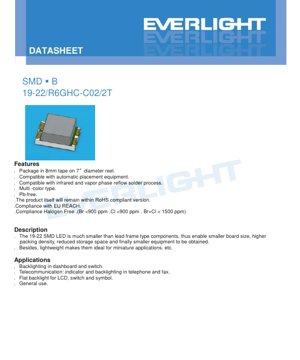
19-22/R6GHC-C02/2T is a compact surface-mount device (SMD) LED designed for high-density electronic assembly. This component integrates two distinct LED chip technologies within a single package: a bright red-emitting AlGaInP chip (designated R6) and a bright green-emitting InGaN chip (designated GH). This multi-color configuration offers design flexibility within an extremely small footprint.
Compared to traditional lead-frame components, the primary advantage of this LED is its significantly reduced size. This miniaturization enables smaller printed circuit board (PCB) designs, higher component mounting density, lower storage requirements, and ultimately contributes to the development of more compact end-user equipment. Its lightweight construction further makes it an ideal choice for micro and portable applications where space and weight are critical constraints.
该器件以行业标准的8mm载带、7英寸直径卷盘形式提供,确保与高速自动化贴片组装设备的兼容性。其配方为无铅,并符合包括RoHS、欧盟REACH和无卤标准(Br <900 ppm, Cl <900 ppm, Br+Cl < 1500 ppm)在内的关键环保法规。
LEDs are sorted (binned) according to their dominant wavelength to ensure color consistency within an application.
2.1 Absolute Maximum Ratings
Operating the device beyond these limits may cause permanent damage. All ratings are specified at an ambient temperature (Ta) of 25°C.
- Reverse Voltage (VR):5 V (max). This device is not designed for operation in reverse bias; this rating is primarily for testing reverse leakage current (IR).
- Continuous Forward Current (IF):Both the R6 (red) and GH (green) chips are 25 mA.
- Peak Forward Current (IFP):Applied under conditions of 1 kHz frequency and a duty cycle of 1/10. The R6 chip can withstand 60 mA, while the GH chip is rated for 100 mA. This parameter is crucial for pulse operation applications.
- Power Dissipation (Pd):The maximum allowable power dissipation for the R6 chip is 60 mW, and for the GH chip, it is 95 mW. This is a key parameter for thermal management.
- Electrostatic Discharge (ESD) Human Body Model (HBM):The R6 chip provides robust ESD protection up to 2000V, while the GH chip is more sensitive, rated at 150V. Proper ESD handling procedures must be followed, especially for green chips.
- Operating and Storage Temperature:The device's rated operating temperature range is -40°C to +85°C, and the storage temperature range is -40°C to +90°C.
- Welding Temperature:For reflow soldering, the peak temperature is specified as 260°C for a maximum of 10 seconds. For manual soldering, the soldering iron tip temperature must not exceed 350°C, with a maximum of 3 seconds per terminal.
2.2 Electro-Optical Characteristics
These parameters define the optical output and electrical behavior under normal operating conditions (unless otherwise specified, Ta=25°C, IF=5mA).
- Luminous intensity (Iv):The typical intensity for the R6 (red) chip is 20.0 mcd (minimum 14.5 mcd). The typical intensity for the GH (green) chip is 65.0 mcd (minimum 45.0 mcd). A tolerance of ±11% applies.
- Viewing Angle (2θ1/2):This package typically features a wide viewing angle of 130 degrees, providing an extensive illumination range.
- Wavelength:
- R6 (Red):Peak wavelength (λp) is 632 nm. Dominant wavelength (λd) range is 617.5 nm to 629.5 nm, with a tolerance of ±1 nm. Spectral bandwidth (Δλ) is 20 nm.
- GH (Green):Peak wavelength (λp) is 518 nm. Dominant wavelength (λd) range is 517.5 nm to 533.5 nm, with a tolerance of ±1 nm. Spectral bandwidth (Δλ) is 35 nm.
- Forward voltage (VF):
- R6 (Red):At 5mA, typical value 1.9 V, maximum value 2.3 V.
- GH (Green):At 5mA, typical value 2.9 V, maximum value 3.4 V.
- Reverse Current (IR):Measured at VR=5V. R6 max. 10 μA, GH max. 50 μA.
3. Grading System Description
LEDs are sorted (binned) based on their Dominant Wavelength to ensure color consistency within an application.
3.1 R6 (Red) Wavelength Binning
- Binning Code 1:617.5 nm ≤ λd < 621.5 nm
- Bin code 2:621.5 nm ≤ λd < 625.5 nm
- Bin code 3:625.5 nm ≤ λd ≤ 629.5 nm
3.2 GH (Green) Wavelength Binning
- Binning Code 1:517.5 nm ≤ λd < 525.5 nm
- Bin code 2:525.5 nm ≤ λd ≤ 533.5 nm
For designers who need to achieve precise color matching of multiple LEDs on display or indicator panels, this binning information is crucial.
4. Performance Curve Analysis
4.1 R6 (Red Chip) Characteristics
The provided curves illustrate the key relationships:
- Relative Luminous Intensity vs. Forward Current:Shows the nonlinear increase of light output with current. Operation above the recommended 5mA may yield higher intensity but can affect efficiency and lifespan.
- Relative Luminous Intensity vs. Ambient Temperature:Demonstrates the negative temperature coefficient of light output. As the junction temperature rises, luminous intensity decreases, which is a fundamental characteristic of LED semiconductors.
- Forward Voltage vs. Forward Current:Depicts the I-V characteristic curve of a diode.
- Peak Wavelength vs. Ambient Temperature:Show slight shift of emission wavelength with temperature.
4.2 GH (Green Chip) Features
The curve of green chip includes:
- Spectral distribution:A plot of relative intensity versus wavelength, centered at 518 nm with a defined bandwidth.
- Forward Voltage vs. Forward Current:Similar to the red chip, but with a higher turn-on voltage, which is typical for InGaN-based green LEDs.
- Forward Current Derating Curve:A crucial chart showing the maximum allowable forward current as a function of ambient temperature. As temperature increases, the maximum current must be reduced to prevent overheating and ensure reliability.
- Radiation Pattern:Illustrates the spatial distribution of luminous intensity, confirming a viewing angle of 130 degrees.
- Relative Luminous Intensity vs. Forward Current and Ambient Temperature:These curves combined show how the light output depends on the drive current and operating temperature.
5. Mechanical and Packaging Information
5.1 Package Dimensions
The 19-22 SMD package has the following key dimensions (tolerance ±0.1mm):
- Length: 2.0 mm
- The package features a polarity indicator, typically a notch or dot on the cathode side, to ensure correct orientation during assembly. In the recommended pad layout, the cathode is also associated with a specific pad shape.
- Height: 0.8 mm
- Lead pitch: 1.5 mm
- Pad size and shape are defined to ensure reliable soldering.
5.2 Polarity Marking
The package features a polarity marking, typically a notch or a dot on the cathode side, to ensure correct orientation during assembly. The cathode is also associated with a specific pad shape in the recommended footprint.
6. Soldering and Assembly Guide
6.1 Reflow Soldering Temperature Profile
Specifies the lead-free reflow soldering temperature profile:
- Preheating:150–200°C, for 60–120 seconds.
- Time above liquidus (217°C):60–150 seconds.
- Peak temperature:Maximum 260°C.
- Time within ±5°C of peak temperature:Maximum 10 seconds.
- Heating rate:Maximum 6°C/sec.
- Time above 255°C:Maximum 30 seconds.
- Cooling rate:Maximum 3°C/sec.
6.2 Storage and Handling Precautions
- Moisture Sensitivity:Devices are packaged in moisture barrier bags with desiccant. Do not open the bag until ready to use the components.
- Floor Life:After opening, if stored under conditions of ≤30°C and ≤60% RH, LEDs should be used within 168 hours (7 days). Unused components must be resealed.
- Baking:If the exposure time exceeds the specified limit or the desiccant indicates moisture, baking at 60 ±5°C for 24 hours is required before reflow soldering.
- Current Limiting:An external current-limiting resistor must be used. LEDs exhibit an exponential current-voltage relationship, so a small increase in voltage can lead to a large, destructive current surge.
- Mechanical Stress:Avoid applying stress to the LED body during soldering or final application. Do not twist the PCB after assembly.
7. Packaging and Ordering Information
7.1 Reel and Carrier Tape Specifications
Products are supplied in moisture barrier packaging systems:
- Carrier tape:Width 8mm, with cavities designed for 19-22 packages.
- Reel:Standard 7-inch diameter reel.
- Quantity per reel:2000 pieces.
- Reel Size:Outer diameter, hub diameter, and width are specified to ensure compatibility with automated equipment.
7.2 Label Information
Label reel ya keɓe bayanai masu mahimmanci don bincike da aikace-aikace:
- Lambar samfurin Abokin ciniki (CPN)
- Lambar samfurin (P/N)
- QTY
- CAT
- HUE
- Forward Voltage Grade (REF)
- Lot Number (LOT No)
8. Application Recommendations
8.1 Typical Application Scenarios
- Backlight:Due to its small size and wide viewing angle, it is very suitable for dashboard indicator lights, switch illumination, and symbol backlighting.
- Communication Equipment:Status indicator lights and keyboard backlighting in telephones, fax machines, and other communication equipment.
- LCD Planar Backlight:Can be used in arrays to provide edge or direct backlighting for small LCD panels.
- General Indication:Widely used in consumer, industrial, and automotive electronics for power status, mode selection, and alarm indication.
8.2 Design Considerations
- Drive Circuit:Always use a series resistor to set the forward current. Calculate the resistor value based on the supply voltage (Vs), the LED's forward voltage (VF), and the desired current (IF): R = (Vs - VF) / IF. For a conservative design, use the maximum VF value from the datasheet.
- Thermal Management:Despite its small size, power dissipation (Pd) must be considered, especially in high ambient temperatures or enclosed spaces. Follow the derating curve for the GH chip. Ensure sufficient copper area on the PCB for heat dissipation.
- ESD Protection:If there is an ESD risk during the assembly process or in the final use environment, especially on the GH chip, ESD protection should be implemented on the input lines.
- Optical Design:The wide viewing angle of 130 degrees provides broad, diffused light. For more focused light, external lenses or light guides may be required.
9. Technical Comparison and Differentiation
19-22/R6GHC-C02/2T offers several key advantages in its category:
- Dual-Chip/Multi-Color Capability:Compared to using two separate monochromatic LEDs, integrating red and green in a single package saves board space and simplifies design and assembly.
- Compact footprint:The 2.0 x 1.6 mm footprint is among the smaller SMD LED packages, enabling high-density layouts.
- Robust red chip:The AlGaInP-based R6 chip offers high ESD immunity (2000V HBM), enhancing reliability during operation and handling.
- Environmental Compliance:Fully compliant with RoHS, REACH, and halogen-free standards, meeting stringent global regulatory requirements for modern electronic products.
- Automation-friendly:Tape and reel packaging, along with compatibility with infrared/vapor phase reflow soldering, supports cost-effective high-volume manufacturing.
10. Frequently Asked Questions (Based on Technical Parameters)
10.1 Can I drive this LED by connecting it directly to a 5V power supply without using a resistor?
A'a, hakan zai lalata LED.LED na'urar kunnawa ce ta halin yanzu. Haɗa tushen wutar lantarki na 5V kai tsaye zuwa LED (musamman jajayen guntu na al'ada mai VF na 1.9V) zai haifar da halin yanzu da ya wuce ƙimar iyakar 25mA, wanda zai haifar da gazawar nan take. Waje iyakance resistor ya zama dole.
10.2 Me ma chipi fure da kore ya bambanta da matakin ESD?
This difference stems from the underlying semiconductor material. AlGaInP (red) structures are generally more resistant to electrostatic discharge than InGaN (green/blue) structures. This is a fundamental material property. This necessitates careful ESD handling, especially when dealing with green chips.
10.3 Bayanin "Binning" yana nufin me ga zanina?
Binning ensures color consistency. If your application requires multiple LEDs to appear the same color (e.g., an indicator bar), you should specify LEDs from the same wavelength bin code (HUE). Mixing different bins may result in visibly different red or green hues.
10.4 How many reflow cycles can this component undergo?
The specification stipulates a maximum of two reflow soldering cycles. Each thermal cycle induces stress on internal die attach and wire bonding. Exceeding two cycles increases the risk of potential reliability failures.
11. Practical Design Case Analysis
Scenario:Design a dual-color (red/green) status indicator for portable devices using a 3.3V power rail.
Design Steps:
- Component Selection:Choose 19-22/R6GHC-C02/2T for its dual-color capability and compact size.
- Circuit Design:Two independent drive circuits are required (one for the red anode, one for the green anode, common cathode).
- Resistance calculation:
- For red (R6, target IF=5mA, using maximum VF=2.3V for safety): R_red = (3.3V - 2.3V) / 0.005A = 200 Ω. Use a standard 200 Ω or 220 Ω resistor.
- For green (GH, target IF=5mA, using maximum VF=3.4V): R_green = (3.3V - 3.4V) / 0.005A = -20 Ω. This calculation shows that 3.3V is insufficient to drive the green chip at 5mA (VF typical is 2.9V, but maximum is 3.4V). The supply voltage must be greater than the LED's forward voltage. For the green LED, a higher supply voltage (e.g., 5V) or a lower drive current is required.
- PCB layout:If used as an indicator light, place the LED near the edge of the board. Use the pad layout recommended in the datasheet dimension drawing. Provide some small thermal relief connections on the cathode pad to aid soldering while providing a heat dissipation path.
- Software control:Microcontroller can independently control the red and green anodes to display red, green, or (via rapid alternation) amber/yellow.
12. Working Principle Introduction
Light-emitting diode (LED) is a semiconductor p-n junction device that emits light through a process called electroluminescence. When a forward voltage is applied across the p-n junction, electrons from the n-type region and holes from the p-type region are injected into the active region. When these charge carriers (electrons and holes) recombine, they release energy. In conventional semiconductors like silicon, this energy is released primarily as heat. In the direct bandgap semiconductor materials used in LEDs (AlGaInP for red/orange/yellow, InGaN for green/blue/white), a significant portion of this energy is released as photons (light). The specific wavelength (color) of the emitted light is determined by the bandgap energy of the semiconductor material, which is controlled by its precise chemical composition. The 19-22 device incorporates two such p-n junctions made from different materials within a single package, thereby enabling the emission of two distinct colors.
13. Teknoloji Gelişim Trendleri
The LED industry continues to evolve along several key trajectories related to components such as the 19-22 SMD LED:
- Efficiency Improvement:Continuous improvements in Internal Quantum Efficiency (IQE) and light extraction techniques enable higher luminous intensity (mcd) at the same input current, or lower power consumption for the same output.
- Miniaturization:The drive towards smaller end products is pushing LED packaging towards smaller footprints and lower profiles, following trends such as 1.6x0.8mm and 1.0x0.5mm packages.
- Color Consistency and Binning Improvements:Advances in epitaxial growth and manufacturing control have reduced natural variations in wavelength and intensity, leading to tighter bins, reduced sorting needs, or more precise color mixing in RGB applications.
- Enhanced Reliability and Robustness:The research focuses on improving the lifespan under high-temperature operation and increasing ESD tolerance, especially for sensitive InGaN-based green and blue chips.
- Integrated Solutions:The trend is towards LEDs with built-in current-limiting resistors, protective diodes, or even driver ICs ("smart LEDs") to simplify circuit design and save board space.
Detailed Explanation of LED Specification Terminology
Complete Explanation of LED Technical Terminology
I. Core Indicators of Photoelectric Performance
| Terminology | Unit/Representation | Popular Explanation | Why It Is Important |
|---|---|---|---|
| Luminous Efficacy | lm/W | The luminous flux emitted per watt of electrical power, higher values indicate greater energy efficiency. | Directly determines the energy efficiency rating and electricity cost of the luminaire. |
| Luminous Flux | lm (lumen) | The total amount of light emitted by a light source, commonly known as "brightness". | Determines whether a luminaire is bright enough. |
| Viewing Angle | ° (degrees), such as 120° | The angle at which light intensity drops to half determines the beam width. | Affects the illumination range and uniformity. |
| Color Temperature (CCT) | K (Kelvin), e.g., 2700K/6500K | The warmth or coolness of light color; lower values are yellowish/warm, higher values are whitish/cool. | Determines the lighting atmosphere and suitable application scenarios. |
| Color Rendering Index (CRI / Ra) | Unitless, 0–100 | The ability of a light source to restore the true color of an object, Ra≥80 is recommended. | Affects color authenticity, used in high-demand places such as shopping malls and art galleries. |
| SDCM (Standard Deviation of Color Matching) | MacAdam ellipse steps, e.g., "5-step" | A quantitative metric for color consistency; a smaller step number indicates higher color consistency. | Ensure no color difference among the same batch of luminaires. |
| Dominant Wavelength | nm (nanometer), e.g., 620nm (red) | The wavelength values corresponding to the colors of colored LEDs. | Determines the hue of monochromatic LEDs such as red, yellow, and green. |
| Spectral Distribution | Wavelength vs. Intensity Curve | Display the intensity distribution of light emitted by the LED across various wavelengths. | Affects color rendering and color quality. |
II. Electrical Parameters
| Terminology | Symbol | Popular Explanation | Design Considerations |
|---|---|---|---|
| Forward Voltage | Vf | The minimum voltage required to light up an LED, similar to a "starting threshold". | The driving power supply voltage must be ≥ Vf; voltages add up when multiple LEDs are connected in series. |
| Forward Current | If | The current value that makes the LED emit light normally. | Constant current drive is often used, as the current determines brightness and lifespan. |
| Maximum Pulse Current (Pulse Current) | Ifp | Peak current that can be sustained for a short period, used for dimming or flashing. | Pulse width and duty cycle must be strictly controlled to prevent overheating and damage. |
| Reverse Voltage | Vr | The maximum reverse voltage that an LED can withstand; exceeding it may cause breakdown. | Circuit must be protected against reverse polarity or voltage surges. |
| Thermal Resistance | Rth (°C/W) | The resistance to heat transfer from the chip to the solder joint. A lower value indicates better heat dissipation. | High thermal resistance requires a stronger heat dissipation design; otherwise, the junction temperature will increase. |
| ESD Immunity | V (HBM), e.g., 1000V | The higher the ESD immunity rating, the more resistant the device is to electrostatic damage. | Anti-static measures must be implemented during production, especially for high-sensitivity LEDs. |
III. Thermal Management and Reliability
| Terminology | Key Indicators | Popular Explanation | Impact |
|---|---|---|---|
| Junction Temperature | Tj (°C) | The actual operating temperature inside the LED chip. | For every 10°C reduction, lifespan may double; excessively high temperatures cause lumen depreciation and color shift. |
| Lumen Depreciation | L70 / L80 (hours) | The time required for brightness to drop to 70% or 80% of its initial value. | Directly defines the "service life" of an LED. |
| Lumen Maintenance | % (e.g., 70%) | The percentage of remaining brightness after a period of use. | Characterizes the ability to maintain brightness after long-term use. |
| Color Shift | Δu′v′ or MacAdam ellipse | The degree of color change during use. | Affects the color consistency of the lighting scene. |
| Thermal Aging | Material performance degradation | Deterioration of packaging materials due to prolonged high temperatures. | May lead to decreased brightness, color shift, or open-circuit failure. |
IV. Packaging and Materials
| Terminology | Common Types | Popular Explanation | Characteristics and Applications |
|---|---|---|---|
| Packaging Type | EMC, PPA, Ceramic | The housing material that protects the chip and provides optical and thermal interfaces. | EMC tahan panas baik, biaya rendah; keramik pendinginan unggul, umur panjang. |
| Struktur chip | Face-up, Flip Chip | Chip electrode arrangement method. | Flip Chip offers better heat dissipation and higher luminous efficacy, suitable for high-power applications. |
| Phosphor coating | YAG, Silicate, Nitride | Covered on the blue light chip, partially converted into yellow/red light, mixed into white light. | Different phosphors affect luminous efficacy, color temperature, and color rendering. |
| Lens/Optical design | Flat, Microlens, Total Internal Reflection | Optical structure on the encapsulation surface, controlling light distribution. | Determine the beam angle and photometric distribution curve. |
V. Quality Control and Binning
| Terminology | Binning Content | Popular Explanation | Purpose |
|---|---|---|---|
| Luminous Flux Classification | Codes such as 2G, 2H | Group by brightness level, each group has a minimum/maximum lumen value. | Ensure consistent brightness for the same batch of products. |
| Voltage binning | Codes such as 6W, 6X | Group by forward voltage range. | Facilitate driver matching and improve system efficiency. |
| Color binning. | 5-step MacAdam Ellipse | Group by color coordinates to ensure colors fall within a minimal range. | Ensure color consistency to avoid uneven color within the same luminaire. |
| Color temperature binning | 2700K, 3000K, etc. | Grouped by color temperature, each group has a corresponding coordinate range. | To meet the color temperature requirements of different scenarios. |
VI. Testing and Certification
| Terminology | Standards/Testing | Popular Explanation | Significance |
|---|---|---|---|
| LM-80 | Lumen Maintenance Test | Record brightness attenuation data under constant temperature conditions over a long period of illumination. | Used to estimate LED lifespan (combined with TM-21). |
| TM-21 | Standard for Life Projection | Projecting lifetime under actual use conditions based on LM-80 data. | Provide scientific life prediction. |
| IESNA Standard | Illuminating Engineering Society Standard | Covers optical, electrical, and thermal testing methods. | Industry-recognized testing basis. |
| RoHS / REACH | Environmental Certification | Ensure products are free from hazardous substances (e.g., lead, mercury). | Market access requirements for entering the international market. |
| ENERGY STAR / DLC | Energy Efficiency Certification | Energy Efficiency and Performance Certification for Lighting Products. | Commonly used in government procurement and subsidy programs to enhance market competitiveness. |