Table of Contents
- 1. Product Overview
- 2. Technical Parameters: In-depth Objective Interpretation
- 2.1 Absolute Maximum Ratings
- 2.2 Electro-Optical Characteristics
- 3. Grading System Description
- 4. Performance Curve Analysis
- 5. Mechanical and Packaging Information
- 5.1 Package Dimensions
- 5.2 Polarity Identification
- 6. Welding and Assembly Guide
- 6.1 Reflow soldering parameters
- 6.2 Manual soldering
- 6.3 Storage and Moisture Sensitivity
- 6.4 Precautions
- 7. Packaging and Ordering Information
- 7.1 Packaging Specifications
- 7.2 Model Naming Rules
- 8. Application Suggestions
- 8.1 Typical Application Scenarios
- 8.2 Design Considerations
- 9. Technical Comparison and Differentiation
- 10. Frequently Asked Questions (Based on Technical Parameters)
- 10.1 For a green (GH) LED, what value of resistor should be used with a 5V power supply?
- 10.2 Can I use a PWM signal to drive this LED for dimming?
- 10.3 Why is the ESD rating of red LEDs different from that of green/blue LEDs?
- 10.4 "Water Clear" resin yana nufin me ga fitar da haske?
- 11. Zane na Ainihi da Misalan Amfani.
- 12. Introduction to Principles
- 13. Development Trends
1. Product Overview
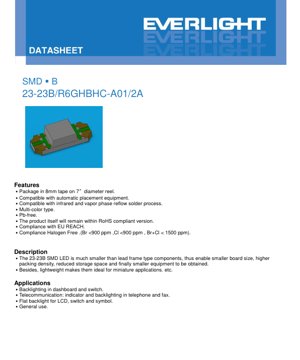
The 23-23B is a compact surface-mount device (SMD) LED, specifically designed for high-density PCB applications. It is significantly smaller than traditional lead-frame type LEDs, which helps reduce circuit board size, increase packaging density, and ultimately enable smaller end devices. Its lightweight structure makes it an ideal choice for miniaturization and space-constrained applications.
该系列通过不同的芯片材料提供多种颜色选择:亮红色(R6代码,AlGaInP芯片)、亮绿色(GH代码,InGaN芯片)和蓝色(BH代码,InGaN芯片)。所有型号均采用水透明树脂封装。产品符合RoHS、欧盟REACH等关键行业标准,且为无卤素产品(Br <900 ppm, Cl <900 ppm, Br+Cl < 1500 ppm)。产品以8mm载带、7英寸直径卷盘形式供应,兼容标准自动贴装设备。
2. Technical Parameters: In-depth Objective Interpretation
2.1 Absolute Maximum Ratings
All ratings are specified at an ambient temperature (Ta) of 25°C. Exceeding these limits may cause permanent damage.
- Reverse Voltage (VR):5 V (all codes).
- Forward Current (IF):R6 (Red) is 25 mA, GH (Green) and BH (Blue) are 20 mA.
- Peak Forward Current (IFP):Duty cycle 1/10 @ 1kHz. R6 is 60 mA, GH and BH are 75 mA.
- Power Dissipation (Pd):R6 is 60 mW, GH and BH are 95 mW.
- Electrostatic Discharge (ESD) Human Body Model (HBM):R6 is 2000 V, GH and BH are 150 V. This indicates that the red LED has higher inherent ESD robustness.
- Operating Temperature (Topr):-40°C to +85°C.
- Storage Temperature (Tstg):-40°C to +90°C.
- Welding Temperature (Tsol):Reflow Soldering: Peak temperature 260°C, maximum 10 seconds. Hand Soldering: Maximum 350°C per solder terminal, maximum 3 seconds.
2.2 Electro-Optical Characteristics
Typical values are measured at Ta=25°C, IF=20mA unless otherwise specified. Min/Max values define specification limits.
- Luminous Intensity (Iv):
- R6 (Red): Typical 100 mcd, Min 72 mcd.
- GH (Green): Typical value 200 mcd, minimum value 140 mcd.
- BH (Blue): Typical value 65 mcd, minimum value 45 mcd.
- Tolerance:±11%.
- Viewing angle (2θ1/2):Typical value 130 degrees (all codes).
- Peak wavelength (λp):
- R6: 632 nm.
- GH: 518 nm.
- BH: 468 nm.
- Dominant wavelength (λd):
- R6: 624 nm.
- GH: 525 nm.
- BH: 470 nm.
- Spectral radiation bandwidth (Δλ):
- R6: 20 nm.
- GH: 35 nm.
- BH: 25 nm.
- Forward Voltage (VF) @ IF=20mA:
- R6: Typical 2.0V (Min 1.7V, Max 2.4V)
- GH/BH: Typical 3.3V (Min 2.7V, Max 3.7V)
- Reverse current (IR) @ VR=5V:
- R6: Maximum 10 μA.
- GH/BH: Maximum 50 μA.
3. Grading System Description
The product employs a comprehensive labeling system for traceability and performance binning, with relevant information marked on the reel label.
- CAT:Indicates the luminous intensity grade.
- HUE:Represents the chromaticity coordinate and dominant wavelength grade.
- REF:Specifies the forward voltage grade.
- LOT No:The unique batch number used for production traceability.
This binning method allows designers to select LEDs with closely grouped electrical and optical parameters to ensure performance consistency in their applications.
4. Performance Curve Analysis
The datasheet contains typical photoelectric characteristic curves for each LED code (R6, GH, BH). Although specific graphs are not detailed in the text, such curves typically illustrate the following relationships:
- Forward Current (IF) versus Forward Voltage (VF):Displaying the IV characteristics of a diode is crucial for driver design.
- Forward Current (IF) vs. Luminous Intensity (Iv):It shows how the light output changes with current, indicating linearity and saturation point.
- Environmental temperature (Ta) and relative luminous intensity:Shows the decrease in light output with increasing temperature.
- Spectral distribution:Depict relative radiant power at each wavelength, confirm peak wavelength and dominant wavelength.
These curves are crucial for understanding device behavior under non-standard conditions (varying current, temperature) and optimizing circuit design.
5. Mechanical and Packaging Information
5.1 Package Dimensions
This LED features a compact SMD package size. Key dimensions (unit: mm, tolerance ±0.1mm unless specified) include:
- Overall dimensions: approximately 3.2mm (length) x 2.8mm (width) x 1.9mm (height).
- Defines pad size and spacing to ensure reliable soldering.
- The cathode mark is typically indicated on the package.
5.2 Polarity Identification
Components have polarity markings (such as a notch, bevel, or dot) to identify the cathode pin. During assembly, correct orientation must be ensured to guarantee proper function and avoid damage from reverse bias.
6. Welding and Assembly Guide
6.1 Reflow soldering parameters
Specifies the lead-free reflow soldering temperature profile:
- Preheating:150–200°C, for 60–120 seconds.
- Time above liquidus (217°C):60–150 segundos.
- Temperatura máxima:Máximo 260°C.
- Tiempo en el pico:Maximum 10 seconds.
- Heating rate:Maximum 6°C/sec, up to 255°C.
- Time above 255°C:Maximum 30 seconds.
- Cooling rate:Maximum 3°C per second.
- Limitation:The number of reflow soldering should not exceed two times.
6.2 Manual soldering
If manual soldering is necessary:
- 使用烙铁头温度< 350°C的烙铁。
- Heating time for each solder terminal ≤ 3 seconds.
- Use a soldering iron with power ≤ 25W.
- Interval between soldering each terminal ≥ 2 seconds.
- Please operate with caution, as damage often occurs during manual soldering.
6.3 Storage and Moisture Sensitivity
Components are packaged in moisture-barrier shielding bags with desiccant.
- Before opening:Store at ≤ 30°C and ≤ 90% RH.
- After opening:Under conditions of ≤ 30°C and ≤ 60% RH, the "shop life" is 1 year. Unused components must be resealed in moisture barrier packaging.
- Baking:If the desiccant indicator changes color or the storage time is exceeded, bake at 60 ±5°C for 24 hours before use.
6.4 Precautions
- Current Protection:External current-limiting resistors must be used. LEDs are current-driven devices; minor voltage variations can cause large current surges, leading to burnout.
- Avoid stress:Do not apply mechanical stress to the LED due to PCB warping during or after heating (soldering).
- Rework:Rework after soldering is not recommended. If unavoidable, use a dedicated dual-tip soldering iron to simultaneously heat both solder terminals and remove the component to avoid unilateral stress. Verify characteristics after rework.
7. Packaging and Ordering Information
7.1 Packaging Specifications
- Carrier Tape:Width 8mm.
- Reel:Diameter 7 inches (178mm).
- Quantity per reel:2000 pieces.
- Moisture-proof bag:Aluminum-plastic composite bag, containing desiccant and humidity indicator card.
7.2 Model Naming Rules
Part Number23-23B/R6GHBHC-A01/2ACan be interpreted as:
- 23-23B:Basic package type and dimensions.
- /R6GHBHC:Indicates a specific chip/color configuration (possibly a combination or selection of R6, GH, BH).
- -A01/2A:Internal code for grading, version, or other attributes.
8. Application Suggestions
8.1 Typical Application Scenarios
- Backlight:Used for dashboards, switches, and symbols in automotive and consumer electronics.
- Communication Equipment:Status indicators and keyboard backlighting in telephones and fax machines.
- LCD Flat Backlight:For small display screens.
- General indicator light:Status lights, power indicator lights, etc., in various electronic devices.
8.2 Design Considerations
- Driving Circuit:Always use a constant current source or a voltage source with a series resistor. Calculate the resistor value using the formula R = (Power Supply Voltage - LED Forward Voltage) / Forward Current, and consider the maximum forward voltage to ensure the current never exceeds the absolute maximum rating.
- Thermal Management:Although power consumption is low, when operating under high ambient temperatures or high duty cycles, ensure sufficient PCB copper foil area or thermal vias to maintain performance and lifespan.
- ESD Protection:Implement ESD protection measures on the PCB traces connected to the LED pins, especially for the more sensitive green and blue (GH/BH) models.
9. Technical Comparison and Differentiation
The 23-23B series offers the following significant advantages:
- Compared to large leaded LEDs:Significantly reduces package size and weight, enabling miniaturization and automated assembly.
- Compared to other SMD LEDs:Its specific combination of a 130-degree viewing angle, clear package, and multiple color options (red, green, blue) available in a single package form factor makes it ideal for applications requiring color differentiation or RGB color mixing.
- Compliance:Its RoHS, REACH, and halogen-free compliance is a key advantage for products targeting global markets with stringent environmental regulations.
10. Frequently Asked Questions (Based on Technical Parameters)
10.1 For a green (GH) LED, what value of resistor should be used with a 5V power supply?
Using a typical forward voltage of 3.3V and a forward current of 20mA: R = (5V - 3.3V) / 0.02A = 85 ohms. To ensure safe operation under worst-case conditions (minimum forward voltage = 2.7V), recalculate to limit the maximum current: R_min = (5V - 2.7V) / 0.02A = 115 ohms. Using a standard 120-ohm resistor is a safe choice, with a typical current of approximately ~14mA ((5-3.3)/120).
10.2 Can I use a PWM signal to drive this LED for dimming?
可以,PWM调光是一种有效的方法。确保脉冲中的峰值电流不超过峰值正向电流(IFP)额定值(GH/BH为75mA,R6为60mA)。频率应足够高以避免可见闪烁(通常>100Hz)。
10.3 Why is the ESD rating of red LEDs different from that of green/blue LEDs?
Red LED yana amfani da kayan semiconductor na AlGaInP, idan aka kwatanta da kayan InGaN da ake amfani da su don LED na kore da shuɗi, tsarin crystal ɗinsa yawanci yana da ƙarfi sosai ga fitar da wutar lantarki. Wannan wani siffa ne na gama gari a cikin masana'antu, don haka ana buƙatar ƙarin matakan kariya na ESD don nau'ikan kore da shuɗi.
10.4 "Water Clear" resin yana nufin me ga fitar da haske?
"Ruwa mai tsabta" yana nufin cewa kayan rufin epoxy ba su da yaduwa kuma suna bayyana. Wannan yana haifar da ƙarin haske mai mahimmanci, mai ƙarfi, tare da kusurwar gani mai ma'ana (a cikin wannan misali 130°), wanda ya bambanta da "madara" ko resin mai yaduwa, wanda ke watsa haske don samun faɗi, siffa mai laushi.
11. Zane na Ainihi da Misalan Amfani.
Case: Designing a Multi-State Indicator Panel
Designers need to set up red (power/fault), green (ready/on), and blue (activity/connection) indicator lights on the control panel of small consumer devices. Using the R6, GH, and BH codes from the 23-23B series ensures:
- Unified package size:All three colors share the same PCB pad pattern, simplifying layout and assembly.
- Consistent viewing angle:All LEDs feature the same 130° viewing angle, providing uniform visual effects from different perspectives.
- Simplified Bill of Materials:Similar driving circuits can be used, with only slight adjustments to the current-limiting resistor values based on different forward voltages (red ~2.0V, green/blue ~3.3V).
- Compliance:Single component series meets all necessary environmental regulations for the target market.
12. Introduction to Principles
A light-emitting diode (LED) is a semiconductor device that emits light when current passes through it. This phenomenon is called electroluminescence, which occurs when electrons and holes recombine within the device, releasing energy in the form of photons. The color of the emitted light is determined by the band gap of the semiconductor material used:
- AlGaInP (aluminum gallium indium phosphide):Used for R6 (red) LEDs, this material system produces light in the red to yellow-orange spectrum. Its specific composition is adjusted for a dominant wavelength of 624nm (red).
- InGaN (indium gallium nitride):For GH (green) and BH (blue) LEDs. By altering the indium/gallium ratio, the bandgap can be tuned to emit green (~525nm) or blue (~470nm) light. InGaN technology also forms the basis for white LEDs, which utilize a blue LED chip combined with a phosphor coating.
The SMD package protects the fragile semiconductor chip, provides electrical contacts (anode and cathode), and incorporates a lens (molded from transparent resin) to control the light output pattern.
13. Development Trends
The development of SMD LEDs like 23-23B is driven by several key trends in the electronics field:
- Efficiency improvement (lumens per watt):Continuous advancements in material science and chip design enable higher luminous intensity at the same input current, thereby reducing power consumption and thermal load.
- Miniaturization:The relentless pursuit of smaller devices has led to further reductions in package sizes (e.g., metric codes 2016, 1608, 1005) while maintaining or improving optical performance.
- Color Consistency and Binning Improvements:The manufacturing process has become more precise, resulting in tighter binning in terms of luminous intensity, wavelength, and forward voltage. This reduces the need for circuit calibration in color-critical applications.
- Higher reliability and lifespan:Advancements in packaging materials (epoxy, silicone) and die-attach technology have enhanced resistance to thermal cycling, moisture, and other environmental stresses, extending the service life.
- Integration:Trends include integrating multiple LED chips (e.g., RGB) into a single package with a built-in control IC, creating intelligent LED modules that simplify system design.
The 23-23B represents a mature and reliable component in this ongoing technological evolution, balancing performance, size, and cost for a wide range of indicator and backlight applications.
Detailed Explanation of LED Specification Terminology
Complete Interpretation of LED Technical Terminology
I. Core Indicators of Photoelectric Performance
| Terminology | Unit/Representation | Popular Explanation | Aiseā e Tāua ai |
|---|---|---|---|
| Luminous Efficacy | lm/W (lumens per watt) | The luminous flux emitted per watt of electrical power; higher values indicate greater energy efficiency. | It directly determines the energy efficiency rating of the luminaire and the electricity cost. |
| Luminous Flux | lm (lumen) | The total amount of light emitted by a light source, commonly known as "brightness". | Determines whether the luminaire is bright enough. |
| Viewing Angle | ° (degree), e.g., 120° | The angle at which luminous intensity drops to half, determining the beam width. | Affects the range and uniformity of illumination. |
| Color Temperature (CCT) | K (Kelvin), such as 2700K/6500K | Launin haske mai dumi da sanyi, ƙananan ƙima sun karkata zuwa rawaya/dumi, manyan ƙima sun karkata zuwa fari/sanyi. | Yana ƙayyade yanayin hasken wuta da yanayin da ya dace. |
| Color Rendering Index (CRI / Ra) | Unitless, 0–100 | The ability of a light source to reproduce the true colors of objects, with Ra≥80 being preferable. | Affects color fidelity, used in high-demand places such as shopping malls and art galleries. |
| Color tolerance (SDCM) | MacAdam ellipse steps, such as "5-step" | A quantitative metric for color consistency; a smaller step number indicates better color consistency. | Ensure no color difference among luminaires from the same batch. |
| Dominant Wavelength | nm (nanometer), e.g., 620nm (red) | Wavelength values corresponding to the colors of colored LEDs. | Determines the hue of monochromatic LEDs such as red, yellow, and green. |
| Spectral Distribution | Wavelength vs. Intensity Curve | Shows the intensity distribution of light emitted by an LED at each wavelength. | Affects color rendering and color quality. |
II. Electrical Parameters
| Terminology | Symbol | Popular Explanation | Design Considerations |
|---|---|---|---|
| Forward Voltage (Forward Voltage) | Vf | The minimum voltage required to light up an LED, similar to a "starting threshold". | The driving power supply voltage must be ≥ Vf; the voltages add up when multiple LEDs are connected in series. |
| Forward Current | If | The current value that makes the LED emit light normally. | Constant current drive is often used, as the current determines brightness and lifespan. |
| Maximum Pulse Current | Ifp | The peak current that can be withstood for a short period of time, used for dimming or flashing. | Pulse width and duty cycle must be strictly controlled, otherwise overheating damage will occur. |
| Reverse Voltage | Vr | Maximum reverse voltage that an LED can withstand; exceeding it may cause breakdown. | Reverse connection or voltage surges must be prevented in the circuit. |
| Thermal Resistance (Thermal Resistance) | Rth (°C/W) | The resistance to heat flow from the chip to the solder joint. A lower value indicates better heat dissipation. | High thermal resistance requires a more robust thermal design, otherwise the junction temperature will increase. |
| Electrostatic Discharge Immunity (ESD Immunity) | V (HBM), such as 1000V | Electrostatic discharge immunity, the higher the value, the less susceptible to damage from static electricity. | Anti-static measures must be implemented during production, especially for high-sensitivity LEDs. |
III. Thermal Management and Reliability
| Terminology | Key Indicators | Popular Explanation | Impact |
|---|---|---|---|
| Junction Temperature | Tj (°C) | The actual operating temperature inside the LED chip. | For every 10°C reduction, the lifespan may double; excessively high temperatures lead to lumen depreciation and color shift. |
| Lumen Depreciation | L70 / L80 (hours) | The time required for the brightness to drop to 70% or 80% of its initial value. | Directly define the "service life" of LED. |
| Lumen Maintenance | % (e.g., 70%) | The percentage of remaining brightness after a period of use. | Characterizes the ability to maintain brightness after long-term use. |
| Color Shift | Δu′v′ or MacAdam ellipse | The degree of color change during use. | Affects the color consistency of the lighting scene. |
| Thermal Aging | Material performance degradation | Degradation of packaging materials due to prolonged high temperatures. | It may lead to a decrease in brightness, color change, or open-circuit failure. |
IV. Packaging and Materials
| Terminology | Common Types | Popular Explanation | Characteristics and Applications |
|---|---|---|---|
| Package Types | EMC, PPA, Ceramic | The housing material that protects the chip and provides optical and thermal interfaces. | EMC offers good heat resistance and low cost; ceramic provides superior heat dissipation and long lifespan. |
| Chip Structure | Front-side, Flip Chip | Chip electrode arrangement method. | Flip-chip offers better heat dissipation and higher luminous efficacy, suitable for high-power applications. |
| Phosphor coating. | YAG, silicate, nitride | Coated on the blue LED chip, partially converted to yellow/red light, mixed to form white light. | Different phosphors affect luminous efficacy, color temperature, and color rendering. |
| Lens/Optical Design | Planar, microlens, total internal reflection | Optical structure on the packaging surface, controlling light distribution. | Determines the emission angle and light distribution curve. |
V. Quality Control and Grading
| Terminology | Grading Content | Popular Explanation | Purpose |
|---|---|---|---|
| Luminous Flux Binning | Codes such as 2G, 2H | Group by brightness level, each group has a minimum/maximum lumen value. | Ensure consistent brightness for products in the same batch. |
| Voltage binning | Codes such as 6W, 6X | Grouped by forward voltage range. | Ease of matching the drive power supply, improving system efficiency. |
| Color binning | 5-step MacAdam ellipse | Group by color coordinates to ensure colors fall within a minimal range. | Ensure color consistency to avoid uneven colors within the same luminaire. |
| Color temperature grading | 2700K, 3000K, etc. | Group by color temperature, each group has a corresponding coordinate range. | Meet the color temperature requirements of different scenarios. |
VI. Testing and Certification
| Terminology | Standard/Test | Popular Explanation | Meaning |
|---|---|---|---|
| LM-80 | Lumen Maintenance Test | Long-term operation under constant temperature conditions, recording luminance attenuation data. | For estimating LED lifetime (in conjunction with TM-21). |
| TM-21 | Lifetime projection standard | Estimating lifespan under actual usage conditions based on LM-80 data. | Providing scientific life prediction. |
| IESNA Standard | Illuminating Engineering Society Standard | Covers optical, electrical, and thermal test methods. | Industry-recognized testing basis. |
| RoHS / REACH | Environmental Certification | Ensure the product does not contain harmful substances (e.g., lead, mercury). | Entry requirements for the international market. |
| ENERGY STAR / DLC | Energy efficiency certification | Energy efficiency and performance certification for lighting products. | Commonly used in government procurement and subsidy programs to enhance market competitiveness. |