Table of Contents
- 1. Product Overview
- 2. Key Features and Compliance
- 3. Absolute Maximum Ratings
- 4. Electro-Optical Characteristics
- 5. Binning and Grading System
- 5.1 Luminous Intensity Binning Range
- 5.2 Forward Voltage Binning Range
- 5.3 Chromaticity Coordinate Grading
- 6. Performance Curve Analysis
- 7. Mechanical and Packaging Information
- 8. Welding and Assembly Guide
- 8.1 Welding Process
- 8.2 Storage and Moisture Protection Requirements
- 8.3 Circuit Protection
- 9. Packaging and Ordering Information
- 10. Application Suggestions
- 10.1 Typical Applications
- 10.2 Design Considerations
- 11. Technical Comparison and Advantages
- 12. Frequently Asked Questions (FAQ)
- 13. How It Works
- 14. Industry Trends and Background
1. Product Overview
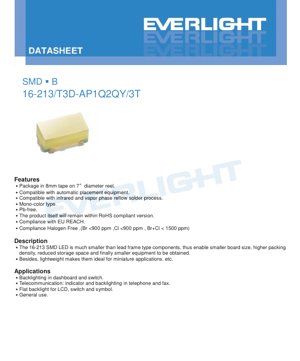
16-213/T3D-AP1Q2QY/3T is a compact surface-mount device (SMD) LED, specifically designed for modern electronic applications that require miniaturization and high reliability. This monochromatic pure white LED utilizes InGaN chip technology and is encapsulated in a yellow diffused resin. Its primary advantage lies in a significantly reduced footprint compared to traditional lead-frame LEDs, enabling higher component assembly density on printed circuit boards (PCBs), lowering storage requirements, and ultimately contributing to the development of smaller, lighter end-user equipment. Its lightweight construction makes it particularly suitable for space-constrained and portable devices.
2. Key Features and Compliance
Wannan LED ana samar da shi a cikin nau'in tef 8mm, wanda aka naɗe a kan ƙwanƙwasa mai diamita 7 inci, cikakkiyar dacewa da na'urorin haɗa kayan aiki na atomatik na daidaitaccen tsari, don sauƙaƙe samar da yawa. An ƙera shi don amfani da hanyoyin haɗa IR da na tururi, don tabbatar da sassaucin layin samarwa. An ƙera na'urar da kayan muhalli: mara gubar (Pb-free), ya bi ka'idojin RoHS na EU, kuma ya cika buƙatun REACH. Bugu da ƙari, an rarraba shi azaman samfurin mara halogen, tare da ƙarancin bromine (Br) da chlorine (Cl) duka ƙasa da 900 ppm, kuma jimlar su ƙasa da 1500 ppm.
3. Absolute Maximum Ratings
The operating limits of the device are defined under the condition of an ambient temperature (Ta) of 25°C. Exceeding these ratings may cause permanent damage.
- Reverse Voltage (VR):5 V
- Continuous Forward Current (IF):25 mA
- Peak Forward Current (IFP):100 mA (under conditions of duty cycle 1/10, frequency 1 kHz)
- Power consumption (Pd):110 mW
- Electrostatic discharge (ESD) human body model:150 V
- Operating Temperature Range (Topr):-40°C to +85°C
- Storage temperature range (Tstg):-40°C to +90°C
- Welding Temperature (Tsol):Reflow Soldering: Maximum 260°C for 10 seconds; Hand Soldering: Maximum 350°C for 3 seconds.
4. Electro-Optical Characteristics
Unless otherwise specified, all characteristics are measured at an ambient temperature of 25°C and a standard test current (IF) of 5 mA.
- Luminous Intensity (Iv):Minimum 45 mcd, typical value not specified, maximum 112 mcd. Luminous intensity tolerance is ±11%.
- Viewing Angle (2θ1/2):120 degrees (typical). This wide viewing angle ensures good visibility from all directions, making it ideal for indicator lights and backlight applications.
- Forward Voltage (VF):Minimum value 2.7 V, typical value not specified, maximum value 3.2 V. Forward voltage tolerance is ±0.05V.
- Reverse current (IR):When a reverse voltage (VR) of 5V is applied, the maximum value is 50 μA.
Notes on tolerance:The dominant wavelength tolerance is ±1 nm.
5. Binning and Grading System
LEDs are binned based on performance to ensure consistency between batches. This allows designers to select components that meet specific brightness and electrical requirements.
5.1 Luminous Intensity Binning Range
Binning is performed under the condition of IF= 5mA. Tolerance: ±11%.
- P1:45 mcd (minimum) to 57 mcd (maximum)
- P2:57 mcd to 72 mcd
- Q1:72 mcd to 90 mcd
- Q2:90 mcd to 112 mcd
5.2 Forward Voltage Binning Range
Binning is performed under the condition of IF= Binning under 5mA condition. Tolerance: ±0.1V.
- 29:2.7 V to 2.8 V
- 30:2.8 V zuwa 2.9 V
- 31:2.9 V zuwa 3.0 V
- 32:3.0 V to 3.1 V
- 33:3.1 V to 3.2 V
5.3 Chromaticity Coordinate Grading
The white point is defined by the chromaticity coordinates (CIE_x, CIE_y) on the CIE 1931 chromaticity diagram, with a tolerance of ±0.01. Products are graded into group (A) and bins (1-6), where each bin defines a quadrilateral area on the chromaticity diagram to ensure color consistency. The specification provides the specific coordinate ranges for bins 1 to 6, defining the allowable variation range of the white point.
6. Performance Curve Analysis
The datasheet contains multiple characteristic curves crucial for circuit design and thermal management.
- Forward Current Derating Curve:It shows the maximum allowable continuous forward current as a function of ambient temperature. To prevent overheating, the current must be reduced as the temperature increases.
- Relative luminous intensity vs. ambient temperature:It illustrates how the light output decreases with increasing junction temperature. This is crucial for applications operating over a wide temperature range.
- Luminous intensity vs. forward current:It demonstrates the nonlinear relationship between the drive current and the light output.
- Forward Voltage vs. Forward Current (I-V Curve):It is crucial for designing current-limiting circuits. This curve shows the typical voltage drop of an LED at different currents.
- Spectral Distribution:It depicts the spectral power distribution of the emitted white light, showing the relative intensity at each wavelength.
- Radiation Pattern:Polar plot, intuitively showing the spatial distribution of light intensity within a 120-degree viewing angle.
7. Mechanical and Packaging Information
This LED uses a standard SMD package. The package drawing shows key dimensions, including length, width, height, and pad pitch. Unless otherwise specified, all tolerances are ±0.1mm. A recommended pad layout for PCB design is provided for reference, but designers are advised to modify it based on their specific manufacturing process and thermal requirements. The drawing also clearly marks the cathode (negative) and anode (positive) terminals for correct orientation during assembly.
8. Welding and Assembly Guide
8.1 Welding Process
This device is compatible with lead-free reflow soldering. The recommended temperature profile is provided: preheat between 150-200°C for 60-120 seconds, time above liquidus (217°C) for 60-150 seconds, peak temperature not exceeding 260°C for a maximum of 10 seconds. The maximum heating rate should be 6°C/second, and the cooling rate should be 3°C/second. Reflow soldering should not be performed more than twice. No stress should be applied to the LED body during heating, and the PCB should not warp after soldering.
8.2 Storage and Moisture Protection Requirements
LEDs are packaged in moisture barrier bags with desiccant. Before opening, they should be stored in an environment of ≤30°C and ≤90% relative humidity. After opening, the "floor life" (the time components can be exposed to factory ambient conditions) is 1 year at ≤30°C and ≤60% relative humidity. Unused parts should be resealed. If the desiccant indicator changes color or the storage time is exceeded, baking at 60±5°C for 24 hours is required before use to remove absorbed moisture and prevent the "popcorn" effect during reflow soldering.
8.3 Circuit Protection
Key Tip:An external current-limiting resistor must always be used in series with the LED. The forward voltage has a range (2.7-3.2V), and if not properly current-limited, small variations in the supply voltage can cause large and potentially destructive changes in the forward current.
9. Packaging and Ordering Information
LEDs are supplied in tape-and-reel format, with tape dimensions specified in the datasheet. Each reel contains 3000 pieces. Reel dimensions are also provided for use with automated handling equipment. The reel label contains key information: Customer Part Number (CPN), Product Number (P/N), Quantity (QTY), Luminous Intensity Category (CAT), Chromaticity and Wavelength Category (HUE), Forward Voltage Category (REF), and Lot Number (LOT No).
10. Application Suggestions
10.1 Typical Applications
- Backlighting:Perfect for dashboard indicator lights, switch backlighting, and providing planar backlighting for LCD panels and symbols.
- Communication equipment:Status indicator lights and keyboard backlighting in telephones and fax machines.
- General indicator lights:Any application requiring small, bright, wide-angle white indicator lights.
10.2 Design Considerations
- Current Drive:Always use a constant current source or a voltage source with a series resistor. According to the power supply voltage (Vsupply), the maximum forward voltage of the LED (VFmax) and the required forward current (IF) calculate the resistance value: R = (Vsupply- VFmax) / IF. Use the worst-case VFto ensure the current never exceeds the maximum rated value.
- Thermal Management:Although power consumption is low, if operating at high ambient temperatures or near maximum current, ensure sufficient PCB copper area or thermal vias under the LED pad, as heat reduces light output and lifespan.
- ESD Protection:This device is sensitive to electrostatic discharge (150V HBM). Standard ESD handling precautions should be observed during assembly.
11. Technical Comparison and Advantages
Compared to older through-hole LEDs, the 16-213 SMD LED offers significant advantages: a much smaller footprint, which aids miniaturization; suitability for automated assembly, reducing labor costs; and a wider viewing angle (120°), providing better visibility. Its halogen-free and RoHS compliance makes it suitable for global markets with strict environmental regulations. The detailed binning system provides designers with predictable performance, ensuring consistency in brightness and color across mass-produced products.
12. Frequently Asked Questions (FAQ)
Q: What is the purpose of binning codes (P1, Q2, 29, 31, etc.)?
A: Binning codes ensure consistency in electrical and optical performance. Luminous intensity bins (P1, Q1, etc.) guarantee minimum brightness. Forward voltage bins (29, 31, etc.) ensure predictable power consumption. Chromaticity bins ensure consistent white color. Designers can specify bins to meet their application requirements.
Q: Why is a current-limiting resistor absolutely necessary?
A: LED is a current-driven device. Its V-I characteristic is exponential. A voltage slightly exceeding the nominal VFwill cause a sharp increase in current, potentially damaging the LED immediately. A resistor (or constant current driver) provides a stable, safe operating current.
Q: Can I use this LED outdoors?
A: Its operating temperature range is -40°C to +85°C, covering most outdoor conditions. However, the package is not specifically rated for waterproofing or UV resistance. For direct outdoor exposure, additional environmental protection (such as conformal coating, lens) is required.
What does "lead-free" and "halogen-free" mean for my design?
"Lead-free" means the solder and plating contain no lead, complying with environmental regulations. "Halogen-free" means reduced bromine and chlorine content, which can minimize the emission of toxic fumes if the device is exposed to extreme high temperatures or fire, thereby enhancing safety and environmental friendliness.
13. How It Works
Wannan LED ya dogara ne akan guntu na semiconductor na Indium Gallium Nitride (InGaN). Lokacin da aka yi amfani da ƙarfin lantarki mai kyau wanda ya wuce ƙimar bakin kofa na diode, electrons da ramuka suna haɗuwa a cikin yankin aiki na semiconductor, suna sakin makamashi a cikin nau'in photon (haske). Takamaiman abun da ke cikin Layer na InGaN yana ƙayyade babban tsawon zango na hasken da ake fitarwa. Don samar da farin haske, guntu yawanci yana fitar da shuɗin haske, sannan yana motsa Layer na phosphor mai rawaya (wanda ke cikin kullun resin mai watsawa mai rawaya). Shuɗin haske daga guntu yana haɗuwa da rawayan haske daga phosphor, yana haifar da fahimtar farin haske a idon mutum. Resin mai watsawa yana taimakawa wajen watsa haske, yana haifar da faɗin kusurwar gani na digiri 120.
14. Industry Trends and Background
16-213 LED yana wakiltar cikakkiyar rukuni na samfura a cikin babban yanayin ƙananan kayan lantarki da ingantaccen aiki. Canjawa daga kullun rami zuwa kullun SMD shine babban yanayi a cikin shekarun da suka gabata, wanda ke motsa shi ne buƙatar ƙananan, mafi sauƙi, kayan haɗin kai cikin sauƙi don haɗawa ta atomatik. Babban ci gaban masana'antu a yanzu yana kan mafi inganci (lumens da yawa kowace watt), ingantaccen Index na Launi (CRI) na farin LED, da mafi tsauraran daidaiton launi. A lokaci guda, akwai ƙoƙari mai ƙarfi don mafi ingantaccen aminci da tsawon rayuwa, musamman don aikace-aikacen mota da masana'antu. Bugu da ƙari, ba da fifiko ga kayan da ba su da halogen da ƙananan iskar gas, yana dacewa da ƙa'idodin muhalli da aminci na duniya masu tsauri don kayan lantarki na mabukaci da na ƙwararru.
Detailed Explanation of LED Specification Terminology
Complete Explanation of LED Technical Terminology
I. Core Indicators of Optoelectronic Performance
| Terminology | Units/Representation | Popular Explanation | Why It Is Important |
|---|---|---|---|
| Luminous Efficacy | lm/W (lumens per watt) | The luminous flux emitted per watt of electrical power; the higher the value, the more energy-efficient it is. | Directly determines the energy efficiency rating and electricity cost of the luminaire. |
| Luminous Flux | lm (lumen) | The total amount of light emitted by a light source, commonly known as "brightness". | Determines whether a luminaire is bright enough. |
| Viewing Angle | ° (degrees), e.g., 120° | The angle at which the light intensity drops to half determines the beam width. | Affects the illumination range and uniformity. |
| Correlated Color Temperature (CCT) | K (Kelvin), e.g., 2700K/6500K | The warmth or coolness of light color; lower values are yellowish/warm, higher values are whitish/cool. | Determines the lighting atmosphere and suitable application scenarios. |
| Color Rendering Index (CRI / Ra) | Unitless, 0–100 | The ability of a light source to restore the true color of an object, Ra≥80 is recommended. | Affects color authenticity, used in high-demand places such as shopping malls and art galleries. |
| SDCM (Standard Deviation of Color Matching) | MacAdam ellipse steps, e.g., "5-step" | A quantitative indicator of color consistency; a smaller step number indicates higher color consistency. | Ensure no color difference among the same batch of luminaires. |
| Dominant Wavelength | nm (nanometer), misali 620nm (ja) | Rangi ya LED zenye rangi zinazolingana na thamani ya urefu wa wimbi. | Kuamua rangi ya LED moja kama nyekundu, manjano, kijani, n.k. |
| Spectral Distribution | Wavelength vs. Intensity Curve | Display the intensity distribution of light emitted by the LED across various wavelengths. | Affects color rendering and color quality. |
II. Electrical Parameters
| Terminology | Symbol | Popular Explanation | Design Considerations |
|---|---|---|---|
| Forward Voltage | Vf | The minimum voltage required to light up an LED, similar to a "starting threshold". | The driving power supply voltage must be ≥ Vf; voltages add up when multiple LEDs are connected in series. |
| Forward Current | If | The current value that makes the LED emit light normally. | Constant current drive is often used, as the current determines brightness and lifespan. |
| Matsakaicin ƙarfin wutar lantarki na bugun jini (Pulse Current) | Ifp | Peak current that can be sustained for a short period, used for dimming or flashing. | Pulse width and duty cycle must be strictly controlled to prevent overheating and damage. |
| Reverse Voltage | Vr | The maximum reverse voltage that an LED can withstand; exceeding it may cause breakdown. | The circuit must be protected against reverse polarity or voltage surges. |
| Thermal Resistance | Rth (°C/W) | The resistance to heat transfer from the chip to the solder joint. A lower value indicates better heat dissipation. | High thermal resistance requires a stronger heat dissipation design; otherwise, the junction temperature will rise. |
| ESD Immunity | V (HBM), e.g., 1000V | The higher the value, the more resistant it is to electrostatic damage. | Anti-static measures must be taken during production, especially for high-sensitivity LEDs. |
III. Thermal Management and Reliability
| Terminology | Key Metrics | Popular Explanation | Impact |
|---|---|---|---|
| Junction Temperature | Tj (°C) | The actual operating temperature inside the LED chip. | For every 10°C reduction, lifespan may double; excessively high temperatures cause lumen depreciation and color shift. |
| Lumen Depreciation | L70 / L80 (hours) | The time required for brightness to drop to 70% or 80% of its initial value. | Directly defines the "service life" of an LED. |
| Lumen Maintenance | % (e.g., 70%) | The percentage of remaining brightness after a period of use. | Characterizes the ability to maintain brightness after long-term use. |
| Color Shift | Δu′v′ or MacAdam ellipse | The degree of color change during use. | Affects the color consistency of the lighting scene. |
| Thermal Aging | Material performance degradation | Deterioration of packaging materials due to prolonged high temperatures. | May lead to decreased brightness, color shift, or open-circuit failure. |
IV. Packaging and Materials
| Terminology | Common Types | Popular Explanation | Features and Applications |
|---|---|---|---|
| Packaging Type | EMC, PPA, Ceramic | The housing material that protects the chip and provides optical and thermal interfaces. | EMC tahan panas baik, biaya rendah; keramik pendinginan unggul, umur panjang. |
| Struktur chip | Face-up, Flip Chip | Chip electrode arrangement method. | Flip Chip offers better heat dissipation and higher luminous efficacy, suitable for high-power applications. |
| Phosphor coating | YAG, silicate, nitride | Covered on the blue light chip, partially converted into yellow/red light, mixed into white light. | Different phosphors affect luminous efficacy, color temperature, and color rendering. |
| Lens/Optical design | Flat, Microlens, Total Internal Reflection | Optical structure on the encapsulation surface, controlling light distribution. | Determine the beam angle and light distribution curve. |
V. Quality Control and Binning
| Terminology | Binning Content | Popular Explanation | Purpose |
|---|---|---|---|
| Luminous Flux Classification | Codes such as 2G, 2H | Group by brightness level, each group has a minimum/maximum lumen value. | Ensure consistent brightness for the same batch of products. |
| Voltage binning | Codes such as 6W, 6X | Group by forward voltage range. | Facilitates driver matching and improves system efficiency. |
| Color binning. | 5-step MacAdam Ellipse | Group by color coordinates to ensure colors fall within a minimal range. | Ensure color consistency to avoid uneven color within the same luminaire. |
| Color temperature binning | 2700K, 3000K, etc. | Grouped by color temperature, each group has a corresponding coordinate range. | To meet the color temperature requirements of different scenarios. |
VI. Testing and Certification
| Terminology | Standard/Test | Popular Explanation | Significance |
|---|---|---|---|
| LM-80 | Lumen Maintenance Test | Record brightness attenuation data under constant temperature conditions over long-term operation. | Used for estimating LED lifetime (in conjunction with TM-21). |
| TM-21 | Standard for Life Projection | Projecting lifetime under actual use conditions based on LM-80 data. | Provide scientific life prediction. |
| IESNA Standard | Illuminating Engineering Society Standard | Covers optical, electrical, and thermal testing methods. | Industry-recognized testing basis. |
| RoHS / REACH | Environmental Certification | Ensure products are free from hazardous substances (e.g., lead, mercury). | Market access requirements for entering the international market. |
| ENERGY STAR / DLC | Energy Efficiency Certification | Energy Efficiency and Performance Certification for Lighting Products. | Commonly used in government procurement and subsidy programs to enhance market competitiveness. |