Table of Contents
- 1. Product Overview
- 1.1 Siffofi da fa'idodi na asali
- 1.2 Yankunan aikace-aikace da aka yi niyya
- 2. Cikakken bayani na ƙayyadaddun fasaha
- 2.1 Matsakaicin ƙididdiga na cikakken iyaka
- 2.2 Electro-Optical Characteristics
- 3. Binning System Description
- 3.1 Luminous Intensity Binning
- 3.2 Forward Voltage Binning
- 3.3 Chromaticity Coordinate Binning
- 4. Performance Curve Analysis
- 4.1 Forward Current vs. Forward Voltage (I-V Curve)
- 4.2 Luminous Intensity vs. Forward Current
- 4.3 Luminous Intensity vs. Ambient Temperature
- 4.4 Forward Current Derating Curve
- 4.5 Spectral Distribution
- 4.6 Radiation Pattern
- 5. Mechanical and Packaging Information
- 5.1 Package Dimensions
- 5.2 Polarity Identification
- 6. Soldering and Assembly Guide
- 6.1 Tsarin Zazzabi na Solder na Gudu
- 6.2 Walda da Hannu
- 6.3 Ajiya da Kula da Danshi
- 6.4 Muhimman Abubuwan da za a Lura
- 7. Bayani game da Marufi da Oda
- 7.1 Ƙayyadaddun Reel da Kayan Aiki
- 7.2 Bayanin Tambari
- 8. Tunani game da Ƙirar Aikace-aikace
- 8.1 Circuit Design
- 8.2 Thermal Management
- 8.3 Optical Design
- 9. Technical Comparison and Positioning
- 10. Frequently Asked Questions (FAQ)
- 10.1 Why is a current-limiting resistor absolutely necessary?
- 10.2 Can I drive this LED with a 5V power supply?
- 10.3 What does the binning code mean for my design?
- 10.4 How sensitive is this LED to ESD?
- 11. Design and Application Case Studies
- 11.1 Case Study: Multi-LED Status Indicator Panel
- 12. Introduction to Technical Principles
- 13. Industry Trends and Development
- Detailed Explanation of LED Specification Terminology
- I. Core Indicators of Photoelectric Performance
- II. Electrical Parameters
- III. Thermal Management and Reliability
- IV. Packaging and Materials
- V. Quality Control and Binning
- VI. Testing and Certification
1. Product Overview
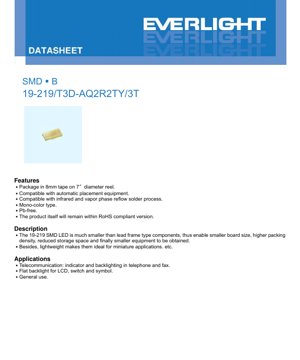
The 19-219/T3D-AQ2R2TY/3T is a compact surface-mount device (SMD) LED, specifically designed for modern electronic applications requiring reliable indicator lights and backlighting. This monochrome LED emits a pure white light, achieved through an InGaN chip encapsulated in yellow diffused resin. Compared to traditional lead-frame LEDs, its primary advantage is a significantly reduced package size, which increases component density on PCBs, lowers storage requirements, and ultimately contributes to the miniaturization of end devices. The component is lead-free and RoHS compliant, making it suitable for environmentally conscious designs.
1.1 Siffofi da fa'idodi na asali
- Miniaturized Package:The compact footprint (1.6mm x 0.8mm) supports high-density board layouts and smaller end products.
- Automation Compatibility:Supplied in 8mm carrier tape and 7-inch reels, fully compatible with standard automatic pick-and-place assembly equipment.
- Robust Solderability:Compatible with infrared reflow and vapor phase reflow soldering processes, ensuring reliable manufacturing quality.
- Environmental Compliance:The product is lead-free and continuously complies with RoHS regulations.
- Light Weight:An ideal choice for portable and miniature applications where weight is a critical factor.
1.2 Yankunan aikace-aikace da aka yi niyya
This LED is versatile and suitable for the following key areas:
- Telecommunications Equipment:Used as status indicators in telephones and fax machines, and for backlighting keys and displays.
- Display Backlighting:Suitable for flat backlighting of LCD panels, and for backlighting switches and symbols.
- General Indication:Can be used in various consumer electronics, industrial controls, and automotive interiors requiring a compact white light source.
2. Cikakken bayani na ƙayyadaddun fasaha
This section provides a detailed analysis of the absolute maximum ratings and key operating parameters of the LED. Adhering to these limits is crucial for ensuring long-term reliability and preventing device damage.
2.1 Matsakaicin ƙididdiga na cikakken iyaka
These ratings define the stress limits that could cause permanent damage to the device. Operation at or near these limits is not recommended.
- Reverse Voltage (VR):5V. Exceeding this voltage under reverse bias may lead to junction breakdown.
- Continuous Forward Current (IF):25mA. Maximum continuous DC current.
- Peak forward current (IFP):100mA (duty cycle 1/10, frequency 1kHz). Allows brief high-current pulses, suitable for multiplexing or pulsed operation.
- Power dissipation (Pd):95mW. Maximum power that the package can dissipate, calculated as VF* IF.
- Electrostatic discharge (ESD):150V (human body model). Proper ESD handling procedures must be followed during assembly and operation.
- Operating temperature (Topr):-40°C to +85°C. The ambient temperature range that ensures reliable operation.
- Storage temperature (Tstg):-40°C to +90°C.
- Soldering temperature:Reflow soldering: maximum 260°C, duration not exceeding 10 seconds. Hand soldering: maximum 350°C per solder terminal, duration not exceeding 3 seconds.
2.2 Electro-Optical Characteristics
These are typical performance parameters measured at an ambient temperature (Ta) of 25°C. Designers should use typical values for initial calculations, but the design must accommodate the min/max range.
- Luminous intensity (Iv):90.0 - 180 mcd (min to max, binned). Measured at a forward current (IF) of 5mA. The wide range is managed through a binning system detailed later.
- Viewing angle (2θ1/2):130 degrees (typical). This wide viewing angle makes it suitable for applications requiring wide-angle illumination or multi-angle visibility.
- Forward voltage (VF):2.6V - 3.0V (at IF=5mA condition). This parameter is also binned. A current-limiting resistor must be used in series with the LED, based on the supply voltage and VF range.
- Reverse current (IR):Maximum 50 µA (at VR=5V condition). This indicates the leakage current level when the device is reverse biased.
3. Binning System Description
To ensure consistency in brightness and color during production, LEDs are sorted into different grades based on measured performance. The 19-219 LED employs three independent grading criteria.
3.1 Luminous Intensity Binning
LEDs are classified into different grades (Q1, R1, R2) based on their luminous intensity measured at a 5mA current. This allows designers to select the appropriate brightness level for their application, ensuring a uniform appearance in multi-LED designs.
- Gear Q1:90.0 - 112 mcd
- Gear R1:112 - 140 mcd
- Gear R2:140 - 180 mcd
3.2 Forward Voltage Binning
LEDs are also binned according to their forward voltage (VF) bin daidaitawa. Matching VFMatsayin daidaitawa yana taimakawa wajen samar da rarraba ƙarfin lantarki mafi daidaito lokacin haɗa LED a jere.
- Matsayi 28:2.6V - 2.7V
- Matsayi 29:2.7V - 2.8V
- Matsayi 30:2.8V - 2.9V
- Matsayi 31:2.9V - 3.0V
3.3 Chromaticity Coordinate Binning
For white LEDs, color consistency is crucial. Products are categorized into six bins (1-6) based on their measured CIE 1931 (x, y) chromaticity coordinates under IF=5mA conditions. Each bin defines a quadrilateral area on the CIE chromaticity diagram. The specification requires a coordinate tolerance of ±0.01. In applications where color matching is important, it is essential to select LEDs from the same chromaticity bin.
4. Performance Curve Analysis
The datasheet provides several characteristic curves that illustrate the LED's behavior under different conditions. Understanding these curves is key to optimizing circuit design.
4.1 Forward Current vs. Forward Voltage (I-V Curve)
Wannan lanƙwasa yana nuna alaƙar da ba ta layi tsakanin ƙarfin lantarki da ƙarfin wutar lantarki. Ƙarfin lantarki mai kyau yana ƙaruwa yayin da ƙarfin lantarki ke ƙaruwa. Wannan lanƙwasa yana da mahimmanci don zaɓar ƙimar resistor mai iyakancewa da ya dace. Ƙananan canje-canjen ƙarfin lantarki na iya haifar da babban canjin ƙarfin lantarki, wanda ke nuna wajabcin daidaita ƙarfin lantarki.
4.2 Luminous Intensity vs. Forward Current
Wannan hoto yana nuna cewa, a cikin kewayon aiki, fitar da haske yana daidai da ƙarfin lantarki mai kyau. Duk da haka, a cikin ƙarfin lantarki mai ƙarfi sosai, yuwuwar aiki na iya raguwa saboda ƙaruwar zafi.
4.3 Luminous Intensity vs. Ambient Temperature
Fitar da haske na LED yana raguwa yayin da zafin jiki ya ƙaru. Wannan lanƙwasa yana ƙididdige wannan alaƙar rage ƙima. Don yanayin zafi mai zafi ko aiki mai ƙarfi, dole ne a yi la'akari da sarrafa zafi don kiyaye haske.
4.4 Forward Current Derating Curve
Wannan lanƙwasa ta ayyana alaƙar aiki tsakanin mafi girman ƙarfin kwarara mai ci gaba da yanayin zafi na muhalli. Yayin da zafin ya ƙaru, dole ne a rage mafi girman ƙarfin kwarara don hana wuce iyakar amfani da wutar lantarki na na'urar kuma a tabbatar da amincinta.
4.5 Spectral Distribution
Lanƙwasa fitar da bakan tana nuna ƙarfin dangi na wannan LED farin haske a mabanbantan tsayin raƙuman ruwa. Yawanci tana da kololuwar shuɗi daga guntuwar InGaN da kuma mafi faɗin fitar da rawaya daga phosphor, waɗanda suka haɗu don samar da farin haske.
4.6 Radiation Pattern
Wannan zanen ma'aunin igiyoyin ruwa na iyakacin duniya yana nuna rarraba sararin samaniya na haske (yanayin kallon) a bayyane, yana tabbatar da matsakaicin kallon digiri 130.
5. Mechanical and Packaging Information
5.1 Package Dimensions
The compact package size of the LED is 1.6mm (length) x 0.8mm (width), with a typical height of 0.77mm. Key dimensions include pad pitch and size. A recommended pad layout is provided to ensure reliable solder joint connections and proper alignment during the reflow soldering process. The cathode is identified by a specific pad marking or a chamfer on the package bottom view.
5.2 Polarity Identification
Correct polarity is crucial. The cathode pad is clearly marked in the package drawing. On the carrier tape, the polarity direction is also indicated to guide automated assembly equipment.
6. Soldering and Assembly Guide
6.1 Tsarin Zazzabi na Solder na Gudu
For lead-free soldering, specific temperature profiles must be followed:
- Preheating:150-200°C, for 60-120 seconds.
- Time above liquidus (217°C):60-150 seconds.
- Peak temperature:Maximum 260°C, with a dwell time not exceeding 10 seconds.
- Heating/Cooling rate:Maximum 3°C per second when heating up to 255°C, with an overall maximum of 6°C per second.
6.2 Walda da Hannu
If manual soldering is necessary, extra caution is required. Use a soldering iron with a tip temperature below 350°C, and heat each solder terminal for no more than 3 seconds. The soldering iron power should be 25W or lower. Allow at least a 2-second interval between soldering each terminal to prevent thermal shock.
6.3 Ajiya da Kula da Danshi
LED packages are in moisture barrier bags with desiccant.
- Before Opening:Store at ≤30°C and ≤90% relative humidity (RH).
- After Opening (Workshop Life):Can be stored for 1 year under conditions of ≤30°C and ≤60% RH. Unused components should be resealed.
- Baking:If the desiccant indicator changes color or the storage time is exceeded, bake at 60±5°C for 24 hours before using the reflow soldering process.
6.4 Muhimman Abubuwan da za a Lura
- Current Limiting:An external series resistor must be used. Without it, even minor power supply voltage fluctuations can cause massive, destructive current surges.
- Mechanical Stress:Avoid applying stress to the LED body during soldering or final application. Do not bend the PCB after assembly.
- Rework:Rework after soldering is strongly discouraged. If unavoidable, a dedicated dual-tip soldering iron must be used to simultaneously heat both solder terminals to prevent mechanical stress caused by thermal expansion mismatch.
7. Bayani game da Marufi da Oda
7.1 Ƙayyadaddun Reel da Kayan Aiki
Components are supplied on 8mm wide carrier tape wound on standard 7-inch diameter reels. Each reel contains 3000 pieces. Detailed reel and tape dimensions are provided to ensure compatibility with automated assembly equipment.
7.2 Bayanin Tambari
The reel label contains multiple codes:
- P/N:Product Number (e.g., 19-219/T3D-AQ2R2TY/3T).
- CAT:Luminous Intensity Grade (e.g., Q1, R1, R2).
- HUE:Chromaticity Coordinates and Dominant Wavelength Grade (e.g., 1-6).
- REF:Forward voltage rating (e.g., 28-31).
- LOT No:Traceable production lot number.
8. Tunani game da Ƙirar Aikace-aikace
8.1 Circuit Design
The most critical aspect of driving this LED is current regulation. For many applications, a simple series resistor is sufficient. The resistor value (Rs) can be calculated using Ohm's Law: Rs= (Vsupply- VF) / IF. Always use the maximum V value within the gear range.Fvalue to ensure that when VFsupplyis at its maximum, the current does not exceed the required I. To maintain stability during temperature changes or with variable power supply voltage, consider using a constant current driver.
8.2 Thermal Management
Ko da yake amfani da wutar lantarki ya yi ƙasa, a cikin yanayin zafi mai girma ko kuma a cikin sarari mai ƙarfi, zafin jiki na iya ƙaruwa, wanda zai rage fitowar haske da kuma tsawon rayuwa. Tabbatar da isasshen iska ko kuma tsarin sanyaya a cikin tsarin PCB, musamman a lokacin amfani da LED da yawa a jere.
8.3 Optical Design
Kallon digiri 130 yana ba da haske mai fadi da kuma watsawa. Don aikace-aikacen da ke buƙatar haske mai maida hankali, ana buƙatar na'urori na gani na biyu (lenses). Resin mai watsawa mai launin rawaya yana taimakawa wajen samun kamanni mai haske daidai.
9. Technical Comparison and Positioning
19-219 LED yana cikin rukunin SMD LED masu ƙanƙanta sosai. Babban bambancinsa shine ƙaramin girman fakitin sa na 1.6mm x 0.8mm, wanda ya fi na kowa 0603 (yanki iri ɗaya amma siffa daban) ko kuma fakitin 0805 ƙanƙanta. Wannan ya sa ya zama zaɓi mai kyau ga aikace-aikacen da ke da ƙarancin sarari, inda kowace milimita murabba'i ke da muhimmanci. Idan aka kwatanta da PLCC mafi girma ko kuma LED na ramuka, yana ba da yawan fakitin da ya fi girma, kuma ya zama dole don haɗa kai ta atomatik na zamani. Farin tsantsa da aka samu ta hanyar guntu na shuɗi da foda mai launin rawaya, yana ba da zafin farin tsaka-tsaki zuwa sanyi wanda ya dace da amfani da alamun nuni da hasken baya.
10. Frequently Asked Questions (FAQ)
10.1 Why is a current-limiting resistor absolutely necessary?
An LED is a diode, and its I-V curve in the forward region is very steep. A voltage slightly exceeding the nominal VFwill cause a disproportionately large increase in current, which can immediately damage the device due to overheating. The resistor provides a linear, predictable voltage drop, thereby stabilizing the current.
10.2 Can I drive this LED with a 5V power supply?
Yes, but a series resistor must be used. For example, to achieve IF=20mA when VFis 3.0V (maximum), the resistor value should be R = (5V - 3.0V) / 0.020A = 100 ohms. The power dissipated by the resistor is P = I2R = (0.02^2)*100 = 0.04W, so a standard 1/8W or 1/10W resistor is sufficient.
10.3 What does the binning code mean for my design?
If your design uses multiple LEDs and requires uniform brightness, you should specify LEDs from the same luminous intensity bin (CAT) and chromaticity bin (HUE). If you drive LEDs in parallel, using the same forward voltage bin (REF) helps achieve more balanced current distribution, although using a separate resistor for each LED remains the most reliable method.
10.4 How sensitive is this LED to ESD?
Its ESD rating is 150V (HBM), indicating medium sensitivity. Standard ESD precautions should be observed during handling: use grounded workstations, wrist straps, and conductive containers. The automatic tape and reel packaging helps minimize manual handling.
11. Design and Application Case Studies
11.1 Case Study: Multi-LED Status Indicator Panel
Consider designing a compact control panel with 12 white status indicator lights. Using the 19-219 LED allows them to be placed at very tight spacing. To ensure a uniform appearance, the designer specifies all LEDs from bin R1 (112-140 mcd) and chromaticity bin 3. Each LED is driven from a 5V supply rail through a 150-ohm series resistor, setting the current to approximately 13mA (assuming VF~ 3.0V), which is well below the 25mA limit and provides ample brightness while maximizing lifespan. The PCB layout incorporates the recommended pad geometry and includes small thermal relief connections to the pads to facilitate soldering while maintaining a good thermal path.
12. Introduction to Technical Principles
This white LED is based on a semiconductor principle called electroluminescence. Its core is an indium gallium nitride (InGaN) chip that emits blue light when a forward current is applied across its p-n junction. This blue light then strikes a layer of yellow phosphor (ceramic particles) encapsulated in epoxy resin. The phosphor absorbs a portion of the blue light and re-emits it as yellow light. The remaining blue light and the converted yellow light combine to be perceived by the human eye as white light. The specific ratio of chip emission to phosphor conversion efficiency determines the exact color temperature (warm white, neutral white, cool white) and chromaticity coordinates of the resulting white light.
13. Industry Trends and Development
The trend for indicator and backlight LEDs continues towards miniaturization, higher efficiency, and improved color consistency. Packages like the 19-219 represent ongoing efforts to reduce size while maintaining or improving optical performance. Furthermore, to meet automotive and industrial standards, the industry is continuously pushing for higher reliability over wider temperature ranges and harsher environmental conditions. The use of lead-free and RoHS-compliant materials has become standard. Future developments may include smaller form factors, integration of driving circuits within the package, and tunable color temperature LEDs for smart lighting applications. However, for simple indicator roles, the core technology of blue chip + phosphor will remain dominant due to its cost-effectiveness and reliability.
Detailed Explanation of LED Specification Terminology
Complete Explanation of LED Technical Terminology
I. Core Indicators of Photoelectric Performance
| Terminology | Unit/Representation | Layman's Explanation | Why It Is Important |
|---|---|---|---|
| Luminous Efficacy | lm/W (lumens per watt) | The luminous flux emitted per watt of electrical power; higher values indicate greater energy efficiency. | Directly determines the energy efficiency rating of the luminaire and the electricity cost. |
| Luminous Flux | lm (lumen) | The total amount of light emitted by a light source, commonly referred to as "brightness". | Determines if the light fixture is bright enough. |
| Viewing Angle | ° (degrees), e.g., 120° | The angle at which light intensity drops to half, determining the beam width. | Affects the illumination range and uniformity. |
| CCT | K (Kelvin), misali 2700K/6500K | Launin haske mai dumi da sanyi, ƙananan ƙima suna karkata zuwa rawaya/dumi, manyan ƙima suna karkata zuwa fari/sanyi. | Yana ƙayyade yanayin haske da kuma yanayin da ya dace. |
| Ma'aunin nuna launi (CRI / Ra) | Ba shi da raka'a, 0–100 | Ƙarfin tushen haske na mayar da ainihin launin abu, Ra≥80 ya fi kyau. | Affects color fidelity, used in high-demand places like shopping malls and art galleries. |
| Color tolerance (SDCM) | MacAdam ellipse steps, e.g., "5-step" | A quantitative indicator of color consistency; the smaller the step number, the more consistent the color. | Ensures no color variation among the same batch of luminaires. |
| Dominant Wavelength | nm (nanometer), misali 620nm (ja) | Rangi ya LED ya rangi inayolingana na thamani ya urefu wa mawimbi. | Huamua rangi ya LED moja kama nyekundu, manjano, kijani, n.k. |
| Spectral Distribution | Mkunjo wa Urefu wa Mawimbi dhidi ya Nguvu | Inaonyesha usambazaji wa nguvu ya mwanga unaotolewa na LED katika kila urefu wa mawimbi. | Yana tasiri ga launi da ingancin launi. |
II. Electrical Parameters
| Terminology | Alama. | Layman's Explanation | Abubuwan da ake la'akari da su na zane. |
|---|---|---|---|
| Forward Voltage (Forward Voltage). | Vf. | Minimum voltage required to light up an LED, similar to a "starting threshold". | The driving power supply voltage must be ≥ Vf; voltages add up when multiple LEDs are connected in series. |
| Forward Current | If | The current value that allows an LED to emit light normally. | Constant current drive is commonly used, where the current determines brightness and lifespan. |
| Maximum Pulse Current (Pulse Current) | Ifp | Peak current that can be withstood for a short time, used for dimming or flashing. | Pulse width and duty cycle must be strictly controlled, otherwise overheating damage will occur. |
| Reverse Voltage (Reverse Voltage) | Vr | The maximum reverse voltage that an LED can withstand; exceeding this may cause breakdown. | The circuit must be protected against reverse connection or voltage surges. |
| Thermal Resistance | Rth (°C/W) | The resistance to heat flow from the chip to the solder joint; a lower value indicates better heat dissipation. | High thermal resistance requires a stronger heat dissipation design; otherwise, the junction temperature will rise. |
| ESD Immunity | V (HBM), e.g., 1000V | The higher the ESD resistance value, the less susceptible the component is to damage from electrostatic discharge. | Anti-static measures must be implemented during production, especially for high-sensitivity LEDs. |
III. Thermal Management and Reliability
| Terminology | Key Indicators | Layman's Explanation | Tasiri |
|---|---|---|---|
| Junction Temperature | Tj (°C) | Yanayin aiki na ainihi a cikin guntu na LED. | Kowane raguwa na 10°C, rayuwa na iya tsawaita sau biyu; yawan zafi yana haifar da raguwar haske, karkatar launi. |
| Lumen Depreciation | L70 / L80 (hours) | The time required for brightness to drop to 70% or 80% of its initial value. | Directly defines the "useful life" of an LED. |
| Lumen Maintenance | % (e.g., 70%) | The percentage of remaining brightness after a period of use. | Characterizes the ability to maintain brightness after long-term use. |
| Color Shift | Δu′v′ or MacAdam Ellipse | The degree of color change during use. | Affects the color consistency of the lighting scene. |
| Thermal Aging | Material performance degradation | Degradation of packaging materials due to prolonged high temperature. | May lead to decreased brightness, color shift, or open-circuit failure. |
IV. Packaging and Materials
| Terminology | Common Types | Layman's Explanation | Characteristics and Applications |
|---|---|---|---|
| Packaging Type | EMC, PPA, Ceramic | A housing material that protects the chip and provides optical and thermal interfaces. | EMC offers good heat resistance and low cost; ceramic provides superior heat dissipation and long lifespan. |
| Chip Structure | Wire Bond, Flip Chip | Chip electrode arrangement method. | Flip-chip offers better heat dissipation and higher luminous efficacy, suitable for high-power applications. |
| Phosphor coating | YAG, silicate, nitride | Coated on the blue LED chip, partially converting to yellow/red light, mixing to form white light. | Different phosphors affect luminous efficacy, color temperature, and color rendering. |
| Lens/Optical Design | Flat, Microlens, Total Internal Reflection | Optical structure on the encapsulation surface, controlling light distribution. | Determines the emission angle and light distribution curve. |
V. Quality Control and Binning
| Terminology | Binning Content | Layman's Explanation | Purpose |
|---|---|---|---|
| Luminous Flux Binning | Codes such as 2G, 2H | Grouped by brightness level, each group has a minimum/maximum lumen value. | Ensure consistent brightness within the same batch of products. |
| Voltage Binning | Codes such as 6W, 6X | Grouped by forward voltage range. | Facilitates driver power matching and improves system efficiency. |
| Color binning | 5-step MacAdam ellipse | Grouped by color coordinates to ensure colors fall within a very small range. | Ensure color consistency to avoid uneven color within the same luminaire. |
| Color temperature binning. | 2700K, 3000K, etc. | Group by color temperature, each group has a corresponding coordinate range. | Meet the color temperature requirements of different scenarios. |
VI. Testing and Certification
| Terminology | Standard/Test | Layman's Explanation | Meaning |
|---|---|---|---|
| LM-80 | Lumen Maintenance Test | Long-term operation under constant temperature conditions, recording luminance attenuation data. | Used to estimate LED lifespan (in conjunction with TM-21). |
| TM-21 | Standard na ƙayyadaddun rayuwa | Ƙididdigar rayuwa a yanayin amfani na ainihi bisa bayanan LM-80. | Bayar da hasashen rayuwa na kimiyya. |
| IESNA Standard | Ma'aunin Ƙungiyar Injiniyoyin Haske | Covering optical, electrical, and thermal testing methods. | Industry-recognized testing basis. |
| RoHS / REACH | Environmental certification. | Ensuring products are free from harmful substances (e.g., lead, mercury). | Entry requirements for the international market. |
| ENERGY STAR / DLC | Tabbatar da ingancin kuzari | Tabbatar da ingancin kuzari da aiki don samfuran haske. | Ana amfani da shi sau da yawa a cikin sayayyar gwamnati da shirye-shiryen tallafi, don haɓaka gasar kasuwa. |