Table of Contents
- 1. Product Overview
- 1.1 Core Advantages and Target Market
- 2. In-Depth Technical Parameter Analysis
- 2.1 Absolute Maximum Ratings
- 2.2 Electro-Optical Characteristics
- 3. Binning System Explanation
- 3.1 Luminous Intensity Binning
- 3.2 Dominant Wavelength Binning
- 3.3 Forward Voltage Binning
- 4. Performance Curve Analysis
- 5. Mechanical and Package Information
- 5.1 Package Dimensions and Drawing
- 5.2 Polarity Identification
- 6. Soldering and Assembly Guidelines
- 6.1 Reflow Soldering Profile
- 6.2 Hand Soldering Instructions
- 6.3 Storage and Moisture Sensitivity
- 7. Packaging and Ordering Information
- 7.1 Packaging Specifications
- 7.2 Label Explanation
- 8. Application Design Recommendations
- 8.1 Typical Application Circuits
- 8.2 Design Considerations and Precautions
- 9. Technical Comparison and Differentiation
- 10. Frequently Asked Questions (FAQ)
- 10.1 What resistor should I use with a 3.3V supply?
- 10.2 Can I drive this LED with a PWM signal for brightness control?
- 10.3 Why is the storage and baking information so important?
- 10.4 How do I interpret the bin codes when ordering?
- 11. Misalai na Aikace-aikace na Aiki
- 11.1 Automotive Dashboard Switch Backlighting
- 11.2 Status Indicator on a Network Router
- 12. Operating Principle Introduction
- 13. Technology Trends and Context
- 14. Application Restrictions Disclaimer
1. Product Overview
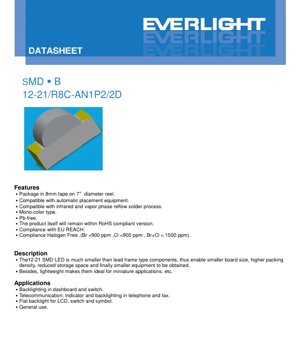
The 12-21 SMD LED is a compact, surface-mount device designed for high-density electronic assemblies. Utilizing AlGaInP chip technology, it emits a deep red light with a typical dominant wavelength of 650 nm. Its primary advantage lies in its significantly reduced footprint compared to traditional leaded LEDs, enabling miniaturization of end products. The component is packaged on 8mm tape within 7-inch reels, making it fully compatible with high-speed automated pick-and-place and soldering equipment. It is a mono-color, Pb-free device compliant with RoHS, EU REACH, and halogen-free standards (Br <900 ppm, Cl <900 ppm, Br+Cl < 1500 ppm).
1.1 Core Advantages and Target Market
The miniaturized 1206 package format (approximately 3.2mm x 1.6mm) allows for smaller printed circuit board (PCB) designs, higher component packing density, and reduced storage and shipping costs. Its lightweight construction makes it ideal for portable and space-constrained applications. Key target markets include consumer electronics, industrial controls, and automotive interiors, specifically for backlighting functions in instrument clusters, switch panels, and membrane keypads. It is also suitable for status indicators in telecommunication devices (e.g., phones, fax machines) and general-purpose indicator applications.
2. In-Depth Technical Parameter Analysis
This section provides a detailed, objective interpretation of the key electrical, optical, and thermal parameters defined in the datasheet.
2.1 Absolute Maximum Ratings
These ratings define the stress limits beyond which permanent damage to the device may occur. Operation under or at these limits is not guaranteed.
- Reverse Voltage (VR): 5V. Exceeding this voltage in reverse bias can cause junction breakdown.
- Continuous Forward Current (IF): 25 mA. The DC current that can be continuously applied.
- Peak Forward Current (IFP): 60 mA (Duty Cycle 1/10, 1 kHz). This rating is for pulsed operation, reducing average power dissipation.
- Power Dissipation (Pd): 60 mW at Ta=25°C. The maximum allowable power loss, calculated as VF * IF. This rating derates with increasing ambient temperature.
- Electrostatic Discharge (ESD): 2000V (Human Body Model). Yana nuna da hankali na matsakaici na ESD; ana buƙatar hanyoyin sarrafa da suka dace.
- Operating & Storage Temperature: -40°C to +85°C (Operating), -40°C to +90°C (Storage). Specifies the environmental range for reliable function and non-operational storage.
- Soldering Temperature: Reflow: 260°C peak for 10 seconds max. Hand Soldering: 350°C for 3 seconds max per terminal. Critical for assembly process control.
2.2 Electro-Optical Characteristics
Measured at Ta=25°C and IF=20 mA, these are the typical performance parameters.
- Luminous Intensity (Iv): 28.5 to 72.0 mcd (millicandela). Iva iyoyamikira kwa LED. Mipimo yosiyanasiyana imayendetsedwa kupitiriza njira ya binning (onani Gawo 3).
- Kuwona Kona (2θ1/2): Digiri 120 (zambiri). Kona yakuthwa iyi imapereka njira yowala yofala yoyenera kugwiritsidwa ntchito m'mbuyo ndi zofotokozera zosiyanasiyana.
- Peak Wavelength (λp): 650 nm (typical). The wavelength at which the spectral power distribution is maximum.
- Dominant Wavelength (λd): 629.5 to 645.5 nm. This is the single-wavelength perception of the LED's color by the human eye, also managed through binning.
- Spectral Bandwidth (Δλ): 20 nm (typical). The width of the emitted spectrum at half the maximum intensity (FWHM).
- Forward Voltage (VF): 1.75 to 2.35 V at IF=20mA. The voltage drop across the LED when operating. Lower VF can improve system efficiency.
- Reverse Current (IR): 10 μA max at VR=5V. A small leakage current when the device is reverse-biased.
3. Binning System Explanation
To ensure color and brightness consistency in production, LEDs are sorted into bins. The 12-21 LED uses three independent binning criteria.
3.1 Luminous Intensity Binning
LEDs are categorized into four bins (N1, N2, P1, P2) based on their measured luminous intensity at 20mA. This allows designers to select a brightness grade suitable for their application, ensuring uniform appearance in multi-LED arrays.
- Bin N1: 28.5 - 36.0 mcd
- Bin N2: 36.0 - 45.0 mcd
- Bin P1: 45.0 - 57.0 mcd
- Bin P2: 57.0 - 72.0 mcd
3.2 Dominant Wavelength Binning
Color consistency is controlled by binning the dominant wavelength into four codes (E7, E8, E9, E10). This is crucial for applications where precise color matching is required.
- Bin E7: 629.5 - 633.5 nm
- Bin E8: 633.5 - 637.5 nm
- Bin E9: 637.5 - 641.5 nm
- Bin E10: 641.5 - 645.5 nm
3.3 Forward Voltage Binning
Forward voltage is binned to aid in current-limiting resistor calculation and to manage power dissipation in series strings. Three bins (0, 1, 2) are defined.
- Bin 0: 1.75 - 1.95 V
- Bin 1: 1.95 - 2.15 V
- Bin 2: 2.15 - 2.35 V
4. Performance Curve Analysis
While specific graphs are not detailed in the provided text, typical performance curves for such an LED would include the following relationships, critical for design:
- I-V (Current-Voltage) Curve: Shows the exponential relationship between forward voltage and current. The knee voltage is around 1.8V. A current-limiting resistor is mandatory as a slight increase in voltage beyond VF causes a large, potentially destructive, increase in current.
- Luminous Intensity vs. Forward Current: Intensity increases approximately linearly with current up to the maximum rating. Operating above IF=20mA increases brightness but also power dissipation and junction temperature.
- Luminous Intensity vs. Ambient Temperature: Intensity typically decreases as ambient temperature rises due to reduced internal quantum efficiency and other thermal effects. This is a key consideration for high-temperature environments.
- Spectral Distribution: A plot of relative intensity vs. wavelength, showing a peak around 650nm with a ~20nm FWHM, confirming the deep red color point.
- Forward Voltage vs. Temperature: VF has a negative temperature coefficient, meaning it decreases as junction temperature increases. This can affect constant-current drive stability.
5. Mechanical and Package Information
5.1 Package Dimensions and Drawing
The LED conforms to a standard 1206 (3216 metric) SMD footprint. Key dimensions (in mm, tolerance ±0.1mm unless specified) include: overall length (3.2), width (1.6), and height (1.1). The drawing specifies the cathode identification mark, typically a green stripe or a chamfered corner on the package. The recommended land pattern (solder pad) dimensions on the PCB are crucial for reliable soldering and are usually slightly larger than the device terminals to form a proper fillet.
5.2 Polarity Identification
Correct orientation is vital. The cathode is marked on the device. The datasheet diagram must be consulted to identify this marking (e.g., a colored band, a notch). Incorrect polarity will prevent the LED from illuminating and applying a reverse voltage above 5V may damage it.
6. Soldering and Assembly Guidelines
6.1 Reflow Soldering Profile
The LED is compatible with infrared and vapor phase reflow. A lead-free (Pb-free) temperature profile is specified:
- Pre-heating: 150-200°C for 60-120 seconds. Gradual heating to minimize thermal shock.
- Time Above Liquidus (217°C): 60-150 seconds.
- Peak Temperature: 260°C maximum, held for no more than 10 seconds.
- Maximum Ramp-Up Rate: 3°C/second.
- Maximum Ramp-Down Rate: 6°C/second.
6.2 Hand Soldering Instructions
If manual repair is necessary:
- Use a soldering iron with a tip temperature < 350°C.
- Apply heat to each terminal for < 3 seconds.
- Use an iron with power rating < 25W.
- A ba da mafi ƙarancin tazarar daƙiƙa 2 tsakanin gyaɗa kowane tashar.
- Don cirewa, ana ba da shawarar ƙarfe mai gyaɗa mai ƙaho biyu don dumama tashoshi biyu lokaci guda kuma a guji matsin inji.
6.3 Storage and Moisture Sensitivity
The device is packaged in a moisture-resistant bag with desiccant.
- Before Opening: Ajiye a ≤30°C da ≤90% RH.
- Bayan Budewa (Rayuwar Benen): Shekara 1 a ≤30°C da ≤60% RH. Dole ne a sake rufe na'urorin da ba a yi amfani da su ba a cikin jakar hana danshi.
- Baking: If the desiccant indicator changes color or storage time is exceeded, bake at 60 ±5°C for 24 hours before use to remove absorbed moisture and prevent "popcorning" during reflow.
7. Packaging and Ordering Information
7.1 Packaging Specifications
LEDs are supplied in embossed carrier tape on 7-inch diameter reels. Each reel contains 2000 pieces. The tape dimensions (pocket size, pitch) are specified to ensure compatibility with automated feeders. The reel has specific hub, flange, and outer dimensions for mounting on placement machines.
7.2 Label Explanation
The reel label contains critical information for traceability and correct application:
- P/N: Full product number (e.g., 12-21/R8C-AN1P2B/2D).
- QTY: Quantity on the reel.
- CAT (or Luminous Intensity Rank): The intensity bin code (e.g., P1).
- HUE (Chromaticity/Wavelength Rank): The dominant wavelength bin code (e.g., E9).
- REF (Forward Voltage Rank): The voltage bin code (e.g., 1).
- LOT No: Manufacturing lot number for quality tracking.
8. Application Design Recommendations
8.1 Typical Application Circuits
The most common drive method is a series current-limiting resistor. The resistor value (Rs) is calculated using Ohm's Law: Rs = (Vsupply - VF) / IF. Using the maximum VF from the bin (e.g., 2.35V for Bin 2) ensures sufficient current even with worst-case LED variation. For a 5V supply and IF=20mA: Rs = (5 - 2.35) / 0.02 = 132.5Ω. A standard 130Ω or 150Ω resistor would be suitable. The resistor's power rating should be at least (IF2 * Rs).
8.2 Design Considerations and Precautions
- Current Limiting is Mandatory: As emphasized in the "Precautions," an external current-limiting mechanism (resistor or constant-current driver) is absolutely required. Connecting directly to a voltage source will destroy the LED.
- Thermal Management: While a single LED dissipates only ~60mW, high-density arrays or operation at high ambient temperatures require attention to PCB layout for heat dissipation. Avoid placing near other heat sources.
- ESD Protection: Implement ESD-safe handling procedures during assembly. Circuit-level ESD protection may be necessary in sensitive environments.
- Optical Design: The 120-degree viewing angle provides wide coverage. For focused light, secondary optics (lenses) would be required. The water-clear resin package is suitable for applications where the die color is acceptable or when used with external diffusers.
9. Technical Comparison and Differentiation
Compared to older through-hole (e.g., 3mm, 5mm) red LEDs, the 12-21 SMD LED offers:
- Size Reduction: Drastically smaller footprint and profile, enabling modern miniaturized designs.
- Automation Compatibility: Designed for high-volume, low-cost surface-mount assembly.
- Improved Reliability: SMD packages often have better thermal paths to the PCB and no bent leads that can cause stress.
- Compared to some other SMD red LEDs (e.g., those using InGaN for red), AlGaInP technology typically offers higher efficiency and more saturated color in the red/amber spectrum.
10. Frequently Asked Questions (FAQ)
10.1 What resistor should I use with a 3.3V supply?
Using the maximum VF of 2.35V and target IF of 20mA: R = (3.3 - 2.35) / 0.02 = 47.5Ω. Use a standard 47Ω resistor. Verify current: I = (3.3 - 2.0[typical]) / 47 ≈ 27.7mA, which is above the 25mA continuous rating. To be safe, choose a 68Ω resistor: I = (3.3 - 2.0) / 68 ≈ 19.1mA, which is within spec.
10.2 Can I drive this LED with a PWM signal for brightness control?
Yes. Pulse Width Modulation (PWM) is an excellent method for dimming LEDs. Ensure the peak current in each pulse does not exceed the absolute maximum ratings (IFP = 60mA for 10% duty cycle pulses). The frequency should be high enough to avoid visible flicker (typically >100Hz).
10.3 Why is the storage and baking information so important?
SMD plastic packages can absorb moisture from the air. During the high-temperature reflow soldering process, this trapped moisture can rapidly vaporize, creating internal pressure that can delaminate the package or crack the die ("popcorning"). The storage conditions and baking procedure prevent this failure mode.
10.4 How do I interpret the bin codes when ordering?
For consistent appearance in a product, specify the desired bins for Luminous Intensity (CAT), Dominant Wavelength (HUE), and optionally Forward Voltage (REF). For example, requesting "CAT=P1, HUE=E9" ensures all LEDs will have similar brightness and a very specific shade of deep red. If not specified, you may receive a mix from production.
11. Misalai na Aikace-aikace na Aiki
11.1 Automotive Dashboard Switch Backlighting
In this application, multiple 12-21 LEDs are placed behind translucent switch caps or symbols on a dashboard. The wide 120-degree viewing angle ensures even illumination across the symbol. They are typically driven in parallel strings, each with its own current-limiting resistor, from the vehicle's 12V system (via a voltage regulator). The -40°C to +85°C operating range is suitable for the automotive interior environment. Consistency in wavelength (HUE bin) is critical here to match the color of other interior lighting.
11.2 Status Indicator on a Network Router
A single LED can be used to indicate power or network activity. It is driven by a GPIO pin of a microcontroller. The circuit includes a series resistor (calculated for the MCU's 3.3V or 5V output) and possibly a transistor if the MCU pin cannot source 20mA directly. The deep red color is highly visible. The SMD package allows it to be placed very close to a small indicator window on the router's casing.
12. Operating Principle Introduction
LED 12-21 na'urar hoto ce ta semiconductor. Tsakiyarta shine guntu wanda aka yi daga kayan AlGaInP (Aluminum Gallium Indium Phosphide). Lokacin da ake amfani da ƙarfin lantarki na gaba wanda ya wuce ƙarfin haɗin diode (∼1.8V), ana allurar electrons da ramuka cikin yankin aiki inda suke sake haɗuwa. A cikin wannan tsarin kayan, babban yanki na wannan makamashin sake haɗuwa ana fitar da shi azaman photons (haske) maimakon zafi. Takamaiman abun da ke cikin AlGaInP yana ƙayyade makamashin bandgap, wanda kai tsaye ke ayyana tsayin daka (launi) na hasken da aka fitar—a wannan yanayin, ja mai zurfi kusan 650 nm. Kunshin epoxy resin mai tsabta na ruwa yana rufe guntun, yana ba da kariya ta injiniya, kuma yana aiki azaman ruwan tabarau na farko wanda ke siffanta fitarwar haske zuwa tsarin digiri 120.
13. Technology Trends and Context
The 1206 SMD LED represents a mature and widely adopted packaging technology. Current trends in LED packaging are moving towards even smaller footprints (e.g., 0805, 0603, 0402) for ultra-miniaturization and higher-density arrays. There is also a strong trend towards chip-scale packages (CSP) that eliminate the traditional plastic package for minimal size and optimal thermal performance. For red emission, while AlGaInP remains highly efficient, developments in phosphor-converted LEDs and novel semiconductor materials continue. Furthermore, integration of control electronics (e.g., constant-current drivers, PWM controllers) directly into the LED package ("smart LEDs") is becoming more common for advanced lighting applications. The 12-21 LED sits in a well-established, cost-optimized segment of the market, prized for its reliability, simplicity, and compatibility with standard SMT processes.
14. Application Restrictions Disclaimer
This product is designed for general commercial and industrial applications. It is not specifically qualified or guaranteed for use in high-reliability or safety-critical systems such as:
- Military or aerospace equipment
- Automotive safety systems (e.g., brake lights, airbag controls)
- Medical life-support equipment
LED Specification Terminology
Complete explanation of LED technical terms
Photoelectric Performance
| Term | Unit/Representation | Simple Explanation | Why Important |
|---|---|---|---|
| Luminous Efficacy | lm/W (lumens per watt) | Light output per watt of electricity, higher means more energy efficient. | Directly determines energy efficiency grade and electricity cost. |
| Luminous Flux | lm (lumens) | Total light emitted by source, commonly called "brightness". | Determines if the light is bright enough. |
| Viewing Angle | ° (degrees), e.g., 120° | Angle where light intensity drops to half, determines beam width. | Affects illumination range and uniformity. |
| CCT (Color Temperature) | K (Kelvin), e.g., 2700K/6500K | Warmth/coolness of light, lower values yellowish/warm, higher whitish/cool. | Determines lighting atmosphere and suitable scenarios. |
| CRI / Ra | Unitless, 0–100 | Ability to render object colors accurately, Ra≥80 is good. | Affects color authenticity, used in high-demand places like malls, museums. |
| SDCM | MacAdam ellipse steps, e.g., "5-step" | Color consistency metric, smaller steps mean more consistent color. | Inahakikisha rangi sawa kwenye kundi moja la LED. |
| Dominant Wavelength | nm (nanometers), e.g., 620nm (red) | Wavelength corresponding to color of colored LEDs. | Determines hue of red, yellow, green monochrome LEDs. |
| Spectral Distribution | Wavelength vs intensity curve | Yana nuna yanar gici a tsaka. | Yana shafi launi da inganci. |
Electrical Parameters
| Term | Symbol | Simple Explanation | Design Considerations |
|---|---|---|---|
| Forward Voltage | Vf | Minimum voltage to turn on LED, like "starting threshold". | Driver voltage must be ≥Vf, voltages add up for series LEDs. |
| Forward Current | If | Current value for normal LED operation. | Usually constant current drive, current determines brightness & lifespan. |
| Max Pulse Current | Ifp | Peak current tolerable for short periods, used for dimming or flashing. | Pulse width & duty cycle must be strictly controlled to avoid damage. |
| Reverse Voltage | Vr | Max reverse voltage LED can withstand, beyond may cause breakdown. | Circuit must prevent reverse connection or voltage spikes. |
| Thermal Resistance | Rth (°C/W) | Resistance to heat transfer from chip to solder, lower is better. | High thermal resistance requires stronger heat dissipation. |
| ESD Immunity | V (HBM), e.g., 1000V | Ability to withstand electrostatic discharge, higher means less vulnerable. | Anti-static measures needed in production, especially for sensitive LEDs. |
Thermal Management & Reliability
| Term | Metric Key | Simple Explanation | Impact |
|---|---|---|---|
| Junction Temperature | Tj (°C) | Actual operating temperature inside LED chip. | Kowane raguwar zafin jiki da 10°C na iya ninka tsawon rayuwa; yawan zafi yana haifar da raguwar haske, canjin launi. |
| Lumen Depreciation | L70 / L80 (hours) | Time for brightness to drop to 70% or 80% of initial. | Directly defines LED "service life". |
| Lumen Maintenance | % (e.g., 70%) | Percentage of brightness retained after time. | Indicates brightness retention over long-term use. |
| Color Shift | Δu′v′ or MacAdam ellipse | Degree of color change during use. | Affects color consistency in lighting scenes. |
| Thermal Aging | Material degradation | Deterioration due to long-term high temperature. | May cause brightness drop, color change, or open-circuit failure. |
Packaging & Materials
| Term | Common Types | Simple Explanation | Features & Applications |
|---|---|---|---|
| Package Type | EMC, PPA, Ceramic | Housing material protecting chip, providing optical/thermal interface. | EMC: good heat resistance, low cost; Ceramic: better heat dissipation, longer life. |
| Chip Structure | Front, Flip Chip | Chip electrode arrangement. | Flip chip: better heat dissipation, higher efficacy, for high-power. |
| Phosphor Coating | YAG, Silicate, Nitride | Covers blue chip, converts some to yellow/red, mixes to white. | Different phosphors affect efficacy, CCT, and CRI. |
| Lens/Optics | Flat, Microlens, TIR | Optical structure on surface controlling light distribution. | Determines viewing angle and light distribution curve. |
Quality Control & Binning
| Term | Binning Content | Simple Explanation | Purpose |
|---|---|---|---|
| Luminous Flux Bin | Code e.g., 2G, 2H | Grouped by brightness, each group has min/max lumen values. | Ensures uniform brightness in same batch. |
| Voltage Bin | Code e.g., 6W, 6X | Grouped by forward voltage range. | Facilitates driver matching, improves system efficiency. |
| Color Bin | 5-step MacAdam ellipse | Grouped by color coordinates, ensuring tight range. | Guarantees color consistency, avoids uneven color within fixture. |
| CCT Bin | 2700K, 3000K etc. | Grouped by CCT, each has corresponding coordinate range. | Meets different scene CCT requirements. |
Testing & Certification
| Term | Standard/Test | Simple Explanation | Significance |
|---|---|---|---|
| LM-80 | Lumen maintenance test | Long-term lighting at constant temperature, recording brightness decay. | Used to estimate LED life (with TM-21). |
| TM-21 | Standard ya kukadiria maisha | Inakadiria maisha chini ya hali halisi kulingana na data ya LM-80. | Provides scientific life prediction. |
| IESNA | Illuminating Engineering Society | Covers optical, electrical, thermal test methods. | Industry-recognized test basis. |
| RoHS / REACH | Environmental certification | Ensures no harmful substances (lead, mercury). | Market access requirement internationally. |
| ENERGY STAR / DLC | Energy efficiency certification | Energy efficiency and performance certification for lighting. | Used in government procurement, subsidy programs, enhances competitiveness. |