Table of Contents
- 1. Product Overview
- 1.1 Core Features and Advantages
- 1.2 Target Applications
- 2. Technical Parameter Analysis
- 2.1 Absolute Maximum Ratings
- 2.2 Photoelectric Characteristics
- 3. Binning System Description
- 3.1 Luminous Intensity Binning
- 3.2 Dominant Wavelength Binning
- 3.3 Forward Voltage Binning
- 4. Performance Curve Analysis
- 5. Mechanical and Packaging Information
- 5.1 Package Dimensions
- 5.2 Polarity Identification
- 6. Welding and Assembly Guide
- 6.1 Reflow soldering temperature profile
- 6.2 Manual soldering
- 6.3 Storage and Moisture Sensitivity
- 7. Packaging and Ordering Information
- 7.1 Packaging Specifications
- 7.2 Label Description
- 8. Application Design Considerations
- 8.1 Current Limiting Resistor Must Be Used
- 8.2 Thermal Management
- 8.3 Application Limitations
- 9. Technical Comparison and Differentiation
- 10. Frequently Asked Questions (FAQs)
- 10.1 Why does my LED need a series resistor?
- 10.2 Can I drive this LED with a voltage higher than its VF?
- 10.3 What happens if it is soldered in reverse?
- 10.4 Why is there a 7-day time limit after opening the moisture-proof bag?
- 11. Practical Design and Usage Examples
- 12. Working Principle
- 13. Technical Trends
1. Product Overview
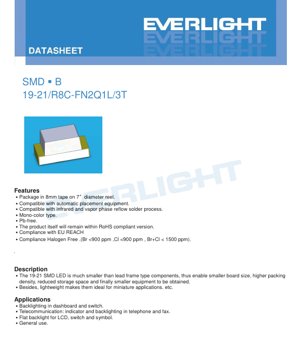
Bu belge, 19-21 paketleme formunu kullanan kompakt yüzey montajlı derin kırmızı LED'in özelliklerini ayrıntılı olarak açıklamaktadır. Bu bileşen, modern otomatik montaj süreçleri için tasarlanmış olup, devre kartı alanı kullanımı ve tasarım küçültme açısından belirgin avantajlar sunar. Ana uygulaması, küçük boyutlu paketleme içinde elde ettiği yüksek parlaklık ve güvenilir performansı sayesinde çeşitli elektronik cihazlarda gösterge ışığı veya arka aydınlatma kaynağı olarak kullanılmaktır.
1.1 Core Features and Advantages
The key advantages of this LED stem from its SMD (Surface Mount Device) structure. Compared to traditional leaded components, it enables:
- 减小电路板尺寸 & 提高密度:The compact 19-21 package allows for tighter component placement, enabling more compact PCB design.
- Compatible with automated production:Available in 8mm carrier tape and 7-inch reels, fully compatible with high-speed placement equipment, simplifying the manufacturing process.
- Environmental Compliance:产品无铅,符合 RoHS 和欧盟 REACH 法规,并满足无卤素标准(Br <900ppm,Cl <900ppm,Br+Cl <1500ppm)。
- High Solder Joint Reliability:Suitable for infrared and vapor phase reflow soldering processes.
1.2 Target Applications
This LED is suitable for various applications requiring reliable red indicator or backlight, including:
- Backlighting for instrument panels, switches, and symbols.
- Status indicator lights and backlighting in communication equipment (e.g., telephones, fax machines).
- General backlight for LCD panels.
- General indicator lights for consumer and industrial electronics.
2. Technical Parameter Analysis
This section provides a detailed and objective interpretation of the key electrical, optical, and thermal parameters that define the performance range of LEDs.
2.1 Absolute Maximum Ratings
These ratings define the limits that may cause permanent damage to the device. Operation under these conditions is not guaranteed.
- Reverse Voltage (VR):5V. Exceeding this voltage under reverse bias may cause immediate junction breakdown.
- Continuous Forward Current (IF):25mA. The maximum DC current to ensure long-term reliable operation.
- Peak Forward Current (IFP):60mA (duty cycle 1/10, frequency 1kHz). Suitable for pulse operation, not suitable for DC.
- Power consumption (Pd):60mW. The maximum power that the package can dissipate at ambient temperature Ta=25°C, limiting the combination of forward voltage and current.
- ESD Sensitivity (HBM):2000V. Inaonyesha kifaa kina uwezo wa kati wa kustahimili umeme wa tuli, lakini bado inahitaji hatua za kawaida za ulinzi dhidi ya ESD.
- Safu ya joto:Joto la kufanya kazi: -40°C hadi +85°C; Joto la kuhifadhi: -40°C hadi +90°C.
- Joto la kuchomelea:Withstand a reflow soldering profile with a peak temperature of 260°C for 10 seconds, or hand soldering at 350°C for 3 seconds per solder terminal.
2.2 Photoelectric Characteristics
At Ta=25°C and IFMeasured under =20mA conditions, these are typical performance parameters.
- Luminous intensity (Iv):Ranges from 36.0 mcd (minimum) to 90.0 mcd (maximum), with a typical tolerance of ±11%. This defines the perceived brightness.
- Viewing angle (2θ1/2):Kusanin kimanin 100 digiri (misali). Wannan fadi na kallo yana ba da kyakkyawan gani daga gefe.
- Kololuwar tsayin raɗaɗi (λp):650 nm (misali). Tsayin raɗaɗi mafi ƙarfi na fitarwa.
- Babban tsayin raɗaɗi (λd):Between 636.0 nm and 646.0 nm. This defines the perceived color (deep red).
- Spectral bandwidth (Δλ):Approximately 20 nm (typical). Indicates the spectral purity of the emitted light.
- Forward voltage (VF):Between 1.70 V and 2.30 V at 20mA, with a typical tolerance of ±0.05V. This is crucial for the calculation of the current-limiting resistor.
- Reverse current (IR):At VR=5V, maximum 10 μA. This device is not suitable for reverse bias operation.
3. Binning System Description
Products are binned according to performance to ensure consistency within the same production lot. Part number 19-21/R8C-FN2Q1/3T includes these binning codes.
3.1 Luminous Intensity Binning
In IFGrading at =20mA. The code "Q1" in the part number corresponds to the highest brightness grade.
- N2:36.0 – 45.0 mcd
- P1:45.0 – 57.0 mcd
- P2:57.0 – 72.0 mcd
- Q1:72.0 – 90.0 mcd
3.2 Dominant Wavelength Binning
In IFBinning at =20mA. Code "FN2" is likely related to this chromaticity sorting.
- FF4:636.0 – 641.0 nm
- FF5:641.0 – 646.0 nm
3.3 Forward Voltage Binning
In IF=20mA time grading. The code "19-21" in the part number indicates the voltage grading range.
- 19:1.70 – 1.80 V
- 20:1.80 – 1.90 V
- 21:1.90 – 2.00 V
- 22:2.00 – 2.10 V
- 23:2.10 – 2.20 V
- 24:2.20 – 2.30 V
4. Performance Curve Analysis
Although the provided text does not detail specific charts, typical curves for such devices include:
- Relative Luminous Intensity vs. Forward Current:How display brightness increases with current, typically growing sublinearly at higher currents due to heating.
- Forward Voltage vs. Forward Current:Demonstrates the exponential I-V characteristic of a diode.
- Relative Luminous Intensity vs. Ambient Temperature:The graph shows the decrease in light output with increasing junction temperature, a key consideration for thermal management.
- Spectral distribution:Relative intensity vs. wavelength plot, centered at 650nm with a bandwidth of approximately 20nm.
Designers should refer to these curves to understand performance under non-standard conditions (different current, temperature).
5. Mechanical and Packaging Information
5.1 Package Dimensions
The nominal dimensions of the 19-21 SMD package are 2.0mm (length) x 1.25mm (width) x 0.8mm (height). A clear cathode mark is indicated on the package to ensure correct orientation. All unspecified tolerances are ±0.1mm. An accurate dimensional drawing is essential for PCB pad layout design.
5.2 Polarity Identification
Correct polarity is crucial. The package has a clear cathode mark. Incorrect insertion will cause the LED to fail to illuminate, as it will be in a reverse-biased state.
6. Welding and Assembly Guide
6.1 Reflow soldering temperature profile
This LED is rated for lead-free reflow soldering. The recommended temperature profile includes:
- Preheat:150–200°C, for 60–120 seconds.
- Time above liquidus (217°C):60–150 seconds.
- Peak temperature:Maximum 260°C, hold time not exceeding 10 seconds.
- Heating/Cooling Rate:Above 255°C, maximum heating rate 6°C/sec, maximum cooling rate 3°C/sec.
Key Points:Reflow soldering should not exceed two times to avoid thermal stress damage.
6.2 Manual soldering
If manual soldering is necessary:
- 使用烙铁头温度 <350°C 的烙铁。
- 每个焊端的接触时间限制在 3 秒以内。Use a soldering iron with a power ≤25W.
- Allow at least 2 seconds between soldering each terminal.
- Avoid applying mechanical stress to the component during soldering.
6.3 Storage and Moisture Sensitivity
Components are packaged in moisture barrier bags with desiccant.
- Before use:Do not open the bag before preparing for assembly.
- After opening:Use within 168 hours (7 days) if stored at ≤30°C and ≤60% RH.
- Exposure Limit:If the exposure time is exceeded or the desiccant indicator shows saturation, baking at 60±5°C for 24 hours is required before reflow soldering to remove moisture.
7. Packaging and Ordering Information
7.1 Packaging Specifications
LEDs are supplied in carrier tape reels suitable for automated assembly.
- Carrier tape width: 8mm.
- Reel diameter:7 inches.
- Quantity per roll:3000 pieces.
- Moisture-proof bag:Contains desiccant and humidity indicator label.
7.2 Label Description
Reel label contains key information for traceability and verification:
- Customer Part Number (CPN)
- Part Number (P/N)
- Quantity (QTY)
- CAT
- HUE
- Forward Voltage Level (REF)
- Lot Number (LOT No.)
8. Application Design Considerations
8.1 Current Limiting Resistor Must Be Used
LED is a current-driven device.An external current-limiting resistor must always be connected in series.The forward voltage has a negative temperature coefficient; a small increase in voltage can lead to a large, potentially destructive increase in current if not properly limited. Use the formula R = (VPower Supply- VF) / IF.
Calculate the resistance value.
8.2 Thermal Management
Although the package is small, the power consumption (up to 60mW) generates heat. For continuous operation in high current or high-temperature environments, ensure sufficient PCB copper foil area or thermal vias are used to conduct heat away from the LED pad to maintain a low junction temperature, thereby achieving optimal lifespan and light output stability.
8.3 Application Limitations
This product is designed for general commercial and industrial applications. It may not be suitable for high-reliability applications without prior certification. Such applications include, but are not limited to, automotive safety/security systems, military/aerospace, and life-critical medical equipment. The device must not be operated outside the conditions specified in this datasheet.
9. Technical Comparison and Differentiation
- The primary differentiation of this 19-21 Deep Red LED lies in the specific combination of its attributes:Compared to larger SMD LEDs (e.g., 3528):
- It offers a significantly smaller footprint for space-constrained designs, although the total light output is typically lower.Compared to standard red LEDs (e.g., 630nm):
- The 650nm deep red emission provides a unique color point, which may be desired for specific aesthetic or functional reasons (e.g., certain sensor applications, specific backlight color requirements).Compared to non-binned LEDs:
A comprehensive binning system (intensity, wavelength, voltage) ensures higher consistency in color and brightness within the same production batch, which is crucial for applications using multiple LEDs where uniformity is important.
10. Frequently Asked Questions (FAQs)
10.1 Why does my LED need a series resistor?
The I-V characteristic of an LED is very steep. Without a resistor to limit the current, any small variation in the supply voltage or forward voltage drop (which changes with temperature) can cause a large change in current, likely exceeding the absolute maximum rating and damaging the LED. The resistor provides a stable, predictable current.F?
10.2 Can I use a voltage higher than its VCan this voltage drive this LED?Yes, butFprovided you must use a series resistor
(or a constant current driver) to reduce the excess voltage and set the correct current. Due to device variations and temperature changes, directly applying a voltage equal to V
is impractical.
10.3 What happens if it is soldered in reverse?
LED will not light up because it will be in a reverse bias state. As long as the reverse voltage does not exceed the maximum rating of 5V, a brief incorrect insertion should not cause immediate damage. However, it will not function.
10.4 Why is there a 7-day time limit after opening the moisture-proof bag?
The plastic packaging of SMD components absorbs moisture from the air. During high-temperature reflow soldering, this trapped moisture rapidly expands, causing internal delamination or the "popcorn" effect, which can damage the LED chip or package. The 7-day floor life assumes proper storage conditions; exceeding this time requires baking to remove moisture.11. Practical Design and Usage Examples
- Scenario:Design a status indicator panel using 10 uniform deep red LEDs, powered by a 5V digital logic power rail.
- Current selection:Select the drive current. For good brightness and lifetime, it is specified as 20mA in the datasheet. Using 15mA will increase lifetime and reduce heat generation.FResistance calculation:FAssuming worst-case VF= 2.3V (maximum value in the datasheet). For a 5V power supply with I
- =20mA: R = (5V - 2.3V) / 0.02A = 135 Ω. The closest standard values are 130 Ω or 150 Ω. Using 150 Ω yields I≈ (5-2.3)/150 = 18mA, which is safe and within the specification range.2Resistor power dissipation:2P = I
- R = (0.018)* 150 = 0.0486W. A standard 1/8W (0.125W) resistor is sufficient.
- PCB layout:Connect a 150Ω resistor in series with the anode of each LED. Design the pad layout according to the package size. Ensure the cathode marking on the PCB silkscreen matches the marking on the LED. For thermal performance, connect the LED pads to a small copper pour.
Assembly:
Keep the reel sealed until the production line is ready. Precisely follow the reflow soldering temperature profile. After assembly, avoid bending the PCB near the LEDs.F12. Working Principle
This LED is based on an AlGaInP (aluminum gallium indium phosphide) semiconductor chip. When a forward voltage exceeding the diode junction potential (V
) is applied, electrons and holes are injected into the active region where they recombine. In this specific material system, the energy released during recombination corresponds to photons in the deep red portion of the visible spectrum (approximately 650nm). The epoxy encapsulation is water-clear to maximize light extraction efficiency and also serves to protect the semiconductor chip from environmental influences.
- 13. Technical Trends19-21 Paketleme, fotonikte küçülme ve entegrasyon yönündeki süregelen eğilimi temsil eder. Günümüzde mevcut en küçük paketleme olmasa da, boyut, üretilebilirlik ve performans arasında bir denge sağlar. Gösterge tipi LED'lerde endüstri trendi şu alanlara odaklanmaya devam etmektedir:
- Verimliliği Artırma:Daha düşük sürücü akımında daha yüksek ışık şiddeti (mcd) elde ederek sistem güç tüketimini azaltmak.
- Enhancing reliability:Improving materials and packaging to withstand higher reflow soldering temperatures and harsher environmental conditions.
- Finer binning:Provide more precise color and intensity sorting to meet the application requirements that demand high uniformity, such as full-color displays or backlight arrays.
Detailed Explanation of LED Specification Terminology
Complete Explanation of LED Technical Terminology
I. Core Indicators of Optoelectronic Performance
| Terminology | Units/Representation | Popular Explanation | Why It Is Important |
|---|---|---|---|
| Luminous Efficacy | lm/W | The luminous flux emitted per watt of electrical power; higher values indicate greater energy efficiency. | Directly determines the energy efficiency rating and electricity cost of the luminaire. |
| Luminous Flux | lm (lumen) | The total amount of light emitted by a light source, commonly known as "brightness". | Determines whether a luminaire is bright enough. |
| Viewing Angle | ° (degrees), e.g., 120° | The angle at which light intensity drops to half determines the beam width. | Affects the illumination range and uniformity. |
| Color Temperature (CCT) | K (Kelvin), e.g., 2700K/6500K | The warmth or coolness of light color; lower values are yellowish/warm, higher values are whitish/cool. | Determining the lighting atmosphere and applicable scenarios. |
| Color Rendering Index (CRI / Ra) | Unitless, 0–100 | The ability of a light source to restore the true color of an object, Ra≥80 is recommended. | Affects color authenticity, used in high-demand places such as shopping malls and art galleries. |
| SDCM (Standard Deviation of Color Matching) | MacAdam ellipse steps, e.g., "5-step" | A quantitative metric for color consistency; a smaller step number indicates higher color consistency. | Ensure no color difference among luminaires from the same batch. |
| Dominant Wavelength | nm (nanometer), misali 620nm (ja) | Rangi ya LED zenye rangi inayolingana na thamani ya urefu wa wimbi. | Inaamua rangi ya LED moja kama nyekundu, manjano, kijani, n.k. |
| Spectral Distribution | Wavelength vs. Intensity Curve | Display the intensity distribution of light emitted by the LED across various wavelengths. | Affects color rendering and color quality. |
II. Electrical Parameters
| Terminology | Symbol | Popular Explanation | Design Considerations |
|---|---|---|---|
| Forward Voltage | Vf | The minimum voltage required to light up an LED, similar to a "starting threshold". | The driving power supply voltage must be ≥ Vf; voltages add up when multiple LEDs are connected in series. |
| Forward Current | If | The current value that makes the LED emit light normally. | Constant current drive is often used, as the current determines brightness and lifespan. |
| Matsakaicin ƙarfin kwararar bugun jini (Pulse Current) | Ifp | Peak current that can be sustained for a short period, used for dimming or flashing. | Pulse width and duty cycle must be strictly controlled to prevent overheating and damage. |
| Reverse Voltage | Vr | The maximum reverse voltage that an LED can withstand; exceeding it may cause breakdown. | Circuit ina buƙatar hana jujjuyawar baya ko kuma ƙarfin wutar lantarki. |
| Thermal Resistance | Rth (°C/W) | The resistance to heat flow from the chip to the solder joint. A lower value indicates better heat dissipation. | High thermal resistance requires a more robust thermal design; otherwise, the junction temperature will increase. |
| ESD Immunity | V (HBM), e.g., 1000V | The higher the value, the more resistant it is to electrostatic damage. | Anti-static measures must be taken during production, especially for high-sensitivity LEDs. |
III. Thermal Management and Reliability
| Terminology | Key Indicators | Popular Explanation | Impact |
|---|---|---|---|
| Junction Temperature | Tj (°C) | The actual operating temperature inside the LED chip. | For every 10°C reduction, lifespan may double; excessively high temperatures cause lumen depreciation and color shift. |
| Lumen Depreciation | L70 / L80 (hours) | The time required for brightness to drop to 70% or 80% of its initial value. | Directly defines the "service life" of an LED. |
| Lumen Maintenance | % (e.g., 70%) | The percentage of remaining brightness after a period of use. | Characterizes the ability to maintain brightness after long-term use. |
| Color Shift | Δu′v′ or MacAdam ellipse | The degree of color change during use. | Affects the color consistency of the lighting scene. |
| Thermal Aging | Material performance degradation | Deterioration of packaging materials due to prolonged high temperatures. | May lead to decreased brightness, color shift, or open-circuit failure. |
IV. Packaging and Materials
| Terminology | Common Types | Popular Explanation | Characteristics and Applications |
|---|---|---|---|
| Packaging Type | EMC, PPA, Ceramic | The housing material that protects the chip and provides optical and thermal interfaces. | EMC tahan panas baik, biaya rendah; keramik pendinginan unggul, umur panjang. |
| Struktur chip | Face-up, Flip Chip | Chip electrode arrangement method. | Flip Chip offers better heat dissipation and higher luminous efficacy, suitable for high-power applications. |
| Phosphor coating | YAG, silicate, nitride | Covered on the blue light chip, partially converted into yellow/red light, mixed into white light. | Different phosphors affect luminous efficacy, color temperature, and color rendering. |
| Lens/Optical design | Flat, Microlens, Total Internal Reflection | Optical structure on the encapsulation surface, controlling light distribution. | Determine the beam angle and light distribution curve. |
V. Quality Control and Binning
| Terminology | Binning Content | Popular Explanation | Purpose |
|---|---|---|---|
| Luminous Flux Classification | Codes such as 2G, 2H | Group by brightness level, each group has a minimum/maximum lumen value. | Ensure consistent brightness for the same batch of products. |
| Voltage binning | Codes such as 6W, 6X | Group by forward voltage range. | Facilitates driver matching and improves system efficiency. |
| Color binning. | 5-step MacAdam Ellipse | Group by color coordinates to ensure colors fall within a minimal range. | Ensure color consistency to avoid uneven color within the same luminaire. |
| Color temperature binning | 2700K, 3000K, etc. | Grouped by color temperature, each group has a corresponding coordinate range. | To meet the color temperature requirements of different scenarios. |
VI. Testing and Certification
| Terminology | Standard/Test | Popular Explanation | Significance |
|---|---|---|---|
| LM-80 | Lumen Maintenance Test | Record brightness attenuation data under constant temperature conditions over a long period of illumination. | Used to estimate LED lifetime (in conjunction with TM-21). |
| TM-21 | Standard for Lifetime Projection | Projecting lifetime under actual use conditions based on LM-80 data. | Provide scientific life prediction. |
| IESNA Standard | Illuminating Engineering Society Standard | Covers optical, electrical, and thermal testing methods. | Industry-recognized testing basis. |
| RoHS / REACH | Environmental Certification | Ensure products are free from hazardous substances (e.g., lead, mercury). | Access conditions for entering the international market. |
| ENERGY STAR / DLC | Energy Efficiency Certification | Energy Efficiency and Performance Certification for Lighting Products. | Commonly used in government procurement and subsidy programs to enhance market competitiveness. |