Table of Contents
- 1. Product Overview
- 1.1 Core Advantages and Compliance
- 2. Technical Parameter Deep-Dive
- 2.1 Absolute Maximum Ratings
- 2.2 Electro-Optical Characteristics
- 3. Binning System Explanation
- 3.1 Luminous Intensity Binning
- 3.2 Dominant Wavelength Binning
- 4. Performance Curve Analysis
- 5. Mechanical and Packaging Information
- 5.1 Package Dimensions
- 5.2 Polarity Identification
- 6. Soldering and Assembly Guide
- 6.1 Storage and Moisture Sensitivity
- 6.2 Reflow Soldering Profile
- 6.3 Hand Soldering and Rework
- 7. Packaging and Ordering Information
- 7.1 Reel and Tape Specifications
- 7.2 Label Explanation
- 8. Application Suggestions
- 8.1 Typical Application Scenarios
- 8.2 Critical Design Considerations
- 9. Application Restrictions and Reliability Note
- 10. FAQ Based on Technical Parameters
- 11. Design-in Case Study Example
1. Product Overview
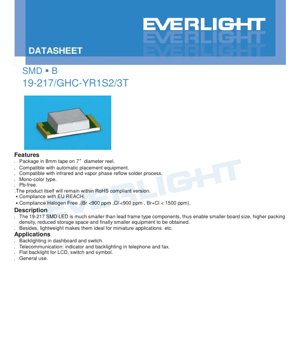
The 19-217/GHC-YR1S2/3T is a surface-mount device (SMD) LED designed for modern electronic applications requiring compact size, high reliability, and efficient assembly. This component represents a significant advancement over traditional lead-frame LEDs, enabling substantial reductions in board space, increased packing density, and ultimately contributing to the miniaturization of end equipment. Its lightweight construction makes it particularly suitable for applications where space and weight are critical constraints.
The LED emits a brilliant green light, achieved through an InGaN (Indium Gallium Nitride) semiconductor chip encapsulated in a water-clear resin. This combination provides high luminous intensity and excellent color purity. The device is supplied in industry-standard 8mm tape on 7-inch diameter reels, ensuring full compatibility with high-speed automatic pick-and-place equipment used in modern electronics manufacturing.
1.1 Core Advantages and Compliance
Samfurin yana ba da fa'idodi masu mahimmanci da yawa waɗanda suka dace da ka'idojin masana'antu da muhalli na zamani:
- Miniaturization: The SMD package is significantly smaller than leaded alternatives, directly enabling smaller PCB designs and higher component density.
- Automation Friendly: E yipada lori teepu ati reeli, o wa ni ibaramu patapata pẹlu awọn ilana iṣeto adaṣe, n din awọn iye owo iṣẹ ati n ṣe idagbasoke iṣọra fifi sii.
- Ibori Ayika: Ẹrọ naa ti ṣe ṣiṣe bi apakan alailẹ-gbẹ (Pb). A ṣe apẹrẹ rẹ lati wa ni ibamu pẹlu ofin EU ti Idiwọn Awọn ohun elo ipalara (RoHS).
- REACH & Halogen-Free: O le oloa e tausisia le tulafono a le EU REACH e faatatau i vailaʻau. E faʻavasegaina foi e leai se halogen, ma le bromine (Br) ma le chlorine (Cl) i lalo ifo o le 900 ppm taʻitasi, ma le aofaʻi faʻatasi e itiiti ifo i le 1500 ppm.
- Soldering Process Compatibility: E talafeagai mo faiga faʻapipiʻi faʻafoʻi infrared ma vapor phase, e ofoina atu le fetuutuunai i le faʻatulagaina o laina gaosiga.
2. Technical Parameter Deep-Dive
This section provides a detailed, objective analysis of the LED's electrical, optical, and thermal specifications as defined in the absolute maximum ratings and electro-optical characteristics tables.
2.1 Absolute Maximum Ratings
These ratings define the stress limits beyond which permanent damage to the device may occur. Operation at or beyond these limits is not advised.
- Continuous Forward Current (IF): 25 mA. This is the maximum DC current that can be applied continuously to the LED anode.
- Peak Forward Current (IFP): 50 mA. This higher current is permissible only under pulsed conditions, specifically at a duty cycle of 1/10 and a frequency of 1 kHz. Exceeding the continuous rating, even briefly in DC operation, risks catastrophic failure.
- Power Dissipation (Pd): 95 mW. This is the maximum power the package can dissipate as heat, calculated as Forward Voltage (VF) multiplied by Forward Current (IF). Designers must ensure operating conditions stay within this limit, considering ambient temperature.
- Electrostatic Discharge (ESD): Human Body Model (HBM) 150V. This is a relatively low ESD tolerance. Strict ESD handling procedures (use of grounded workstations, wrist straps, etc.) are essential during assembly and handling to prevent latent or immediate damage.
- Temperature Ranges:
- Operating Temperature (Topr): -40°C to +85°C. The device is guaranteed to function within this ambient temperature range.
- Storage Temperature (Tstg): -40°C to +90°C.
- Soldering Temperature (Tsol):
- Reflow Soldering: Peak temperature of 260°C for a maximum of 10 seconds.
- Hand Soldering: Iron tip temperature not exceeding 350°C for a maximum of 3 seconds per terminal.
2.2 Electro-Optical Characteristics
These parameters, measured at a standard test condition of 25°C ambient temperature and a forward current of 20mA, define the device's performance.
- Luminous Intensity (Iv): Ranges from a minimum of 112 mcd to a maximum of 285 mcd. The specific value is determined by the product's bin code (see Section 3). The typical value is not stated, implying significant variation across the production spread.
- Viewing Angle (2θ1/2): 120 degrees (typical). This is the full angle at which the luminous intensity drops to half of its peak value. A 120° angle indicates a very wide viewing pattern, suitable for applications requiring broad illumination or visibility from wide angles.
- Peak Wavelength (λp): 518 nm (typical). This is the wavelength at which the spectral power distribution is at its maximum.
- Dominant Wavelength (λd): Ranges from 520 nm to 535 nm. This is the single wavelength perceived by the human eye as the color of the light. It is closely related to chromaticity coordinates and is also subject to binning.
- Spectral Bandwidth (Δλ): 35 nm (typical). This is the width of the emitted spectrum at half of the maximum intensity (Full Width at Half Maximum - FWHM). A value of 35nm is characteristic of a relatively pure green color from an InGaN chip.
- Forward Voltage (VF): Ranges from 2.7V (min) to 3.7V (max), with a typical value of 3.3V at IF=20mA. This parameter is crucial for circuit design, particularly for calculating the current-limiting resistor value: R = (Vsupply - VF) / IF.
- Reverse Current (IR): Maximum of 50 μA when a reverse voltage (VR) of 5V is applied. LEDs are not designed to be reverse-biased, and this parameter indicates the level of leakage under such a condition.
Critical Note on Tolerances: The datasheet specifies a luminous intensity tolerance of ±11% and a dominant wavelength tolerance of ±1nm. These are inherent manufacturing variations that are managed through the binning system described next.
3. Binning System Explanation
To manage natural variations in semiconductor manufacturing, LEDs are sorted (binned) based on key performance parameters. This allows designers to select parts that meet specific application requirements for brightness and color.
3.1 Luminous Intensity Binning
The LED is categorized into four distinct bins based on its measured luminous intensity at 20mA. The bin code is part of the product ordering code (e.g., S2 in GHC-YR1S2/3T).
- Bin R1: 112 mcd (Min) to 140 mcd (Max)
- Bin R2: 140 mcd to 180 mcd
- Bin S1: 180 mcd to 225 mcd
- Bin S2: 225 mcd to 285 mcd
Selecting a higher bin code (e.g., S2) ensures a brighter LED, which may be necessary for applications in high-ambient-light conditions or where maximum visibility is critical.
3.2 Dominant Wavelength Binning
The color (hue) of the green light is controlled by binning the dominant wavelength. This ensures color consistency within a batch of LEDs.
- Bin X: 520 nm (Min) to 525 nm (Max) – A greener, slightly shorter wavelength.
- Bin Y: 525 nm to 530 nm
- Bin Z: 530 nm to 535 nm – A slightly more yellowish-green, longer wavelength.
The specific bin (e.g., Y in GHC-YR1S2/3T) should be specified when color matching between multiple LEDs is important for the application's aesthetics or functional requirements.
4. Performance Curve Analysis
The datasheet provides several typical characteristic curves that illustrate how the LED's performance changes with operating conditions. Understanding these is key to robust design.
- Relative Luminous Intensity vs. Forward Current: This curve shows that light output is approximately proportional to forward current in the typical operating range. However, driving the LED above its rated current leads to super-linear heat generation and efficiency droop, reducing lifespan.
- Relative Luminous Intensity vs. Ambient Temperature: The light output of an LED decreases as the junction temperature increases. This curve quantifies that derating. For high-reliability applications or those operating in hot environments, thermal management (adequate PCB copper area, possible heatsinking) is necessary to maintain brightness.
- Forward Voltage vs. Forward Current: This is the diode's IV curve. It is non-linear, showing the typical exponential relationship. The voltage rises sharply once the turn-on threshold is passed. The specified VF at 20mA is the operating point on this curve.
- Spectral Distribution: While not a detailed graph, the peak wavelength (518nm) and bandwidth (35nm) define a roughly Gaussian-shaped curve centered on green light.
- Radiation Pattern: The polar diagram confirms the 120° viewing angle, showing a Lambertian-like distribution where intensity is highest at 0° (perpendicular to the LED face) and falls off symmetrically to the sides.
5. Mechanical and Packaging Information
5.1 Package Dimensions
LED ina sifa ya kifurushi cha kawaida cha SMD. Mchoro wa vipimo hutoa vipimo muhimu kwa muundo wa muundo wa ardhi ya PCB (ukubwa wa mguu), ikiwa ni pamoja na urefu wa mwili, upana, urefu, na eneo na ukubwa wa pedi za kuuza. Kuzingatia vipimo hivi ni muhimu kwa kuuza kwa kuaminika na usawa unaofaa wakati wa usanikishaji wa kiotomatiki. Tolerances zisizobainishwa zote ni ±0.1mm.
5.2 Polarity Identification
Cathode kawaida huwa alama kwenye kifaa, mara nyingi kwa nukta ya kijani, notch kwenye kifurushi, au pedi ya umbo tofauti. Ukubwa wa mguu wa PCB unapaswa kujumuisha alama inayolingana ya ubaguzi (kama vile muhtasari wa silkscreen au nukta) ili kuzuia uwekaji usio sahihi. Kuunganisha LED kwa upendeleo wa nyuma, huku ikiwa na kikomo cha 5V kwa mujibu wa IR spec, should be avoided in circuit design.
6. Soldering and Assembly Guide
Proper handling and soldering are critical to achieving the reliability promised by the component specifications.
6.1 Storage and Moisture Sensitivity
The LEDs are packaged in a moisture-resistant bag with desiccant to prevent absorption of atmospheric moisture.
- Do not open the moisture-proof bag until the components are ready for use on the production line.
- After opening, unused LEDs should be stored in an environment of 30°C or less and 60% relative humidity or less.
- The floor life After opening the bag is 168 hours (7 days). If not used within this time, they must be re-baked according to the specified profile (typically 125°C for 24 hours) and re-bagged with fresh desiccant.
- If the desiccant indicator has changed color (e.g., from blue to pink), baking is required before use.
6.2 Reflow Soldering Profile
The recommended Pb-free reflow profile is crucial for forming reliable solder joints without damaging the LED.
- Pre-heating: Ramp from ambient to 150-200°C over 60-120 seconds. This gradual heating minimizes thermal shock.
- Soak/Preflow: Maintain between 150-200°C. This allows the PCB and components to thermally equalize and activates the flux.
- Reflow: Rapid ramp-up (max 6°C/sec) into the reflow zone. The peak temperature must reach above 217°C (the melting point of typical Pb-free solder) for 60-150 seconds. The absolute maximum peak is 260°C, and the time above 255°C must not exceed 30 seconds. The time at the actual peak (e.g., 260°C) must not exceed 10 seconds.
- Cooling: Controlled cool-down at a maximum rate of 3°C/sec to minimize stress on the solder joints.
Critical Restrictions:
- Reflow should not be performed more than two times. A third reflow cycle risks damaging the LED's internal wire bonds or the epoxy encapsulant.
- Avoid mechanical stress on the LED during the heating and cooling phases of soldering.
- Do not warp or bend the PCB after soldering, as this can crack the solder joints or the LED itself.
6.3 Hand Soldering and Rework
Hand soldering is permissible but carries higher risk.
- Use a temperature-controlled soldering iron set to a maximum of 350°C.
- A yi zafi ga kowane tashoshi har zuwa daƙiƙa 3.
- A yi amfani da ƙarfe mai ƙarfin watsar da zafi na 25W ko ƙasa da haka don guje wa wuce gona da iri.
- A ba da tazarar sanyaya aƙalla daƙiƙa 2 tsakanin yin siyar da kowane tashoshi.
- Gyara/Sake aiki ana ƙarfafa hana shi sosai. Idan babu makawa, yi amfani da na'urar solder mai kai biyu na musamman da aka ƙera don kayan SMD don dumama tashoshi biyu lokaci guda da ɗaga kayan ba tare da karkatarwa ba. Koyaushe tabbatar cewa halayen LED ba su lalace bayan sake aikin.
7. Packaging and Ordering Information
7.1 Reel and Tape Specifications
The product is supplied for automated assembly:
- Carrier Tape: 8mm wide tape.
- Reel: 7-inch (178mm) diameter reel.
- Quantity per Reel: 3000 pieces.
Detailed dimensional drawings for the carrier tape pockets and the reel are provided to ensure compatibility with feeder mechanisms on placement machines.
7.2 Label Explanation
The reel label contains several key identifiers:
- P/N: The manufacturer's product number (e.g., 19-217/GHC-YR1S2/3T).
- CAT: Luminous Intensity Rank (the bin code, e.g., S2).
- HUE: Chromaticity Coordinates & Dominant Wavelength Rank (the color bin, e.g., Y).
- REF: Forward Voltage Rank.
- LOT No: Traceability lot number.
8. Application Suggestions
8.1 Typical Application Scenarios
Based on its wide viewing angle, green color, and SMD format, this LED is well-suited for:
- Backlighting: Illumination of symbols, icons, or panels on dashboards, control panels, switches, and keypads.
- Status Indicators: Power, activity, or mode indicators in telecommunications equipment (telephones, fax machines), consumer electronics, and computer peripherals.
- LCD Backlighting: As a discrete light source for small, flat panel LCDs where edge-lighting is employed.
- General Purpose Indication: Any application requiring a compact, reliable, bright green indicator light.
8.2 Critical Design Considerations
- Current Limiting is Mandatory: An LED is a current-driven device. You must use a series current-limiting resistor. The forward voltage has a range (2.7V-3.7V). A slight increase in supply voltage above VF can cause a large, potentially destructive increase in current if not limited by a resistor. Calculate the resistor value using the maximum VF from the datasheet to ensure safe operation under all conditions: Rmin = (Vsupply - VF_max) / IF_desired.
- Thermal Management: While power dissipation is low (95mW max), operating at high ambient temperatures or high currents will reduce light output and lifespan. Provide adequate copper area on the PCB connected to the LED's thermal pads (if any) or the cathode/anode traces to act as a heatsink.
- ESD Protection: Implement ESD protection on input lines if the LED is connected to user-accessible ports (like buttons or connectors). Always follow ESD-safe handling procedures during assembly.
9. Application Restrictions and Reliability Note
The datasheet includes a critical disclaimer regarding high-reliability applications. This LED is designed and specified for general commercial and industrial use. It may not be suitable for applications where failure could lead to serious injury, loss of life, or significant property damage without additional qualification and possibly a different product variant designed for such environments.
Examples of such restricted applications include:
- Military and aerospace systems (especially flight-critical).
- Automotive safety and security systems (e.g., airbag indicators, brake lights).
- Medical life-support or critical diagnostic equipment.
For these applications, it is imperative to consult with the component manufacturer to discuss specific requirements, potential deratings, and the availability of products qualified to higher reliability standards (such as AEC-Q100 for automotive). This datasheet guarantees performance only within the stated specifications and not for use beyond them or in unspecified conditions.
10. FAQ Based on Technical Parameters
Q: What resistor value should I use with a 5V supply?
A: Yana amfani da mafi muni matsakaicin VF na 3.7V da kuma ake so IF na 20mA: R = (5V - 3.7V) / 0.020A = 65 ohms. Matsakaicin ƙimar daidaitaccen ƙima shine 68 ohms. Ƙimar wutar lantarki na resistor shine (5V-3.3V)^2 / 68Ω ≈ 0.042W, don haka daidaitaccen 1/8W (0.125W) resistor ya isa.
Q: Zan iya tuƙa wannan LED a 30mA don ƙarin haske?
A: No. The Absolute Maximum Rating for continuous forward current is 25mA. Operating at 30mA exceeds this rating, which will significantly reduce the LED's lifespan and may cause immediate failure due to overheating. Always operate within the specified limits.
Q: The LED is dimmer in my final product than a sample. Why?
A> Common causes are: 1) Operating at a higher ambient temperature than 25°C, causing intensity drop. 2) Using a resistor value that results in a lower actual forward current. 3) Voltage drop in the supply lines. 4) Selecting an LED from a lower luminous intensity bin (e.g., R1 instead of S2).
Q: How do I ensure consistent green color across multiple units in my product?
A> You must specify and order LEDs from the same Dominant Wavelength bin (e.g., all from Bin Y). Mixing bins (X, Y, Z) will result in visible color differences between LEDs.
11. Design-in Case Study Example
Scenario: Designing a status indicator panel for a network router. The panel has 10 identical green "Link Active" indicators.
Design Choices:
- Brightness Consistency: To ensure all 10 indicators appear equally bright, the designer specifies the highest luminous intensity bin available (S2: 225-285 mcd) in the purchase order.
- Color Consistency: To prevent one indicator from looking slightly more yellow or blue-green than another, the designer also specifies a single dominant wavelength bin (e.g., Bin Y).
- Circuit Design: The router's internal logic supply is 3.3V. Using the typical VF of 3.3V, the voltage drop across a current-limiting resistor would be nearly zero. Therefore, a constant-current LED driver IC is chosen instead of a simple resistor to ensure stable brightness regardless of VF variation and to improve efficiency. The driver is set to provide 20mA.
- PCB Layout: The PCB footprint is designed exactly per the package dimension drawing. Additional copper pour is connected to the LED's solder pads on inner layers to aid in heat dissipation, as the router enclosure may get warm.
- Assembly: LEDs are supplied on 8mm tape-and-reel. The manufacturing team strictly adheres to the specified reflow profile, ensuring the peak temperature does not exceed 260°C. Moisture-sensitive devices are baked prior to use due to the multiple passes involved in the PCB assembly process.
This systematic approach, grounded in a comprehensive understanding of the datasheet, yields a reliable, professional-looking product with consistent indicator performance.
LED Specification Terminology
Complete explanation of LED technical terms
Photoelectric Performance
| Term | Unit/Representation | Simple Explanation | Why Important |
|---|---|---|---|
| Luminous Efficacy | lm/W (lumens per watt) | Haske a kowane watt na wutar lantarki, mafi girma yana nufin mafi ingancin makamashi. | Kai tsaye yana ƙayyade matakin ingancin makamashi da farashin wutar lantarki. |
| Luminous Flux | lm (lumens) | Total light emitted by source, commonly called "brightness". | Determines if the light is bright enough. |
| Viewing Angle | ° (degrees), e.g., 120° | Angle where light intensity drops to half, determines beam width. | Affects illumination range and uniformity. |
| CCT (Color Temperature) | K (Kelvin), e.g., 2700K/6500K | Mwangaza wa joto/baridi, thamani za chini ni manjano/joto, za juu nyeupe/baridi. | Huamua mazingira ya taa na matukio yanayofaa. |
| CRI / Ra | Unitless, 0–100 | Ability to render object colors accurately, Ra≥80 is good. | Affects color authenticity, used in high-demand places like malls, museums. |
| SDCM | MacAdam ellipse steps, e.g., "5-step" | Color consistency metric, smaller steps mean more consistent color. | Ensures uniform color across same batch of LEDs. |
| Dominant Wavelength | nm (nanometers), e.g., 620nm (red) | Wavelength corresponding to color of colored LEDs. | Determines hue of red, yellow, green monochrome LEDs. |
| Spectral Distribution | Wavelength vs intensity curve | Shows intensity distribution across wavelengths. | Affects color rendering and quality. |
Electrical Parameters
| Term | Symbol | Simple Explanation | Design Considerations |
|---|---|---|---|
| Forward Voltage | Vf | Minimum voltage to turn on LED, like "starting threshold". | Driver voltage must be ≥Vf, voltages add up for series LEDs. |
| Forward Current | If | Current value for normal LED operation. | Usually constant current drive, current determines brightness & lifespan. |
| Max Pulse Current | Ifp | Peak current tolerable for short periods, used for dimming or flashing. | Pulse width & duty cycle must be strictly controlled to avoid damage. |
| Reverse Voltage | Vr | Max reverse voltage LED can withstand, beyond may cause breakdown. | Circuit must prevent reverse connection or voltage spikes. |
| Thermal Resistance | Rth (°C/W) | Resistance to heat transfer from chip to solder, lower is better. | High thermal resistance requires stronger heat dissipation. |
| ESD Immunity | V (HBM), e.g., 1000V | Ability to withstand electrostatic discharge, higher means less vulnerable. | Anti-static measures needed in production, especially for sensitive LEDs. |
Thermal Management & Reliability
| Term | Key Metric | Simple Explanation | Impact |
|---|---|---|---|
| Junction Temperature | Tj (°C) | Yana aiki zazzabi a cikin LED chip. | Kowane raguwa 10°C na iya ninka tsawon rayuwa; yana da yawa yana haifar da lalacewar haske, canjin launi. |
| Lumen Depreciation | L70 / L80 (hours) | Time for brightness to drop to 70% or 80% of initial. | Directly defines LED "service life". |
| Lumen Maintenance | % (e.g., 70%) | Percentage of brightness retained after time. | Indicates brightness retention over long-term use. |
| Color Shift | Δu′v′ or MacAdam ellipse | Iru lilo awọ nigba lilo. | O n fa ibaramu awọ ninu awọn iboju itansẹ. |
| Thermal Aging | Material degradation | Deterioration due to long-term high temperature. | May cause brightness drop, color change, or open-circuit failure. |
Packaging & Materials
| Term | Common Types | Simple Explanation | Features & Applications |
|---|---|---|---|
| Package Type | EMC, PPA, Ceramic | Housing material protecting chip, providing optical/thermal interface. | EMC: good heat resistance, low cost; Ceramic: better heat dissipation, longer life. |
| Muundo wa Chip | Mbele, Flip Chip | Chip electrode arrangement. | Flip chip: better heat dissipation, higher efficacy, for high-power. |
| Phosphor Coating | YAG, Silicate, Nitride | Covers blue chip, converts some to yellow/red, mixes to white. | Phosphors ya daban-daban suna tasiri inganci, CCT, da CRI. |
| Lens/Optics | Flat, Microlens, TIR | Optical structure on surface controlling light distribution. | Determines viewing angle and light distribution curve. |
Quality Control & Binning
| Term | Binning Content | Simple Explanation | Purpose |
|---|---|---|---|
| Luminous Flux Bin | Code e.g., 2G, 2H | Grouped by brightness, each group has min/max lumen values. | Ensures uniform brightness in same batch. |
| Voltage Bin | Code e.g., 6W, 6X | Grouped by forward voltage range. | Yana kafa daidaita direbobi, yana inganta ingancin tsarin. |
| Kwandon Launi | 5-step MacAdam ellipse | Grouped by color coordinates, ensuring tight range. | Guarantees color consistency, avoids uneven color within fixture. |
| CCT Bin | 2700K, 3000K etc. | Grouped by CCT, each has corresponding coordinate range. | Meets different scene CCT requirements. |
Testing & Certification
| Term | Standard/Test | Simple Explanation | Significance |
|---|---|---|---|
| LM-80 | Lumen maintenance test | Long-term lighting at constant temperature, recording brightness decay. | Used to estimate LED life (with TM-21). |
| TM-21 | Life estimation standard | Yana kiyasin rayuwa a ƙarƙashin yanayi na ainihi bisa bayanan LM-80. | Yana ba da hasashen rayuwa na kimiyya. |
| IESNA | Illuminating Engineering Society | Covers optical, electrical, thermal test methods. | Industry-recognized test basis. |
| RoHS / REACH | Environmental certification | Ensures no harmful substances (lead, mercury). | Market access requirement internationally. |
| ENERGY STAR / DLC | Energy efficiency certification | Energy efficiency and performance certification for lighting. | Used in government procurement, subsidy programs, enhances competitiveness. |