Table of Contents
- 1. Product Overview
- 2. Detailed Technical Specifications
- 2.1 Absolute Maximum Ratings
- 2.2 Electro-Optical Characteristics
- 3. Grading System Description
- 3.1 Luminous Intensity Binning
- 3.2 Dominant Wavelength Binning
- 4. Performance Curve Analysis
- 4.1 Relationship Between Relative Luminous Intensity and Ambient Temperature
- 4.2 Forward Current Derating Curve
- 3.3 Relationship between Luminous Intensity and Forward Current
- 4.4 Spectral Distribution
- 4.5 Forward Current vs. Forward Voltage Relationship
- 4.6 Radiation Pattern Diagram
- 5. Mechanical and Packaging Information
- 5.1 Package Size
- 5.2 Polarity Marking
- 6. Welding and Assembly Guide
- 6.1 Reflow Soldering Temperature Profile
- 6.2 Manual Soldering
- 6.3 Rework and Repair
- 7. Packaging and Ordering Information
- 7.1 Reel Specification
- 7.2 Moisture Sensitivity and Storage
- 7.3 Label Description
- 8. Application Suggestions
- 8.1 Typical Application Scenarios
- 8.2 Key Design Considerations
- 9. Technical Comparison and Differentiation
- 10. Frequently Asked Questions (Based on Technical Parameters)
- 10.1 When using a 5V power supply, what value of resistor should be selected?
- 10.2 Can I drive this LED with 30mA to achieve higher brightness?
- 10.3 How does temperature affect the light output?
- 10.4 Is a heat sink necessary?
- 11. Design Use Case Study
- 12. Introduction to Working Principles
- 13. Technology Trends
1. Product Overview
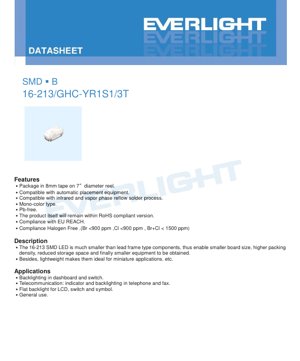
16-213/GHC-YR1S1/3T wani na'urar LED ne mai haɗawa ta saman (SMD), wanda aka ƙera don aikace-aikacen lantarki na zamani waɗanda ke buƙatar ƙaramin girma, ingantaccen aminci da kyakkyawan aikin gani. Wannan ɓangaren yana amfani da guntu na semiconductor na InGaN (Indium Gallium Nitride) don samar da fitowar haske mai haske mai kore. Babban fa'idodinsa sun haɗa da: rage girman filin allon da ya fi na LED na tsarin igiya na al'ada, wanda hakan ke haɓaka yawan ɓangarorin akan allon da'ira (PCB), rage buƙatun ajiya, kuma a ƙarshe yana taimakawa wajen rage girman na'urar ƙarshe. Na'urar tana da nauyi mai sauƙi, musamman ma don aikace-aikacen da ke da ƙarancin sarari da na ɗauka.
Key product positioning includes use as high-efficiency indicator lights and backlight sources. It is packaged in 8mm carrier tape, wound onto reels with a 7-inch diameter, ensuring compatibility with standard automated surface-mount assembly equipment. The LED is encapsulated in transparent resin to maximize light output and provide a clean, bright appearance.
2. Detailed Technical Specifications
2.1 Absolute Maximum Ratings
The operating limits of the device are defined under the condition of Ta=25°C. Exceeding these ratings may cause permanent damage.
- Reverse Voltage (VR):5V. Applying a reverse voltage higher than this value may break down the PN junction of the LED.
- Continuous forward current (IF):25mA. This is the maximum DC current recommended for continuous operation.
- Peak forward current (IFP):100mA. This rating applies under pulse conditions with a duty cycle of 1/10 and a frequency of 1kHz, allowing for short periods of high-brightness operation.
- Power Dissipation (Pd):110mW. This is the maximum power the package can dissipate without exceeding its thermal limits.
- Electrostatic Discharge (ESD):Withstand 150V (Human Body Model). Proper ESD handling procedures must be followed during assembly.
- Operating Temperature (Topr):-40°C to +85°C. This LED is rated to operate under a wide range of environmental conditions.
- Storage temperature (Tstg):-40°C to +90°C.
- Welding Temperature (Tsol):This device can withstand reflow soldering with a peak temperature of 260°C for up to 10 seconds, or hand soldering at 350°C for up to 3 seconds per pin.
2.2 Electro-Optical Characteristics
Typical performance measured under conditions of Ta=25°C, IF=20mA, unless otherwise specified.
- Luminous intensity (Iv):ranges from a minimum of 112 mcd to a maximum of 225 mcd, with typical values falling within this grading range. The applicable tolerance is ±11%.
- Perspective (2θ1/2):120 degrees. This wide viewing angle ensures good visibility from different angles.
- Peak wavelength (λp):Typical value 518 nm, indicating the wavelength at which the emission light intensity is highest.
- Dominant Wavelength (λd):Ranging from 520 nm to 535 nm, defining the perceived color (green). Applicable tolerance is ±1 nm.
- Spectral Bandwidth (Δλ):Typical value 35 nm, measured at full width at half maximum (FWHM).
- Forward voltage (VF):Ranges from 2.7V (min) to 3.7V (max), with a typical value of 3.3V at 20mA. Applicable tolerance is ±0.05V.
- Reverse current (IR):Maximum 50 μA when a 5V reverse voltage is applied.
3. Grading System Description
Products are classified based on key optical and electrical parameters to ensure consistency in application design.
3.1 Luminous Intensity Binning
Under the condition of Iv=20mA, grade the IF:
- R1:112 mcd to 140 mcd
- R2:140 mcd to 180 mcd
- S1:180 mcd to 225 mcd
3.2 Dominant Wavelength Binning
Under the condition of IdUnder the condition of =20mA, for λF:
- X:520 nm to 525 nm
- Y:525 nm to 530 nm
- Z:530 nm to 535 nm
4. Performance Curve Analysis
The datasheet provides several characteristic curves that are crucial for design.
4.1 Relationship Between Relative Luminous Intensity and Ambient Temperature
The curve shows that the luminous intensity is relatively stable from -40°C to approximately 25°C. Beyond 25°C, the intensity gradually decreases as temperature increases, which is a common characteristic of LEDs, stemming from increased non-radiative recombination and other thermal effects. At the maximum operating temperature of 85°C, the output may be significantly lower than at room temperature. This must be considered in designs where high ambient temperatures are expected.
4.2 Forward Current Derating Curve
This graph defines the maximum allowable forward current as a function of ambient temperature. At 25°C, the full rating of 25mA is permitted. As the ambient temperature increases, the maximum allowable current must be reduced linearly to prevent exceeding the device's 110mW power dissipation limit and to ensure long-term reliability. This is crucial for preventing thermal runaway and premature failure.
3.3 Relationship between Luminous Intensity and Forward Current
At lower currents, the relationship is typically linear, but at higher currents (approaching the maximum rating), it may show signs of saturation or a decrease in efficiency. This curve allows designers to predict the brightness at a given drive current.
4.4 Spectral Distribution
The spectrum shows a single dominant peak centered at approximately 518 nm (green), with a characteristic FWHM of 35 nm. Minimal emission in other parts of the visible spectrum confirms pure green color.
4.5 Forward Current vs. Forward Voltage Relationship
This IV curve demonstrates the typical exponential relationship of a diode. The forward voltage increases with increasing current. The specified VFThe range (2.7V-3.7V at 20mA) is visible on this curve. Designers use this curve to calculate the required current-limiting resistor value for a given supply voltage.
4.6 Radiation Pattern Diagram
The polar plot illustrates a 120° viewing angle. The intensity is nearly uniform within the central conical region and attenuates towards the edges. This pattern is crucial for applications requiring specific illumination angles.
5. Mechanical and Packaging Information
5.1 Package Size
This LED features a compact SMD footprint. Key dimensions include body size, lead pitch, and overall height. The datasheet provides a detailed dimensional drawing, with standard tolerances of ±0.1mm unless otherwise noted. The recommended pad layout on the PCB is also shown, which is designed for reliable soldering and mechanical stability. Designers are advised to modify the pad dimensions based on their specific PCB fabrication process and thermal requirements.
5.2 Polarity Marking
This component has an anode and a cathode. The datasheet drawing indicates the polarity, typically marked by a notch, a dot, or different lead shapes. Correct polarity must be observed during PCB layout and assembly to ensure proper functionality.
6. Welding and Assembly Guide
6.1 Reflow Soldering Temperature Profile
Provides a detailed temperature profile for lead-free reflow soldering:
- Preheating:150-200°C, for 60-120 seconds.
- Time above liquidus (217°C):60-150 segundos.
- No se recomienda realizar reparaciones después de la soldadura. Si es inevitable, se debe utilizar un soldador de doble punta para calentar simultáneamente los dos pines, con el fin de minimizar la tensión sobre el LED. Es necesario evaluar de antemano el impacto potencial de la reparación en las características del LED.Máximo 260°C, mantener durante no más de 10 segundos.
- Tasa de calentamiento:Maximum 6°C/s.
- Cooling rate:Maximum 3°C/s.
6.2 Manual Soldering
If manual soldering is necessary, the soldering iron tip temperature should be below 350°C, and the contact time per pin should not exceed 3 seconds. It is recommended to use a low-power soldering iron (≤25W). A cooling interval of at least 2 seconds should be allowed between soldering two pins to prevent thermal shock.
6.3 Rework and Repair
Repair after soldering is discouraged. If unavoidable, a dual-head soldering iron should be used to simultaneously heat both terminals, minimizing stress on the LED. The potential impact on LED characteristics from rework must be evaluated beforehand.
7. Packaging and Ordering Information
7.1 Reel Specification
LEDs are supplied in carrier tape packaging, with dimensions specified in the datasheet. Each reel contains 3000 pieces. Reel dimensions (7-inch diameter) are provided for automated handling equipment setup.
7.2 Moisture Sensitivity and Storage
The product is packaged in a moisture-proof aluminum foil bag with desiccant and humidity indicator card included. To prevent damage during the reflow soldering process due to moisture ("popcorn" effect):
- Before opening:Store under conditions of ≤30°C and ≤90% RH.
- After opening:Under conditions of ≤30°C and ≤60% RH, the "shop life" is 1 year. Unused components should be resealed.
- Baking:If the desiccant indicator shows saturation or the storage time is exceeded, it should be baked at 60±5°C for 24 hours before use.
7.3 Label Description
The reel label contains the following codes:
- Customer Part Number (CPN)
- Product Number (P/N)
- Packaging Quantity (QTY)
- CAT
- HUE
- Forward Voltage Grade (REF)
- Lot Number (LOT No.)
8. Application Suggestions
8.1 Typical Application Scenarios
- Backlight:For flat backlighting of dashboard indicators, switch illumination, and LCD panels and symbols.
- Telecommunications equipment:Status indicators and keyboard backlighting in telephones and fax machines.
- General indication:Widely used in consumer electronics, industrial electronics, and automotive electronics for power status, mode selection, and other user interface indicators.
8.2 Key Design Considerations
- Current Limiting:An external series resistor isabsolutely essentialto limit the forward current. The exponential V-I characteristic of an LED means that a small voltage increase can cause a large, destructive current surge.
- Thermal Management:Observe the forward current derating curve. Ensure sufficient PCB copper area or other heat dissipation measures if operating at high ambient temperatures or near maximum current.
- ESD Protection:Implement ESD protection circuits on sensitive lines and follow proper handling procedures during assembly.
- Optical Design:When designing light guides, lenses, or diffusers, consider a 120° viewing angle and radiation pattern to achieve the desired lighting effect.
9. Technical Comparison and Differentiation
Compared to older through-hole LED technology, this SMD LED offers significant advantages:
- Size and Density:The board footprint is greatly reduced, aiding in miniaturization.
- Automation:Fully compatible with high-speed SMT assembly, reducing manufacturing costs.
- Performance:InGaN technology provides higher efficiency and brighter green light output compared to old materials.
- Reliability:When properly soldered, SMD structure typically offers better thermal performance and mechanical robustness.
- Compliance:该器件无铅,符合RoHS和欧盟REACH法规,并满足无卤标准(Br <900ppm,Cl <900ppm,Br+Cl <1500ppm),使其适合注重环保的设计和全球市场。
10. Frequently Asked Questions (Based on Technical Parameters)
10.1 When using a 5V power supply, what value of resistor should be selected?
Using Ohm's Law (R = (VPower supply- VF) / IF), and assuming a typical VFof 3.3V at 20mA: R = (5V - 3.3V) / 0.02A = 85 ohms. A standard 82 or 100 ohm resistor is suitable. Always calculate based on the minimum VF(2.7V) to ensure the current does not exceed the maximum rating.
10.2 Can I drive this LED with 30mA to achieve higher brightness?
A'a. Matsakaicin ƙimar halin yanzu na gaba shine 25mA. Wucewa wannan ƙimar zai lalata amincin, kuma yana iya haifar da gazawa nan take ko a hankali. Idan kuna buƙatar haske mai ƙarfi, zaɓi LED tare da matakin ƙarfin haske mafi girma (misali, matakin S1) ko samfurin da ke da ƙimar halin yanzu mafi girma.
10.3 How does temperature affect the light output?
Kamar yadda lanƙwan aikin ya nuna, ƙarfin haske yana raguwa yayin da zafin muhalli ya ƙaru. A 85°C, fitarwa na iya zama kawai 60-70% na na 25°C. Wannan dole ne a yi la'akari da shi a cikin ƙirar haske na tsarin.
10.4 Is a heat sink necessary?
对于在20mA连续工作且环境温度适中(<50°C)的情况,热量通常通过LED引脚传导到PCB铜箔上即可充分散发。遵循建议的焊盘布局可改善散热。对于高环境温度或驱动电流接近最大值的情况,增加连接到LED焊盘的PCB铜箔面积可作为有效的散热片。
11. Design Use Case Study
Scenario: Designing a status indicator panel for an industrial controller.
- Requirements:Multiple bright green LEDs are used to indicate the "System Ready" status. The panel's operating environment temperature can reach up to 60°C.
- Selection:Select the S1 grade (180-225 mcd) of 16-213/GHC-YR1S1/3T for high visibility.
- Circuit Design:Use the 3.3V system power rail. Assuming V = 3.3V, calculate the series resistor: R = (3.3V - 3.3V) / 0.02A = 0 ohms. This value is invalid. Therefore, drive the LED with a lower current, such as 15mA. R = (3.3V - 3.0V*) / 0.015A = 20 ohms. (*V is estimated to be lower at 15mA according to the IV curve).FThermal check:FThermal check:
- Thermal check:At an ambient temperature of 60°C, the derating curve requires a reduction in maximum current. Operating at 15mA provides a good safety margin below the derating limit, ensuring long-term reliability.
- Layout:The PCB pad design follows the datasheet recommendations, with additional copper foil connected to the cathode pad to enhance heat dissipation.
- Results:A reliable, uniform-brightness indicator light system suitable for work environments.
12. Introduction to Working Principles
This LED operates based on the principle of electroluminescence in a semiconductor PN junction. The active region is composed of InGaN. When a forward voltage exceeding the diode's threshold voltage is applied, electrons and holes are injected into the active region from the N-type and P-type layers, respectively. These carriers recombine, releasing energy in the form of photons. The specific composition of the InGaN alloy determines the bandgap energy, which directly corresponds to the wavelength (color) of the emitted light—in this case, green (~518 nm). The transparent epoxy resin encapsulation protects the semiconductor chip, provides mechanical stability, and acts as a lens to shape the output beam.
13. Technology Trends
Bu tür SMD LED'lerin gelişimi, fotonik alanındaki daha geniş bir trendin parçasıdır:
- Miniaturizasyon:Package size continues to decrease (e.g., from 0603 to 0402 to 0201 metric sizes) to enable smaller devices.
- Efficiency improvement:Continuous improvements in epitaxial growth and chip design lead to higher luminous efficacy (more light output per watt of electrical input).
- Color consistency:Stricter binning specifications and advanced manufacturing processes ensure high consistency in color and brightness across different production batches, which is crucial for multi-LED arrays and displays.
- Reliability Enhancement:Improved packaging materials and thermal management designs are extending operational lifespan and enabling use in harsher environments (higher temperature, humidity).
- Integration:Trends include integrating the control IC, current-limiting resistors, and even multi-color chips (RGB) into a single package, thereby simplifying circuit design for end-users.
Detailed Explanation of LED Specification Terminology
Complete Explanation of LED Technical Terminology
I. Core Indicators of Photoelectric Performance
| Terminology | Unit/Representation | Popular Explanation | Why It Matters |
|---|---|---|---|
| Luminous Efficacy | lm/W (lumens per watt) | The luminous flux emitted per watt of electrical power; higher values indicate greater energy efficiency. | It directly determines the energy efficiency rating of the luminaire and the electricity cost. |
| Luminous Flux | lm (lumen) | The total amount of light emitted by a light source, commonly known as "brightness". | Determines whether the luminaire is bright enough. |
| Viewing Angle | ° (degree), e.g., 120° | The angle at which luminous intensity drops to half, determining the beam width. | Affects the range and uniformity of illumination. |
| Color Temperature (CCT) | K (Kelvin), such as 2700K/6500K | Haske launin dumi da sanyi, ƙananan ƙima sun karkata zuwa rawaya/dumi, manyan ƙima sun karkata zuwa fari/sanyi. | Yana ƙayyade yanayin hasken wuta da kuma yanayin da ya dace. |
| Color Rendering Index (CRI / Ra) | Unitless, 0–100 | The ability of a light source to reproduce the true colors of objects, with Ra≥80 being preferable. | Affects color authenticity, used in high-demand places such as shopping malls and art galleries. |
| Color tolerance (SDCM) | MacAdam ellipse step, such as "5-step" | A quantitative metric for color consistency; a smaller step number indicates better color consistency. | Ensure no color variation among luminaires from the same batch. |
| Dominant Wavelength | nm (nanometer), e.g., 620nm (red) | Wavelength values corresponding to the colors of colored LEDs. | Determines the hue of monochromatic LEDs such as red, yellow, and green. |
| Spectral Distribution | Wavelength vs. Intensity Curve | It shows the intensity distribution of light emitted by an LED at each wavelength. | Affects color rendering and color quality. |
II. Electrical Parameters
| Terminology | Symbol | Popular Explanation | Design Considerations |
|---|---|---|---|
| Forward Voltage (Forward Voltage) | Vf | The minimum voltage required to light up an LED, similar to a "starting threshold". | The driving power supply voltage must be ≥ Vf; voltages add up when multiple LEDs are connected in series. |
| Forward Current | If | The current value that makes the LED emit light normally. | Constant current drive is often used, as the current determines brightness and lifespan. |
| Maximum Pulse Current | Ifp | The peak current that can be withstood for a short period of time, used for dimming or flashing. | Pulse width and duty cycle must be strictly controlled to prevent overheating damage. |
| Reverse Voltage | Vr | Maximum reverse voltage that an LED can withstand; exceeding it may cause breakdown. | Reverse connection or voltage surges must be prevented in the circuit. |
| Thermal Resistance (Thermal Resistance) | Rth (°C/W) | The resistance to heat flow from the chip to the solder joint. A lower value indicates better heat dissipation. | High thermal resistance requires stronger heat dissipation design, otherwise junction temperature will rise. |
| Electrostatic Discharge Immunity (ESD Immunity) | V (HBM), such as 1000V | Electrostatic discharge immunity, the higher the value, the less susceptible to damage from static electricity. | Anti-static measures must be implemented during production, especially for high-sensitivity LEDs. |
III. Thermal Management and Reliability
| Terminology | Key Indicators | Popular Explanation | Impact |
|---|---|---|---|
| Junction Temperature | Tj (°C) | The actual operating temperature inside the LED chip. | For every 10°C reduction, the lifespan may double; excessively high temperatures lead to lumen depreciation and color shift. |
| Lumen Depreciation | L70 / L80 (hours) | The time required for the brightness to drop to 70% or 80% of its initial value. | Directly define the "useful life" of LED. |
| Lumen Maintenance | % (e.g., 70%) | The percentage of remaining brightness after a period of use. | Characterizes the ability to maintain brightness after long-term use. |
| Color Shift | Δu′v′ or MacAdam ellipse | The degree of color change during use. | Affects the color consistency of the lighting scene. |
| Thermal Aging | Material performance degradation | Degradation of packaging materials due to prolonged high temperatures. | Zai iya haifar da raguwar haske, canjin launi ko gazawar bude hanya. |
IV. Kullewa da Kayan aiki
| Terminology | Nau'o'in gama gari | Popular Explanation | Characteristics and Applications |
|---|---|---|---|
| Package Types | EMC, PPA, Ceramics | The housing material that protects the chip and provides optical and thermal interfaces. | EMC offers good heat resistance and low cost; ceramics provide superior heat dissipation and long lifespan. |
| Chip Structure | Front-side, Flip Chip | Chip electrode arrangement method. | Flip-chip offers better heat dissipation and higher luminous efficacy, suitable for high-power applications. |
| Phosphor coating. | YAG, silicate, nitride | Coated on the blue LED chip, partially converted to yellow/red light, mixed to form white light. | Different phosphors affect luminous efficacy, color temperature, and color rendering. |
| Lens/Optical Design | Flat, microlens, total internal reflection | Optical structure on the packaging surface, controlling light distribution. | Determines the emission angle and light distribution curve. |
V. Quality Control and Grading
| Terminology | Grading Content | Popular Explanation | Purpose |
|---|---|---|---|
| Luminous Flux Binning | Codes such as 2G, 2H | Group by brightness level, each group has a minimum/maximum lumen value. | Ensure consistent brightness for products in the same batch. |
| Voltage binning | Codes such as 6W, 6X | Grouped by forward voltage range. | Ease of matching the drive power supply, improving system efficiency. |
| Color binning | 5-step MacAdam ellipse | Group by color coordinates to ensure colors fall within a minimal range. | Ensure color consistency to avoid uneven colors within the same luminaire. |
| Color temperature grading | 2700K, 3000K, etc. | Group by color temperature, each group has a corresponding coordinate range. | Meet the color temperature requirements of different scenarios. |
VI. Testing and Certification
| Terminology | Standard/Test | Popular Explanation | Meaning |
|---|---|---|---|
| LM-80 | Lumen Maintenance Test | Long-term operation under constant temperature conditions, recording luminance attenuation data. | For estimating LED lifetime (in conjunction with TM-21). |
| TM-21 | Lifetime extrapolation standard | Estimating lifespan under actual operating conditions based on LM-80 data. | Providing scientific life prediction. |
| IESNA Standard | Illuminating Engineering Society Standard | Covers optical, electrical, and thermal testing methods. | Industry-recognized testing basis. |
| RoHS / REACH | Environmental Certification | Ensure products are free from harmful substances (e.g., lead, mercury). | Entry requirements for the international market. |
| ENERGY STAR / DLC | Energy efficiency certification | Energy efficiency and performance certification for lighting products. | Commonly used in government procurement and subsidy programs to enhance market competitiveness. |