Table of Contents
- 1. Product Overview
- 1.1 Core Features and Compliance
- 1.2 Target Applications
- 2. Technical Specifications Deep Dive
- 2.1 Absolute Maximum Ratings
- 2.2 Electro-Optical Characteristics
- 3. Binning System Explanation
- 3.1 Luminous Intensity Binning
- 3.2 Forward Voltage Binning
- 3.3 Chromaticity Coordinate Binning
- 4. Performance Curve Analysis
- 4.1 Forward Current vs. Forward Voltage (I-V Curve)
- 4.2 Relative Luminous Intensity vs. Forward Current
- 4.3 Relative Luminous Intensity vs. Ambient Temperature
- 4.4 Forward Current Derating Curve
- 4.5 Spectrum Distribution
- 4.6 Radiation Pattern
- 5. Mechanical and Package Information
- 5.1 Package Dimensions
- 5.2 Polarity Identification
- 6. Soldering and Assembly Guidelines
- 6.1 Current Limiting Requirement
- 6.2 Storage and Moisture Sensitivity
- 6.3 Reflow Soldering Profile
- 7. Packaging and Ordering Information
- 7.1 Reel and Tape Specifications
- 7.2 Label Explanation
- 8. Application Design Considerations
- 8.1 Driving Circuit Design
- 8.2 Thermal Management
- 8.3 Optical Integration
- 9. Technical Comparison and Positioning
- 10. Frequently Asked Questions (FAQ)
- 10.1 What resistor do I need for a 3.3V supply?
- 10.2 Can I drive it with a PWM signal for dimming?
- 10.3 Why is the luminous intensity given in mcd instead of lumens?
- 10.4 What does the "T1D" in the part number signify?
- 11. Design-in Case Study: Dashboard Switch Backlighting
- 12. Technology Principle
- 13. Industry Trends
1. Product Overview
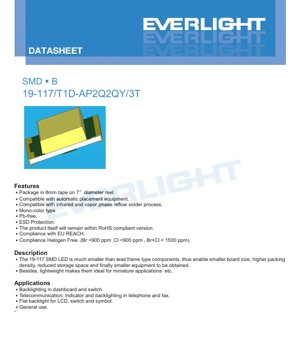
Takardar nan ta bayyana cikakkun bayanai game da na'urar LED mai hawa a saman (SMD) wacce aka gano da 19-117/T1D-AP2Q2QY/3T. Wannan kayan aiki LED ne mai launi guda, farar tsantsa wanda aka tsara don hanyoyin haɗa na'urorin lantarki na zamani. Ƙaramin fakitin SMD ɗin sa yana ba da fa'idodi masu mahimmanci fiye da na'urorin da suka dace da tsarin gubar na gargajiya, yana ba da damar ƙira ƙananan allunan da'ira (PCBs), mafi girman yawan adadin kayan aiki, kuma a ƙarshe ƙananan kayan aiki masu amfani. Yanayin sauƙin nauyin fakitin ya ƙara sa ya dace da ƙananan aikace-aikace da na ɗaukuwa.
1.1 Core Features and Compliance
Ana samar da LED akan tef na milimita 8 da aka nada a kan reel mai diamita na inci 7, wanda ya sa ya dace gaba ɗaya da daidaitattun kayan aikin sarrafawa ta atomatik don samarwa mai yawa. An ƙera shi don sarrafa shi ta amfani da dabarun gogewar infrared da tururi. An gina na'urar ta amfani da kayan da ba su da gubar (Pb-free) kuma ta haɗa da kariya daga fitar da wutar lantarki (ESD). Tana bin muhimman ka'idojin muhalli da aminci, gami da umarnin RoHS na EU (Ƙuntata Abubuwa Masu Haɗari), ƙa'idar REACH (Rajista, Kimantawa, Izini da Ƙuntata Sinadarai), kuma an rarraba shi azaman Ba Halogen ba, tare da abun ciki na Bromine (Br) da Chlorine (Cl) ƙasa da 900 ppm kowanne kuma jimlar su ƙasa da 1500 ppm.
1.2 Target Applications
Wannan LED yana da amfani da yawa kuma ana amfani da shi a cikin ayyukan haske da nuni daban-daban. Manyan aikace-aikacen sun haɗa da hasken baya na dashbodin kayan aikin kayan aiki da maɓallan membrane. A cikin kayan aikin sadarwa, yana iya zama alamomin yanayi ko hasken baya don na'urori kamar wayoyi da na'urorin faks. Hakanan ya dace don samar da hasken baya mai lebur don nuni na ruwa mai ruwa (LCDs), bangarorin canji, da alamomi. Yanayinsa na gabaɗaya yana ba da damar amfani da shi a cikin kayan lantarki na mabukaci da masana'antu da yawa inda ake buƙatar tushen haske mai ƙarfi, amintacce.
2. Technical Specifications Deep Dive
Wannan sashe yana ba da cikakken bincike na iyakoki da halaye na lantarki, na gani, da na zafi na LED. Fahimtar waɗannan sigogi yana da mahimmanci don ƙirar da'ira mai dogaro da kuma tabbatar da aiki na dogon lokaci.
2.1 Absolute Maximum Ratings
The Absolute Maximum Ratings define the stress limits beyond which permanent damage to the device may occur. These ratings are specified at an ambient temperature (Ta) of 25\u00b0C and must not be exceeded under any operating conditions. The key limits are:
- Reverse Voltage (VR): 5V. Applying a reverse bias voltage higher than this can break down the LED's semiconductor junction.
- Continuous Forward Current (IF): 10mA. This is the maximum DC current that can be passed through the LED continuously.
- Peak Forward Current (IFP): 100mA. This is the maximum allowable pulsed current, specified at a duty cycle of 1/10 and a frequency of 1 kHz. It is suitable for brief, high-intensity flashes.
- Power Dissipation (Pd): 40mW. This is the maximum amount of power the device can dissipate as heat, calculated as Forward Voltage (VF) × Forward Current (IF).
- ESD Withstand (HBM): 2000V. The device can withstand electrostatic discharge up to this level per the Human Body Model (HBM), indicating good handling robustness.
- Operating Temperature (Topr): -40\u00b0C to +85\u00b0C. The ambient temperature range over which the LED is designed to function.
- Storage Temperature (Tstg): -40°C to +90°C. The temperature range for storing the device when not powered.
- Soldering Temperature: The package can withstand reflow soldering with a peak temperature of 260°C for up to 10 seconds, or hand soldering at 350°C for up to 3 seconds.
2.2 Electro-Optical Characteristics
Electro-Optical Characteristics are measured at Ta=25°C and a standard test current (IF) of 5mA. These represent the typical performance parameters.
- Luminous Intensity (Iv): The light output ranges from a minimum of 57.0 millicandelas (mcd) to a maximum of 112.0 mcd. The typical value falls within this range, and specific bins are defined (see Section 3). The tolerance is \u00b111%.
- Viewing Angle (2\u03b81/2): The typical viewing angle, defined as the angle where intensity drops to half of its peak value, is 130 degrees. This indicates a wide, diffuse emission pattern suitable for area illumination.
- Forward Voltage (VF): The voltage drop across the LED when conducting 5mA typically ranges from 2.70V to 3.20V. The tolerance is \u00b10.05V. This parameter is critical for designing the current-limiting circuitry.
3. Binning System Explanation
To ensure consistency in mass production, LEDs are sorted into "bins" based on key performance parameters. This allows designers to select parts that meet specific brightness and electrical requirements for their application.
3.1 Luminous Intensity Binning
The luminous output is categorized into three bins (P2, Q1, Q2) when measured at IF=5mA:
- Bin P2: 57.0 mcd (Min) to 72.0 mcd (Max)
- Bin Q1: 72.0 mcd (Min) to 90.0 mcd (Max)
- Bin Q2: 90.0 mcd (Min) to 112.0 mcd (Max)
The specific bin code (e.g., Q2 in the part number 19-117/T1D-AP2Q2QY/3T) indicates the guaranteed minimum light output for that particular unit.
3.2 Forward Voltage Binning
The forward voltage is categorized into five bins (29 to 33) at IF=5mA:
- Bin 29: 2.70V to 2.80V
- Bin 30: 2.80V to 2.90V
- Bin 31: 2.90V zuwa 3.00V
- Bin 32: 3.00V zuwa 3.10V
- Bin 33: 3.10V to 3.20V
This binning helps in designing power supplies and predicting current draw more accurately across a batch of LEDs.
3.3 Chromaticity Coordinate Binning
Launin farin yana da ma'anar ma'aunin launi (x, y) akan zanen CIE 1931. Takardar bayanan tana bayyana rukunoni shida (1 zuwa 6), kowanne yana ƙayyadadden yanki mai siffar huɗu akan taswirar launi. An ba da ma'auni na kusurwoyi huɗu na kowane rukuni. Wannan yana tabbatar da cewa hasken farin da ake fitarwa yana cikin takamaiman sararin launi mai sarrafawa. Ƙimar jurewar waɗannan ma'auni ita ce \u00b10.01.
4. Performance Curve Analysis
Graphical data provides deeper insight into the LED's behavior under varying conditions.
4.1 Forward Current vs. Forward Voltage (I-V Curve)
The I-V curve shows the exponential relationship between current and voltage. For this LED, at a fixed ambient temperature of 25\u00b0C, the forward voltage increases as the current increases. This curve is essential for determining the operating point and the necessary series resistor value to achieve a desired current.
4.2 Relative Luminous Intensity vs. Forward Current
This graph demonstrates how light output increases with forward current. It typically shows a near-linear relationship at lower currents, which may saturate at higher currents due to thermal and efficiency effects. The curve is plotted on a semi-log scale, showing intensity from 10% to 1000% relative to a baseline.
4.3 Relative Luminous Intensity vs. Ambient Temperature
LED efficiency decreases as junction temperature rises. This curve plots the relative light output against ambient temperature (Ta). It typically shows a peak near room temperature, with output declining as temperature increases or decreases significantly. This is critical for applications operating in non-ideal thermal environments.
4.4 Forward Current Derating Curve
Domin kuma ya hana zafi mai yawa, dole ne a rage matsakaicin ƙarfin gaba mai ci gaba yayin da yanayin yanayi ya karu. Wannan lanƙwasa na rage ƙarfi yana ƙayyadad da ƙarfin aiki mai aminci don yanayin yanayi sama da 25°C har zuwa matsakaicin zafin aiki.
4.5 Spectrum Distribution
The spectral power distribution curve shows the intensity of light emitted at each wavelength. For a white LED based on an InGaN blue chip with a yellow phosphor (as indicated in the Device Selection Guide), the spectrum will typically show a dominant blue peak from the chip and a broader yellow/green emission from the phosphor, combining to produce white light.
4.6 Radiation Pattern
A polar diagram illustrates the spatial distribution of light intensity. The provided diagram, with normalized intensity values at various angles, confirms the wide 130-degree viewing angle, showing a Lambertian or near-Lambertian emission pattern where intensity is highest at 0 degrees (perpendicular to the emitting surface) and decreases towards the sides.
5. Mechanical and Package Information
5.1 Package Dimensions
Datasheet ya haɗa da cikakken zanen injiniya na LED package. Ma'auni mafi muhimmanci sun haɗa da tsayin gabaɗaya, faɗi, da tsayi, da girman da matsayin solder pads (anode da cathode). Zanen ya ƙayyade ƙimar ƙima, yawanci ±0.1mm sai dai idan an faɗi akasin haka. Daidaitaccen fassarar wannan zanen yana da mahimmanci ga ƙirar PCB footprint don tabbatar da ingantaccen gini da daidaitawa.
5.2 Polarity Identification
Zanen package ya nuna a sarari wane solder pad yayi daidai da anode (positive) da cathode (negative). Haɗin polarity mara daidai zai hana LED haskakawa kuma yana iya wuce ƙimar ƙarfin lantarki na baya.
6. Soldering and Assembly Guidelines
6.1 Current Limiting Requirement
Critical: An external current-limiting resistor (or constant-current driver) must be used in series with the LED. The LED's forward voltage has a negative temperature coefficient and a small variation can cause a large change in current due to its diode characteristics. Operating without current control will almost certainly lead to thermal runaway and rapid failure.
6.2 Storage and Moisture Sensitivity
The LEDs are packaged in a moisture-resistant barrier bag with desiccant to prevent absorption of atmospheric moisture, which can cause "popcorning" (package cracking) during reflow soldering.
- Kafin Buɗewa: Ajiye a \u2264 30\u00b0C da \u2264 90% Danshin Yanayi (RH).
- Bayan Buɗewa: "Floor life" (o lokacin da sassan za su iya kasancewa cikin yanayin masana'anta) shine shekara 1 a \u2264 30\u00b0C da \u2264 60% RH. Sasassan da ba a yi amfani da su ba yakamata a sake rufe su a cikin jakar hana danshi tare da sabon desiccant.
- Baking: Idan mai nuna desiccant ya nuna jikewa ko kuma an wuce lokacin bayyanawa, dole ne a gasa sassan a 60 \u00b1 5\u00b0C na tsawon awanni 24 don cire danshi kafin a yi soldering.
6.3 Reflow Soldering Profile
A recommended Pb-free reflow temperature profile is provided:
- Pre-heating: Ramp from ambient to 150-200°C over 60-120 seconds.
- Soak/Preflow: Maintain above 217°C (the melting point of Pb-free solder) for 60-150 seconds.
- Reflow: Peak temperature should not exceed 260°C, and the time above 255°C should be limited to 30 seconds maximum. The time at the actual peak should be 10 seconds maximum.
- Cooling: The maximum cooling rate is specified as 6°C/second.
Important Notes: Reflow soldering should not be performed more than two times. Avoid mechanical stress on the LED during heating, and do not warp the PCB after soldering, as this can damage the solder joints or the component itself.
7. Packaging and Ordering Information
7.1 Reel and Tape Specifications
The LEDs are supplied in embossed carrier tape for automated handling.
- Reel: Standard 7-inch (178mm) diameter reel.
- Tape Width: 8mm.
- Pocket Pitch & Quantity: The carrier tape dimensions are specified to hold 3000 pieces per reel.
- Reel Dimensions: Detailed drawings show the reel hub diameter, flange diameter, and overall width.
7.2 Label Explanation
The packaging label contains several codes:
- CPN: Customer's Product Number (optional).
- P/N: The manufacturer's full part number (e.g., 19-117/T1D-AP2Q2QY/3T).
- QTY: Packing quantity on the reel.
- CAT: Luminous Intensity bin rank (e.g., Q2).
- HUE: Chromaticity coordinate and dominant wavelength rank.
- REF: Forward Voltage bin rank (e.g., 29-33).
- LOT No: Traceability lot number.
8. Application Design Considerations
8.1 Driving Circuit Design
Hanyoyin tuƙa na yau da kullun shine resistor na jerin. Ana ƙididdige ƙimar resistor (R) ta amfani da Dokar Ohm: R = (Vsupply - VF) / IF. Zaɓi VF daga matsakaicin ƙima ko ƙimar ra'ayi daga cikin kewayon kwandon don tabbatar da cewa halin yanzu bai wuce iyaka ba ko da tare da bambance-bambancen abubuwan. Misali, tare da wadata 5V kuma ana amfani da VF_max na 3.2V don manufa IF na 5mA: R = (5V - 3.2V) / 0.005A = 360Ω. Za a zaɓi mafi kusancen ƙimar daidaitaccen ƙima (misali, 390Ω), wanda zai haifar da ƙarancin halin yanzu. Don daidaito ko bambancin wadataccen wutar lantarki, ana ba da shawarar direbobi na halin yanzu akai-akai.
8.2 Thermal Management
Yayin da ɓarnawar wutar lantarki ta yi ƙasa (matsakaicin 40mW), ingantaccen gudanar da zafi akan PCB yana da mahimmanci har yanzu don kiyaye fitowar haske da tsawon rai, musamman a cikin yanayin zafi mai girma ko lokacin da aka tuƙa kusa da matsakaicin halin yanzu. Tabbatar cewa PCB yana da isasshen yanki na tagulla da aka haɗa zuwa kushin zafi na LED (idan akwai) ko kushin solder don yin aiki azaman nutsewar zafi. Bi madaidaicin lankwasa na raguwa na halin yanzu don aikin zafi mai girma.
8.3 Optical Integration
Faɗin kusurwar kallo na digiri 130 yana sa wannan LED ya dace da aikace-aikacen da ke buƙatar haske mai daidaito, watsawa a kan yanki, kamar a bayan jagorar haske ko panel mai watsawa. Don ƙarin haske mai da hankali, ruwan tabarau na waje ko masu haskakawa za su zama dole. Resin mai watsa rawaya yana taimakawa wajen watsa haske, yana ba da gudummawa ga faɗin kusurwar kallo.
9. Technical Comparison and Positioning
Wannan LED, bisa ga sigoginsa, an sanya shi a matsayin tushen haske na farin wuta mai ƙarancin wuta. Idan aka kwatanta da tsofaffin LEDs na rami, tsarinsa na SMD yana ba da tanadin sarari mai mahimmanci da ingantaccen masana'antu. A cikin yanayin SMD farin LED, mahimman bambance-bambancensa su ne haɗin kai na musamman na ƙarancin ƙarfin gaba (mai dacewa da wadataccen dabaru na 3.3V), matsakaicin ƙarfin haske wanda ya dace da nuni da hasken baya na gida, da kuma bin ka'idojin muhalli na zamani (Halogen-Free, Pb-free). Ba babban LED mai ƙarfi ko mai haske ba ne don hasken farko amma an inganta shi don ingantaccen haske na biyu mai ƙarfi, ƙanƙanta da nuni na matsayi.
10. Frequently Asked Questions (FAQ)
10.1 What resistor do I need for a 3.3V supply?
Yin amfani da VF mai ra'ayi na 3.2V da IF mai niyya na 5mA: R = (3.3V - 3.2V) / 0.005A = 20Ω. Wannan ƙaramin juriya ne, kuma halin yanzu zai kasance mai mahimmanci ga bambance-bambance a cikin VF da ƙarfin wadata. Ana ba da shawarar yin amfani da direban halin yanzu na tsaye ko kuma yi la'akari da yin amfani da ƙarancin halin yanzu mai niyya (misali, 3-4mA) don tsarin 3.3V, ko zaɓi LED tare da ƙaramin VF bin.
10.2 Can I drive it with a PWM signal for dimming?
Yes, pulse-width modulation (PWM) is an excellent method for dimming LEDs. It involves switching the LED on and off at a frequency high enough to be imperceptible to the human eye (typically >100Hz). The average light output is proportional to the duty cycle. This method maintains the color temperature better than analog (current reduction) dimming. Ensure the peak current in each pulse does not exceed the Peak Forward Current (IFP) rating of 100mA.
10.3 Why is the luminous intensity given in mcd instead of lumens?
Millicandelas (mcd) measure luminous intensity, which is the amount of light emitted in a particular direction. Lumens measure total luminous flux (light output in all directions). For a directional component like an LED with a defined viewing angle, mcd is a common specification. Luminous flux can be approximated if the radiation pattern is known, but for comparison and indication purposes, mcd is standard.
10.4 What does the "T1D" in the part number signify?
While not explicitly decoded in this datasheet, in common industry naming conventions for such SMD LEDs, "T1" often refers to the package size/style (a specific 2-pad SMD footprint), and "D" may refer to the color (Diffused) or other variant. The critical performance parameters are defined by the subsequent bin codes (AP2Q2QY).
11. Design-in Case Study: Dashboard Switch Backlighting
Scenario: Designing backlighting for an automotive dashboard switch that requires uniform, low-level white illumination across a small icon.
Implementation: A single 19-117 LED is placed beneath a translucent switch cap. The LED is driven from the vehicle's 12V system via a series resistor. The resistor is calculated for a safe current of 8mA (below the 10mA maximum) using a high VF of 3.2V: R = (12V - 3.2V) / 0.008A = 1.1k\u03a9. A 1.2k\u03a9 resistor is selected, yielding ~7.3mA. The wide 130-degree viewing angle ensures the icon is evenly lit without hotspots. The LED's operating temperature range (-40\u00b0C to +85\u00b0C) comfortably covers the automotive environment. The Pb-free and halogen-free compliance meets automotive industry standards.
12. Technology Principle
This white LED operates on the principle of phosphor conversion. The core semiconductor element is an Indium Gallium Nitride (InGaN) chip that emits blue light when electrical current passes through its p-n junction (electroluminescence). This blue light is not emitted directly. Instead, it strikes a layer of yellow-emitting phosphor material (e.g., Yttrium Aluminum Garnet doped with Cerium, YAG:Ce) that is deposited on or around the chip. The phosphor absorbs a portion of the blue photons and re-emits photons across a broad spectrum in the yellow region. The combination of the remaining unabsorbed blue light and the newly generated yellow light is perceived by the human eye as white light. The specific ratios of blue and yellow, controlled by the phosphor composition and thickness, determine the correlated color temperature (CCT) of the white light, which is managed through the chromaticity binning process.
13. Industry Trends
Gabaɗaya yanayin SMD LEDs don nunawa da hasken baya na gida yana ci gaba zuwa ingantacciyar inganci (ƙarin lumens ko mcd a kowace watt), wanda ke ba da damar ko dai fitarwa mai haske a cikin wannan ƙarfin wutar lantarki ko rage amfani da wutar lantarki don irin wannan haske. Hakanan akwai yunƙuri don ingantacciyar daidaiton launi (ƙaramin binning) da ingantaccen aminci a ƙarƙashin yanayi masu tsanani. Karɓar kayan haɗin gwiwa na ci gaba yana inganta aikin zafin jiki, yana ba da damar manyan hanyoyin tuƙi a cikin takamaiman ƙafa. Bugu da ƙari, haɗin kai tare da na'urorin sarrafa kan jirgin (misali, direban ICs a cikin fakitin guda) shine yanayin girma don sauƙaƙe ƙirar tsarin. Ma'auni na yarda da muhalli da aka haskaka a cikin wannan takardar bayani (RoHS, REACH, Halogen-Free) sun zama buƙatun tushe a cikin masana'antar lantarki ta duniya.
Kalmomin Ƙayyadaddun LED
Complete explanation of LED technical terms
Photoelectric Performance
| Term | Unit/Representation | Simple Explanation | Why Important |
|---|---|---|---|
| Luminous Efficacy | lm/W (lumens per watt) | Light output per watt of electricity, higher means more energy efficient. | Directly determines energy efficiency grade and electricity cost. |
| Luminous Flux | lm (lumens) | Total light emitted by source, commonly called "brightness". | Determines if the light is bright enough. |
| Viewing Angle | ° (degrees), e.g., 120° | Angle where light intensity drops to half, determines beam width. | Affects illumination range and uniformity. |
| CCT (Zazzabin Launi) | K (Kelvin), misali, 2700K/6500K | Warmth/coolness of light, lower values yellowish/warm, higher whitish/cool. | Determines lighting atmosphere and suitable scenarios. |
| CRI / Ra | Unitless, 0–100 | Ability to render object colors accurately, Ra≥80 is good. | Affects color authenticity, used in high-demand places like malls, museums. |
| SDCM | MacAdam ellipse steps, e.g., "5-step" | Color consistency metric, smaller steps mean more consistent color. | Ensures uniform color across same batch of LEDs. |
| Dominant Wavelength | nm (nanometers), e.g., 620nm (red) | Wavelength corresponding to color of colored LEDs. | Determines hue of red, yellow, green monochrome LEDs. |
| Spectral Distribution | Wavelength vs intensity curve | Shows intensity distribution across wavelengths. | Affects color rendering and quality. |
Electrical Parameters
| Term | Symbol | Simple Explanation | Design Considerations |
|---|---|---|---|
| Forward Voltage | Vf | Minimum voltage to turn on LED, like "starting threshold". | Driver voltage must be ≥Vf, voltages add up for series LEDs. |
| Forward Current | If | Current value for normal LED operation. | Usually constant current drive, current determines brightness & lifespan. |
| Max Pulse Current | Ifp | Peak current tolerable for short periods, used for dimming or flashing. | Pulse width & duty cycle must be strictly controlled to avoid damage. |
| Reverse Voltage | Vr | Max reverse voltage LED can withstand, beyond may cause breakdown. | Circuit must prevent reverse connection or voltage spikes. |
| Thermal Resistance | Rth (°C/W) | Resistance to heat transfer from chip to solder, lower is better. | High thermal resistance requires stronger heat dissipation. |
| ESD Immunity | V (HBM), e.g., 1000V | Ability to withstand electrostatic discharge, higher means less vulnerable. | Anti-static measures needed in production, especially for sensitive LEDs. |
Thermal Management & Reliability
| Term | Key Metric | Simple Explanation | Impact |
|---|---|---|---|
| Junction Temperature | Tj (°C) | Halin yanar furo LED chip din ciki. | Kowane ragewa 10°C na iya ninka tsawon rayuwa; yawan zafi yana haifar da raguwar haske, canjin launi. |
| Lumen Depreciation | L70 / L80 (hours) | Time for brightness to drop to 70% or 80% of initial. | Directly defines LED "service life". |
| Lumen Maintenance | % (e.g., 70%) | Percentage of brightness retained after time. | Indicates brightness retention over long-term use. |
| Color Shift | Δu′v′ or MacAdam ellipse | Degree of color change during use. | O nifun iṣedede awọ ninu awọn iṣẹlẹ itansẹ. |
| Thermal Aging | Material degradation | Deterioration due to long-term high temperature. | May cause brightness drop, color change, or open-circuit failure. |
Packaging & Materials
| Term | Common Types | Simple Explanation | Features & Applications |
|---|---|---|---|
| Package Type | EMC, PPA, Ceramic | Housing material protecting chip, providing optical/thermal interface. | EMC: good heat resistance, low cost; Ceramic: better heat dissipation, longer life. |
| Chip Structure | Front, Flip Chip | Chip electrode arrangement. | Flip chip: better heat dissipation, higher efficacy, for high-power. |
| Phosphor Coating | YAG, Silicate, Nitride | Covers blue chip, converts some to yellow/red, mixes to white. | Different phosphors affect efficacy, CCT, and CRI. |
| Lens/Optics | Flat, Microlens, TIR | Optical structure on surface controlling light distribution. | Determines viewing angle and light distribution curve. |
Quality Control & Binning
| Term | Binning Content | Simple Explanation | Purpose |
|---|---|---|---|
| Luminous Flux Bin | Code e.g., 2G, 2H | Grouped by brightness, each group has min/max lumen values. | Ensures uniform brightness in same batch. |
| Voltage Bin | Code e.g., 6W, 6X | Grouped by forward voltage range. | Facilitates driver matching, improves system efficiency. |
| Color Bin | 5-step MacAdam ellipse | Grouped by color coordinates, ensuring tight range. | Guarantees color consistency, avoids uneven color within fixture. |
| CCT Bin | 2700K, 3000K etc. | Grouped by CCT, each has corresponding coordinate range. | Meets different scene CCT requirements. |
Testing & Certification
| Term | Standard/Test | Simple Explanation | Significance |
|---|---|---|---|
| LM-80 | Lumen maintenance test | Long-term lighting at constant temperature, recording brightness decay. | Used to estimate LED life (with TM-21). |
| TM-21 | Life estimation standard | Estimates life under actual conditions based on LM-80 data. | Provides scientific life prediction. |
| IESNA | Illuminating Engineering Society | Covers optical, electrical, thermal test methods. | Industry-recognized test basis. |
| RoHS / REACH | Environmental certification | Ensures no harmful substances (lead, mercury). | Market access requirement internationally. |
| ENERGY STAR / DLC | Energy efficiency certification | Energy efficiency and performance certification for lighting. | Used in government procurement, subsidy programs, enhances competitiveness. |