1. Product Overview
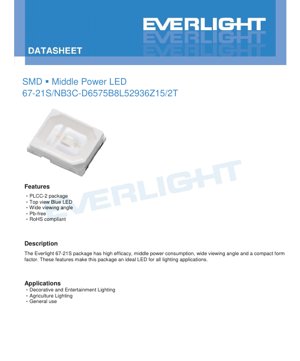
The 67-21S is a surface-mount device (SMD) middle power LED designed for general lighting applications. It utilizes a PLCC-2 (Plastic Leaded Chip Carrier) package, offering a compact form factor suitable for automated assembly processes. The primary emitted color is blue, achieved through InGaN chip technology, encapsulated in a water-clear resin to maximize light output. This LED is characterized by its high efficacy and a wide 120-degree viewing angle, making it versatile for various illumination needs. It is compliant with RoHS directives and is manufactured as a lead-free (Pb-free) component.
1.1 Core Advantages and Target Market
The key advantages of this LED include its balance of performance and power consumption, often referred to as "middle power." It provides higher luminous output than typical low-power indicator LEDs while maintaining better thermal management and efficiency compared to some high-power counterparts. Its wide viewing angle ensures uniform light distribution, which is crucial for area lighting. The primary target markets are decorative and entertainment lighting, where color and diffuse light are important, and agriculture lighting, where specific light spectra can influence plant growth. It is also suitable for general-purpose illumination in consumer and commercial products.
2. Technical Parameter Deep-Dive
2.1 Absolute Maximum Ratings
The device's operational limits are defined under specific conditions (soldering point temperature at 25°C). The maximum continuous forward current (IF) is 150 mA. It can withstand a peak forward current (IFP) of 300 mA, but only under pulsed conditions with a duty cycle of 1/10 and a pulse width of 10 ms. The maximum power dissipation (Pd) is 540 mW. The operating temperature range (Topr) is from -40°C to +85°C, and the storage temperature range (Tstg) is from -40°C to +100°C. The thermal resistance from the junction to the soldering point (Rth J-S) is 50 °C/W, which is a critical parameter for thermal management design. The maximum allowable junction temperature (Tj) is 125°C. The device is sensitive to electrostatic discharge (ESD), requiring proper handling procedures.
2.2 Electro-Optical Characteristics
Under standard test conditions (Tsoldering = 25°C, IF = 150 mA), the LED's typical performance is specified. The luminous flux (Φ) ranges from a minimum of 9.0 lm to a maximum of 15.0 lm, with a typical tolerance of ±11%. The forward voltage (VF) typically falls between 2.9 V and 3.6 V, with a tighter manufacturing tolerance of ±0.1V. The viewing angle (2θ1/2), defined as the angle where luminous intensity drops to half of its peak value, is typically 120 degrees. The reverse current (IR) is specified at a maximum of 50 μA when a reverse voltage (VR) of 5V is applied.
3. Binning System Explanation
To ensure consistency in production, LEDs are sorted into bins based on key performance parameters.
3.1 Photometric (Luminous Flux) Binning
The luminous flux output is categorized into multiple bin codes (B8, B9, L1-L5). Each code represents a specific flux range measured at 150 mA. For example, bin B8 covers 9.0 to 9.5 lm, while bin L5 covers 14.0 to 15.0 lm. This allows designers to select LEDs with the desired brightness level for their application.
3.2 Forward Voltage Binning
The forward voltage is binned into codes 36 through 42. Each code represents a 0.1V range, starting from 2.9-3.0V for bin 36 up to 3.5-3.6V for bin 42. Selecting LEDs from the same or adjacent voltage bins is important for ensuring uniform current distribution when multiple LEDs are connected in parallel.
3.3 Dominant Wavelength Binning
The color (dominant wavelength) is binned into two ranges: B54 (465-470 nm) and B55 (470-475 nm). This provides a degree of color consistency for applications where a specific blue hue is required. The measurement tolerance for dominant/peak wavelength is ±1 nm.
4. Performance Curve Analysis
4.1 Spectrum Distribution
The provided spectrum graph shows a typical emission curve for a blue InGaN LED. The peak is centered in the blue wavelength region (around 465-475 nm), with a relatively narrow spectral width, which is characteristic of this semiconductor material.
4.2 Forward Voltage vs. Junction Temperature
Figure 1 illustrates how the forward voltage shifts with increasing junction temperature. The voltage typically decreases linearly as temperature rises (a negative temperature coefficient), which is a common characteristic of semiconductor diodes. This must be considered in constant-voltage drive circuits.
4.3 Relative Radiometric Power vs. Forward Current
Figure 2 shows the relationship between optical output power and forward current. The output increases sub-linearly with current, and efficiency may drop at very high currents due to increased heat generation and other non-ideal effects.
4.4 Relative Luminous Flux vs. Junction Temperature
Figure 3 demonstrates the thermal quenching effect. As the junction temperature increases, the luminous flux output decreases. Proper heat sinking is essential to maintain light output and longevity.
4.5 Forward Current vs. Forward Voltage (IV Curve)
Figure 4 presents the classic diode IV characteristic curve at 25°C. It shows the exponential relationship between current and voltage once the turn-on voltage is exceeded.
4.6 Maximum Driving Current vs. Soldering Temperature
Figure 5 provides a derating curve. It indicates the maximum allowable forward current to keep the junction temperature below its 125°C limit, based on the temperature of the soldering point (which is related to the PCB temperature). At higher ambient or board temperatures, the current must be reduced.
4.7 Radiation Pattern
Figure 6 is a polar diagram showing the spatial distribution of light intensity. The pattern confirms the wide, Lambertian-like emission profile with a 120° viewing angle.
5. Mechanical and Package Information
5.1 Package Dimensions
The datasheet includes a detailed dimensional drawing of the PLCC-2 package. Key dimensions include the overall length, width, and height, as well as the pad spacing and size. The cathode is typically identified by a mark or a chamfered corner on the package. All unspecified tolerances are ±0.15 mm.
6. Soldering and Assembly Guidelines
The LED is suitable for reflow soldering. The maximum recommended profile is 260°C peak temperature for a duration of 10 seconds. For hand soldering, the iron tip temperature should not exceed 350°C, and contact time should be limited to 3 seconds per pad. These limits are crucial to prevent damage to the plastic package and the internal wire bonds.
7. Packaging and Ordering Information
7.1 Reel and Tape Specifications
The components are supplied on moisture-resistant tape and reel for automated pick-and-place assembly. The reel dimensions and carrier tape pocket dimensions are provided. The standard loaded quantity is 4000 pieces per reel.
7.2 Moisture Sensitivity and Packing
The LEDs are packaged in an aluminum moisture-proof bag with desiccant to protect them from ambient humidity during storage and transport, as moisture absorption can cause "popcorning" during reflow soldering.
7.3 Label Explanation
The reel label contains information such as the product number (P/N), quantity (QTY), and the specific bin codes for luminous intensity (CAT), dominant wavelength (HUE), and forward voltage (REF).
8. Application Suggestions
8.1 Typical Application Scenarios
Decorative and Entertainment Lighting: The blue color and wide angle make it suitable for accent lighting, signage, and stage effects.
Agriculture Lighting: Blue light is a key component in horticultural lighting spectra, influencing plant morphology and photosynthesis.
General Illumination: E be fit for use for panel lights, downlights, and other fixtures wey dey need diffuse blue or white (when combined with phosphors) light source for array.
8.2 Design Considerations
Thermal Management: With an Rth J-S of 50 °C/W, effective heat sinking via the PCB (using thermal vias, copper pours) is mandatory for reliable operation at full current.
Current Driving: A constant current driver is highly recommended over a constant voltage source to ensure stable light output and prevent thermal runaway.
Optics: The wide viewing angle may require secondary optics (lenses, reflectors) if a more focused beam is desired.
ESD Protection: Implement ESD protection on PCB inputs and ensure proper handling during assembly.
9. Reliability and Testing
The datasheet lists a comprehensive set of reliability tests performed with a 90% confidence level and 10% LTPD (Lot Tolerance Percent Defective). Tests include reflow soldering resistance, thermal shock, temperature cycling, high temperature/humidity storage and operation, low temperature storage and operation, and multiple high-temperature operation life tests under various conditions (25°C, 55°C, 85°C with different currents). These tests validate the LED's robustness under typical environmental and operational stresses.
10. Tambayoyin da ake yawan yi (Dangane da Ma'auni na Fasaha)
Q: Shin zan iya tuka wannan LED a 300 mA akai-akai?
A: No. The 300 mA rating is for pulsed operation only (1/10 duty cycle, 10ms pulse width). The maximum continuous current is 150 mA. Exceeding this will likely overheat and damage the LED.
Q: Why is the forward voltage binning important?
A: When connecting multiple LEDs in parallel, differences in forward voltage cause an uneven distribution of current. LEDs with a lower VF will draw more current, potentially leading to premature failure. Using LEDs from the same voltage bin minimizes this risk.
Q: Yaya za a fassara ƙimar juriyar zafi (50 °C/W)?
A: Wannan yana nufin cewa ga kowace watt na wutar lantarki da ke ɓacewa a cikin haɗin LED, zafin haɗin zai tashi 50°C sama da zafin wurin gyaɗa. Misali, a 150 mA da VF na 3.2V, wutar lantarki tana kusan 0.48W. Wannan zai haifar da hawan zafin 24°C daga wurin PCB zuwa haɗin.
Q: Menene manufar jakar hana danshi?
A> SMD packages can absorb moisture from the air. During the high-temperature reflow soldering process, this trapped moisture can vaporize rapidly, creating internal pressure that cracks the package (\"popcorning\"). The moisture-proof bag and desiccant prevent absorption before use.
11. Practical Design Case
Scenario: Designing a linear light bar using 20 pieces of the 67-21S LED.
Design Steps:
1. Electrical Design: Decide on a series-parallel configuration. For example, connect 10 strings in parallel, with each string containing 2 LEDs in series. This requires a drive voltage of ~6.4V (2 * 3.2V) and a total current of 1.5A (10 strings * 150mA). A constant current driver set to 1.5A and capable of >7V output is needed.
2. Thermal Design: Calculate total power dissipation: 20 LEDs * 0.48W ≈ 9.6W. The PCB must act as a heat sink. Use a 2-oz copper layer, thermal vias under each LED pad connecting to a large internal ground plane, and consider an aluminum-core PCB (MCPCB) for better heat spreading.
3. Optical Design: For a linear bar, the native 120° beam may be sufficient. If a diffused cover is used, ensure it has high transmittance to maintain efficiency.
4. Component Selection: Specify LEDs from the same luminous flux bin (e.g., L2) and forward voltage bin (e.g., 38) to ensure uniform brightness and current sharing.
12. Gabatarwar Ka'idar Fasaha
LED 67-21S ya dogara ne akan tsarin heterostructure na semiconductor da aka yi daga Indium Gallium Nitride (InGaN). Lokacin da ake amfani da ƙarfin lantarki mai gaba a kan haɗin p-n, ana shigar da electrons da ramuka cikin yanki mai aiki. Haɗuwarsu yana sakin makamashi ta hanyar photons (haske). Takamaiman abun da ke cikin gawa na InGaN yana ƙayyade makamashin bandgap, wanda kuma ke ayyana tsayin raƙuman ruwa (launi) na hasken da aka fitar—a wannan yanayin, shuɗi. Kunshin PLCC-2 yana ɗaukar die ɗin semiconductor akan leadframe, yana haɗa shi da wayoyi masu kyau, kuma yana rufe shi a cikin filastik mai tsabta ko guduro na silicone wanda ke kare die kuma yana aiki azaman farkon kayan gani.
13. Trends na Fasaha
The market for middle-power LEDs like the 67-21S continues to evolve. Key trends include:
Increased Efficacy (lm/W): Ongoing improvements in chip design, epitaxial growth, and package extraction efficiency lead to higher light output for the same electrical input.
Improved Color Consistency: Tighter binning tolerances and advanced manufacturing controls reduce color variation within and between production batches.
Enhanced Reliability: Development of more robust package materials (e.g., high-temperature silicones) and die attach technologies to withstand higher operating temperatures and harsher environments.
Application-Specific Optimization: LEDs are increasingly tailored for specific markets like horticulture, with spectra optimized for plant photoreceptors, or for human-centric lighting, considering circadian rhythms.
LED Specification Terminology
Complete explanation of LED technical terms
Photoelectric Performance
| Term | Unit/Representation | Simple Explanation | Why Important |
|---|---|---|---|
| Luminous Efficacy | lm/W (lumens per watt) | Haske a kowane watt na wutar lantarki, mafi girma yana nufin mafi ingancin makamashi. | Kai tsaye yana ƙayyade matakin ingancin makamashi da farashin wutar lantarki. |
| Luminous Flux | lm (lumens) | Total light emitted by source, commonly called "brightness". | Determines if the light is bright enough. |
| Viewing Angle | ° (degrees), e.g., 120° | Angle where light intensity drops to half, determines beam width. | Affects illumination range and uniformity. |
| CCT (Color Temperature) | K (Kelvin), e.g., 2700K/6500K | Mwangaza wa joto/baridi, thamani za chini ni manjano/joto, za juu nyeupe/baridi. | Huamua mazingira ya taa na matukio yanayofaa. |
| CRI / Ra | Unitless, 0–100 | Ability to render object colors accurately, Ra≥80 is good. | Affects color authenticity, used in high-demand places like malls, museums. |
| SDCM | MacAdam ellipse steps, e.g., "5-step" | Color consistency metric, smaller steps mean more consistent color. | Ensures uniform color across same batch of LEDs. |
| Dominant Wavelength | nm (nanometers), e.g., 620nm (red) | Wavelength corresponding to color of colored LEDs. | Determines hue of red, yellow, green monochrome LEDs. |
| Spectral Distribution | Wavelength vs intensity curve | Shows intensity distribution across wavelengths. | Affects color rendering and quality. |
Electrical Parameters
| Term | Symbol | Simple Explanation | Design Considerations |
|---|---|---|---|
| Forward Voltage | Vf | Minimum voltage to turn on LED, like "starting threshold". | Driver voltage must be ≥Vf, voltages add up for series LEDs. |
| Forward Current | If | Current value for normal LED operation. | Usually constant current drive, current determines brightness & lifespan. |
| Max Pulse Current | Ifp | Peak current tolerable for short periods, used for dimming or flashing. | Pulse width & duty cycle must be strictly controlled to avoid damage. |
| Reverse Voltage | Vr | Max reverse voltage LED can withstand, beyond may cause breakdown. | Circuit must prevent reverse connection or voltage spikes. |
| Thermal Resistance | Rth (°C/W) | Resistance to heat transfer from chip to solder, lower is better. | High thermal resistance requires stronger heat dissipation. |
| ESD Immunity | V (HBM), e.g., 1000V | Ability to withstand electrostatic discharge, higher means less vulnerable. | Anti-static measures needed in production, especially for sensitive LEDs. |
Thermal Management & Reliability
| Term | Key Metric | Simple Explanation | Impact |
|---|---|---|---|
| Junction Temperature | Tj (°C) | Yanzu aiki zazzabi a cikin LED chip. | Kowane raguwa 10°C na iya ninka tsawon rayuwa; yana da yawa yana haifar da lalacewar haske, canjin launi. |
| Lumen Depreciation | L70 / L80 (hours) | Time for brightness to drop to 70% or 80% of initial. | Directly defines LED "service life". |
| Lumen Maintenance | % (e.g., 70%) | Percentage of brightness retained after time. | Indicates brightness retention over long-term use. |
| Color Shift | Δu′v′ or MacAdam ellipse | Iru lilo awọ nigba lilo. | O n fa ibaramu awọ ninu awọn iboju itanna. |
| Thermal Aging | Material degradation | Deterioration due to long-term high temperature. | May cause brightness drop, color change, or open-circuit failure. |
Packaging & Materials
| Term | Common Types | Simple Explanation | Features & Applications |
|---|---|---|---|
| Package Type | EMC, PPA, Ceramic | Housing material protecting chip, providing optical/thermal interface. | EMC: good heat resistance, low cost; Ceramic: better heat dissipation, longer life. |
| Tsarin Chip | Front, Flip Chip | Chip electrode arrangement. | Flip chip: better heat dissipation, higher efficacy, for high-power. |
| Phosphor Coating | YAG, Silicate, Nitride | Covers blue chip, converts some to yellow/red, mixes to white. | Phosphors ya daban-daban suna tasiri inganci, CCT, da CRI. |
| Lens/Optics | Flat, Microlens, TIR | Optical structure on surface controlling light distribution. | Determines viewing angle and light distribution curve. |
Quality Control & Binning
| Term | Binning Content | Simple Explanation | Purpose |
|---|---|---|---|
| Luminous Flux Bin | Code e.g., 2G, 2H | Grouped by brightness, each group has min/max lumen values. | Ensures uniform brightness in same batch. |
| Voltage Bin | Code e.g., 6W, 6X | Grouped by forward voltage range. | Facilitates driver matching, improves system efficiency. |
| Color Bin | 5-step MacAdam ellipse | Grouped by color coordinates, ensuring tight range. | Guarantees color consistency, avoids uneven color within fixture. |
| CCT Bin | 2700K, 3000K etc. | Grouped by CCT, each has corresponding coordinate range. | Meets different scene CCT requirements. |
Testing & Certification
| Term | Standard/Test | Simple Explanation | Significance |
|---|---|---|---|
| LM-80 | Lumen maintenance test | Long-term lighting at constant temperature, recording brightness decay. | Used to estimate LED life (with TM-21). |
| TM-21 | Life estimation standard | Yana kiyasin rayuwa a ƙarƙashin yanayi na ainihi bisa bayanan LM-80. | Yana ba da hasashen rayuwa na kimiyya. |
| IESNA | Illuminating Engineering Society | Covers optical, electrical, thermal test methods. | Industry-recognized test basis. |
| RoHS / REACH | Environmental certification | Ensures no harmful substances (lead, mercury). | Market access requirement internationally. |
| ENERGY STAR / DLC | Energy efficiency certification | Energy efficiency and performance certification for lighting. | Used in government procurement, subsidy programs, enhances competitiveness. |