Table of Contents
- 1. Product Overview
- 2. Technical Parameter Analysis
- 2.1 Absolute Maximum Ratings
- 2.2 Electro-Optical Characteristics
- 3. Binning System Description
- 3.1 Luminous Intensity Binning
- 3.2 Dominant Wavelength Binning
- 3.3 Forward Voltage Binning
- 4. Performance Curve Analysis
- 4.1 Relationship between Relative Luminous Intensity and Forward Current
- 4.2 Forward Current Derating Curve
- 4.3 Spectral Distribution
- 4.4 Forward Voltage vs. Forward Current Relationship
- 4.5 Radiation Pattern
- 5. Mechanical and Packaging Information
- 5.1 Package Dimensions
- 6. Soldering and Assembly Guide
- 6.1 Reflow Soldering Temperature Profile
- 6.2 Storage and Handling Precautions
- 7. Packaging and Ordering Information
- 7.1 Tape and Reel Specifications
- 7.2 Label Description
- 8. Application Suggestions
- 8.1 Typical Application Scenarios
- 8.2 Design Considerations
- 9. Technical Comparison and Differentiation
- 10. Frequently Asked Questions (Based on Technical Parameters)
- 10.1 What is the difference between peak wavelength and dominant wavelength?
- 10.2 Can I drive this LED with 30mA?
- 10.3 Why is the forward voltage of a blue LED higher than that of a red one?
- 10.4 Yaya yin oda yadda ake fassara lambobin rarrabawa?
- 11. Nazarin ƙira da amfani da shari'o'i
- 12. Working Principle
- 13. Technology Trends
1. Product Overview
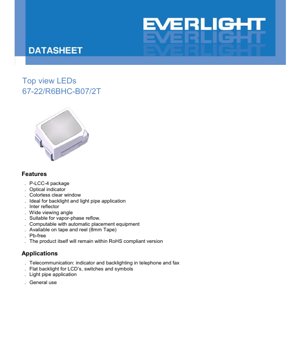
Bu belge, P-LCC-4 paketleme kullanılan ve entegre dahili reflektör kasesine sahip bir yüzey montaj cihazı (SMD) LED olan 67-22/R6BHC-B07/2T'nin teknik özelliklerini ayrıntılı olarak açıklamaktadır. Bu bileşen, yüksek parlaklık çıktısı ve geniş görüş açısı sağlamak üzere tasarlanmış olup, net görsel gösterge veya düzgün arka aydınlatma gerektiren uygulamalar için ideal bir seçimdir. Ürün, her ikisi de renksiz şeffaf reçine pencere içinde paketlenmiş iki farklı çip modeli sunar: R6 (parlak kırmızı) ve BH (mavi). Tasarımı, ışık çıkış verimliliğini ve yönlülüğünü artırmak için dahili bir reflektör kullanır.
The core advantages of this LED include: compatibility with automated pick-and-place equipment, suitability for vapor phase reflow soldering processes, and availability in tape-and-reel packaging to accommodate high-volume production. It is a lead-free component, compliant with relevant environmental regulations. The primary target markets are telecommunications equipment, consumer electronics, and industrial control panels, where it serves as a reliable indicator light, backlight for LCDs and switches, or as a light source for light guide assemblies.
2. Technical Parameter Analysis
2.1 Absolute Maximum Ratings
The operating limits of the device are defined under specific environmental conditions (Ta=25°C). Exceeding these ratings may cause permanent damage.
- Reverse Voltage (VR):Maximum 5V. This is a key parameter for circuit protection; applying a reverse bias exceeding this value will damage the LED junction.
- Forward Current (IF):The continuous DC forward current rating varies by chip: 50 mA for R6 (red), 25 mA for BH (blue). The typical operating condition specified in the datasheet is 20mA.
- Peak Forward Current (IFP):Both chips are 100 mA, suitable for pulse operation at specified duty cycles.
- Power Dissipation (Pd):R6 is 120 mW, BH is 95 mW. This parameter, together with the thermal resistance (implied), determines the maximum allowable power under given thermal conditions.
- Temperature Range:Operating temperature (Topr) is -40°C to +85°C; storage temperature (Tstg) is -40°C to +90°C.
- Soldering Temperature:This component can withstand reflow soldering with a peak temperature of 260°C for up to 10 seconds, or hand soldering at 350°C for up to 3 seconds.
2.2 Electro-Optical Characteristics
Key performance indicators are measured under the conditions of Ta=25°C and IF=20mA, unless otherwise specified.
- Luminous Intensity (Iv):The range for both R6 and BH chips is from a minimum of 90 mcd to a maximum of 225 mcd. Typical values fall within this binning range.
- Viewing Angle (2θ1/2):The full width at half maximum is typically 120 degrees, providing a very broad emission pattern, which is ideal for large-area lighting.
- Wavelength:
- R6 (Red):Peak wavelength (λp) is typically 632 nm. Dominant wavelength (λd) range is 621 nm to 631 nm.
- BH (Blue):Peak wavelength (λp) is typically 468 nm. Dominant wavelength (λd) range is 466.5 nm to 471.5 nm.
- Spectral Radiation Bandwidth (Δλ):R6 is approximately 20 nm, and BH is approximately 25 nm, defining the spectral purity of the emitted light.
- Forward Voltage (VF):
- R6 (Red):At 20mA, the range is from 1.75V to 2.35V.
- BH (Blue):At 20mA, the range is from 2.9V to 3.7V. This higher forward voltage is typical for InGaN-based blue LEDs.
- Reverse Current (IR):Maximum 10 μA when a 5V reverse bias is applied.
Tolerance Description:The datasheet specifies manufacturing tolerances: luminous intensity (±11%), dominant wavelength (±1nm), and forward voltage (±0.1V). These are important for design consistency.
3. Binning System Description
Kwa kuhakikisha usawa wa rangi na mwangaza katika uzalishaji, LED zimegawanywa katika vigezo mbalimbali kulingana na vigezo muhimu.
3.1 Luminous Intensity Binning
Wakati wa kupima kwa IF=20mA, chipi za R6 na BH zimegawanywa katika vigezo vinne vya nguvu (Q2, R1, R2, S1). Vigezo hivi vinabainisha thamani ya chini na ya juu, ikiruhusu wabunifu kuchagua kiwango sahihi cha mwangaza kwa matumizi yao, kuanzia mwangaza wa kawaida (Q2: 90-112 mcd) hadi mwangaza wa juu (S1: 180-225 mcd).
3.2 Dominant Wavelength Binning
For the R6 (red) chip, the dominant wavelength is divided into two codes: FF1 (621-626 nm) and FF2 (626-631 nm). This allows for the selection of a specific red hue. The BH (blue) chip has a narrower specified range (466.5-471.5 nm), indicating higher consistency in blue wavelength output.
3.3 Forward Voltage Binning
Forward voltage is also binned to aid circuit design, particularly for current-limiting resistor calculation and power supply design.
- R6 (Red):Bins 0 (1.75-1.95V), 1 (1.95-2.15V), and 2 (2.15-2.35V).
- BH (Blue):Gear 11 (2.90-3.10V), 12 (3.10-3.30V), 13 (3.30-3.50V), and 14 (3.50-3.70V).
4. Performance Curve Analysis
The datasheet provides characteristic curves for both the R6 and BH models to facilitate a deeper understanding of performance under different conditions.
4.1 Relationship between Relative Luminous Intensity and Forward Current
The curve shows that before reaching the rated current, there is an approximately linear relationship between forward current and light output. It confirms that 20mA is the standard operating point where both colors are within the linear region. Driving the LED with a higher current increases output but also raises junction temperature and accelerates lumen depreciation.
4.2 Forward Current Derating Curve
This chart is crucial for thermal management. It illustrates the maximum allowable continuous forward current as a function of ambient temperature (Ta). As Ta increases, the maximum allowable current decreases linearly. For reliable operation in high-temperature environments (e.g., +85°C), the forward current must be significantly derated from its 25°C rating.
4.3 Spectral Distribution
The spectral diagram shows the relationship between normalized radiant power and wavelength. The R6 curve is centered at 632 nm with a typical bandwidth, while the BH curve is centered at 468 nm. These charts are useful for applications sensitive to specific spectral content.
4.4 Forward Voltage vs. Forward Current Relationship
This IV characteristic curve demonstrates a typical diode exponential relationship. The voltage increases with the logarithm of the current. This curve is helpful for understanding the dynamic resistance of an LED, which is crucial for designing efficient drive circuits.
4.5 Radiation Pattern
The polar plot intuitively represents the typical 120° viewing angle. Intensity is normalized to the peak (axial) value. The plot shows a pattern resembling a Lambertian distribution, which is common in LEDs with diffusive lenses or reflectors, providing broad and uniform illumination.
5. Mechanical and Packaging Information
5.1 Package Dimensions
The LED is packaged in a P-LCC-4 (Plastic Leaded Chip Carrier, 4-pin) package. The detailed dimension drawing specifies overall dimensions, lead pitch, and cavity details. Key dimensions include the pad size, which is crucial for PCB pad design. This package incorporates a built-in reflector cup surrounding the LED chip to collimate light and enhance forward luminous intensity. The anode and cathode are clearly marked on the package drawing.
6. Soldering and Assembly Guide
6.1 Reflow Soldering Temperature Profile
Provides a detailed lead-free reflow soldering temperature profile. Key stages include:
- Preheat:150-200°C, lasting 60-120 seconds, with a maximum heating rate of 3°C/second.
- Reflow (Above Liquidus):Time above 217°C shall be 60-150 seconds. Peak temperature shall not exceed 260°C, and time within ±5°C of peak temperature shall be no more than 10 seconds.
- Cooling:Maximum cooling rate 6°C per second.
Important Notice:Reflow soldering should not exceed two times to prevent thermal stress damage to the package and bonding wires.
6.2 Storage and Handling Precautions
- Moisture Sensitivity:This component is packaged in a moisture barrier bag with desiccant. Do not open the bag until ready to use the component. The floor life after opening is 168 hours at ≤30°C and ≤60% RH.
- Baking:If the storage time is exceeded or the desiccant indicator changes color, baking at 60 ±5°C for 24 hours is required before reflow soldering to prevent the "popcorn" phenomenon (package cracking due to vapor pressure).
- Current Protection:An external current-limiting resistor must be used. LEDs are current-driven devices; a small change in forward voltage can cause a large change in current, potentially leading to instantaneous failure.
- Mechanical Stress:Avoid applying mechanical stress to the LED body during the soldering process.
7. Packaging and Ordering Information
7.1 Tape and Reel Specifications
The product is supplied in 8mm carrier tape format, wound on standard reels. Each reel contains 2000 units. Detailed drawings of the carrier tape pocket dimensions and reel dimensions are provided to ensure compatibility with automated assembly equipment feeders.
7.2 Label Description
The reel label contains multiple codes:
- P/N:Manufacturer Part Number (67-22/R6BHC-B07/2T).
- QTY:Number of parts on the reel.
- CAT, HUE, REF:Codes corresponding to luminous intensity binning, dominant wavelength binning, and forward voltage binning, respectively.
- LOT No:Traceable lot number.
8. Application Suggestions
8.1 Typical Application Scenarios
- Telecommunications Equipment:Status indicators on routers, modems, telephones, and fax machines.
- LCD backlight:Side-lit or direct-lit backlighting for small monochrome or color LCD displays used in home appliances, instruments, and handheld devices.
- Switch and symbol illumination:Backlighting for membrane switches, keypads, and panel legends.
- Light Guide Applications:As a light source for acrylic or PC light guides, transmitting light from the PCB to the front panel or display.
- General Status Indication:Power, activity, alarm, or mode indicators in a wide range of electronic products.
8.2 Design Considerations
- Current Limiting:Always use a series resistor. Calculate the resistor value using the formula R = (Vsupply - Vf) / If, where Vf should be selected as the maximum value from the datasheet (e.g., 2.35V for R6, 3.7V for BH) to ensure a conservative design where the current never exceeds 20mA, even accounting for power supply voltage tolerance and Vf variation.
- Thermal Management:For continuous operation at high ambient temperatures or near maximum current, PCB layout must be considered. Use sufficient copper foil connected to the LED's thermal pad (if available) or cathode pin to act as a heat sink.
- Optical Design:A wide viewing angle of 120° may require light guides, diffusers, or lenses to shape the beam for specific applications. Integrated reflectors provide good forward intensity but may not be suitable for extremely narrow beam requirements.
- ESD Protection:Although there is no explicit ESD rating, standard ESD handling precautions should be observed during assembly to prevent potential damage to semiconductor junctions.
9. Technical Comparison and Differentiation
Compared to standard SMD LEDs without an integrated reflector, this component provides a significantly higher forward luminous intensity at the same drive current due to the light-gathering effect of the reflector cup. The P-LCC-4 package offers a more robust mechanical structure than chip-scale packages and typically provides better thermal performance through its leads. Compared to LEDs that are unbinned or have wide bins, providing detailed intensity, wavelength, and voltage binning information enables tighter system design and better end-product consistency. The combination of a wide viewing angle with good intensity makes it a versatile choice for applications requiring both off-axis angle visibility and bright on-axis performance.
10. Frequently Asked Questions (Based on Technical Parameters)
10.1 What is the difference between peak wavelength and dominant wavelength?
Peak wavelength (λp) is the wavelength at which the spectral power distribution reaches its maximum. Dominant wavelength (λd) is the wavelength of monochromatic light that most closely matches the perceived color of the LED light. For design purposes, especially in color-sensitive applications, the dominant wavelength and its binning are more relevant.
10.2 Can I drive this LED with 30mA?
While the absolute maximum rating for continuous forward current is 50mA (R6) or 25mA (BH), the photometric and electrical characteristics are specified at 20mA. Driving at 30mA will produce more light but also increases power consumption, junction temperature, and may accelerate lumen depreciation. It is essential to refer to the derating curves and ensure the junction temperature remains within safe limits. For long-term reliable operation, it is recommended to follow the typical condition of 20mA.
10.3 Why is the forward voltage of a blue LED higher than that of a red one?
This is determined by the fundamental semiconductor materials. The R6 red LED uses AlGaInP (aluminum gallium indium phosphide), which has a lower bandgap energy. The BH blue LED uses InGaN (indium gallium nitride), which has a wider bandgap. A wider bandgap requires more energy for electrons to cross, which translates to a higher forward voltage at the same current.
10.4 Yaya yin oda yadda ake fassara lambobin rarrabawa?
When placing an order, you can specify the required CAT (intensity), HUE (wavelength), and REF (voltage) bin codes to ensure the received LED performance parameters are within your specific design window. For example, to achieve consistent bright red output, you can specify CAT=S1 and HUE=FF2. If not specified, you will receive parts from the standard production bins.
11. Nazarin ƙira da amfani da shari'o'i
Scenario: Designing a multi-status indicator panel for a network switch.The panel requires a red LED for "Critical Alarm," a blue LED for "System Activity," and must be visible from all angles in a rack-mounted unit. Therefore, the 67-22/R6BHC-B07/2T was selected.
Implementation Plan:R6 (red) and BH (blue) models were used. The designer selected the S1 intensity bin for maximum brightness and specified tight wavelength bins (e.g., FF2 for red) to ensure color consistency across all units. A simple drive circuit was designed using a 5V supply. For the blue LED (max Vf=3.7V @20mA), the current-limiting resistor was calculated: R = (5V - 3.7V) / 0.02A = 65 ohms. A standard 68-ohm resistor was chosen. For the red LED (max Vf=2.35V), R = (5V - 2.35V) / 0.02A = 132.5 ohms; a 130-ohm resistor was used. The wide 120° viewing angle ensures the indicator is clearly visible even when technicians are not directly facing the panel. Components were placed using automated equipment with the provided tape-and-reel.
12. Working Principle
A Light Emitting Diode (LED) is a semiconductor device that emits light through electroluminescence. When a forward voltage is applied across the p-n junction, electrons from the n-type material recombine with holes from the p-type material in the active region. This recombination process releases energy in the form of photons (light). The specific wavelength (color) of the emitted light is determined by the bandgap energy of the semiconductor material used in the active region. The AlGaInP material system produces red, orange, and yellow light, while the InGaN system produces blue, green, and white light (when combined with a phosphor). The integrated reflector in this package is a molded cavity, typically made of a highly reflective material, surrounding the chip. It redirects light that would otherwise be emitted sideways or backward toward the front of the package, thereby increasing useful forward luminous intensity and controlling the beam pattern.
13. Technology Trends
Nin SMD LED siratili bɛ tugu industry ka gɛlɛnman trendw fɛ: miniaturization, efficiency kɔnɔntɔni (lumens per watt), ani reliability kɔnɔntɔni. Reflector technology baara kɛ standard package size kɔnɔ, o ye gɛlɛya-fɛn sɔrɔli ye ka performance jɔ, a tɛ sɔrɔ ka taa Chip-on-Board (COB) min sɔngɔ ka gɛlɛ, walima advanced packaging typew fɛ. Industry bɛ daɲɛ kɛ ka AlGaInP (wulu) ani InGaN (bulu/nɛrɛjinɛ) materialw ka efficiency jɔ, nka o bɛ kɛ ka brightness kɔnɔntɔni sɔrɔ same current kɔnɔ, walima ka same brightness sɔrɔ lower power kɔnɔ. Packaging innovation bɛ jɔli kɛ thermal management ɲumanw kan ka increased power density fɛ, ani ka color consistency ani Angular Color Uniformity (ACU) ɲɛnabɔ whole emission pattern kɔnɔ. Nin datasheet bɛ kɛ ɲɛ fɛ, lead-free ani RoHS compliance ka ɲɛfɔli in, o bɛ industry bɛɛ ka taama ɲɛ fɛ environmental sustainable manufacturing fɛ kalan.
Detailed Explanation of LED Specification Terminology
Complete Explanation of LED Technical Terminology
I. Core Indicators of Photoelectric Performance
| Terminology | Unit/Representation | Popular Explanation | Why It Matters |
|---|---|---|---|
| Luminous Efficacy | lm/W | The luminous flux emitted per watt of electrical power, higher values indicate greater energy efficiency. | Directly determines the energy efficiency rating and electricity cost of the lighting fixture. |
| Luminous Flux | lm (Lumen) | Total light output from a light source, commonly known as "brightness". | Determines whether a luminaire is bright enough. |
| Viewing Angle | ° (degrees), e.g., 120° | The angle at which luminous intensity drops to half, determining the width of the light beam. | Affects the illumination range and uniformity. |
| Color Temperature (CCT) | K (Kelvin), e.g., 2700K/6500K | The warmth or coolness of light color; lower values are yellowish/warm, higher values are whitish/cool. | Determines the lighting ambiance and suitable application scenarios. |
| Color Rendering Index (CRI / Ra) | Unitless, 0–100 | The ability of a light source to restore the true color of an object, Ra≥80 is recommended. | Affects color authenticity, used in high-demand places such as shopping malls and art galleries. |
| Color tolerance (SDCM) | MacAdam ellipse step, e.g., "5-step" | A quantitative metric for color consistency; a smaller step number indicates better color consistency. | Ensure no color variation among luminaires from the same batch. |
| Dominant Wavelength | nm (nanometer), e.g., 620nm (red) | Rangi ya LED ya rangi inayolingana na thamani ya urefu wa mawimbi. | Inaamua rangi ya LED ya rangi moja kama nyekundu, manjano, kijani, n.k. |
| Spectral Distribution | Wavelength vs. Intensity Curve | It shows the intensity distribution of light emitted by an LED across various wavelengths. | Affects color rendering and color quality. |
II. Electrical Parameters
| Terminology | Symbol | Popular Explanation | Design Considerations |
|---|---|---|---|
| Forward Voltage | Vf | The minimum voltage required to light up an LED, similar to a "starting threshold". | The driving power supply voltage must be ≥ Vf, and the voltage accumulates when multiple LEDs are connected in series. |
| Forward Current | If | The current value that makes the LED emit light normally. | Constant current drive is often used, as current determines brightness and lifespan. |
| Maximum Pulse Current (Pulse Current) | Ifp | Peak current that can be withstood for a short period, used for dimming or flashing. | Pulse width and duty cycle must be strictly controlled to prevent overheating and damage. |
| Reverse Voltage | Vr | The maximum reverse voltage that an LED can withstand; exceeding it may cause breakdown. | The circuit needs to prevent reverse connection or voltage surges. |
| Thermal Resistance | Rth (°C/W) | The resistance to heat transfer from the chip to the solder joint; a lower value indicates better heat dissipation. | High thermal resistance requires a stronger heat dissipation design; otherwise, the junction temperature will increase. |
| Electrostatic Discharge Immunity (ESD Immunity) | V (HBM), e.g., 1000V | ESD strike resistance, the higher the value, the less susceptible to ESD damage. | Anti-static measures must be implemented during production, especially for high-sensitivity LEDs. |
III. Thermal Management and Reliability
| Terminology | Key Indicators | Popular Explanation | Impact |
|---|---|---|---|
| Junction Temperature | Tj (°C) | The actual operating temperature inside the LED chip. | For every 10°C reduction, the lifespan may double; excessively high temperatures lead to lumen depreciation and color shift. |
| Lumen Depreciation | L70 / L80 (hours) | Time required for brightness to drop to 70% or 80% of its initial value. | Directly define the "useful life" of an LED. |
| Lumen Maintenance | % (e.g., 70%) | The percentage of remaining brightness after a period of use. | Characterization of luminance maintenance capability after long-term use. |
| Color Shift | Δu′v′ or MacAdam ellipse | The degree of color change during use. | Affects the color consistency of the lighting scene. |
| Thermal Aging | Material performance degradation | Deterioration of packaging materials due to long-term high temperature. | May lead to decreased brightness, color shift, or open-circuit failure. |
IV. Packaging and Materials
| Terminology | Common Types | Popular Explanation | Features and Applications |
|---|---|---|---|
| Package Types | EMC, PPA, Ceramic | The housing material that protects the chip and provides optical and thermal interfaces. | EMC has good heat resistance and low cost; ceramic has excellent heat dissipation and long lifespan. |
| Chip structure | Front side, Flip Chip | Chip electrode arrangement method. | Flip Chip offers better heat dissipation and higher luminous efficacy, suitable for high-power applications. |
| Phosphor coating | YAG, silicate, nitride | Coated on the blue LED chip, partially converted to yellow/red light, mixed to form white light. | Different phosphors affect luminous efficacy, color temperature, and color rendering. |
| Lens/Optical Design | Planar, microlens, total internal reflection | Optical structure on the encapsulation surface, controlling light distribution. | Determines the emission angle and light distribution curve. |
V. Quality Control and Binning
| Terminology | Binning Content | Popular Explanation | Purpose |
|---|---|---|---|
| Luminous Flux Binning | Codes such as 2G, 2H | Group by brightness level, each group has a minimum/maximum lumen value. | Ensure consistent brightness for products within the same batch. |
| Voltage binning | Codes such as 6W, 6X | Grouped by forward voltage range. | Facilitates driver power matching and improves system efficiency. |
| Color binning | 5-step MacAdam ellipse | Group by color coordinates to ensure colors fall within an extremely small range. | Ensure color consistency to avoid color unevenness within the same luminaire. |
| Color temperature binning | 2700K, 3000K, etc. | Group by color temperature, each group has a corresponding coordinate range. | Meet the color temperature requirements of different scenarios. |
VI. Testing and Certification
| Terminology | Standard/Test | Popular Explanation | Significance |
|---|---|---|---|
| LM-80 | Lumen Maintenance Test | Long-term illumination under constant temperature conditions, recording brightness attenuation data. | Used to estimate LED lifetime (combined with TM-21). |
| TM-21 | Life Extrapolation Standard | Estimating service life under actual use conditions based on LM-80 data. | Providing scientific life prediction. |
| IESNA standard | Illuminating Engineering Society standard | Covering optical, electrical, and thermal testing methods. | Industry-recognized testing basis. |
| RoHS / REACH | Environmental Certification | Ensure products are free from hazardous substances (e.g., lead, mercury). | Conditions for market entry into the international market. |
| ENERGY STAR / DLC | Energy efficiency certification | Energy Efficiency and Performance Certification for Lighting Products. | Commonly used in government procurement and subsidy programs to enhance market competitiveness. |