Teburin Abubuwan Ciki
- 1. Bayanin Samfur
- 1.1 Fa'idodi na Asali da Kasuwar da Ake Nufi
- . Technical Parameter Deep-Dive
- .1 Absolute Maximum Ratings
- .2 Electro-Optical Characteristics (Ta=25°C)
- . Binning System Explanation
- .1 Luminous Intensity Binning
- .2 Forward Voltage Binning
- .3 Chromaticity Coordinate Binning
- . Performance Curve Analysis
- .1 Luminous Intensity vs. Ambient Temperature
- .2 Forward Current Derating Curve
- .3 Forward Current vs. Forward Voltage (I-V Curve)
- .4 Luminous Intensity vs. Forward Current
- .5 Spectrum Distribution and Radiation Pattern
- . Mechanical and Packaging Information
- .1 Package Dimensions
- .2 Polarity Identification
- . Soldering and Assembly Guidelines
- .1 Reflow Soldering Profile
- .2 Storage and Handling
- .3 Hand Soldering and Rework
- . Packaging and Ordering Information
- .1 Tape and Reel Specifications
- .2 Label Explanation
- . Application Design Considerations
- .1 Current Limiting is Mandatory
- .2 Thermal Management
- .3 Achieving Uniformity in Multi-LED Arrays
- . Technical Comparison and Differentiation
- . Frequently Asked Questions (FAQ)
- .1 What is the typical operating current?
- .2 How do I select the right current-limiting resistor?
- .3 Can I use PWM for dimming?
- .4 Why is the viewing angle so important for light pipe applications?
- . Practical Design and Usage Examples
- .1 Mobile Device Button Backlighting
- .2 Automotive Climate Control Display
- .3 Industrial Panel Meter Indicator
- . Operating Principle Introduction
- . Technology Trends and Context
- Kalmomin Ƙayyadaddun LED
- Aikin Hasken Wutar Lantarki
- Ma'auni na Lantarki
- Gudanar da Zafi & Amincewa
- Tufafi & Kayan Aiki
- Kula da Inganci & Rarraba
- Gwaji & Takaddun Shaida
1. Bayanin Samfur
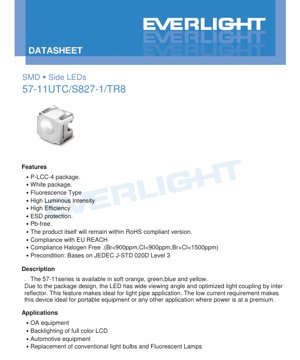
57-11UTC/S827-1/TR8 babban LED ne mai launin fari (LED) wanda aka ƙera shi a cikin ƙaramin kunshin na'urar haɗawa ta saman (SMD) P-LCC-4. Wannan LED na gefe an ƙera shi don samar da haske mai inganci kuma mai dogaro ga nau'ikan aikace-aikacen lantarki na zamani inda sarari da amfani da wutar lantarki suke da matuƙar mahimmanci.
Na'urar tana da kunshin fari tare da guduro mai tsabta kamar ruwa, tana amfani da fasahar guntu InGaN don samar da hasken fari. Wani muhimmin al'amari na ƙira shi ne faɗin kusurwar gani, wanda aka samu ta hanyar ingantaccen ƙirar mai nuna haske a cikin kunshin. Wannan ƙirar tana haɓaka haɗin haske kuma tana sa LED ya dace musamman ga aikace-aikacen da suka haɗa da bututun haske, inda ake buƙatar hasken gefe iri ɗaya. Ƙarancin buƙatun wutar lantarki ya ƙara sanya shi zama kayan aiki mai kyau don kayan aikin da ake ɗauka da baturi da sauran aikace-aikacen da ingancin makamashi ya fi muhimmanci.
Samfurin yana bin ƙa'idodin muhalli da inganci masu tsauri, ba shi da gubar, yana bin ka'idojin EU RoHS da REACH, kuma ya cika buƙatun rashin halogen (Br<900ppm, Cl<900ppm, Br+Cl<1500ppm). Hakanan an riga an shirya shi bisa ga JEDEC J-STD-020D Mataki na 3 don hankalin danshi.
1.1 Fa'idodi na Asali da Kasuwar da Ake Nufi
Fa'idodi na Asali:
- Ƙarfin Hasken Hasken Hasken Hasken Hasken Hasken Hasken Hasken Hasken Hasken Hasken Hasken Hasken Hasken Hasken Hasken Hasken Hasken Hasken Hasken Hasken Hasken Hasken Hasken Hasken Hasken Hasken Hasken Hasken Hasken Hasken Hasken Hasken Hasken Hasken Hasken Hasken Hasken Hasken Hasken Hasken Hasken Hasken Hasken Hasken Hasken Hasken Hasken Hasken Hasken Hasken Hasken Hasken Hasken Hasken Hasken Hasken Hasken Hasken Hasken Hasken Hasken Hasken Hasken Hasken Hasken Hasken Hasken Hasken Hasken Hasken Hasken Hasken Hasken Hasken Hasken Hasken Hasken Hasken Hasken Hasken Hasken Hasken Hasken Hasken Hasken Hasken Hasken Hasken Hasken Hasken Hasken Hasken Hasken Hasken Hasken Hasken Hasken Hasken Hasken Hasken Hasken Hasken Hasken Hasken Hasken Hasken Hasken Hasken Hasken Hasken Hasken Hasken Hasken Hasken Hasken Hasken Hasken Hasken Hasken Hasken Hasken Hasken Hasken Hasken Hasken Hasken Hasken Hasken Hasken Hasken Hasken Hasken Hasken Hasken Hasken Hasken Hasken Hasken Hasken Hasken Hasken Hasken Hasken Hasken Hasken Hasken Hasken Hasken Hasken Hasken Hasken Hasken Hasken Hasken Hasken Hasken Hasken Hasken Hasken Hasken Hasken Hasken Hasken Hasken Hasken Hasken Hasken Hasken Hasken Hasken Hasken Hasken Hasken Hasken Hasken Hasken Hasken Hasken Hasken Hasken Hasken Hasken Hasken Hasken Hasken Hasken Hasken Hasken Hasken Hasken Hasken Hasken Hasken Hasken Hasken Hasken Hasken Hasken Hasken Hasken Hasken Hasken Hasken Hasken Hasken Hasken Hasken Hasken Hasken Hasken Hasken Hasken Hasken Hasken Hasken Hasken Hasken Hasken Hasken Hasken Hasken Hasken Hasken Hasken Hasken Hasken Hasken Hasken Hasken Hasken Hasken Hasken Hasken Hasken Hasken Hasken Hasken Hasken Hasken Hasken Hasken Hasken Hasken Hasken Hasken Hasken Hasken Hasken Hasken Hasken Hasken Hasken Hasken Hasken Hasken Hasken Hasken Hasken Hasken Hasken Hasken Hasken Hasken Hasken Hasken Hasken Hasken Hasken Hasken Hasken Hasken Hasken Hasken Hasken Hasken Hasken Hasken Hasken Hasken Hasken Hasken Hasken Hasken Hasken Hasken Hasken Hasken Hasken Hasken Hasken Hasken Hasken Hasken Hasken Hasken Hasken Hasken Hasken Hasken Hasken Hasken Hasken Hasken Hasken Hasken Hasken Hasken Hasken Hasken Hasken Hasken Hasken Hasken Hasken Hasken Hasken Hasken Hasken Hasken Hasken Hasken Hasken Hasken Hasken Hasken Hasken Hasken Hasken Hasken Hasken Hasken Hasken Hasken Hasken Hasken Hasken Hasken Hasken Hasken Hasken Hasken Hasken Hasken Hasken Hasken Hasken Hasken Hasken Hasken Hasken Hasken Hasken Hasken Hasken Hasken Hasken Hasken Hasken Hasken Hasken Hasken Hasken Hasken Hasken Hasken Hasken Hasken Hasken Hasken Hasken Hasken Hasken Hasken Hasken Hasken Hasken Hasken Hasken Hasken Hasken Hasken Hasken Hasken Hasken Hasken Hasken Hasken Hasken Hasken Hasken Hasken Hasken Hasken Hasken Hasken Hasken Hasken Hasken Hasken Hasken Hasken Hasken Hasken Hasken Hasken Hasken Hasken Hasken Hasken Hasken Hasken Hasken Hasken Hasken Hasken Hasken Hasken Hasken Hasken Hasken Hasken Hasken Hasken Hasken Hasken Hasken Hasken Hasken Hasken Hasken Hasken Hasken Hasken Hasken Hasken Hasken Hasken Hasken Hasken Hasken Hasken Hasken Hasken Hasken Hasken Hasken Hasken Hasken Hasken Hasken Hasken Hasken Hasken Hasken Hasken Hasken Hasken Hasken Hasken Hasken Hasken Hasken Hasken Hasken Hasken Hasken Hasken Hasken Hasken Hasken Hasken Hasken Hasken Hasken Hasken Hasken Hasken Hasken Hasken Hasken Hasken Hasken Hasken Hasken Hasken Hasken Hasken Hasken Hasken Hasken Hasken Hasken Hasken Hasken Hasken Hasken Hasken Hasken Hasken Hasken Hasken Hasken Hasken Hasken Hasken Hasken Hasken Hasken Hasken Hasken Hasken Hasken Hasken Hasken Hasken Hasken Hasken Hasken Hasken Hasken Hasken Hasken Hasken Hasken Hasken Hasken Hasken Hasken Hasken Hasken Hasken Hasken Hasken Hasken Hasken Hasken Hasken Hasken Hasken Hasken Hasken Hasken Hasken Hasken Hasken Hasken Hasken Hasken Hasken Hasken Hasken Hasken Hasken Hasken Hasken Hasken Hasken Hasken Hasken Hasken Hasken Hasken Hasken Hasken Hasken Hasken Hasken Hasken Hasken Hasken Hasken Hasken Hasken Hasken Hasken Hasken Hasken Hasken Hasken Hasken Hasken Hasken Hasken Hasken Hasken Hasken Hasken Hasken Hasken Hasken Hasken Hasken Hasken Hasken Hasken Hasken Hasken Hasken Hasken Hasken Hasken Hasken Hasken Hasken Hasken Hasken Hasken Hasken Hasken Hasken Hasken Hasken Hasken Hasken Hasken Hasken Hasken Hasken Hasken Hasken Hasken Hasken Hasken Hasken Hasken Hasken Hasken Hasken Hasken Hasken Hasken Hasken Hasken Hasken Hasken Hasken Hasken Hasken Hasken Hasken Hasken Hasken Hasken Hasken Hasken Hasken Hasken Hasken Hasken Hasken Hasken Hasken Hasken Hasken Hasken Hasken Hasken Hasken Hasken Hasken Hasken Hasken Hasken Hasken Hasken Hasken Hasken Hasken Hasken Hasken Hasken Hasken Hasken Hasken Hasken Hasken Hasken Hasken Hasken Hasken Hasken Hasken Hasken Hasken Hasken Hasken Hasken Hasken Hasken Hasken Hasken Hasken Hasken Hasken Hasken Hasken Hasken Hasken Hasken Hasken Hasken Hasken Hasken Hasken Hasken Hasken Hasken Hasken Hasken Hasken Hasken Hasken Hasken Hasken Hasken Hasken Hasken Hasken Hasken Hasken Hasken Hasken Hasken Hasken Hasken Hasken Hasken Hasken Hasken Hasken Hasken Hasken Hasken Hasken Hasken Hasken Hasken Hasken Hasken Hasken Hasken Hasken Hasken Hasken Hasken Hasken Hasken Hasken Hasken Hasken Hasken Hasken Hasken Hasken Hasken Hasken Hasken Hasken Hasken Hasken Hasken Hasken Hasken Hasken Hasken Hasken Hasken Hasken Hasken Hasken Hasken Hasken Hasken Hasken Hasken Hasken Hasken Hasken Hasken Hasken Hasken Hasken Hasken Hasken Hasken Hasken Hasken Hasken Hasken Hasken Hasken Hasken Hasken Hasken Hasken Hasken Hasken Hasken Hasken Hasken Hasken Hasken Hasken Hasken Hasken Hasken Hasken Hasken Hasken Hasken Hasken Hasken Hasken Hasken Hasken Hasken Hasken Hasken Hasken Hasken Hasken Hasken Hasken Hasken Hasken Hasken Hasken Hasken Hasken Hasken Hasken Hasken Hasken Hasken Hasken Hasken Hasken Hasken Hasken Hasken Hasken Hasken Hasken Hasken Hasken Hasken Hasken Hasken Hasken Hasken Hasken Hasken Hasken Hasken Hasken Hasken Hasken Hasken Hasken Hasken Hasken Hasken Hasken Hasken Hasken Hasken Hasken Hasken Hasken Hasken Hasken Hasken Hasken Hasken Hasken Hasken Hasken Hasken Hasken Hasken Hasken Hasken Hasken Hasken Hasken Hasken Hasken Hasken Hasken Hasken Hasken Hasken Hasken Hasken Hasken Hasken Hasken Hasken Hasken Hasken Hasken Hasken Hasken Hasken Hasken Hasken Hasken Hasken Hasken Hasken Hasken Hasken Hasken Hasken Hasken Hasken Hasken Hasken Hasken Hasken Hasken Hasken Hasken Hasken Hasken Hasken Hasken Hasken Hasken Hasken Hasken Hasken Hasken Hasken Hasken Hasken Hasken Hasken Hasken Hasken Hasken Hasken Hasken Hasken Hasken Hasken Hasken Hasken Hasken Hasken Hasken Hasken Hasken Hasken Hasken Hasken Hasken Hasken Hasken Hasken Hasken Hasken Hasken Hasken Hasken Hasken Hasken Hasken Hasken Hasken Hasken Hasken Hasken Hasken Hasken Hasken Hasken Hasken Hasken Hasken Hasken Hasken Hasken Hasken Hasken Hasken Hasken Hasken Hasken Hasken Hasken Hasken Hasken Hasken Hasken Hasken Hasken Hasken Hasken Hasken Hasken Hasken Hasken Hasken Hasken Hasken Hasken Hasken Hasken Hasken Hasken Hasken Hasken Hasken Hasken Hasken Hasken Hasken Hasken Hasken Hasken Hasken Hasken Hasken Hasken Hasken Hasken Hasken Hasken Hasken Hasken Hasken Hasken Hasken Hasken Hasken Hasken Hasken Hasken Hasken Hasken Hasken Hasken Hasken Hasken Hasken Hasken Hasken Hasken Hasken Hasken Hasken Hasken Hasken Hasken Hasken Hasken Hasken Hasken Hasken Hasken Hasken Hasken Hasken Hasken Hasken Hasken Hasken Hasken Hasken Hasken Hasken Hasken Hasken Hasken Hasken Hasken Hasken Hasken Hasken Hasken Hasken Hasken Hasken Hasken Hasken Hasken Hasken Hasken Hasken Hasken Hasken Hasken Hasken Hasken Hasken Hasken Hasken Hasken Hasken Hasken Hasken Hasken Hasken Hasken Hasken Hasken Hasken Hasken Hasken Hasken Hasken Hasken Hasken Hasken Hasken Hasken Hasken Hasken Hasken Hasken Hasken Hasken Hasken Hasken Hasken Hasken Hasken Hasken Hasken Hasken Hasken Hasken Hasken Hasken Hasken Hasken Hasken Hasken Hasken Hasken Hasken Hasken Hasken Hasken Hasken Hasken Hasken Hasken Hasken Hasken Hasken Hasken Hasken Hasken Hasken Hasken Hasken Hasken Hasken Hasken Hasken Hasken Hasken Hasken Hasken Hasken Hasken Hasken Hasken Hasken Hasken Hasken Hasken Hasken Hasken Hasken Hasken Hasken Hasken Hasken Hasken Hasken Hasken Hasken Hasken Hasken Hasken Hasken Hasken Hasken Hasken Hasken Hasken Hasken Hasken Hasken Hasken Hasken Hasken Hasken Hasken Hasken Hasken Hasken Hasken Hasken Hasken Hasken Hasken Hasken Hasken Hasken Hasken Hasken Hasken Hasken Hasken Hasken Hasken Hasken Hasken Hasken Hasken Hasken Hasken Hasken Hasken Hasken Hasken Hasken Hasken Hasken Hasken Hasken Hasken Hasken Hasken Hasken Hasken Hasken Hasken Hasken Hasken Hasken Hasken Hasken Hasken Hasken Hasken Hasken Hasken Hasken Hasken Hasken Hasken Hasken Hasken Hasken Hasken Hasken Hasken Hasken Hasken Hasken Hasken Hasken Hasken Hasken Hasken Hasken Hasken Hasken Hasken Hasken Hasken Hasken Hasken Hasken Hasken Hasken Hasken Hasken Hasken Hasken Hasken Hasken Hasken Hasken Hasken Hasken Hasken Hasken Hasken Hasken Hasken Hasken Hasken Hasken Hasken Hasken Hasken Hasken Hasken Hasken Hasken Hasken Hasken Hasken Hasken Hasken Hasken Hasken Hasken Hasken Hasken Hasken Hasken Hasken Hasken Hasken Hasken Hasken Hasken Hasken Hasken Hasken Hasken Hasken Hasken Hasken Hasken Hasken Hasken Hasken Hasken Hasken Hasken Hasken Hasken Hasken Hasken Hasken Hasken Hasken Hasken Hasken Hasken Hasken Hasken Hasken Hasken Hasken Hasken Hasken Hasken Hasken Hasken Hasken Hasken Hasken Hasken Hasken Hasken Hasken Hasken Hasken Hasken Hasken Hasken Hasken Hasken Hasken Hasken Hasken Hasken Hasken Hasken Hasken Hasken Hasken Hasken Hasken Hasken Hasken Hasken Hasken Hasken Hasken Hasken Hasken Hasken Hasken Hasken Hasken Hasken Hasken Hasken Hasken Hasken Hasken Hasken Hasken Hasken Hasken Hasken Hasken Hasken Hasken Hasken Hasken Hasken Hasken Hasken Hasken Hasken Hasken Hasken Hasken Hasken Hasken Hasken Hasken Hasken Hasken Hasken Hasken Hasken Hasken Hasken Hasken Hasken Hasken Hasken Hasken Hasken Hasken Hasken Hasken Hasken Hasken Hasken Hasken Hasken Hasken Hasken Hasken Hasken Hasken Hasken Hasken Hasken Hasken Hasken Hasken Hasken Hasken Hasken Hasken Hasken Hasken Hasken Hasken Hasken Hasken Hasken Hasken Hasken Hasken Hasken Hasken Hasken Hasken Hasken Hasken Hasken Hasken Hasken Hasken Hasken Hasken Hasken Hasken Hasken Hasken Hasken Hasken Hasken Hasken Hasken Hasken Hasken Hasken Hasken Hasken Hasken Hasken Hasken Hasken Hasken Hasken Hasken Hasken Hasken Hasken Hasken Hasken Hasken Hasken Hasken Hasken Hasken Hasken Hasken Hasken Hasken Hasken Hasken Hasken Hasken Hasken Hasken Hasken Hasken Hasken Hasken Hasken Hasken Hasken Hasken Hasken Hasken Hasken Hasken Hasken Hasken Hasken Hasken Hasken Hasken Hasken Hasken Hasken Hasken Hasken Hasken Hasken Hasken Hasken Hasken Hasken Hasken Hasken Hasken Hasken Hasken Hasken Hasken Hasken Hasken Hasken Hasken Hasken Hasken Hasken Hasken Hasken Hasken Hasken Hasken Hasken Hasken Hasken Hasken Hasken Hasken Hasken Hasken Hasken Hasken Hasken Hasken Hasken Hasken Hasken Hasken Hasken Hasken Hasken Hasken Hasken Hasken Hasken Hasken Hasken Hasken Hasken Hasken Hasken Hasken Hasken Hasken Hasken Hasken Hasken Hasken Hasken Hasken Hasken Hasken Hasken Hasken Hasken Hasken Hasken Hasken Hasken Hasken Hasken Hasken Hasken Hasken Hasken Hasken Hasken Hasken Hasken Hasken Hasken Hasken Hasken Hasken Hasken Hasken Hasken Hasken Hasken Hasken Hasken Hasken Hasken Hasken Hasken Hasken Hasken Hasken Hasken Hasken Hasken Hasken Hasken Hasken Hasken Hasken Hasken Hasken Hasken Hasken Hasken Hasken Hasken Hasken Hasken Hasken Hasken Hasken Hasken Hasken Hasken Hasken Hasken Hasken Hasken Hasken Hasken Hasken Hasken Hasken Hasken Hasken Hasken Hasken Hasken Hasken Hasken Hasken Hasken Hasken Hasken Hasken Hasken Hasken Hasken Hasken Hasken Hasken Hasken Hasken Hasken Hasken Hasken Hasken Hasken Hasken Hasken Hasken Hasken Hasken Hasken Hasken Hasken Hasken Hasken Hasken Hasken Hasken Hasken Hasken Hasken Hasken Hasken Hasken Hasken Hasken Hasken Hasken Hasken Hasken Hasken Hasken Hasken Hasken Hasken Hasken Hasken Hasken Hasken Hasken Hasken Hasken Hasken Hasken Hasken Hasken Hasken Hasken Hasken Hasken Hasken Hasken Hasken Hasken Hasken Hasken Hasken Hasken Hasken Hasken Hasken Hasken Hasken Hasken Hasken Hasken Hasken Hasken Hasken Hasken Hasken Hasken Hasken Hasken Hasken Hasken Hasken Hasken Hasken Hasken Hasken Hasken Hasken Hasken Hasken Hasken Hasken Hasken Hasken Hasken Hasken Hasken Hasken Hasken Hasken Hasken Hasken Hasken Hasken Hasken Hasken Hasken Hasken Hasken Hasken Hasken Hasken Hasken Hasken Hasken Hasken Hasken Hasken Hasken Hasken Hasken Hasken Hasken Hasken Hasken Hasken Hasken Hasken Hasken Hasken Hasken Hasken Hasken Hasken Hasken Hasken Hasken Hasken Hasken Hasken Hasken Hasken Hasken Hasken Hasken Hasken Hasken Hasken Hasken Hasken Hasken Hasken Hasken Hasken Hasken Hasken Hasken Hasken Hasken Hasken Hasken Hasken Hasken Hasken Hasken Hasken Hasken Hasken Hasken Hasken Hasken Hasken Hasken Hasken Hasken Hasken Hasken Hasken Hasken Hasken Hasken Hasken Hasken Hasken Hasken Hasken Hasken Hasken Hasken Hasken Hasken Hasken Hasken Hasken Hasken Hasken Hasken Hasken Hasken Hasken Hasken Hasken Hasken Hasken Hasken Hasken Hasken Hasken Hasken Hasken Hasken Hasken Hasken Hasken Hasken Hasken Hasken Hasken Hasken Hasken Hasken Hasken Hasken Hasken Hasken Hasken Hasken Hasken Hasken Hasken Hasken Hasken Hasken Hasken Hasken Hasken Hasken Hasken Hasken Hasken Hasken Hasken Hasken Hasken Hasken Hasken Hasken Hasken Hasken Hasken Hasken Hasken Hasken Hasken Hasken Hasken Hasken Hasken Hasken Hasken Hasken Hasken Hasken Hasken Hasken Hasken Hasken Hasken Hasken Hasken Hasken Hasken Hasken Hasken Hasken Hasken Hasken Hasken Hasken Hasken Hasken Hasken Hasken Hasken Hasken Hasken Hasken Hasken Hasken Hasken Hasken Hasken Hasken Hasken Hasken Hasken Hasken Hasken Hasken Hasken Hasken Hasken Hasken Hasken Hasken Hasken Hasken Hasken Hasken Hasken Hasken Hasken Hasken Hasken Hasken Hasken Hasken Hasken Hasken Hasken Hasken Hasken Hasken Hasken Hasken Hasken Hasken Hasken Hasken Hasken Hasken Hasken Hasken Hasken Hasken Hasken Hasken Hasken Hasken Hasken Hasken Hasken Hasken Hasken Hasken Hasken Hasken Hasken Hasken Hasken Hasken Hasken Hasken Hasken Hasken Hasken Hasken Hasken Hasken Hasken Hasken Hasken Hasken Hasken Hasken Hasken Hasken Hasken Hasken Hasken Hasken Hasken Hasken Hasken Hasken Hasken Hasken Hasken Hasken Hasken Hasken Hasken Hasken Hasken Hasken Hasken Hasken Hasken Hasken Hasken Hasken Hasken Hasken Hasken Hasken Hasken Hasken Hasken Hasken Hasken Hasken Hasken Hasken Hasken Hasken Hasken Hasken Hasken Hasken Hasken Hasken Hasken Hasken Hasken Hasken Hasken Hasken Hasken Hasken Hasken Hasken Hasken Hasken Hasken Hasken Hasken Hasken Hasken Hasken Hasken Hasken Hasken Hasken Hasken Hasken Hasken Hasken Hasken Hasken Hasken Hasken Hasken Hasken Hasken Hasken Hasken Hasken Hasken Hasken Hasken Hasken Hasken Hasken Hasken Hasken Hasken Hasken Hasken Hasken Hasken Hasken Hasken Hasken Hasken Hasken Hasken Hasken Hasken Hasken Hasken Hasken Hasken Hasken Hasken Hasken Hasken Hasken Hasken Hasken Hasken Hasken Hasken Hasken Hasken Hasken Hasken Hasken Hasken Hasken Hasken Hasken Hasken Hasken Hasken Hasken Hasken Hasken Hasken Hasken Hasken Hasken Hasken Hasken Hasken Hasken Hasken Hasken Hasken Hasken Hasken Hasken Hasken Hasken Hasken Hasken Hasken Hasken Hasken Hasken Hasken Hasken Hasken Hasken Hasken Hasken Hasken Hasken Hasken Hasken Hasken Hasken Hasken Hasken Hasken Hasken Hasken Hasken Hasken Hasken Hasken Hasken Hasken Hasken Hasken Hasken Hasken Hasken Hasken Hasken Hasken Hasken Hasken Hasken Hasken Hasken Hasken Hasken Hasken Hasken Hasken Hasken Hasken Hasken Hasken Hasken Hasken Hasken Hasken Hasken Hasken Hasken Hasken Hasken Hasken Hasken Hasken Hasken Hasken Hasken Hasken Hasken Hasken Hasken Hasken Hasken Hasken Hasken Hasken Hasken Hasken Hasken Hasken Hasken Hasken Hasken Hasken Hasken Hasken Hasken Hasken Hasken Hasken Hasken Hasken Hasken Hasken Hasken Hasken Hasken Hasken Hasken Hasken Hasken Hasken Hasken Hasken Hasken Hasken Hasken Hasken Hasken Hasken Hasken Hasken Hasken Hasken Hasken Hasken Hasken Hasken Hasken Hasken Hasken Hasken Hasken Hasken Hasken Hasken Hasken Hasken Hasken Hasken Hasken Hasken Hasken Hasken Hasken Hasken Hasken Hasken Hasken Hasken Hasken Hasken Hasken Hasken Hasken Hasken Hasken Hasken Hasken Hasken Hasken Hasken Hasken Hasken Hasken Hasken Hasken Hasken Hasken Hasken Hasken Hasken Hasken Hasken Hasken Hasken Hasken Hasken Hasken Hasken Hasken Hasken Hasken Hasken Hasken Hasken Hasken Hasken Hasken Hasken Hasken Hasken Hasken Hasken Hasken Hasken Hasken Hasken Hasken Hasken Hasken Hasken Hasken Hasken Hasken Hasken Hasken Hasken Hasken HDelivers bright output with optimized power consumption.
- Wide Viewing Angle (~120°):The side-view design with an inter-reflector ensures broad and even light distribution, perfect for edge-lighting.
- Compact P-LCC-4 Package:The small form factor saves valuable PCB space.
- Robust Construction:Includes ESD protection (2000V HBM) and is designed for reliable reflow soldering processes.
- Environmental Compliance:Meets modern regulatory requirements for hazardous substances.
Target Applications:
- Backlighting for full-color LCD displays in consumer electronics, industrial panels, and automotive displays.
- Status indicators and backlighting in office automation (OA) equipment such as printers, scanners, and multifunction devices.
- Automotive interior lighting, dashboard illumination, and switch backlighting.
- General replacement for conventional miniature light bulbs and fluorescent lamps in indicator applications.
. Technical Parameter Deep-Dive
This section provides a detailed, objective analysis of the key electrical, optical, and thermal parameters specified in the datasheet.
.1 Absolute Maximum Ratings
These ratings define the limits beyond which permanent damage to the device may occur. Operation under these conditions is not guaranteed.
- Reverse Voltage (VR):V. Exceeding this voltage in reverse bias can cause junction breakdown.
- Continuous Forward Current (IF):mA. The maximum DC current for reliable long-term operation.
- Peak Forward Current (IFP):mA (at 1/10 duty cycle, 1kHz). Allows for short pulses of higher current, useful for multiplexing or PWM dimming schemes.
- Power Dissipation (Pd):mW. The maximum power the package can dissipate, calculated as VF* IF. This limit is crucial for thermal management.
- Operating & Storage Temperature:-40°C to +85°C (operating), -40°C to +90°C (storage). Specifies the full environmental range for device functionality and non-operational storage.
- ESD Withstand (HBM):V. Provides a level of protection against electrostatic discharge during handling.
- Soldering Temperature:Reflow: 260°C peak for 10 sec max. Hand soldering: 350°C for 3 sec max per terminal. Critical for assembly process control.
.2 Electro-Optical Characteristics (Ta=25°C)
These are the typical performance parameters measured under standard test conditions.
- Luminous Intensity (Iv):mcd (Min), 1800mcd (Max) at IF=20mA. This is the primary measure of light output. The wide range indicates a binning system is used (see Section 3). A typical (Typ.) value is not given, implying selection based on specific bin codes.
- Viewing Angle (2θ/2):° (Typ). Defined as the full angle where intensity drops to half of the peak value. This confirms the wide, diffuse emission pattern.
- Forward Voltage (VF):.75V (Min), 3.95V (Max) at IF=20mA. The voltage drop across the LED when operating. This parameter is also binned. The variation is due to inherent semiconductor process tolerances.
- Tolerances:The datasheet notes a ±11% tolerance on luminous intensity and a ±0.1V tolerance on forward voltage within a given bin, which must be considered for precise design.
. Binning System Explanation
To ensure consistency in mass production, LEDs are sorted into performance groups or "bins." This allows designers to select parts that meet specific brightness and electrical requirements.
.1 Luminous Intensity Binning
LEDs are categorized into three bins based on their measured luminous intensity at 20mA:
- Bin V2: mcd to 1120 mcd
- Bin W1: mcd to 1420 mcd
- Bin W2: mcd to 1800 mcd
This binning ensures that within a production batch, the brightness variation is controlled. For applications requiring uniform brightness across multiple LEDs, specifying a single, tighter bin (e.g., W1) is essential.
.2 Forward Voltage Binning
LEDs are also binned by their forward voltage drop into four groups:
- Group M5:.75V to 3.05V
- Group 6:.05V to 3.35V
- Group 7:.35V to 3.65V
- Group 8:.65V to 3.95V
Voltage binning is critical for designing current-limiting resistor networks, especially when driving multiple LEDs in series. Using LEDs from the same voltage bin minimizes current imbalance in parallel strings.
.3 Chromaticity Coordinate Binning
The white color point is defined by its coordinates on the CIE 1931 chromaticity diagram. The datasheet defines four primary bins:
- K, 6L, 7K, 7L:Each bin has a defined quadrilateral area on the x,y color chart. For example, Bin 6K covers x from 0.3130 to 0.3300 and y from 0.2840 to 0.3300.
- Tolerance:The chromaticity coordinate tolerance is ±0.01, which defines the allowable variation from the nominal bin corner points.
This binning allows selection of LEDs for applications where color consistency is important, such as LCD backlighting or multi-LED indicators.
. Performance Curve Analysis
The provided characteristic curves offer valuable insights into the LED's behavior under non-standard conditions.
.1 Luminous Intensity vs. Ambient Temperature
The curve shows that luminous intensity is relatively stable from -40°C to approximately 25°C, remaining near 100% of its room-temperature value. As temperature increases beyond 25°C, the intensity gradually decreases. At the maximum operating temperature of 85°C, the output may be around 80-85% of its 25°C value. This thermal quenching effect is typical for LEDs and must be factored into designs operating in warm environments.
.2 Forward Current Derating Curve
This graph dictates the maximum allowable continuous forward current as a function of ambient temperature. At 25°C, the full 30mA is permitted. As ambient temperature rises, the maximum allowed current must be reduced linearly to prevent exceeding the 110mW power dissipation limit and to manage junction temperature. This is a critical design rule for reliability.
.3 Forward Current vs. Forward Voltage (I-V Curve)
The curve exhibits the classic exponential relationship of a diode. The forward voltage increases with current. At the typical operating current of 20mA, VFis approximately 3.2V to 3.4V (depending on the bin). This curve is essential for selecting an appropriate current-limiting resistor value when using a constant voltage source: R = (Vsupply- VF) / IF.
.4 Luminous Intensity vs. Forward Current
The light output increases approximately linearly with current in the lower range but may show signs of saturation or reduced efficiency at higher currents (closer to 30-40mA). Operating at 20mA represents a good balance between brightness and efficiency/reliability.
.5 Spectrum Distribution and Radiation Pattern
The spectrum curve shows a peak wavelength typical for a phosphor-converted white LED, likely in the blue region (~450-460nm) with a broad phosphor emission in the yellow spectrum, combining to produce white light. The radiation pattern diagram visually confirms the wide, Lambertian-like emission profile with a 120° viewing angle.
. Mechanical and Packaging Information
.1 Package Dimensions
The LED is housed in a P-LCC-4 package. Key dimensions (in mm) include the overall body size, the lead spacing, and the placement of the cathode identifier (typically a notch or a green mark on the package). The recommended PCB land pattern (footprint) is also provided, showing the solder pad dimensions and spacing to ensure proper soldering and alignment.
.2 Polarity Identification
Correct polarity is essential. The datasheet indicates the cathode (negative) terminal. On the package, this is often marked by a green dot, a notch on one side of the body, or a chamfered corner. The PCB footprint should include a polarity marker matching this feature.
. Soldering and Assembly Guidelines
.1 Reflow Soldering Profile
A detailed Pb-free reflow profile is provided:
- Preheat:-200°C for 60-120 seconds (max ramp 3°C/sec).
- Reflow:Time above 217°C: 60-150 seconds. Peak temperature: 260°C maximum for 10 seconds maximum.
- Cooling:Maximum ramp-down rate of 6°C/sec from above 255°C.
Adherence to this profile is critical to prevent thermal shock, solder joint defects, or damage to the LED epoxy.
.2 Storage and Handling
- The component is moisture-sensitive (MSL level implied). Moisture barrier bags (MBB) must remain sealed until use.
- The recommended opening environment is <30°C / 60% RH.
- If the humidity indicator card shows excessive moisture, a bake at 60°C ±5°C for 24 hours is required before soldering.
- Reflow soldering should not be performed more than two times.
.3 Hand Soldering and Rework
If hand soldering is necessary:
- Use a soldering iron with a tip temperature <350°C.
- Limit contact time to 3 seconds per terminal.Use an iron with a power rating ≤25W.
- Allow a cooling interval of at least 2 seconds between soldering each terminal.
- For rework, a dual-head soldering iron is recommended to simultaneously heat both terminals and avoid mechanical stress. The feasibility of rework without damaging the LED should be verified beforehand.
. Packaging and Ordering Information
.1 Tape and Reel Specifications
The LEDs are supplied in moisture-resistant packing on embossed carrier tape wound onto reels.
- Packing Quantity: pieces per reel.
- Detailed dimensions for the carrier tape (pocket size, pitch), the cover tape, and the reel (diameter, hub size, width) are provided for compatibility with automated pick-and-place equipment.
.2 Label Explanation
The reel label contains key information:
- CPN:Customer's Part Number (optional).
- P/N:Manufacturer's Part Number (57-11UTC/S827-1/TR8).
- QTY:Quantity on the reel.
- CAT:Luminous Intensity Rank (e.g., W1, V2).
- HUE:Dominant Wavelength/Chromaticity Rank (e.g., 7K).
- REF:Forward Voltage Rank (e.g., 6, 7).
- LOT No:Traceability lot number.
. Application Design Considerations
.1 Current Limiting is Mandatory
The datasheet explicitly warns: "Customer must apply resistors for protection, otherwise slight voltage shift will cause big current change (Burn out will happen)." LEDs are current-driven devices. A constant current source or, more commonly, a series current-limiting resistor is absolutely required when using a voltage supply. The resistor value is calculated using the maximum VFfrom the selected bin to ensure current never exceeds the absolute maximum rating, even with supply voltage tolerances.
.2 Thermal Management
While the package is small, power dissipation (up to 110mW) generates heat. For continuous operation at high currents or in elevated ambient temperatures, consider:
- Adhering to the forward current derating curve.
- Providing adequate copper area on the PCB under and around the LED pads to act as a heat sink.
- Ensuring good airflow in the end application.
.3 Achieving Uniformity in Multi-LED Arrays
For backlighting or indicator arrays where consistent brightness and color are crucial:
- Specify tight bins for luminous intensity (Iv) and chromaticity (x,y).
- For LEDs connected in parallel, use LEDs from the same forward voltage (VF) bin and/or employ individual series resistors for each LED to balance currents.
- Consider driving LEDs in series strings from a constant current driver to guarantee identical current through each device.
. Technical Comparison and Differentiation
Compared to generic SMD LEDs, the 57-11UTC/S827-1/TR8 series offers specific advantages:
- Side-View vs. Top-View:Unlike common top-emitting LEDs, this side-view package is designed to emit light parallel to the PCB plane, which is essential for light guide and edge-lighting applications.
- Optimized Optical Design:The integrated inter-reflector differentiates it from basic side-view LEDs by providing a wider and more uniform viewing angle.
- Comprehensive Binning:The detailed three-way binning (Intensity, Voltage, Chromaticity) provides a higher level of performance consistency and selection flexibility compared to parts with looser or no binning.
- Robustness:The inclusion of ESD protection and specification for lead-free reflow soldering makes it suitable for modern, automated assembly processes.
. Frequently Asked Questions (FAQ)
.1 What is the typical operating current?
The electro-optical characteristics are tested at IF= 20mA, which is the recommended typical operating point for balancing brightness, efficiency, and longevity. The absolute maximum continuous current is 30mA.
.2 How do I select the right current-limiting resistor?
Use the formula: R = (Vsupply- VF) / IF. Use the maximum VFfrom your selected voltage bin (e.g., 3.95V for Bin 8) and your desired IF(e.g., 20mA). For a 5V supply: R = (5V - 3.95V) / 0.02A = 52.5Ω. Choose the next higher standard value (e.g., 56Ω) and ensure the resistor power rating is sufficient (P = I2* R).
.3 Can I use PWM for dimming?
Yes, PWM (Pulse Width Modulation) is an excellent method for dimming LEDs. The peak current in the pulse should not exceed the IFPrating of 100mA (at 1/10 duty cycle). Ensure the average current over time does not exceed the continuous IFrating of 30mA.
.4 Why is the viewing angle so important for light pipe applications?
A wide viewing angle ensures that light is emitted over a broad cone. When coupled into the edge of a light pipe (a clear plastic guide), this wide injection angle promotes total internal reflection and efficient distribution of light along the length of the pipe, leading to even backlighting with minimal hotspots.
. Practical Design and Usage Examples
.1 Mobile Device Button Backlighting
In a smartphone, several of these side-view LEDs can be placed along the edge of the main PCB, directly coupling into a thin, complex-shaped light guide that illuminates capacitive touch buttons or navigation icons uniformly. The low current draw preserves battery life.
.2 Automotive Climate Control Display
An instrument cluster or center console display may use a single row of these LEDs along one or two edges of a small LCD panel. The light pipe distributes the white light evenly across the display area. The wide temperature operating range (-40°C to +85°C) makes it suitable for the automotive environment.
.3 Industrial Panel Meter Indicator
The LED can be used as a high-brightness, wide-angle status indicator (e.g., power on, alarm) on an industrial control panel. Its reliability and compatibility with automated SMD assembly streamline manufacturing.
. Operating Principle Introduction
This is a phosphor-converted white LED. The core is a semiconductor chip made of Indium Gallium Nitride (InGaN), which emits light in the blue spectrum when electrical current passes through its P-N junction (electroluminescence). This blue light is partially absorbed by a layer of yellow phosphor coating deposited inside the package. The phosphor re-emits light across a broad range of yellow wavelengths. The combination of the remaining blue light and the converted yellow light is perceived by the human eye as white. The water-clear resin encapsulant protects the chip and phosphor while allowing efficient light extraction. The inter-reflector structure around the chip helps direct more of the emitted light out through the side of the package, creating the wide viewing angle.
. Technology Trends and Context
Side-view LEDs like the 57-11 series represent a mature and optimized solution for specific spatial constraints in electronics design. The trend in this segment continues to focus on:
- Increased Efficiency (lm/W):Improving the light output per unit of electrical input, allowing for lower power consumption or higher brightness.
- Higher Color Rendering Index (CRI):For display backlighting, LEDs with broader and more continuous spectra are being developed to reproduce colors more accurately.
- Miniaturization:Even smaller package footprints while maintaining or improving optical performance to enable thinner end products.
- Enhanced Reliability and Lifetime:Ongoing improvements in materials (epoxy, phosphor) and chip technology to withstand higher operating temperatures and longer operational hours.
- Integration:The emergence of integrated LED modules that combine the LED, driver IC, and passive components into a single package, simplifying design for the end user.
While newer technologies like Micro-LEDs and advanced COB (Chip-on-Board) packages emerge for direct-display applications, the dedicated side-view SMD LED remains the dominant and most cost-effective solution for edge-lighting and compact indicator applications where light guides are employed.
Kalmomin Ƙayyadaddun LED
Cikakken bayanin kalmomin fasaha na LED
Aikin Hasken Wutar Lantarki
| Kalma | Naúrar/Wakilci | Bayanin Sauri | Me yasa yake da muhimmanci |
|---|---|---|---|
| Ingancin Hasken Wuta | lm/W (lumen kowace watt) | Fitowar haske kowace watt na wutar lantarki, mafi girma yana nufin mafi ingancin kuzari. | Kai tsaye yana ƙayyade matakin ingancin kuzari da farashin wutar lantarki. |
| Gudun Hasken Wuta | lm (lumen) | Jimillar hasken da tushe ke fitarwa, ana kiransa "haske". | Yana ƙayyade ko hasken yana da haske sosai. |
| Kusurwar Dubawa | ° (digiri), misali 120° | Kusurwar da ƙarfin haske ya ragu zuwa rabi, yana ƙayyade faɗin haske. | Yana shafar kewar haskakawa da daidaito. |
| Zafin Launi (CCT) | K (Kelvin), misali 2700K/6500K | Zafi/sanyin haske, ƙananan ƙimomi rawaya/zafi, mafi girma fari/sanyi. | Yana ƙayyade yanayin haskakawa da yanayin da suka dace. |
| CI / Ra | Ba naúrar, 0–100 | Ikon ba da launukan abubuwa daidai, Ra≥80 yana da kyau. | Yana shafar sahihancin launi, ana amfani dashi a wurare masu buƙatu kamar shaguna, gidajen tarihi. |
| SDCM | Matakan ellipse MacAdam, misali "5-mataki" | Ma'aunin daidaiton launi, ƙananan matakai suna nufin mafi daidaiton launi. | Yana tabbatar da daidaiton launi a cikin rukunin LED iri ɗaya. |
| Matsakaicin Tsawon Raɗaɗin Hasken | nm (nanomita), misali 620nm (ja) | Tsawon raɗaɗin haske daidai da launin LED masu launi. | Yana ƙayyade launin ja, rawaya, kore LED masu launi ɗaya. |
| Rarraba Bakan Hasken | Layin tsawon raɗaɗi da ƙarfi | Yana nuna rarraba ƙarfi a cikin tsawon raɗaɗin haske. | Yana shafar ba da launi da ingancin launi. |
Ma'auni na Lantarki
| Kalma | Alamar | Bayanin Sauri | Abubuwan ƙira |
|---|---|---|---|
| Ƙarfin lantarki na gaba | Vf | Mafi ƙarancin ƙarfin lantarki don kunna LED, kamar "maƙallan farawa". | Ƙarfin lantarki na injin dole ya zama ≥Vf, ƙarfin lantarki yana ƙara don LED a jere. |
| Ƙarfin lantarki na gaba | If | Ƙimar ƙarfin lantarki don aikin LED na yau da kullun. | Yawanci tuƙi mai ƙarfi akai-akai, ƙarfin lantarki yana ƙayyade haske da tsawon rai. |
| Matsakaicin Ƙarfin lantarki na bugun jini | Ifp | Matsakaicin ƙarfin lantarki mai jurewa na ɗan lokaci, ana amfani dashi don duhu ko walƙiya. | Fadin bugun jini da sake zagayowar aiki dole ne a sarrafa su sosai don guje wa lalacewa. |
| Ƙarfin lantarki na baya | Vr | Matsakaicin ƙarfin lantarki na baya da LED zai iya jurewa, wanda ya wuce zai iya haifar da rushewa. | Dangane dole ne ya hana haɗin baya ko ƙarfin lantarki. |
| Juriya na zafi | Rth (°C/W) | Juriya ga canja wurin zafi daga guntu zuwa solder, ƙasa yana da kyau. | Babban juriya na zafi yana buƙatar zubar da zafi mai ƙarfi. |
| Rigakafin ESD | V (HBM), misali 1000V | Ikon jurewa zubar da wutar lantarki, mafi girma yana nufin ƙasa mai rauni. | Ana buƙatar matakan hana wutar lantarki a cikin samarwa, musamman ga LED masu hankali. |
Gudanar da Zafi & Amincewa
| Kalma | Ma'aunin maɓalli | Bayanin Sauri | Tasiri |
|---|---|---|---|
| Zazzabin Haɗin gwiwa | Tj (°C) | Ainihin yanayin aiki a cikin guntun LED. | Kowane raguwa 10°C na iya ninka tsawon rai; yayi yawa yana haifar da lalacewar haske, canjin launi. |
| Ragewar Lumen | L70 / L80 (sa'o'i) | Lokacin da haske ya ragu zuwa 70% ko 80% na farko. | Kai tsaye yana ayyana "tsawon sabis" na LED. |
| Kula da Lumen | % (misali 70%) | Kashi na hasken da aka riƙe bayan lokaci. | Yana nuna riƙon haske akan amfani na dogon lokaci. |
| Canjin Launi | Δu′v′ ko ellipse MacAdam | Matsakaicin canjin launi yayin amfani. | Yana shafar daidaiton launi a cikin yanayin haskakawa. |
| Tsufa na Zafi | Lalacewar kayan aiki | Lalacewa saboda yanayin zafi na dogon lokaci. | Zai iya haifar da raguwar haske, canjin launi, ko gazawar buɗe kewaye. |
Tufafi & Kayan Aiki
| Kalma | Nau'ikan gama gari | Bayanin Sauri | Siffofi & Aikace-aikace |
|---|---|---|---|
| Nau'in Kunshin | EMC, PPA, Yumbu | Kayan gida masu kare guntu, samar da hanyar sadarwa ta gani/zafi. | EMC: juriya mai kyau na zafi, farashi mai rahusa; Yumbu: mafi kyawun zubar da zafi, tsawon rai. |
| Tsarin Guntu | Gaba, Guntu Juyawa | Tsarin na'urorin lantarki na guntu. | Juyawar guntu: mafi kyawun zubar da zafi, inganci mafi girma, don ƙarfi mai ƙarfi. |
| Rufin Phosphor | YAG, Silicate, Nitride | Yana rufe guntu shuɗi, yana canza wasu zuwa rawaya/ja, yana haɗa su zuwa fari. | Phosphor daban-daban suna shafar inganci, CCT, da CRI. |
| Ruwan tabarau/Optics | Lefi, Microlens, TIR | Tsarin gani a saman yana sarrafa rarraba haske. | Yana ƙayyade kusurwar dubawa da layin rarraba haske. |
Kula da Inganci & Rarraba
| Kalma | Abun rarraba | Bayanin Sauri | Manufa |
|---|---|---|---|
| Kwalin Gudun Hasken | Lambar misali 2G, 2H | An tattara su ta hanyar haske, kowace ƙungiya tana da ƙananan/matsakaicin ƙimar lumen. | Yana tabbatar da daidaiton haske a cikin jeri ɗaya. |
| Kwalin Ƙarfin lantarki | Lambar misali 6W, 6X | An tattara su ta hanyar kewayon ƙarfin lantarki na gaba. | Yana sauƙaƙe daidaitawar tuƙi, yana inganta ingancin tsarin. |
| Kwalin Launi | Ellipse MacAdam 5-mataki | An tattara su ta hanyar daidaitattun launi, yana tabbatar da ƙuntataccen kewayon. | Yana ba da garantin daidaiton launi, yana guje wa launi mara daidaituwa a cikin kayan aikin. |
| Kwalin CCT | 2700K, 3000K da sauransu | An tattara su ta hanyar CCT, kowanne yana da madaidaicin kewayon daidaitawa. | Yana cika buƙatun CCT na yanayi daban-daban. |
Gwaji & Takaddun Shaida
| Kalma | Matsakaicin/Gwaji | Bayanin Sauri | Muhimmanci |
|---|---|---|---|
| LM-80 | Gwajin kula da lumen | Haskakawa na dogon lokaci a yanayin zafi akai-akai, yana rikodin lalacewar haske. | Ana amfani dashi don kimanta rayuwar LED (tare da TM-21). |
| TM-21 | Matsakaicin kimanta rayuwa | Yana kimanta rayuwa a ƙarƙashin yanayi na ainihi bisa bayanan LM-80. | Yana ba da hasashen kimiyya na rayuwa. |
| IESNA | Ƙungiyar Injiniyoyin Haskakawa | Yana rufe hanyoyin gwajin gani, lantarki, zafi. | Tushen gwaji da masana'antu suka amince. |
| RoHS / REACH | Tabbatarwar muhalli | Yana tabbatar da babu abubuwa masu cutarwa (darma, mercury). | Bukatar shiga kasuwa a duniya. |
| ENERGY STAR / DLC | Tabbatarwar ingancin kuzari | Tabbatarwar ingancin kuzari da aiki don samfuran haskakawa. | Ana amfani dashi a cikin sayayyan gwamnati, shirye-shiryen tallafi, yana haɓaka gasa. |