Teburin Abubuwan Ciki
- 1. Bayanin Samfur
- 2. Bincike Mai Zurfi na Ma'auni na Fasaha
- 2.1 Halayen Hasken Lantarki
- 2.2 Matsakaicin Matsakaici da Ma'aunin Lantarki
- 2.3 Halayen Zafi
- 3. Bincike na Lankwasa Aiki
- 3.1 Rarraba Bakan Hasken da Tsarin Watsa Hasken
- 3.2 Halin Yanzu na Gaba da Ƙarfin Lantarki (Lankwasa IV)
- 3.3 Dogaro da Zafin Jiki
- 3.4 Rage Halin Yanzu da Sarrafa Bugun Jini
- 4. Bayanin Tsarin Rarraba
- 4.1 Rarraba Ƙarfin Hasken
- 4.2 Rarraba Tsawon Tsawon Tsawon Tsawon Tsawon Tsawon Tsawon Tsawon Tsawon Tsawon Tsawon Tsawon Tsawon Tsawon Tsawon Tsawon Tsawon Tsawon Tsawon Tsawon Tsawon Tsawon Tsawon Tsawon Tsawon Tsawon Tsawon Tsawon Tsawon Tsawon Tsawon Tsawon Tsawon Tsawon Tsawon Tsawon Tsawon Tsawon Tsawon Tsawon Tsawon Tsawon Tsawon Tsawon Tsawon Tsawon Tsawon Tsawon Tsawon Tsawon Tsawon Tsawon Tsawon Tsawon Tsawon Tsawon Tsawon Tsawon Tsawon Tsawon Tsawon Tsawon Tsawon Tsawon Tsawon Tsawon Tsawon Tsawon Tsawon Tsawon Tsawon Tsawon Tsawon Tsawon Tsawon Tsawon Tsawon Tsawon Tsawon Tsawon Tsawon Tsawon Tsawon Tsawon Tsawon Tsawon Tsawon Tsawon Tsawon Tsawon Tsawon Tsawon Tsawon Tsawon Tsawon Tsawon Tsawon Tsawon Tsawon Tsawon Tsawon Tsawon Tsawon Tsawon Tsawon Tsawon Tsawon Tsawon Tsawon Tsawon Tsawon Tsawon Tsawon Tsawon Tsawon Tsawon Tsawon Tsawon Tsawon Tsawon Tsawon Tsawon Tsawon Tsawon Tsawon Tsawon Tsawon Tsawon Tsawon Tsawon Tsawon Tsawon Tsawon Tsawon Tsawon Tsawon Tsawon Tsawon Tsawon Tsawon Tsawon Tsawon Tsawon Tsawon Tsawon Tsawon Tsawon Tsawon Tsawon Tsawon Tsawon Tsawon Tsawon Tsawon Tsawon Tsawon Tsawon Tsawon Tsawon Tsawon Tsawon Tsawon Tsawon Tsawon Tsawon Tsawon Tsawon Tsawon Tsawon Tsawon Tsawon Tsawon Tsawon Tsawon Tsawon Tsawon Tsawon Tsawon Tsawon Tsawon Tsawon Tsawon Tsawon Tsawon Tsawon Tsawon Tsawon Tsawon Tsawon Tsawon Tsawon Tsawon Tsawon Tsawon Tsawon Tsawon Tsawon Tsawon Tsawon Tsawon Tsawon Tsawon Tsawon Tsawon Tsawon Tsawon Tsawon Tsawon Tsawon Tsawon Tsawon Tsawon Tsawon Tsawon Tsawon Tsawon Tsawon Tsawon Tsawon Tsawon Tsawon Tsawon Tsawon Tsawon Tsawon Tsawon Tsawon Tsawon Tsawon Tsawon Tsawon Tsawon Tsawon Tsawon Tsawon Tsawon Tsawon Tsawon Tsawon Tsawon Tsawon Tsawon Tsawon Tsawon Tsawon Tsawon Tsawon Tsawon Tsawon Tsawon Tsawon Tsawon Tsawon Tsawon Tsawon Tsawon Tsawon Tsawon Tsawon Tsawon Tsawon Tsawon Tsawon Tsawon Tsawon Tsawon Tsawon Tsawon Tsawon Tsawon Tsawon Tsawon Tsawon Tsawon Tsawon Tsawon Tsawon Tsawon Tsawon Tsawon Tsawon Tsawon Tsawon Tsawon Tsawon Tsawon Tsawon Tsawon Tsawon Tsawon Tsawon Tsawon Tsawon Tsawon Tsawon Tsawon Tsawon Tsawon Tsawon Tsawon Tsawon Tsawon Tsawon Tsawon Tsawon Tsawon Tsawon Tsawon Tsawon Tsawon Tsawon Tsawon Tsawon Tsawon Tsawon Tsawon Tsawon Tsawon Tsawon Tsawon Tsawon Tsawon Tsawon Tsawon Tsawon Tsawon Tsawon Tsawon Tsawon Tsawon Tsawon Tsawon Tsawon Tsawon Tsawon Tsawon Tsawon Tsawon Tsawon Tsawon Tsawon Tsawon Tsawon Tsawon Tsawon Tsawon Tsawon Tsawon Tsawon Tsawon Tsawon Tsawon Tsawon Tsawon Tsawon Tsawon Tsawon Tsawon Tsawon Tsawon Tsawon Tsawon Tsawon Tsawon Tsawon Tsawon Tsawon Tsawon Tsawon Tsawon Tsawon Tsawon Tsawon Tsawon Tsawon Tsawon Tsawon Tsawon Tsawon Tsawon Tsawon Tsawon Tsawon Tsawon Tsawon Tsawon Tsawon Tsawon Tsawon Tsawon Tsawon Tsawon Tsawon Tsawon Tsawon Tsawon Tsawon Tsawon Tsawon Tsawon Tsawon Tsawon Tsawon Tsawon Tsawon Tsawon Tsawon Tsawon Tsawon Tsawon Tsawon Tsawon Tsawon Tsawon Tsawon Tsawon Tsawon Tsawon Tsawon Tsawon Tsawon Tsawon Tsawon Tsawon Tsawon Tsawon Tsawon Tsawon Tsawon Tsawon Tsawon Tsawon Tsawon Tsawon Tsawon Tsawon Tsawon Tsawon Tsawon Tsawon Tsawon Tsawon Tsawon Tsawon Tsawon Tsawon Tsawon Tsawon Tsawon Tsawon Tsawon Tsawon Tsawon Tsawon Tsawon Tsawon Tsawon Tsawon Tsawon Tsawon Tsawon Tsawon Tsawon Tsawon Tsawon Tsawon Tsawon Tsawon Tsawon Tsawon Tsawon Tsawon Tsawon Tsawon Tsawon Tsawon Tsawon Tsawon Tsawon Tsawon Tsawon Tsawon Tsawon Tsawon Tsawon Tsawon Tsawon Tsawon Tsawon Tsawon Tsawon Tsawon Tsawon Tsawon Tsawon Tsawon Tsawon Tsawon Tsawon Tsawon Tsawon Tsawon Tsawon Tsawon Tsawon Tsawon Tsawon Tsawon Tsawon Tsawon Tsawon Tsawon Tsawon Tsawon Tsawon Tsawon Tsawon Tsawon Tsawon Tsawon Tsawon Tsawon Tsawon Tsawon Tsawon Tsawon Tsawon Tsawon Tsawon Tsawon Tsawon Tsawon Tsawon Tsawon Tsawon Tsawon Tsawon Tsawon Tsawon Tsawon Tsawon Tsawon Tsawon Tsawon Tsawon Tsawon Tsawon Tsawon Tsawon Tsawon Tsawon Tsawon Tsawon Tsawon Tsawon Tsawon Tsawon Tsawon Tsawon Tsawon Tsawon Tsawon Tsawon Tsawon Tsawon Tsawon Tsawon Tsawon Tsawon Tsawon Tsawon Tsawon Tsawon Tsawon Tsawon Tsawon Tsawon Tsawon Tsawon Tsawon Tsawon Tsawon Tsawon Tsawon Tsawon Tsawon Tsawon Tsawon Tsawon Tsawon Tsawon Tsawon Tsawon Tsawon Tsawon Tsawon Tsawon Tsawon Tsawon Tsawon Tsawon Tsawon Tsawon Tsawon Tsawon Tsawon Tsawon Tsawon Tsawon Tsawon Tsawon Tsawon Tsawon Tsawon Tsawon Tsawon Tsawon Tsawon Tsawon Tsawon Tsawon Tsawon Tsawon Tsawon Tsawon Tsawon Tsawon Tsawon Tsawon Tsawon Tsawon Tsawon Tsawon Tsawon Tsawon Tsawon Tsawon Tsawon Tsawon Tsawon Tsawon Tsawon Tsawon Tsawon Tsawon Tsawon Tsawon Tsawon Tsawon Tsawon Tsawon Tsawon Tsawon Tsawon Tsawon Tsawon Tsawon Tsawon Tsawon Tsawon Tsawon Tsawon Tsawon Tsawon Tsawon Tsawon Tsawon Tsawon Tsawon Tsawon Tsawon Tsawon Tsawon Tsawon Tsawon Tsawon Tsawon Tsawon Tsawon Tsawon Tsawon Tsawon Tsawon Tsawon Tsawon Tsawon Tsawon Tsawon Tsawon Tsawon Tsawon Tsawon Tsawon Tsawon Tsawon Tsawon Tsawon Tsawon Tsawon Tsawon Tsawon Tsawon Tsawon Tsawon Tsawon Tsawon Tsawon Tsawon Tsawon Tsawon Tsawon Tsawon Tsawon Tsawon Tsawon Tsawon Tsawon Tsawon Tsawon Tsawon Tsawon Tsawon Tsawon Tsawon Tsawon Tsawon Tsawon Tsawon Tsawon Tsawon Tsawon Tsawon Tsawon Tsawon Tsawon Tsawon Tsawon Tsawon Tsawon Tsawon Tsawon Tsawon Tsawon Tsawon Tsawon Tsawon Tsawon Tsawon Tsawon Tsawon Tsawon Tsawon Tsawon Tsawon Tsawon Tsawon Tsawon Tsawon Tsawon Tsawon Tsawon Tsawon Tsawon Tsawon Tsawon Tsawon Tsawon Tsawon Tsawon Tsawon Tsawon Tsawon Tsawon Tsawon Tsawon Tsawon Tsawon Tsawon Tsawon Tsawon Tsawon Tsawon Tsawon Tsawon Tsawon Tsawon Tsawon Tsawon Tsawon Tsawon Tsawon Tsawon Tsawon Tsawon Tsawon Tsawon Tsawon Tsawon Tsawon Tsawon Tsawon Tsawon Tsawon Tsawon Tsawon Tsawon Tsawon Tsawon Tsawon Tsawon Tsawon Tsawon Tsawon Tsawon Tsawon Tsawon Tsawon Tsawon Tsawon Tsawon Tsawon Tsawon Tsawon Tsawon Tsawon Tsawon Tsawon Tsawon Tsawon Tsawon Tsawon Tsawon Tsawon Tsawon Tsawon Tsawon Tsawon Tsawon Tsawon Tsawon Tsawon Tsawon Tsawon Tsawon Tsawon Tsawon Tsawon Tsawon Tsawon Tsawon Tsawon Tsawon Tsawon Tsawon Tsawon Tsawon Tsawon Tsawon Tsawon Tsawon Tsawon Tsawon Tsawon Tsawon Tsawon Tsawon Tsawon Tsawon Tsawon Tsawon Tsawon Tsawon Tsawon Tsawon Tsawon Tsawon Tsawon Tsawon Tsawon Tsawon Tsawon Tsawon Tsawon Tsawon Tsawon Tsawon Tsawon Tsawon Tsawon Tsawon Tsawon Tsawon Tsawon Tsawon Tsawon Tsawon Tsawon Tsawon Tsawon Tsawon Tsawon Tsawon Tsawon Tsawon Tsawon Tsawon Tsawon Tsawon Tsawon Tsawon Tsawon Tsawon Tsawon Tsawon Tsawon Tsawon Tsawon Tsawon Tsawon Tsawon Tsawon Tsawon Tsawon Tsawon Tsawon Tsawon Tsawon Tsawon Tsawon Tsawon Tsawon Tsawon Tsawon Tsawon Tsawon Tsawon Tsawon Tsawon Tsawon Tsawon Tsawon Tsawon Tsawon Tsawon Tsawon Tsawon Tsawon Tsawon Tsawon Tsawon Tsawon Tsawon Tsawon Tsawon Tsawon Tsawon Tsawon Tsawon Tsawon Tsawon Tsawon Tsawon Tsawon Tsawon Tsawon Tsawon Tsawon Tsawon Tsawon Tsawon Tsawon Tsawon Tsawon Tsawon Tsawon Tsawon Tsawon Tsawon Tsawon Tsawon Tsawon Tsawon Tsawon Tsawon Tsawon Tsawon Tsawon Tsawon Tsawon Tsawon Tsawon Tsawon Tsawon Tsawon Tsawon Tsawon Tsawon Tsawon Tsawon Tsawon Tsawon Tsawon Tsawon Tsawon Tsawon Tsawon Tsawon Tsawon Tsawon Tsawon Tsawon Tsawon Tsawon Tsawon Tsawon Tsawon Tsawon Tsawon Tsawon Tsawon Tsawon Tsawon Tsawon Tsawon Tsawon Tsawon Tsawon Tsawon Tsawon Tsawon Tsawon Tsawon Tsawon Tsawon Tsawon Tsawon Tsawon Tsawon Tsawon Tsawon Tsawon Tsawon Tsawon Tsawon Tsawon Tsawon Tsawon Tsawon Tsawon Tsawon Tsawon Tsawon Tsawon Tsawon Tsawon Tsawon Tsawon Tsawon Tsawon Tsawon Tsawon Tsawon Tsawon Tsawon Tsawon Tsawon Tsawon Tsawon Tsawon Tsawon Tsawon Tsawon Tsawon Tsawon Tsawon Tsawon Tsawon Tsawon Tsawon Tsawon Tsawon Tsawon Tsawon Tsawon Tsawon Tsawon Tsawon Tsawon Tsawon Tsawon Tsawon Tsawon Tsawon Tsawon Tsawon Tsawon Tsawon Tsawon Tsawon Tsawon Tsawon Tsawon Tsawon Tsawon Tsawon Tsawon Tsawon Tsawon Tsawon Tsawon Tsawon Tsawon Tsawon Tsawon Tsawon Tsawon Tsawon Tsawon Tsawon Tsawon Tsawon Tsawon Tsawon Tsawon Tsawon Tsawon Tsawon Tsawon Tsawon Tsawon Tsawon Tsawon Tsawon Tsawon Tsawon Tsawon Tsawon Tsawon Tsawon Tsawon Tsawon Tsawon Tsawon Tsawon Tsawon Tsawon Tsawon Tsawon Tsawon Tsawon Tsawon Tsawon Tsawon Tsawon Tsawon Tsawon Tsawon Tsawon Tsawon Tsawon Tsawon Tsawon Tsawon Tsawon Tsawon Tsawon Tsawon Tsawon Tsawon Tsawon Tsawon Tsawon Tsawon Tsawon Tsawon Tsawon Tsawon Tsawon Tsawon Tsawon Tsawon Tsawon Tsawon Tsawon Tsawon Tsawon Tsawon Tsawon Tsawon Tsawon Tsawon Tsawon Tsawon Tsawon Tsawon Tsawon Tsawon Tsawon Tsawon Tsawon Tsawon Tsawon Tsawon Tsawon Tsawon Tsawon Tsawon Tsawon Tsawon Tsawon Tsawon Tsawon Tsawon Tsawon Tsawon Tsawon Tsawon Tsawon Tsawon Tsawon Tsawon Tsawon Tsawon Tsawon Tsawon Tsawon Tsawon Tsawon Tsawon Tsawon Tsawon Tsawon Tsawon Tsawon Tsawon Tsawon Tsawon Tsawon Tsawon Tsawon Tsawon Tsawon Tsawon Tsawon Tsawon Tsawon Tsawon Tsawon Tsawon Tsawon Tsawon Tsawon Tsawon Tsawon Tsawon Tsawon Tsawon Tsawon Tsawon Tsawon Tsawon Tsawon Tsawon Tsawon Tsawon Tsawon Tsawon Tsawon Tsawon Tsawon Tsawon Tsawon Tsawon Tsawon Tsawon Tsawon Tsawon Tsawon Tsawon Tsawon Tsawon Tsawon Tsawon Tsawon Tsawon Tsawon Tsawon Tsawon Tsawon Tsawon Tsawon Tsawon Tsawon Tsawon Tsawon Tsawon Tsawon Tsawon Tsawon Tsawon Tsawon Tsawon Tsawon Tsawon Tsawon Tsawon Tsawon Tsawon Tsawon Tsawon Tsawon Tsawon Tsawon Tsawon Tsawon Tsawon Tsawon Tsawon Tsawon Tsawon Tsawon Tsawon Tsawon Tsawon Tsawon Tsawon Tsawon Tsawon Tsawon Tsawon Tsawon Tsawon Tsawon Tsawon Tsawon Tsawon Tsawon Tsawon Tsawon Tsawon Tsawon Tsawon Tsawon Tsawon Tsawon Tsawon Tsawon Tsawon Tsawon Tsawon Tsawon Tsawon Tsawon Tsawon Tsawon Tsawon Tsawon Tsawon Tsawon Tsawon Tsawon Tsawon Tsawon Tsawon Tsawon Tsawon Tsawon Tsawon Tsawon Tsawon Tsawon Tsawon Tsawon Tsawon Tsawon Tsawon Tsawon Tsawon Tsawon Tsawon Tsawon Tsawon Tsawon Tsawon Tsawon Tsawon Tsawon Tsawon Tsawon Tsawon Tsawon Tsawon Tsawon Tsawon Tsawon Tsawon Tsawon Tsawon Tsawon Tsawon Tsawon Tsawon Tsawon Tsawon Tsawon Tsawon Tsawon Tsawon Tsawon Tsawon Tsawon Tsawon Tsawon Tsawon Tsawon Tsawon Tsawon Tsawon Tsawon Tsawon Tsawon Tsawon Tsawon Tsawon Tsawon Tsawon Tsawon Tsawon Tsawon Tsawon Tsawon Tsawon Tsawon Tsawon Tsawon Tsawon Tsawon Tsawon Tsawon Tsawon Tsawon Tsawon Tsawon Tsawon Tsawon Tsawon Tsawon Tsawon Tsawon Tsawon Tsawon Tsawon Tsawon Tsawon Tsawon Tsawon Tsawon Tsawon Tsawon Tsawon Tsawon Tsawon Tsawon Tsawon Tsawon Tsawon Tsawon Tsawon Tsawon Tsawon Tsawon Tsawon Tsawon Tsawon Tsawon Tsawon Tsawon Tsawon Tsawon Tsawon Tsawon Tsawon Tsawon Tsawon Tsawon Tsawon Tsawon Tsawon Tsawon Tsawon Tsawon Tsawon Tsawon Tsawon Tsawon Tsawon Tsawon Tsawon Tsawon Tsawon Tsawon Tsawon Tsawon Tsawon Tsawon Tsawon Tsawon Tsawon Tsawon Tsawon Tsawon Tsawon Tsawon Tsawon Tsawon Tsawon Tsawon Tsawon Tsawon Tsawon Tsawon Tsawon Tsawon Tsawon Tsawon Tsawon Tsawon Tsawon Tsawon Tsawon Tsawon Tsawon Tsawon Tsawon Tsawon Tsawon Tsawon Tsawon Tsawon Tsawon Tsawon Tsawon Tsawon Tsawon Tsawon Tsawon Tsawon Tsawon Tsawon Tsawon Tsawon Tsawon Tsawon Tsawon Tsawon Tsawon Tsawon Tsawon Tsawon Tsawon Tsawon Tsawon Tsawon Tsawon Tsawon Tsawon Tsawon Tsawon Tsawon Tsawon Tsawon Tsawon Tsawon Tsawon Tsawon Tsawon Tsawon Tsawon Tsawon Tsawon Tsawon Tsawon Tsawon Tsawon Tsawon Tsawon Tsawon Tsawon Tsawon Tsawon Tsawon Tsawon Tsawon Tsawon Tsawon Tsawon Tsawon Tsawon Tsawon Tsawon Tsawon Tsawon Tsawon Tsawon Tsawon Tsawon Tsawon Tsawon Tsawon Tsawon Tsawon Tsawon Tsawon Tsawon Tsawon Tsawon Tsawon Tsawon Tsawon Tsawon Tsawon Tsawon Tsawon Tsawon Tsawon Tsawon Tsawon Tsawon Tsawon Tsawon Tsawon Tsawon Tsawon Tsawon Tsawon Tsawon Tsawon Tsawon Tsawon Tsawon Tsawon Tsawon Tsawon Tsawon Tsawon Tsawon Tsawon Tsawon Tsawon Tsawon Tsawon Tsawon Tsawon Tsawon Tsawon Tsawon Tsawon Tsawon Tsawon Tsawon Tsawon Tsawon Tsawon Tsawon Tsawon Tsawon Tsawon Tsawon Tsawon Tsawon Tsawon Tsawon Tsawon Tsawon Tsawon Tsawon Tsawon Tsawon Tsawon Tsawon Tsawon Tsawon Tsawon Tsawon Tsawon Tsawon Tsawon Tsawon Tsawon Tsawon Tsawon Tsawon Tsawon Tsawon Tsawon Tsawon Tsawon Tsawon Tsawon Tsawon Tsawon Tsawon Tsawon Tsawon Tsawon Tsawon Tsawon Tsawon Tsawon Tsawon Tsawon Tsawon Tsawon Tsawon Tsawon Tsawon Tsawon Tsawon Tsawon Tsawon Tsawon Tsawon Tsawon Tsawon Tsawon Tsawon Tsawon Tsawon Tsawon Tsawon Tsawon Tsawon Tsawon Tsawon Tsawon Tsawon Tsawon Tsawon Tsawon Tsawon Tsawon Tsawon Tsawon Tsawon Tsawon Tsawon Tsawon Tsawon Tsawon Tsawon Tsawon Tsawon Tsawon Tsawon Tsawon Tsawon Tsawon Tsawon Tsawon Tsawon Tsawon Tsawon Tsawon Tsawon Tsawon Tsawon Tsawon Tsawon Tsawon Tsawon Tsawon Tsawon Tsawon Tsawon Tsawon Tsawon Tsawon Tsawon Tsawon Tsawon Tsawon Tsawon Tsawon Tsawon Tsawon Tsawon Tsawon Tsawon Tsawon Tsawon Tsawon Tsawon Tsawon Tsawon Tsawon Tsawon Tsawon Tsawon Tsawon Tsawon Tsawon Tsawon Tsawon Tsawon Tsawon Tsawon Tsawon Tsawon Tsawon Tsawon Tsawon Tsawon Tsawon Tsawon Tsawon Tsawon Tsawon Tsawon Tsawon Tsawon Tsawon Tsawon Tsawon Tsawon Tsawon Tsawon Tsawon Tsawon Tsawon Tsawon Tsawon Tsawon Tsawon Tsawon Tsawon Tsawon Tsawon Tsawon Tsawon Tsawon Tsawon Tsawon Tsawon Tsawon Tsawon Tsawon Tsawon Tsawon Tsawon Tsawon Tsawon Tsawon Tsawon Tsawon Tsawon Tsawon Tsawon Tsawon Tsawon Tsawon Tsawon Tsawon Tsawon Tsawon Tsawon Tsawon Tsawon Tsawon Tsawon Tsawon Tsawon Tsawon Tsawon Tsawon Tsawon Tsawon Tsawon Tsawon Tsawon Tsawon Tsawon Tsawon Tsawon Tsawon Tsawon Tsawon Tsawon Tsawon Tsawon Tsawon Tsawon Tsawon Tsawon Tsawon Tsawon Tsawon Tsawon Tsawon Tsawon Tsawon Tsawon Tsawon Tsawon Tsawon Tsawon Tsawon Tsawon Tsawon Tsawon Tsawon Tsawon Tsawon Tsawon Tsawon Tsawon Tsawon Tsawon Tsawon Tsawon Tsawon Tsawon Tsawon Tsawon Tsawon Tsawon Tsawon Tsawon Tsawon Tsawon Tsawon Tsawon Tsawon Tsawon Tsawon Tsawon Tsawon Tsawon Tsawon Tsawon Tsawon Tsawon Tsawon Tsawon Tsawon Tsawon Tsawon Tsawon Tsawon Tsawon Tsawon Tsawon Tsawon Tsawon Tsawon Tsawon Tsawon Tsawon Tsawon Tsawon Tsawon Tsawon Tsawon Tsawon Tsawon Tsawon Tsawon Tsawon Tsawon Tsawon Tsawon Tsawon Tsawon Tsawon Tsawon Tsawon Tsawon Tsawon Tsawon Tsawon Tsawon Tsawon Tsawon Tsawon Tsawon Tsawon Tsawon Tsawon Tsawon Tsawon Tsawon Tsawon Tsawon Tsawon Tsawon Tsawon Tsawon Tsawon Tsawon Tsawon Tsawon Tsawon Tsawon Tsawon Tsawon Tsawon Tsawon Tsawon Tsawon Tsawon Tsawon Tsawon Tsawon Tsawon Tsawon Tsawon Tsawon Tsawon Tsawon Tsawon Tsawon Tsawon Tsawon Tsawon Tsawon Tsawon Tsawon Tsawon Tsawon Tsawon Tsawon Tsawon Tsawon Tsawon Tsawon Tsawon Tsawon Tsawon Tsawon Tsawon Tsawon Tsawon Tsawon Tsawon Tsawon Tsawon Tsawon Tsawon Tsawon Tsawon Tsawon Tsawon Tsawon Tsawon Tsawon Tsawon Tsawon Tsawon Tsawon Tsawon Tsawon Tsawon Tsawon Tsawon Tsawon Tsawon Tsawon Tsawon Tsawon Tsawon Tsawon Tsawon Tsawon Tsawon Tsawon Tsawon Tsawon Tsawon Tsawon Tsawon Tsawon Tsawon Tsawon Tsawon Tsawon Tsawon Tsawon Tsawon Tsawon Tsawon Tsawon Tsawon Tsawon Tsawon Tsawon Tsawon Tsawon Tsawon Tsawon Tsawon Tsawon Tsawon Tsawon Tsawon Tsawon Tsawon Tsawon Tsawon Tsawon Tsawon Tsawon Tsawon Tsawon Tsawon Tsawon Tsawon Tsawon Tsawon Tsawon Tsawon Tsawon Tsawon Tsawon Tsawon Tsawon Tsawon Tsawon Tsawon Tsawon Tsawon Tsawon Tsawon Tsawon Tsawon Tsawon Tsawon Tsawon Tsawon Tsawon Tsawon Tsawon Tsawon Tsawon Tsawon Tsawon Tsawon Tsawon Tsawon Tsawon Tsawon Tsawon Tsawon Tsawon Tsawon Tsawon Tsawon Tsawon Tsawon Tsawon Tsawon Tsawon Tsawon Tsawon Tsawon Tsawon Tsawon Tsawon Tsawon Tsawon Tsawon Tsawon Tsawon Tsawon Tsawon Tsawon Tsawon Tsawon Tsawon Tsawon Tsawon Tsawon Tsawon Tsawon Tsawon Tsawon Tsawon Tsawon Tsawon Tsawon Tsawon Tsawon Tsawon Tsawon Tsawon Tsawon Tsawon Tsawon Tsawon Tsawon Tsawon Tsawon Tsawon Tsawon Tsawon Tsawon Tsawon Tsawon Tsawon Tsawon Tsawon Tsawon Tsawon Tsawon Tsawon Tsawon Tsawon Tsawon Tsawon Tsawon Tsawon Tsawon Tsawon Tsawon Tsawon Tsawon Tsawon Tsawon Tsawon Tsawon Tsawon Tsawon Tsawon Tsawon Tsawon Tsawon Tsawon Tsawon Tsawon Tsawon Tsawon Tsawon Tsawon Tsawon Tsawon Tsawon Tsawon Tsawon Tsawon Tsawon Tsawon Tsawon Tsawon Tsawon Tsawon Tsawon Tsawon Tsawon Tsawon Tsawon Tsawon Tsawon Tsawon Tsawon Tsawon Tsawon Tsawon Tsawon Tsawon Tsawon Tsawon Tsawon Tsawon Tsawon Tsawon Tsawon Tsawon Tsawon Tsawon Tsawon Tsawon Tsawon Tsawon Tsawon Tsawon Tsawon Tsawon Tsawon Tsawon Tsawon Tsawon Tsawon Tsawon Tsawon Tsawon Tsawon Tsawon Tsawon Tsawon Tsawon Tsawon Tsawon Tsawon Tsawon Tsawon Tsawon Tsawon Tsawon Tsawon Tsawon Tsawon Tsawon Tsawon Tsawon Tsawon Tsawon Tsawon Tsawon Tsawon Tsawon Tsawon Tsawon Tsawon Tsawon Tsawon Tsawon Tsawon Tsawon Tsawon Tsawon Tsawon Tsawon Tsawon Tsawon Tsawon Tsawon Tsawon Tsawon Tsawon Tsawon Tsawon Tsawon Tsawon Tsawon Tsawon Tsawon Tsawon Tsawon Tsawon Tsawon Tsawon Tsawon Tsawon Tsawon Tsawon Tsawon Tsawon Tsawon Tsawon Tsawon Tsawon Tsawon Tsawon Tsawon Tsawon Tsawon Tsawon Tsawon Tsawon Tsawon Tsawon Tsawon Tsawon Tsawon Tsawon Tsawon Tsawon Tsawon Tsawon Tsawon Tsawon Tsawon Tsawon Tsawon Tsawon Tsawon Tsawon Tsawon Tsawon Tsawon Tsawon Tsawon Tsawon Tsawon Tsawon Tsawon Tsawon Tsawon Tsawon Tsawon Tsawon Tsawon Tsawon Tsawon Tsawon Tsawon Tsawon Tsawon Tsawon Tsawon Tsawon Tsawon Tsawon Tsawon Tsawon Tsawon Tsawon Tsawon Tsawon Tsawon Tsawon Tsawon Tsawon Tsawon Tsawon Tsawon Tsawon Tsawon Tsawon Tsawon Tsawon Tsawon Tsawon Tsawon Tsawon Tsawon Tsawon Tsawon Tsawon Tsawon Tsawon Tsawon Tsawon Tsawon Tsawon Tsawon Tsawon Tsawon Tsawon Tsawon Tsawon Tsawon Tsawon Tsawon Tsawon Tsawon Tsawon Tsawon Tsawon Tsawon Tsawon Tsawon Tsawon Tsawon Tsawon Tsawon Tsawon Tsawon Tsawon Tsawon Tsawon Tsawon Tsawon Tsawon Tsawon Tsawon Tsawon Tsawon Tsawon Tsawon Tsawon Tsawon Tsawon Tsawon Tsawon Tsawon Tsawon Tsawon Tsawon Tsawon Tsawon Tsawon Tsawon Tsawon Tsawon Tsawon Tsawon Tsawon Tsawon Tsawon Tsawon Tsawon Tsawon Tsawon Tsawon Tsawon Tsawon Ts
- . Mechanical, Packaging & Assembly Information
- .1 Mechanical Dimensions
- .2 Recommended Solder Pad Layout
- .3 Reflow Soldering Profile
- .4 Packaging Information
- . Application Guidelines & Design Considerations
- .1 Primary Application Scenarios
- .2 Circuit Design Considerations
- . Precautions for Use
- . Ordering Information and Part Number Breakdown
- . Technical Comparison and Differentiation
- . Frequently Asked Questions (FAQ)
- .1 What is the primary cause of luminous intensity drop over time?
- .2 Can I drive this LED with a 5V supply and a resistor?
- .3 Is this LED suitable for exterior automotive lighting?
- .4 How do I interpret the two different thermal resistance values?
- . Practical Design and Usage Examples
- .1 Automotive Dashboard Backlighting
- .2 Door Handle Pocket Light
- . Technology Principle Introduction
- . Industry Trends and Developments
. Product Overview
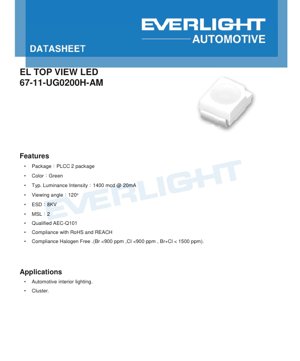
The 67-11-UG0200H-AM is a high-performance, surface-mount Top View LED designed primarily for demanding automotive applications. It utilizes a PLCC-2 (Plastic Leaded Chip Carrier) package, offering a robust and reliable solution for interior lighting and instrument cluster backlighting. Its core advantages include high luminous intensity, a wide viewing angle, and compliance with stringent automotive and environmental standards such as AEC-Q101, RoHS, REACH, and halogen-free requirements.
. In-Depth Technical Parameter Analysis
.1 Optoelectronic Characteristics
The device exhibits a typical luminous intensity of 1400 millicandelas (mcd) when driven at its standard forward current of 20mA. The dominant wavelength is typically 523nm, producing a green color. A key feature is its wide 120-degree viewing angle (with a tolerance of ±5°), ensuring uniform light distribution. The forward voltage (Vf) typically measures 3.1V at 20mA, with a specified range from 2.75V (Min) to 3.75V (Max) for 99% of production units.
.2 Absolute Maximum Ratings and Electrical Parameters
Critical limits for reliable operation include a maximum continuous forward current of 30mA and a maximum power dissipation of 112mW. The device can withstand a surge current of 300mA for pulses ≤10μs. It is not designed for reverse voltage operation. The operating and storage temperature range is specified from -40°C to +110°C, with a maximum junction temperature of 125°C. The component has an ESD sensitivity rating of 8kV (Human Body Model).
.3 Thermal Characteristics
Thermal management is crucial for LED performance and longevity. The datasheet specifies two thermal resistance values: a real thermal resistance (Rth JS real) of 130 K/W and an electrical thermal resistance (Rth JS el) of 100 K/W, both measured from the junction to the solder point. This parameter is essential for calculating the junction temperature under specific operating conditions and for proper heatsinking design.
. Performance Curve Analysis
.1 Spectral Distribution and Radiation Pattern
The relative spectral distribution graph shows a peak emission in the green wavelength region (~523nm). The radiation pattern diagram confirms the Lambertian-like distribution characteristic of this top-view LED, with the relative luminous intensity dropping to half its peak value at ±60 degrees from the centerline, defining the 120° viewing angle.
.2 Forward Current vs. Voltage (IV Curve)
The IV curve demonstrates the exponential relationship typical of LEDs. At the recommended 20mA operating point, the forward voltage clusters around 3.1V. Designers must consider the Vf range when designing current-limiting circuits to ensure consistent brightness across multiple units.
.3 Temperature Dependency
Several graphs detail performance variation with temperature. The forward voltage has a negative temperature coefficient, decreasing by approximately 2mV/°C. Luminous intensity also decreases as junction temperature rises, which is a critical consideration for maintaining brightness in high-temperature environments like automotive cabins. The dominant wavelength exhibits a slight positive shift (increase) with temperature.
.4 Current Derating and Pulse Handling
A forward current derating curve is provided, indicating that the maximum allowable continuous current must be reduced as the solder pad temperature (Ts) increases above 25°C. For example, at a Ts of 110°C, the maximum current is 30mA. The permissible pulse handling capability graph allows designers to calculate safe peak currents for pulsed operation based on duty cycle and pulse width.
. Binning System Explanation
The product is available in sorted bins for key parameters to ensure application consistency.
.1 Luminous Intensity Binning
A comprehensive binning table lists groups from L1 (11.2-14 mcd) up to GA (18000-22400 mcd). The 67-11-UG0200H-AM part number corresponds to bins within the AA (1120-1400 mcd) and AB (1400-1800 mcd) ranges, as highlighted. This allows selection based on required brightness levels.
.2 Dominant Wavelength Binning
The dominant wavelength is binned with a measurement tolerance of ±1nm. The specific bin codes for this product are defined in the ordering information, enabling precise color selection for applications requiring tight color matching.
. Mechanical, Packaging & Assembly Information
.1 Mechanical Dimensions
The LED is housed in a standard PLCC-2 package. The detailed mechanical drawing (referenced in the PDF) provides exact dimensions for the package body, lead spacing, and overall height, which are critical for PCB footprint design and clearance checks.
.2 Recommended Solder Pad Layout
A recommended solder pad pattern is provided to ensure reliable soldering and proper thermal connection. Adhering to this layout helps prevent tombstoning and ensures optimal heat dissipation from the thermal pad of the component to the PCB.
.3 Reflow Soldering Profile
The component is suitable for reflow soldering. The profile must maintain the solder joint temperature above 217°C for a duration between 60 and 150 seconds. The peak temperature and time above liquidus must be controlled according to standard IPC/JEDEC guidelines to prevent thermal damage.
.4 Packaging Information
The LEDs are supplied on embossed tape and reel packaging suitable for automated pick-and-place assembly machines. The packing specifications include details on tape width, pocket spacing, reel diameter, and quantity per reel.
. Application Guidelines & Design Considerations
.1 Primary Application Scenarios
The primary designed applications areAutomotive interior lighting(e.g., footwell lights, door panel lights, switch backlighting) andClusterinstrumentation backlighting. The AEC-Q101 qualification and wide operating temperature range make it suitable for these harsh environments.
.2 Circuit Design Considerations
1. Current Driving:A constant current driver is strongly recommended over a constant voltage source with a series resistor for stable luminous output and longevity, especially given the Vf variation. The typical operating point is 20mA. 2.ESD Protection:Although rated for 8kV HBM, implementing external ESD protection on PCB lines connected to the LED is advisable for automotive applications. 3.Thermal Design:Use the provided thermal resistance values and derating curves to calculate the expected junction temperature. Ensure adequate copper area on the PCB under the LED's thermal pad to act as a heatsink and keep Ts within safe limits. 4.Optical Design:The 120° viewing angle is ideal for wide-area illumination. For focused light, secondary optics (lenses) may be required.
. Precautions for Use
- Avoid applying reverse voltage to the device.
- Do not operate below the minimum forward current of 3mA as indicated on the derating curve.
- Adhere strictly to the recommended reflow soldering profile to prevent package cracking or degradation of internal materials.
- Handle components in accordance with MSL (Moisture Sensitivity Level) 2 precautions if the packaging has been opened.
- Avoid mechanical stress on the lens during handling or assembly.
. Ordering Information and Part Number Breakdown
The part number 67-11-UG0200H-AM follows a specific coding system. While the full breakdown is detailed in the PDF, it typically encodes information such as package type (PLCC-2), color (Green), luminous intensity bin, and dominant wavelength bin. Specific bin selections for intensity and wavelength are made at the time of order to tailor the component to the application's needs.
. Technical Comparison and Differentiation
Compared to standard non-automotive PLCC-2 LEDs, the 67-11-UG0200H-AM offers key differentiators: 1.Automotive Qualification:AEC-Q101 certification ensures reliability under automotive-grade temperature cycling, humidity, and operational stress tests. 2.Extended Temperature Range:Operation from -40°C to +110°C exceeds the range of typical commercial-grade LEDs. 3.Enhanced Reliability Standards:Compliance with Halogen-Free (Br/Cl limits), RoHS, and REACH addresses environmental and regulatory requirements in automotive and other sensitive markets. 4.Consistent Binning:Tight binning on intensity and wavelength provides predictable performance in multi-LED arrays.
. Frequently Asked Questions (FAQ)
.1 What is the primary cause of luminous intensity drop over time?
The primary cause is junction temperature. Operating the LED above its recommended current or with insufficient heatsinking accelerates lumen depreciation. Always design to keep the junction temperature as low as possible within the application constraints.
.2 Can I drive this LED with a 5V supply and a resistor?
Yes, but it is not optimal. Using a series resistor (R = (Vsupply - Vf_led) / I_f) is common. However, due to the typical Vf variation (2.75V to 3.75V), the current and thus brightness will vary significantly from one unit to another. For consistent performance, a constant current circuit is recommended.
.3 Is this LED suitable for exterior automotive lighting?
The datasheet specifies applications for interior lighting and clusters. Exterior lighting often requires higher ingress protection (IP) ratings, different color specifications, and may be subject to different regulatory standards. This PLCC-2 package is typically not sealed for direct exposure to weather.
.4 How do I interpret the two different thermal resistance values?
Rth JS real (130 K/W) is measured using a physical thermal method. Rth JS el (100 K/W) is calculated from the electrical behavior (change in Vf with temperature). For detailed thermal modeling, consult the manufacturer's application notes, but the higher value (130 K/W) should be used for conservative design.
. Practical Design and Usage Examples
.1 Automotive Dashboard Backlighting
In a dashboard cluster, multiple LEDs are often arranged in an array behind a light guide plate. Using LEDs from the same intensity and wavelength bin (e.g., all from bin AA and a specific wavelength bin) is crucial to achieve uniform color and brightness across the display. The wide 120° viewing angle helps couple light efficiently into the edge of the light guide.
.2 Door Handle Pocket Light
A single LED, driven by a simple current-regulating circuit from the vehicle's 12V system (using a buck converter or linear regulator), can illuminate a door handle pocket. The high luminous intensity (1400mcd typical) ensures sufficient light output even when diffused by a lens or cover. The robust PLCC-2 package withstands vibration in the door assembly.
. Technology Principle Introduction
This LED is based on semiconductor electroluminescence. When a forward bias voltage is applied across the p-n junction of the semiconductor chip (typically InGaN for green light), electrons and holes recombine, releasing energy in the form of photons. The specific material composition and quantum well structure determine the dominant wavelength (color). The PLCC-2 package encapsulates the chip in a plastic mold with a built-in reflector cup to shape the light output into a top-viewing pattern, and it provides mechanical protection and thermal dissipation paths via the leads and thermal pad.
. Industry Trends and Developments
The automotive LED market continues to evolve with several clear trends: 1.Increased Integration:Movement towards multi-chip packages (e.g., RGB LEDs) and integrated driver LEDs for simplified design. 2.Higher Efficiency:Ongoing development of chip technology to deliver higher lumens per watt (efficacy), reducing power consumption and thermal load. 3.Advanced Communication:Integration of LEDs with sensors and communication protocols (like LIN or CAN) for smart, adaptive lighting systems. 4.Miniaturization:Development of smaller package footprints with maintained or improved optical performance for space-constrained designs. 5.Enhanced Reliability Demands:As LEDs become more critical in safety-signaling applications, lifetime and failure rate requirements become even more stringent, pushing for improved materials and manufacturing processes.
Kalmomin Ƙayyadaddun LED
Cikakken bayanin kalmomin fasaha na LED
Aikin Hasken Wutar Lantarki
| Kalma | Naúrar/Wakilci | Bayanin Sauri | Me yasa yake da muhimmanci |
|---|---|---|---|
| Ingancin Hasken Wuta | lm/W (lumen kowace watt) | Fitowar haske kowace watt na wutar lantarki, mafi girma yana nufin mafi ingancin kuzari. | Kai tsaye yana ƙayyade matakin ingancin kuzari da farashin wutar lantarki. |
| Gudun Hasken Wuta | lm (lumen) | Jimillar hasken da tushe ke fitarwa, ana kiransa "haske". | Yana ƙayyade ko hasken yana da haske sosai. |
| Kusurwar Dubawa | ° (digiri), misali 120° | Kusurwar da ƙarfin haske ya ragu zuwa rabi, yana ƙayyade faɗin haske. | Yana shafar kewar haskakawa da daidaito. |
| Zafin Launi (CCT) | K (Kelvin), misali 2700K/6500K | Zafi/sanyin haske, ƙananan ƙimomi rawaya/zafi, mafi girma fari/sanyi. | Yana ƙayyade yanayin haskakawa da yanayin da suka dace. |
| CI / Ra | Ba naúrar, 0–100 | Ikon ba da launukan abubuwa daidai, Ra≥80 yana da kyau. | Yana shafar sahihancin launi, ana amfani dashi a wurare masu buƙatu kamar shaguna, gidajen tarihi. |
| SDCM | Matakan ellipse MacAdam, misali "5-mataki" | Ma'aunin daidaiton launi, ƙananan matakai suna nufin mafi daidaiton launi. | Yana tabbatar da daidaiton launi a cikin rukunin LED iri ɗaya. |
| Matsakaicin Tsawon Raɗaɗin Hasken | nm (nanomita), misali 620nm (ja) | Tsawon raɗaɗin haske daidai da launin LED masu launi. | Yana ƙayyade launin ja, rawaya, kore LED masu launi ɗaya. |
| Rarraba Bakan Hasken | Layin tsawon raɗaɗi da ƙarfi | Yana nuna rarraba ƙarfi a cikin tsawon raɗaɗin haske. | Yana shafar ba da launi da ingancin launi. |
Ma'auni na Lantarki
| Kalma | Alamar | Bayanin Sauri | Abubuwan ƙira |
|---|---|---|---|
| Ƙarfin lantarki na gaba | Vf | Mafi ƙarancin ƙarfin lantarki don kunna LED, kamar "maƙallan farawa". | Ƙarfin lantarki na injin dole ya zama ≥Vf, ƙarfin lantarki yana ƙara don LED a jere. |
| Ƙarfin lantarki na gaba | If | Ƙimar ƙarfin lantarki don aikin LED na yau da kullun. | Yawanci tuƙi mai ƙarfi akai-akai, ƙarfin lantarki yana ƙayyade haske da tsawon rai. |
| Matsakaicin Ƙarfin lantarki na bugun jini | Ifp | Matsakaicin ƙarfin lantarki mai jurewa na ɗan lokaci, ana amfani dashi don duhu ko walƙiya. | Fadin bugun jini da sake zagayowar aiki dole ne a sarrafa su sosai don guje wa lalacewa. |
| Ƙarfin lantarki na baya | Vr | Matsakaicin ƙarfin lantarki na baya da LED zai iya jurewa, wanda ya wuce zai iya haifar da rushewa. | Dangane dole ne ya hana haɗin baya ko ƙarfin lantarki. |
| Juriya na zafi | Rth (°C/W) | Juriya ga canja wurin zafi daga guntu zuwa solder, ƙasa yana da kyau. | Babban juriya na zafi yana buƙatar zubar da zafi mai ƙarfi. |
| Rigakafin ESD | V (HBM), misali 1000V | Ikon jurewa zubar da wutar lantarki, mafi girma yana nufin ƙasa mai rauni. | Ana buƙatar matakan hana wutar lantarki a cikin samarwa, musamman ga LED masu hankali. |
Gudanar da Zafi & Amincewa
| Kalma | Ma'aunin maɓalli | Bayanin Sauri | Tasiri |
|---|---|---|---|
| Zazzabin Haɗin gwiwa | Tj (°C) | Ainihin yanayin aiki a cikin guntun LED. | Kowane raguwa 10°C na iya ninka tsawon rai; yayi yawa yana haifar da lalacewar haske, canjin launi. |
| Ragewar Lumen | L70 / L80 (sa'o'i) | Lokacin da haske ya ragu zuwa 70% ko 80% na farko. | Kai tsaye yana ayyana "tsawon sabis" na LED. |
| Kula da Lumen | % (misali 70%) | Kashi na hasken da aka riƙe bayan lokaci. | Yana nuna riƙon haske akan amfani na dogon lokaci. |
| Canjin Launi | Δu′v′ ko ellipse MacAdam | Matsakaicin canjin launi yayin amfani. | Yana shafar daidaiton launi a cikin yanayin haskakawa. |
| Tsufa na Zafi | Lalacewar kayan aiki | Lalacewa saboda yanayin zafi na dogon lokaci. | Zai iya haifar da raguwar haske, canjin launi, ko gazawar buɗe kewaye. |
Tufafi & Kayan Aiki
| Kalma | Nau'ikan gama gari | Bayanin Sauri | Siffofi & Aikace-aikace |
|---|---|---|---|
| Nau'in Kunshin | EMC, PPA, Yumbu | Kayan gida masu kare guntu, samar da hanyar sadarwa ta gani/zafi. | EMC: juriya mai kyau na zafi, farashi mai rahusa; Yumbu: mafi kyawun zubar da zafi, tsawon rai. |
| Tsarin Guntu | Gaba, Guntu Juyawa | Tsarin na'urorin lantarki na guntu. | Juyawar guntu: mafi kyawun zubar da zafi, inganci mafi girma, don ƙarfi mai ƙarfi. |
| Rufin Phosphor | YAG, Silicate, Nitride | Yana rufe guntu shuɗi, yana canza wasu zuwa rawaya/ja, yana haɗa su zuwa fari. | Phosphor daban-daban suna shafar inganci, CCT, da CRI. |
| Ruwan tabarau/Optics | Lefi, Microlens, TIR | Tsarin gani a saman yana sarrafa rarraba haske. | Yana ƙayyade kusurwar dubawa da layin rarraba haske. |
Kula da Inganci & Rarraba
| Kalma | Abun rarraba | Bayanin Sauri | Manufa |
|---|---|---|---|
| Kwalin Gudun Hasken | Lambar misali 2G, 2H | An tattara su ta hanyar haske, kowace ƙungiya tana da ƙananan/matsakaicin ƙimar lumen. | Yana tabbatar da daidaiton haske a cikin jeri ɗaya. |
| Kwalin Ƙarfin lantarki | Lambar misali 6W, 6X | An tattara su ta hanyar kewayon ƙarfin lantarki na gaba. | Yana sauƙaƙe daidaitawar tuƙi, yana inganta ingancin tsarin. |
| Kwalin Launi | Ellipse MacAdam 5-mataki | An tattara su ta hanyar daidaitattun launi, yana tabbatar da ƙuntataccen kewayon. | Yana ba da garantin daidaiton launi, yana guje wa launi mara daidaituwa a cikin kayan aikin. |
| Kwalin CCT | 2700K, 3000K da sauransu | An tattara su ta hanyar CCT, kowanne yana da madaidaicin kewayon daidaitawa. | Yana cika buƙatun CCT na yanayi daban-daban. |
Gwaji & Takaddun Shaida
| Kalma | Matsakaicin/Gwaji | Bayanin Sauri | Muhimmanci |
|---|---|---|---|
| LM-80 | Gwajin kula da lumen | Haskakawa na dogon lokaci a yanayin zafi akai-akai, yana rikodin lalacewar haske. | Ana amfani dashi don kimanta rayuwar LED (tare da TM-21). |
| TM-21 | Matsakaicin kimanta rayuwa | Yana kimanta rayuwa a ƙarƙashin yanayi na ainihi bisa bayanan LM-80. | Yana ba da hasashen kimiyya na rayuwa. |
| IESNA | Ƙungiyar Injiniyoyin Haskakawa | Yana rufe hanyoyin gwajin gani, lantarki, zafi. | Tushen gwaji da masana'antu suka amince. |
| RoHS / REACH | Tabbatarwar muhalli | Yana tabbatar da babu abubuwa masu cutarwa (darma, mercury). | Bukatar shiga kasuwa a duniya. |
| ENERGY STAR / DLC | Tabbatarwar ingancin kuzari | Tabbatarwar ingancin kuzari da aiki don samfuran haskakawa. | Ana amfani dashi a cikin sayayyan gwamnati, shirye-shiryen tallafi, yana haɓaka gasa. |