Table of Contents
- 1. Product Overview
- 2. Technical Parameters
- 2.1 Absolute Maximum Ratings
- 2.2 Electro-Optical Characteristics (Ta = 25°C)
- 3. Binning System
- 3.1 Luminous Intensity Binning
- 3.2 Dominant Wavelength Binning
- 3.3 Forward Voltage Binning
- 4. Performance Curve Analysis
- 4.1 Relationship between Relative Luminous Intensity and Forward Current
- 4.2 Relationship between Luminous Intensity and Ambient Temperature
- 4.3 Relationship between Forward Current and Forward Voltage (I-V Curve)
- 4.4 Spectral Distribution
- 4.5 Radiation Pattern Diagram
- 4.6 Forward Current Derating Curve
- 5. Mechanical and Packaging Information
- 5.1 Package Dimensions
- 5.2 Polarity Marking
- 6. Soldering and Assembly Guide
- 6.1 Reflow Soldering Temperature Profile
- 6.2 Manual Welding
- 6.3 Moisture Sensitivity and Storage
- 7. Packaging and Ordering Information
- 7.1 Carrier Tape and Reel Specifications
- 7.2 Label Description
- 8. Application Suggestions
- 8.1 Typical Application Scenarios
- 8.2 Design Considerations
- 9. Reliability and Quality Assurance
- 10. Technical Comparison and Differentiation
- 11. FAQ
- 11.1 What is the recommended operating current?
- 11.2 Yaya ake fassara lambar rarrabawa akan lakabin?
- 11.3 Shin za a iya kunna wannan LED ba tare da amfani da resistor mai iyakancewa ba?
- 11.4 Is this LED suitable for outdoor use?
- 12. Practical Design Case Analysis
- 13. Working Principle
- 14. Technology Trends
1. Product Overview
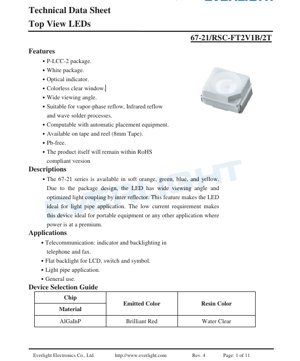
This document specifies the specifications of a surface-mount top-view LED in a P-LCC-2 package. The device features a white package body and a colorless transparent window, offering a wide viewing angle, making it highly suitable for indicator applications. Its design is compatible with modern assembly processes, including vapor phase reflow, infrared reflow, and wave soldering, and is suitable for automatic placement equipment. The product is supplied on 8mm carrier tape reels and complies with lead-free and RoHS requirements.
The primary application of this LED series is as an optical indicator. Its wide viewing angle and optimized light coupling achieved through internal reflector design make it particularly suitable for use with light guide pipes. The low forward current requirement also makes it an excellent choice for battery-powered or power-sensitive portable electronic devices.
2. Technical Parameters
2.1 Absolute Maximum Ratings
The device must not be operated beyond these limits, as doing so may cause permanent damage.
- Reverse voltage (VR):5 V
- Continuous forward current (IF):50 mA
- Peak forward current (IFP):100 mA (duty cycle 1/10, 1 kHz)
- Power Consumption (Pd):120 mW
- Electrostatic Discharge (ESD) HBM:2000 V
- Operating Temperature (Topr):-40°C to +85°C
- Storage Temperature (Tstg):-40°C to +90°C
- Welding temperature (Tsol):Reflow soldering: 260°C for 10 seconds; Hand soldering: 350°C for 3 seconds.
2.2 Photoelectric Characteristics (Ta= 25°C)
Typical performance parameters measured under standard test conditions.
- Luminous intensity (Iv):360 - 900 mcd (IF= 20mA)
- Viewing angle (2θ1/2):120° (IF= 20mA)
- Peak wavelength (λp):632 nm (IF= 20mA)
- Dominant Wavelength (λd):621 - 631 nm (IF= 20mA)
- Spectral Bandwidth (Δλ):20 nm (IF= 20mA)
- Forward Voltage (VF):1.75 - 2.35 V (IF= 20mA)
- Reverse Current (IR):Max 10 μA (VR= 5V)
Remark:The tolerance is specified as follows: luminous intensity ±11%, dominant wavelength ±1nm, forward voltage ±0.1V.
3. Binning System
To ensure color and brightness consistency in production, devices are sorted into different bins based on key parameters.
3.1 Luminous Intensity Binning
Bins are defined by codes (e.g., T2, U1), corresponding to IFMinimum and maximum luminous intensity values at =20mA.
- T2:360 - 450 mcd
- U1:450 - 565 mcd
- U2:565 - 715 mcd
- V1:715 - 900 mcd
3.2 Dominant Wavelength Binning
Wavelength grouping is used to control the subjective color (hue) of red light.
- Group F, code FF1:621 - 626 nm
- Group F, code FF2:626 - 631 nm
3.3 Forward Voltage Binning
Forward voltage binning facilitates circuit design for current regulation.
- Group B, Code 0:1.75 - 1.95 V
- Group B, Code 1:1.95 - 2.15 V
- Group B, Code 2:2.15 - 2.35 V
4. Performance Curve Analysis
Graphical data reveals the behavioral characteristics of the device under different conditions.
4.1 Relationship between Relative Luminous Intensity and Forward Current
This curve shows how the light output increases with the forward current. It is typically nonlinear, and efficiency may decrease at extremely high currents. Designers should select an operating point that balances brightness, power consumption, and device lifetime.
4.2 Relationship between Luminous Intensity and Ambient Temperature
This curve illustrates the thermal derating characteristics of light output. Luminous intensity typically decreases as ambient temperature rises. For applications in high ambient temperatures, this derating effect must be considered to ensure sufficient brightness.
4.3 Relationship between Forward Current and Forward Voltage (I-V Curve)
I-V curve is the typical characteristic of a diode. The forward voltage has a positive temperature coefficient, which means that at a given current, it slightly decreases as the temperature increases.
4.4 Spectral Distribution
The spectrogram confirms the monochromaticity of the light, with its center at a peak wavelength of 632 nm, located in the bright red region of the visible spectrum. The narrow bandwidth indicates its good color purity.
4.5 Radiation Pattern Diagram
The polar plot demonstrates a wide viewing angle of 120°, exhibiting near-Lambertian emission characteristics. This confirms the device's suitability for applications requiring wide-angle visibility.
4.6 Forward Current Derating Curve
This graph defines the maximum allowable continuous forward current as a function of ambient temperature. To prevent overheating, the current must be reduced when the operating temperature exceeds a specific value (typically starting around 60-70°C).
5. Mechanical and Packaging Information
5.1 Package Dimensions
The P-LCC-2 package has specific mechanical outlines and pad layouts. Key dimensions include overall length, width, height, and the location of the cathode identification mark. All unspecified tolerances are ±0.1 mm. Designers must refer to the detailed dimensioned drawing to create the PCB footprint.
5.2 Polarity Marking
The cathode is typically identified by visual markers on the package, such as a notch, dot, or beveled corner. Correct orientation is crucial for circuit operation.
6. Soldering and Assembly Guide
6.1 Reflow Soldering Temperature Profile
This device is rated for a peak reflow soldering temperature of 260°C for a maximum duration of 10 seconds. It is suitable for the IPC/JEDEC J-STD-020 standard temperature profile for lead-free assembly. The time above the liquidus must be precisely controlled to prevent thermal damage to the epoxy package.
6.2 Manual Welding
If manual soldering is required, the temperature of the soldering iron tip should not exceed 350°C, and the contact time for each pin should be limited to 3 seconds or less.
6.3 Moisture Sensitivity and Storage
The product is shipped in moisture barrier packaging (aluminum foil bag with desiccant). Once the sealed bag is opened, components should be used within the specified time frame (not explicitly stated, but standard practice is 168 hours at ≤30°C/60%RH for Level 3 devices) or baked according to standard procedures before reflow soldering to prevent "popcorn" effect.
7. Packaging and Ordering Information
7.1 Carrier Tape and Reel Specifications
The device is supplied in 8mm carrier tape format. The standard reel quantity is 2000 pieces. Other minimum packaging quantities include 250, 500, and 1000 pieces per reel. Detailed carrier tape and reel dimensions are provided to facilitate the setup of automated handling equipment.
7.2 Label Description
The reel label contains multiple codes:
- CAT:Corresponding luminous intensity bin code (e.g., V1).
- HUE:Code corresponding to dominant wavelength grading (e.g., FF1).
- REF:Corresponding forward voltage bin code (e.g., 1).
8. Application Suggestions
8.1 Typical Application Scenarios
- Communication Equipment:Status indicator lights in telephones, fax machines, routers, and backlights for buttons or displays.
- Consumer Electronics:Power, silent, or connection status indicator lights in audio-visual equipment, computers, and peripherals.
- Industrial Control:Panel indicator lights for machine status, fault alarms, or operation modes.
- Light Guide Tube Application:Its wide viewing angle and optimized coupling characteristics make it very suitable for use with injection-molded light guide tubes to transmit light from the PCB to the front panel or display.
- General Indication:Any application requiring bright, reliable, low-power visual indication.
8.2 Design Considerations
- Current Limit:Ensure to use a series resistor or constant current driver to limit the forward current to a safe value, typically 20mA at standard brightness, and must not exceed the absolute maximum of 50mA.
- Thermal Management:Under high ambient temperatures or when driven with higher current, ensure sufficient PCB copper foil or other heat dissipation measures to keep the junction temperature within limits. Please refer to the derating curve.
- ESD Protection:Although rated for 2000V HBM, standard ESD precautions should still be observed during assembly and handling.
- Optical Design:For light guide applications, the radiation pattern of the LED and the design of the light guide entry point should be considered to maximize coupling efficiency.
9. Reliability and Quality Assurance
The product has undergone a series of comprehensive reliability tests with a confidence level of 90% and an LTPD of 10%. The test items and conditions include:
- Reflow Soldering Resistance:260°C ±5°C, minimum 10 seconds.
- Temperature Cycling:300 cycles between -40°C and +100°C.
- Thermal Shock:300 cycles between -10°C and +100°C.
- High and Low Temperature Storage:Store at +100°C and -40°C for 1000 hours respectively.
- DC operating life:Operate at 20mA, 25°C for 1000 hours.
- High temperature and high humidity (85/85):Operate for 1000 hours under conditions of 85°C and 85% relative humidity.
These tests verify the robustness of the device under typical environmental and operational stresses encountered in electronic products.
10. Technical Comparison and Differentiation
This P-LCC-2 LED offers differentiated advantages in several key areas for indicator light applications. Compared to simpler chip LEDs, the molded P-LCC package provides superior mechanical protection, easier handling for pick-and-place machines, and a more consistent optical interface. Its wide 120-degree viewing angle offers a significant advantage over narrow-viewing-angle LEDs when off-axis visibility is required. The use of AlGaInP semiconductor material for the red chip, compared to older technologies like GaAsP, delivers higher luminous efficiency and better temperature stability, resulting in brighter and more consistent red light output. A comprehensive binning system for intensity, wavelength, and voltage enables more precise color and brightness matching in the final product, which is crucial for multi-indicator panels or aesthetic applications.
11. FAQ
11.1 What is the recommended operating current?
The standard test condition and typical application current is 20mA. This provides a good balance of brightness and efficiency. The device can operate at its absolute maximum of 50mA, but this generates more heat and reduces long-term reliability unless proper thermal management is implemented.
11.2 Yaya ake fassara lambar rarrabawa akan lakabin?
Lambar CAT (misali V1) tana nuna kewayon ƙarfin haske. Lambar HUE (misali FF1) tana nuna kewayon babban tsawon raƙuman ruwa, tana sarrafa ainihin launin ja. Lambar REF (misali 1) tana nuna kewayon ƙarfin lantarki na gaba. Don tabbatar da daidaiton aikin na'urori da yawa a cikin haɗawa, ya kamata a ƙayyade ko a buƙaci amfani da abubuwa masu lambar rarrabawa iri ɗaya.
11.3 Shin za a iya kunna wannan LED ba tare da amfani da resistor mai iyakancewa ba?
No.LED is a current-driven device. Connecting it directly to a voltage source will cause excessive current to flow, which may immediately damage the LED. A series resistor or an active constant current circuit must be used.
11.4 Is this LED suitable for outdoor use?
Its operating temperature range extends from -40°C to +85°C, covering many outdoor conditions. However, it is not specified for long-term direct exposure to UV sunlight and weather (rain, moisture). For outdoor use, the LED should be placed behind a protective lens or cover, and the entire assembly should be properly sealed and have an appropriate environmental exposure rating.
12. Practical Design Case Analysis
Scenario:Design a status indicator panel for a network switch with 24 ports, each requiring a red link/activity LED. The LEDs must have wide viewing angle visibility, consistent color and brightness, and the design must be energy efficient.
Implementation Plan:
- Component Selection:This P-LCC-2 bright red LED is selected for its 120° wide viewing angle, low drive current of 20mA, and availability of tight performance binning.
- Circuit Design:Each LED is driven by a microcontroller GPIO pin through a 100Ω series resistor (based on a 3.3V supply and typical VFCalculated for 2.0V, the current is approximately 13mA. This is below the 20mA test point but provides sufficient brightness while saving power.
- PCB Layout:LEDs are placed in a grid pattern. The PCB footprint recommended in the datasheet was used. A small keep-out area was maintained beneath the LED to prevent solder wicking.
- Optical Design:A custom injection-molded light guide array was designed to direct light from each SMD LED on the PCB to individual transparent windows on the front panel. The wide viewing angle of the LEDs ensures efficient coupling into the light guides.
- Bin:To ensure uniform appearance, a single luminous intensity bin (e.g., U2) and a single dominant wavelength bin (e.g., FF1) for the LEDs are specified in the purchase order.
- Thermal Considerations:Since all 24 LEDs may be lit simultaneously, the total power consumption is low (approximately 0.75W). No special thermal management is required on the PCB.
13. Working Principle
This LED is a semiconductor photonic device. Its core is a chip made from an aluminum gallium indium phosphide (AlGaInP) epitaxial layer grown on a substrate. When a forward voltage exceeding the diode's turn-on threshold (approximately 1.8V) is applied, electrons and holes are injected across the p-n junction. These carriers recombine within the active region of the semiconductor, releasing energy in the form of photons. The specific composition of the AlGaInP alloy determines the bandgap energy, which directly dictates the wavelength (color) of the emitted light—in this case, a bright red at approximately 632 nm. The generated light is then extracted through the chip surface and is shaped and directed by the internal reflector and transparent epoxy lens of the P-LCC package to achieve the desired wide viewing angle.
14. Technology Trends
The indicator LED market continues to evolve. Overall trends include the pursuit of higher luminous efficacy (more light output per watt of electrical input), enabling brighter indicators at lower currents for portable and IoT devices, improving energy efficiency. Miniaturization is another trend, with packages smaller than P-LCC-2 becoming common for space-constrained applications. Enhanced reliability under higher temperature reflow profiles is another key focus area to accommodate advanced PCB assembly processes. Furthermore, the direct integration of control electronics (such as constant current drivers or even simple logic circuits) into the LED package ("smart LEDs") is a growing trend, simplifying circuit design for end users. While this specific device represents a mature and reliable technology, these ongoing developments in materials, packaging, and integration are shaping the future landscape of indicator components.
Detailed Explanation of LED Specification Terminology
Complete Explanation of LED Technical Terminology
I. Core Indicators of Photoelectric Performance
| Terminology | Unit/Representation | Popular Explanation | Why It's Important |
|---|---|---|---|
| Luminous Efficacy | lm/W | The luminous flux emitted per watt of electrical power, the higher the more energy efficient. | Directly determines the energy efficiency rating and electricity cost of the lighting fixture. |
| Luminous Flux | lm (lumen) | Total light output from a light source, commonly known as "brightness". | Determines if a luminaire is bright enough. |
| Viewing Angle | ° (degrees), e.g., 120° | The angle at which luminous intensity drops to half, determining the width of the light beam. | Affects the illumination range and uniformity. |
| Color Temperature (CCT) | K (Kelvin), e.g., 2700K/6500K | The warmth or coolness of light color; lower values are yellowish/warm, higher values are whitish/cool. | Determines the lighting ambiance and suitable application scenarios. |
| Color Rendering Index (CRI / Ra) | Unitless, 0–100 | The ability of a light source to restore the true color of an object, Ra≥80 is recommended. | Affects color authenticity, used in high-demand places such as shopping malls and art galleries. |
| Color tolerance (SDCM) | MacAdam ellipse steps, e.g., "5-step" | A quantitative metric for color consistency; a smaller step number indicates better color consistency. | Ensure no color variation among luminaires from the same batch. |
| Dominant Wavelength | nm (nanometer), e.g., 620nm (red) | Thamani ya urefu wa wimbi inayolingana na rangi ya LED ya rangi. | Huamua rangi ya LED moja kama nyekundu, njano, kijani, n.k. |
| Spectral Distribution | Wavelength vs. Intensity Curve | Shows the intensity distribution of light emitted by an LED across various wavelengths. | Affects color rendering and color quality. |
II. Electrical Parameters
| Terminology | Symbol | Popular Explanation | Design Considerations |
|---|---|---|---|
| Forward Voltage | Vf | The minimum voltage required to light up an LED, similar to a "starting threshold". | The driving power supply voltage must be ≥ Vf, and the voltage accumulates when multiple LEDs are connected in series. |
| Forward Current | If | The current value that makes the LED emit light normally. | Constant current drive is often used, as current determines brightness and lifespan. |
| Maximum Pulse Current (Pulse Current) | Ifp | Peak current that can be withstood for a short period, used for dimming or flashing. | Pulse width and duty cycle must be strictly controlled to prevent overheating and damage. |
| Reverse Voltage | Vr | The maximum reverse voltage that an LED can withstand; exceeding this may cause breakdown. | The circuit must be protected against reverse connection or voltage surges. |
| Thermal Resistance | Rth (°C/W) | The resistance to heat transfer from the chip to the solder joint; a lower value indicates better heat dissipation. | High thermal resistance requires a more robust heat dissipation design; otherwise, the junction temperature will increase. |
| Electrostatic Discharge Immunity (ESD Immunity) | V (HBM), e.g., 1000V | ESD strike resistance, the higher the value, the less susceptible to ESD damage. | Anti-static measures must be implemented during production, especially for high-sensitivity LEDs. |
III. Thermal Management and Reliability
| Terminology | Key Indicators | Popular Explanation | Impact |
|---|---|---|---|
| Junction Temperature | Tj (°C) | The actual operating temperature inside the LED chip. | For every 10°C reduction, the lifespan may double; excessively high temperatures cause lumen depreciation and chromaticity shift. |
| Lumen Depreciation | L70 / L80 (hours) | Time required for brightness to drop to 70% or 80% of its initial value. | Directly define the "useful life" of an LED. |
| Lumen Maintenance | % (e.g., 70%) | The percentage of remaining brightness after a period of use. | Characterizes the ability to maintain brightness after long-term use. |
| Color Shift | Δu′v′ or MacAdam Ellipse | The degree of color change during use. | Affects the color consistency of the lighting scene. |
| Thermal Aging | Material performance degradation | Deterioration of packaging materials due to prolonged high temperatures. | May lead to decreased brightness, color changes, or open-circuit failure. |
IV. Packaging and Materials
| Terminology | Common Types | Popular Explanation | Features and Applications |
|---|---|---|---|
| Package Types | EMC, PPA, Ceramic | The housing material that protects the chip and provides optical and thermal interfaces. | EMC has good heat resistance and low cost; ceramic has excellent heat dissipation and long lifespan. |
| Chip Structure | Front Side, Flip Chip | Chip electrode arrangement method. | Flip Chip offers better heat dissipation and higher luminous efficacy, suitable for high-power applications. |
| Phosphor coating | YAG, silicate, nitride | Coated on the blue LED chip, partially converted to yellow/red light, mixed to form white light. | Different phosphors affect luminous efficacy, color temperature, and color rendering. |
| Lens/Optical Design | Planar, microlens, total internal reflection | Optical structure on the encapsulation surface, controlling light distribution. | Determines the emission angle and light distribution curve. |
V. Quality Control and Binning
| Terminology | Binning Content | Popular Explanation | Purpose |
|---|---|---|---|
| Luminous Flux Binning | Codes such as 2G, 2H | Group by brightness level, each group has a minimum/maximum lumen value. | Ensure consistent brightness for products within the same batch. |
| Voltage binning | Codes such as 6W, 6X | Grouped by forward voltage range. | Facilitates driver power matching and improves system efficiency. |
| Color binning. | 5-step MacAdam ellipse | Group by color coordinates to ensure colors fall within an extremely small range. | Ensure color consistency to avoid color unevenness within the same luminaire. |
| Color temperature binning | 2700K, 3000K, etc. | Group by color temperature, each group has a corresponding coordinate range. | Meet the color temperature requirements of different scenarios. |
VI. Testing and Certification
| Terminology | Standard/Test | Popular Explanation | Significance |
|---|---|---|---|
| LM-80 | Lumen Maintenance Test | Long-term operation under constant temperature conditions, recording data on brightness attenuation. | Used to estimate LED lifetime (combined with TM-21). |
| TM-21 | Life Prediction Standard | Life estimation under actual use conditions based on LM-80 data. | Provide scientific life prediction. |
| IESNA standard | Illuminating Engineering Society standard | Covering optical, electrical, and thermal testing methods. | Industry-recognized testing basis. |
| RoHS / REACH | Environmental Certification | Ensure the product does not contain hazardous substances (e.g., lead, mercury). | Conditions for market entry into the international market. |
| ENERGY STAR / DLC | Energy efficiency certification | Energy Efficiency and Performance Certification for Lighting Products. | Commonly used in government procurement and subsidy programs to enhance market competitiveness. |