Table of Contents
- 1. Product Overview
- 2. Binciken Sigogin Fasaha Mai zurfi
- 2.1 Halayen Hasken Wuta da Lantarki
- 2.2 Matsakaicin Matsakaici na Cikakke da Gudanar da Zafi
- 3. Bayanin Tsarin Rarrabawa
- 4. Nazarin Lanƙwan Aiki
- 4.1 Bakan da Dangantakar Ƙarfin Lantarki da Ƙarfin Lantarki
- 4.2 Dogaro da Yanayin Zafi
- 4.3 Ragewa da Aikin Bugun Jini
- 5. Mechanical and Packaging Information
- 6. Soldering and Assembly Guide
- 7. Packaging and Ordering Information
- 8. Application Recommendations
- 8.1 Yanayin Aikace-aikace na Al'ada
- 8.2 Tunani na Zane
- 9. Kwatancen Fasaha da Bambance-bambance
- 10. Amsoshin Tambayoyi na Kowa
- 11. Nazarin shari'o'in zane na ainihi
- 12. Gabatarwar aikin tsari
- 13. Trends da tarihin fasaha
- Cikakken bayani game da kalmomin ƙayyadaddun LED
- I. Core Indicators of Photoelectric Performance
- II. Electrical Parameters
- III. Thermal Management and Reliability
- IV. Packaging and Materials
- V. Quality Control and Binning
- VI. Testing and Certification
1. Product Overview
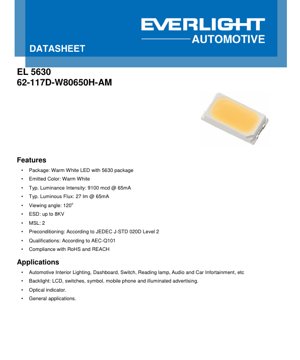
This document details the specifications of a high-performance warm white light-emitting diode utilizing the industry-standard 5630 surface-mount device package. The component is designed for reliability and consistent performance, suitable for applications requiring stable, high-quality white light in a compact form factor. Its core advantages include typical high luminous flux output, excellent light diffusion from a 120-degree wide viewing angle, and a robust structure suitable for demanding environments.
Babban kasuwarsa ta kasuwa ita ce tsarin haske na cikin mota, wanda ya haɗa da hasken dashboard, baya haske na maɓalli, fitilar karatu, da alamun tsarin nishadi na bayanai. Bugu da ƙari, halayensa sun sa ya dace da aikace-aikacen baya haske na gabaɗaya, kamar allon LCD, na'urorin hannu, akwatunan fitilar talla, da kowane aikace-aikacen nuni na gani wanda ke buƙatar daidaiton launi da haske mai tsauri.
2. Binciken Sigogin Fasaha Mai zurfi
2.1 Halayen Hasken Wuta da Lantarki
Aikin LED ana bayyana shi a cikin daidaitattun yanayin gwaji na madaidaicin kwarara na 65mA. A wannan kwarara, madaidaicin hasken haske shine lumens 27, tabbataccen mafi ƙanƙanta shine lumens 24, mafi girma shine lumens 40, wanda ya haɗa da saƙon samarwa. Madaidaicin ƙarfin haske mai alaƙa shine 9100 millicandela. Madaidaicin ƙarfin lantarki na gaba shine volts 2.9, yana aiki a cikin kewayon 2.5V zuwa 3.5V. Faɗin kusurwar gani na digiri 120 yana tabbatar da rarraba haske mai daidaito. Madaidaicin daidaitawar launi na fitowar hasken farin zafi shine CIE x=0.4337 da CIE y=0.4019, tare da saƙo na ±0.005, yana tabbatar da daidaiton launi. Mafi ƙarancin ma'auni na nunin launi shine 80, yana nuna kyakkyawan dawo da launi ga abubuwan da aka haskaka.
2.2 Matsakaicin Matsakaici na Cikakke da Gudanar da Zafi
Don tabbatar da tsawon rayuwar na'urar, kar a taɓa wuce mahimman iyakoki. Matsakaicin yawan amfani da wutar lantarki shine 630 mW. Kewayon aikin kwarara na gaba shine daga 20 mA zuwa 180 mA, ƙimar kwararar igiyar ruwa mara maimaitawa shine 1500 mA. Ba a ƙera na'urar don aiki tare da ƙarfin lantarki na baya ba. Matsakaicin yanayin zafi na haɗin gwiwa da aka yarda shine 125°C, kewayon yanayin zafi na aiki da ajiya shine daga -40°C zuwa +110°C. Kayan yana ba da kariya daga fitar da wutar lantarki mai tsayin kilovolt 8. A cikin haɗawa, yana iya jurewa haɗewar sake kwarara a matsakaicin zafin 260°C na dakika 30.
Gudanar da zafi yana da mahimmanci ga aiki da tsawon rai. Thermal resistance daga junction zuwa solder point ana siffanta shi da ƙima biyu: na yau da kullun thermal resistance shine 30 K/W, kuma electrical thermal resistance shine 15 K/W. Ana buƙatar daidaitaccen shimfidar PCB da ƙirar sanyaya don kiyaye yanayin zafi na junction a cikin amintaccen kewayon, musamman yayin aiki tare da mafi girma na yanzu.
3. Bayanin Tsarin Rarrabawa
Wannan samfurin yana amfani da tsarin rarrabawa, yana rarraba raka'a bisa ga fitarwar haske. Wannan yana tabbatar da cewa masu zane suna samun aikin LED a cikin ƙayyadaddun kewayon. Rarrabawar ana bayyana ta ta lambar haruffa da lambobi, wanda ke dacewa da mafi ƙanƙanta da mafi girman ƙimar haske da ƙarfin haske. Ga wannan takamaiman samfurin, an haskaka rarrabawar da ake samu, wanda ke dacewa da kewayon haske na 24 lm zuwa 27 lm da kewayon ƙarfin haske na 7920 mcd zuwa 8910 mcd. Wannan rarrabawar yana ba da damar zaɓi daidai gwargwado bisa ga buƙatun haske na aikace-aikacen, don haka yana tabbatar da daidaiton kamanni na samfurin ƙarshe.
4. Nazarin Lanƙwan Aiki
4.1 Bakan da Dangantakar Ƙarfin Lantarki da Ƙarfin Lantarki
Taswirar rarraba bakan dangi tana nuna siffofi masu faɗi na fitarwa na phosphor-converted white LED, tare da kololuwa a yankin shuɗi, da ƙaramin kololuwa mai faɗi a yankin rawaya/ja, waɗanda biyun suka haɗu don samar da haske mai dumi. Lankwara na gaba na yanzu zuwa ƙarfin lantarki na gaba yana nuna halayen ma'auni na diode. Lankwara na haske dangi zuwa ƙarfin lantarki na gaba yana nuna cewa fitarwar haske yana ƙaruwa tare da ƙaruwar ƙarfin lantarki, amma a ƙarshe yana cika kuma yana iya rage inganci a cikin matsanancin ƙarfin lantarki.
4.2 Dogaro da Yanayin Zafi
LED performance is significantly affected by its junction temperature. The relative luminous flux vs. junction temperature graph shows that light output typically decreases as temperature increases. The relative forward voltage vs. junction temperature curve exhibits a negative temperature coefficient, meaning the forward voltage decreases with rising temperature, which can be used for temperature monitoring. The chromaticity coordinate shift vs. junction temperature diagram is crucial for color-sensitive applications, showing how the white point drifts with temperature.
4.3 Ragewa da Aikin Bugun Jini
The forward current derating curve is essential for reliable design. It defines the maximum allowable continuous forward current based on the pad temperature. For example, at a pad temperature of 75°C, the maximum current is 180 mA, but at 110°C, it must be derated to 90 mA. The permissible pulse handling capability chart provides guidance for driving the LED with pulse currents higher than the DC maximum, defining safe combinations of pulse amplitude, pulse width, and duty cycle.
5. Mechanical and Packaging Information
This component uses the 5630 package size, with a nominal length of 5.6mm and a width of 3.0mm. The mechanical dimension drawing provides exact tolerances for the package body, lens, and pin locations. A recommended soldering pad layout is provided to ensure reliable solder joint formation and optimal heat transfer from the device's thermal pad to the printed circuit board. Correct polarity is indicated by a marking on the device or an asymmetric pad design; reverse connection may cause immediate failure.
6. Soldering and Assembly Guide
Ana ba da shawarar yin amfani da jadawalin ƙulla na reflow don haɗawa. Wannan jadawalin yana ƙayyadaddun mahimman sigogi: matakan dumama, daidaitawa, reflow, da sanyaya, tare da matsakaicin zafin jiki bai wuce 260°C ba, na tsawon dakika 30. An tsara wannan jadawalin don rage matsanancin zafi a cikin kayan LED da kayan ciki. Gabaɗaya abubuwan da za a lura sun haɗa da amfani da hanyoyin kula da tashin hankali na lantarki, guje wa danna na'ura akan ruwan tabarau, da kuma tabbatar da cewa tsarin ƙulla bai gurɓata saman gani ba. Ya kamata a adana kayan a cikin jakar hana danshi ta asali kuma a sanya su a ƙarƙashin yanayin da aka sarrafa danshi, musamman saboda matakin sa na hankali ga danshi shine 2.
7. Packaging and Ordering Information
Ana samar da LED gabaɗaya a cikin nau'in faifan reeli, don sauƙaƙe haɗawa ta atomatik. Bayanin marufi yana ƙayyadaddun girman reel, faɗin tef ɗin ɗaukar kaya, tazarar aljihu, da kuma alkiblar kayan a kan reel. Lambar sashi da kanta tana ɓoye mahimman halaye. Bayanin oda yana bayyana yadda ake tantance rarrabuwa da ake buƙata ko wasu bambance-bambance, don tabbatar da samar da samfurin daidai don aikace-aikace.
8. Application Recommendations
8.1 Yanayin Aikace-aikace na Al'ada
This LED is highly suitable for:
• Automotive interior lighting:With its AEC-Q101 certification, it is suitable for instrument panel lighting, button backlighting, footwell lights, and reading lights.
• Backlighting:Edge-lit or direct-lit backlighting for small to medium-sized LCDs, icon backlighting, and light guide plates.
• General indication and decorative lighting:Status indicators, ambient lighting, and signage requiring warm white light and reliability.
8.2 Tunani na Zane
• Current Drive:Always use a constant current driver, not a constant voltage source, to ensure stable light output and prevent thermal runaway. For simple low-current applications, a series resistor can be used.
• Thermal Design:Provide sufficient PCB copper area and consider the operating ambient temperature to stay within the derating curve limits.
• Optical Design:A 120-degree viewing angle may require a diffuser or lens to achieve a specific beam pattern. In color-sensitive applications, consider the possibility of color shift with temperature and drive current.
9. Kwatancen Fasaha da Bambance-bambance
Compared to standard 5630 white LEDs, this component differentiates itself through formal AEC-Q101 automotive-grade qualification, which involves rigorous testing for temperature cycling, humidity, and operating life under stress. A guaranteed minimum CRI of 80 is higher than many basic white LEDs, offering better color quality. The inclusion of detailed thermal resistance data and comprehensive derating curves provides designers with the information necessary for robust, high-reliability system design, which is often missing from commercial-grade component datasheets.
10. Amsoshin Tambayoyi na Kowa
Q: Can I drive this LED directly with a 3.3V or 5V power supply?
A: It cannot be driven directly. The forward voltage is approximately 2.9V, but it varies. A current-limiting circuit is mandatory. For a 3.3V supply, a series resistor can be calculated. For a 5V supply, a resistor or, preferably, a constant current driver must be used to avoid exceeding the maximum rated current.
Q: What does MSL 2 mean for storage?
A: Moisture Sensitivity Level 2 indicates that the component can be exposed to the factory floor environment for up to one year prior to reflow soldering. They should be stored in a sealed moisture barrier bag with desiccant.
Q: How is the 27lm luminous flux achieved?
A: This is a typical value measured under standard test conditions with the thermal pad stabilized at 25°C and a forward current of 65mA. In practical applications, the actual luminous flux will be lower due to a higher operating junction temperature.
Q: Need a heatsink?
A: It depends on the drive current and ambient conditions. At the full rated current of 180mA and in warm environments, significant PCB copper area or an external heatsink may be required to keep the junction temperature below 125°C. Refer to the derating curves for guidance.
11. Nazarin shari'o'in zane na ainihi
Scenario:Design backlighting for automotive dashboard switches.
Requirements:Uniform warm white illumination, powered by a 12V automotive battery, with stable brightness across an ambient temperature range of -40°C to +85°C.
Implementation Plan:Three LEDs are placed behind the diffuser. They are connected in series, with a total forward voltage of approximately 8.7V. A constant-current buck driver IC is selected to provide a stable 65mA current from a 12V input, ensuring brightness is unaffected by battery voltage fluctuations. The PCB design features large-area copper pours connected to the LED thermal pads to dissipate heat into the metal housing of the switch assembly. The driver includes PWM dimming functionality controlled by the vehicle's CAN bus.
12. Gabatarwar aikin tsari
The working principle of white LEDs is based on the combination of electroluminescence from semiconductor materials and phosphor conversion. Current flows through the semiconductor chip, causing it to emit photons, primarily in the blue or ultraviolet spectrum. This chip is coated with a layer of phosphor material. The high-energy blue photons from the chip excite the phosphor, which then re-emits photons across a broader yellow-red spectrum. The remaining blue light combines with the yellow/red light from the phosphor, which is perceived by the human eye as white light. The exact ratio of chip emission to phosphor emission determines the correlated color temperature, resulting in cool white, neutral white, or warm white light.
13. Trends da tarihin fasaha
The 5630 package represents a mature and cost-effective platform in LED technology. Current industry trends associated with such components include:
• Efficiency Improvements:Continuous advancements in chip epitaxy and phosphor technology are driving higher luminous efficacy, enabling lower power consumption or higher light output within the same package.
• Improvement of Color Quality and Consistency:Driven by retail lighting and automotive interior applications, tighter chromaticity coordinate binning tolerances and higher minimum Color Rendering Index values are becoming standard.
• Enhancement of Reliability and Robustness:Demands from automotive, industrial, and outdoor applications are driving higher maximum junction temperatures, better resistance to temperature cycling, and stronger resistance to humidity and sulfur-containing atmospheres.
• Integration:While such discrete LEDs remain crucial, there is also a trend toward integrated modules, combining multiple LED chips, drivers, and optical elements into a system-level component, thereby simplifying end-product design.
Cikakken bayani game da kalmomin ƙayyadaddun LED
Complete Explanation of LED Technical Terminology
I. Core Indicators of Photoelectric Performance
| Kalma | Naúra/Bayanin | Bayani a Harshen Gargajiya | Dalilin Muhimmancinsa |
|---|---|---|---|
| Tasirin Haske (Luminous Efficacy) | lm/W | The luminous flux emitted per watt of electrical power; higher values indicate greater energy efficiency. | Directly determines the energy efficiency rating of a luminaire and its electricity cost. |
| Luminous Flux | lm | The total quantity of light emitted by a light source, commonly referred to as "brightness". | Determines whether the luminaire is bright enough. |
| Viewing Angle | ° (degrees), e.g., 120° | The angle at which light intensity drops to half, determining the beam width. | Affects the illumination range and uniformity. |
| CCT | K (Kelvin), e.g., 2700K/6500K | The warmth or coolness of light color; lower values are yellowish/warm, higher values are whitish/cool. | Determines the lighting ambiance and suitable application scenarios. |
| Color Rendering Index (CRI / Ra) | Unitless, 0–100 | The ability of a light source to reproduce an object's true colors; Ra≥80 is considered good. | Yana rinjayar gaskiyar launi, ana amfani dashi a wurare masu buƙatu kamar kantuna, gidajen fasaha. |
| Kuskuren launi (SDCM) | Matakan ellipse na MacAdam, misali "5-step" | Ma'aunin ƙididdiga na daidaiton launi, ƙananan matakan suna nuna mafi daidaiton launi. | Tabbatar da cewa fitilun da ke cikin rukuni ɗaya ba su da bambancin launi. |
| Babban tsayin raƙuman ruwa (Dominant Wavelength) | nm (nanometer), kamar 620nm (ja) | Ƙimar wavelength da ke dacewa da launin LED mai launi. | Yana ƙayyade launi na LED mai launi ɗaya kamar ja, rawaya, kore. |
| Rarraba Bakan (Spectral Distribution) | Lankwila vs. lanƙwila mai ƙarfi | Yana nuna rarraba ƙarfin hasken da LED ke fitarwa a kowane wavelength. | Affects color rendering and color quality. |
II. Electrical Parameters
| Kalma | Symbol | Bayani a Harshen Gargajiya | Design Considerations |
|---|---|---|---|
| Forward Voltage (Forward Voltage) | Vf | Ƙarfin wutar lantarki mafi ƙanƙanta da ake buƙata don kunna LED, kama da "ƙofar farawa". | Ƙarfin wutar lantarki mai tuƙi dole ne ya ≥ Vf, lokacin haɗa LED da yawa a jere, ƙarfin wutar lantarki yana ƙaruwa. |
| Gabaɗaya ƙarfin kwarara (Forward Current) | If | Ƙimar ƙarfin kwarara da ke sa LED ya haskaka daidai. | Yawanci ana amfani da tuƙi na dindindin, ƙarfin kwarara yana ƙayyadaddun haske da tsawon rayuwa. |
| Matsakaicin ƙarfin kwarara na bugun jini (Pulse Current) | Ifp | Matsakaicin ƙarfin kwarara da za a iya jurewa a cikin ɗan gajeren lokaci, ana amfani dashi don daidaita haske ko walƙiya. | Dole ne a sarrafa faɗin bugun jini da rabon aiki da kyau, in ba haka ba zai yi zafi kuma ya lalace. |
| Ƙarfin lantarki na baya (Reverse Voltage) | Vr | Maximum reverse voltage that an LED can withstand; exceeding this may cause breakdown. | Reverse connection or voltage surges must be prevented in the circuit. |
| Thermal Resistance | Rth (°C/W) | The resistance to heat transfer from the chip to the solder joint; a lower value indicates better heat dissipation. | High thermal resistance requires a stronger heat dissipation design; otherwise, the junction temperature will increase. |
| Electrostatic Discharge Immunity (ESD Immunity) | V (HBM), such as 1000V | The ability to withstand electrostatic discharge; a higher value indicates greater resistance to damage from static electricity. | Anti-static measures must be implemented during production, especially for high-sensitivity LEDs. |
III. Thermal Management and Reliability
| Kalma | Key Indicators | Bayani a Harshen Gargajiya | Impact |
|---|---|---|---|
| Junction Temperature | Tj (°C) | The actual operating temperature inside the LED chip. | For every 10°C reduction, lifespan may double; excessively high temperatures cause lumen depreciation and color shift. |
| Lumen Depreciation | L70 / L80 (hours) | The time required for brightness to drop to 70% or 80% of its initial value. | Directly defines the "service life" of an LED. |
| Lumen Maintenance | % (e.g., 70%) | The percentage of remaining brightness after a period of use. | Characterizes the ability to maintain brightness after long-term use. |
| Color Shift | Δu′v′ or MacAdam Ellipse | The degree of color change during use. | Affects the color consistency of the lighting scene. |
| Thermal Aging | Material performance degradation | Degradation of packaging materials due to prolonged high temperatures. | May lead to decreased brightness, color shift, or open-circuit failure. |
IV. Packaging and Materials
| Kalma | Common Types | Bayani a Harshen Gargajiya | Characteristics and Applications |
|---|---|---|---|
| Package Type | EMC, PPA, Ceramic | A housing material that protects the chip and provides optical and thermal interfaces. | EMC offers good heat resistance and low cost; ceramic provides superior heat dissipation and long lifespan. |
| Chip Structure | Front-side, Flip Chip | Chip electrode arrangement method. | Flip chip offers better heat dissipation and higher luminous efficacy, suitable for high power. |
| Phosphor coating | YAG, silicate, nitride | Coated on the blue LED chip, partially converting to yellow/red light, mixing to form white light. | Different phosphors affect luminous efficacy, color temperature, and color rendering. |
| Lens/Optical Design | Flat, microlens, total internal reflection | The optical structure on the encapsulation surface controls light distribution. | Determines the beam angle and light distribution curve. |
V. Quality Control and Binning
| Kalma | Binning Content | Bayani a Harshen Gargajiya | Purpose |
|---|---|---|---|
| Luminous Flux Binning | Codes such as 2G, 2H | Grouped by brightness level, each group has a minimum/maximum lumen value. | Ensure consistent brightness within the same batch of products. |
| Voltage Binning | Codes such as 6W, 6X | Grouped by forward voltage range. | Facilitates driver matching and improves system efficiency. |
| Color Binning | 5-step MacAdam ellipse | Grouped by color coordinates to ensure color falls within a minimal range. | Ensure color consistency to avoid uneven colors within the same luminaire. |
| Color temperature binning | 2700K, 3000K, etc. | Group by color temperature, each group has a corresponding coordinate range. | Meet the color temperature requirements of different scenarios. |
VI. Testing and Certification
| Kalma | Standard/Test | Bayani a Harshen Gargajiya | Significance |
|---|---|---|---|
| LM-80 | Lumen Maintenance Test | Long-term operation under constant temperature conditions, recording lumen depreciation data. | Used to estimate LED lifetime (in conjunction with TM-21). |
| TM-21 | Lifetime projection standard | Estimating lifetime under actual use conditions based on LM-80 data. | Providing scientific lifetime prediction. |
| IESNA standard | Illuminating Engineering Society standard | Covers optical, electrical, and thermal testing methods. | Industry-recognized testing basis. |
| RoHS / REACH | Environmental certification. | Ensures products are free from harmful substances (e.g., lead, mercury). | Entry requirements for the international market. |
| ENERGY STAR / DLC | Tabbatarwar ingancin amfani da makamashi. | Tabbatarwar ingancin amfani da makamashi da aiki don samfuran haske. | Ana amfani da shi sau da yawa a cikin sayayyar gwamnati da ayyukan tallafi, don haɓaka gasar kasuwa. |