1. Product Overview
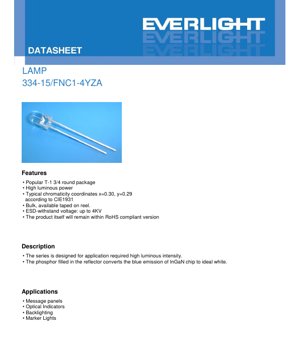
This document details the specifications for a high-luminosity white LED lamp. The device is housed in a popular T-1 3/4 round package, designed to deliver high luminous power for a variety of indicator and illumination applications. The white light is achieved through a phosphor conversion process applied to an InGaN blue chip, resulting in typical chromaticity coordinates as defined by the CIE 1931 standard.
1.1 Core Advantages
The primary advantages of this LED series include its high luminous intensity, making it suitable for applications requiring bright, visible light. The device features an ESD withstand voltage of up to 4KV, enhancing its robustness in handling. It is compliant with relevant environmental regulations and is available in bulk or taped reel packaging for automated assembly.
1.2 Target Market and Applications
This LED is targeted at applications demanding reliable and bright optical indicators. Typical use cases include message panels, status indicators, backlighting for small displays, and marker lights where high visibility is paramount.
2. Technical Parameter Deep Dive
2.1 Absolute Maximum Ratings
The device must not be operated beyond these limits to prevent permanent damage. Key ratings include a continuous forward current (IF) of 30 mA, a peak forward current (IFP) of 100 mA under pulsed conditions (1/10 duty cycle @ 1kHz), and a maximum reverse voltage (VR) of 5V. The power dissipation (Pd) is rated at 110 mW. The operating temperature range (Topr) is from -40°C to +85°C, with storage (Tstg) from -40°C to +100°C. The maximum soldering temperature is 260°C for 5 seconds.
2.2 Electro-Optical Characteristics
These parameters are measured at a standard test condition of 25°C ambient temperature and a forward current of 20mA. The forward voltage (VF) typically ranges from 2.8V to 3.6V. The luminous intensity (IV) has a typical range from 22,500 mcd to 36,000 mcd. The viewing angle (2θ1/2) is approximately 15 degrees, indicating a relatively focused beam. The typical chromaticity coordinates are x=0.30, y=0.29. A Zener diode is integrated with a reverse voltage (Vz) of 5.2V at 5mA, and the reverse current (IR) is a maximum of 50 µA at 5V.
3. Binning System Explanation
The product is classified into bins to ensure consistency in key parameters.
3.1 Luminous Intensity Binning
Luminous intensity is divided into two primary bins: Bin 'Y' (22,500 - 28,500 mcd) and Bin 'Z' (28,500 - 36,000 mcd), both measured at IF=20mA. A general tolerance of ±10% applies.
3.2 Forward Voltage Binning
Forward voltage an rarraba zuwa kwandon guda hudu: 0 (2.8-3.0V), 1 (3.0-3.2V), 2 (3.2-3.4V), da 3 (3.4-3.6V). Rashin tabbacin ma'auni shine ±0.1V.
3.3 Haɗin Launi
Launi an ayyana shi ta hanyar ƙungiyar haɗin gwiwa. Ga wannan samfurin, an ƙayyade ƙungiyar a matsayin '4', wanda yayi daidai da kwandon chromaticity A0, B5, da B6 kamar yadda aka zana akan zanen CIE.
4. Performance Curve Analysis
The datasheet provides several characteristic curves that illustrate device behavior under varying conditions.
4.1 Relative Intensity vs. Wavelength
This curve shows the spectral power distribution of the white light output, which is broad due to the phosphor conversion, peaking in the blue region from the chip and emitting across the visible spectrum.
4.2 Directivity Pattern
The polar plot illustrates the spatial distribution of light intensity, confirming the 15-degree viewing angle with a typical Lambertian or near-Lambertian emission profile.
4.3 Forward Current vs. Forward Voltage (IV Curve)
This graph shows the exponential relationship between current and voltage, crucial for designing appropriate current-limiting circuitry. The curve helps determine the dynamic resistance of the LED.
4.4 Relative Intensity vs. Forward Current
This curve demonstrates how light output increases with drive current. It is generally linear within the recommended operating range but may saturate or degrade at higher currents.
4.5 Chromaticity Coordinate vs. Forward Current
This plot indicates how the color point (x, y coordinates) may shift with changes in drive current, which is important for color-critical applications.
4.6 Forward Current vs. Ambient Temperature
This derating curve shows the maximum allowable forward current as a function of the ambient temperature, essential for thermal management and ensuring long-term reliability.
5. Mechanical and Package Information
5.1 Package Dimensions
The LED uses a standard T-1 3/4 (5mm) round package. The dimensional drawing specifies the diameter, height, lead spacing, and other critical mechanical features. All dimensions are in millimeters with a standard tolerance of ±0.25mm unless otherwise noted. The lead spacing is measured at the point where the leads exit the package body. The maximum protrusion of resin under the flange is 1.5mm.
5.2 Polarity Identification
The cathode is typically identified by a flat spot on the rim of the LED lens or by the shorter lead. The datasheet diagram should be consulted for the exact polarity marking.
6. Soldering and Assembly Guidelines
6.1 Lead Forming
Leads should be bent at a point at least 3mm from the base of the epoxy bulb. Forming must be done before soldering. Stress on the package during bending must be avoided to prevent internal damage or breakage. Leadframes should be cut at room temperature.
6.2 Storage Conditions
LEDs should be stored at 30°C or less and 70% relative humidity or less. The recommended storage life is 3 months from shipment. For longer storage (up to one year), use a sealed container with a nitrogen atmosphere and desiccant.
6.3 Soldering Recommendations
A minimum distance of 3mm must be maintained between the solder joint and the epoxy bulb. Recommended conditions are:
- Hand Soldering: Iron tip temperature max 300°C (30W max), soldering time max 3 seconds.
- Wave/Dip Soldering: Pre-heat temperature max 100°C (60 sec max), solder bath temperature max 260°C for 5 seconds max.
7. Packaging and Ordering Information
7.1 Packing Specification
The LEDs are packed in anti-static bags. Each bag contains a minimum of 200 to a maximum of 500 pieces. Five bags are packed into one inner carton. Ten inner cartons are packed into one master (outside) carton.
7.2 Bayanin Label
Labels na marufi sun haɗa da: CPN (Customer's Part Number), P/N (Part Number), QTY (Quantity), CAT (Luminous Intensity and Forward Voltage Rank), HUE (Color Rank), REF (Reference), da LOT No. (Lot Number).
7.3 Tsarin Lambar Model
The part number 334-15/FNC1-4YZA follows a specific coding system where segments likely indicate the series, package type, color group (4), luminous intensity bin (Y/Z), and forward voltage bin (0-3).
8. Application Suggestions
8.1 Typical Application Circuits
Don gaskiya aiki, jerin kariya na iyakancewar ƙarfin lantarki ya zama dole. Ƙimar resistor (R) za a iya lissafta ta amfani da Dokar Ohm: R = (Vsupply - VF) / IF, inda VF shine ƙarfin lantarki na gaba na LED a cikin ƙarfin lantarki da ake so IF. Don tsayayyen haske, ana ba da shawarar direban ƙarfin lantarki na tsaye, musamman lokacin da ƙarfin lantarkin wadata ya bambanta ko kuma don tuka LED da yawa a jere.
8.2 Design Considerations
Thermal Management: Although power dissipation is low, ensuring adequate ventilation or heat sinking is important for maintaining luminous output and longevity, especially in high ambient temperatures or when driven near maximum ratings.
ESD Protection: Yayin da na'urar ke da kariya ta ESD (4KV HBM), ya kamata a ci gaba da bin matakan kariya na ESD na yau da kullun yayin haɗawa.
Optical Design: Kallon kusurwar digiri 15 ya sa wannan LED ya dace da aikace-aikacen da ke buƙatar haske mai jagora. Don haske mai faɗi, ana iya buƙatar na'urori na gani na biyu kamar ruwan tabarau ko masu watsawa.
9. Technical Comparison and Differentiation
Compared to standard 5mm LEDs, this device offers significantly higher luminous intensity (up to 36,000 mcd), making it suitable for applications where superior brightness is needed. The integrated Zener diode for reverse voltage protection is a feature that adds robustness in circuits where reverse voltage spikes might occur. The precise binning for intensity, voltage, and color allows for better consistency in mass-produced products where uniform appearance and performance are critical.
10. Frequently Asked Questions (FAQ)
Q: What is the typical operating current for this LED?
A: The standard test condition and typical operating point is 20mA. It can be operated up to the continuous maximum of 30mA, but lifetime and color stability should be verified at higher currents.
Q: How do I interpret the color bins A0, B5, B6?
A: Waɗannan yankuna ne na musamman akan zanen launi na CIE 1931 da ke ayyana ƙayyadaddun bambancin launi da aka halatta. Rukuni '4' yana nufin launin LED zai faɗo cikin haɗaɗɗiyar yankin waɗannan rukunoni guda uku, waɗanda suka dace da bambancin yanayin zafin launi (CCTs) kamar yadda aka nuna akan zanen (misali, ~5600K, ~7000K, ~9000K).
Q: Shin zan iya kunna wannan LED ta amfani da wutar lantarki 5V ba tare da resistor ba?
A: A'a. Ba tare da tsarin iyakancewar halin yanzu ba, LED zai yi ƙoƙarin ɗaukar halin yanzu mai yawa, da sauri ya wuce matsakaicin ƙimar sa kuma ya haifar da gazawa mai tsanani. Koyaushe yi amfani da resistor na jeri ko direban halin yanzu na akai.
11. Practical Use Case Example
Scenario: Designing a High-Visibility Status Indicator Panel. A control panel requires a set of bright white status indicators visible under high ambient light. Using this LED in Bin Z (high intensity) ensures visibility. A circuit is designed with a 12V supply. For each LED, assuming a VF of 3.2V (Bin 1) and a desired IF of 20mA, the series resistor is calculated as (12V - 3.2V) / 0.02A = 440 Ohms. A standard 470 Ohm resistor is selected, resulting in a current of approximately 18.7mA, which is within specification. The LEDs are mounted on a PCB with holes aligned to the leads to avoid stress, and hand-soldered following the time and temperature guidelines.
12. Operating Principle Introduction
Wannan fitilar LED ce mai farin phosphor. Tsarin sa shine guntuwar semiconductor da aka yi da Indium Gallium Nitride (InGaN) wanda ke fitar da hasken shuɗi lokacin da aka yi masa lallashi a gaba (electroluminescence). Wannan hasken shuɗi ba a fitar da shi kai tsaye ba. A maimakon haka, yana buga wani Layer na kayan phosphor (yawanci YAG:Ce) da aka ajiye a cikin fakitin. Phosphor din yana ɗaukar wani ɓangare na photons masu shuɗi kuma yana sake fitar da haske a cikin mafi faɗin bakan, musamman a yankin rawaya. Haɗuwar sauran hasken shuɗi da hasken rawaya da aka canza, idon ɗan adam yana ganin su azaman fari. Tabbataccen inuwa (correlated color temperature) ana sarrafa shi ta hanyar abun da ke ciki da yawan phosphor.
13. Technology Trends
Ci gaba da ci gaba a cikin ingancin InGaN chip da fasahar phosphor ne suka taimaka wajen haɓaka farar LED. Ana ci gaba da neman ingantacciyar haske (mafi yawan lumens a kowace watt), ingantacciyar ma'aunin launi (CRI) don ingantaccen ingancin haske, da ƙarancin bambance-bambancen launi don daidaiton launi. Sabbin abubuwan haɗin kai kuma suna mai da hankali kan inganta sarrafa zafin jiki don ba da damar yin amfani da ƙarfin wutar lantarki mafi girma da yawan wutar lantarki, da kuma rage girman su. Fasahar ta kasance tushen hasken ƙwaƙwalwa, wanda ke maye gurbin hasken wuta da na fluorescent a yawancin aikace-aikace saboda ingancin makamashi, tsawon rayuwa, da sassauƙan ƙira.
LED Specification Terminology
Complete explanation of LED technical terms
Photoelectric Performance
| Term | Unit/Representation | Simple Explanation | Why Important |
|---|---|---|---|
| Luminous Efficacy | lm/W (lumens per watt) | Light output per watt of electricity, higher means more energy efficient. | Directly determines energy efficiency grade and electricity cost. |
| Luminous Flux | lm (lumens) | Total light emitted by source, commonly called "brightness". | Determines if the light is bright enough. |
| Viewing Angle | ° (degrees), e.g., 120° | Angle where light intensity drops to half, determines beam width. | Affects illumination range and uniformity. |
| CCT (Zazzabin Launi) | K (Kelvin), misali, 2700K/6500K | Haske ko haske mai dumi/sanyi, ƙananan ƙimomi suna da rawaya/dumi, mafi girma fari/sanyi. | Yana ƙayyade yanayin haske da yanayin da ya dace. |
| CRI / Ra | Unitless, 0–100 | Ability to render object colors accurately, Ra≥80 is good. | Affects color authenticity, used in high-demand places like malls, museums. |
| SDCM | MacAdam ellipse steps, e.g., "5-step" | Color consistency metric, smaller steps mean more consistent color. | Ensures uniform color across same batch of LEDs. |
| Dominant Wavelength | nm (nanometers), e.g., 620nm (red) | Wavelength corresponding to color of colored LEDs. | Determines hue of red, yellow, green monochrome LEDs. |
| Spectral Distribution | Wavelength vs intensity curve | Shows intensity distribution across wavelengths. | Affects color rendering and quality. |
Electrical Parameters
| Term | Symbol | Simple Explanation | Design Considerations |
|---|---|---|---|
| Forward Voltage | Vf | Minimum voltage to turn on LED, like "starting threshold". | Driver voltage must be ≥Vf, voltages add up for series LEDs. |
| Forward Current | If | Current value for normal LED operation. | Usually constant current drive, current determines brightness & lifespan. |
| Max Pulse Current | Ifp | Peak current tolerable for short periods, used for dimming or flashing. | Pulse width & duty cycle must be strictly controlled to avoid damage. |
| Reverse Voltage | Vr | Max reverse voltage LED can withstand, beyond may cause breakdown. | Circuit must prevent reverse connection or voltage spikes. |
| Thermal Resistance | Rth (°C/W) | Resistance to heat transfer from chip to solder, lower is better. | High thermal resistance requires stronger heat dissipation. |
| ESD Immunity | V (HBM), e.g., 1000V | Ability to withstand electrostatic discharge, higher means less vulnerable. | Anti-static measures needed in production, especially for sensitive LEDs. |
Thermal Management & Reliability
| Term | Key Metric | Simple Explanation | Impact |
|---|---|---|---|
| Junction Temperature | Tj (°C) | Halin zazzabi na aiki a cikin LED chip. | Kowane raguwar 10°C na iya ninka tsawon rayuwa; yawan zafi yana haifar da raguwar haske, canjin launi. |
| Lumen Depreciation | L70 / L80 (hours) | Time for brightness to drop to 70% or 80% of initial. | Directly defines LED "service life". |
| Lumen Maintenance | % (e.g., 70%) | Percentage of brightness retained after time. | Indicates brightness retention over long-term use. |
| Color Shift | Δu′v′ or MacAdam ellipse | Degree of color change during use. | Yana shafar daidaiton launi a cikin yanayin haske. |
| Thermal Aging | Material degradation | Deterioration due to long-term high temperature. | May cause brightness drop, color change, or open-circuit failure. |
Packaging & Materials
| Term | Common Types | Simple Explanation | Features & Applications |
|---|---|---|---|
| Package Type | EMC, PPA, Ceramic | Housing material protecting chip, providing optical/thermal interface. | EMC: good heat resistance, low cost; Ceramic: better heat dissipation, longer life. |
| Chip Structure | Front, Flip Chip | Chip electrode arrangement. | Flip chip: better heat dissipation, higher efficacy, for high-power. |
| Phosphor Coating | YAG, Silicate, Nitride | Covers blue chip, converts some to yellow/red, mixes to white. | Different phosphors affect efficacy, CCT, and CRI. |
| Ruwan tabarau/Optics | Lebur, Microlens, TIR | Optical structure on surface controlling light distribution. | Determines viewing angle and light distribution curve. |
Quality Control & Binning
| Term | Binning Content | Simple Explanation | Purpose |
|---|---|---|---|
| Luminous Flux Bin | Code e.g., 2G, 2H | Grouped by brightness, each group has min/max lumen values. | Ensures uniform brightness in same batch. |
| Voltage Bin | Code e.g., 6W, 6X | Grouped by forward voltage range. | Facilitates driver matching, improves system efficiency. |
| Color Bin | 5-step MacAdam ellipse | Grouped by color coordinates, ensuring tight range. | Guarantees color consistency, avoids uneven color within fixture. |
| CCT Bin | 2700K, 3000K etc. | Grouped by CCT, each has corresponding coordinate range. | Meets different scene CCT requirements. |
Testing & Certification
| Term | Standard/Test | Simple Explanation | Significance |
|---|---|---|---|
| LM-80 | Lumen maintenance test | Long-term lighting at constant temperature, recording brightness decay. | Used to estimate LED life (with TM-21). |
| TM-21 | Life estimation standard | Estimates life under actual conditions based on LM-80 data. | Provides scientific life prediction. |
| IESNA | Illuminating Engineering Society | Covers optical, electrical, thermal test methods. | Industry-recognized test basis. |
| RoHS / REACH | Environmental certification | Ensures no harmful substances (lead, mercury). | Market access requirement internationally. |
| ENERGY STAR / DLC | Energy efficiency certification | Energy efficiency and performance certification for lighting. | Used in government procurement, subsidy programs, enhances competitiveness. |