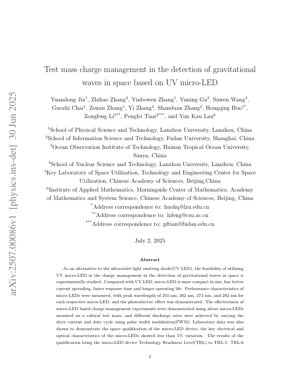
Amfani da UV Micro-LED don Gudanar da Caji a cikin Gwajin Mass a Ganin Raɗaɗin Gravitational na Sararin Samaniya
Nazarin gwaji kan amfani da UV micro-LEDs a matsayin tushen haske mai ƙarfi da inganci don kawar da caji akan gwajin mass a cikin gidajen kallo na gravitational na sararin samaniya kamar LISA.
Gida »
Takaddun »
Amfani da UV Micro-LED don Gudanar da Caji a cikin Gwajin Mass a Ganin Raɗaɗin Gravitational na Sararin Samaniya
Bayyani Gabaɗaya
Wannan takardar bincike ta gabatar da binciken gwaji kan amfani da Ultraviolet Micro-Light Emitting Diodes (UV micro-LEDs) don sarrafa cajin lantarki akan gwajin mass masu faɗuwa cikin 'yanci a cikin na'urori masu gano raɗaɗin gravitational na sararin samaniya na gaba, kamar Laser Interferometer Space Antenna (LISA). Binciken ya nuna cewa micro-LEDs suna ba da madadin mafi girma fiye da fitilun mercury na al'ada da daidaitattun UV LEDs, suna ba da fa'idodi a cikin girma, ingancin wutar lantarki, daidaitaccen sarrafawa, da tsawon rayuwa, waɗanda ke da mahimmanci ga nasarar ayyukan sararin samaniya na shekaru da yawa.
1. Gabatarwa
Gidajen kallo na raɗaɗin gravitational na sararin samaniya suna aiki a cikin yanayi mai wuyar gaske inda haskoki na sararin samaniya da barbashi na rana zasu iya cajin gwajin mass masu keɓewa, suna haifar da hayaniyar lantarki wanda ke rufe raunin siginar raɗaɗin gravitational. Saboda haka, ingantaccen gudanar da caji shine tushen fasaha. A tarihi, ayyuka kamar Gravity Probe B da LISA Pathfinder sun yi amfani da fitilun mercury. Wannan takarda tana binciken UV micro-LEDs a matsayin mafita na zamani na gaba, tana nuna yuwuwarsu don haɗawa, sarrafawa daidai, da amincinsu a sararin samaniya.
2. Fasaha & Hanyoyin Aiki
2.1 UV Micro-LED vs. Tushen Al'ada
Binciken ya kwatanta micro-LEDs da na al'ada UV LEDs da fitilun mercury. Manyan fa'idodin da aka gano sun haɗa da:
Girma & Nauyi Mai Ƙarfi: Yana ba da damar haɗawa kai tsaye akan gidajen lantarki.
Mafi Girman Yaduwar Wutar Lantarki & Ingantacciyar Aiki: Yana haifar da fitar da haske mafi daidaito.
Lokacin Amsa Mafi Sauri: Yana ba da damar daidaitawa cikin sauri (PWM) don sarrafa cire caji daidai.
Tsawon Rayuwar Aiki: Yana da mahimmanci ga ayyuka masu tsawon shekaru goma kamar LISA.
Sarrafa Ƙarfin Hasken Gani Daidai: Yana iya isar da wutar lantarki har zuwa matakin picowatt.
2.2 Tsarin Gwaji & Ka'idar Gudanar da Caji
Tushen ka'idar shine tasirin hoto (photoelectric effect): Ƙwayoyin UV da suka faɗo akan gwajin mass (ko gidansa) suna fitar da electrons, ta haka ne suke kawar da tarin caji mai kyau. Tsarin gwaji ya ƙunshi ɗora micro-LEDs tare da tsayin zango mafi girma na 254 nm, 262 nm, 274 nm, da 282 nm akan gwajin mass mai siffar cube a cikin ɗakin da ba shi da iska don kwaikwayi yanayin sararin samaniya. An sarrafa ƙimar cire caji ta hanyar bambanta yanayin tuƙi na LED da cikakken zagayowar aiki ta hanyar Pulse Width Modulation (PWM).
3. Sakamako & Bincike
Tsawon Zango
254 - 282 nm
Mafi girman fitarwa na micro-LEDs da aka gwada
Kwanciyar Aiki
< 5%
Bambanci a cikin mahimman halaye yayin cancanta
Shirye-shiryen Fasaha
TRL-5
An cimma; Ana nufin TRL-6 tare da ƙarin gwaje-gwaje
3.1 Halayen Aikin Micro-LED
Micro-LEDs da aka gwada sun nuna tsayin zango mafi girma da aka fayyace a cikin bakan UV mai zurfi, wanda ya fi dacewa don fitar da electrons daga gwajin mass masu lulluɓe da zinariya. An nuna tasirin hoto (photoelectric effect) cikin nasara, wanda ya tabbatar da yuwuwar tushen hanyar.
3.2 Sarrafa Ƙimar Cire Caji ta hanyar PWM
Gwajin ya nuna cikin nasara cewa za a iya sarrafa ƙimar cire caji akan gwajin mass a layi daya daidai ta hanyar daidaita cikakken zagayowar aikin PWM da yanayin tuƙi na micro-LED. Wannan yana ba da ingantacciyar hanya don aiwatar da tsarin gudanar da caji mai aiki, mai sarrafa martani.
Bayanin Ginshiƙi: Wani ginshiƙi na hasashe (dangane da hanyar da aka bayyana) zai zana Ƙimar Cire Caji (e/s) akan Y-axis da Cikakken Zagayowar Aikin PWM (%) akan X-axis don bambancin yanayin tuƙi na akai (misali, 5 mA, 10 mA, 20 mA). Lankwasa zai nuna alaƙa mai kyau, kusan a layi daya, tare da mafi girman yanayin tuƙi yana haifar da gangaren gangare, yana nuna ma'auni na sarrafawa masu zaman kansu.
3.3 Ingantaccen Sararin Samaniya & Kimanta TRL
Gwaje-gwajen muhalli na dakin gwaje-gwaje da suka kwaikwayi yanayin sararin samaniya sun nuna cewa mahimman halayen lantarki da na gani na micro-LEDs sun bambanta da ƙasa da 5%. Wannan ƙarfin ya goyi bayan kimanta cewa fasahar ta kai matakin Matakin Shirye-shiryen Fasaha (TRL) 5 (tabbatar da ɓangaren a cikin yanayi mai dacewa). Takardar ta bayyana cewa TRL-6 (nunin tsarin/tsarin ƙirar a cikin yanayi mai dacewa) yana yiwuwa tare da ƙarin gwajin radiation da zafi mara iska.
4. Fahimtar Masanin Bincike na Tsakiya
Fahimta ta Tsakiya
Wannan ba kawai ci gaba ne a cikin gudanar da caji ba; yana da canji na tushe zuwa haɗawa guda ɗaya da sarrafa lambobi a cikin awo na sararin samaniya. Matsi daga fitilun analog zuwa semiconductor micro-LEDs yana kwatanta juyin juya hali a cikin kwamfuta daga bututun vacuum zuwa transistors, yana alƙawarin ribobi masu yawa a cikin daidaito, aminci, da rage girman don gidajen kallo na zamani.
Kwararar Hankali
Hankalin takardar yana da inganci amma mai tsattsauran ra'ayi. Ya gano matsala daidai (hayaniyar caji), ya ba da shawarar ɓangaren mafi girma (micro-LED), ya tabbatar da aikin sa na asali (tasirin hoto), kuma ya nuna sarrafawa na farko (PWM). Duk da haka, ya tsaya kafin cikakken binciken kasafin kuɗi na hayaniya ko nunin sarrafa rufaffiyar madauki, waɗanda su ne ainihin ƙofofin karɓar aiki. Mataki na gaba na hankali shine haɗa wannan ɓangaren cikin ƙirar ƙirar tsarin.
Ƙarfi & Kurakurai
Ƙarfi: Bayanan gwaji akan sarrafa PWM suna da gogayya kuma suna aiki kai tsaye. Mai da hankali kan TRL yana da hankali kuma yana magana da harshen hukumomin sararin samaniya. Hanyar tsayin zango da yawa tana da wayo, tana ba da damar inganta don kayan lantarki daban-daban. Kurakurai: Babban raunin takardar shine rashin bayanan tsawon rayuwa na dogon lokaci a ƙarƙashin aikin UV mai ƙarfi. Rage ingancin micro-LED da lalacewa a ƙarƙashin fitar da UV mai zurfi akai-akai shine ƙalubalen masana'antu da aka sani (kamar yadda aka lura a cikin bincike daga Nature Photonics). Bugu da ƙari, tattaunawar haɗa micro-lenses don tuƙi na katako yana da ban sha'awa amma an gabatar da shi ba tare da tabbacin gwaji ba, yana jin hasashe.
Fahimta Mai Aiki
1. Ga Masu Tsara Aiki (ESA/NASA/CNSA): Ku ba da kuɗin yaƙin neman zaɓe na musamman, mai saurin gwajin rayuwa don waɗannan takamaiman micro-LEDs a ƙarƙashin wakilcin aikin UV flux da cikakken zagayowar aiki. Wannan shine babban mai rage haɗari guda ɗaya.
2. Ga Ƙungiyar Bincike: Haɗin gwiwa tare da ginin MEMS don ƙirar ƙirar na gaba: tsararrun micro-LED masu adireshi tare da haɗaɗɗun micro-lenses. Wannan yana ba da damar kawar da caji mai canzawa, mai yuwuwa rage tasirin filin faci—wani mummunan tushen hayaniya da ba a taɓa ambata a cikin takardar ba amma yana da mahimmanci ga aikin LISA, kamar yadda aka bayyana a cikin Takaddun Bukatun Aikin LISA na hukuma.
3. Ga Masu Bayar da Kayan Aiki: Wannan binciken yana buɗe sabon kasuwa mai inganci, ƙarancin girma, babban ƙima. Ku saka hannun jari a cikin haɓaka fakitin UV micro-LED na sararin samaniya wanda ya cika ka'idojin fitar da iska da taurin radiation.
Za a iya ƙirar yanayin cire caji $I_{dis}$ a matsayin aikin ƙwayar UV da ke faɗowa:
$I_{dis} = e \cdot \Phi \cdot \eta \cdot QE(\lambda)$
Inda:
$e$ shine cajin farko.
$\Phi$ shine ƙwayar ƙwayar cuta da ke faɗowa akan saman (ƙwayoyin/s).
$\eta$ shine ma'auni na geometric wanda ke lissafin ɓangaren electrons da aka fitar waɗanda ke tserewa daga saman kuma ana tattara su.
$QE(\lambda)$ shine ingancin quantum (electrons/ƙwayar cuta) na saman saman gwajin mass (misali, zinariya) a takamaiman tsayin zango na UV $\lambda$.
Ƙarfin gani na micro-LED $P_{opt}$ yana da alaƙa da ƙwayar ƙwayar cuta: $\Phi = \frac{P_{opt} \cdot \lambda}{h c}$, inda $h$ shine akai-akai Planck kuma $c$ shine saurin haske. Sarrafa PWM yana daidaita $P_{opt}$ akan lokaci kai tsaye, yana ba da damar sarrafa $I_{dis}$ daidai.
Kimanta irin wannan ɓangaren don amfani da sararin samaniya yana buƙatar tsarin da aka tsara. Ƙasa akwai matrix mai sauƙaƙe na kimanta dangane da bayanan takardar:
Ma'auni
Kima (Dangane da Takarda)
Matakin Haɗari
Mataki na Gaba na Tabbaci
Aikin Aiki
An nuna tasirin hoto & sarrafa PWM.
Ƙananan
Gwajin kwanciyar hankali na rufaffiyar madauki tare da kwaikwayon hayaniya.
Ƙarfin Muhalli
<5% bambanci a cikin gwaje-gwajen dakin gwaje-gwaje. Radiation/Zafi mara iska yana jiran.
Matsakaici-Babba
Cikakken jerin gwaje-gwajen cancantar sararin samaniya na ma'aunin ECSS.
Tsawon Rayuwa & Aminci
An yi iƙirarin cewa ya fi UV LED tsayi, amma ba a nuna bayanai ba.
Babba
Gwajin tsawon rayuwa mai sauri don hasashen aikin shekaru 10.
Yiwuwar Haɗawa
Girma mai ƙarfi fa'ida ce. Ba a nuna samfurin tsararrun haɗaɗɗu ba.
Matsakaici
Ƙira da gwada samfurin haɗin gwiwa na injiniya/zafi tare da gidan lantarki.
Wannan tsarin yana taimakawa gano tsarin cewa tsawon rayuwa/amincin da gwajin muhalli su ne abubuwan mahimmanci, ba aikin asali ba.
6. Aikace-aikace na Gaba & Jagorori
Tasirin wannan fasahar ya wuce ayyukan LISA-class:
Hankali na Quantum & Interferometry na Atomic a Sararin Samaniya: Ayyuka na gaba ta amfani da atom masu sanyi sosai ko abubuwa na quantum masu girma a matsayin gwajin mass zasu sami ƙarin ƙa'idodin sarrafa caji. Tsararrun micro-LEDs na iya samar da kawar da caji na gida, mara kutsawa da ake buƙata.
Sadarwar Gani mai zurfi na Sararin Samaniya: Haɓaka ingantattun tushen UV mai zurfi kai tsaye yana amfana da sadarwar Laser ta tsakanin tauraron dan adam, inda za a iya amfani da UV don saye da bin diddigin.
Sarrafa Yuwuwar Jirgin Ruwa mai zurfi a cikin Wuri: Ana iya amfani da irin waɗannan tsarin micro-LED don sarrafa caji akan madubai na hangen nesa masu hankali ko saman jirgin ruwa na waje, yana rage haɗarin fitar da lantarki.
Ayyukan Raɗaɗin Gravitational na Zamani: Don ra'ayoyi kamar Big Bang Observer (BBO), wanda ke hasashen tarin na'urori masu tsaka-tsaki, rage girman da ribobi daga micro-LEDs sun zama mahimmanci don yiwuwa.
Jagorar nan gaba dole ne ta zama tuƙi mai haɗin kai zuwa TRL-6 da TRL-7 ta hanyar haɗin gwiwa tare da hukumar sararin samaniya don nunin fasaha na musamman a cikin kewayawa, watakila akan dandalin CubeSat.
7. Nassoshi
J. P. et al., "Gudanar da caji don na'urori masu aunawa na gravitational," Class. Quantum Grav., vol. 26, 2009. (Wakilin gadon LISA Pathfinder).
G. M. et al., "Gudanar da caji na UV LED don aikin LISA," Phys. Rev. D, vol. 105, 2022.
A. H. et al., "Rage inganci a cikin III-nitride micro-light-emitting diodes," Nature Photonics, vol. 15, pp. 148–155, 2021. (Yana nuna ainihin ƙalubalen fasaha don tsawon rayuwar micro-LED).
Haɗin gwiwar Turai don Daidaitaccen Sararin Samaniya (ECSS), "Injiniyan sararin samaniya: Gwaji," ECSS-E-ST-10-03C, 2022. (Ma'auni don gwajin cancantar sararin samaniya).
Ƙungiyar Gravitational ta Huazhong, "Nazarin farko akan micro-LED don gudanar da caji na sararin samaniya," Chinese Journal of Space Science, 2023. (An ambata a matsayin aikin tushe na farko).
Isogai et al., "Tsawon Rayuwa da Hanyoyin Kasawa na Deep-UV LEDs," Journal of Applied Physics, vol. 125, 2019. (Yana ba da mahallin ƙalubalen aminci).