सामग्री
- 1. उत्पाद अवलोकन
- 1.1 मुख्य लाभ
- 1.2 लक्षित बाजार एवं अनुप्रयोग
- 2. गहन तकनीकी मापदंड विश्लेषण
- 2.1 पूर्ण अधिकतम रेटिंग
- 2.2 ऑप्टोइलेक्ट्रॉनिक विशेषताएँ
- 3. बिनिंग प्रणाली विवरण
- 3.1 कलर रेंडरिंग इंडेक्स (CRI) बिनिंग
- 3.2 फॉरवर्ड करंट इंडेक्स
- 3.3 फॉरवर्ड वोल्टेज एक्सपोनेंट
- 3.4 लुमेनस फ्लक्स बिनिंग
- 3.5 फॉरवर्ड वोल्टेज बिनिंग
- 3.6 क्रोमैटिसिटी (कलर) बिनिंग
- 4. प्रदर्शन वक्र विश्लेषण
- 4.1 स्पेक्ट्रम वितरण
- 4.2 विशिष्ट फोटोइलेक्ट्रिक विशेषता वक्र
- 5. डिवाइस चयन और आदेश जानकारी
- 5.1 उत्पाद संख्या स्पष्टीकरण
- 5.2 वॉल्यूम उत्पादन सूची
- 6. अनुप्रयोग मार्गदर्शिका और डिजाइन विचार
- 6.1 थर्मल प्रबंधन
- 6.2 इलेक्ट्रिकल ड्राइव
- 6.3 ऑप्टिकल डिज़ाइन
- 6.4 वेल्डिंग और असेंबली
- 7. तकनीकी तुलना और बाजार स्थिति
- 8. सामान्य प्रश्न (तकनीकी मापदंडों पर आधारित)
- 9. व्यावहारिक अनुप्रयोग उदाहरण
- 10. कार्य सिद्धांत और तकनीकी रुझान
- 10.1 मूल कार्य सिद्धांत
- 10.2 उद्योग प्रवृत्तियाँ
- LED विनिर्देश शब्दावली का विस्तृत विवरण
- 1. प्रकाशविद्युत प्रदर्शन के मुख्य संकेतक
- 2. विद्युत मापदंड
- तीन, ताप प्रबंधन और विश्वसनीयता
- चार, पैकेजिंग और सामग्री
- पाँच, गुणवत्ता नियंत्रण और ग्रेडिंग
- छह, परीक्षण और प्रमाणन
1. उत्पाद अवलोकन
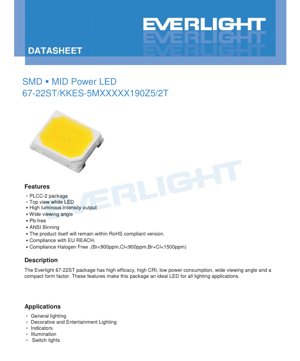
67-22ST एक PLCC-2 पैकेज वाला सरफेस माउंट डिवाइस (SMD) मिड-पावर LED है। इसे व्हाइट LED के रूप में डिज़ाइन किया गया है, जो उच्च प्रकाश दक्षता, उच्च कलर रेंडरिंग इंडेक्स (CRI), कम बिजली की खपत और चौड़े व्यूइंग एंगल जैसे फायदों को जोड़ती है। इसका कॉम्पैक्ट फॉर्म फैक्टर इसे स्पेस एफिशिएंसी और अच्छी प्रकाश गुणवत्ता की आवश्यकता वाले व्यापक प्रकाश अनुप्रयोगों के लिए आदर्श बनाता है।
1.1 मुख्य लाभ
定义本产品的关键特性包括其高光强输出,确保明亮的照明效果。宽视角可在较大区域内提供均匀的光分布。产品采用无铅材料制造,并符合RoHS、欧盟REACH及无卤标准(溴<900ppm,氯<900ppm,溴+氯<1500ppm)等主要环保与安全法规。产品采用ANSI标准分档,以确保颜色和性能分类的一致性。
1.2 लक्षित बाजार एवं अनुप्रयोग
यह एलईडी विभिन्न प्रकाश अनुप्रयोगों के लिए एक आदर्श समाधान है। इसका मुख्य उपयोग आवासीय और वाणिज्यिक स्थानों में सामान्य प्रकाश व्यवस्था के लिए है। यह सजावटी और मनोरंजन प्रकाश व्यवस्था के लिए भी उपयुक्त है जहाँ रंग गुणवत्ता और विश्वसनीयता की उच्च मांग है। इसके अतिरिक्त, इसका उपयोग इलेक्ट्रॉनिक उपकरणों और प्रकाश युक्तियों में संकेतक और सामान्य प्रकाश व्यवस्था के लिए भी किया जा सकता है।
2. गहन तकनीकी मापदंड विश्लेषण
यह खंड निर्दिष्ट शर्तों के तहत एलईडी की कार्य सीमाओं और प्रदर्शन विशेषताओं का विस्तृत विश्लेषण प्रस्तुत करता है।
2.1 पूर्ण अधिकतम रेटिंग
पूर्ण अधिकतम रेटिंग उन सीमाओं को परिभाषित करती है जिनके बाहर उपकरण को स्थायी क्षति हो सकती है। ये रेटिंग सोल्डर पॉइंट तापमान (Tसोल्डरिंग) 25°C पर निर्दिष्ट की गई हैं।
- Forward current (IF):60 mA (continuous).
- Peak forward current (IFP):120 mA, allowed under pulse conditions with a duty cycle of 1/10 and a pulse width of 10 ms.
- Power dissipation (Pd):1080 mW.
- Operating temperature (Topr):-40°C से +85°C।
- भंडारण तापमान (Tstg):-40°C से +100°C।
- तापीय प्रतिरोध (Rth J-S):17 °C/W (जंक्शन से सोल्डर पॉइंट)।
- जंक्शन तापमान (Tj):115 °C (अधिकतम)।
- सोल्डरिंग तापमान:रिफ्लो सोल्डरिंग के लिए, यह 260°C पर 10 सेकंड के लिए निर्धारित है। हैंड सोल्डरिंग के लिए, सीमा 350°C पर 3 सेकंड है।
महत्वपूर्ण सूचना:यह घटक इलेक्ट्रोस्टैटिक डिस्चार्ज (ESD) के प्रति संवेदनशील है। क्षति को रोकने के लिए असेंबली और हैंडलिंग के दौरान उचित ESD प्रक्रियाओं का पालन किया जाना चाहिए।
2.2 ऑप्टोइलेक्ट्रॉनिक विशेषताएँ
विशिष्ट प्रदर्शन 50mA की फॉरवर्ड करंट (IF) और 25°C के सोल्डर पॉइंट तापमान पर मापा जाता है।
- ल्यूमिनस फ्लक्स (Φ):न्यूनतम ल्यूमिनस फ्लक्स 118 लुमेन से शुरू होता है, जो उत्पाद बिनिंग पर निर्भर करता है (धारा 3 देखें)। उत्पादन विशिष्ट मान 133 लुमेन और 145 लुमेन श्रृंखला हैं। सहनशीलता ±11% है।
- Forward Voltage (VF):At 50mA, the maximum forward voltage is 19.0V. The typical range is between 17.0V and 19.0V, and they are binned accordingly. The tolerance is ±0.1V.
- Color Rendering Index (Ra / CRI):The minimum CRI for the standard series is 80, with an R9 value of 0. The tolerance is ±2.
- Viewing Angle (2θ1/2):The typical half-intensity viewing angle is 120 degrees, providing a very wide beam.
3. बिनिंग प्रणाली विवरण
To ensure consistency in applications, LEDs are sorted into different bins based on key performance parameters.
3.1 कलर रेंडरिंग इंडेक्स (CRI) बिनिंग
产品使用单个字母符号表示最小显色指数。对于所列的67-22ST系列,使用符号‘M’,对应最小CRI为60。其他可能的档位包括N(65)、L(70)、Q(75)、K(80)、P(85)、H(90)和R(R9 >50的90)。
3.2 फॉरवर्ड करंट इंडेक्स
प्रतीक 'Z5' कार्यशील फॉरवर्ड करंट 50mA को दर्शाता है।
3.3 फॉरवर्ड वोल्टेज एक्सपोनेंट
पार्ट नंबर में कोड '190' अधिकतम फॉरवर्ड वोल्टेज 19.0V को दर्शाता है।
3.4 लुमेनस फ्लक्स बिनिंग
4000K कलर टेम्परेचर के सापेक्ष, दो मुख्य ल्यूमिनस फ्लक्स श्रृंखलाएं परिभाषित की गई हैं: 133 लुमेन (न्यूनतम) श्रृंखला और 145 लुमेन (न्यूनतम) श्रृंखला। प्रत्येक श्रृंखला को आगे 5 लुमेन के चरणों में कई बिन में उप-विभाजित किया गया है। उदाहरण के लिए, 133 लुमेन श्रृंखला में 118L5 (118-123 लुमेन), 123L5 (123-128 लुमेन) से लेकर 148L5 (148-153 लुमेन) तक के बिन शामिल हैं।
3.5 फॉरवर्ड वोल्टेज बिनिंग
फॉरवर्ड वोल्टेज को 0.5V के चरणों में 17.0V से 20.0V तक बिन में विभाजित किया गया है। बिन कोड जैसे 170E (17.0-17.5V), 175E (17.5-18.0V) से लेकर 195E (19.5-20.0V) तक हैं।
3.6 क्रोमैटिसिटी (कलर) बिनिंग
LED को वाइट LED के ANSI C78.377 मानक के अनुसार, मैकएडम 5-स्टेप एलिप्स सिस्टम का उपयोग करके बिन में विभाजित किया गया है। यह सुनिश्चित करता है कि एक ही बिन के भीतर LED रंग में दृश्यत: अविभेद्य हैं। संबंधित कलर टेम्परेचर (CCT) के लिए बिन कोड प्रदान किए गए हैं, जिनमें 2700K, 3000K, 3500K, 4000K, 5000K, 5700K, 6000K और 6500K, और CIE 1931 क्रोमैटिसिटी डायग्राम पर उनके लक्षित क्रोमैटिसिटी निर्देशांक (Cx, Cy) शामिल हैं।
4. प्रदर्शन वक्र विश्लेषण
ग्राफिकल डेटा विभिन्न परिस्थितियों में LED के व्यवहार को समझने में सहायता करता है।
4.1 स्पेक्ट्रम वितरण
डेटाशीट में स्पेक्ट्रम वितरण वक्र शामिल होता है, जो विभिन्न तरंगदैर्ध्य पर उत्सर्जित प्रकाश की सापेक्ष तीव्रता दर्शाता है। ब्लू चिप और फॉस्फर कोटिंग पर आधारित व्हाइट LED के लिए, यह वक्र आमतौर पर चिप से आने वाली एक तीव्र नीली चोटी और फॉस्फर से आने वाला एक व्यापक पीला/हरा/लाल उत्सर्जन दिखाता है, जिसके संयोजन से सफेद प्रकाश उत्पन्न होता है। सटीक आकार रंग तापमान और रंग प्रतिपादन विशेषताओं को निर्धारित करता है।
4.2 विशिष्ट फोटोइलेक्ट्रिक विशेषता वक्र
दो प्रमुख वक्र प्रदान किए गए हैं:
चित्र 1: फॉरवर्ड वोल्टेज शिफ्ट और जंक्शन तापमान के बीच संबंध।यह वक्र दर्शाता है कि फॉरवर्ड वोल्टेज (VF) जंक्शन तापमान (Tj) में वृद्धि के साथ कैसे कम होता है। यह सेमीकंडक्टर LED का विशिष्ट नकारात्मक तापमान गुणांक व्यवहार है। थर्मल प्रबंधन और निरंतर धारा ड्राइवर डिजाइन के लिए इसे समझना महत्वपूर्ण है।
चित्र 2: सापेक्ष प्रकाश तीव्रता और फॉरवर्ड करंट के बीच संबंध।यह वक्र ड्राइव करंट और प्रकाश उत्पादन के बीच संबंध को दर्शाता है। प्रकाश तीव्रता आमतौर पर करंट बढ़ने के साथ बढ़ती है, लेकिन उच्च करंट पर, दक्षता में कमी और गर्मी बढ़ने के कारण यह संबंध उप-रैखिक हो सकता है।
5. डिवाइस चयन और आदेश जानकारी
5.1 उत्पाद संख्या स्पष्टीकरण
पार्ट नंबर 67-22ST/KKES-5MXXXXX190Z5/2T की संरचना प्रमुख विनिर्देशों को संप्रेषित करने के लिए डिज़ाइन की गई है:
- 67-22ST/KKES:मूल उत्पाद श्रृंखला और पैकेजिंग कोड।
- 5M:संभवतः लुमेन आउटपुट/प्रदर्शन स्तर और CRI ग्रेड (M=CRI 80 न्यूनतम) से संबंधित।
- XX:संबंधित रंग तापमान (CCT) कोड का प्रतिनिधित्व करता है (उदाहरण के लिए, 40 का अर्थ 4000K है)।
- XX:न्यूनतम लुमेन आउटपुट कोड का प्रतिनिधित्व करता है (उदाहरण के लिए, 133 का अर्थ 133 लुमेन है)।
- XXX:अन्य संभावित कोड के लिए प्लेसहोल्डर।
- 190:अधिकतम फॉरवर्ड वोल्टेज एक्सपोनेंट (19.0V)।
- Z5:फॉरवर्ड करंट एक्सपोनेंट (50mA)।
- /2T:संभवतः पैकेजिंग प्रकार (रील टेप पैकेजिंग) और मात्रा या अन्य वेरिएंट जानकारी को दर्शाता है।
5.2 वॉल्यूम उत्पादन सूची
डेटाशीट 133 लुमेन और 145 लुमेन श्रृंखला के लिए आठ CCT (2700K से 6500K) रेंज में उपलब्ध उत्पादों का विस्तृत तालिका प्रदान करती है। प्रत्येक सूची में पूर्ण पार्ट नंबर, न्यूनतम CRI (80), न्यूनतम R9 (0), न्यूनतम लुमेन आउटपुट और अधिकतम फॉरवर्ड वोल्टेज (19.0V) शामिल हैं। यह डिजाइनरों को उनके एप्लिकेशन के आधार पर सटीक कलर टेम्परेचर और चमक संयोजन चुनने में सक्षम बनाता है।
6. अनुप्रयोग मार्गदर्शिका और डिजाइन विचार
6.1 थर्मल प्रबंधन
जंक्शन से सोल्डर पॉइंट तक थर्मल रेजिस्टेंस 17°C/W होने के कारण, प्रदर्शन और आयु बनाए रखने के लिए प्रभावी हीट डिसिपेशन महत्वपूर्ण है। अधिकतम फॉरवर्ड करंट या उसके निकट पर संचालन से काफी ऊष्मा उत्पन्न होती है। PCB डिजाइन में LED सोल्डर पॉइंट से ऊष्मा को हटाने के लिए पर्याप्त कॉपर पैड या थर्मल वाया शामिल होने चाहिए, ताकि जंक्शन तापमान 115°C की अधिकतम रेटिंग से काफी नीचे रहे।
6.2 इलेक्ट्रिकल ड्राइव
इस LED को कॉन्स्टेंट वोल्टेज स्रोत के बजाय कॉन्स्टेंट करंट स्रोत द्वारा संचालित किया जाना चाहिए। अनुशंसित संचालन करंट 50mA है। चूंकि VFनकारात्मक तापमान गुणांक के साथ, एक स्थिर-धारा ड्राइवर यह सुनिश्चित करता है कि हल्के तापमान में उतार-चढ़ाव के बावजूद प्रकाश उत्पादन स्थिर रहे। ड्राइवर को आवश्यक वोल्टेज प्रदान करने में सक्षम होना चाहिए, प्रत्येक LED के लिए 19.0V तक। एकाधिक LEDs को श्रृंखला में उपयोग करने वाले डिज़ाइनों के लिए, ड्राइवर वोल्टेज को तदनुसार समायोजित किया जाना चाहिए।
6.3 ऑप्टिकल डिज़ाइन
120 डिग्री का विस्तृत देखने का कोण इस LED को उन अनुप्रयोगों के लिए उपयुक्त बनाता है जिन्हें द्वितीयक प्रकाशिकी उपकरणों की आवश्यकता के बिना व्यापक, विसरित प्रकाश व्यवस्था की आवश्यकता होती है। अधिक केंद्रित बीम के लिए, बाहरी लेंस या परावर्तक का उपयोग किया जा सकता है। डिजाइनरों को प्रकाश वितरण की योजना बनाते समय विशिष्ट स्थानिक विकिरण पैटर्न पर विचार करना चाहिए।
6.4 वेल्डिंग और असेंबली
निर्दिष्ट सोल्डरिंग प्रोफाइल का पालन करना महत्वपूर्ण है। रीफ्लो सोल्डरिंग के लिए, चरम तापमान 260°C से अधिक 10 सेकंड से अधिक नहीं होना चाहिए। हैंड सोल्डरिंग के लिए, आयरन टिप का तापमान अधिकतम 350°C पर नियंत्रित किया जाना चाहिए और संपर्क का समय 3 सेकंड तक सीमित होना चाहिए। हमेशा मानक SMD असेंबली और ESD सुरक्षा प्रोटोकॉल का पालन करें।
7. तकनीकी तुलना और बाजार स्थिति
PLCC-2 पैकेज में एक मध्यम-शक्ति LED के रूप में, 67-22ST एक विशिष्ट बाजार खंड पर कब्जा करता है। उच्च-शक्ति LEDs की तुलना में, इसकी कम तापीय घनत्व और आम तौर पर सरल ड्राइव आवश्यकताएं हैं, जो इसे लागत-संवेदनशील, उच्च-मात्रा वाले अनुप्रयोगों जैसे लाइट पैनल, ट्रोफर लाइट्स और बल्ब प्रतिस्थापन के लिए उपयुक्त बनाती हैं। छोटे, कम-शक्ति वाले LEDs की तुलना में, यह काफी अधिक लुमेन आउटपुट प्रदान करता है, जिससे समान कुल प्रकाश उत्पादन कम घटकों के साथ प्राप्त किया जा सकता है, जिससे प्रकाशिकी और यांत्रिक डिजाइन सरल हो सकते हैं। अपनी श्रेणी के भीतर, इसके प्रमुख अंतरकारी लाभ अपेक्षाकृत उच्च वोल्टेज (मेन्स-व्युत्पन्न ड्राइवरों के साथ सरल श्रृंखला विन्यास की सुविधा), अच्छा CRI (80), और आधुनिक पर्यावरणीय मानकों के अनुपालन का संयोजन हैं।
8. सामान्य प्रश्न (तकनीकी मापदंडों पर आधारित)
प्रश्न: इस LED की वास्तविक बिजली खपत क्या है?
उत्तर: शक्ति (P) की गणना फॉरवर्ड वोल्टेज (VF) × फॉरवर्ड करंट (IF) के रूप में की जाती है। 50mA के विशिष्ट ऑपरेटिंग बिंदु और लगभग 18V के VFपर, शक्ति लगभग 0.9W (900mW) होती है।
प्रश्न: क्या मैं इस LED को लगातार 60mA पर चला सकता हूं?
उत्तर: हालांकि पूर्ण अधिकतम रेटिंग 60mA है, लेकिन अनुशंसित ऑपरेटिंग शर्तें और सभी प्रदर्शन डेटा 50mA के लिए निर्दिष्ट हैं। 60mA पर काम करने से जीवनकाल कम हो सकता है, जंक्शन तापमान बढ़ सकता है और रंग मापदंडों में बदलाव हो सकता है। सर्वोत्तम विश्वसनीयता के लिए, 50mA या उससे कम करंट पर डिजाइन करने की सलाह दी जाती है।
प्रश्न: डेटाशीट में R9 मान 0 क्यों है?
उत्तर: R9 मान 0 का अर्थ है कि LED में गहरे लाल स्पेक्ट्रम की मात्रा बहुत कम है। यह CRI 80 वाले मानक सफेद LED के लिए आम है। उन अनुप्रयोगों के लिए जिन्हें उत्कृष्ट रंग प्रतिपादन, विशेष रूप से लाल वस्तुओं के रंग प्रतिपादन की आवश्यकता होती है, उच्च CRI और R9 मान (जैसे 'R' बिन) वाले LED का चयन करना चाहिए।
प्रश्न: लुमेन आउटपुट बिन कोड, उदाहरण के लिए 133L5, कैसे समझें?
उत्तर: '133' उस बिन की न्यूनतम लुमेन आउटपुट (इकाई: लुमेन) को दर्शाता है। 'L5' संभवतः बिन स्टेप साइज (5 लुमेन) और श्रृंखला को दर्शाता है। इसलिए, 133L5 का अर्थ है कि LED की लुमेन आउटपुट 133 लुमेन (न्यूनतम) और 138 लुमेन (अगले निचले बिन का अधिकतम मान) के बीच होगी।
9. व्यावहारिक अनुप्रयोग उदाहरण
परिदृश्य: 4000K, 1000 लुमेन का एक LED पैनल लाइट डिज़ाइन करना।
1. LED चयन:बड़े पैमाने पर उत्पादन सूची से 67-22ST/KKES-5M40145190Z5/2T का चयन करें। यह 4000K CCT, न्यूनतम 145 लुमेन चमकदार प्रवाह, CRI 80, और 50mA पर V प्रदान करता है।Fmax19.0V है।
2. मात्रा गणना:लक्ष्य चमकदार प्रवाह / एलईडी चमकदार प्रवाह = 1000 लुमेन / 145 लुमेन ≈ 6.9 एलईडी। ग्रेडिंग और सहनशीलता को ध्यान में रखते हुए, 8 एलईडी का उपयोग करें। यह डिजाइन मार्जिन प्रदान करता है।
3. विद्युत डिजाइन:8 एलईडी को श्रृंखला में जोड़कर चलाएं। आवश्यक चालक वोल्टेज अधिकतम 8 × 19.0V = 152V है। लगभग 150V, 50mA रेटेड आउटपुट वाला एक निरंतर धारा चालक चुनें।
4. थर्मल डिजाइन:सोल्डर जॉइंट तापमान को कम रखने के लिए धातु-कोर प्रिंटेड सर्किट बोर्ड (एमसीपीसीबी) या पर्याप्त ताप अपव्यय उपायों वाला मानक पीसीबी डिजाइन करें। परिवेश के तापमान, तापीय प्रतिरोध और कुल शक्ति (8 × 0.9W = 7.2W) के आधार पर अपेक्षित Tj。
5. ऑप्टिकल डिजाइन:मूल 120-डिग्री बीम पैनल डिफ्यूज़र के लिए पर्याप्त हो सकता है। एलईडी के ऊपर एक डिफ्यूज़र शीट रखकर व्यक्तिगत प्रकाश स्रोतों को मिलाकर एक समान पैनल प्रकाश व्यवस्था प्राप्त करें।
10. कार्य सिद्धांत और तकनीकी रुझान
10.1 मूल कार्य सिद्धांत
67-22ST जैसे व्हाइट एसएमडी एलईडी आमतौर पर इंडियम गैलियम नाइट्राइड (InGaN) सेमीकंडक्टर चिप का उपयोग करते हैं, जो करंट प्रवाहित होने पर नीली रोशनी (इलेक्ट्रोलुमिनेसेंस) उत्सर्जित करती है। यह नीली रोशनी तब पैकेज के अंदर जमी फॉस्फर कोटिंग (YAG:Ce या इसी तरह) पर पड़ती है। फॉस्फर नीली रोशनी का एक हिस्सा अवशोषित कर लेता है और उसे पीली रोशनी के रूप में पुनः उत्सर्जित कर देता है। शेष बची नीली रोशनी और रूपांतरित पीली रोशनी मिलकर मानव आँख को सफेद प्रकाश के रूप में प्रतीत होती हैं। नीली और पीली रोशनी का सटीक अनुपात, और बहु-घटक फॉस्फर के उपयोग से संबंधित कलर टेम्परेचर (CCT) और कलर रेंडरिंग इंडेक्स (CRI) निर्धारित होता है।
10.2 उद्योग प्रवृत्तियाँ
मिड-पावर एलईडी क्षेत्र में निरंतर विकास जारी है, जिसमें कई स्पष्ट रुझान दिखाई दे रहे हैं:प्रकाश दक्षता में वृद्धि:चिप तकनीक और फॉस्फर दक्षता में निरंतर सुधार के कारण प्रति वाट अधिक लुमेन (lm/W) प्राप्त हो रहे हैं, जिससे समान प्रकाश उत्पादन पर ऊर्जा खपत कम हो रही है।रंग गुणवत्ता में सुधार:बाजार विशेष रूप से वाणिज्यिक और आवासीय प्रकाश व्यवस्था में, उच्च सीआरआई मान (90+) और बेहतर विशिष्ट रंग संतृप्ति (जैसे आर9) की ओर बढ़ रहा है।लघुकरण और एकीकरण:पैकेजिंग छोटी और अधिक एकीकृत हो रही है, कभी-कभी कई LED चिप्स को संयोजित करती है या पैकेज के अंदर ड्राइवर IC (COB - चिप ऑन बोर्ड, या एकीकृत मॉड्यूल) शामिल करती है।स्मार्ट और डिमेबल:LED को अब अधिकतर नियंत्रण प्रणालियों के साथ उपयोग के लिए डिज़ाइन किया जाता है, जो डिमिंग और CCT (वार्म व्हाइट से कूल व्हाइट) समायोजन की अनुमति देता है।स्थिरता पर ध्यान:सख्त पर्यावरणीय नियमों (RoHS, REACH, हैलोजन-मुक्त) का अनुपालन अब एक मानक आवश्यकता है, जिसने पैकेजिंग और फॉस्फर सामग्री विज्ञान में नवाचार को प्रेरित किया है।
LED विनिर्देश शब्दावली का विस्तृत विवरण
LED प्रौद्योगिकी शब्दावली की पूर्ण व्याख्या
1. प्रकाशविद्युत प्रदर्शन के मुख्य संकेतक
| शब्दावली | इकाई/प्रतिनिधित्व | सामान्य व्याख्या | यह महत्वपूर्ण क्यों है |
|---|---|---|---|
| दीप्त प्रभावकारिता (Luminous Efficacy) | lm/W (लुमेन प्रति वाट) | प्रति वाट विद्युत ऊर्जा से उत्सर्जित प्रकाश प्रवाह, जितना अधिक होगा उतनी ही अधिक ऊर्जा बचत। | यह सीधे तौर पर प्रकाश उपकरण की ऊर्जा दक्षता श्रेणी और बिजली लागत निर्धारित करता है। |
| प्रकाश प्रवाह (Luminous Flux) | lm (लुमेन) | प्रकाश स्रोत द्वारा उत्सर्जित कुल प्रकाश मात्रा, जिसे आम बोलचाल में "चमक" कहा जाता है। | यह निर्धारित करता है कि प्रकाश जुड़नार पर्याप्त रूप से चमकीले हैं या नहीं। |
| प्रकाश उत्सर्जन कोण (Viewing Angle) | ° (डिग्री), जैसे 120° | वह कोण जिस पर प्रकाश तीव्रता आधी रह जाती है, यह प्रकाश पुंज की चौड़ाई निर्धारित करता है। | यह प्रकाश के कवरेज क्षेत्र और एकरूपता को प्रभावित करता है। |
| वर्ण तापमान (CCT) | K (केल्विन), जैसे 2700K/6500K | प्रकाश के रंग की गर्माहट या ठंडापन, कम मान पीला/गर्म, उच्च मान सफेद/ठंडा। | प्रकाश व्यवस्था के वातावरण और उपयुक्त परिदृश्य का निर्धारण करता है। |
| रंग प्रतिपादन सूचकांक (CRI / Ra) | कोई इकाई नहीं, 0–100 | प्रकाश स्रोत द्वारा वस्तुओं के वास्तविक रंगों को प्रदर्शित करने की क्षमता, Ra≥80 उत्तम माना जाता है। | रंगों की वास्तविकता को प्रभावित करता है, शॉपिंग मॉल, कला दीर्घाओं जैसे उच्च आवश्यकता वाले स्थानों के लिए उपयोग किया जाता है। |
| रंग सहनशीलता (SDCM) | मैकएडम दीर्घवृत्त चरण, जैसे "5-step" | रंग एकरूपता का मात्रात्मक मापदंड, चरण संख्या जितनी कम होगी, रंग उतने ही अधिक एकसमान होंगे। | यह सुनिश्चित करता है कि एक ही बैच के दीपकों के रंगों में कोई अंतर न हो। |
| प्रमुख तरंगदैर्घ्य (Dominant Wavelength) | nm (नैनोमीटर), उदाहरणार्थ 620nm (लाल) | रंगीन LED रंगों के संगत तरंगदैर्ध्य मान। | लाल, पीला, हरा आदि एकवर्णी LED के रंग-संवेदन (ह्यू) का निर्धारण करता है। |
| स्पेक्ट्रम वितरण (Spectral Distribution) | तरंगदैर्ध्य बनाम तीव्रता वक्र | LED द्वारा उत्सर्जित प्रकाश की विभिन्न तरंगदैर्ध्य पर तीव्रता वितरण को प्रदर्शित करता है। | रंग प्रतिपादन और रंग गुणवत्ता को प्रभावित करता है। |
2. विद्युत मापदंड
| शब्दावली | प्रतीक | सामान्य व्याख्या | डिज़ाइन विचार |
|---|---|---|---|
| फॉरवर्ड वोल्टेज (Forward Voltage) | Vf | LED को प्रकाशित करने के लिए आवश्यक न्यूनतम वोल्टेज, "स्टार्ट-अप थ्रेशोल्ड" के समान। | ड्राइविंग पावर सप्लाई वोल्टेज ≥ Vf होना चाहिए, कई LEDs को श्रृंखला में जोड़ने पर वोल्टेज जुड़ जाता है। |
| फॉरवर्ड करंट (Forward Current) | If | LED को सामान्य रूप से चमकने के लिए आवश्यक करंट मान। | आमतौर पर कॉन्स्टेंट करंट ड्राइव का उपयोग किया जाता है, करंट चमक और आयु निर्धारित करता है। |
| अधिकतम स्पंद धारा (Pulse Current) | Ifp | अल्प अवधि में सहन करने योग्य शिखर धारा, डिमिंग या फ्लैश के लिए उपयोग की जाती है। | स्पंद चौड़ाई और ड्यूटी साइकिल को सख्ती से नियंत्रित किया जाना चाहिए, अन्यथा अत्यधिक गर्मी से क्षति होगी। |
| रिवर्स वोल्टेज (Reverse Voltage) | Vr | एलईडी द्वारा सहन की जा सकने वाली अधिकतम रिवर्स वोल्टेज, जिससे अधिक होने पर ब्रेकडाउन हो सकता है। | सर्किट में रिवर्स कनेक्शन या वोल्टेज स्पाइक से बचाव आवश्यक है। |
| Thermal Resistance | Rth(°C/W) | चिप से सोल्डर पॉइंट तक ऊष्मा प्रवाह के प्रतिरोध को दर्शाता है, कम मान बेहतर हीट डिसिपेशन दर्शाता है। | उच्च थर्मल रेजिस्टेंस के लिए मजबूत हीट सिंक डिज़ाइन की आवश्यकता होती है, अन्यथा जंक्शन तापमान बढ़ सकता है। |
| इलेक्ट्रोस्टैटिक डिस्चार्ज इम्यूनिटी (ESD Immunity) | V (HBM), जैसे 1000V | इलेक्ट्रोस्टैटिक शॉक प्रतिरोध क्षमता, मान जितना अधिक होगा, स्थैतिक बिजली से क्षतिग्रस्त होने की संभावना उतनी ही कम होगी। | उत्पादन में इलेक्ट्रोस्टैटिक सुरक्षा उपाय करने आवश्यक हैं, विशेष रूप से उच्च संवेदनशीलता वाले LED के लिए। |
तीन, ताप प्रबंधन और विश्वसनीयता
| शब्दावली | प्रमुख संकेतक | सामान्य व्याख्या | प्रभाव |
|---|---|---|---|
| जंक्शन तापमान (Junction Temperature) | Tj (°C) | LED चिप का आंतरिक वास्तविक कार्य तापमान। | प्रत्येक 10°C कमी पर, जीवनकाल दोगुना हो सकता है; अत्यधिक तापमान से प्रकाश क्षय और रंग विस्थापन होता है। |
| प्रकाश क्षय (Lumen Depreciation) | L70 / L80 (घंटे) | वह समय जब चमक प्रारंभिक मान का 70% या 80% तक कम हो जाती है। | LED के "उपयोगी जीवन" को सीधे परिभाषित करता है। |
| लुमेन रखरखाव दर (Lumen Maintenance) | % (जैसे 70%) | एक निश्चित उपयोग अवधि के बाद शेष चमक का प्रतिशत। | दीर्घकालिक उपयोग के बाद चमक बनाए रखने की क्षमता को दर्शाता है। |
| Color Shift | Δu′v′ या MacAdam Ellipse | उपयोग के दौरान रंग में परिवर्तन की मात्रा। | प्रकाश व्यवस्था के दृश्य की रंग एकरूपता को प्रभावित करता है। |
| Thermal Aging | सामग्री प्रदर्शन में गिरावट | दीर्घकालिक उच्च तापमान के कारण एनकैप्सुलेशन सामग्री का क्षरण। | चमक में कमी, रंग परिवर्तन या ओपन-सर्किट विफलता का कारण बन सकता है। |
चार, पैकेजिंग और सामग्री
| शब्दावली | सामान्य प्रकार | सामान्य व्याख्या | विशेषताएँ और अनुप्रयोग |
|---|---|---|---|
| एनकैप्सुलेशन प्रकार | EMC, PPA, सिरेमिक | चिप की सुरक्षा करने और प्रकाशिकी एवं ऊष्मीय इंटरफेस प्रदान करने वाली आवरण सामग्री। | EMC उच्च ताप सहनशील और कम लागत वाला; सिरेमिक बेहतर ऊष्मा अपव्यय और लंबी आयु वाला। |
| चिप संरचना | फ़ॉरवर्ड-माउंटेड, फ़्लिप चिप | चिप इलेक्ट्रोड व्यवस्था का तरीका। | उलटी स्थापना में बेहतर ताप निकासी और उच्च प्रकाश दक्षता होती है, जो उच्च शक्ति के लिए उपयुक्त है। |
| फॉस्फर कोटिंग | YAG, सिलिकेट, नाइट्राइड | नीले प्रकाश चिप पर लगाया जाता है, जो कुछ हिस्से को पीले/लाल प्रकाश में बदल देता है और सफेद प्रकाश में मिला देता है। | विभिन्न फॉस्फर प्रकाश दक्षता, रंग तापमान और रंग प्रतिपादन को प्रभावित करते हैं। |
| लेंस/ऑप्टिकल डिज़ाइन | समतल, माइक्रोलेंस, कुल आंतरिक परावर्तन | पैकेजिंग सतह की प्रकाशिक संरचना, प्रकाश वितरण को नियंत्रित करती है। | उत्सर्जन कोण और प्रकाश वितरण वक्र निर्धारित करता है। |
पाँच, गुणवत्ता नियंत्रण और ग्रेडिंग
| शब्दावली | ग्रेडिंग विषयवस्तु | सामान्य व्याख्या | उद्देश्य |
|---|---|---|---|
| ल्यूमिनस फ्लक्स बिनिंग | कोड जैसे 2G, 2H | चमक के स्तर के अनुसार समूहीकरण, प्रत्येक समूह का न्यूनतम/अधिकतम लुमेन मान होता है। | यह सुनिश्चित करना कि उत्पादों के एक ही बैच की चमक एक समान हो। |
| वोल्टेज बिनिंग | कोड जैसे 6W, 6X | फॉरवर्ड वोल्टेज रेंज के अनुसार समूहीकरण। | ड्राइविंग पावर स्रोत मिलान की सुविधा और सिस्टम दक्षता में सुधार। |
| रंग ग्रेडिंग | 5-step MacAdam ellipse | रंग निर्देशांक के अनुसार समूहीकरण, यह सुनिश्चित करते हुए कि रंग बहुत संकीर्ण सीमा में आता है। | रंग एकरूपता सुनिश्चित करें, एक ही ल्यूमिनेयर के भीतर रंग असमानता से बचें। |
| रंग तापमान श्रेणीकरण | 2700K, 3000K, आदि | रंग तापमान के अनुसार समूहीकरण करें, प्रत्येक समूह की अपनी संबंधित निर्देशांक सीमा होती है। | विभिन्न परिदृश्यों की रंग तापमान आवश्यकताओं को पूरा करें। |
छह, परीक्षण और प्रमाणन
| शब्दावली | मानक/परीक्षण | सामान्य व्याख्या | महत्व |
|---|---|---|---|
| LM-80 | ल्यूमेन रखरखाव परीक्षण | निरंतर तापमान की स्थिति में लंबे समय तक जलाकर, चमक क्षय डेटा रिकॉर्ड करना। | LED जीवनकाल का अनुमान लगाने के लिए (TM-21 के साथ संयोजन में)। |
| TM-21 | जीवनकाल प्रक्षेपण मानक | वास्तविक उपयोग की स्थितियों में जीवनकाल का LM-80 डेटा के आधार पर अनुमान। | वैज्ञानिक जीवनकाल पूर्वानुमान प्रदान करता है। |
| IESNA मानक | इल्युमिनेटिंग इंजीनियरिंग सोसाइटी मानक | Optical, electrical, and thermal testing methods are covered. | Industry-recognized testing basis. |
| RoHS / REACH | Environmental Certification | Ensures products are free from harmful substances (e.g., lead, mercury). | Entry requirements for the international market. |
| ENERGY STAR / DLC | ऊर्जा दक्षता प्रमाणन | प्रकाश उत्पादों के लिए ऊर्जा दक्षता और प्रदर्शन प्रमाणन। | सामान्यतः सरकारी खरीद, सब्सिडी कार्यक्रमों में उपयोग किया जाता है, बाजार प्रतिस्पर्धा बढ़ाने के लिए। |