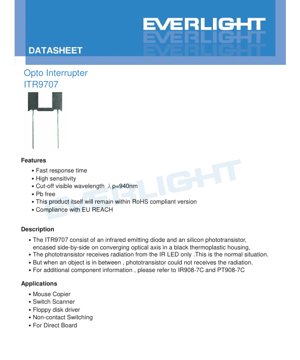
1. उत्पाद अवलोकन
ITR9707 एक कॉम्पैक्ट ऑप्टो इंटरप्टर मॉड्यूल है, जिसे फोटो इंटरप्टर या स्लॉट सेंसर के रूप में भी जाना जाता है। यह एक ही काले थर्मोप्लास्टिक आवास के भीतर एक इन्फ्रारेड एमिटिंग डायोड (IRED) और एक सिलिकॉन फोटोट्रांजिस्टर को एकीकृत करता है। घटकों को अभिसारी प्रकाशीय अक्षों पर साथ-साथ रखा गया है। मूलभूत संचालन सिद्धांत एक इन्फ्रारेड प्रकाश किरण के अवरोधन पर आधारित है। अपनी सामान्य अवस्था में, फोटोट्रांजिस्टर सह-स्थित IR LED द्वारा उत्सर्जित विकिरण प्राप्त करता है। जब एक अपारदर्शी वस्तु एमिटर और डिटेक्टर के बीच के स्लॉट से गुजरती है, तो प्रकाश मार्ग अवरुद्ध हो जाता है, जिससे फोटोट्रांजिस्टर का आउटपुट अवस्था परिवर्तित हो जाता है। यह किसी वस्तु की उपस्थिति, अनुपस्थिति या स्थिति का पता लगाने के लिए एक विश्वसनीय, गैर-संपर्क विधि प्रदान करता है।
1.1 मुख्य विशेषताएं और लाभ
- तीव्र प्रतिक्रिया समय: 15 माइक्रोसेकंड के विशिष्ट उदय और पतन समय के साथ उच्च-गति घटनाओं का पता लगाने में सक्षम बनाता है।
- उच्च संवेदनशीलता: सिलिकॉन फोटोट्रांजिस्टर अवरक्त प्रकाश के प्रबल विद्युतीय प्रतिक्रिया प्रदान करता है।
- विशिष्ट तरंगदैर्ध्य: 940nm शिखर उत्सर्जन तरंगदैर्ध्य (λp) वाला एक IR LED का उपयोग करता है, जो दृश्यमान स्पेक्ट्रम से बाहर है, जिससे परिवेशी प्रकाश से हस्तक्षेप कम होता है।
- पर्यावरण अनुपालन: यह उत्पाद सीसा-मुक्त है, RoHS निर्देश का अनुपालन करता है, और EU REACH विनियमों का पालन करता है।
1.2 लक्षित अनुप्रयोग
यह उपकरण विभिन्न गैर-संपर्क संवेदन और स्विचिंग अनुप्रयोगों के लिए डिज़ाइन किया गया है, जिनमें शामिल हैं लेकिन इन्हीं तक सीमित नहीं: कंप्यूटर माउस और कॉपियर में स्थिति संवेदन, स्कैनर और फ्लॉपी डिस्क ड्राइव में किनारा पहचान, सामान्य-उद्देश्य गैर-संपर्क स्विचिंग, और विभिन्न इलेक्ट्रॉनिक असेंबली में सीधे बोर्ड माउंटिंग।
2. तकनीकी विशिष्टताएँ और गहन व्याख्या
2.1 Absolute Maximum Ratings
ये रेटिंग्स उन सीमाओं को परिभाषित करती हैं जिनके परे डिवाइस को स्थायी क्षति हो सकती है। इन स्थितियों में संचालन की गारंटी नहीं है।
- इनपुट (IR LED): अधिकतम निरंतर अग्र धारा (IF) 50 mA है। अधिकतम विपरीत वोल्टेज (VR) 5 V है। 25°C या उससे कम मुक्त वायु तापमान पर शक्ति क्षय (Pd) 75 mW है।
- आउटपुट (Phototransistor): अधिकतम कलेक्टर धारा (IC) 20 mA है। कलेक्टर-एमिटर ब्रेकडाउन वोल्टेज (BVCEO) 30 V है। शक्ति अपव्यय (Pd) 75 mW है।
- थर्मल: कार्यशील तापमान सीमा (Topr) -25°C से +85°C है। भंडारण तापमान सीमा (Tstg) -40°C से +85°C है।
- सोल्डरिंग: लीड सोल्डरिंग तापमान (Tsol) पैकेज बॉडी से 3mm दूरी पर मापे जाने पर 5 सेकंड या उससे कम समय के लिए 260°C से अधिक नहीं होना चाहिए।
2.2 Electro-Optical Characteristics
ये Ta=25°C पर मापे गए विशिष्ट प्रदर्शन पैरामीटर हैं, जो डिवाइस के संचालन व्यवहार को परिभाषित करते हैं।
- इनपुट विशेषताएँ: IR LED का फॉरवर्ड वोल्टेज (VF) 20mA की ड्राइव करंट (IF) पर आम तौर पर 1.2V होता है, जिसकी अधिकतम सीमा 1.5V है। रिवर्स करंट (IR) VR=5V पर अधिकतम 10 µA होता है।
- आउटपुट विशेषताएँ: कलेक्टर डार्क करंट (ICEO), जो बिना प्रकाश के लीकेज करंट है, VCE=20V पर अधिकतम 100 nA है। कलेक्टर-एमिटर संतृप्ति वोल्टेज (VCE(sat)) अधिकतम 0.4V है जब फोटोट्रांजिस्टर संतृप्ति में चलाया जाता है (IC=2mA, Ee=1mW/cm²)।
- ट्रांसफर विशेषताएँ: यह इनपुट और आउटपुट के बीच संबंध को परिभाषित करता है। जब आईआर एलईडी को IF=20mA से संचालित किया जाता है और फोटोट्रांजिस्टर को VCE=5V से बायस किया जाता है, तो ऑन-स्टेट कलेक्टर करंट (IC(on)) कम से कम 0.5mA होने की गारंटी है। यह पैरामीटर, जिसे करंट ट्रांसफर रेशियो (CTR) के रूप में जाना जाता है, इंटरफेस सर्किट डिजाइन करने के लिए महत्वपूर्ण है।
- डायनामिक रिस्पॉन्स: निर्दिष्ट परीक्षण स्थितियों (VCE=5V, IC=1mA, RL=1kΩ) के तहत राइज टाइम (tr) और फॉल टाइम (tf) दोनों आम तौर पर 15 µs होते हैं। यह अधिकतम स्विचिंग फ्रीक्वेंसी निर्धारित करता है।
3. Performance Curve Analysis
3.1 IR LED Characteristics
The datasheet provides typical curves for the infrared emitter component. The Forward Current vs. Ambient Temperature ग्राफ दर्शाता है कि कैसे अधिकतम अनुमेय फॉरवर्ड करंट, परिवेश के तापमान के 25°C से अधिक बढ़ने पर कम होता है, जो थर्मल प्रबंधन के लिए महत्वपूर्ण है। Forward Current vs. Forward Voltage वक्र डायोड की IV विशेषता को दर्शाता है, जो करंट-सीमित रोकनेवाला (रजिस्टर) चुनने के लिए आवश्यक है। Spectral Sensitivity प्लॉट 940nm पर शिखर उत्सर्जन और उत्सर्जन बैंड की चौड़ाई की पुष्टि करता है।
3.2 Phototransistor Characteristics
The Spectral Sensitivity फोटोट्रांजिस्टर का वक्र विभिन्न तरंगदैर्ध्य पर इसकी प्रतिसादशीलता दर्शाता है। यह निकट-अवरक्त क्षेत्र में चरम पर होता है, जो युग्मित IR LED के 940nm आउटपुट से निकटता से मेल खाता है। यह वर्णक्रमीय मिलान संवेदनशीलता को अधिकतम करता है और अवांछित परिवेशी प्रकाश स्रोतों के प्रति प्रतिक्रिया को न्यूनतम करता है।
4. Mechanical and Package Information
4.1 Package Dimensions
ITR9707 एक मानक, कॉम्पैक्ट पैकेज में रखा गया है। मुख्य आयामों में लगभग 7.0 मिमी की समग्र बॉडी चौड़ाई, 4.0 मिमी की ऊंचाई और 3.0 मिमी की गहराई शामिल है। स्लॉट गैप चौड़ाई, जो पता लगाए जा सकने वाली वस्तु के आकार को निर्धारित करती है, एक महत्वपूर्ण आयाम है। लीड स्पेसिंग थ्रू-होल PCB माउंटिंग के लिए मानकीकृत है। जब तक अन्यथा निर्दिष्ट न हो, सभी आयामी सहनशीलताएं आम तौर पर ±0.3 मिमी होती हैं।
4.2 ध्रुवीयता पहचान और माउंटिंग
घटक में एक मानक पिनआउट होता है जहां आईआर एलईडी का एनोड और कैथोड एक तरफ होते हैं, और फोटोट्रांजिस्टर का एमिटर और कलेक्टर दूसरी तरफ होते हैं। काला आवरण और विशिष्ट लीड लंबाई या पैकेज चिह्न आमतौर पर अभिविन्यास दर्शाते हैं। पीसीबी लेआउट और असेंबली के दौरान सही पोलैरिटी का पालन किया जाना चाहिए।
5. सोल्डरिंग और असेंबली दिशानिर्देश
5.1 लीड फॉर्मिंग सावधानियां
यदि माउंटिंग के लिए लीड को मोड़ने की आवश्यकता हो, तो यह कार्य पहले सोल्डरिंग से किया जाना चाहिए। एपॉक्सी पैकेज बॉडी के आधार से 3 मिमी से कम दूरी पर मोड़ नहीं किया जाना चाहिए, ताकि आवास में दरार या आंतरिक डाई को क्षति पहुँचाने वाले तनाव के संचरण से बचा जा सके। मोड़ते समय लीड को सुरक्षित रखा जाना चाहिए, और यह ऑपरेशन कमरे के तापमान पर किया जाना चाहिए।
5.2 अनुशंसित सोल्डरिंग पैरामीटर्स
- हैंड सोल्डरिंग: आयरन टिप का तापमान 300°C से अधिक नहीं होना चाहिए (30W आयरन के लिए अधिकतम)। प्रति लीड सोल्डरिंग समय 3 सेकंड या उससे कम होना चाहिए। सोल्डर जोड़ एपॉक्सी बल्ब से कम से कम 3mm दूर होना चाहिए।
- Wave/Dip Soldering: प्रीहीट तापमान 60 सेकंड तक के लिए अधिकतम 100°C होना चाहिए। सोल्डर बाथ का तापमान 260°C से अधिक नहीं होना चाहिए, और वेव में निवास समय 5 सेकंड या उससे कम होना चाहिए। फिर से, पैकेज से न्यूनतम 3mm की दूरी बनाए रखें।
एक सोल्डरिंग तापमान प्रोफ़ाइल की सिफारिश की जाती है, जो थर्मल शॉक को रोकने के लिए नियंत्रित रैंप-अप, एक पीक तापमान पठार और नियंत्रित कूलडाउन पर जोर देती है।
5.3 सोल्डरिंग के बाद की प्रक्रिया
सोल्डरिंग के बाद डिवाइस के गर्म रहने पर उस पर यांत्रिक दबाव या कंपन न डालें। इसे कमरे के तापमान पर प्राकृतिक रूप से ठंडा होने दें। डिप या हैंड सोल्डरिंग एक से अधिक बार न दोहराएं। इस डिवाइस के लिए अल्ट्रासोनिक सफाई की अनुशंसा नहीं की जाती है।
6. भंडारण और प्रबंधन
शिपमेंट से मानक 3-महीने के शेल्फ लाइफ से अधिक लंबी अवधि के भंडारण के लिए, उपकरणों को 10°C~25°C और 20%~60% सापेक्ष आर्द्रता पर नाइट्रोजन वातावरण वाले सीलबंद कंटेनर में रखा जाना चाहिए। नमी-संवेदनशील पैकेजिंग खोलने के बाद, घटकों का उपयोग 24 घंटे के भीतर या जितनी जल्दी हो सके किया जाना चाहिए। संक्षेपण को रोकने के लिए उच्च-आर्द्रता वाले वातावरण में तापमान में तेजी से बदलाव से बचना चाहिए, जो बाद की सोल्डरिंग के दौरान जंग या अन्य क्षति का कारण बन सकता है।
7. पैकेजिंग और ऑर्डरिंग जानकारी
मानक पैकेजिंग विन्यास प्रति ट्यूब 78 टुकड़े है। बयालीस ट्यूब एक बॉक्स में पैक किए जाते हैं, और चार बॉक्स एक मास्टर कार्टन में पैक किए जाते हैं। पैकेजिंग पर लेबल में ट्रेसबिलिटी के लिए ग्राहक पार्ट नंबर (CPN), निर्माता पार्ट नंबर (P/N), मात्रा (QTY), संदर्भ पदनाम (REF), और लॉट नंबर (LOT No) के लिए फ़ील्ड शामिल हैं।
8. एप्लिकेशन डिज़ाइन विचार
8.1 टिपिकल सर्किट कॉन्फ़िगरेशन
एक सामान्य अनुप्रयोग सर्किट में IR LED एनोड के साथ श्रृंखला में एक करंट-लिमिटिंग रेसिस्टर शामिल होता है। इसका मान सप्लाई वोल्टेज (Vcc), LED का फॉरवर्ड वोल्टेज (VF ~1.2V), और वांछित फॉरवर्ड करंट (IF, उदाहरण के लिए, 20mA) के आधार पर गणना की जाती है। फोटोट्रांजिस्टर का उपयोग आमतौर पर स्विच मोड में किया जाता है, इसे एक पुल-डाउन डिवाइस के रूप में जोड़ा जाता है जिसका कलेक्टर Vcc से (यदि आवश्यक हो तो एक पुल-अप रेसिस्टर के माध्यम से) और इसका एमिटर ग्राउंड से जुड़ा होता है। कलेक्टर नोड पर वोल्टेज कम होगा जब बीम अबाधित हो (ट्रांजिस्टर ON) और उच्च होगा जब बीम अवरुद्ध हो (ट्रांजिस्टर OFF)।
8.2 Design Factors
- वस्तु पहचान: यह उपकरण स्लॉट के भीतर अवरक्त किरण को पूरी तरह से बाधित करने वाले अपारदर्शी वस्तुओं का पता लगाता है। परावर्तक या पारभासी सामग्री एक विश्वसनीय स्थिति परिवर्तन को ट्रिगर नहीं कर सकती है।
- परिवेश प्रकाश प्रतिरक्षा: 940nm तरंगदैर्ध्य और मेल खाती वर्णक्रमीय प्रतिक्रिया सामान्य दृश्यमान परिवेशी प्रकाश को प्रभावी रूप से दूर रखती है। हालाँकि, अवरक्त प्रकाश के प्रबल स्रोत (जैसे सूर्य का प्रकाश, तापदीप्त बल्ब) संभावित रूप से हस्तक्षेप उत्पन्न कर सकते हैं और गंभीर अनुप्रयोगों के लिए प्रकाशीय परिरक्षण या मॉड्यूलेशन/डीमॉड्यूलेशन तकनीकों की आवश्यकता हो सकती है।
- प्रतिक्रिया गति: 15 µs की प्रतिक्रिया अवधि अपेक्षाकृत उच्च गति से चलती वस्तुओं का पता लगाने की अनुमति देती है, जो एनकोडर और गति सेंसर के लिए उपयुक्त है।
- संरेखण: अंतर्निहित अभिसारी प्रकाशिकी संरेखण को सरल बनाती है, लेकिन PCB को इस तरह डिज़ाइन किया जाना चाहिए कि लीड्स बिना किसी तनाव के डाली जा सकें, और स्लॉट अवरोधित न रहे।
9. तकनीकी तुलना और पोजिशनिंग
ITR9707 थ्रू-होल माउंटिंग के लिए एक मानक, लागत-प्रभावी समाधान का प्रतिनिधित्व करता है। इसके मुख्य अंतर इसकी विशिष्ट 940nm तरंगदैर्ध्य, जो एक सामान्य उद्योग मानक है, और इसके मजबूत निर्माण हैं। परावर्तक सेंसरों की तुलना में, इंटरप्टर अधिक विश्वसनीय और सुसंगत पहचान प्रदान करते हैं क्योंकि वे लक्ष्य सतह की परावर्तकता में भिन्नता के प्रति कम संवेदनशील होते हैं। आधुनिक सतह-माउंट उपकरणों की तुलना में, थ्रू-होल पैकेज कंपन वाले अनुप्रयोगों में या जहां मैनुअल असेंबली का उपयोग किया जाता है, वहां यांत्रिक मजबूती प्रदान करता है।
10. अक्सर पूछे जाने वाले प्रश्न (FAQ)
प्र: सामान्य संचालन दूरी या अंतर क्या है?
A: ऑपरेटिंग "गैप" पैकेज के भीतर एक भौतिक स्लॉट है। डिवाइस किसी भी अपारदर्शी वस्तु का पता लगाता है जो इस आंतरिक स्लॉट में प्रवेश करती है और उसे अवरुद्ध करती है। इसका उपयोग पैकेज के बाहर दूरी पर वस्तुओं का पता लगाने के लिए नहीं किया जाता है।
Q: क्या मैं IR LED को सीधे वोल्टेज स्रोत से चला सकता हूँ?
A: नहीं। LED एक करंट-ड्रिवन डिवाइस है। एक श्रृंखला करंट-लिमिटिंग रेसिस्टर अनिवार्य है ताकि अत्यधिक करंट को रोका जा सके जो LED को नष्ट कर देगा, भले ही आपूर्ति वोल्टेज कम लगता हो।
Q: IC(on) के न्यूनतम मान 0.5mA की व्याख्या कैसे करूँ?
A> This is the guaranteed minimum output current when the input is driven under standard test conditions (IF=20mA, VCE=5V). Your circuit design should function correctly even if the actual device is at this minimum specification, ensuring robustness over production variations.
Q: क्या यह सेंसर सूर्य के प्रकाश से प्रतिरक्षित है?
A> While the 940nm filter helps, direct sunlight contains a significant amount of infrared radiation and can saturate the sensor. For outdoor use or in very bright indoor environments, additional optical shielding or electronic filtering (e.g., modulated light) is recommended.
11. व्यावहारिक अनुप्रयोग उदाहरण
Example 1: Paper Jam Detection in a Printer. इंटरप्टर इस प्रकार लगाया जाता है कि एक पेपर फ्लैग या स्वयं कागज उसके स्लॉट से गुजरे। जब कागज मौजूद होता है, तो बीम अवरुद्ध हो जाता है और फोटोट्रांजिस्टर बंद हो जाता है। पेपर जैम या कागज खत्म होने की स्थिति (कोई अवरोध नहीं) ट्रांजिस्टर को चालू कर देती है, जो माइक्रोकंट्रोलर को संकेत देती है।
उदाहरण 2: मोटर गति के लिए रोटरी एनकोडर। मोटर शाफ्ट से जुड़ा एक स्लॉटेड डिस्क इंटरप्टर की भुजाओं के बीच घूमता है। प्रत्येक स्लॉट के गुजरने पर, बीम को बारी-बारी से बाधित किया जाता है और गुजरने दिया जाता है, जिससे एक वर्गाकार तरंग पल्स ट्रेन उत्पन्न होती है। इस सिग्नल की आवृत्ति मोटर की घूर्णन गति के सीधे अनुपात में होती है।
12. कार्य सिद्धांत
ITR9707 प्रेषित प्रकाश अवरोध के सिद्धांत पर कार्य करता है। एक अवरक्त प्रकाश किरण GaAlAs LED द्वारा उत्पन्न की जाती है। यह किरण डिवाइस के आवास के भीतर एक छोटे वायु अंतराल को पार करती है और सिलिकॉन NPN फोटोट्रांजिस्टर के संवेदनशील क्षेत्र पर केंद्रित होती है। फोटोट्रांजिस्टर एक धारा स्रोत के रूप में कार्य करता है; आपतित फोटॉन इसके बेस क्षेत्र में इलेक्ट्रॉन-होल युग्म उत्पन्न करते हैं, जिससे एक बेस करंट प्रेरित होता है जिसे ट्रांजिस्टर के लाभ द्वारा प्रवर्धित किया जाता है, जिसके परिणामस्वरूप बहुत बड़ा कलेक्टर करंट उत्पन्न होता है। जब कोई वस्तु किरण को अवरुद्ध करती है, तो फोटॉन फ्लक्स शून्य हो जाता है, बेस करंट बंद हो जाता है, और कलेक्टर करंट इसकी बहुत कम डार्क करंट स्तर तक गिर जाता है। आउटपुट करंट में इस तीव्र परिवर्तन का उपयोग वस्तु की उपस्थिति को इंगित करने वाले डिजिटल सिग्नल के रूप में किया जाता है।
13. Technology Trends
ऑप्टो इंटरप्टर स्थिति और गति संवेदन में मूलभूत घटक बने हुए हैं। वर्तमान रुझानों में स्वचालित असेंबली के लिए सरफेस-माउंट डिवाइस (एसएमडी) संस्करणों का विकास शामिल है, जो छोटे फुटप्रिंट और कम प्रोफाइल प्रदान करते हैं। ऑन-चिप अतिरिक्त सर्किट्री को एकीकृत करने की ओर भी एक बढ़त है, जैसे कि हिस्टैरिसीस के साथ डिजिटल आउटपुट के लिए श्मिट ट्रिगर, एनालॉग आउटपुट के लिए एम्पलीफायर, या यहां तक कि पूर्ण एनकोडर लॉजिक। इसके अलावा, पैकेजिंग सामग्रियों में प्रगति का उद्देश्य थर्मल प्रदर्शन और बोर्ड-वाशिंग प्रक्रियाओं के प्रति प्रतिरोध में सुधार करना है। हालांकि, ऑप्टिकल इंटरप्शन का मूल सिद्धांत अपनी सरलता, विश्वसनीयता और गैर-संपर्क प्रकृति के लिए मूल्यवान बना हुआ है।
LED Specification Terminology
LED तकनीकी शब्दों की पूर्ण व्याख्या
प्रकाशविद्युत प्रदर्शन
| शब्द | इकाई/प्रतिनिधित्व | सरल व्याख्या | महत्वपूर्ण क्यों |
|---|---|---|---|
| दीप्त प्रभावकारिता | lm/W (लुमेन प्रति वाट) | प्रति वाट बिजली से प्रकाश उत्पादन, अधिक होने का अर्थ है अधिक ऊर्जा कुशल। | सीधे ऊर्जा दक्षता ग्रेड और बिजली लागत निर्धारित करता है। |
| Luminous Flux | lm (लुमेन) | स्रोत द्वारा उत्सर्जित कुल प्रकाश, जिसे आमतौर पर "चमक" कहा जाता है। | प्रकाश पर्याप्त चमकीला है या नहीं, यह निर्धारित करता है। |
| Viewing Angle | ° (degrees), e.g., 120° | वह कोण जहाँ प्रकाश की तीव्रता आधी रह जाती है, यह बीम की चौड़ाई निर्धारित करता है। | प्रकाशन सीमा और एकरूपता को प्रभावित करता है। |
| CCT (रंग तापमान) | K (केल्विन), उदाहरणार्थ, 2700K/6500K | प्रकाश की गर्माहट/ठंडक, कम मान पीलेपन/गर्माहट, अधिक मान सफेदी/ठंडक दर्शाते हैं। | प्रकाश व्यवस्था का वातावरण और उपयुक्त परिदृश्य निर्धारित करता है। |
| CRI / Ra | इकाईहीन, 0–100 | वस्तुओं के रंगों को सटीकता से प्रस्तुत करने की क्षमता, Ra≥80 अच्छा माना जाता है। | रंग की प्रामाणिकता को प्रभावित करता है, मॉल, संग्रहालय जैसे उच्च मांग वाले स्थानों में प्रयुक्त। |
| SDCM | मैकएडम दीर्घवृत्त चरण, उदाहरण के लिए, "5-चरण" | रंग स्थिरता मापदंड, छोटे चरण अधिक सुसंगत रंग का संकेत देते हैं। | एलईडी के समान बैच में एकसमान रंग सुनिश्चित करता है। |
| Dominant Wavelength | nm (नैनोमीटर), उदाहरणार्थ, 620nm (लाल) | रंगीन एलईडी के रंग के अनुरूप तरंगदैर्ध्य। | लाल, पीले, हरे मोनोक्रोम LED के रंग का स्वर निर्धारित करता है। |
| Spectral Distribution | Wavelength vs intensity curve | Shows intensity distribution across wavelengths. | Affects color rendering and quality. |
विद्युत मापदंड
| शब्द | प्रतीक | सरल व्याख्या | डिज़ाइन संबंधी विचार |
|---|---|---|---|
| फॉरवर्ड वोल्टेज | Vf | एलईडी चालू करने के लिए न्यूनतम वोल्टेज, जैसे "प्रारंभिक सीमा"। | ड्राइवर वोल्टेज ≥Vf होना चाहिए, श्रृंखला एलईडी के लिए वोल्टेज जुड़ते हैं। |
| फॉरवर्ड करंट | If | सामान्य LED संचालन के लिए करंट मान। | Usually constant current drive, current determines brightness & lifespan. |
| अधिकतम पल्स धारा | Ifp | कम समय के लिए सहन करने योग्य शिखर धारा, जो मंद या चमकने के लिए उपयोग की जाती है। | Pulse width & duty cycle must be strictly controlled to avoid damage. |
| Reverse Voltage | Vr | Max reverse voltage LED can withstand, beyond may cause breakdown. | सर्किट को रिवर्स कनेक्शन या वोल्टेज स्पाइक्स को रोकना चाहिए। |
| Thermal Resistance | Rth (°C/W) | चिप से सोल्डर तक ऊष्मा स्थानांतरण के लिए प्रतिरोध, कम होना बेहतर है। | उच्च तापीय प्रतिरोध के लिए मजबूत ऊष्मा अपव्यय की आवश्यकता होती है। |
| ESD Immunity | V (HBM), e.g., 1000V | इलेक्ट्रोस्टैटिक डिस्चार्ज को सहन करने की क्षमता, उच्च मान कम संवेदनशीलता दर्शाता है। | उत्पादन में एंटी-स्टैटिक उपाय आवश्यक हैं, विशेष रूप से संवेदनशील एलईडी के लिए। |
Thermal Management & Reliability
| शब्द | प्रमुख मापदंड | सरल व्याख्या | प्रभाव |
|---|---|---|---|
| जंक्शन तापमान | Tj (°C) | एलईडी चिप के अंदर का वास्तविक संचालन तापमान। | हर 10°C कमी जीवनकाल को दोगुना कर सकती है; बहुत अधिक तापमान प्रकाश क्षय, रंग परिवर्तन का कारण बनता है। |
| Lumen Depreciation | L70 / L80 (घंटे) | प्रारंभिक चमक के 70% या 80% तक गिरने में लगने वाला समय। | सीधे तौर पर LED की "सेवा जीवन" को परिभाषित करता है। |
| लुमेन रखरखाव | % (उदाहरण के लिए, 70%) | समय के बाद बची हुई चमक का प्रतिशत। | दीर्घकालिक उपयोग में चमक की स्थिरता को दर्शाता है। |
| Color Shift | Δu′v′ या मैकएडम दीर्घवृत्त | उपयोग के दौरान रंग परिवर्तन की डिग्री। | प्रकाश दृश्यों में रंग स्थिरता को प्रभावित करता है। |
| Thermal Aging | सामग्री अवक्रमण | दीर्घकालिक उच्च तापमान के कारण ह्रास। | इससे चमक में कमी, रंग परिवर्तन, या ओपन-सर्किट विफलता हो सकती है। |
Packaging & Materials
| शब्द | सामान्य प्रकार | सरल व्याख्या | Features & Applications |
|---|---|---|---|
| पैकेज प्रकार | EMC, PPA, Ceramic | हाउसिंग सामग्री चिप की सुरक्षा करती है, ऑप्टिकल/थर्मल इंटरफेस प्रदान करती है। | EMC: अच्छी हीट रेजिस्टेंस, कम लागत; Ceramic: बेहतर हीट डिसिपेशन, लंबी लाइफ। |
| Chip Structure | फ्रंट, फ्लिप चिप | चिप इलेक्ट्रोड व्यवस्था। | फ्लिप चिप: बेहतर ताप अपव्यय, उच्च प्रभावकारिता, उच्च-शक्ति के लिए। |
| फॉस्फर कोटिंग | YAG, Silicate, Nitride | नीले चिप को कवर करता है, कुछ को पीले/लाल में बदलता है, सफेद में मिलाता है। | विभिन्न फॉस्फर प्रभावकारिता, CCT, और CRI को प्रभावित करते हैं। |
| लेंस/ऑप्टिक्स | फ्लैट, माइक्रोलेंस, TIR | सतह पर प्रकाश वितरण को नियंत्रित करने वाली प्रकाशीय संरचना। | दृश्य कोण और प्रकाश वितरण वक्र निर्धारित करता है। |
Quality Control & Binning
| शब्द | बिनिंग सामग्री | सरल व्याख्या | उद्देश्य |
|---|---|---|---|
| Luminous Flux Bin | कोड उदाहरण के लिए, 2G, 2H | चमक के आधार पर समूहीकृत, प्रत्येक समूह के न्यूनतम/अधिकतम लुमेन मान होते हैं। | एक ही बैच में समान चमक सुनिश्चित करता है। |
| Voltage Bin | Code e.g., 6W, 6X | Forward voltage range ke anusaar vargikrit. | Driver matching ko sahaj banata hai, system efficiency ko sudhaarta hai. |
| Color Bin | 5-step MacAdam ellipse | रंग निर्देशांकों के आधार पर समूहीकृत, सुनिश्चित करता है कि सीमा सघन हो। | रंग स्थिरता की गारंटी देता है, फिक्स्चर के भीतर असमान रंग से बचाता है। |
| CCT Bin | 2700K, 3000K आदि। | CCT के अनुसार समूहीकृत, प्रत्येक की अपनी संबंधित निर्देशांक सीमा है। | विभिन्न दृश्य CCT आवश्यकताओं को पूरा करता है। |
Testing & Certification
| शब्द | Standard/Test | सरल व्याख्या | महत्त्व |
|---|---|---|---|
| LM-80 | लुमेन रखरखाव परीक्षण | निरंतर तापमान पर दीर्घकालिक प्रकाश व्यवस्था, चमक क्षय रिकॉर्ड करना। | LED जीवन का अनुमान लगाने के लिए उपयोग किया जाता है (TM-21 के साथ)। |
| TM-21 | जीवन अनुमान मानक | LM-80 डेटा के आधार पर वास्तविक परिस्थितियों में जीवन का अनुमान लगाता है। | वैज्ञानिक जीवन पूर्वानुमान प्रदान करता है। |
| IESNA | Illuminating Engineering Society | प्रकाशिक, विद्युत, तापीय परीक्षण विधियों को शामिल करता है। | उद्योग-मान्यता प्राप्त परीक्षण आधार। |
| RoHS / REACH | पर्यावरण प्रमाणन | हानिकारक पदार्थों (सीसा, पारा) की अनुपस्थिति सुनिश्चित करता है। | अंतरराष्ट्रीय स्तर पर बाजार पहुंच की आवश्यकता। |
| ENERGY STAR / DLC | ऊर्जा दक्षता प्रमाणन | प्रकाश व्यवस्था के लिए ऊर्जा दक्षता और प्रदर्शन प्रमाणन। | सरकारी खरीद, सब्सिडी कार्यक्रमों में प्रयुक्त, प्रतिस्पर्धात्मकता बढ़ाता है। |