Table of Contents
- 1. Mchakato wa Bidhaa
- 1.1 Faida Kuu
- 1.2 Soko Lengwa na Matumizi
- 2. Uchambuzi wa Kina wa Vigezo vya Kiufundi
- 2.1 Viwango vya Juu Kabisa
- 2.2 Electro-Optical Characteristics
- 2.3 Thermal Characteristics
- 3. Maelezo ya Mfumo wa Binning
- 4. Uchambuzi wa Mkunjo wa Utendaji
- 4.1 Mkondo wa Mbele dhidi ya Joto la Mazingira
- 4.2 Usambazaji wa Wigo
- 4.3 Urefu wa Kilele cha Mionzi dhidi ya Joto la Mazingira
- 4.4 Forward Current vs. Forward Voltage (IV Curve)
- 4.5 Radiant Intensity vs. Forward Current
- 4.6 Relative Radiant Intensity vs. Angular Displacement
- 5. Mechanical and Package Information
- 5.1 Package Dimensions
- 5.2 Polarity Identification
- 6. Soldering and Assembly Guidelines
- 6.1 Uundaji wa Pini
- 6.2 Hali ya Uhifadhi
- 6.3 Vigezo vya Kuuza
- 6.4 Usafishaji
- 7. Habari za Ufungaji na Maagizo
- 7.1 Uainishaji wa Ufungaji
- 7.2 Uainishaji wa Fomu ya Lebo
- 8. Mambo ya Kuzingatia katika Ubunifu wa Programu
- 8.1 Saketi za Kawaida za Programu
- 8.2 Vidokezo vya Ubunifu wa Mwanga
- 8.3 Usimamizi wa Joto
- 9. Ulinganisho wa Kiufundi na Utofautishaji
- 10. Maswali Yanayoulizwa Mara Kwa Mara (FAQ)
- 11. Utafiti wa Kesi za Usanifu na Matumizi
- 12. Kanuni ya Uendeshaji
- 13. Mielekeo ya Teknolojia
1. Mchakato wa Bidhaa
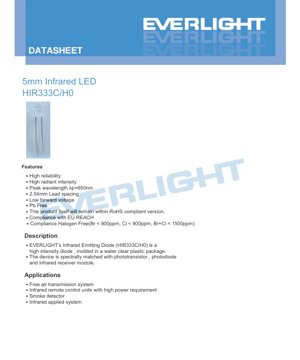
Waraka huu unaelezea kwa kina vipimo vya diode inayotoa mwanga wa infrared (IR) yenye kipenyo cha 5.0mm (T-1 3/4) inayopitishwa kwenye tundu. Kifaa hiki kimeundwa kutokeza mwanga wenye urefu wa wimbi la kilele la 850nm, na kukifanya kifaa kinachofaa kwa matumizi mbalimbali ya kuhisi na usambazaji wa infrared. Kimewekwa kwenye mfuko wa plastiki ulio wazi kama maji, ambao huruhusu utoaji wa juu wa mnururisho.
1.1 Faida Kuu
The primary advantages of this component include its high reliability and ukali wa juu wa mnururisho. It features a voltage ya chini ya mbele, which contributes to energy efficiency in circuit designs. The device is constructed using lead-free materials and complies with major environmental and safety regulations, including RoHS, EU REACH, and halogen-free standards (Br < 900ppm, Cl < 900ppm, Br+Cl < 1500ppm).
1.2 Soko Lengwa na Matumizi
This infrared LED is spectrally matched with common silicon phototransistors, photodiodes, and infrared receiver modules. Its typical applications include:
- Free-air transmission systems for data communication.
- Infrared remote control units requiring higher power output.
- Smoke detection systems.
- General infrared applied systems for sensing and detection.
2. Uchambuzi wa Kina wa Vigezo vya Kiufundi
Sehemu zifuatazo zinatoa muhtasari wa kina wa sifa za kielektroniki, za kuona na za joto za kifaa.
2.1 Viwango vya Juu Kabisa
Viwango hivi vinabainisha mipaka ambayo kuzidi kwao kunaweza kusababisha uharibifu wa kudumu kwa kifaa. Hazikusudiwa kwa utendakazi endelevu.
- Mvutano wa Mbele Endelevu (IF): 100 mA
- Peak Forward Current (IFP): 1.0 A (Pulse Width ≤100μs, Duty Cycle ≤1%)
- Reverse Voltage (VR): 5 V
- Operating Temperature (Topr): -40°C to +85°C
- Joto la Uhifadhi (Tstg): -40°C to +85°C
- Joto la Kuuza (Tsol): 260°C for ≤5 seconds
- Power Dissipation (Pd) at 25°C: 150 mW
2.2 Electro-Optical Characteristics
Vigezo hivi vinapimwa kwa joto la mazingira (Ta) la 25°C na vinabainisha utendaji wa kawaida wa kifaa chini ya hali maalum.
- Radiant Intensity (Ie): Thamani ya chini ya kawaida ni 7.8 mW/sr kwa mkondo wa mbele (IF) wa 20mA. Chini ya hali ya mipigo (IF=100mA, Pulse Width ≤100μs, Duty ≤1%), Radiant Intensity ya kawaida ni 80 mW/sr. Kwenye mkondo wa kilele cha 1A chini ya hali ile ile ya mipigo, inafikia 800 mW/sr.
- Peak Wavelength (λp): 850 nm (typical) at IF=20mA.
- Spectral Bandwidth (Δλ): 45 nm (kawaida) kwa IF=20mA, inayoonyesha upana wa wigo kwa nusu ya ukubwa wa juu.
- Voltage ya Mbele (VF): Inaanzia 1.45V (kawaida) hadi kiwango cha juu cha 1.65V kwa IF=20mA. Inaongezeka kwa mkondo wa juu zaidi, ikifikia kiwango cha juu cha 2.40V kwa 100mA na 5.25V kwa 1A chini ya uendeshaji wa mfululizo.
- Mkondo wa Nyuma (IR): Maximum of 10 μA at VR=5V.
- View Angle (2θ1/2): 30 degrees (typical) at IF=20mA, defining the angular spread where the radiant intensity is at least half of its peak value.
2.3 Thermal Characteristics
Utendaji wa kifaa unategemea joto. Uvujaji wa juu zaidi wa nguvu umekadiriwa kuwa 150 mW katika hewa huria kwenye 25°C. Wabunifu lazima wazingatie kupunguza thamani hii wakati wa kufanya kazi katika halijoto ya mazingira ya juu ili kuhakikisha uimara wa muda mrefu na kuzuia kukimbia kwa joto.
3. Maelezo ya Mfumo wa Binning
Bidhaa inapatikana katika viwango tofauti vya utendaji, au "bins," kulingana na ukubwa wa mnururisho uliopimwa kwa IF=20mA. Hii inawawezesha wabunifu kuchagua sehemu inayolingana kwa usahihi na mahitaji ya unyeti ya programu yao.
Muundo wa binning kwa ukubwa wa mnururisho ni kama ifuatavyo:
- Bin M: 7.8 - 12.5 mW/sr
- Bin N: 11.0 - 17.6 mW/sr
- Bin P: 15.0 - 24.0 mW/sr
- Bin Q: 21.0 - 34.0 mW/sr
- Bin R: 30.0 - 48.0 mW/sr
The datasheet also indicates that the device is available with ranks for Dominant Wavelength (HUE) and Forward Voltage (REF), though specific bin codes for these parameters are not detailed in the provided excerpt.
4. Uchambuzi wa Mkunjo wa Utendaji
Graphical data provides deeper insight into the device's behavior under varying conditions.
4.1 Mkondo wa Mbele dhidi ya Joto la Mazingira
Mkunjo huu unaonyesha kupunguzwa kwa upeo wa sasa wa mbele unaoruhusiwa kadri joto la mazingira linavyoongezeka zaidi ya 25°C. Ili kudumisha uaminifu, sasa wa uendeshaji lazima upunguzwe kwenye hali za joto la juu.
4.2 Usambazaji wa Wigo
Grafu inaonyesha pato la nguvu ya mionzi inayohusiana katika wigo wa urefu wa wimbi, ikilenga kilele cha 850nm. Upana wa wigo wa 45nm unaonyesha anuwai ya urefu wa mawimbi yanayotolewa.
4.3 Urefu wa Kilele cha Mionzi dhidi ya Joto la Mazingira
Uhusiano huu unaonyesha jinsi urefu wa wimbi la kilele (λp) unavyobadilika na mabadiliko ya joto la makutano. Kwa kawaida, urefu wa wimbi huongezeka kidogo kwa joto linalopanda, ambalo ni jambo muhimu katika matumizi yanayohitaji ulinganifu sahihi wa wigo na kigunduzi.
4.4 Forward Current vs. Forward Voltage (IV Curve)
Mkunjo huu wa msingi unaonyesha uhusiano wa kielelezo kati ya voltage inayotumiwa kwenye diode na mtiririko wa sasa unaotokana. Ni muhimu kwa kubuni mzunguko wa kuzuia sasa (k.m., kuchagua resistor ya mfululizo).
4.5 Radiant Intensity vs. Forward Current
Mkunjo huu unaonyesha kuwa Radiant Intensity huongezeka kwa kiwango cha juu zaidi kuliko mstari kadiri Forward Current inavyoongezeka. Hata hivyo, kufanya kazi kwenye mikondo ya juu sana (hasa DC) husababisha ongezeko la joto na upotezaji uwezekano wa ufanisi, na kufanya uendeshaji wa pulsed kuwa bora kwa mahitaji ya ukubwa wa juu.
4.6 Relative Radiant Intensity vs. Angular Displacement
Grafu hii ya polar inawakilisha kwa macho pembe ya mtazamo (2θ1/2 = 30°). Inaonyesha jinsi ukubwa unavyopungua kadiri pembe ya uchunguzi inavyotoka kwenye mhimili wa kati (0°), ambayo ni muhimu sana katika kubuni mifumo ya macho na kupanga vitoa miale na vigunduzi.
5. Mechanical and Package Information
5.1 Package Dimensions
The device conforms to the standard T-1 3/4 (5mm) radial leaded package. Key dimensions include the overall diameter of approximately 5.0mm and a standard lead spacing of 2.54mm (0.1 inches), compatible with standard perforated boards. The dimensional drawing specifies tolerances of ±0.25mm unless otherwise noted. The exact shape of the lens dome and the lead length are defined in the detailed package drawing.
5.2 Polarity Identification
Cathode kwa kawaida hutambuliwa kwa alama ya gorofa kwenye ukingo wa lenzi ya plastiki au kwa waya mfupi. Ugavi sahihi wa umeme lazima uzingatiwe wakati wa kukusanyia mzunguko ili kuzuia uharibifu wa bias ya nyuma.
6. Soldering and Assembly Guidelines
Ushughulikiaji sahihi ni muhimu ili kuzuia uharibifu wa mitambo na wa joto.
6.1 Uundaji wa Pini
- Kupinda lazima kutokea angalau 3mm kutoka msingi wa balbu ya epoksi.
- Unda mionzi kabla ya kuuza.
- Epuka kutumia mkazo kwenye kifurushi wakati wa kupinda.
- Kata waya za umeme kwenye halijoto ya kawaida.
- Hakikisha mashimo ya PCB yanalingana kikamilifu na waya za LED ili kuepuka mkazo wa kusanikisha.
6.2 Hali ya Uhifadhi
- Hifadhi kwa ≤30°C na ≤70% Unyevu wa Jamaa (RH).
- Upeo wa uhai wa uhifadhi katika ufungaji asili ni miezi 3.
- Kwa uhifadhi wa muda mrefu (hadi mwaka 1), tumia chombo kilichofungwa kwa mazingira ya nitrojeni na kikaushi.
- Epuka mabadiliko ya haraka ya joto katika mazingira yenye unyevu ili kuzuia umande.
6.3 Vigezo vya Kuuza
Kuuza kwa Mkono: Joto la ncha ya chuma ≤300°C (kwa chuma chenye upeo wa 30W), muda wa kuuza ≤ sekunde 3 kwa kila pini. Weka umbali wa chini wa mm 3 kutoka kwenye kiungo cha kuuza hadi kwenye tufe ya epoxy.
Kuuza kwa Wimbi/Kuzamisha: Joto la kuchoma kabla ≤100°C kwa ≤ sekunde 60. Joto la bafu ya kuuza ≤260°C kwa ≤ sekunde 5. Shikilia kanuni ya umbali wa mm 3.
Kanuni za Jumla: Usitumie mkazo kwenye waya wa kuunganisha kwenye joto la juu. Epuka kufanya uuzaji wa leza kwenye kifaa kimoja zaidi ya mara moja. Linda kifaa dhidi ya mshtuko/uteteko wakati wa kupoa hadi joto la kawaida. Usitumie michakato ya kupoa kwa kasi. Fuata wasifu ulipendekezwa wa uuzaji wa leza kwa uuzaji wa leza wa wimbi.
6.4 Usafishaji
Karatasi ya data inataja kwamba usafishaji unafaa kufanyika tu wakati unahitajika, ingawa mapendekezo maalum ya dawa ya kusafisha au vigezo vya usafishaji wa ultrasonic hayajaelezwa kwa kina katika sehemu iliyotolewa. Mazoea ya kawaida ni kutumia vifaa vya kusafisha vyenye ulegevu, visivyo na athari kali, vinavyolingana na hariri ya epoksi.
7. Habari za Ufungaji na Maagizo
7.1 Uainishaji wa Ufungaji
Kifaa kimepakwa kwenye mifuko ya kuzuia umeme tuli kwa ulinzi wa ESD. Mtiririko wa kawaida wa ufungashaji ni:
1. Vipande 500 kwa kila mfuko wa kuzuia umeme tuli.
2. Mifuko 5 (vipande 2,500) kwa kila sanduku la ndani.
3. Masanduku ya ndani 10 (vipande 25,000) kwa kila sanduku kuu la nje.
7.2 Uainishaji wa Fomu ya Lebo
Lebo za bidhaa zinajumuisha maelezo muhimu ya kufuatilia na kutambua:
- CPN (Nambari ya Sehemu ya Mteja)
- P/N (Nambari ya Sehemu ya Mtengenezaji: HIR333C/H0)
- QTY (Idadi ya Ufungaji)
- CAT (Luminous/Radient Intensity Rank, e.g., M, N, P, Q, R)
- HUE (Dominant Wavelength Rank)
- REF (Forward Voltage Rank)
- LOT No. (Lot Number for traceability)
- Date Code
8. Mambo ya Kuzingatia katika Ubunifu wa Programu
8.1 Saketi za Kawaida za Programu
Saketi ya kawaida ya kuendesha ni upinzani wa mfululizo rahisi ili kupunguza mkondo wa mbele. Thamani ya upinzani (R) inahesabiwa kwa kutumia Sheria ya Ohm: R = (Vcc - Vf) / If, ambapo Vcc ni voltage ya usambazaji, Vf ni voltage ya mbele ya LED (tumia thamani ya juu kwa uhakika), na If ni mkondo wa mbele unaotakikana. Kwa uendeshaji wa mipigo (k.m., katika vifaa vya udhibiti wa mbali), kitufe cha transistor kwa kawaida hutumiwa kutoa mikondo ya kilele ya juu (hadi 1A) huku ikidumisha mzunguko wa kazi mdogo ili kuweka nguvu ya wastani ndani ya mipaka.
8.2 Vidokezo vya Ubunifu wa Mwanga
Pembe ya maono ya digrii 30 hutoa usawa mzuri kati ya mkusanyiko wa boriti na ufunuo. Kwa matumizi ya masafa marefu au boriti nyembamba zaidi, optiki za sekondari (lensi) zinaweza kuhitajika. Lensi ya maji wazi ni bora zaidi kwa usambazaji wa 850nm. Hakikisha mpokeaji (phototransistor, photodiode, au IC) unahisi kwa wigo katika eneo la 850nm kwa ufanisi wa juu zaidi wa mfumo.
8.3 Usimamizi wa Joto
Ingawa kifurushi kinaweza kupunguza 150mW kwenye 25°C, kupitisha joto kwa ufanisi kupitia waya za uunganisho au mpangilio wa bodi mwangalifu ni muhimu kwa uendeshaji endelevu kwenye mikondo mikubwa au halijoto ya mazingira iliyoinuka. Kutumia hali ya kuendesha kwa mapigo hupunguza kwa kiasi kikubwa upotevu wa wastani wa nguvu na mkazo wa joto.
9. Ulinganisho wa Kiufundi na Utofautishaji
Ikilinganishwa na LED za kawaida zinazoonekana au IR LED zingine, tofauti kuu za kifaa hiki ni mchanganyiko wake wa ukali wa juu wa mnururisho (hadi 48 mW/sr katika Bin R), voltage ya chini ya mbele (kawaida 1.45V), na utii kamili wa mazingira (RoHS, REACH, Halogen-Free). Matumizi ya nyenzo za chipi za GaAlAs ni kawaida kwa utoaji wa mwanga wa 850nm wenye ufanisi. Kifurushi cha 5mm kinatoa umbo thabiti cha shimo-linalopita kinachofaa kwa matumizi mengi ya viwanda na watumiaji ambapo vifaa vya kushikilia kwenye uso vinaweza kuwa si bora.
10. Maswali Yanayoulizwa Mara Kwa Mara (FAQ)
Q: Je, naweza kuendesha LED hii kwa mfululizo kwa 100mA?
A: Kikomo cha Juu Kabisa cha mkondo endelevu wa mbele ni 100mA. Hata hivyo, uendeshaji endelevu kwenye mkondo huu wa juu kabisa utazalisha joto kubwa (Pd ≈ Vf * If). Kwa uendeshaji wa kuaminika kwa muda mrefu, inashauriwa kupunguza thamani ya mkondo, hasa ikiwa halijoto ya mazingira ni zaidi ya 25°C, au kutumia kifaa cha kupoza joto.
Q: Je, ni tofauti gani kati ya makundi (M, N, P, Q, R)?
A: Makundi yanapanga kiwango cha chini na cha juu cha nguvu ya mnururisho wa LED inapotumika kwa 20mA. Kundi M lina pato la chini kabisa (7.8-12.5 mW/sr), na Kundi R lina pato la juu kabisa (30.0-48.0 mW/sr). Chagua kundi kulingana na nguvu ya ishara inayohitajika na usikivu wa mzunguko wako wa kupokea.
Q: Kwa nini voltage ya mbele ni ya juu zaidi kwenye 1A kuliko kwenye 20mA?
A> This is due to the internal series resistance of the semiconductor die and the bond wires. As current increases, the voltage drop across this resistance (V = I*R) increases, leading to a higher total forward voltage.
Ninawezaje kufikia ukubwa wa mnururisho wa 800 mW/sr?
Ukubwa huu umebainishwa chini ya hali ya msukumo: mkondo wa mbele wa 1A, na upana wa msukumo wa mikrosekunde 100 au chini, na mzunguko wa wajibu wa 1% au chini. Hii hupunguza joto huku ikiruhusu pato la papo hapo la nuru kuwa la juu sana.
11. Utafiti wa Kesi za Usanifu na Matumizi
Case Study 1: Long-Range Infrared Remote Control
A designer needs a remote control with a range of over 30 meters. They select the HIR333C/H0 in Bin R for maximum output. The circuit uses a microcontroller to generate modulated data pulses. The LED is driven with 1A pulses (100μs width, 1% duty cycle) via an NPN transistor switch. The high peak intensity ensures a strong signal reaches the distant receiver, while the low duty cycle keeps battery consumption and device heating minimal.
Uchunguzi wa Kesi 2: Sensor ya Ujirani katika Mazingira ya Viwanda
Mashine ya otomatiki inahitaji sensor thabiti ya ujirani. LED ya IR na fototransista huwekwa kinyume kinyume katika njia ya usafirishaji. LED inaendeshwa kwa mkondo wa mara kwa mara wa 50mA (uliopunguzwa kutoka kwa upeo wa 100mA kwa uhakika). Wavelength ya 850nm haifikiwi kirahisi na usumbufu wa mwanga unaoonekana wa mazingira kuliko LED nyekundu zinazoonekana. Boriti ya digrii 30 hutoa chaneli ya kutosha bila kuenea kupita kiasi. Sensor hugundua wakati kitu kinavunja boriti.
12. Kanuni ya Uendeshaji
Mwanga wa Infrared wa Kutoa Diode (IR LED) ni diode ya makutano ya nusu-gaasi p-n. Wakati voltage ya mbele inatumika, elektroni kutoka eneo la n hujumuishwa tena na mashimo kutoka eneo la p ndani ya eneo linalofanya kazi la chipu. Utaratibu huu wa kujumuishwa tena hutoa nishati kwa njia ya fotoni (mwanga). Nyenzo maalum zinazotumiwa katika eneo linalofanya kazi la chipu (kwa mfano huu, Gallium Aluminum Arsenide - GaAlAs) huamua urefu wa wimbi la fotoni zinazotolewa. Kwa GaAlAs, hii husababisha mwanga wa infrared wenye urefu wa wimbi la kilele karibu 850nm, ambao hauwezi kuonekana na jicho la binadamu lakini hugundulika kwa urahisi na vigunduzi vya mwanga vya msingi wa silikoni.
13. Mielekeo ya Teknolojia
Mwenendo katika IR LED unaendelea kuelekea ufanisi wa juu zaidi (utoaji mkubwa zaidi wa mnururisho kwa kila wati ya umeme inayotumiwa), ambao huruhusu matumizi ya nguvu ya chini au utoaji wa juu kutoka kwa kifurushi kilekile. Pia kuna juhudi za kuongeza uwezo wa usimbaji wa kasi ya juu kwa matumizi ya mawasiliano ya data kama vile IrDA na mitandao isiyo na waya ya optiki. Ufungaji unabadilika kujumuisha vifaa vya kusakinishwa kwenye uso (SMDs) vilivyo na utendaji bora wa joto kwa matumizi ya nguvu ya juu, ingawa vifurushi vya kupitia-shimo kama vile 5mm bado vinavuma kwa sababu ya nguvu yao ya kiufundi na urahisi wa kutengeneza mfano. Ujumuishaji na saketi ya kiendeshi na vigunduzi vya mwanga katika moduli moja ni mwenendo mwingine wa kawaida kwa muundo rahisi wa mfumo.
Istilahi za Uainishaji wa LED
Maelezo kamili ya istilahi za kiteknolojia za LED
Utendaji wa Umeme na Mwanga
| Muda | Kitengo/Uwakilishi | Mafafanuzi Rahisi | Kwa Nini Ni Muhimu |
|---|---|---|---|
| Ufanisi wa Mwangaza | lm/W (lumens kwa watt) | Mwangaza unaotolewa kwa watt moja ya umeme, thamani kubwa zaidi inamaanisha ufanisi zaidi wa nishati. | Huamua moja kwa moja daraja la ufanisi wa nishati na gharama ya umeme. |
| Luminous Flux | lm (lumens) | Jumla ya mwanga unaotolewa na chanzo, kwa kawaida huitwa "mwangaza". | Huamua ikiwa taa ina mwangaza wa kutosha. |
| Pembe ya Kuona | ° (digrii), mfano, 120° | Pembe ambayo ukali wa mwangi hupungua hadi nusu, huamua upana wa boriti. | Huathiri anuwai ya mwangaza na usawa. |
| CCT (Color Temperature) | K (Kelvin), mfano, 2700K/6500K | Joto/baridi ya mwanga, thamani za chini ni manjano/joto, za juu ni nyeupe/baridi. | Inabainisha mazinga ya taa na matukio yanayofaa. |
| CRI / Ra | Hauna kitengo, 0–100 | Uwezo wa kuonyesha rangi za vitu kwa usahihi, Ra≥80 ni nzuri. | Huathiri ukweli wa rangi, hutumika katika maeneo yenye mahitaji makubwa kama maduka makubwa, makumbusho. |
| SDCM | MacAdam ellipse steps, e.g., "5-step" | Color consistency metric, smaller steps mean more consistent color. | Inahakikisha rangi sawa kwenye kundi moja la LED. |
| Dominant Wavelength | nm (nanometers), k.m., 620nm (nyekundu) | Wavelength inayolingana na rangi ya LEDs zenye rangi. | Huamua hue ya LEDs za rangi moja nyekundu, manjano, kijani. |
| Usambazaji wa Wigo | Mkunjo wa urefu wa wimbi dhidi ya ukali | Inaonyesha usambazaji wa ukali kwenye urefu wa mawimbi. | Inaathiri uwasilishaji wa rangi na ubora. |
Electrical Parameters
| Muda | Ishara | Mafafanuzi Rahisi | Mambo ya Kuzingatia katika Ubunifu |
|---|---|---|---|
| Voltage ya Mbele | Vf | Voltage ya chini ya kuwasha LED, kama "kizingiti cha kuanzisha". | Voltage ya kiendeshi lazima iwe ≥Vf, voltage hujumlishwa kwa LED zilizounganishwa mfululizo. |
| Forward Current | If | Current value for normal LED operation. | Usually constant current drive, current determines brightness & lifespan. |
| Mkondo wa Pigo wa Juu Zaidi | Ifp | Upeo wa sasa unaoweza kustahimili kwa muda mfupi, hutumika kwa kupunguza mwanga au kuwasha na kuzima. | Pulse width & duty cycle must be strictly controlled to avoid damage. |
| Reverse Voltage | Vr | Voltage ya juu ya kinyume ambayo LED inaweza kustahimili, kupita hiyo kunaweza kusababisha kuvunjika. | Mzunguko lazima uzuie muunganisho wa nyuma au mipigo ya voltage. |
| Upinzani wa Joto | Rth (°C/W) | Upinzani wa uhamisho joto kutoka chip hadi solder, chini ni bora. | Upinzani mkubwa wa joto unahitaji utoaji joto wenye nguvu zaidi. |
| Upinzani wa ESD | V (HBM), mfano, 1000V | Uwezo wa kustahimili kutokwa na umeme tuli, thamani kubwa zaidi inamaanisha usioathirika kwa urahisi. | Hatua za kuzuia umeme tuli zinahitajika katika uzalishaji, hasa kwa LEDs nyeti. |
Thermal Management & Reliability
| Muda | Kipimo Muhimu | Mafafanuzi Rahisi | Athari |
|---|---|---|---|
| Junction Temperature | Tj (°C) | Actual operating temperature inside LED chip. | Kupungua kwa kila 10°C kunaweza kuongeza maisha ya taa maradufu; joto la juu sana husababisha kupungua kwa mwanga na mabadiliko ya rangi. |
| Kupungua kwa Lumen | L70 / L80 (saa) | Muda wa mwangaza kupungua hadi 70% au 80% ya kiwango cha awali. | Inafafanua moja kwa moja "maisha ya huduma" ya LED. |
| Uendelevu wa Mwanga | % (mfano, 70%) | Asilimia ya mwangaza uliobakizwa baada ya muda. | Inaonyesha udumishaji wa mwangaza kwa matumizi ya muda mrefu. |
| Color Shift | Δu′v′ au Ellipse ya MacAdam | Kiwango cha mabadiliko ya rangi wakati wa matumizi. | Huathiri uthabiti wa rangi katika mandhari ya taa. |
| Uzevu wa Joto | Uharibifu wa nyenzo | Uharibifu kutokana na joto la juu la muda mrefu. | Inaweza kusababisha kupungua kwa mwangaza, mabadiliko ya rangi, au kushindwa kwa mzunguko wazi. |
Packaging & Materials
| Muda | Aina za Kawaida | Mafafanuzi Rahisi | Features & Applications |
|---|---|---|---|
| Aina ya Kifurushi | EMC, PPA, Ceramic | Nyenzo ya kifurushi inayolinda chip, inayotoa kiolesura cha kuona/joto. | EMC: upinzani mzuri wa joto, gharama nafuu; Kauri: upitishaji bora wa joto, maisha marefu zaidi. |
| Muundo wa Chip | Front, Flip Chip | Chip electrode arrangement. | Flip chip: better heat dissipation, higher efficacy, for high-power. |
| Mipako ya Fosforasi | YAG, Silicate, Nitride | Inashughulikia chip ya bluu, hubadilisha baadhi kuwa njano/nyekundu, na kuchanganya kuwa nyeupe. | Fosfori tofauti huathiri ufanisi, CCT, na CRI. |
| Lens/Optics | Flat, Microlens, TIR | Optical structure on surface controlling light distribution. | Inabainisha pembe ya kuona na mkunjo wa usambazaji wa mwanga. |
Quality Control & Binning
| Muda | Yaliyomo ya Binning | Mafafanuzi Rahisi | Kusudi |
|---|---|---|---|
| Luminous Flux Bin | Code e.g., 2G, 2H | Imeunganishwa kwa mwangaza, kila kikundi kina thamani za chini/za juu za lumen. | Inahakikisha mwangaza sawa katika kundi moja. |
| Voltage Bin | Code e.g., 6W, 6X | Imegawanywa kulingana na safu ya voltage ya mbele. | Inarahisisha uendeshaji wa madereva, inaboresha ufanisi wa mfumo. |
| Color Bin | 5-step MacAdam ellipse | Grouped by color coordinates, ensuring tight range. | Inahakikisha usawa wa rangi, inazuia kutofautiana kwa rangi ndani ya taa. |
| CCT Bin | 2700K, 3000K etc. | Imegawanywa kwa CCT, kila moja ina anuwai ya kuratibu inayolingana. | Inakidhi mahitaji ya CCT ya mandhari tofauti. |
Testing & Certification
| Muda | Kigezo/Majaribio | Mafafanuzi Rahisi | Umuhimu |
|---|---|---|---|
| LM-80 | Mtihani wa udumishaji wa lumen | Mwanga wa muda mrefu kwa joto la kudumu, kurekodi kupungua kwa mwangaza. | Inatumika kukadiria maisha ya LED (kwa TM-21). |
| TM-21 | Kigezo cha makadirio ya maisha | Inakadiria maisha chini ya hali halisi kulingana na data ya LM-80. | Inatoa utabiri wa maisha ya kisayansi. |
| IESNA | Illuminating Engineering Society | Inashughuli za vipimo vya mwanga, umeme na joto. | Msingi wa vipimo unaokubalika katika tasnia. |
| RoHS / REACH | Uthibitisho wa mazingira | Inahakikisha hakuna vitu vyenye madhara (risasi, zebaki). | Mahitaji ya ufikiaji wa soko kimataifa. |
| ENERGY STAR / DLC | Uthibitisho wa ufanisi wa nishati | Uthibitisho wa ufanisi wa nishati na utendaji wa taa. | Inatumika katika ununuzi wa serikali, programu za ruzuku, inaboresha ushindani. |