Table of Contents
- 1. Product Overview
- 1.1 Core Advantages and Target Market
- 2. In-depth Analysis of Technical Parameters
- 2.1 Absolute Maximum Ratings
- 2.2 Electro-Optical Characteristics
- 2.2.1 Sifa za Ingizo
- 2.2.2 Sifa za Matokeo
- 2.2.3 Sifa za Usafirishaji
- 3. Maelezo ya Mfumo wa Ngazi
- 4. Uchambuzi wa Mkunjo wa Utendaji
- 5. Mechanical and Packaging Information
- 5.1 Package Dimensions and Type
- 5.2 Pad Layout and Polarity Marking
- 6. Soldering and Assembly Guidelines
- 7. Taarifa za Ufungaji na Maagizo
- 8. Application Suggestions
- 8.1 Typical Application Circuit
- 8.2 Design Considerations
- 9. Technical Comparison and Differentiation
- 10. Maswali Yanayoulizwa Mara kwa Mara (Kulingana na Vigezo vya Kiufundi)
- 11. Utafiti wa Kesi Halisi ya Ubunifu
- 12. Kanuni ya Uendeshaji
- 13. Mwelekeo wa Teknolojia
1. Product Overview
The H11AAX series is a family of AC-input optocouplers (also known as opto-isolators or photocouplers). These devices are specifically designed to provide electrical isolation between AC or unknown polarity DC input circuits and output control circuits. Their core function is to transmit electrical signals using light, thereby eliminating electrical connections and preventing ground loops, voltage spikes, and noise from propagating between circuits.
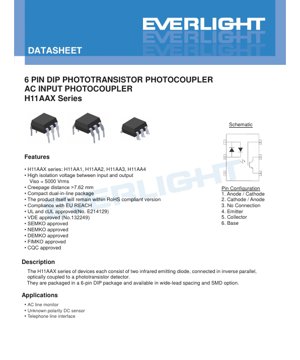
This series includes four main models: H11AA1, H11AA2, H11AA3, and H11AA4. The primary difference between them lies in the Current Transfer Ratio (CTR), which defines the signal transmission efficiency from the input to the output. These devices utilize a compact 6-pin Dual In-line Package (DIP), offering standard through-hole mounting, wide pin spacing, and Surface-Mount Device (SMD) options.
1.1 Core Advantages and Target Market
The H11AAX series offers several key advantages, making it suitable for demanding industrial and consumer applications. Its most prominent feature is an isolation voltage of up to 5000Vrms, which is crucial for the safety and reliability of mains-connected equipment. A creepage distance exceeding 7.62mm further enhances its safety rating. The device is certified by major international safety agencies including UL, cUL, VDE, SEMKO, NEMKO, DEMKO, FIMKO, and CQC, making it globally suitable for products requiring regulatory compliance.
Its signature feature is the integrated back-to-back parallel infrared LED configuration on the input side. This design allows the device to be driven directly by AC voltage or DC voltage of unknown polarity, eliminating the need for external rectification circuits and thereby simplifying circuit design. The output is a silicon NPN phototransistor.
Soko lengwa na matumizi ni mbalimbali, yanayolenga hasa maeneo ambapo utengano wa umeme na kugundua ishara za AC ni muhimu sana. Matumizi ya kawaida ni pamoja na ufuatiliaji wa mstari wa AC kwa kugundua uwepo au kutokuwepo kwa voltage ya umeme wa jumuiya, saketi za kiolesura cha mstari wa simu, na sensorer katika mifumo ya udhibiti wa viwanda kwa kugundua ishara za DC zisizojulikana polarity.
2. In-depth Analysis of Technical Parameters
Sehemu hii inachambua kwa kina na kwa uwazi sifa za umeme, za mwanga na za joto zilizobainishwa katika mwongozo wa data. Kuelewa vigezo hivi ni muhimu sana kwa kubuni saketi zinazotegemewa.
2.1 Absolute Maximum Ratings
Viwango hivi vinabainisha mipaka ya mkazo kwa kifaa; kuzidi mipaka hii kunaweza kusababisha uharibifu wa kudumu. Hakuna uhakikisho wa utendaji chini ya hali hizi.
- Mchongo wa mbele wa pembejeo (IF):60 mA (endelevu). Hii ndiyo mkondo wa moja kwa moja wa juu zaidi unaoweza kutumiwa kwenye LED ya pembejeo.
- Mchongo wa mbele wa kilele (IFM):It is 1 A for an extremely short pulse duration of 10 µs. This rating is very important for withstanding transient surges.
- Input Power Dissipation (PD):It is 120 mW at an ambient temperature of 25°C, derating at a rate of 3.8 mW/°C above 90°C. This limits the product of VF * IF.
- Output Collector-Emitter Voltage (VCEO):80 V. The maximum voltage that can be sustained between the collector and emitter of the phototransistor when the base is open.
- Total Device Power Dissipation (PTOT):200 mW. Jumla ya nguvu ya kuingiza na kutolewa haipaswi kuzidi thamani hii.
- Voltage ya kutengwa (VISO):Katika unyevunyevu wa jamaa 40-60%, 5000 Vrms kwa dakika 1. Hii ni kigezo muhimu cha usalama, wakati wa majaribio, pini za kuingiza na kutolewa zimefungwa fupi tofauti.
- Joto la uendeshaji (TOPR):-55°C to +100°C. The device can operate normally over this full industrial temperature range.
- Soldering Temperature (TSOL):260°C for up to 10 seconds, suitable for wave soldering or reflow soldering processes.
2.2 Electro-Optical Characteristics
Vigezo hivi kawaida hupimwa kwenye 25°C, na hufafanua utendaji wa kifaa chini ya hali ya kawaida ya uendeshaji.
2.2.1 Sifa za Ingizo
- Voltage ya Mwelekeo Sahihi (VF):Thamani ya kawaida 1.2V, upeo wa 1.5V wakati mkondo wa mwelekeo sahihi (IF) ni ±10mA. Thamani ya ulinganifu inaonyesha tabia ya jozi ya LED zinazofanana kinyume.
- Uwezo wa Ingizo (Cin):Typical value 80 pF. This may affect the high-frequency performance of the driving circuit.
2.2.2 Sifa za Matokeo
- Collector-Emitter Dark Current (ICEO):Maximum 50 nA at VCE=10V and IF=0mA. This is the leakage current of the phototransistor without light irradiation, important for off-state leakage.
- Breakdown Voltage (BVCEO, BVCBO, BVECO):Minimum values are 80V, 80V, and 7V respectively. These define the withstand voltage capability under different pin configurations.
- Collector-Emitter Saturation Voltage (VCE(sat)):Maximum 0.4V at IF=±10mA and IC=0.5mA. This is the voltage drop across the output transistor when it is fully turned on.
2.2.3 Sifa za Usafirishaji
Vigezo hivi vinafafanua ufanisi na kasi ya usafirishaji wa ishara.
- Uwiano wa Usafirishaji wa Umeme (CTR):Hiki ni kigezo kikuu cha kiwango cha mfululizo huu, kinachofafanuliwa kama (IC / IF) * 100% chini ya hali maalum (IF=±10mA, VCE=10V).
- H11AA1: CTR ≥ 20%
- H11AA2: CTR ≥ 10%
- H11AA3: CTR ≥ 50%
- H11AA4: CTR ≥ 100%
- CTR Symmetry:The ratio of the CTR of one LED polarity to the CTR of the other polarity, specified to be between 0.5 and 2.0. This indicates the degree of balance between the two back-to-back parallel LEDs.
- Isolation Resistance (RIO):Minimum of 10^11 Ω at 500 V DC. This is the DC resistance between input and output, contributing to isolation quality.
- Input-Output Capacitance (CIO):Typical value 0.7 pF. This extremely low capacitance is crucial for suppressing high-frequency common-mode noise across the isolation barrier.
- Switching Times (Ton, Toff, Tr, Tf):Chini ya hali ya majaribio (VCC=10V, IC=10mA, RL=100Ω), thamani ya juu zaidi kwa vigezo vyote ni 10 µs. Muda huu unafafanua kasi ya mwitikio wa pato kwa mabadiliko ya ishara ya ingizo, na kuweka kikomo cha juu zaidi cha mzunguko wa AC au kiwango cha data.
3. Maelezo ya Mfumo wa Ngazi
Mfululizo wa H11AAX hutumia mfumo rahisi wa kupanga daraja unaotegemea tu Uwiano wa Usafirishaji wa Umeme (CTR).
CTR Grading (X in H11AAX):The numerical suffix (1, 2, 3, 4) directly corresponds to the minimum guaranteed CTR percentage listed in Section 2.2.3. There is no grading based on wavelength, forward voltage, or other parameters. Designers must select the appropriate grade based on the required output current drive capability versus the available input current. For example, the H11AA4 (minimum CTR 100%) has the highest sensitivity and is suitable for applications with very low input drive capability; whereas in circuits with higher available drive current, the H11AA2 may be sufficient and more cost-effective.
4. Uchambuzi wa Mkunjo wa Utendaji
Data sheet inarejelewa mali za kawaida za mwanga na umeme. Ingawa michoro maalum haijakopishwa katika maandishi yaliyotolewa, madhumuni yao na habari zinazowasilishwa ni za kawaida kwa vipengele kama hivi.
Mviringo wa kawaida unajumuisha:
- Uhusiano wa Uwiano wa Usafirishaji wa Umeme (CTR) na Umeme wa Mbele (IF):Mkunjo huu unaonyesha jinsi CTR inavyobadilika kulingana na umeme wa kuendesha. Kwa kawaida, CTR iko juu zaidi katika IF ya wastani, na inaweza kupungua kwa umeme wa chini sana au wa juu sana.
- Uhusiano wa CTR na Joto la Mazingira (Ta):CTR ya optocoupler kwa kawaida ina mgawo hasi wa joto, ambayo inamaanisha kuwa hupungua kadri joto linavyoongezeka. Chati hii ni muhimu sana katika kubuni saketi zinazofanya kazi katika anuwai kamili ya joto.
- Uhusiano kati ya mkondo wa kolekta (IC) na voltage ya kolekta-emiteri (VCE):Hii ni familia ya curve ya sifa ya pato, sawa na transistor ya bipolar, kwa mkondo wa pembejeo wa LED (IF) kama parameta. Inaonyesha eneo la kujaa na eneo lenye ufanisi.
- Uhusiano kati ya voltage ya mbele (VF) na mkondo wa mbele (IF):Ingiza sifa za IV za jozi ya LED.
- Uhusiano kati ya Muda wa Kubadili na Upinzani wa Mzigo (RL):Onyesha jinsi muda wa kupanda, kushuka, kuwasha na kuzima unavyoathiriwa na mzigo wa pato.
Wabunifu wapaswa kukagua mikunjo hii katika mwongozo kamili wa data ili kuelewa tabia zisizo za mstari na sababu za kupunguza nguvu ambazo hazijaonyeshwa kwenye jedwali la thamani ndogo/kawaida/kuu.
5. Mechanical and Packaging Information
Kifaa hiki kinatoa aina mbalimbali za ufungaji ili kukabiliana na mbinu tofauti za usanikishaji.
5.1 Package Dimensions and Type
- Aina ya kawaida ya DIP:Default through-hole package.
- M-type option:Features "wide pin bend," providing a pin pitch of 0.4 inches (approximately 10.16mm) instead of the standard 0.3 inches (7.62mm), suitable for circuit boards requiring greater creepage distance.
- S-type option:Surface mount pin form for reflow soldering.
- S1-type option:A "low-profile" surface mount version, possibly with a lower PCB mounting height.
Detailed dimensional drawings are provided for each type, including body dimensions, lead length, lead pitch, and coplanarity specifications. These are crucial for PCB pad design.
5.2 Pad Layout and Polarity Marking
Recommended pad layouts are provided for the surface mount options (S and S1). The datasheet notes this is a recommendation, and designers should modify it based on their specific PCB fabrication process and thermal requirements.
Alama ya kifaa:Alama ya juu ya kifurushi:
- "EL" (mfumo wa msimbo wa mtengenezaji)
- Full model number (e.g., H11AA1)
- 1-digit year code (Y)
- 2-digit week code (WW)
- Optional "V" suffix if the unit is specified for VDE safety certification.
Pin configuration (6-pin DIP):
1. Anode/Cathode (LED1 Anode, LED2 Cathode)
2. Cathode/Anode (LED1 Cathode, LED2 Anode)
3. No Connection (NC)
4. Emitter (Phototransistor)
5. Collector (Phototransistor)
6. Base (Phototransistor). The base pin is typically left floating or connected to the emitter via a resistor for sensitivity adjustment or speed enhancement.
6. Soldering and Assembly Guidelines
A key guideline in the Absolute Maximum Ratings is the soldering temperature: 260°C for a maximum of 10 seconds. This is compatible with standard lead-free (SnAgCu) reflow profiles.
Uangalizi Muhimu:
- Nyeti kwa Unyevu:Ingawa hakuna maelezo ya wazi katika maandishi yaliyotolewa, plastiki iliyofungwa SMD optocouplers kawaida huwa na kiwango cha unyeti wa unyevunyevu (MSL). Kwa vipengele vilivyowekwa kwenye uso (chaguzi za S, S1), lazima zifuate maagizo ya usindikaji ya mtengenezaji kuhusu kuchoma na maisha ya karakana, ili kuzuia tukio la "popcorn" wakati wa kuyeyusha tena.
- Kusafisha:Hakikisha kuwa mumunyifu wa kusafisha unalingana na nyenzo za plastiki za kifaa.
- Hali ya uhifadhi:Kulingana na mwongozo wa data, anuwai ya joto ya uhifadhi ni -55°C hadi +125°C. Kifaa kinapaswa kuhifadhiwa katika mazingira yaliyokauka na yasiyo na umeme tuli.
7. Taarifa za Ufungaji na Maagizo
Nambari ya kuagiza inafuata muundo ufuatao:H11AAXY(Z)-V
- X:CTR daraja (1, 2, 3, 4).
- Y:Pini muundo chaguo.
- Hakuna: Standard DIP-6 (65 pcs/tube).
- M: Wide lead bend (65 pieces/tube).
- S: Surface mount lead form.
- S1: Thin surface mount pin form.
- Z:Tape and reel options (for S/S1 only).
- TA: Specific tape and reel types.
- TB: Alternative tape and reel types.
- Both TA and TB are 1000 units per reel.
- V:Alama ya hiari ya uthibitisho wa usalama wa VDE.
Vipimo vya mkanda wa roll na reel:Provides detailed dimensions for carrier tape (pocket size A, B), cover tape, and reel for automated assembly.
8. Application Suggestions
8.1 Typical Application Circuit
AC Line Monitor:The input is directly connected across the AC line (with current-limiting resistors). The output transistor switches synchronously with the AC zero-crossing, providing a digital pulse train or rectified signal to the microcontroller for detecting the presence of the power supply.
Unknown Polarity DC Sensor:Reverse parallel input allows the device to be connected to a DC voltage source without considering polarity, making it ideal for detection in battery-powered equipment or industrial sensors where wiring polarity may be reversed.
Telephone Line Interface:For ring detection or off-hook detection, providing isolation between the telephone line and the logic circuit.
8.2 Design Considerations
- Input Current Limitation:A series resistor must always be used to limit the input current (IF) to a safe value below 60mA, calculated based on the peak input voltage and the LED forward voltage. The power rating of the resistor must also be considered.
- Mzigo wa pato:Upinzani wa mzigo (RL) kwenye kolekta huamua mzunguko wa voltage ya pato na kuathiri kasi ya kubadili. RL ndogo hutoa kasi ya kubadili ya haraka lakini hutumia nguvu zaidi.
- Ukinzani wa kelele:Low input-output capacitance (0.7pF) provides excellent high-frequency common-mode noise rejection. For optimal performance, keep the input and output traces physically separated on the PCB.
- CTR Degradation:Over extended periods and at high temperatures, the CTR of an optocoupler may degrade. For critical long-life applications, design with sufficient initial CTR margin.
9. Technical Comparison and Differentiation
The H11AAX series primarily differentiates itself through itsAC input capability(achieved via a back-to-back LED structure). Most standard optocouplers (e.g., 4N25, PC817) have a single LED input requiring a defined forward bias, thus necessitating an external bridge rectifier for AC operation. The H11AAX integrates this functionality.
Ikilinganisho na vichanganyiko vya mawasiliano vya pembejeo vya optocoupler, faida yake kuu niKiwango cha kutengwa hadi 5000VrmsnaUthibitisho wa usalama wa kimataifa ulio kamili(UL, VDE, n.k.), ambayo ni muhimu kwa bidhaa zinazouzwa katika masoko mengi ya kimataifa. Upatikanaji wa viwango mbalimbali vya CTR na aina za ufungaji (kupitia shimo na SMD) hutoa mabadiliko katika muundo.
10. Maswali Yanayoulizwa Mara kwa Mara (Kulingana na Vigezo vya Kiufundi)
Q1: Je, naweza kutumia umeme wa moja kwa moja wa 120VAC au 230VAC kuendesha H11AAX?
A: No, it cannot be driven directly. You must connect a current-limiting resistor in series with the input. The resistor value must be calculated based on the peak mains voltage (e.g., ~340V for 230VAC), the desired forward current, and the LED's VF. The resistor's power rating must also be considered.
Q2: What is the maximum AC frequency I can use this photocoupler for?
A: The maximum switching time is 10 µs. Theoretically, this allows for square wave frequencies up to approximately 50 kHz. However, it is perfectly suitable for clean 50/60 Hz AC sine wave detection, as its period (16.7ms/20ms) is much longer than the switching time.
Q3: Kwa nini kuna pini ya msingi (pini 6), naipasaje kuitumia?
A: Pini ya msingi inatoa ufikiaji wa msingi wa fototransista. Ni desturi ya kawaida kuiacha bila kuunganishwa. Kuunganisha resistor kati ya msingi na emitter kunaweza:
1. Kuongeza kasi:Upinzani wa thamani ya chini (k.m. 10kΩ hadi 100kΩ) unaweza kugawanya malipo yaliyohifadhiwa, na hivyo kupunguza muda wa kuzima (Toff).
2. Kupunguza usikivu/Kuongeza kizingiti:Upinzani hutoa njia ya uvujaji, na huongeza kidogo mkondo wa chini wa pembejeo unaohitajika kuwasha pato.
Q4: Ninawezaje kuchagua kati ya viwango tofauti vya CTR (H11AA1, AA2, AA3, AA4)?
A: Chagua kulingana na uwezo wako wa kuendesha pembejeo na mkondo wa pato unaohitajika. Ikiwa mzunguko wako unaweza tu kutoa mkondo mdogo wa pembejeo (kwa mfano kutoka kwa upinzani wa voltage ya juu), chagua kiwango cha juu cha CTR (AA3 au AA4) ili kupata pato la kutosha. Ikiwa mkondo wa pembejeo unatosha, viwango vya chini (AA1 au AA2) vinaweza kuwa na gharama nafuu zaidi. Wakati wa kubuni, daima weka nafasi ya ziada kwa ajili ya kupungua kwa CTR kwa muda na joto.
11. Utafiti wa Kesi Halisi ya Ubunifu
Tukio: Kubuni Kigunduzi cha Uwepo wa Umeme wa 230VAC.
Lengo:Inapotoa ishara ya mantiki ya juu ya 3.3V kwa microcontroller wakati kuna 230VAC.
Hatua za Ubunifu:
1. Uchaguzi wa Vifaa:H11AA1 imechaguliwa (CTR ya chini 20%) kwa sababu mkondo wa kuingiza utakuwa wa kutosha.
2. Hesabu ya Upinzani wa Kuingiza:Voltage ya kilele = 230V * √2 ≈ 325V. IF inayotarajiwa ≈ 10mA (ili kupata CTR nzuri). VF ≈ 1.2V. R = (325V - 1.2V) / 0.01A ≈ 32.4kΩ. Tumia upinzani wa kawaida wa 33kΩ. Nguvu inayotumiwa na upinzani R: P = (230V)^2 / 33000Ω ≈ 1.6W. Upinzani wenye nguvu ya kiwango cha 2W au 3W unahitajika.
3. Mzunguko wa pato:Unganisha kolekta (pini 5) kwenye usambazaji wa umeme wa 3.3V ya microcontroller kupitia upinzani wa kuvuta juu (mfano 10kΩ). Unganisha emita (pini 4) kwenye ardhi. Msingi (pini 6) usiunganishwe.
4. Kanuni ya Uendeshaji:Wakati mkondo wa AC upo, transistor ya pato huwasha katika kila nusu ya mzunguko, ikivuta kolekta (na pini ya pembejeo ya MCU) chini. MCU huona ishara ya chini ya msisimko ya 50/60 Hz, ambayo inaweza kusawazishwa kwa programu kuashiria "nguvu imewashwa".
5. Mpangilio wa PCB:在PCB上,输入端(引脚1、2、3、电阻)和输出端(引脚4、5、6、MCU)走线之间保持>7.62mm的爬电距离,以保持隔离等级。
12. Kanuni ya Uendeshaji
The H11AAX operates based on the principle of opto-isolation. On the input side, two gallium arsenide infrared light-emitting diodes (LEDs) are connected in inverse parallel. When an AC voltage (with a series current-limiting resistor) is applied, one LED conducts and emits light during the positive half-cycle, while the other LED conducts and emits light during the negative half-cycle. Consequently, infrared light pulses are generated at twice the frequency of the input AC signal.
Mwanga huu hupita kwenye kizuizi cha uwazi cha kutenganishwa ndani ya kifurushi. Kwenye upande wa pato, mwanga huangaza kwenye eneo la msingi la transistor ya mwanga ya silikoni ya NPN. Photoni huzalisha jozi za elektroni na mashimo, na kuunda mkondo wa msingi, na hivyo kuwasha transistor, na kuruhusu mkondo wa kolekta (IC) kupita. Uwiano wa mkondo huu wa pato wa kolekta kwa mkondo wa pembejeo wa mwelekeo mzuri ndio Uwiano wa Uhamishaji wa Mkondo (CTR). Voltage ya kolekta-emitter ya transistor ya mwanga inadhibitiwa na mzunguko wa mzigo wa nje.
13. Mwelekeo wa Teknolojia
Teknolojia ya optocoupler inaendelea kusitawi. Ingawa kanuni za msingi zinabaki sawa, mwelekeo unajumuisha:
- Kasi ya juu zaidi:Kukuza vifaa vyenye muda wa kubadili haraka zaidi (katika kiwango cha nanosekunde) kwa matumizi ya mawasiliano ya dijiti na uendeshaji wa lango la inverter, kwa kawaida kwa kutumia photodiode au pato la msingi wa IC, badala ya phototransistor.
- Ujumbe wa kiwango cha juu cha ushirikiano:Kuunganisha optocoupler na utendaji wa ziada, kama vile IGBT gate driver, kikokotoo cha makosa, au interface ya dijiti (I²C isolator).
- Ujumbe wa kuaminika zaidi na maisha marefu:Uboreshaji wa nyenzo za LED na teknolojia ya ufungaji ili kupunguza kiwango cha kudhoofika kwa CTR kwa muda na joto.
- Kupunguzwa kwa ukubwa:Kupunguza ukubwa wa ufungaji kwa mfululizo, hasa toleo la kusakinishwa kwenye uso, ili kuokoa nafasi kwenye PCB.
- Teknolojia mbadala za kutengwa:Vihifadhi vya umeme na sumaku (GMR) vinashindana katika matumizi mengine ya kasi na msongamano mkubwa, ingawa viunganishi vya mwanga bado vina faida katika upinzani wa mabadiliko ya kawaida (CMTI) na uthibitisho kamili wa usalama.
Mfululizo wa H11AAX, kwa muundo wake thabiti na uthibitisho wa usalama, unawakilisha suluhisho imara na kuaminika kwa ajili ya kugundua mkondo wa AC ya jadi na mahitaji ya msingi ya kutenganisha, uwezo wake uliounganishwa wa pembejeo ya AC ukitoa faida kubwa.
Maelezo ya Istilahi za Vipimo vya LED
Ufafanuzi Kamili wa Istilahi za Teknolojia ya LED
I. Viashiria Muhimu vya Utendaji wa Kielektroniki na Mwanga
| Terminology | Unit/Representation | Layman's Explanation | Kwa Nini Ni Muhimu |
|---|---|---|---|
| Ufanisi wa Mwanga (Luminous Efficacy) | lm/W (lumens per watt) | The luminous flux emitted per watt of electrical power; the higher the value, the more energy-efficient. | It directly determines the energy efficiency rating of the luminaire and the electricity cost. |
| Mfumuko wa Mwanga (Luminous Flux) | lm (lumen) | Jumla ya mwanga unaotolewa na chanzo cha mwanga, unaojulikana kwa kawaida kama "mwangaza". | Huamua kama taa inatosha kuwa na mwangaza. |
| Pembe ya kuona mwanga (Viewing Angle) | ° (digrii), kama 120° | Pembe ambayo nguvu ya mwana hupungua hadi nusu, inayoamua upana wa boriti ya mwanga. | Inapata ushawishi kwenye upeo wa mwanga na usawa wake. |
| Joto la rangi (CCT) | K (Kelvin), kama 2700K/6500K | Joto la rangi ya mwanga, thamani ya chini inaelekea manjano/joto, thamani ya juu inaelekea nyeupe/baridi. | Huamua mazingira ya taa na matumizi yanayofaa. |
| Color Rendering Index (CRI / Ra) | Unitless, 0–100 | The ability of a light source to reproduce the true colors of objects, with Ra≥80 being preferable. | Inaathiri ukweli wa rangi, hutumika katika maeneo yenye mahitaji makubwa kama maduka makubwa, majumba ya sanaa. |
| Tofauti ya uvumilivu wa rangi (SDCM) | MacAdam ellipse steps, such as "5-step" | A quantitative metric for color consistency; a smaller step number indicates better color consistency. | Ensure no color variation among luminaires from the same batch. |
| Mdomo mkuu (Dominant Wavelength) | nm (nanomita), k.m. 620nm (nyekundu) | Wavelength values corresponding to the colors of colored LEDs. | Determines the hue of monochromatic LEDs such as red, yellow, and green. |
| Spectral Distribution | Mkunjo wa Urefu wa Mawimbi dhidi ya Ukubwa | Inaonyesha usambazaji wa ukubwa wa mwanga unaotolewa na LED katika urefu wa mawimbi mbalimbali. | Inapotosha uhalisi wa rangi na ubora wa rangi. |
II. Vigezo vya Umeme
| Terminology | Ishara | Layman's Explanation | Mazingatio ya Ubunifu |
|---|---|---|---|
| Forward Voltage (Forward Voltage) | Vf | The minimum voltage required to light up an LED, similar to a "starting threshold". | The driving power supply voltage must be ≥ Vf; the voltages add up when multiple LEDs are connected in series. |
| Mfuko wa Mbele (Forward Current) | If | The current value that makes the LED emit light normally. | Constant current drive is often used, as the current determines brightness and lifespan. |
| Maximum Pulse Current | Ifp | Kilele cha mkondo kinachoweza kustahimili kwa muda mfupi, kinachotumika kwa kudimisha au kumulika. | Upanaaji wa upana wa msukumo na uwiano wa kazi unahitaji udhibiti mkali, vinginevyo utaharibika kwa joto kupita kiasi. |
| Reverse Voltage | Vr | Upeo wa voltage ya nyuma ambayo LED inaweza kustahimili, ikiwa unazidi hii inaweza kuvunjika. | Katika mzunguko, ni muhimu kuzuia uunganishaji wa nyuma au mshtuko wa voltage. |
| Upinzani wa Joto (Thermal Resistance) | Rth (°C/W) | Upinzani wa joto unaopita kutoka kwenye chip hadi kwenye sehemu ya kuunganishia, thamani ya chini inaonyesha usambazaji bora wa joto. | Upinzani wa joto wa juu unahitaji muundo wenye nguvu zaidi wa kupoza joto, vinginevyo joto la kiungo litaongezeka. |
| ESD Immunity | V (HBM), kama 1000V | Uwezo wa kukabiliana na mshtuko wa umeme wa tuli, thamani ya juu zaidi ina maana uwezekano mdogo wa kuharibika na umeme wa tuli. | Hatua za kinga dhidi ya umeme wa tuli zinahitajika katika uzalishaji, hasa kwa LED zenye usikivu mkubwa. |
III. Thermal Management and Reliability
| Terminology | Key Indicators | Layman's Explanation | Athari |
|---|---|---|---|
| Joto la Kiungo (Junction Temperature) | Tj (°C) | The actual operating temperature inside the LED chip. | For every 10°C reduction, the lifespan may double; excessively high temperatures lead to lumen depreciation and color shift. |
| Kupungua kwa Mwangaza (Lumen Depreciation) | L70 / L80 (saa) | Muda unaohitajika kwa mwangaza kushuka hadi 70% au 80% ya thamani ya awali. | Kufafanua moja kwa moja "maisha ya huduma" ya LED. |
| Lumen Maintenance | % (e.g., 70%) | The percentage of remaining brightness after a period of use. | Characterizes the ability to maintain brightness after long-term use. |
| Mabadiliko ya rangi (Color Shift) | Δu′v′ au MacAdam ellipses | Kiwango cha mabadiliko ya rangi wakati wa matumizi. | Inaathiri uthabiti wa rangi katika eneo la taa. |
| Thermal Aging | Kupungua kwa sifa za nyenzo | Uharibifu wa nyenzo za ufungaji unaosababishwa na joto la juu kwa muda mrefu. | Inaweza kusababisha kupungua kwa mwangaza, mabadiliko ya rangi au kushindwa kwa mzunguko wazi. |
Nne. Ufungaji na Nyenzo
| Terminology | Aina za Kawaida | Layman's Explanation | Sifa na Matumizi |
|---|---|---|---|
| Aina ya Ufungaji | EMC, PPA, Ceramic | A housing material that protects the chip and provides optical and thermal interfaces. | EMC offers good heat resistance and low cost; ceramic provides superior heat dissipation and long lifespan. |
| Muundo wa Chip | Usakinishaji wa Kawaida, Usakinishaji wa Kichwa-chini (Flip Chip) | Chip electrode arrangement method. | Flip-chip offers better heat dissipation and higher luminous efficacy, suitable for high-power applications. |
| Phosphor coating. | YAG, silicate, nitride | Coated on the blue LED chip, partially converted to yellow/red light, mixed to form white light. | Different phosphors affect luminous efficacy, color temperature, and color rendering. |
| Lens/Optical Design | Flat, microlens, total internal reflection | Optical structure on the package surface, controlling light distribution. | Determines the emission angle and light distribution curve. |
V. Udhibiti wa Ubora na Uainishaji
| Terminology | Yaliyomo katika Uainishaji | Layman's Explanation | Kusudi |
|---|---|---|---|
| Kikomo cha Flux ya Mwanga | Msimbo kama 2G, 2H | Group by brightness level, each group has a minimum/maximum lumen value. | Ensure consistent brightness within the same batch of products. |
| Voltage binning | Codes such as 6W, 6X | Grouped by forward voltage range. | Inafaa kwa usawazishaji wa chanzo cha umeme cha kuendesha, kuboresha ufanisi wa mfumo. |
| Kugawanya kwa makundi kulingana na rangi | 5-step MacAdam ellipse | Group by color coordinates to ensure colors fall within an extremely small range. | Ensure color consistency to avoid color unevenness within the same luminaire. |
| Color temperature grading | 2700K, 3000K, etc. | Group by color temperature, each group has a corresponding coordinate range. | Kukidhi mahitaji ya joto la rangi katika hali tofauti. |
VI. Uchunguzi na Uthibitisho
| Terminology | Standard/Test | Layman's Explanation | Significance |
|---|---|---|---|
| LM-80 | Lumen Maintenance Test | Long-term operation under constant temperature conditions, recording luminance attenuation data. | For estimating LED lifetime (in conjunction with TM-21). |
| TM-21 | Lifetime extrapolation standard | Projecting lifespan under actual use conditions based on LM-80 data. | Providing scientific life prediction. |
| IESNA Standard | Illuminating Engineering Society Standard | Covers optical, electrical, and thermal testing methods. | Msingi wa upimaji unaokubalika na tasnia. |
| RoHS / REACH | Uthibitisho wa Mazingira | Hakikisha bidhaa hazina vitu hatari (kama risasi, zebaki). | Masharti ya kuingia kwenye soko la kimataifa. |
| ENERGY STAR / DLC | Uthibitisho wa ufanisi wa nishati | Uthibitishaji wa ufanisi wa nishati na utendaji wa bidhaa za taa. | Hutumiwa kwa kawaida katika ununuzi wa serikali, miradi ya ruzuku, na kuimarisha ushindani wa soko. |